
1 Kings 21:11

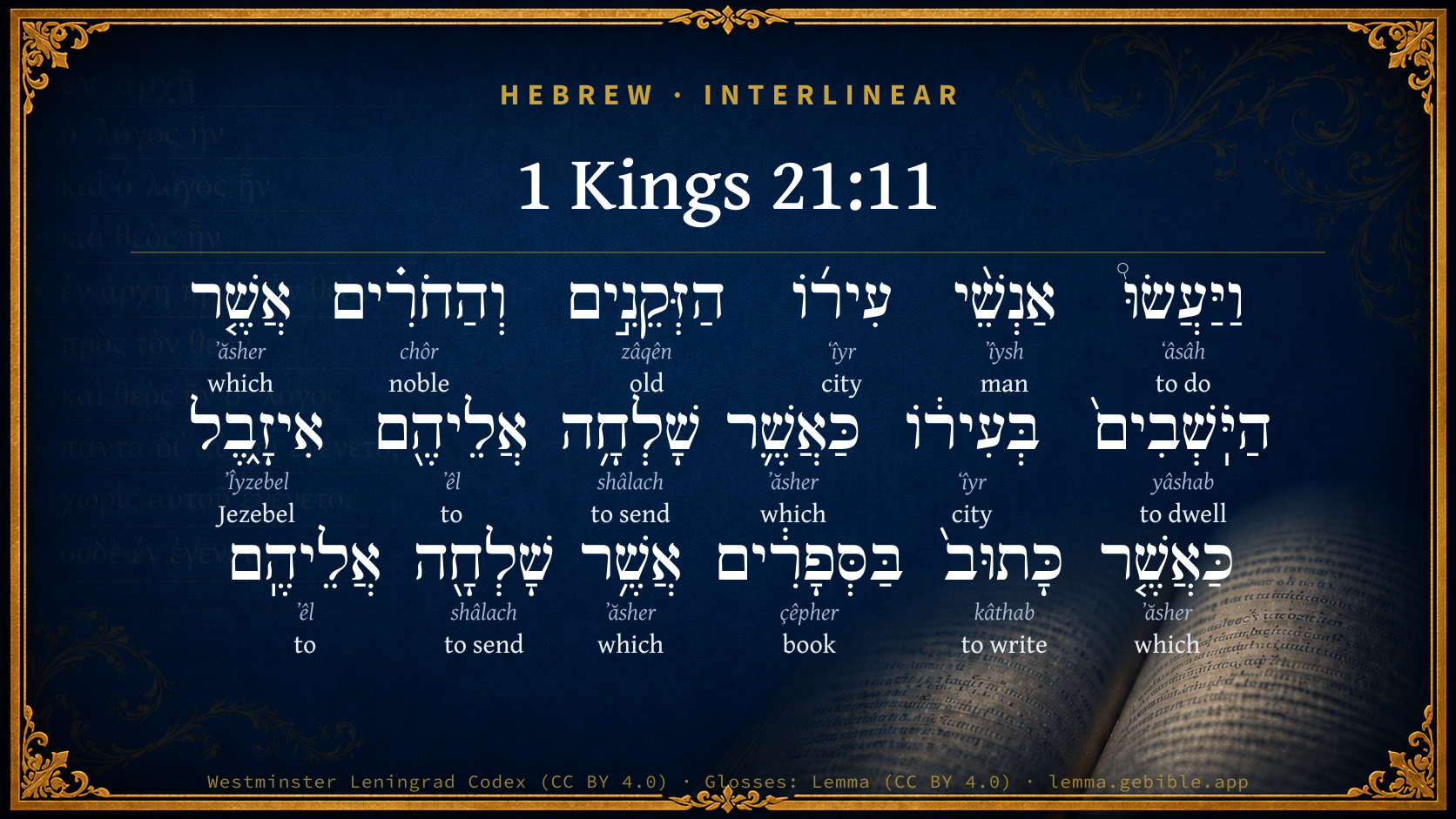
Hebrew (Westminster Leningrad Codex) 1 Kings 21:11 appears in the Hebrew Old Testament. The text above is from the Westminster Leningrad Codex. Each word links to its Strong’s number, a concise gloss, and parsing drawn from the Open Scriptures Hebrew Bible morphology. Click any word for its full Brown-Driver-Briggs (BDB) entry.
Download image
Cite this verse

1 Kings 21:11 (World English Bible). Public Domain. Lemma interlinear Bible study tool, https://lemma.gebible.app/v/1-kings/21/11.

Show BibTeX & RIS
BibTeX
RIS
English Translation
The men of his city, even the elders and the nobles who lived in his city, did as Jezebel had sent to them, according as it was written in the letters which she had sent to them.
World English Bible · Public Domain
Download a study sheet

One document with this verse’s original text, its word-by-word gloss line, the meaning frame, cross-references with their text, attributed commentary, and full source and license credits — printable, and it pastes into notes with its structure intact.

This verse Autodidact and up

Study sheet (.html) Plain text (.txt)

A passage Seminary Student

Up to 50 verses in one chapter. A passage sheet keeps up to 6 commentary sources and 12 cross-references per verse, in the order this page ranks them, and says so on the sheet whenever that leaves anything out. Ask for a single verse and you get the Autodidact verse sheet above.

Everything on this page stays free to read, with no account — the sheet is a download of what is already on screen, not access to it.

Want to remove ads? Support Godless Engineer
Compare translations 3

The same verse in 3 English versions, stacked beneath the original-language interlinear above. Click any original word for its lexicon entry.

Each is an independent rendering of the whole verse — the interlinear is not word-aligned to these translations.

Highlighted words mark where these versions differ — a whole-verse word diff, not a word-by-word alignment.

  • World English Bible Public Domain
    The men of his city, even the elders and the nobles who lived in his city, did as Jezebel had sent to them, according as it was written in the letters which she had sent to them.
  • King James Version Public Domain
    And the men of his city, even the elders and the nobles who were the inhabitants in his city, did as Jezebel had sent unto them, and as it was written in the letters which she had sent unto them.
  • unfoldingWord Literal Text CC BY-SA 4.0
    And the men of his city, the elders and the nobles who were dwelling in his city, did just as Jezebel sent to them, just as was written in the letters that she sent to them.

unfoldingWord Literal Text — © unfoldingWord, licensed CC BY-SA 4.0. Word-aligned USFM3 via Door43 (git.door43.org/unfoldingWord/en_ult).

Versions to compare (up to 4)

3 of 4 selected

Show all 18 translations

Every available English version of this verse, each an independent rendering of the whole verse.

  • World English Bible Public Domain
    The men of his city, even the elders and the nobles who lived in his city, did as Jezebel had sent to them, according as it was written in the letters which she had sent to them.
  • Berean Standard Bible Public Domain
    So the elders and nobles who lived in Naboth’s city did as Jezebel had instructed in the letters she had written to them.
  • Majority Standard Bible Public Domain
    So the elders and nobles who lived in Naboth’s city did as Jezebel had instructed in the letters she had written to them.
  • King James Version Public Domain
    And the men of his city, even the elders and the nobles who were the inhabitants in his city, did as Jezebel had sent unto them, and as it was written in the letters which she had sent unto them.
  • American Standard Version (1901) Public Domain
    And the men of his city, even the elders and the nobles who dwelt in his city, did as Jezebel had sent unto them, according as it was written in the letters which she had sent unto them.
  • Revised Version (1885) Public Domain
    And the men of his city, even the elders and the nobles who dwelt in his city, did as Jezebel had sent unto them, according as it was written in the letters which she had sent unto them.
  • Geneva Bible (1599) Public Domain
    And the men of his citie, euen the Elders and gouernours, which dwelt in his citie, did as Iezebel had sent vnto them: as it was written in the letters, which she had sent vnto them.
  • Douay-Rheims (1899) Public Domain
    And the men of his city, the ancients and nobles, that dwelt with him in the city, did as Jezabel had commanded them, and as it was written in the letters which she had sent to them:
  • Young's Literal Translation Public Domain
    And the men of his city, the elders and the freemen who are dwelling in his city, do as Jezebel hath sent unto them, as written in the letters that she sent unto them,
  • Literal Standard Version CC BY-SA 4.0
    And the men of his city, the elderly and the nobles who are dwelling in his city, do as Jezebel has sent to them, as written in the letters that she sent to them,
  • Unlocked Literal Bible CC BY-SA 4.0
    So the men of his city, the elders and the wealthy who lived in Naboth's city, did as Jezebel had described to them, as was written in the letters that she had sent to them.
  • unfoldingWord Literal Text CC BY-SA 4.0
    And the men of his city, the elders and the nobles who were dwelling in his city, did just as Jezebel sent to them, just as was written in the letters that she sent to them.
  • Darby Bible Public Domain
    And the men of his city, the elders and the nobles that dwelt in his city, did as Jezebel had sent to them, as it was written in the letter that she had sent to them:
  • World Messianic Bible Public Domain
    The men of his city, even the elders and the nobles who lived in his city, did as Jezebel had instructed them in the letters which she had written and sent to them.
  • Webster's Bible Public Domain
    And the men of his city, even the elders and the nobles who were the inhabitants in his city, did as Jezebel had sent to them, and as it was written in the letters which she had sent to them.
  • Free Bible Version CC BY-SA 4.0
    So the elders and leaders who lived in Naboth's town did as Jezebel had said in the letters she had written and sent to them.
  • Bible in Basic English Public Domain
    So the responsible men and the chiefs who were in authority in his town, did as Jezebel had said in the letter she sent them.
  • JPS Tanakh (1917) Public Domain
    And the men of his city, even the elders and the nobles who dwelt in his city, did as Jezebel had sent unto them, according as it was written in the letters which she had sent unto them.

Literal Standard Version (2020), Covenant Press — licensed CC BY-SA 4.0. Text via the HelloAO Bible API (eBible.org). Unlocked Literal Bible (unfoldingWord) — licensed CC BY-SA 4.0. Text via the HelloAO Bible API (eBible.org). unfoldingWord Literal Text — © unfoldingWord, licensed CC BY-SA 4.0. Word-aligned USFM3 via Door43 (git.door43.org/unfoldingWord/en_ult). Free Bible Version, Dr. Jonathan Gallagher — licensed CC BY-SA 4.0. Text via the HelloAO Bible API (eBible.org).

Word by word

More ways to search: Search by grammar → Find every occurrence → Compare this word →

Practice this passage: Drill this verse → Learn its vocabulary →

וְהַחֹרִ֗ים
chôr
H2715
“and · the · nobles”
Conjunction + Particle, Definite Article + Noun, Common, Masculine, Plural, Absolute
Part of Speech
Conjunction + Particle + Noun
Type
Common
Gender
Masculine
Number
Plural
State
Absolute
Full BDB Definition

Origin: from H2787

TWOT: 757a

a noble, freeborn one
  1. וַיַּעֲשׂוּ֩ ʻâsâh H6213 “and · to do” Conjunction + Verb, Qal, Sequential Imperfect, 3rd Person, Masculine, Plural
  2. אַנְשֵׁ֨י ʼîysh H376 “men of” Noun, Common, Masculine, Plural, Construct
  3. עִיר֜וֹ ʻîyr H5892 “city · his” Noun, Common, Feminine, Singular, Construct + Suffix, Personal, 3rd Person, Masculine, Singular
  4. הַזְּקֵנִ֣ים zâqên H2205 “the · old” Particle, Definite Article + Adjective, Adjective, Masculine, Plural, Absolute
  5. אֲשֶׁ֤ר ʼăsher H834 “which” Particle, Relative
  6. הַיֹּֽשְׁבִים֙ yâshab H3427 “the · dwelling” Particle, Definite Article + Verb, Qal, Participle Active, Masculine, Plural, Absolute
  7. בְּעִיר֔וֹ ʻîyr H5892 “in/at · city · his” Preposition + Noun, Common, Feminine, Singular, Construct + Suffix, Personal, 3rd Person, Masculine, Singular
  8. כַּאֲשֶׁ֛ר ʼăsher H834 “like/as · which” Preposition + Particle, Relative
  9. שָׁלְחָ֥ה shâlach H7971 “to send” Verb, Qal, Perfect, 3rd Person, Feminine, Singular
  10. אֲלֵיהֶ֖ם ʼêl H413 “to · them” Preposition + Suffix, Personal, 3rd Person, Masculine, Plural
  11. אִיזָ֑בֶל ʼÎyzebel H348 “Jezebel” Noun, Proper
  12. כַּאֲשֶׁ֤ר ʼăsher H834 “like/as · which” Preposition + Particle, Relative
  13. כָּתוּב֙ kâthab H3789 “written” Verb, Qal, Participle Passive, Masculine, Singular, Absolute
  14. בַּסְּפָרִ֔ים çêpher H5612 “in/at the · books” Preposition, Determined + Noun, Common, Masculine, Plural, Absolute
  15. אֲשֶׁ֥ר ʼăsher H834 “which” Particle, Relative
  16. שָׁלְחָ֖ה shâlach H7971 “to send” Verb, Qal, Perfect, 3rd Person, Feminine, Singular
  17. אֲלֵיהֶֽם ʼêl H413 “to · them” Preposition + Suffix, Personal, 3rd Person, Masculine, Plural

About this verse

These counts appear in no published source. They are computed here, from the morphology-tagged text and Lemma’s own curated glosses. What Lemma adds →

18
words
12
distinct lemmas
Historical
section

Notable vocabulary

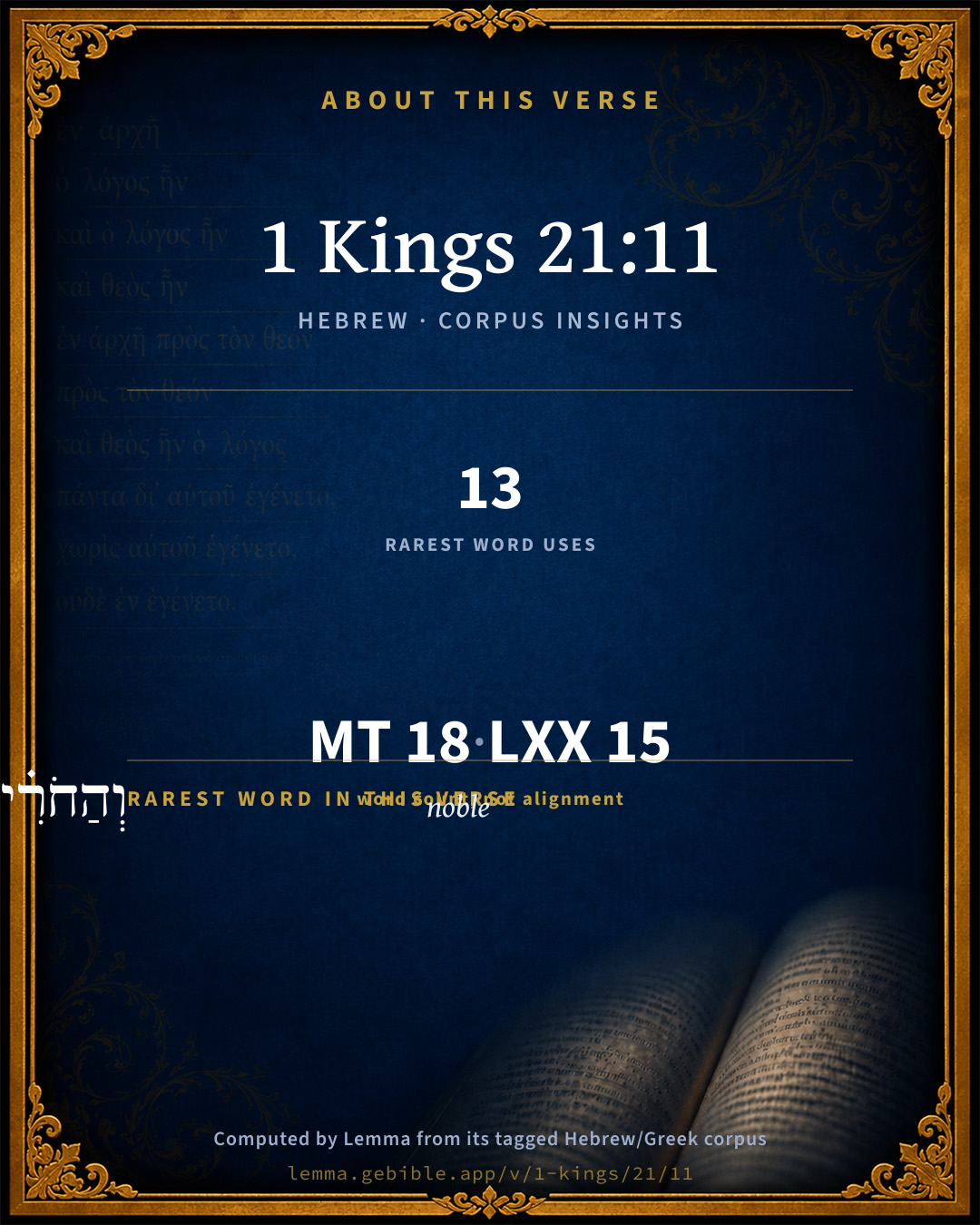
The rarest word here is וְהַחֹרִ֗ים noble H2715 — appearing just 13 times in the whole Hebrew Bible.

Shared distinctive vocabulary

וְהַחֹרִ֗ים noble H2715 occurs in 13 verses of the Hebrew Bible. Also found in:

Grammatical profile

  • 5 verbs
  • 6 nouns
  • 1 adjective
  • 2 prepositions
  • 4 particles

Verb forms

  • וַיַּעֲשׂוּ֩ Qal · Sequential Imperfect
  • הַיֹּֽשְׁבִים֙ Qal · Participle Active
  • שָׁלְחָ֥ה Qal · Perfect
  • כָּתוּב֙ Qal · Participle Passive
  • שָׁלְחָ֖ה Qal · Perfect

Repetition

Words recur within this verse — often emphatic in Hebrew:

  • עִיר֜וֹ city H5892 ×2
  • שָׁלְחָ֥ה to send H7971 ×2
  • אֲשֶׁ֤ר which H834 ×4
  • אֲלֵיהֶ֖ם to H413 ×2

Hebrew & Septuagint length

In English translation the verse runs 37 words from the Hebrew and 22 from the Septuagint (LXX English) — the Septuagint runs noticeably shorter here. See the side-by-side →

A rough comparison of the two English renderings, which tokenize alike — not a word-level alignment.

Word counts can differ between the Hebrew and the Greek without any difference in meaning — e.g. the Hebrew direct-object marker אֵת has no separate Greek word, and Greek often adds the article ὁ.

In the original languages it is 18 Hebrew tokens and 15 Greek tokens — but the two are counted differently (Hebrew bundles its prefixes and suffixes into one token; the Greek is in lemma form), so that isn’t a like-for-like length.

Cross-references

17

Topical passages linked to 1 Kings 21:11 in the Treasury of Scripture Knowledge — connected by theme and wording, ordered by reader-vote popularity; previews shown in the World English Bible.

  • Exodus 1:17 But the midwives feared God, and didn't do what the king of Egypt commanded them, but saved the baby boys alive.
  • Exodus 1:21 It happened, because the midwives feared God, that he gave them families.
  • Exodus 23:1–2 "You shall not spread a false report. Don't join your hand with the wicked to be a malicious witness.
  • Leviticus 19:15 "'You shall do no injustice in judgment: you shall not be partial to the poor, nor show favoritism to the great; but in righteousness shall you judge your neighbor.
  • 1 Samuel 22:17 The king said to the guard who stood about him, Turn, and kill the priests of Yahweh; because their hand also is with David, and because they knew that he fled, and didn't disclose it to me. But the servants of the king wouldn't put forth their hand to fall on the priests of Yahweh.
  • 1 Samuel 23:20 Now therefore, O king, come down, according to all the desire of your soul to come down; and our part shall be to deliver him up into the king's hand.
  • 2 Kings 10:6–7 Then he wrote a letter the second time to them, saying, If you be on my side, and if you will listen to my voice, take the heads of the men your master's sons, and come to me to Jezreel by tomorrow this time. Now the king's sons, being seventy persons, were with the great men of the city, who brought them up.
  • 2 Chronicles 24:21 They conspired against him, and stoned him with stones at the commandment of the king in the court of the house of Yahweh.
  • Proverbs 29:12 If a ruler listens to lies, All of his officials are wicked.
  • Proverbs 29:26 Many seek the ruler's favor, But a man's justice comes from Yahweh.
  • Daniel 3:18–25 But if not, be it known to you, O king, that we will not serve your gods, nor worship the golden image which you have set up.
  • Hosea 5:11 Ephraim is oppressed, He is crushed in judgment; Because he is intent in his pursuit of idols.
  • Micah 6:16 For the statutes of Omri are kept, And all the works of the house of Ahab. You walk in their counsels, That I may make you a ruin, And her inhabitants a hissing; And you will bear the reproach of my people."
  • Matthew 2:12 Being warned in a dream that they shouldn't return to Herod, they went back to their own country another way.
  • Matthew 2:16 Then Herod, when he saw that he was mocked by the wise men, was exceedingly angry, and sent out, and killed all the male children who were in Bethlehem and in all the surrounding countryside, from two years old and under, according to the exact time which he had learned from the wise men.
  • Acts 4:19 But Peter and John answered them, "Whether it is right in the sight of God to listen to you rather than to God, judge for yourselves,
  • Acts 5:29 But Peter and the apostles answered, "We must obey God rather than men.

Cross-references courtesy of OpenBible.info (CC BY 4.0).

Hebrew and Greek witnesses Masoretic Hebrew ↔ Greek Septuagint

The same verse in the two great witnesses to the Old Testament, shown verse-for-verse.

Here the Septuagint runs noticeably shorter than the Hebrew — LXX2012 (modern English Septuagint) 22 words vs World English Bible 37. A rough length comparison of the two English translations, not a word-level alignment — read both below.

These are two independent witnesses, not word-aligned to each other, and the Septuagint is shown in lemma (dictionary) form.

Hebrew 1 Kings 21:11 Masoretic · Westminster Leningrad Codex

וַיַּעֲשׂוּ֩ אַנְשֵׁ֨י עִיר֜וֹ הַזְּקֵנִ֣ים וְהַחֹרִ֗ים אֲשֶׁ֤ר הַיֹּֽשְׁבִים֙ בְּעִיר֔וֹ כַּאֲשֶׁ֛ר שָׁלְחָ֥ה אֲלֵיהֶ֖ם אִיזָ֑בֶל כַּאֲשֶׁ֤ר כָּתוּב֙ בַּסְּפָרִ֔ים אֲשֶׁ֥ר שָׁלְחָ֖ה אֲלֵיהֶֽם

The men of his city, even the elders and the nobles who lived in his city, did as Jezebel had sent to them, according as it was written in the letters which she had sent to them.

World English Bible · Public Domain

Greek LXX 1 Kings 21:11 Septuagint · lemma form

καί ἀποκρίνω ὁ βασιλεύς ἰσραήλ καί εἶπον ἱκανόω μή καυχάομαι ὁ κυρτός ὡς ὁ ὀρθός

And the king of Israel answered and said, Let it be sufficient; let not the humpbacked boast as he that is upright.

LXX2012 (modern English Septuagint) · Public Domain

Hebrew: Westminster Leningrad Codex (CC BY 4.0). Greek: Septuagint (public domain); English from LXX2012 (modern English Septuagint) (Public Domain). How the Septuagint differs from the Hebrew →

Targum (Aramaic paraphrase)

1

The Targum is the ancient Jewish Aramaic paraphrase of the Hebrew Scriptures — an interpretive translation, not the Hebrew text itself. Onkelos (literal) and Pseudo-Jonathan (expansive) render the Torah, and Jonathan the Prophets. Coverage is partial: where no permissively-licensed English translation exists for a verse, only the Aramaic is shown. This is verse-level text, not a word-by-word alignment to the Hebrew.

  1. Targum Jonathan Prophets (Joshua–Malachi)
    וַעֲבַדוּ אֱנָשֵׁי קַרְתֵּיהּ סָבַיָא וְתוּרְבְּיָנֵי דְיַתְבִין בְּקַרְתֵּיהּ כְּמָא דִשְׁלָחַת לְוַתְהוֹן אִיזֶבֶל כְּמָא דִכְתָבַת בְּאִגַרְתָּא דִשְׁלָחַת לְהוֹן:

    (no public-domain English translation for this verse)

    Targum Jonathan — Aramaic: “Mikraot Gedolot” (public domain). English: “Sefaria Community Translation” (CC0 1.0 (public-domain dedication)); “London "Chaldee Paraphrase," 1871” (public domain). Text via Sefaria.

Commentary

Notes on 1 Kings 21:11 from classic Christian and Jewish commentators (each source and its license shown beneath its notes). The classic Christian expositions comment on the surrounding passage and are grouped to its opening verse, so a note may address several verses; the Jewish commentaries on the Tanakh (Rashi and others) are per-verse, so they appear only where the commentator wrote on this verse.

Lemma curates 59 commentaries, every one of them public domain or Creative Commons licensed, each selected and text-cleaned for this edition rather than reprinted as found. About our sources →

Trapp's Complete Commentary

John Trapp

1Ki 21:11 And the men of his city, [even] the elders and the nobles who were the inhabitants in his city, did as Jezebel had sent unto them, [and] as it [was] written in the letters which she had sent unto them.

Ver. 11. Did as Jezebel had sent unto them.] So wretched were those times, that whatsoever pleased the prince, pleased all. But, oh, how miserable is that people whose rulers, instead of punishing, plot and encourage wickedness! When a distillation of evil falleth from the head upon the lungs of any state, there must needs follow a deadly consumption.

John Trapp, A Commentary or Exposition upon All the Books of the Old and New Testament (1647–1656) — public domain. Text from a community e-Sword module.

Joseph Benson's Commentary

1Ki 21:11. The men of his city did as Jezebel had sent to them — Which is not at all strange, considering that they had for a long time cast off the fear of God; prostituted their consciences and religion to please their king; and sold themselves to all manner of wickedness; so that they could not now make a safe and honourable retreat. Besides, they durst not disobey Jezebel’s command, by whom they knew the king was wholly governed, and who could easily have taken away their lives, in the same manner, if they had refused to kill Naboth: and it is not unlikely that she sent private messengers to tell them, by word of mouth, what she expected from them, and how she would reward them; as well as public letters to authorize what they did. Princes never want instruments to execute their pleasure; but it is strange that, in this case, there should be none among the judges and great men that abhorred such villany: it argues the great corruption of their manners by idolatry.

Joseph Benson's Commentary on the Old and New Testaments (1811–1818) — public domain. Text from a community e-Sword module.

Geneva Bible (1599)

Geneva Bible translators

Thus the worldlings contrary to God’s commandment, who willeth not to consent to the shedding of innocent blood, obey rather the wicked commandments of princes than the just laws of God.

Geneva Bible (1599) marginal notes — public domain. Text via Bolls.life.

Ellicott's Commentary for English Readers

(11) And the men of his city . . . did.—The pains taken in the invention of this foul plot, and the ready acquiescence of the rulers of the city in carrying it out, are characteristic of the baser forms of organised Eastern despotism—not venturing to take life by simple violence without some cause apparently shown, and yet always able to poison the springs of justice, and do murder under form of law. In Israel, where the king was held to be but a vicegerent of God, subject, in theory, under the old constitution or “manner of the kingdom” (1Sa_10:25), to the supreme law, the need of clothing crime with legal form would be especially felt.

A Bible Commentary for English Readers, edited by Charles John Ellicott (1878–1897) — public domain. Text from a community e-Sword module.

The Cambridge Bible for Schools and Colleges

gen. ed. J. J. S. Perowne

11. who were the inhabitants] R.V. who dwelt. The word is the same as in 1Ki_21:8.

The Cambridge Bible for Schools and Colleges (gen. ed. J. J. S. Perowne; Cambridge University Press, 1878–1918) — public domain. Text from a community e-Sword module.

John Gill's Exposition

And there came in two men, children of Belial, and sat before him,.... Which position showed that they were his accusers, and had a charge against him; it being usual for the accusers and accused to be set face to face, as it was the manner of the Romans in later times, Act 25:16. Josephus says (d) there were "three" men to accuse him; but the Targum, and all the ancient versions, have only "two":

and the men of Belial witnessed against him, even against Naboth, in the presence of the people; both before the judges of the court, and before all the people that filled it, who came to hear the trial; so bold and impudent were they:

saying, Naboth did blaspheme God and the king; or "bless", an euphemism; the phrase of cursing God being shocking to the ear, and therefore such a word is used to express it, see Job 1:5,

then they carried him forth out of the city; without any further process of examining witnesses, and of hearing what the accused had to say in his defence; but immediately they carried him out of court, and out of the city, to put him to death, malefactors being executed always without the city:

and stoned him with stones, that he died; which was the death blasphemers were put to, Lev 24:14, of the manner of which; see Gill on Act 7:58, it seems from Kg2 9:26, that his sons were stoned with him.

(d) Antiqu. l. 3. c. 13. sect. 8.

John Gill's Exposition of the Whole Bible (1746–1763) — public domain (CC PDM 1.0). Text via the HelloAO Bible API.

Albert Barnes' Notes on the Bible

The ready submission of the elders and nobles implies a deep moral degradation among the Israelites, the fruit of their lapse into idolatry.

Albert Barnes' Notes on the Bible (1834–1885) — public domain. Text from a community e-Sword/MySword module.

Matthew Poole's English Annotations

The elders and the nobles did as Jezebel had sent unto them; which is not at all strange in them who had for a long time cast off the fear and sense of God, and prostituted their consciences and religion to please their king, and sold themselves to all manner of wickedness, and could not now make a safe and honourable retreat, and durst not disobey Jezebel’s command, by whom they knew the king was wholly governed, and who could easily have taken away their lives in the same manner, if they had refused to kill Naboth.

Matthew Poole's English Annotations on the Holy Bible (1683–1685) — public domain. Text from a community e-Sword/MySword module.

The Pulpit Commentary

And the men of his city, even the elders and the nobles who were the inhabitants in his city, did as Jezebel had sent unto them Their ready compliance shows not merely the "deep moral degradation of the Israelites" at that period, but also the terror which the name of Jezebel inspired, and as it was written in the letters which she had sent unto them. That she did not hesitate to put her infamous command into writing shows the character of the woman.

The Pulpit Commentary (1880–1919), ed. H.D.M. Spence-Jones & Joseph S. Exell — public domain. Text from a community e-Sword module.

unfoldingWord translationNotes

Door43 World Missions Community

the wealthy who lived in Naboth's city

The word "wealthy" refers to wealthy people. AT: "the wealthy people who lived in Naboth's city" (See: Nominal Adjectives)

as was written in the letters

This can be stated in active form. AT: "as she had written in the letters" (See: Active or Passive)

seated Naboth above the people

Having Naboth sit in a place of honor is spoken of as if it were having him sit above the rest of the people who were present. See how you translated this idea in 1 Kings 21:9. AT: "had Naboth sit in a place of honor among the people" (See: Metaphor)

sat before Naboth

"sat in front of Naboth"

they carried him out

Here the word "they" refers to the people of the city.

Naboth has been stoned and is dead

This can be stated in active form. AT: "We have stoned Naboth and he is dead" (See: Active or Passive)

translationWords

send

word

unfoldingWord translationNotes — © Distant Shores Media and the Door43 World Missions Community, licensed CC BY-SA 4.0. Source: git.door43.org/Door43/en_tn.

Lesson kit

Teaching starters — assembled from the data on this page, not authored interpretation. Every prompt links to the verse data it draws on. Edit before teaching.

1 Kings, in the Historical, opens this verse with 18 words (12 distinct Hebrew lemmas). Its most distinctive word is chôr (“noble”). The Greek Septuagint runs shorter here. A historical commentator’s framing appears above. Read the whole chapter for the surrounding context.

Discussion questions

  1. What does “noble” (chôr) contribute to the verse as a whole?
  2. 1 Kings 21:8 shares the word «noble» with this verse. How do the two illuminate each other?
  3. “city” occurs 2× in this one verse. What is the effect of the repetition?
  4. Compared with the Hebrew, the Septuagint runs shorter here. What questions does that raise?
  5. These translations render this verse differently; the difference is in the English rendering, not the original. What questions does that raise?
  6. The verb «וַיַּעֲשׂוּ֩» is Qal Sequential Imperfect. How does its form color the action?
  7. Reading how Trapp's Complete Commentary and Joseph Benson's Commentary read this verse, where do the two commentators agree and where do they part?

Things to notice

Reading settings

Reading text

Shown beneath each verse's original-language words.

Old Testament
Old Testament edition

Read the OT as the Masoretic Hebrew (MT) or the Greek Septuagint (LXX).

English shown for the Greek Septuagint (in the Hebrew ↔ Greek comparison).

Comparing translations? Open the Compare panel on any verse page to stack up to four side by side.