Numbers 17:3

Hebrew (Westminster Leningrad Codex) Numbers 17:3 appears in the Hebrew Old Testament. The text above is from the Westminster Leningrad Codex. Each word links to its Strong’s number, a concise gloss, and parsing drawn from the Open Scriptures Hebrew Bible morphology. Click any word for its full Brown-Driver-Briggs (BDB) entry.
Download image
Cite this verse

Numbers 17:3 (World English Bible). Public Domain. Lemma interlinear Bible study tool, https://lemma.gebible.app/v/numbers/17/3.

Show BibTeX & RIS
BibTeX
RIS
English Translation
You shall write Aaron's name on the rod of Levi; for there shall be one rod for each head of their fathers' houses.
World English Bible · Public Domain
Download a study sheet

One document with this verse’s original text, its word-by-word gloss line, the meaning frame, cross-references with their text, attributed commentary, and full source and license credits — printable, and it pastes into notes with its structure intact.

This verse Autodidact and up

Study sheet (.html) Plain text (.txt)

A passage Seminary Student

Up to 50 verses in one chapter. A passage sheet keeps up to 6 commentary sources and 12 cross-references per verse, in the order this page ranks them, and says so on the sheet whenever that leaves anything out. Ask for a single verse and you get the Autodidact verse sheet above.

Everything on this page stays free to read, with no account — the sheet is a download of what is already on screen, not access to it.

Want to remove ads? Support Godless Engineer
Compare translations 3

The same verse in 3 English versions, stacked beneath the original-language interlinear above. Click any original word for its lexicon entry.

Each is an independent rendering of the whole verse — the interlinear is not word-aligned to these translations.

Highlighted words mark where these versions differ — a whole-verse word diff, not a word-by-word alignment.

  • World English Bible Public Domain
    You shall write Aaron's name on the rod of Levi; for there shall be one rod for each head of their fathers' houses.
  • King James Version Public Domain
    And thou shalt write Aaron's name upon the rod of Levi: for one rod shall be for the head of the house of their fathers.
  • unfoldingWord Literal Text CC BY-SA 4.0
    And the name of Aaron you shall write on the staff of Levi, for one staff for the head of the house of their fathers.

unfoldingWord Literal Text — © unfoldingWord, licensed CC BY-SA 4.0. Word-aligned USFM3 via Door43 (git.door43.org/unfoldingWord/en_ult).

Versions to compare (up to 4)

3 of 4 selected

Show all 18 translations

Every available English version of this verse, each an independent rendering of the whole verse.

  • World English Bible Public Domain
    You shall write Aaron's name on the rod of Levi; for there shall be one rod for each head of their fathers' houses.
  • Berean Standard Bible Public Domain
    and write Aaron’s name on the staff of Levi, because there must be one staff for the head of each tribe.
  • Majority Standard Bible Public Domain
    and write Aaron’s name on the staff of Levi, because there must be one staff for the head of each tribe.
  • King James Version Public Domain
    And thou shalt write Aaron's name upon the rod of Levi: for one rod shall be for the head of the house of their fathers.
  • American Standard Version (1901) Public Domain
    And thou shalt write Aaron's name upon the rod of Levi; for there shall be one rod for each head of their fathers' houses.
  • Revised Version (1885) Public Domain
    And thou shalt write Aaron’s name upon the rod of Levi: for there shall be one rod for each head of their fathers’ houses.
  • Geneva Bible (1599) Public Domain
    And write Aarons name vpon the rod of Leui: for euery rodde shalbe for the head of the house of their fathers.
  • Douay-Rheims (1899) Public Domain
    And the name of Aaron shall be for the tribe of Levi, and one rod shall contain all their families:
  • Young's Literal Translation Public Domain
    and Aaron's name thou dost write on the tribe of Levi; for one rod `is' for the head of their fathers' house:
  • Literal Standard Version CC BY-SA 4.0
    and you write Aaron’s name on the tribe of Levi; for one rod [is] for the head of their fathers’ house.
  • Unlocked Literal Bible CC BY-SA 4.0
    You must write Aaron's name on Levi's staff. There must be one staff for each leader from his ancestors' tribe.
  • unfoldingWord Literal Text CC BY-SA 4.0
    And the name of Aaron you shall write on the staff of Levi, for one staff for the head of the house of their fathers.
  • Darby Bible Public Domain
    And Aaron's name shalt thou write upon the staff of Levi; for one staff shall be for [each] head of their fathers' houses.
  • World Messianic Bible Public Domain
    You shall write Aaron’s name on Levi’s rod. There shall be one rod for each head of their fathers’ houses.
  • Webster's Bible Public Domain
    And thou shalt write Aaron's name upon the rod of Levi: for one rod shall be for the head of the house of their fathers.
  • Free Bible Version CC BY-SA 4.0
    and write Aaron's name on the walking stick of the tribe of Levi, because there has to be a walking stick for the head of each tribe.
  • Bible in Basic English Public Domain
    And let Aaron's name be placed on the rod of Levi: for there is to be one rod for the head of every family.
  • JPS Tanakh (1917) Public Domain
    (17-18) And thou shalt write Aaron's name upon the rod of Levi, for there shall be one rod for the head of their fathers' houses.

Literal Standard Version (2020), Covenant Press — licensed CC BY-SA 4.0. Text via the HelloAO Bible API (eBible.org). Unlocked Literal Bible (unfoldingWord) — licensed CC BY-SA 4.0. Text via the HelloAO Bible API (eBible.org). unfoldingWord Literal Text — © unfoldingWord, licensed CC BY-SA 4.0. Word-aligned USFM3 via Door43 (git.door43.org/unfoldingWord/en_ult). Free Bible Version, Dr. Jonathan Gallagher — licensed CC BY-SA 4.0. Text via the HelloAO Bible API (eBible.org).

Word by word

More ways to search: Search by grammar → Find every occurrence → Compare this word →

Practice this passage: Drill this verse → Learn its vocabulary →

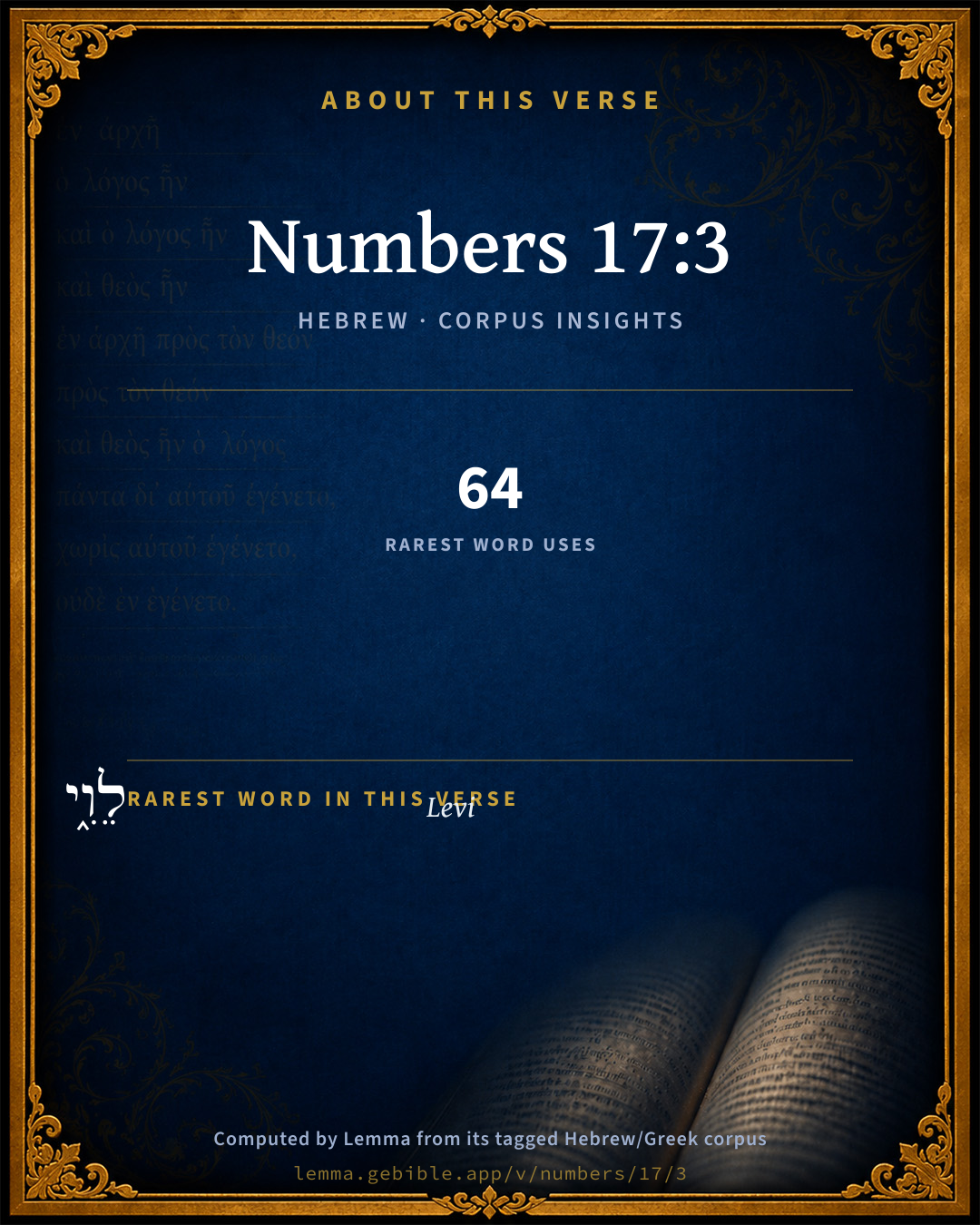
לֵוִ֑י
Lêvîy
H3878
“Levi”
Noun, Proper
Part of Speech
Noun
Type
Proper
Full BDB Definition

Origin: from H3867

TWOT: 1093

Levi = "joined to" - the 3rd son of Jacob by Leah and progenitor of tribe of Levites
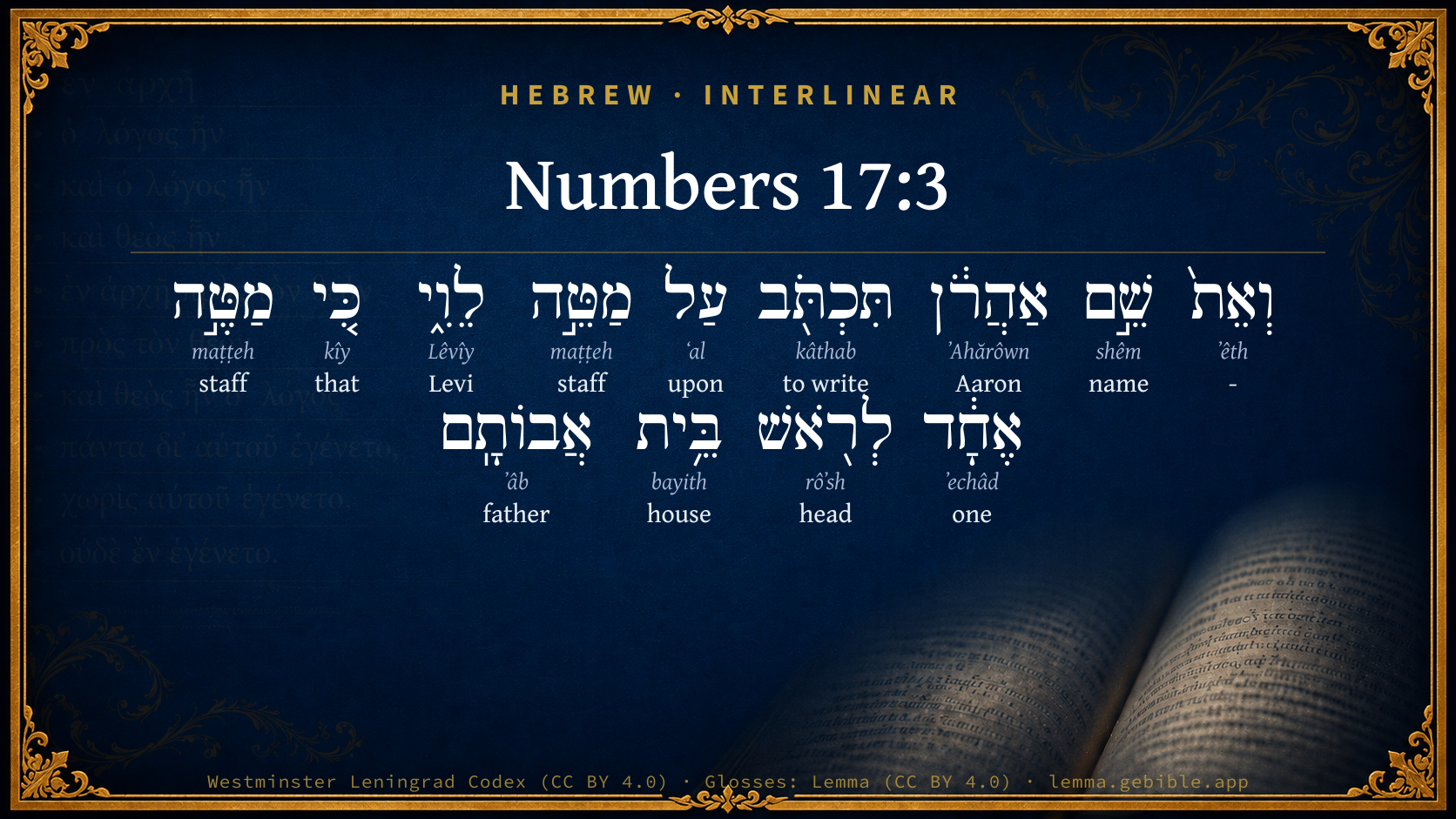
  1. וְאֵת֙ ʼêth H853 “and · -” Conjunction + Particle, Direct Object
  2. שֵׁ֣ם shêm H8034 “name of” Noun, Common, Masculine, Singular, Construct
  3. אַהֲרֹ֔ן ʼAhărôwn H175 “Aaron” Noun, Proper
  4. תִּכְתֹּ֖ב kâthab H3789 “to write” Verb, Qal, Imperfect, 2nd Person, Masculine, Singular
  5. עַל ʻal H5921 “upon” Preposition
  6. מַטֵּ֣ה maṭṭeh H4294 “staff of” Noun, Common, Masculine, Singular, Construct
  7. כִּ֚י kîy H3588 “that” Conjunction
  8. מַטֶּ֣ה maṭṭeh H4294 “staff” Noun, Common, Masculine, Singular, Absolute
  9. אֶחָ֔ד ʼechâd H259 “one” Adjective, Cardinal number, Masculine, Singular, Absolute
  10. לְרֹ֖אשׁ rôʼsh H7218 “to/for · head of” Preposition + Noun, Common, Masculine, Singular, Construct
  11. בֵּ֥ית bayith H1004 “house of” Noun, Common, Masculine, Singular, Construct
  12. אֲבוֹתָֽם ʼâb H1 “fathers · their” Noun, Common, Masculine, Plural, Construct + Suffix, Personal, 3rd Person, Masculine, Plural

About this verse

These counts appear in no published source. They are computed here, from the morphology-tagged text and Lemma’s own curated glosses. What Lemma adds →

13
words
12
distinct lemmas
Pentateuch
section

Grammatical profile

  • 1 verb
  • 8 nouns
  • 1 adjective
  • 1 preposition
  • 1 conjunction
  • 1 particle

Verb forms

  • תִּכְתֹּ֖ב Qal · Imperfect

Repetition

A word recurs within this verse — often emphatic in Hebrew:

  • מַטֵּ֣ה staff H4294 ×2

Hebrew & Septuagint length

In English translation the verse runs 23 words from the Hebrew and 32 from the Septuagint (LXX English) — closely comparable.

A rough comparison of the two English renderings, which tokenize alike — not a word-level alignment.

Word counts can differ between the Hebrew and the Greek without any difference in meaning — e.g. the Hebrew direct-object marker אֵת has no separate Greek word, and Greek often adds the article ὁ.

Cross-references

5

Topical passages linked to Numbers 17:3 in the Treasury of Scripture Knowledge — connected by theme and wording, ordered by reader-vote popularity; previews shown in the World English Bible.

  • Exodus 6:16 These are the names of the sons of Levi according to their generations: Gershon, and Kohath, and Merari; and the years of the life of Levi were one hundred thirty-seven years.
  • Exodus 6:20 Amram took Jochebed his father's sister to himself as wife; and she bore him Aaron and Moses: and the years of the life of Amram were a hundred and thirty-seven years.
  • Numbers 3:2–3 These are the names of the sons of Aaron: Nadab the firstborn, and Abihu, Eleazar, and Ithamar.
  • Numbers 18:1 Yahweh said to Aaron, You and your sons and your fathers' house with you shall bear the iniquity of the sanctuary; and you and your sons with you shall bear the iniquity of your priesthood.
  • Numbers 18:7 You and your sons with you shall keep your priesthood for everything of the altar, and for that within the veil; and you shall serve: I give you the priesthood as a service of gift: and the stranger who comes near shall be put to death.

Cross-references courtesy of OpenBible.info (CC BY 4.0).

Hebrew and Greek witnesses Masoretic Hebrew ↔ Greek Septuagint

The same verse in the two great witnesses to the Old Testament, shown verse-for-verse.

These are two independent witnesses, not word-aligned to each other, and the Septuagint is shown in lemma (dictionary) form.

Hebrew Numbers 17:3 Masoretic · Westminster Leningrad Codex

וְאֵת֙ שֵׁ֣ם אַהֲרֹ֔ן תִּכְתֹּ֖ב עַל מַטֵּ֣ה לֵוִ֑י כִּ֚י מַטֶּ֣ה אֶחָ֔ד לְרֹ֖אשׁ בֵּ֥ית אֲבוֹתָֽם

You shall write Aaron's name on the rod of Levi; for there shall be one rod for each head of their fathers' houses.

World English Bible · Public Domain

Greek LXX Numbers 17:3 Septuagint · lemma form

ὁ πυρεῖον ὁ ἁμαρτωλός οὗτος ἐν ὁ ψυχή αὐτός καί ποιέω αὐτός λεπίς ἐλάτη περίθεμα ὁ θυσιαστήριον ὅτι προςφέρω ἔναντι κύριος καί ἁγιάζω καί γίγνομαι εἰς σημεῖον ὁ υἱός ἰσραήλ

And write the name of Aaron on the rod of Levi; for it is one rod for each: they shall give them according to the tribe of the house of their families.

LXX2012 (modern English Septuagint) · Public Domain

Hebrew: Westminster Leningrad Codex (CC BY 4.0). Greek: Septuagint (public domain); English from LXX2012 (modern English Septuagint) (Public Domain). How the Septuagint differs from the Hebrew →

Targum (Aramaic paraphrase)

2

The Targum is the ancient Jewish Aramaic paraphrase of the Hebrew Scriptures — an interpretive translation, not the Hebrew text itself. Onkelos (literal) and Pseudo-Jonathan (expansive) render the Torah, and Jonathan the Prophets. Coverage is partial: where no permissively-licensed English translation exists for a verse, only the Aramaic is shown. This is verse-level text, not a word-by-word alignment to the Hebrew.

  1. Targum Onkelos Torah (Genesis–Deuteronomy)
    יָת מַחְתְּיַת חַיָיבַיָא הָאִלֵין דְאִתְחַיְיבוּ בְּנַפְשָׁתֵיהוֹן וְיַעְבְּדוּן יַתְהוֹן טַסִין רְדִידִין חוֹפָאָה לְמַדְבְּחָא אֲרֵי קָרֵבֻנוּן קֳדָם יְיָ וְאִתְקַדָשׁוּ וִיהֶוְיָן לְאָת לִבְּנֵי יִשְׂרָאֵל

    (no public-domain English translation for this verse)

    Targum Onkelos — Aramaic: “Onkelos Genesis” (public domain); “Onkelos Exodus” (public domain); “Onkelos Leviticus” (public domain); “Onkelos Numbers” (public domain); “Onkelos Deuteronomy” (public domain). English: “Sefaria Community Translation” (CC0 1.0 (public-domain dedication)); “J.W. Etheridge. The Targums of Onkelos and Jonathan Ben Uzziel on the Pentateuch. London: Longmans, Green, 1862” (public domain). Text via Sefaria.

  2. Targum Pseudo-Jonathan Torah (Genesis–Deuteronomy)
    יַת מַחְתְּיַית חַיָיבַיָא הָאִלֵין דְאִתְחַיְיבוּ קְטוֹל בְּנַפְשַׁתְהוֹן וְיַעַבְדוּן מִנְהוֹן רְדִידֵי טָסִין חַפְיֵי לְמַדְבְּחָא אֲרוּם קְרֵיבוּנוּן קֳדָם יְיָ וְאִתְקַדָשׁוּ וִיהוֹן לְאַת לִבְנֵי יִשְרָאֵל

    and make of them broad plates for the covering of the altar, because they bare them before the Lord, therefore they are consecrate; and they shall be for a sign to the children of Israel.

    Targum Pseudo-Jonathan — Aramaic: “Targum Jonathan on Genesis” (public domain); “Targum Jonathan on Exodus” (public domain); “Targum Jonathan on Leviticus” (public domain); “Targum Jonathan on Numbers” (public domain); “Targum Jonathan on Deuteronomy” (public domain). English: “The Targum of Jonathan ben Uzziel, trans. J. W. Etheridge, London, 1862” (public domain). Text via Sefaria.

Commentary

Notes on Numbers 17:3 from classic Christian and Jewish commentators (each source and its license shown beneath its notes). The classic Christian expositions comment on the surrounding passage and are grouped to its opening verse, so a note may address several verses; the Jewish commentaries on the Tanakh (Rashi and others) are per-verse, so they appear only where the commentator wrote on this verse.

Lemma curates 59 commentaries, every one of them public domain or Creative Commons licensed, each selected and text-cleaned for this edition rather than reprinted as found. About our sources →

Joseph Benson's Commentary

Num 17:3. Aaron’s name — Rather than Levi’s, for that would have left the controversy undecided between Aaron and the other Levites, whereas this would justify the appropriation of the priesthood to Aaron’s family. One rod — There shall be in this, as there is in all the other tribes, only one rod, and that for the head of their tribe, who is Aaron in this tribe: whereas it might have been expected that there should have been two rods, one for Aaron and another for his competitors of the same tribe. But Aaron’s name was sufficient to determine both the tribe, and that branch or family of the tribe to whom this dignity should be affixed.

Joseph Benson's Commentary on the Old and New Testaments (1811–1818) — public domain. Text from a community e-Sword module.

Ellicott's Commentary for English Readers

(3) And thou shalt write Aaron’s name upon the rod of Levi.—Aaron was descended from the second son of Levi. He was not, therefore, the natural, but the divinely-appointed head of his father’s house, and hence it would not have sufficed for the purpose contemplated to have inscribed the name of Levi upon the rod. Aaron was constituted the head alike of the priests and of the Levites, into which two classes the tribe of Levi was divided.

A Bible Commentary for English Readers, edited by Charles John Ellicott (1878–1897) — public domain. Text from a community e-Sword module.

The Cambridge Bible for Schools and Colleges

gen. ed. J. J. S. Perowne

3. one staff for the head of their clans] lit. ‘their fathers’ houses’ as R.V. This apparently refers not to all the tribes but to the tribe of Levi with its three divisions or clans, the Gershonites, Kohathites, and Merarites. They were to have only one representative, i.e. Aaron.

The Cambridge Bible for Schools and Colleges (gen. ed. J. J. S. Perowne; Cambridge University Press, 1878–1918) — public domain. Text from a community e-Sword module.

John Gill's Exposition

And thou shalt write Aaron's name upon the rod of Levi,.... Or upon the rod that was for the tribe of Levi; the name of "Aaron" was to be written, not the word "Levi", or a "Levite", as Josephus (e); for that would not have decided the controversy about the priesthood, which chiefly lay between the Levites and the family of Aaron, who were of the same tribe:

for one rod shall be for the head of the house of their fathers; one rod for the head or prince of every tribe, every prince representing his own tribe he was the head of, and the rod the prince; and though the tribe of Levi was divided into two families, the family of the priests, and the family of the Levites; yet, as Jarchi observes, they were but one tribe, and so one rod for them, as for the other tribes.

(e) Antiqu. l. 4. c. 4. sect. 2.

John Gill's Exposition of the Whole Bible (1746–1763) — public domain (CC PDM 1.0). Text via the HelloAO Bible API.

Albert Barnes' Notes on the Bible

Thou shalt write Aaron’s name upon the rod of Levi - The Levites had taken part in the late outbreak. It was therefore necessary to vindicate the supremacy of the house of Aaron over them; and accordingly his name was written on the rod of Levi, although being the son of Kohath, the second son of Levi (Exo 6:16 ff), he would not be the natural head of the tribe.

Albert Barnes' Notes on the Bible (1834–1885) — public domain. Text from a community e-Sword/MySword module.

Matthew Poole's English Annotations

Aaron’s rather than Levi’s name, for that would have left the controversy undecided between Aaron and the other Levites, whereas this would justify the appropriation of the priesthood to Aaron’s family.

For the head of the house of their fathers; i.e. there shall be in this, as there is in all the other tribes, only one rod, and that for the head of their tribe, who is Aaron in this tribe; whereas it might have been expected that there should have been two rods, one for Aaron, and another for his competitors of the same tribe. But Aaron’s name was sufficient to determine both the tribe, and that branch or family of the tribe, to whom this dignity should be affixed.

Matthew Poole's English Annotations on the Holy Bible (1683–1685) — public domain. Text from a community e-Sword/MySword module.

The Pulpit Commentary

Thou shalt write Aaron"s name upon the rod of Levi. There was no tribe prince of Levi, and it is not probable that either of the three chiefs of the sub-tribes (Num_3:24, Num_3:30) was called upon to bring a rod. This rod was, therefore, provided by Moses himself, and inscribed by him with the name of Aaron, who stood by Divine appointment (so recently and fearfully attested) above all his brethren. For the significance of the act cf. Eze_37:16-28. For one rod... for the head of the house of their fathers. For Levi, therefore, there must be, not three rods inscribed with the names of the chiefs, but one only bearing the name of Aaron, as their common superior.

The Pulpit Commentary (1880–1919), ed. H.D.M. Spence-Jones & Joseph S. Exell — public domain. Text from a community e-Sword module.

John Wesley's Explanatory Notes

Aaron's name - Rather than Levi's, for that would have left the controversy undecided between Aaron and the other Levites, whereas this would justify the appropriation of the priesthood to Aaron's family. One rod - There shall be in this, as there is in all the other tribes, only one rod, and that for the head of their tribe, who is Aaron in this tribe: whereas it might have been expected that there should have been two rods, one for Aaron, and another for his competitors of the same tribe. But Aaron's name was sufficient to determine both the tribe, and that branch or family of the tribe, to whom this dignity should be affixed.

John Wesley, Explanatory Notes Upon the Whole Bible (1754–1765) — public domain. Text via the GEBible commentary corpus.

unfoldingWord translationNotes

Door43 World Missions Community

Connecting Statement:

Yahweh continues speaking to Moses.

Levi's staff

The name Levi here refers to the tribe of Levi.

for each leader from his ancestors' tribe

Here "his" refers to "each leader."

the covenant decrees

The phrase "the covenant decrees" refers to the box that held the tablets that the covenant decrees were written on. AT: "the ark of the covenant" or "the box that holds the covenant decrees" (See: Synecdoche)

the staff of the man whom I choose will bud

"buds will start to grow on the staff of the man whom I choose"

cause the complaints from the people of Israel to stop, which they are speaking against you

Here "complaints" is an abstract noun that can be expressed as a verb. AT: "make the people of Israel stop complaining against you" (See: Abstract Nouns)

translationWords

Aaron

Levi

tent of meeting

covenant

decree

unfoldingWord translationNotes — © Distant Shores Media and the Door43 World Missions Community, licensed CC BY-SA 4.0. Source: git.door43.org/Door43/en_tn.

Rashi

Rabbi Shlomo Yitzchaki (Rashi)

החטאים האלא בנפשתם THESE SINNERS AGAINST THEIR OWN SOULS — i.e. who became wilful transgressors against their own souls, because they rebelled against the Holy One, blessed be He.

רקעי means beaten out (flattened).

פחים are plates beaten out thin, tendus in O. F.

צפוי למזבח FOR AN OVERLAYING FOR THE ALTAR — i.e. for the copper altar.

ויהיו לאות AND THEY SHALL BE AS AN אות — The word לאות is the same as לזכרון, something to be mentioned (cf. Exodus 13:9) — that people will always say: These plates were from (once belonged to) those who raised dissension about the priesthood and were burnt.

Rashi on the Tanakh — English translations: “The Judaica Press complete Tanach with Rashi, translated by A. J. Rosenberg” (CC BY 4.0); “Pentateuch with Rashi's commentary by M. Rosenbaum and A.M. Silbermann, 1929-1934” (public domain); “The Metsudah Tanach series, Lakewood, N.J” (CC BY 4.0); and “The Book of Joshua, Metsudah Publications, 1997” (CC BY 4.0). Text via Sefaria.

Lesson kit

Teaching starters — assembled from the data on this page, not authored interpretation. Every prompt links to the verse data it draws on. Edit before teaching.

Numbers, in the Pentateuch, opens this verse with 13 words (12 distinct Hebrew lemmas). Its most distinctive word is Lêvîy (“Levi”). A historical commentator’s framing appears above. Read the whole chapter for the surrounding context.

Discussion questions

  1. How does “Levi” (Lêvîy) shape what this verse is saying?
  2. How does Exodus 6:16, which shares this passage’s theme, read alongside this verse?
  3. What does the repetition of “staff” (2× in this one verse) do in this verse?
  4. These translations render this verse differently. What is at stake in choosing one wording over another?
  5. «תִּכְתֹּ֖ב» is a Qal Imperfect verb. How does that grammatical form shape the action described?
  6. Compare how Joseph Benson's Commentary and Ellicott's Commentary for English Readers read this verse. Where do they agree or differ?

Things to notice

Reading settings

Reading text

Shown beneath each verse's original-language words.

Old Testament
Old Testament edition

Read the OT as the Masoretic Hebrew (MT) or the Greek Septuagint (LXX).

English shown for the Greek Septuagint (in the Hebrew ↔ Greek comparison).

Comparing translations? Open the Compare panel on any verse page to stack up to four side by side.