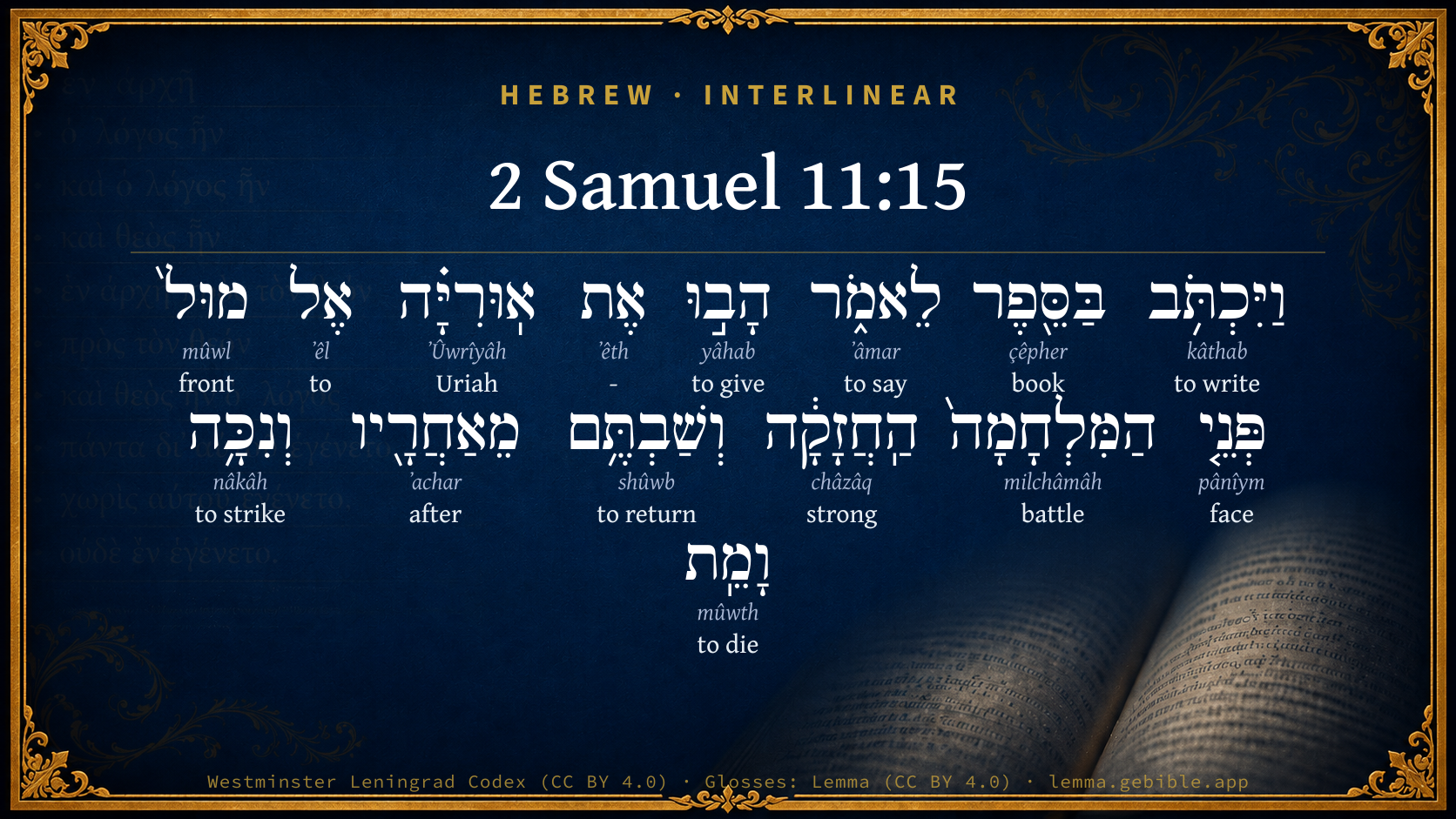
2 Samuel 11:15

Hebrew (Westminster Leningrad Codex) 2 Samuel 11:15 appears in the Hebrew Old Testament. The text above is from the Westminster Leningrad Codex. Each word links to its Strong’s number, a concise gloss, and parsing drawn from the Open Scriptures Hebrew Bible morphology. Click any word for its full Brown-Driver-Briggs (BDB) entry.
Download image
Cite this verse

2 Samuel 11:15 (World English Bible). Public Domain. Lemma interlinear Bible study tool, https://lemma.gebible.app/v/2-samuel/11/15.

Show BibTeX & RIS
BibTeX
RIS
English Translation
He wrote in the letter, saying, Set Uriah in the forefront of the hottest battle, and retire you from him, that he may be struck, and die.
World English Bible · Public Domain
Download a study sheet

One document with this verse’s original text, its word-by-word gloss line, the meaning frame, cross-references with their text, attributed commentary, and full source and license credits — printable, and it pastes into notes with its structure intact.

This verse Autodidact and up

Study sheet (.html) Plain text (.txt)

A passage Seminary Student

Up to 50 verses in one chapter. A passage sheet keeps up to 6 commentary sources and 12 cross-references per verse, in the order this page ranks them, and says so on the sheet whenever that leaves anything out. Ask for a single verse and you get the Autodidact verse sheet above.

Everything on this page stays free to read, with no account — the sheet is a download of what is already on screen, not access to it.

Want to remove ads? Support Godless Engineer
Compare translations 3

The same verse in 3 English versions, stacked beneath the original-language interlinear above. Click any original word for its lexicon entry.

Each is an independent rendering of the whole verse — the interlinear is not word-aligned to these translations.

Highlighted words mark where these versions differ — a whole-verse word diff, not a word-by-word alignment.

  • World English Bible Public Domain
    He wrote in the letter, saying, Set Uriah in the forefront of the hottest battle, and retire you from him, that he may be struck, and die.
  • King James Version Public Domain
    And he wrote in the letter, saying, Set ye Uriah in the forefront of the hottest battle, and retire ye from him, that he may be smitten, and die.
  • unfoldingWord Literal Text CC BY-SA 4.0
    And he wrote in the letter, saying, “Put Uriah in the front of the face of the strongest battle, and turn them back from behind him so he will be struck and die.”

unfoldingWord Literal Text — © unfoldingWord, licensed CC BY-SA 4.0. Word-aligned USFM3 via Door43 (git.door43.org/unfoldingWord/en_ult).

Versions to compare (up to 4)

3 of 4 selected

Show all 18 translations

Every available English version of this verse, each an independent rendering of the whole verse.

  • World English Bible Public Domain
    He wrote in the letter, saying, Set Uriah in the forefront of the hottest battle, and retire you from him, that he may be struck, and die.
  • Berean Standard Bible Public Domain
    In the letter he wrote: “Put Uriah at the front of the fiercest battle; then withdraw from him, so that he may be struck down and killed.”
  • Majority Standard Bible Public Domain
    In the letter he wrote: “Put Uriah at the front of the fiercest battle; then withdraw from him, so that he may be struck down and killed.”
  • King James Version Public Domain
    And he wrote in the letter, saying, Set ye Uriah in the forefront of the hottest battle, and retire ye from him, that he may be smitten, and die.
  • American Standard Version (1901) Public Domain
    And he wrote in the letter, saying, Set ye Uriah in the forefront of the hottest battle, and retire ye from him, that he may be smitten, and die.
  • Revised Version (1885) Public Domain
    And he wrote in the letter, saying, Set ye Uriah in the forefront of the hottest battle, and retire ye from him, that he may be smitten, and die.
  • Geneva Bible (1599) Public Domain
    And he wrote thus in the letter, Put ye Vriah in the forefront of the strength of the battell, and recule ye backe from him, that he may be smitten, and die.
  • Douay-Rheims (1899) Public Domain
    Writing in the letter: Set ye Urias in the front of the battle, where the fight is strongest: and leave ye him, that he may be wounded and die.
  • Young's Literal Translation Public Domain
    and he writeth in the letter, saying, `Place ye Uriah over-against the front of the severest battle, and ye have turned back from after him, and he hath been smitten, and hath died.'
  • Literal Standard Version CC BY-SA 4.0
    and he writes in the letter, saying, “Place Uriah in front of the face of the most severe battle, and you have turned back from after him, and he has been struck, and has died.”
  • Unlocked Literal Bible CC BY-SA 4.0
    David wrote in the letter saying, “Set Uriah at the very front of the most intense battle, and then withdraw from him, that he may be hit and killed.”
  • unfoldingWord Literal Text CC BY-SA 4.0
    And he wrote in the letter, saying, “Put Uriah in the front of the face of the strongest battle, and turn them back from behind him so he will be struck and die.”
  • Darby Bible Public Domain
    And he wrote in the letter saying, Set Urijah in the front of the thickest fight, and withdraw from him, that he may be smitten and die.
  • World Messianic Bible Public Domain
    He wrote in the letter, saying, “Send Uriah to the forefront of the hottest battle, and retreat from him, that he may be struck and die.”
  • Webster's Bible Public Domain
    And he wrote in the letter, saying, Set ye Uriah in the front of the hottest battle, and retire ye from him, that he may be smitten, and die.
  • Free Bible Version CC BY-SA 4.0
    In the letter, David told Joab, “Put Uriah right in the front where the fighting is worst, and then pull back behind him so that he'll be attacked and killed.”
  • Bible in Basic English Public Domain
    And in the letter he said, Take care to put Uriah in the very front of the line, where the fighting is most violent, and go back from him, so that he may be overcome and put to death.
  • JPS Tanakh (1917) Public Domain
    And he wrote in the letter, saying: 'Set ye Uriah in the forefront of the hottest battle, and retire ye from him, that he may be smitten, and die.'

Literal Standard Version (2020), Covenant Press — licensed CC BY-SA 4.0. Text via the HelloAO Bible API (eBible.org). Unlocked Literal Bible (unfoldingWord) — licensed CC BY-SA 4.0. Text via the HelloAO Bible API (eBible.org). unfoldingWord Literal Text — © unfoldingWord, licensed CC BY-SA 4.0. Word-aligned USFM3 via Door43 (git.door43.org/unfoldingWord/en_ult). Free Bible Version, Dr. Jonathan Gallagher — licensed CC BY-SA 4.0. Text via the HelloAO Bible API (eBible.org).

Word by word

More ways to search: Search by grammar → Find every occurrence → Compare this word →

Practice this passage: Drill this verse → Learn its vocabulary →

הָב֣וּ
yâhab
H3051
“give”
Verb, Qal, Imperative, 2nd Person, Masculine, Plural
Part of Speech
Verb
Stem
Qal
Form
Imperative
Person
2nd Person
Gender
Masculine
Number
Plural
Full BDB Definition

Origin: a primitive root

TWOT: 849

to give, provide, ascribe, come - (Qal) - to give - to set, place - to provide (with reflexive) - to ascribe (glory) - to grant, permit, come now
  1. וַיִּכְתֹּ֥ב kâthab H3789 “and · to write” Conjunction + Verb, Qal, Sequential Imperfect, 3rd Person, Masculine, Singular
  2. בַּסֵּ֖פֶר çêpher H5612 “in/at the · book” Preposition, Determined + Noun, Common, Masculine, Singular, Absolute
  3. לֵאמֹ֑ר ʼâmar H559 “to say” Preposition + Verb, Qal, Infinitive Construct
  4. אֶת ʼêth H853 “-” Particle, Direct Object
  5. אֽוּרִיָּ֗ה ʼÛwrîyâh H223 “Uriah” Noun, Proper
  6. אֶל ʼêl H413 “to” Preposition
  7. מוּל֙ mûwl H4136 “front” Preposition
  8. פְּנֵ֤י pânîym H6440 “face(s) of” Noun, Common, Both, Plural, Construct
  9. הַמִּלְחָמָה֙ milchâmâh H4421 “the · battle” Particle, Definite Article + Noun, Common, Feminine, Singular, Absolute
  10. הַֽחֲזָקָ֔ה châzâq H2389 “the · strong” Particle, Definite Article + Adjective, Adjective, Feminine, Singular, Absolute
  11. וְשַׁבְתֶּ֥ם shûwb H7725 “and · to return” Conjunction + Verb, Qal, Sequential Perfect, 2nd Person, Masculine, Plural
  12. מֵאַחֲרָ֖יו ʼachar H310 “from · after · him” Preposition + Preposition + Suffix, Personal, 3rd Person, Masculine, Singular
  13. וְנִכָּ֥ה nâkâh H5221 “and · to strike” Conjunction + Verb, Niphal, Sequential Perfect, 3rd Person, Masculine, Singular
  14. וָמֵֽת mûwth H4191 “and · to die” Conjunction + Verb, Qal, Sequential Perfect, 3rd Person, Masculine, Singular

About this verse

These counts appear in no published source. They are computed here, from the morphology-tagged text and Lemma’s own curated glosses. What Lemma adds →

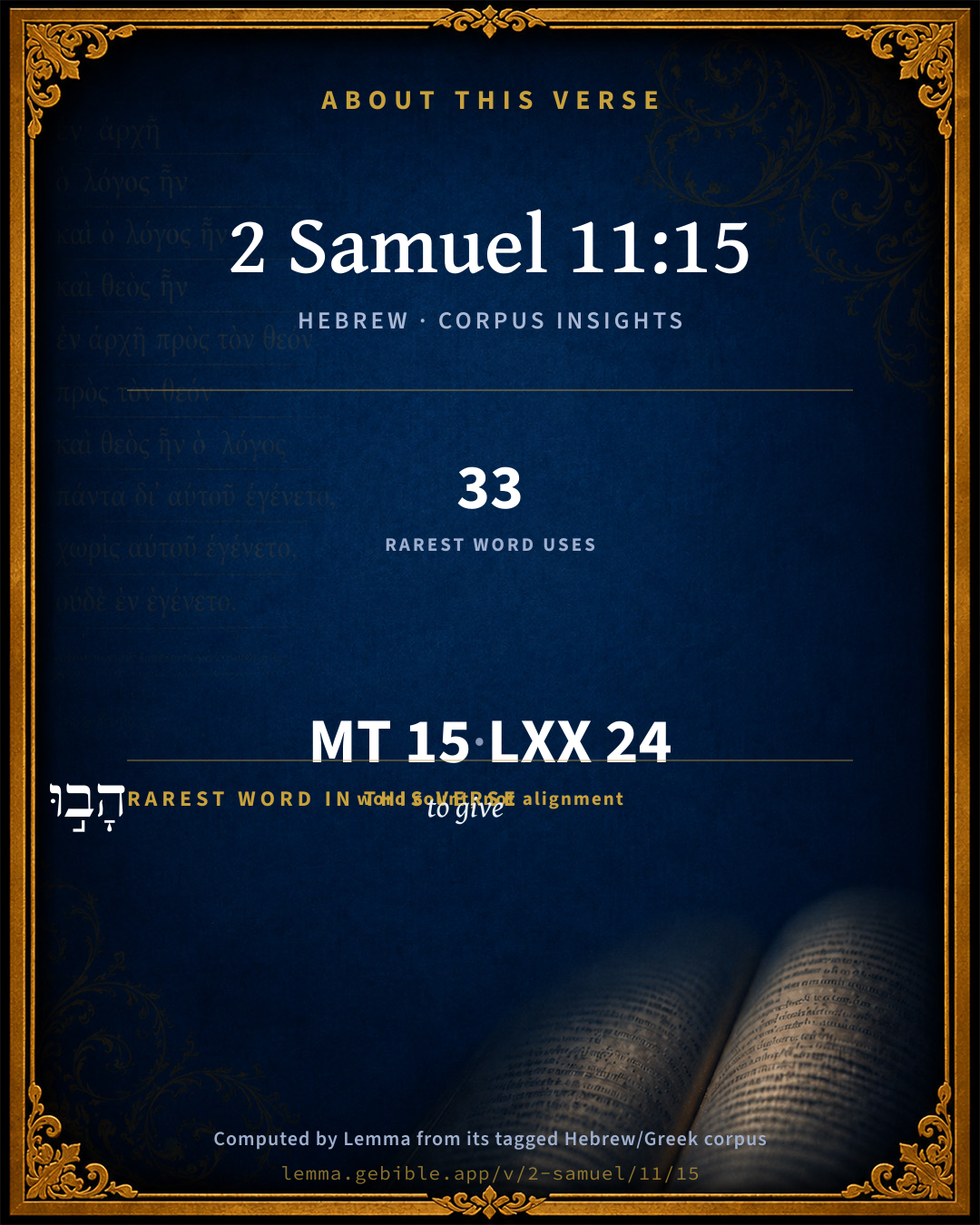
15
words
15
distinct lemmas
Historical
section

Shared distinctive vocabulary

הָב֣וּ to give H3051 occurs in 29 verses of the Hebrew Bible. Also found in:

Grammatical profile

  • 6 verbs
  • 4 nouns
  • 1 adjective
  • 3 prepositions
  • 1 particle

Verb forms

  • וַיִּכְתֹּ֥ב Qal · Sequential Imperfect
  • לֵאמֹ֑ר Qal · Infinitive Construct
  • הָב֣וּ Qal · Imperative
  • וְשַׁבְתֶּ֥ם Qal · Sequential Perfect
  • וְנִכָּ֥ה Niphal · Sequential Perfect
  • וָמֵֽת Qal · Sequential Perfect

Hebrew & Septuagint length

In English translation the verse runs 27 words from the Hebrew and 30 from the Septuagint (LXX English) — closely comparable.

A rough comparison of the two English renderings, which tokenize alike — not a word-level alignment.

Word counts can differ between the Hebrew and the Greek without any difference in meaning — e.g. the Hebrew direct-object marker אֵת has no separate Greek word, and Greek often adds the article ὁ.

In the original languages it is 15 Hebrew tokens and 24 Greek tokens — but the two are counted differently (Hebrew bundles its prefixes and suffixes into one token; the Greek is in lemma form), so that isn’t a like-for-like length.

Cross-references

8

Topical passages linked to 2 Samuel 11:15 in the Treasury of Scripture Knowledge — connected by theme and wording, ordered by reader-vote popularity; previews shown in the World English Bible.

  • 2 Samuel 12:9 Why have you despised the word of Yahweh, to do that which is evil in his sight? You have struck Uriah the Hittite with the sword, and have taken his wife to be your wife, and have slain him with the sword of the children of Ammon.
  • Psalms 51:4 Against you, and you only, have I sinned, And done that which is evil in your sight; That you may be proved right when you speak, And justified when you judge.
  • 1 Samuel 18:17 Saul said to David, Behold, my elder daughter Merab, her will I give you as wife: only be valiant for me, and fight Yahweh's battles. For Saul said, Don't let my hand be on him, but let the hand of the Philistines be on him.
  • 1 Samuel 18:21 Saul said, I will give her to him, that she may be a snare to him, and that the hand of the Philistines may be against him. Therefore Saul said to David, You shall this day be my son-in-law a second time.
  • 1 Samuel 18:25 Saul said, Thus shall you tell David, The king desires no dowry except one hundred foreskins of the Philistines, to be avenged of the king's enemies. Now Saul thought to make David fall by the hand of the Philistines.
  • 2 Samuel 11:17 The men of the city went out, and fought with Joab: and there fell some of the people, even of the servants of David; and Uriah the Hittite died also.
  • Psalms 51:14 Deliver me from bloodguiltiness, O God, the God of my salvation. My tongue shall sing aloud of your righteousness.
  • Jeremiah 20:13 Sing to Yahweh, praise you Yahweh; for he has delivered the soul of the needy from the hand of evil-doers.

Cross-references courtesy of OpenBible.info (CC BY 4.0).

Hebrew and Greek witnesses Masoretic Hebrew ↔ Greek Septuagint

The same verse in the two great witnesses to the Old Testament, shown verse-for-verse.

These are two independent witnesses, not word-aligned to each other, and the Septuagint is shown in lemma (dictionary) form.

Hebrew 2 Samuel 11:15 Masoretic · Westminster Leningrad Codex

וַיִּכְתֹּ֥ב בַּסֵּ֖פֶר לֵאמֹ֑ר הָב֣וּ אֶת אֽוּרִיָּ֗ה אֶל מוּל֙ פְּנֵ֤י הַמִּלְחָמָה֙ הַֽחֲזָקָ֔ה וְשַׁבְתֶּ֥ם מֵאַחֲרָ֖יו וְנִכָּ֥ה וָמֵֽת

He wrote in the letter, saying, Set Uriah in the forefront of the hottest battle, and retire you from him, that he may be struck, and die.

World English Bible · Public Domain

Greek LXX 2 Samuel 11:15 Septuagint · lemma form

καί γράφω ἐν ὁ βιβλίον λέγω ἐιςἄγω ὁ ουριας ἐκ ἐναντίος ὁ πόλεμος ὁ κραταιός καί ἀποστρέφω ἀπό ὄπισθε αὐτός καί πλήσσω καί ἀποθνήσκω

And he wrote in the letter, saying, Station Urias in front of the severe part of the fight, and retreat from behind him, so shall he be wounded and die.

LXX2012 (modern English Septuagint) · Public Domain

Hebrew: Westminster Leningrad Codex (CC BY 4.0). Greek: Septuagint (public domain); English from LXX2012 (modern English Septuagint) (Public Domain). How the Septuagint differs from the Hebrew →

Targum (Aramaic paraphrase)

1

The Targum is the ancient Jewish Aramaic paraphrase of the Hebrew Scriptures — an interpretive translation, not the Hebrew text itself. Onkelos (literal) and Pseudo-Jonathan (expansive) render the Torah, and Jonathan the Prophets. Coverage is partial: where no permissively-licensed English translation exists for a verse, only the Aramaic is shown. This is verse-level text, not a word-by-word alignment to the Hebrew.

  1. Targum Jonathan Prophets (Joshua–Malachi)
    וּכְתַב בְּאִגַרְתָּא לְמֵימָר הָבוּ יַת אוּרִיָה לָקֳבֵיל אַפֵּי קְרָבָא תַּקִיפָא וּתְתוּבוּן מִבַּתְרוֹהִי וְיִתְמְחֵי וִימוּת:

    (no public-domain English translation for this verse)

    Targum Jonathan — Aramaic: “Mikraot Gedolot” (public domain). English: “Sefaria Community Translation” (CC0 1.0 (public-domain dedication)); “London "Chaldee Paraphrase," 1871” (public domain). Text via Sefaria.

Commentary

Notes on 2 Samuel 11:15 from classic Christian and Jewish commentators (each source and its license shown beneath its notes). The classic Christian expositions comment on the surrounding passage and are grouped to its opening verse, so a note may address several verses; the Jewish commentaries on the Tanakh (Rashi and others) are per-verse, so they appear only where the commentator wrote on this verse.

Lemma curates 59 commentaries, every one of them public domain or Creative Commons licensed, each selected and text-cleaned for this edition rather than reprinted as found. About our sources →

Trapp's Complete Commentary

John Trapp

2Sa 11:15 And he wrote in the letter, saying, Set ye Uriah in the forefront of the hottest battle, and retire ye from him, that he may be smitten, and die.

Ver. 15. Set ye Uriah in the forefront of the hottest battle.] Here David schemes it indeed with hellish skill: little thinking how heavily this crimson sin would shortly lie upon his conscience, putting him to no less pain than if all his bones had been broken. {Psa 51:8-14} Joab possibly might not know the cause of this bloody letter, but gather by it that Uriah had some way deserved death, howbeit he could not but know that by the law none should be put to death without witnesses, two or three, produced against him; his obedience, therefore, to so tyrannical a command cannot be justified.

John Trapp, A Commentary or Exposition upon All the Books of the Old and New Testament (1647–1656) — public domain. Text from a community e-Sword module.

Joseph Benson's Commentary

2Sa 11:15. Retire ye from him, that he may be smitten and die — Thus swift is the progress of vice! thus does it lead from bad to worse! thus does it corrupt man’s whole nature, and bring him to such degeneracy as he could not before have thought himself capable of! So far is David from repenting, that he seeks to cover one scandalous and wicked action by another still more scandalous and wicked; to conceal the great crime of adultery by the still greater crime of murder! How are the beginnings of sin to be dreaded! for who knows where they will end? David hath sinned, therefore Uriah must die. That innocent, valiant, gallant man, who was ready to die for his prince’s honour, must die by his prince’s hand! See how fleshly lusts war against the soul, and what devastation they make in that war! How they blind the eyes, sear the conscience, harden the heart, and destroy all sense of honour and justice! See the shameful and deplorable change which they have made in David. Is this the man whose heart smote him because he had cut off Saul’s skirt? who more than once generously saved the life of his most bitter enemy when he had it in his power; but who is now using the basest contrivances to take away the life of a most worthy and faithful servant? Is this he that executed judgment and justice to all his people; and that exercised himself in God’s laws day and night, conscious what extraordinary favours he had received from him, and the infinite obligations he was under to him; the just, the generous, the pious David? Yes, this is the very man. Alas! how can he do such unjust and base actions? How can he be so ungrateful to his heavenly benefactor, as thus to transgress and trample under foot his law in the most capital of all its articles? How can he give such scandal and cause of stumbling to his subjects, whose piety and virtue he was appointed to promote? And how can he thus expose to contempt and reproach the true religion among the idolatrous nations all around? Alas! sin, through its deceitfulness, has gained entrance, and re-established its empire in his soul! Sin has produced this horrid transformation in the mind and heart of one of the bravest and worthiest of men. Reader, take warning, and withstand the first assaults of evil, lest, if they once prevail, they deprive thee of all religious and moral sense and feeling, and plunge thee into the greatest depth of guilt and baseness, to the present dishonour of God and religion, and thy own everlasting ruin and misery!

Joseph Benson's Commentary on the Old and New Testaments (1811–1818) — public domain. Text from a community e-Sword module.

Geneva Bible (1599)

Geneva Bible translators

Hebrew, saying.

Except God continually uphold us with his mighty spirit, the most perfect fall headlong into all vice and abomination.

Geneva Bible (1599) marginal notes — public domain. Text via Bolls.life.

Ellicott's Commentary for English Readers

(15) Retire ye from him.—This part of David’s orders was not carried out. Perhaps Joab thought it would make the stratagem too evident, or perhaps it was impracticable. At all events, the consequence was that others were slain with Uriah, and thus a larger blood-guiltiness fell upon David.

A Bible Commentary for English Readers, edited by Charles John Ellicott (1878–1897) — public domain. Text from a community e-Sword module.

The Cambridge Bible for Schools and Colleges

gen. ed. J. J. S. Perowne

15. that he may be smitten, and die] So blinded was David by his passion, and so eager to screen himself and Bath-sheba from the disgrace of exposure, that he did not shrink from plotting the murder of one of his bravest soldiers. The King’s command was sufficient warrant to Joab, without inquiry into the reason for it.

The Cambridge Bible for Schools and Colleges (gen. ed. J. J. S. Perowne; Cambridge University Press, 1878–1918) — public domain. Text from a community e-Sword module.

John Gill's Exposition

And he wrote in the letter, saying,.... Giving the following orders to Joab:

set ye Uriah is the forefront of the hottest battle: over against that part of the city where the enemy was strongest, and the battle the fiercest, and the stones and arrows were cast the thickest:

and retire ye from him; leave him to himself to combat the enemy alone; who seeing him deserted, would sally out upon him, and the few that might be with him, and slay him:

that he may be smitten, and die; thus he sought to add murder to adultery, and that in the basest manner, and which he accomplished; and this is often the case, that murder follows adultery, either by way of revenge for it, or in order to cover it, as here.

John Gill's Exposition of the Whole Bible (1746–1763) — public domain (CC PDM 1.0). Text via the HelloAO Bible API.

Haydock's Catholic Bible Commentary

Die. We no longer behold the genius of that David who would not hurt his persecutor. What a change does a shameful passion introduce in the whole conduct of a man! and how does one false step conduct from one abyss to another! Proprium humani ingenii est odisse quem læseris. (Tacitus) --- David could no longer bear the sight of a man whom he had injured so grievously. (Calmet)

George Leo Haydock (1774–1849), Haydock's Catholic Family Bible and Commentary, 1859 edition — public domain. Excludes Psalms (Douay-Rheims chapter numbering differs from Protestant) and Deuterocanonical books (Catholic canon only).

Matthew Poole's English Annotations

So far is David from repenting upon these just and great occasions, that he seeks to cover one sin with another; and to hide his adultery with murder, even the murder of a most excellent person, and that in a most malicious and perfidious manner.

Matthew Poole's English Annotations on the Holy Bible (1683–1685) — public domain. Text from a community e-Sword/MySword module.

Whedon's Commentary on the Bible

Daniel D. Whedon

15. That he may be smitten — By a similar device Saul had once sought the bringing about of David’s death. Comp. 1Sa_18:17; 1Sa_18:25.

Daniel D. Whedon (gen. ed.), Commentary on the Old and New Testaments (1874–1909) — public domain. Text from a community e-Sword module.

John Wesley's Explanatory Notes

He arose - So far is David from repenting, that he seeks to cover one sin with another. How are the beginnings of sin to be dreaded! For who knows where it will end? David hath sinned, therefore Uriah must die! That innocent, valiant, gallant man, who was ready to die for his prince's honour, must die by his prince's hand! See how fleshly lusts war against the soul, and what devastations they make in that war! How they blind the eyes, fear the conscience, harden the heart, and destroy all sense of honour and justice!

John Wesley, Explanatory Notes Upon the Whole Bible (1754–1765) — public domain. Text via the GEBible commentary corpus.

Rashi

Rabbi Shlomo Yitzchaki (Rashi)

And he will be struck and killed. In order for [Batsheva] to be divorced [from Urioh] retroactively. the result would be that [Dovid] did not cohabit with a married woman. Because all [soldiers] who went out to war wrote a conditional divorce document for their wife should they die in battle.

Rashi on the Tanakh — English translations: “The Judaica Press complete Tanach with Rashi, translated by A. J. Rosenberg” (CC BY 4.0); “Pentateuch with Rashi's commentary by M. Rosenbaum and A.M. Silbermann, 1929-1934” (public domain); “The Metsudah Tanach series, Lakewood, N.J” (CC BY 4.0); and “The Book of Joshua, Metsudah Publications, 1997” (CC BY 4.0). Text via Sefaria.

Lesson kit

Teaching starters — assembled from the data on this page, not authored interpretation. Every prompt links to the verse data it draws on. Edit before teaching.

2 Samuel, in the Historical, opens this verse with 15 words (15 distinct Hebrew lemmas). Its most distinctive word is yâhab (“to give”). A historical commentator’s framing appears above. Read the whole chapter for the surrounding context.

Discussion questions

  1. What does “to give” (yâhab) contribute to the verse as a whole?
  2. How does Genesis 11:3, which shares the word «to give», read alongside this verse?
  3. These translations render this verse differently. What is at stake in choosing one wording over another?
  4. «וַיִּכְתֹּ֥ב» is a Qal Sequential Imperfect verb. How does that grammatical form shape the action described?
  5. Compare how Trapp's Complete Commentary and Joseph Benson's Commentary read this verse. Where do they agree or differ?

Things to notice

Reading settings

Reading text

Shown beneath each verse's original-language words.

Old Testament
Old Testament edition

Read the OT as the Masoretic Hebrew (MT) or the Greek Septuagint (LXX).

English shown for the Greek Septuagint (in the Hebrew ↔ Greek comparison).

Comparing translations? Open the Compare panel on any verse page to stack up to four side by side.