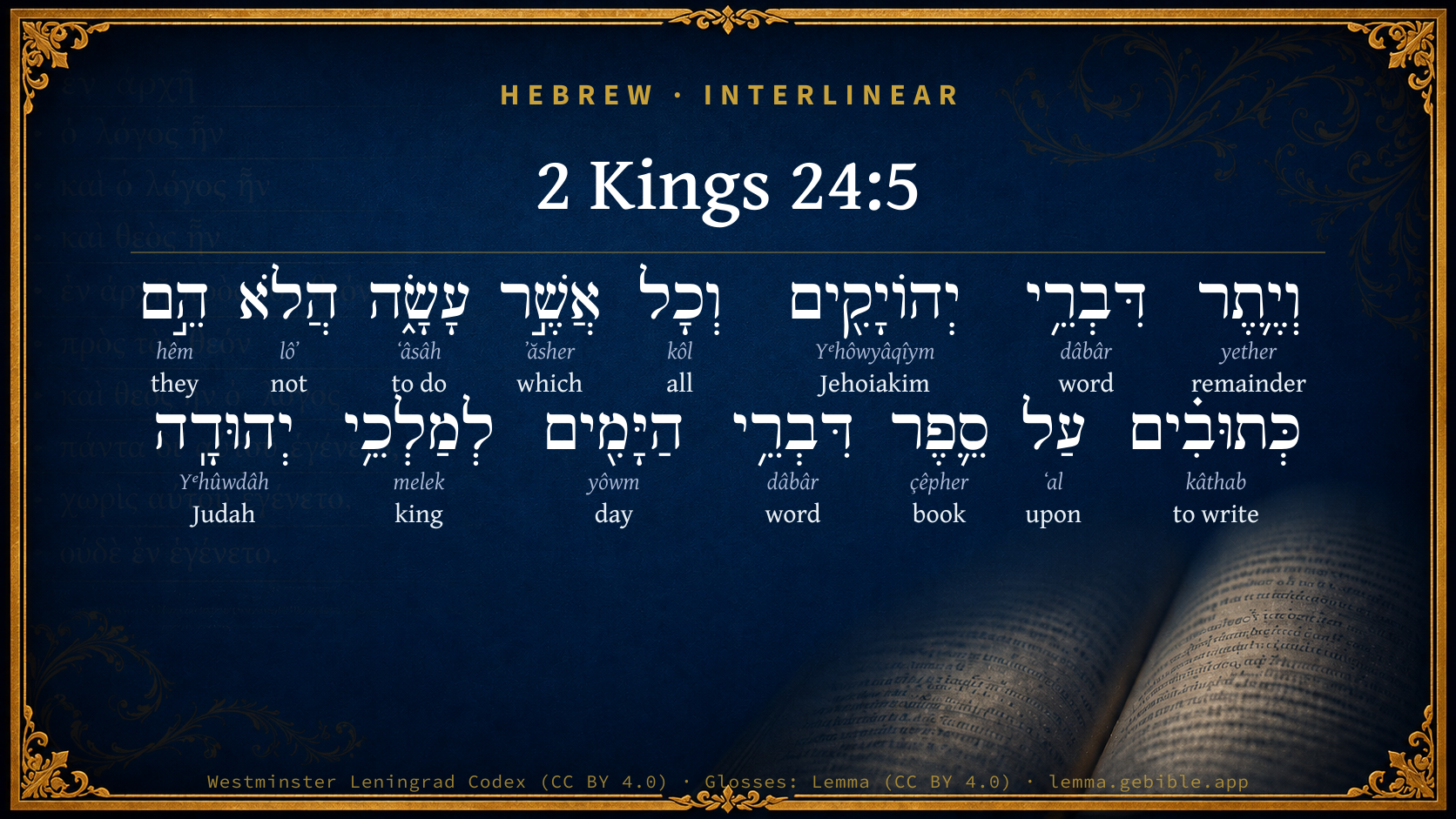
2 Kings 24:5

Hebrew (Westminster Leningrad Codex) 2 Kings 24:5 appears in the Hebrew Old Testament. The text above is from the Westminster Leningrad Codex. Each word links to its Strong’s number, a concise gloss, and parsing drawn from the Open Scriptures Hebrew Bible morphology. Click any word for its full Brown-Driver-Briggs (BDB) entry.
Download image
Cite this verse

2 Kings 24:5 (World English Bible). Public Domain. Lemma interlinear Bible study tool, https://lemma.gebible.app/v/2-kings/24/5.

Show BibTeX & RIS
BibTeX
RIS
English Translation
Now the rest of the acts of Jehoiakim, and all that he did, aren't they written in the book of the chronicles of the kings of Judah?
World English Bible · Public Domain
Download a study sheet

One document with this verse’s original text, its word-by-word gloss line, the meaning frame, cross-references with their text, attributed commentary, and full source and license credits — printable, and it pastes into notes with its structure intact.

This verse Autodidact and up

Study sheet (.html) Plain text (.txt)

A passage Seminary Student

Up to 50 verses in one chapter. A passage sheet keeps up to 6 commentary sources and 12 cross-references per verse, in the order this page ranks them, and says so on the sheet whenever that leaves anything out. Ask for a single verse and you get the Autodidact verse sheet above.

Everything on this page stays free to read, with no account — the sheet is a download of what is already on screen, not access to it.

Want to remove ads? Support Godless Engineer
Compare translations 3

The same verse in 3 English versions, stacked beneath the original-language interlinear above. Click any original word for its lexicon entry.

Each is an independent rendering of the whole verse — the interlinear is not word-aligned to these translations.

Highlighted words mark where these versions differ — a whole-verse word diff, not a word-by-word alignment.

  • World English Bible Public Domain
    Now the rest of the acts of Jehoiakim, and all that he did, aren't they written in the book of the chronicles of the kings of Judah?
  • King James Version Public Domain
    Now the rest of the acts of Jehoiakim, and all that he did, are they not written in the book of the chronicles of the kings of Judah?
  • unfoldingWord Literal Text CC BY-SA 4.0
    Now the rest of the matters of Jehoiakim and all that he did, are they not written in the book of the matters of the days of the kings of Judah?

unfoldingWord Literal Text — © unfoldingWord, licensed CC BY-SA 4.0. Word-aligned USFM3 via Door43 (git.door43.org/unfoldingWord/en_ult).

Versions to compare (up to 4)

3 of 4 selected

Show all 18 translations

Every available English version of this verse, each an independent rendering of the whole verse.

  • World English Bible Public Domain
    Now the rest of the acts of Jehoiakim, and all that he did, aren't they written in the book of the chronicles of the kings of Judah?
  • Berean Standard Bible Public Domain
    As for the rest of the acts of Jehoiakim, along with all his accomplishments, are they not written in the Book of the Chronicles of the Kings of Judah?
  • Majority Standard Bible Public Domain
    As for the rest of the acts of Jehoiakim, along with all his accomplishments, are they not written in the Book of the Chronicles of the Kings of Judah?
  • King James Version Public Domain
    Now the rest of the acts of Jehoiakim, and all that he did, are they not written in the book of the chronicles of the kings of Judah?
  • American Standard Version (1901) Public Domain
    Now the rest of the acts of Jehoiakim, and all that he did, are they not written in the book of the chronicles of the kings of Judah?
  • Revised Version (1885) Public Domain
    Now the rest of the acts of Jehoiakim, and all that he did, are they not written in the book of the chronicles of the kings of Judah?
  • Geneva Bible (1599) Public Domain
    Concerning the rest of the actes of Iehoiakim, and all that he did, are they not written in the booke of the Chronicles of the Kinges of Iudah?
  • Douay-Rheims (1899) Public Domain
    But the rest of the acts of Joakim, and all that he did, are they not written in the book of the words of the days of the kings of Juda? And Joakim slept with his fathers:
  • Young's Literal Translation Public Domain
    And the rest of the matters of Jehoiakim, and all that he did, are they not written on the book of the Chronicles of the kings of Judah?
  • Literal Standard Version CC BY-SA 4.0
    And the rest of the matters of Jehoiakim and all that he did, are they not written on the scroll of the Chronicles of the Kings of Judah?
  • Unlocked Literal Bible CC BY-SA 4.0
    As for the other matters concerning Jehoiakim, and all that he did, are they not written in the book of the events of the kings of Judah?
  • unfoldingWord Literal Text CC BY-SA 4.0
    Now the rest of the matters of Jehoiakim and all that he did, are they not written in the book of the matters of the days of the kings of Judah?
  • Darby Bible Public Domain
    And the rest of the acts of Jehoiakim, and all that he did, are they not written in the book of the chronicles of the kings of Judah?
  • World Messianic Bible Public Domain
    Now the rest of the acts of Jehoiakim, and all that he did, aren’t they written in the book of the chronicles of the kings of Judah?
  • Webster's Bible Public Domain
    Now the rest of the acts of Jehoiakim, and all that he did, are they not written in the book of the chronicles of the kings of Judah?
  • Free Bible Version CC BY-SA 4.0
    The rest of what happened in Jehoiakim's reign, and all he did, are recorded in the Book of Chronicles of the Kings of Judah.
  • Bible in Basic English Public Domain
    Now the rest of the acts of Jehoiakim, and all he did, are they not recorded in the book of the history of the kings of Judah?
  • JPS Tanakh (1917) Public Domain
    Now the rest of the acts of Jehoiakim, and all that he did, are they not written in the book of the chronicles of the kings of Judah?

Literal Standard Version (2020), Covenant Press — licensed CC BY-SA 4.0. Text via the HelloAO Bible API (eBible.org). Unlocked Literal Bible (unfoldingWord) — licensed CC BY-SA 4.0. Text via the HelloAO Bible API (eBible.org). unfoldingWord Literal Text — © unfoldingWord, licensed CC BY-SA 4.0. Word-aligned USFM3 via Door43 (git.door43.org/unfoldingWord/en_ult). Free Bible Version, Dr. Jonathan Gallagher — licensed CC BY-SA 4.0. Text via the HelloAO Bible API (eBible.org).

Word by word

More ways to search: Search by grammar → Find every occurrence → Compare this word →

Practice this passage: Drill this verse → Learn its vocabulary →

יְהוֹיָקִ֖ים
Yᵉhôwyâqîym
H3079
“Jehoiakim”
Noun, Proper
Part of Speech
Noun
Type
Proper
Full BDB Definition

Origin: from H3068 abbreviated and H6965 , cf. H3113

TWOT: None

Jehoiakim = "Jehovah raises up" - son of Josiah and the third from the last king of Judah; subject vassel of Nebuchadnezzar who reigned for 11 years before he died a violent death either in combat or by the hands of his own subjects
  1. וְיֶ֛תֶר yether H3499 “and · remainder of” Conjunction + Noun, Common, Masculine, Singular, Construct
  2. דִּבְרֵ֥י dâbâr H1697 “words of” Noun, Common, Masculine, Plural, Construct
  3. וְכָל kôl H3605 “and · all of” Conjunction + Noun, Common, Masculine, Singular, Construct
  4. אֲשֶׁ֣ר ʼăsher H834 “which” Particle, Relative
  5. עָשָׂ֑ה ʻâsâh H6213 “to do” Verb, Qal, Perfect, 3rd Person, Masculine, Singular
  6. הֲלֹא lôʼ H3808 “not” Particle, Interrogative + Particle, Negative
  7. הֵ֣ם hêm H1992 “they” Pronoun, Personal, 3rd Person, Masculine, Plural
  8. כְּתוּבִ֗ים kâthab H3789 “written” Verb, Qal, Participle Passive, Masculine, Plural, Absolute
  9. עַל ʻal H5921 “upon” Preposition
  10. סֵ֛פֶר çêpher H5612 “book of” Noun, Common, Masculine, Singular, Construct
  11. דִּבְרֵ֥י dâbâr H1697 “words of” Noun, Common, Masculine, Plural, Construct
  12. הַיָּמִ֖ים yôwm H3117 “the · days” Particle, Definite Article + Noun, Common, Masculine, Plural, Absolute
  13. לְמַלְכֵ֥י melek H4428 “to/for · kings of” Preposition + Noun, Common, Masculine, Plural, Construct
  14. יְהוּדָֽה Yᵉhûwdâh H3063 “Judah” Noun, Proper

About this verse

These counts appear in no published source. They are computed here, from the morphology-tagged text and Lemma’s own curated glosses. What Lemma adds →

15
words
14
distinct lemmas
Historical
section

Shared distinctive vocabulary

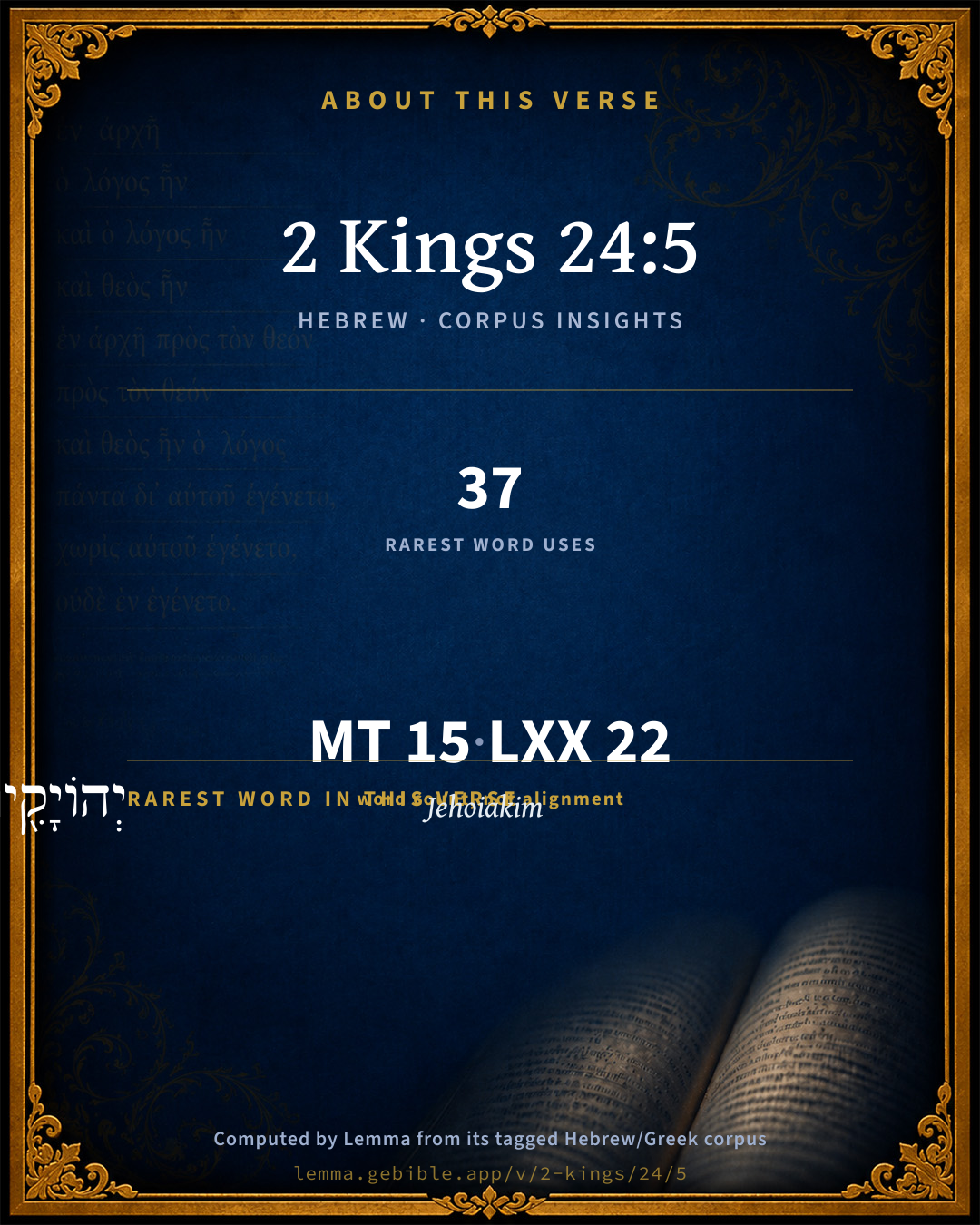
יְהוֹיָקִ֖ים Jehoiakim H3079 occurs in 37 verses of the Hebrew Bible. Also found in:

Grammatical profile

  • 2 verbs
  • 9 nouns
  • 1 pronoun
  • 1 preposition
  • 2 particles

Verb forms

  • עָשָׂ֑ה Qal · Perfect
  • כְּתוּבִ֗ים Qal · Participle Passive

Repetition

A word recurs within this verse — often emphatic in Hebrew:

  • דִּבְרֵ֥י word H1697 ×2

Hebrew & Septuagint length

In English translation the verse runs 27 words from the Hebrew and 29 from the Septuagint (LXX English) — closely comparable.

A rough comparison of the two English renderings, which tokenize alike — not a word-level alignment.

Word counts can differ between the Hebrew and the Greek without any difference in meaning — e.g. the Hebrew direct-object marker אֵת has no separate Greek word, and Greek often adds the article ὁ.

In the original languages it is 15 Hebrew tokens and 22 Greek tokens — but the two are counted differently (Hebrew bundles its prefixes and suffixes into one token; the Greek is in lemma form), so that isn’t a like-for-like length.

Cross-references

3

Topical passages linked to 2 Kings 24:5 in the Treasury of Scripture Knowledge — connected by theme and wording, ordered by reader-vote popularity; previews shown in the World English Bible.

  • 2 Chronicles 36:8 Now the rest of the acts of Jehoiakim, and his abominations which he did, and that which was found in him, behold, they are written in the book of the kings of Israel and Judah: and Jehoiachin his son reigned in his place.
  • Jeremiah 22:13–17 Woe to him who builds his house by unrighteousness, and his chambers by injustice; who uses his neighbor's service without wages, and doesn't give him his hire;
  • Jeremiah 26:1–24 In the beginning of the reign of Jehoiakim the son of Josiah, king of Judah, came this word from Yahweh, saying,

Cross-references courtesy of OpenBible.info (CC BY 4.0).

Hebrew and Greek witnesses Masoretic Hebrew ↔ Greek Septuagint

The same verse in the two great witnesses to the Old Testament, shown verse-for-verse.

These are two independent witnesses, not word-aligned to each other, and the Septuagint is shown in lemma (dictionary) form.

Hebrew 2 Kings 24:5 Masoretic · Westminster Leningrad Codex

וְיֶ֛תֶר דִּבְרֵ֥י יְהוֹיָקִ֖ים וְכָל אֲשֶׁ֣ר עָשָׂ֑ה הֲלֹא הֵ֣ם כְּתוּבִ֗ים עַל סֵ֛פֶר דִּבְרֵ֥י הַיָּמִ֖ים לְמַלְכֵ֥י יְהוּדָֽה

Now the rest of the acts of Jehoiakim, and all that he did, aren't they written in the book of the chronicles of the kings of Judah?

World English Bible · Public Domain

Greek LXX 2 Kings 24:5 Septuagint · lemma form

καί ὁ λοιπός ὁ λόγος ιωακιμ καί πᾶς ὅσος ποιέω οὐ ἰδού οὗτος γράφω ἐπί βιβλίον λόγος ὁ ἡμέρα ὁ βασιλεύς ιουδα

And the rest of the acts of Joakim, and all that he did, behold, are not these written in the book of the chronicles of the kings of Juda?

LXX2012 (modern English Septuagint) · Public Domain

Hebrew: Westminster Leningrad Codex (CC BY 4.0). Greek: Septuagint (public domain); English from LXX2012 (modern English Septuagint) (Public Domain). How the Septuagint differs from the Hebrew →

Targum (Aramaic paraphrase)

1

The Targum is the ancient Jewish Aramaic paraphrase of the Hebrew Scriptures — an interpretive translation, not the Hebrew text itself. Onkelos (literal) and Pseudo-Jonathan (expansive) render the Torah, and Jonathan the Prophets. Coverage is partial: where no permissively-licensed English translation exists for a verse, only the Aramaic is shown. This is verse-level text, not a word-by-word alignment to the Hebrew.

  1. Targum Jonathan Prophets (Joshua–Malachi)
    וּשְׁאַר פִּתְגָמֵי יְהוֹיָקִים וְכָל דִי עֲבָד הֲלָא אִינוּן כְּתִיבִין עַל סְפַר פִּתְגָמֵי יוֹמַיָא לְמַלְכֵי דְבֵית יְהוּדָה:

    (no public-domain English translation for this verse)

    Targum Jonathan — Aramaic: “Mikraot Gedolot” (public domain). English: “Sefaria Community Translation” (CC0 1.0 (public-domain dedication)); “London "Chaldee Paraphrase," 1871” (public domain). Text via Sefaria.

Commentary

Notes on 2 Kings 24:5 from classic Christian and Jewish commentators (each source and its license shown beneath its notes). The classic Christian expositions comment on the surrounding passage and are grouped to its opening verse, so a note may address several verses; the Jewish commentaries on the Tanakh (Rashi and others) are per-verse, so they appear only where the commentator wrote on this verse.

Lemma curates 59 commentaries, every one of them public domain or Creative Commons licensed, each selected and text-cleaned for this edition rather than reprinted as found. About our sources →

Trapp's Complete Commentary

John Trapp

2Ki 24:5 Now the rest of the acts of Jehoiakim, and all that he did, [are] they not written in the book of the chronicles of the kings of Judah?

Ver. 5. Now the rest of the acts.] See 1Ki 15:23.

John Trapp, A Commentary or Exposition upon All the Books of the Old and New Testament (1647–1656) — public domain. Text from a community e-Sword module.

Ellicott's Commentary for English Readers

(5) Now the rest of the acts of Jehoiakim . . .—Assuming with Hitzig that the passage Hab_2:9-14 refers to him, we gather that he severely oppressed his people by his exactions of forced labour upon the defences of Jerusalem. Thenius concludes from the words, “that he may set his nest on high,” &c., that Jehoiakim strengthened and enlarged the fortress on Ophel erected by Manasseh. (Comp. also Jer_22:13-17.)

Are they not written . . .—The last reference to this authority. Bähr concludes that the work did not extend beyond the reign of Jehoiakim.

A Bible Commentary for English Readers, edited by Charles John Ellicott (1878–1897) — public domain. Text from a community e-Sword module.

The Cambridge Bible for Schools and Colleges

gen. ed. J. J. S. Perowne

5. the rest of the acts of Jehoiakim] One of the most conspicuous acts of Jehoiakim’s impiety was the burning of Jeremiah’s roll of prophecies (Jeremiah 36), and the way in which evil-doing had made men callous is expressed in the prophet’s narrative: ‘Yet they were not afraid nor rent their garments, neither the king nor any of his servants’. So the prophecy of the Lord against Jehoiakim was, ‘He shall have none to sit upon the throne of David’. In another place Jeremiah foretells (2Ki_22:18-19) the fate which shall befall him. ‘They shall not lament for him … he shall be buried with the burial of an ass, drawn and cast forth beyond the gates of Jerusalem’. And in another passage, ‘His dead body shall be cast out in the day to the heat and in the night to the frost’. The evil and self-indulgent character of Jehoiakim is abundantly set forth in Jer_22:11-17.

The Cambridge Bible for Schools and Colleges (gen. ed. J. J. S. Perowne; Cambridge University Press, 1878–1918) — public domain. Text from a community e-Sword module.

John Gill's Exposition

Now the rest of the acts of Jehoiakim,.... In Ch2 36:8, it is added, "his abominations, and that which was found in him": which besides his rebellion against the king of Babylon, and his shedding innocent blood, is interpreted of marks made in his body for superstitious and idolatrous purposes; so Lyra.

, it is added, "his abominations, and that which was found in him": which besides his rebellion against the king of Babylon, and his shedding innocent blood, is interpreted of marks made in his body for superstitious and idolatrous purposes; so Lyra.

2 Kings 24:6

kg2 24:6

kg2 24:6

kg2 24:6So Jehoiakim slept with his fathers,.... He died as they did, but was not buried with them, and indeed had no burial at all, according to the prophecy of Jeremiah, Jer 22:18 for, falling into the hands of the king of Babylon, he was bound in chains, in order to be carried to Babylon, but died as soon as he came out of Jerusalem, at the gates of which he was cast, and had no burial, Ch2 36:6. At this time also some of the vessels of the temple were carried away, and put in the idol's temple at Babylon, Ch2 36:7, and Eupolemus (p) says, that whatever gold, silver, and brass, were in the temple, were carried away:

and Jehoiachin his son reigned in his stead; called sometimes Jeconiah, and by contempt Coniah, Jer 22:24.

(p) Ut supra. (Apud Euseb. Evangel. Praepar. l. 9. c. 39. p. 454.)

John Gill's Exposition of the Whole Bible (1746–1763) — public domain (CC PDM 1.0). Text via the HelloAO Bible API.

Albert Barnes' Notes on the Bible

Comparing Jer 22:19; Jer 36:6, Jer 36:30; and Eze 19:8-9, it would seem that Nebuchadnezzar must in the fifth or sixth year after Jehoiakim’s revolt have determined to go in person to Riblah, to direct operations, first against Tyre and then against Jerusalem. Jehoiakim was taken prisoner, and brought in chains to Nebuchadnezzar, who at first designed to convey him to Babylon, but afterward had him taken to Jerusalem, where he was executed. Afterward, when the Babylonians had withdrawn, the remains were collected and interred in the burying-place of Manasseh, so that the king ultimately “slept with his fathers” 2Ki 24:6.

Albert Barnes' Notes on the Bible (1834–1885) — public domain. Text from a community e-Sword/MySword module.

Haydock's Catholic Bible Commentary

Did. Paralipomenon, and his abominations which he wrought, and the things which were found in him. This St. Jerome, (Trad.) explains of certain diabolical marks on his body, shewing him to be devoted to the fiend Codonasar. Suchar are often found on magicians. (Menochius) --- Thus the priests of Baal cut themselves, 3 Kings xviii. 28. (Haydock)

George Leo Haydock (1774–1849), Haydock's Catholic Family Bible and Commentary, 1859 edition — public domain. Excludes Psalms (Douay-Rheims chapter numbering differs from Protestant) and Deuterocanonical books (Catholic canon only).

The Pulpit Commentary

Now the rest of the acts of Jehoiakim; and all that he did, are they not written in the book of the chronicles of the kings of Judah? Among the acts of Jehoiakim recorded elsewhere in the Old Testament, the most remarkable are the following:

(1) His execution of Urijah the son of Shemaiah; (Jer_26:23)

(2) his destruction of the first collection of the early prophecies made by Jeremiah, in a fit of anger at hearing its contents; (Jer_36:20-23)

(3) his order that Jeremiah and Baruch should be arrested; (Jer_36:26)

(4) his capture by some of the "nations" which Nebuchadnezzar had stirred up against him, and delivery into the hands of that monarch, (Eze_19:9) probably at Jerusalem. How Nebuchadnezzar treated him is uncertain. Josephus says ("Ant. Jud:," 10:6. that he put him to death, and east him out unburied beyond the walls of the city. But from the biblical notices we can only gather that he died prematurely after a reign of no more than eleven years (B.C. 608 to B.C. 597), and was u-lamented, "buried with the burial of an ass, drawn and cast forth beyond the gates of Jerusalem". (Jer_22:18, Jer_22:19) Conjecture has filled up the blanks of this history in several ways, the most purely imaginative being, perhaps, that of Ewald, who says ("History of Israel," vol. 4. p. 262), "When the Chaldean armies presented themselves at the gates of the capital, Jehoiakim seems to have been betrayed into the same error as his brother (Jehoahaz), eleven years before. He gave ear to a crafty invitation of the enemy to repair for negotiations to their camp, where, in sight of his own city, he was made prisoner. He offered a frantic resistance, and was dragged away in a scuffle, and miserably cut down; while even an honorable burial for his corpse, which his family certainly solicited, was refused."

The Pulpit Commentary (1880–1919), ed. H.D.M. Spence-Jones & Joseph S. Exell — public domain. Text from a community e-Sword module.

unfoldingWord translationNotes

Door43 World Missions Community

are they not written ... Judah?

This is written as a rhetorical question because at the time this was written people were already aware of this information. This can be written as a statement. It can be translated in active form. See how you translated this in 2 Kings 8:23. AT: "they are indeed written ... Judah." or "you can find them ... Judah" (See: Active or Passive and Rhetorical Question)

slept with his ancestors

Sleeping is a euphemism for dying. AT: "died and was buried along with his ancestors" (See: Euphemism)

translationWords

written

asleep

unfoldingWord translationNotes — © Distant Shores Media and the Door43 World Missions Community, licensed CC BY-SA 4.0. Source: git.door43.org/Door43/en_tn.

Lesson kit

Teaching starters — assembled from the data on this page, not authored interpretation. Every prompt links to the verse data it draws on. Edit before teaching.

2 Kings, in the Historical, opens this verse with 15 words (14 distinct Hebrew lemmas). Its most distinctive word is Yᵉhôwyâqîym (“Jehoiakim”). A historical commentator’s framing appears above. Read the whole chapter for the surrounding context.

Discussion questions

  1. What does “Jehoiakim” (Yᵉhôwyâqîym) contribute to the verse as a whole?
  2. How does 2 Kings 23:34, which shares the word «Jehoiakim», read alongside this verse?
  3. What does the repetition of “word” (2× in this one verse) do in this verse?
  4. These translations render this verse differently. What is at stake in choosing one wording over another?
  5. «עָשָׂ֑ה» is a Qal Perfect verb. How does that grammatical form shape the action described?
  6. Compare how Trapp's Complete Commentary and Ellicott's Commentary for English Readers read this verse. Where do they agree or differ?

Things to notice

Reading settings

Reading text

Shown beneath each verse's original-language words.

Old Testament
Old Testament edition

Read the OT as the Masoretic Hebrew (MT) or the Greek Septuagint (LXX).

English shown for the Greek Septuagint (in the Hebrew ↔ Greek comparison).

Comparing translations? Open the Compare panel on any verse page to stack up to four side by side.