
2 Kings 22:13

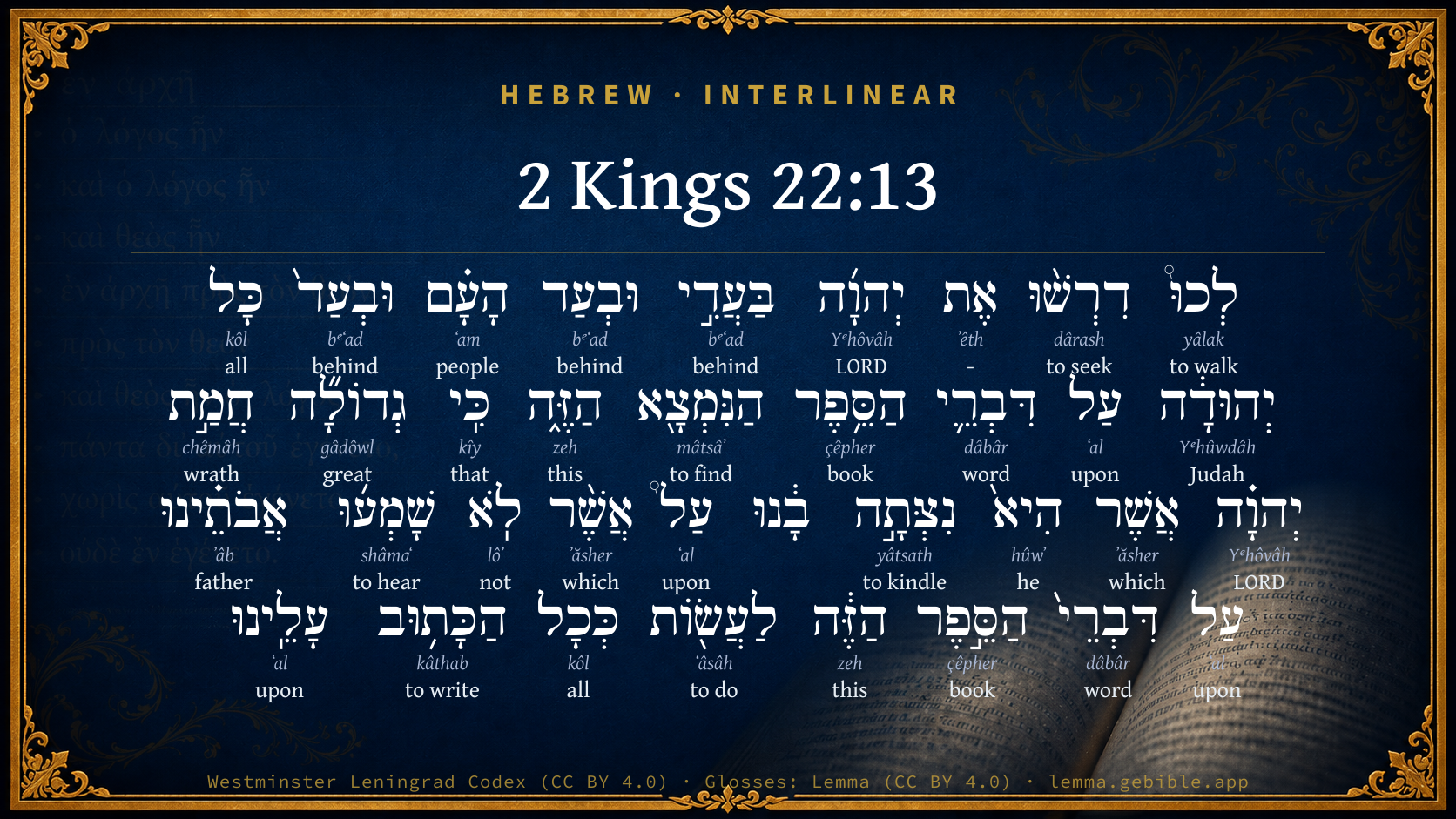
Hebrew (Westminster Leningrad Codex) 2 Kings 22:13 appears in the Hebrew Old Testament. The text above is from the Westminster Leningrad Codex. Each word links to its Strong’s number, a concise gloss, and parsing drawn from the Open Scriptures Hebrew Bible morphology. Click any word for its full Brown-Driver-Briggs (BDB) entry.
Download image
Cite this verse

2 Kings 22:13 (World English Bible). Public Domain. Lemma interlinear Bible study tool, https://lemma.gebible.app/v/2-kings/22/13.

Show BibTeX & RIS
BibTeX
RIS
English Translation
Go you, inquire of Yahweh for me, and for the people, and for all Judah, concerning the words of this book that is found; for great is the wrath of Yahweh that is kindled against us, because our fathers have not listened to the words of this book, to do according to all that which is written concerning us.
World English Bible · Public Domain
Download a study sheet

One document with this verse’s original text, its word-by-word gloss line, the meaning frame, cross-references with their text, attributed commentary, and full source and license credits — printable, and it pastes into notes with its structure intact.

This verse Autodidact and up

Study sheet (.html) Plain text (.txt)

A passage Seminary Student

Up to 50 verses in one chapter. A passage sheet keeps up to 6 commentary sources and 12 cross-references per verse, in the order this page ranks them, and says so on the sheet whenever that leaves anything out. Ask for a single verse and you get the Autodidact verse sheet above.

Everything on this page stays free to read, with no account — the sheet is a download of what is already on screen, not access to it.

Want to remove ads? Support Godless Engineer
Compare translations 3

The same verse in 3 English versions, stacked beneath the original-language interlinear above. Click any original word for its lexicon entry.

Each is an independent rendering of the whole verse — the interlinear is not word-aligned to these translations.

Highlighted words mark where these versions differ — a whole-verse word diff, not a word-by-word alignment.

  • World English Bible Public Domain
    Go you, inquire of Yahweh for me, and for the people, and for all Judah, concerning the words of this book that is found; for great is the wrath of Yahweh that is kindled against us, because our fathers have not listened to the words of this book, to do according to all that which is written concerning us.
  • King James Version Public Domain
    Go ye, enquire of the LORD for me, and for the people, and for all Judah, concerning the words of this book that is found: for great is the wrath of the LORD that is kindled against us, because our fathers have not hearkened unto the words of this book, to do according unto all that which is written concerning us.
  • unfoldingWord Literal Text CC BY-SA 4.0
    “Go, seek Yahweh for me and for the people and for all of Judah concerning the words of this scroll having been found. For great the heat of Yahweh, that which is kindled against us because our fathers did not listen to the words of this scroll, to act according to everything written concerning us.”

unfoldingWord Literal Text — © unfoldingWord, licensed CC BY-SA 4.0. Word-aligned USFM3 via Door43 (git.door43.org/unfoldingWord/en_ult).

Versions to compare (up to 4)

3 of 4 selected

Show all 18 translations

Every available English version of this verse, each an independent rendering of the whole verse.

  • World English Bible Public Domain
    Go you, inquire of Yahweh for me, and for the people, and for all Judah, concerning the words of this book that is found; for great is the wrath of Yahweh that is kindled against us, because our fathers have not listened to the words of this book, to do according to all that which is written concerning us.
  • Berean Standard Bible Public Domain
    “Go and inquire of the LORD for me, for the people, and for all Judah concerning the words in this book that has been found. For great is the wrath of the LORD that burns against us because our fathers have not obeyed the words of this book by doing all that is written about us.”
  • Majority Standard Bible Public Domain
    “Go and inquire of the LORD for me, for the people, and for all Judah concerning the words in this book that has been found. For great is the wrath of the LORD that burns against us because our fathers have not obeyed the words of this book by doing all that is written about us.”
  • King James Version Public Domain
    Go ye, enquire of the LORD for me, and for the people, and for all Judah, concerning the words of this book that is found: for great is the wrath of the LORD that is kindled against us, because our fathers have not hearkened unto the words of this book, to do according unto all that which is written concerning us.
  • American Standard Version (1901) Public Domain
    Go ye, inquire of Jehovah for me, and for the people, and for all Judah, concerning the words of this book that is found; for great is the wrath of Jehovah that is kindled against us, because our fathers have not hearkened unto the words of this book, to do according unto all that which is written concerning us.
  • Revised Version (1885) Public Domain
    Go ye, inquire of the LORD for me, and for the people, and for all Judah, concerning the words of this book that is found: for great is the wrath of the LORD that is kindled against us, because our fathers have not hearkened unto the words of this book, to do according unto all that which is written concerning us.
  • Geneva Bible (1599) Public Domain
    Go ye and inquire of the Lord for me, and for the people, and for all Iudah concerning the wordes of this booke that is founde: for great is the wrath of the Lord that is kindled against vs, because our fathers haue not obeyed the wordes of this booke, to doe according vnto all that which is written therein for vs.
  • Douay-Rheims (1899) Public Domain
    Go and consult the Lord for me, and for the people, and for all Juda, concerning the words of this book which is found: for the great wrath of the Lord is kindled against us, because our fathers have not hearkened to the words of this book, to do all that is written for us.
  • Young's Literal Translation Public Domain
    `Go, seek Jehovah for me, and for the people, and for all Judah, concerning the words of this book that is found, for great `is' the fury of Jehovah that is kindled against us, because that our fathers have not hearkened unto the words of this book, to do according to all that is written for us.'
  • Literal Standard Version CC BY-SA 4.0
    “Go, seek YHWH for me, and for the people, and for all Judah, concerning the words of this scroll that is found, for great [is] the fury of YHWH that is kindled against us, because that our fathers have not listened to the words of this scroll, to do according to all that is written for us.”
  • Unlocked Literal Bible CC BY-SA 4.0
    “Go and consult with Yahweh for me, and for the people and for all Judah, because of the words of this book that has been found. For great is the anger of Yahweh that has been kindled against us because our ancestors have not listened to the words of this book so as to obey all that was written concerning us.”
  • unfoldingWord Literal Text CC BY-SA 4.0
    “Go, seek Yahweh for me and for the people and for all of Judah concerning the words of this scroll having been found. For great the heat of Yahweh, that which is kindled against us because our fathers did not listen to the words of this scroll, to act according to everything written concerning us.”
  • Darby Bible Public Domain
    Go, inquire of Jehovah for me, and for the people, and for all Judah, concerning the words of this book which is found; for great is the wrath of Jehovah that is kindled against us, because our fathers have not hearkened to the words of this book, to do according to all that is written [there] for us.
  • World Messianic Bible Public Domain
    “Go inquire of the LORD for me, and for the people, and for all Judah, concerning the words of this book that is found; for great is the LORD’s wrath that is kindled against us, because our fathers have not listened to the words of this book, to do according to all that which is written concerning us.”
  • Webster's Bible Public Domain
    Go ye, inquire of the LORD for me, and for the people, and for all Judah, concerning the words of this book that is found: for great is the wrath of the LORD that is kindled against us, because our fathers have not hearkened to the words of this book, to do according to all that which is written concerning us.
  • Free Bible Version CC BY-SA 4.0
    “Go and talk to the Lord for me, and for the people, and for all of Judah, about what is said in the book that's been found. For the Lord must be really angry with us, because our forefathers have not obeyed the Lord's instructions in this book; they have not been doing what is written there for us to do.”
  • Bible in Basic English Public Domain
    Go and get directions from the Lord for me and for the people and for all Judah, about the words of this book which has come to light; for great is the wrath of the Lord which is burning against us, because our fathers have not given ear to the words of this book, to do all the things which are recorded in it.
  • JPS Tanakh (1917) Public Domain
    'Go ye, inquire of the LORD for me, and for the people, and for all Judah, concerning the words of this book that is found; for great is the wrath of the LORD that is kindled against us, because our fathers have not hearkened unto the words of this book, to do according unto all that which is written concerning us.'

Literal Standard Version (2020), Covenant Press — licensed CC BY-SA 4.0. Text via the HelloAO Bible API (eBible.org). Unlocked Literal Bible (unfoldingWord) — licensed CC BY-SA 4.0. Text via the HelloAO Bible API (eBible.org). unfoldingWord Literal Text — © unfoldingWord, licensed CC BY-SA 4.0. Word-aligned USFM3 via Door43 (git.door43.org/unfoldingWord/en_ult). Free Bible Version, Dr. Jonathan Gallagher — licensed CC BY-SA 4.0. Text via the HelloAO Bible API (eBible.org).

Word by word

More ways to search: Search by grammar → Find every occurrence → Compare this word →

Practice this passage: Drill this verse → Learn its vocabulary →

נִצְּתָ֣ה
yâtsath
H3341
“to kindle”
Verb, Niphal, Perfect, 3rd Person, Feminine, Singular
Part of Speech
Verb
Stem
Niphal
Form
Perfect
Person
3rd Person
Gender
Feminine
Number
Singular
Full BDB Definition

Origin: a primitive root

TWOT: 899

to kindle, burn, set on fire - (Qal) to kindle - (Niphal) - to be kindled - to be left desolate - (Hiphil) to set on fire, kindle
  1. לְכוּ֩ yâlak H3212 “walk” Verb, Qal, Imperative, 2nd Person, Masculine, Plural
  2. דִרְשׁ֨וּ dârash H1875 “seek” Verb, Qal, Imperative, 2nd Person, Masculine, Plural
  3. אֶת ʼêth H853 “-” Particle, Direct Object
  4. יְהוָ֜ה Yᵉhôvâh H3068 “LORD” Noun, Proper
  5. בַּעֲדִ֣י bᵉʻad H1157 “behind · me” Preposition + Suffix, Personal, 1st Person, Common, Singular
  6. וּבְעַד bᵉʻad H1157 “and · behind” Conjunction + Preposition
  7. הָעָ֗ם ʻam H5971 “the · people” Particle, Definite Article + Noun, Common, Masculine, Singular, Absolute
  8. וּבְעַד֙ bᵉʻad H1157 “and · behind” Conjunction + Preposition
  9. כָּל kôl H3605 “all of” Noun, Common, Masculine, Singular, Construct
  10. יְהוּדָ֔ה Yᵉhûwdâh H3063 “Judah” Noun, Proper
  11. עַל ʻal H5921 “upon” Preposition
  12. דִּבְרֵ֛י dâbâr H1697 “words of” Noun, Common, Masculine, Plural, Construct
  13. הַסֵּ֥פֶר çêpher H5612 “the · book” Particle, Definite Article + Noun, Common, Masculine, Singular, Absolute
  14. הַנִּמְצָ֖א mâtsâʼ H4672 “the · finding” Particle, Definite Article + Verb, Niphal, Participle Active, Masculine, Singular, Absolute
  15. הַזֶּ֑ה zeh H2088 “the · this” Particle, Definite Article + Pronoun, Demonstrative, Masculine, Singular
  16. כִּֽי kîy H3588 “that” Conjunction
  17. גְדוֹלָ֞ה gâdôwl H1419 “great” Adjective, Adjective, Feminine, Singular, Absolute
  18. חֲמַ֣ת chêmâh H2534 “wrath of” Noun, Common, Feminine, Singular, Construct
  19. יְהוָ֗ה Yᵉhôvâh H3068 “LORD” Noun, Proper
  20. אֲשֶׁר ʼăsher H834 “which” Particle, Relative
  21. הִיא֙ hûwʼ H1931 “he” Pronoun, Personal, 3rd Person, Feminine, Singular
  22. עַל֩ ʻal H5921 “upon” Preposition
  23. אֲשֶׁ֨ר ʼăsher H834 “which” Particle, Relative
  24. לֹֽא lôʼ H3808 “not” Particle, Negative
  25. שָׁמְע֜וּ shâmaʻ H8085 “to hear” Verb, Qal, Perfect, 3rd Person, Common, Plural
  26. אֲבֹתֵ֗ינוּ ʼâb H1 “fathers · our” Noun, Common, Masculine, Plural, Construct + Suffix, Personal, 1st Person, Common, Plural
  27. עַל ʻal H5921 “upon” Preposition
  28. דִּבְרֵי֙ dâbâr H1697 “words of” Noun, Common, Masculine, Plural, Construct
  29. הַסֵּ֣פֶר çêpher H5612 “the · book” Particle, Definite Article + Noun, Common, Masculine, Singular, Absolute
  30. הַזֶּ֔ה zeh H2088 “the · this” Particle, Definite Article + Pronoun, Demonstrative, Masculine, Singular
  31. לַעֲשׂ֖וֹת ʻâsâh H6213 “to do” Preposition + Verb, Qal, Infinitive Construct
  32. כְּכָל kôl H3605 “like/as · all of” Preposition + Noun, Common, Masculine, Singular, Construct
  33. הַכָּת֥וּב kâthab H3789 “the · written” Particle, Definite Article + Verb, Qal, Participle Passive, Masculine, Singular, Absolute
  34. עָלֵֽינוּ ʻal H5921 “upon · us” Preposition + Suffix, Personal, 1st Person, Common, Plural

About this verse

These counts appear in no published source. They are computed here, from the morphology-tagged text and Lemma’s own curated glosses. What Lemma adds →

36
words
24
distinct lemmas
Historical
section

Shared distinctive vocabulary

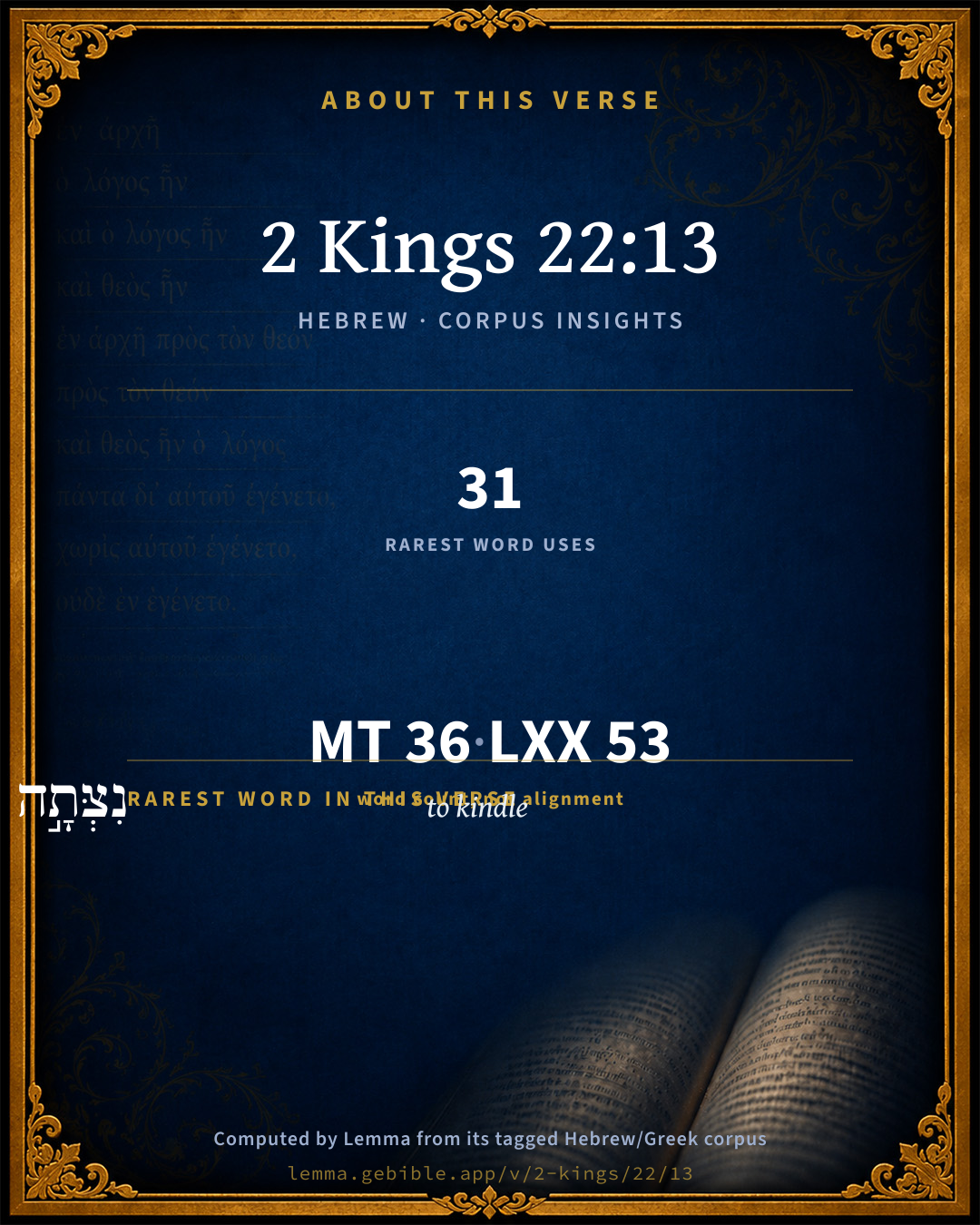
נִצְּתָ֣ה to kindle H3341 occurs in 28 verses of the Hebrew Bible. Also found in:

Grammatical profile

  • 7 verbs
  • 12 nouns
  • 1 adjective
  • 3 pronouns
  • 8 prepositions
  • 1 conjunction
  • 4 particles

Verb forms

  • לְכוּ֩ Qal · Imperative
  • דִרְשׁ֨וּ Qal · Imperative
  • הַנִּמְצָ֖א Niphal · Participle Active
  • נִצְּתָ֣ה Niphal · Perfect
  • שָׁמְע֜וּ Qal · Perfect
  • לַעֲשׂ֖וֹת Qal · Infinitive Construct
  • הַכָּת֥וּב Qal · Participle Passive

Repetition

Words recur within this verse — often emphatic in Hebrew:

  • עַל upon H5921 ×4
  • בַּעֲדִ֣י behind H1157 ×3
  • יְהוָ֜ה LORD H3068 ×2
  • כָּל all H3605 ×2
  • דִּבְרֵ֛י word H1697 ×2
  • הַסֵּ֥פֶר book H5612 ×2
  • הַזֶּ֑ה this H2088 ×2
  • אֲשֶׁר which H834 ×2

Hebrew & Septuagint length

In English translation the verse runs 59 words from the Hebrew and 62 from the Septuagint (LXX English) — closely comparable.

A rough comparison of the two English renderings, which tokenize alike — not a word-level alignment.

Word counts can differ between the Hebrew and the Greek without any difference in meaning — e.g. the Hebrew direct-object marker אֵת has no separate Greek word, and Greek often adds the article ὁ.

In the original languages it is 36 Hebrew tokens and 53 Greek tokens — but the two are counted differently (Hebrew bundles its prefixes and suffixes into one token; the Greek is in lemma form), so that isn’t a like-for-like length.

Cross-references

31

Topical passages linked to 2 Kings 22:13 in the Treasury of Scripture Knowledge — connected by theme and wording, ordered by reader-vote popularity; previews shown in the World English Bible.

  • Exodus 20:5 you shall not bow yourself down to them, nor serve them, for I, Yahweh your God, am a jealous God, visiting the iniquity of the fathers on the children, on the third and on the fourth generation of those who hate me,
  • Deuteronomy 4:23–27 Take heed to yourselves, lest you forget the covenant of Yahweh your God, which he made with you, and make you an engraved image in the form of anything which Yahweh your God has forbidden you.
  • Deuteronomy 29:23–28 [and that] the whole land of it is sulfur, and salt, [and] a burning, [that] it is not sown, nor bears, nor any grass grows therein, like the overthrow of Sodom and Gomorrah, Admah and Zeboiim, which Yahweh overthrew in his anger, and in his wrath:
  • Deuteronomy 31:17–18 Then my anger shall be kindled against them in that day, and I will forsake them, and I will hide my face from them, and they shall be devoured, and many evils and troubles shall come on them; so that they will say in that day, Haven't these evils come on us because our God is not among us?
  • Nehemiah 9:3 They stood up in their place, and read in the book of the law of Yahweh their God a fourth part of the day; and [another] fourth part they confessed, and worshiped Yahweh their God.
  • Jeremiah 37:17 Then Zedekiah the king sent, and fetched him: and the king asked him secretly in his house, and said, Is there any word from Yahweh? Jeremiah said, There is. He said also, You shall be delivered into the hand of the king of Babylon.
  • James 1:22–25 But be doers of the word, and not only hearers, deluding your own selves.
  • 1 Kings 22:7–8 But Jehoshaphat said, Isn't there here a prophet of Yahweh besides, that we may inquire of him?
  • 2 Kings 3:11 But Jehoshaphat said, Isn't there here a prophet of Yahweh, that we may inquire of Yahweh by him? One of the king of Israel's servants answered, Elisha the son of Shaphat is here, who poured water on the hands of Elijah.
  • 1 Chronicles 10:13–14 So Saul died for his trespass which he committed against Yahweh, because of the word of Yahweh, which he didn't keep; and also because he asked counsel of one who had a familiar spirit, to inquire [thereby],
  • 2 Chronicles 29:6 For our fathers have trespassed, and done that which was evil in the sight of Yahweh our God, and have forsaken him, and have turned away their faces from the habitation of Yahweh, and turned their backs.
  • 2 Chronicles 34:21 Go you, inquire of Yahweh for me, and for those who are left in Israel and in Judah, concerning the words of the book that is found; for great is the wrath of Yahweh that is poured out on us, because our fathers have not kept the word of Yahweh, to do according to all that is written in this book.
  • Nehemiah 8:8–9 They read in the book, in the law of God, distinctly; and they gave the sense, so that they understood the reading.
  • Psalms 25:14 The friendship of Yahweh is with those who fear him. He will show them his covenant.
  • Psalms 76:7 You, even you, are to be feared. Who can stand in your sight when you are angry?
  • Psalms 106:6 We have sinned with our fathers. We have committed iniquity. We have done wickedly.
  • Proverbs 3:6 In all your ways acknowledge him, And he will direct your paths.
  • Jeremiah 16:12 and you have done evil more than your fathers; for, behold, you walk every one after the stubbornness of his evil heart, so that you don't listen to me:
  • Jeremiah 21:1–2 The word which came to Jeremiah from Yahweh, when king Zedekiah sent to him Pashhur the son of Malchijah, and Zephaniah the son of Maaseiah, the priest, saying,
  • Jeremiah 44:17 But we will certainly perform every word that is gone forth out of our mouth, to burn incense to the queen of the sky, and to pour out drink-offerings to her, as we have done, we and our fathers, our kings and our princes, in the cities of Judah, and in the streets of Jerusalem; for then had we plenty of food, and were well, and saw no evil.
  • Lamentations 5:7 Our fathers sinned, and are no more; We have borne their iniquities.
  • Ezekiel 14:3–4 Son of man, these men have taken their idols into their heart, and put the stumbling block of their iniquity before their face: should I be inquired of at all by them?
  • Ezekiel 20:1–3 It happened in the seventh year, in the fifth [month], the tenth [day] of the month, that certain of the elders of Israel came to inquire of Yahweh, and sat before me.
  • Daniel 9:5–8 we have sinned, and have dealt perversely, and have done wickedly, and have rebelled, even turning aside from your precepts and from your ordinances;
  • Daniel 9:10 neither have we obeyed the voice of Yahweh our God, to walk in his laws, which he set before us by his servants the prophets.
  • Amos 3:7 Surely the Lord Yahweh will do nothing, Unless he reveals his secret to his servants the prophets.
  • Nahum 1:6 Who can stand before his indignation? Who can endure the fierceness of his anger? His wrath is poured out like fire, and the rocks are broken apart by him.
  • Romans 3:20 Because by the works of the law, no flesh will be justified in his sight. For through the law comes the knowledge of sin.
  • Romans 4:15 For the law works wrath, for where there is no law, neither is there disobedience.
  • Romans 7:9 I was alive apart from the law once, but when the commandment came, sin revived, and I died.
  • Revelation 6:17 for the great day of his wrath has come; and who is able to stand?"

Cross-references courtesy of OpenBible.info (CC BY 4.0).

Hebrew and Greek witnesses Masoretic Hebrew ↔ Greek Septuagint

The same verse in the two great witnesses to the Old Testament, shown verse-for-verse.

These are two independent witnesses, not word-aligned to each other, and the Septuagint is shown in lemma (dictionary) form.

Hebrew 2 Kings 22:13 Masoretic · Westminster Leningrad Codex

לְכוּ֩ דִרְשׁ֨וּ אֶת יְהוָ֜ה בַּעֲדִ֣י וּבְעַד הָעָ֗ם וּבְעַד֙ כָּל יְהוּדָ֔ה עַל דִּבְרֵ֛י הַסֵּ֥פֶר הַנִּמְצָ֖א הַזֶּ֑ה כִּֽי גְדוֹלָ֞ה חֲמַ֣ת יְהוָ֗ה אֲשֶׁר הִיא֙ נִצְּתָ֣ה בָ֔נוּ עַל֩ אֲשֶׁ֨ר לֹֽא שָׁמְע֜וּ אֲבֹתֵ֗ינוּ עַל דִּבְרֵי֙ הַסֵּ֣פֶר הַזֶּ֔ה לַעֲשׂ֖וֹת כְּכָל הַכָּת֥וּב עָלֵֽינוּ

Go you, inquire of Yahweh for me, and for the people, and for all Judah, concerning the words of this book that is found; for great is the wrath of Yahweh that is kindled against us, because our fathers have not listened to the words of this book, to do according to all that which is written concerning us.

World English Bible · Public Domain

Greek LXX 2 Kings 22:13 Septuagint · lemma form

δεῦτε ἐκζητέω ὁ κύριος περί ἐγώ καί περί πᾶς ὁ λαός καί περί πᾶς ὁ ιουδα περί ὁ λόγος ὁ βιβλίον ὁ εὑρίσκω οὗτος ὅτι μέγας ὁ ὀργή κύριος ὁ ἐκκαίω ἐν ἐγώ ὑπέρ ὅς οὐ ἀκούω ὁ πατήρ ἐγώ ὁ λόγος ὁ βιβλίον οὗτος ὁ ποιέω κατά πᾶς ὁ γράφω κατά ἐγώ

Go, enquire of the Lord for me, and for all the people, and for all Juda, and concerning the words of this book that has been found: for the wrath of the Lord that has been kindled against us is great, because our fathers listened not to the words of this book, to do according to all the things written concerning us.

LXX2012 (modern English Septuagint) · Public Domain

Hebrew: Westminster Leningrad Codex (CC BY 4.0). Greek: Septuagint (public domain); English from LXX2012 (modern English Septuagint) (Public Domain). How the Septuagint differs from the Hebrew →

Targum (Aramaic paraphrase)

1

The Targum is the ancient Jewish Aramaic paraphrase of the Hebrew Scriptures — an interpretive translation, not the Hebrew text itself. Onkelos (literal) and Pseudo-Jonathan (expansive) render the Torah, and Jonathan the Prophets. Coverage is partial: where no permissively-licensed English translation exists for a verse, only the Aramaic is shown. This is verse-level text, not a word-by-word alignment to the Hebrew.

  1. Targum Jonathan Prophets (Joshua–Malachi)
    אֱזִילוּ תְבַעוּ מִן קֳדָם יְיָ עֲלֵי וְעַל עַמָא וְעַל כָּל דְבֵית יְהוּדָה עַל פִּתְגָמֵי סִפְרָא דְאִשְׁתְּכַח הָדֵין אֲרֵי סַגִיאָה חֵימְתָא דַייָ דְהִיא דְלִיקַת בָּנָא עַל דְלָא קַבִּילוּ אֲבָהָתָנָא לְפִתְגָמֵי סִפְרָא הָדֵין לְמֶעְבַּד כְּכָל דִכְתִיב עֲלָנָא:

    (no public-domain English translation for this verse)

    Targum Jonathan — Aramaic: “Mikraot Gedolot” (public domain). English: “Sefaria Community Translation” (CC0 1.0 (public-domain dedication)); “London "Chaldee Paraphrase," 1871” (public domain). Text via Sefaria.

Commentary

Notes on 2 Kings 22:13 from classic Christian and Jewish commentators (each source and its license shown beneath its notes). The classic Christian expositions comment on the surrounding passage and are grouped to its opening verse, so a note may address several verses; the Jewish commentaries on the Tanakh (Rashi and others) are per-verse, so they appear only where the commentator wrote on this verse.

Lemma curates 59 commentaries, every one of them public domain or Creative Commons licensed, each selected and text-cleaned for this edition rather than reprinted as found. About our sources →

Trapp's Complete Commentary

John Trapp

2Ki 22:13 Go ye, enquire of the LORD for me, and for the people, and for all Judah, concerning the words of this book that is found: for great [is] the wrath of the LORD that is kindled against us, because our fathers have not hearkened unto the words of this book, to do according unto all that which is written concerning us.

Ver. 13. For great is the wrath of the Lord.] A good heart trembleth at God’s judgments whilst they yet hang in the threatenings; {Isa 66:2} when carnal people put off all with a "God forbid," {Luk 20:16} and bless themselves, though God curse them. {Deu 29:19-20}

John Trapp, A Commentary or Exposition upon All the Books of the Old and New Testament (1647–1656) — public domain. Text from a community e-Sword module.

Geneva Bible (1599)

Geneva Bible translators

Meaning, to some Prophet whom God revealeth the knowledge of things unto, as Jer. 21:8, though at other times they inquired the Lord by Urim and Thummim.

Geneva Bible (1599) marginal notes — public domain. Text via Bolls.life.

Ellicott's Commentary for English Readers

(13) Enquire of the Lord.—Or, seek ye Jehovah. Josiah wished to know whether any hope remained for himself and his people, or whether the vengeance must fall speedily.

For the people.—Of Jerusalem.

Written concerning us.—Thenius conjectures written therein, a slight change in the Hebrew. But Josiah identifies the people and their fathers as one nation. (Comp. also Exo_20:5.) However Chronicles has “in this book,” and the Arabic here “in it.”

A Bible Commentary for English Readers, edited by Charles John Ellicott (1878–1897) — public domain. Text from a community e-Sword module.

The Cambridge Bible for Schools and Colleges

gen. ed. J. J. S. Perowne

13. our fathers have not hearkened] The two reigns of Manasseh and Amon had led the whole people away to idolatry. Of the former of these kings it is said (2Ki_12:11) ‘He hath made Judah also to sin with his idols’. For two generations at the least the retrospect of king Josiah was a very dark one.

The Cambridge Bible for Schools and Colleges (gen. ed. J. J. S. Perowne; Cambridge University Press, 1878–1918) — public domain. Text from a community e-Sword module.

John Gill's Exposition

Go ye, inquire of the Lord,.... Of some of his prophets, as Jeremiah, who began to prophesy in the thirteenth year of Josiah's reign, and had been a prophet five years, Jer 1:1,

for me, and for the people, and for all Judah, concerning the words of this book that is found; for he observed that this book threatened and foretold not only the captivity of the ten tribes, but of Judah, and of their king; and Jarchi thinks, he had a particular respect to that passage:

the Lord shall bring thee and thy king, &c. Deu 28:36 and therefore was desirous of knowing what he and his people must do to avert those judgments:

for great is the wrath of the Lord that is kindled against us; which he concluded from the threatenings denounced:

because that our fathers have not hearkened unto the words of this book, to do according to all which is written concerning us: he clearly saw that his ancestors more remote and immediate had been very deficient in observing the laws, commands, and ordinances enjoined them in that book; and therefore feared that what was threatened would fall upon him and his people, who, he was sensible, came short of doing their duty.

John Gill's Exposition of the Whole Bible (1746–1763) — public domain (CC PDM 1.0). Text via the HelloAO Bible API.

Albert Barnes' Notes on the Bible

Enquire of the Lord - As inquiry by Urim and Thummim had ceased - apparently because superseded by prophecy - this order was equivalent to an injunction to seek the presence of a prophet (compare 2Ki 3:11; 1Ki 22:5).

Because our fathers have not hearkened - Josiah, it will be observed, assumes that preceding generations had had full opportunity of hearing and knowing the Law. He thus regards the loss as comparatively recent (compare 2Ki 22:8 note).

Albert Barnes' Notes on the Bible (1834–1885) — public domain. Text from a community e-Sword/MySword module.

Matthew Poole's English Annotations

Inquire of the Lord; either what he intends to do with us, or what we shall do to him, to appease his wrath.

Concerning the words of this book; whether the curses here threatened must come upon us without remedy, or whether there be hope in Israel concerning the prevention of them.

Matthew Poole's English Annotations on the Holy Bible (1683–1685) — public domain. Text from a community e-Sword/MySword module.

Whedon's Commentary on the Bible

Daniel D. Whedon

13. Inquire of the Lord for me — He does not instruct them where to go, or say whether they shall inquire by urim or by the prophets. He assumes that they know better where to go than he.

Concerning the words of this book — Not whether it were really the book of the law of Moses, and its words to be credited, for he had no doubt of this when he rent his clothes, (2Ki_22:11; 2Ki_22:19,) but to know whether the words of the book are to be immediately fulfilled, and what he is to do and expect under the fearful state of things that has come upon the nation for its sins.

Daniel D. Whedon (gen. ed.), Commentary on the Old and New Testaments (1874–1909) — public domain. Text from a community e-Sword module.

The Pulpit Commentary

Go ye, inquire of the Lord for me. Inquiry of the Lord, which from the time of Moses to that of David was ordinarily "by Urim and Thummim," was after David"s time always made by the consultation of a prophet (see 1Ki_22:5-8; 2Ki_3:11 2Ki_8:8; Jer_21:2 Jer_37:7; Eze_14:7 Eze_20:1, etc.) The officers, therefore, understood the king to mean that they were to seek out a prophet (see ver. 14), and so make the inquiry. And for the people, and for all Judah the threats read in the king"s ears were probably those of Deu_28:15-68 or Lev_26:16-39, which extended to the whole people concerning the words of this book that is found. Not "whether they are authentic, whether they are really the words of Moses" (Duneker), for of that Josiah appears to have had no doubt; but whether they are words that are to have an immediate fulfillment, "whether," as Yon Gerlach says, "the measure of sin is already full, or whether there is yet hope of grace?" (compare Huldah"s answer in vers. 16-20, which shows what she understood the king"s inquiry to be). For great is the wrath of the Lord that is kindled against us. Josiah recognized that Judah had done, and was still doing, exactly those things against which the threatenings of the Law were directed bad forsaken Jehovah and gone after other gods, and made to themselves high places, and set up images, and done after the customs of the nations whom the Lord had cast out before them. He could not, therefore, doubt but that the wrath of the Lord "was kindled;" but would it blaze forth at once? Because our fathers have not hearkened unto the words of this book, to do according unto all that which is written concerning us. Josiah assumes that their fathers have had the book, and might have known its words, either because he conceives that it had not been very long lost, or because he regards them as having possessed other copies.

The Pulpit Commentary (1880–1919), ed. H.D.M. Spence-Jones & Joseph S. Exell — public domain. Text from a community e-Sword module.

John Wesley's Explanatory Notes

Inquire - What we shall do to appease his wrath, and whether the curses here threatened must come upon us without remedy, or whether there be hope in Israel concerning the prevention of them.

John Wesley, Explanatory Notes Upon the Whole Bible (1754–1765) — public domain. Text via the GEBible commentary corpus.

Keil & Delitzsch

C. F. Keil & F. Delitzsch

From the commission, "Inquire ye of Jehovah for me and for the people and for all Judah (i.e., the whole kingdom) concerning the words of this book of the law that has been found, for great is the wrath of the Lord which has been kindled against us, because our fathers have not heard ...," we may infer that the curses of the law upon the despisers of the commandments of God in Lev 26; Deu 28:1, and other passages, had been read to the king. את־יי דּרשׁ means to inquire the will of the Lord, what He has determined concerning the king, his people, and the kingdom. על שׁמע signifies here to hearken to anything, to observe it, for which אל is used elsewhere. על כּתב, to prescribe for performance. עלינוּ, "prescribed for us," is quite appropriate, since the law was not only given to the fathers to obey, but also to the existing generation-a fact which Thenius has overlooked with his conjecture עליו. To render the king's alarm and his fear of severe judgments from God intelligible, there is no need for the far-fetched and extremely precarious hypothesis, that just at that time the Scythians had invaded and devastated the land.

Keil & Delitzsch — Biblical Commentary on the Old Testament (1861–1891) — public domain (CC PDM 1.0). Text via the HelloAO Bible API. (Old Testament only.)

Rashi

Rabbi Shlomo Yitzchaki (Rashi)

Inquire of Adonoy on my behalf. He saw written, "Adonoy will lead you and your king."

Rashi on the Tanakh — English translations: “The Judaica Press complete Tanach with Rashi, translated by A. J. Rosenberg” (CC BY 4.0); “Pentateuch with Rashi's commentary by M. Rosenbaum and A.M. Silbermann, 1929-1934” (public domain); “The Metsudah Tanach series, Lakewood, N.J” (CC BY 4.0); and “The Book of Joshua, Metsudah Publications, 1997” (CC BY 4.0). Text via Sefaria.

Lesson kit

Teaching starters — assembled from the data on this page, not authored interpretation. Every prompt links to the verse data it draws on. Edit before teaching.

2 Kings, in the Historical, opens this verse with 36 words (24 distinct Hebrew lemmas). Its most distinctive word is yâtsath (“to kindle”). A historical commentator’s framing appears above. Read the whole chapter for the surrounding context.

Discussion questions

  1. The word yâtsath carries the sense “to kindle.” How does it shape the verse?
  2. Joshua 8:8 shares the word «to kindle» with this verse. How do the two illuminate each other?
  3. “upon” occurs 4× in this one verse. What is the effect of the repetition?
  4. These translations render this verse differently; the difference is in the English rendering, not the original. What questions does that raise?
  5. The verb «לְכוּ֩» is Qal Imperative. How does its form color the action?
  6. Reading how Trapp's Complete Commentary and Geneva Bible (1599) read this verse, where do the two commentators agree and where do they part?

Things to notice

Reading settings

Reading text

Shown beneath each verse's original-language words.

Old Testament
Old Testament edition

Read the OT as the Masoretic Hebrew (MT) or the Greek Septuagint (LXX).

English shown for the Greek Septuagint (in the Hebrew ↔ Greek comparison).

Comparing translations? Open the Compare panel on any verse page to stack up to four side by side.