
Jeremiah 36:29

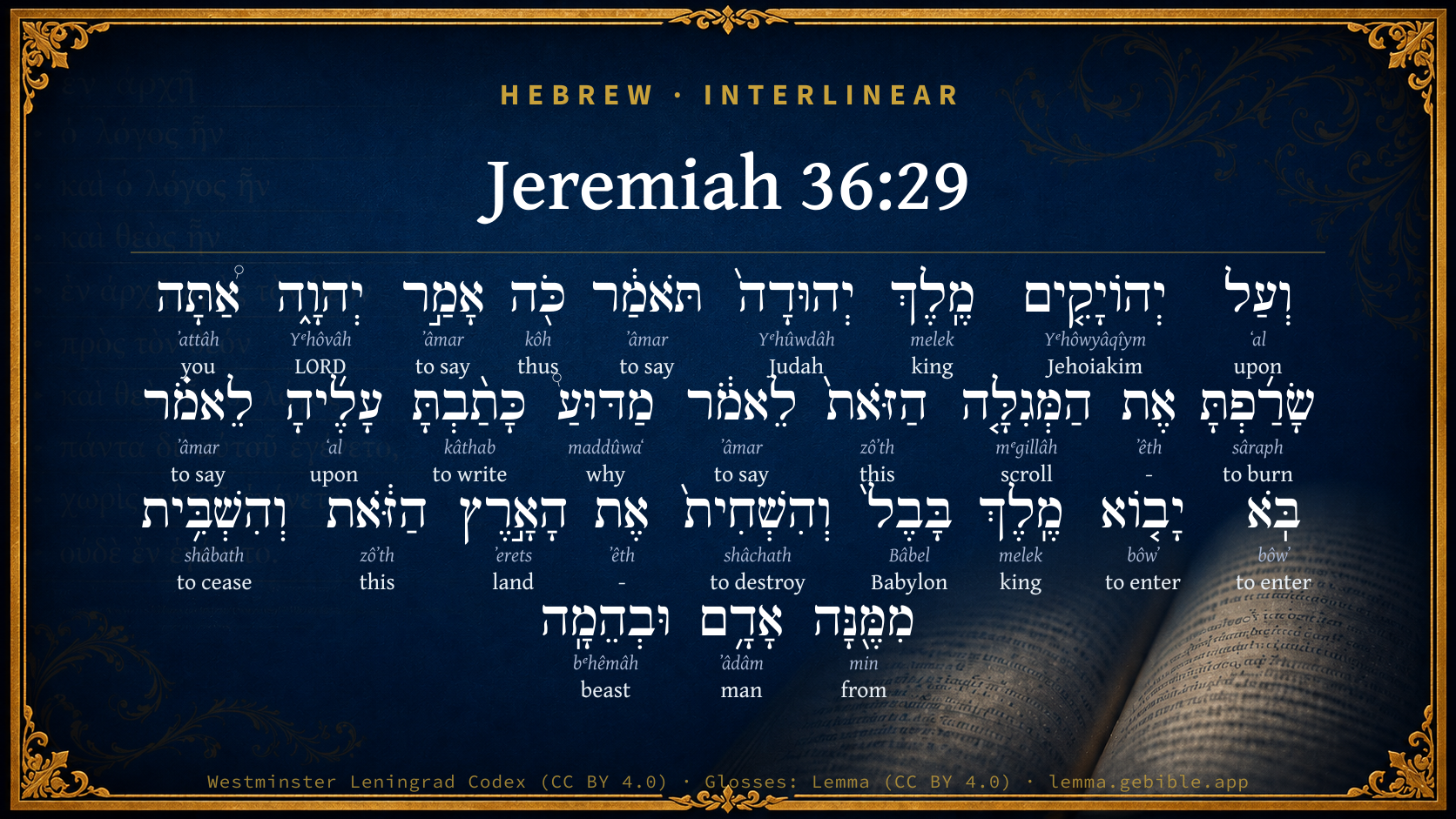
Hebrew (Westminster Leningrad Codex) Jeremiah 36:29 appears in the Hebrew Old Testament. The text above is from the Westminster Leningrad Codex. Each word links to its Strong’s number, a concise gloss, and parsing drawn from the Open Scriptures Hebrew Bible morphology. Click any word for its full Brown-Driver-Briggs (BDB) entry.
Download image
Cite this verse

Jeremiah 36:29 (World English Bible). Public Domain. Lemma interlinear Bible study tool, https://lemma.gebible.app/v/jeremiah/36/29.

Show BibTeX & RIS
BibTeX
RIS
English Translation
Concerning Jehoiakim king of Judah you shall say, Thus says Yahweh: You have burned this scroll, saying, Why have you written therein, saying, The king of Babylon shall certainly come and destroy this land, and shall cause to cease from there man and animal?
World English Bible · Public Domain
Download a study sheet

One document with this verse’s original text, its word-by-word gloss line, the meaning frame, cross-references with their text, attributed commentary, and full source and license credits — printable, and it pastes into notes with its structure intact.

This verse Autodidact and up

Study sheet (.html) Plain text (.txt)

A passage Seminary Student

Up to 50 verses in one chapter. A passage sheet keeps up to 6 commentary sources and 12 cross-references per verse, in the order this page ranks them, and says so on the sheet whenever that leaves anything out. Ask for a single verse and you get the Autodidact verse sheet above.

Everything on this page stays free to read, with no account — the sheet is a download of what is already on screen, not access to it.

Want to remove ads? Support Godless Engineer
Compare translations 3

The same verse in 3 English versions, stacked beneath the original-language interlinear above. Click any original word for its lexicon entry.

Each is an independent rendering of the whole verse — the interlinear is not word-aligned to these translations.

Highlighted words mark where these versions differ — a whole-verse word diff, not a word-by-word alignment.

  • World English Bible Public Domain
    Concerning Jehoiakim king of Judah you shall say, Thus says Yahweh: You have burned this scroll, saying, Why have you written therein, saying, The king of Babylon shall certainly come and destroy this land, and shall cause to cease from there man and animal?
  • King James Version Public Domain
    And thou shalt say to Jehoiakim king of Judah, Thus saith the LORD; Thou hast burned this roll, saying, Why hast thou written therein, saying, The king of Babylon shall certainly come and destroy this land, and shall cause to cease from thence man and beast?
  • unfoldingWord Literal Text CC BY-SA 4.0
    Then you must say this to Jehoiakim king of Judah: ‘You burned that scroll, saying, “Why have you written on it, ‘The king of Babylon will certainly come and destroy this land, for he will destroy both man and beast in it’?”’”

unfoldingWord Literal Text — © unfoldingWord, licensed CC BY-SA 4.0. Word-aligned USFM3 via Door43 (git.door43.org/unfoldingWord/en_ult).

Versions to compare (up to 4)

3 of 4 selected

Show all 18 translations

Every available English version of this verse, each an independent rendering of the whole verse.

  • World English Bible Public Domain
    Concerning Jehoiakim king of Judah you shall say, Thus says Yahweh: You have burned this scroll, saying, Why have you written therein, saying, The king of Babylon shall certainly come and destroy this land, and shall cause to cease from there man and animal?
  • Berean Standard Bible Public Domain
    You are to proclaim concerning Jehoiakim king of Judah that this is what the LORD says: You have burned the scroll and said, ‘Why have you written on it that the king of Babylon would surely come and destroy this land and deprive it of man and beast?’
  • Majority Standard Bible Public Domain
    You are to proclaim concerning Jehoiakim king of Judah that this is what the LORD says: You have burned the scroll and said, ‘Why have you written on it that the king of Babylon would surely come and destroy this land and deprive it of man and beast?’
  • King James Version Public Domain
    And thou shalt say to Jehoiakim king of Judah, Thus saith the LORD; Thou hast burned this roll, saying, Why hast thou written therein, saying, The king of Babylon shall certainly come and destroy this land, and shall cause to cease from thence man and beast?
  • American Standard Version (1901) Public Domain
    And concerning Jehoiakim king of Judah thou shalt say, Thus saith Jehovah: Thou hast burned this roll, saying, Why hast thou written therein, saying, The king of Babylon shall certainly come and destroy this land, and shall cause to cease from thence man and beast?
  • Revised Version (1885) Public Domain
    And concerning Jehoiakim king of Judah thou shalt say, Thus saith the LORD: Thou hast burned this roll, saying, Why hast thou written therein, saying, The king of Babylon shall certainly come and destroy this land, and shall cause to cease from thence man and beast?
  • Geneva Bible (1599) Public Domain
    And thou shalt say to Iehoiakim King of Iudah, Thus saith the Lord, Thou hast burnt this roule, saying, Why hast thou written therein, saying, that the King of Babel shall certainly come and destroye this land, and shall take thence both man and beast?
  • Douay-Rheims (1899) Public Domain
    And thou shalt say to Joakim the king of Juda: Thus saith the Lord: Thou hast burnt that volume, saying: Why hast thou written therein, and said: The king of Babylon shall come speedily, and shall lay waste this land: and shall cause to cease from thence man and beast?
  • Young's Literal Translation Public Domain
    and unto Jehoiakim king of Judah thou dost say: Thus said Jehovah, Thou hast burnt this roll, saying, Wherefore hast thou written on it, saying, The king of Babylon surely cometh in, and hath destroyed this land, and caused to cease from it man and beast?
  • Literal Standard Version CC BY-SA 4.0
    and say to Jehoiakim king of Judah, Thus said YHWH: You have burned this scroll, saying, Why have you written on it, saying, The king of Babylon surely comes in, and has destroyed this land, and caused man and beast to cease from it?
  • Unlocked Literal Bible CC BY-SA 4.0
    Then you must say this to Jehoiakim king of Judah: 'You burned that scroll, saying, “Why have you written on it, 'The king of Babylon will certainly come and destroy this land, for he will destroy both man and beast in it'?”'”
  • unfoldingWord Literal Text CC BY-SA 4.0
    Then you must say this to Jehoiakim king of Judah: ‘You burned that scroll, saying, “Why have you written on it, ‘The king of Babylon will certainly come and destroy this land, for he will destroy both man and beast in it’?”’”
  • Darby Bible Public Domain
    And thou shalt say to Jehoiakim king of Judah, Thus saith Jehovah: Thou hast burned this roll, saying, Why hast thou written therein, saying, The king of Babylon shall certainly come and destroy this land, and shall cause to cease from it man and beast?
  • World Messianic Bible Public Domain
    Concerning Jehoiakim king of Judah you shall say, ‘The LORD says: “You have burned this scroll, saying, ‘Why have you written therein, saying, “The king of Babylon will certainly come and destroy this land, and will cause to cease from there man and animal”?’”
  • Webster's Bible Public Domain
    And thou shalt say to Jehoiakim king of Judah, Thus saith the LORD; Thou hast burned this roll, saying, Why hast thou written therein, saying, The king of Babylon shall certainly come and destroy this land, and shall cause to cease from thence man and beast?
  • Free Bible Version CC BY-SA 4.0
    Regarding Jehoiakim king of Judah announce that this is what the Lord says: You have burned the scroll and asked, “Why did you write that the king of Babylon is going to come and destroy this country and kill all its people and animals?”
  • Bible in Basic English Public Domain
    And about Jehoiakim, king of Judah, you are to say, This is what the Lord has said: You have put this book into the fire, saying, Why have you put in it that the king of Babylon will certainly come, causing the destruction of this land and putting an end to every man and beast in it?
  • JPS Tanakh (1917) Public Domain
    And concerning Jehoiakim king of Judah thou shalt say: Thus saith the LORD: Thou hast burned this roll, saying: Why hast thou written therein, saying: The king of Babylon shall certainly come and destroy this land, and shall cause to cease from thence man and beast?

Literal Standard Version (2020), Covenant Press — licensed CC BY-SA 4.0. Text via the HelloAO Bible API (eBible.org). Unlocked Literal Bible (unfoldingWord) — licensed CC BY-SA 4.0. Text via the HelloAO Bible API (eBible.org). unfoldingWord Literal Text — © unfoldingWord, licensed CC BY-SA 4.0. Word-aligned USFM3 via Door43 (git.door43.org/unfoldingWord/en_ult). Free Bible Version, Dr. Jonathan Gallagher — licensed CC BY-SA 4.0. Text via the HelloAO Bible API (eBible.org).

Word by word

More ways to search: Search by grammar → Find every occurrence → Compare this word →

Practice this passage: Drill this verse → Learn its vocabulary →

הַמְּגִלָּ֤ה
mᵉgillâh
H4039
“the · scroll”
Particle, Definite Article + Noun, Common, Feminine, Singular, Absolute
Part of Speech
Particle + Noun
Type
Common
Gender
Feminine
Number
Singular
State
Absolute
Full BDB Definition

Origin: from H1556

TWOT: 353m

roll, book, writing
  1. וְעַל ʻal H5921 “and · upon” Conjunction + Preposition
  2. יְהוֹיָקִ֤ים Yᵉhôwyâqîym H3079 “Jehoiakim” Noun, Proper
  3. מֶֽלֶךְ melek H4428 “king of” Noun, Common, Masculine, Singular, Construct
  4. יְהוּדָה֙ Yᵉhûwdâh H3063 “Judah” Noun, Proper
  5. תֹּאמַ֔ר ʼâmar H559 “to say” Verb, Qal, Imperfect, 2nd Person, Masculine, Singular
  6. כֹּ֖ה kôh H3541 “thus” Adverb
  7. אָמַ֣ר ʼâmar H559 “to say” Verb, Qal, Perfect, 3rd Person, Masculine, Singular
  8. יְהוָ֑ה Yᵉhôvâh H3068 “LORD” Noun, Proper
  9. אַ֠תָּה ʼattâh H859 “you” Pronoun, Personal, 2nd Person, Masculine, Singular
  10. שָׂרַ֜פְתָּ sâraph H8313 “to burn” Verb, Qal, Perfect, 2nd Person, Masculine, Singular
  11. אֶת ʼêth H853 “-” Particle, Direct Object
  12. הַזֹּאת֙ zôʼth H2063 “the · this” Particle, Definite Article + Pronoun, Demonstrative, Feminine, Singular
  13. לֵאמֹ֔ר ʼâmar H559 “to say” Preposition + Verb, Qal, Infinitive Construct
  14. מַדּוּעַ֩ maddûwaʻ H4069 “why” Particle, Interrogative
  15. כָּתַ֨בְתָּ kâthab H3789 “to write” Verb, Qal, Perfect, 2nd Person, Masculine, Singular
  16. עָלֶ֜יהָ ʻal H5921 “upon · her” Preposition + Suffix, Personal, 3rd Person, Feminine, Singular
  17. לֵאמֹ֗ר ʼâmar H559 “to say” Preposition + Verb, Qal, Infinitive Construct
  18. בֹּֽא bôwʼ H935 “to enter” Verb, Qal, Infinitive Absolute
  19. יָב֤וֹא bôwʼ H935 “to enter” Verb, Qal, Imperfect, 3rd Person, Masculine, Singular
  20. מֶֽלֶךְ melek H4428 “king of” Noun, Common, Masculine, Singular, Construct
  21. בָּבֶל֙ Bâbel H894 “Babylon” Noun, Proper
  22. וְהִשְׁחִית֙ shâchath H7843 “and · to destroy” Conjunction + Verb, Hiphil, Sequential Perfect, 3rd Person, Masculine, Singular
  23. אֶת ʼêth H853 “-” Particle, Direct Object
  24. הָאָ֣רֶץ ʼerets H776 “the · land” Particle, Definite Article + Noun, Common, Both, Singular, Absolute
  25. הַזֹּ֔את zôʼth H2063 “the · this” Particle, Definite Article + Pronoun, Demonstrative, Feminine, Singular
  26. וְהִשְׁבִּ֥ית shâbath H7673 “and · to cease” Conjunction + Verb, Hiphil, Sequential Perfect, 3rd Person, Masculine, Singular
  27. מִמֶּ֖נָּה min H4480 “from · her” Preposition + Suffix, Personal, 3rd Person, Feminine, Singular
  28. אָדָ֥ם ʼâdâm H120 “man” Noun, Common, Masculine, Singular, Absolute
  29. וּבְהֵמָֽה bᵉhêmâh H929 “and · beast” Conjunction + Noun, Common, Feminine, Singular, Absolute

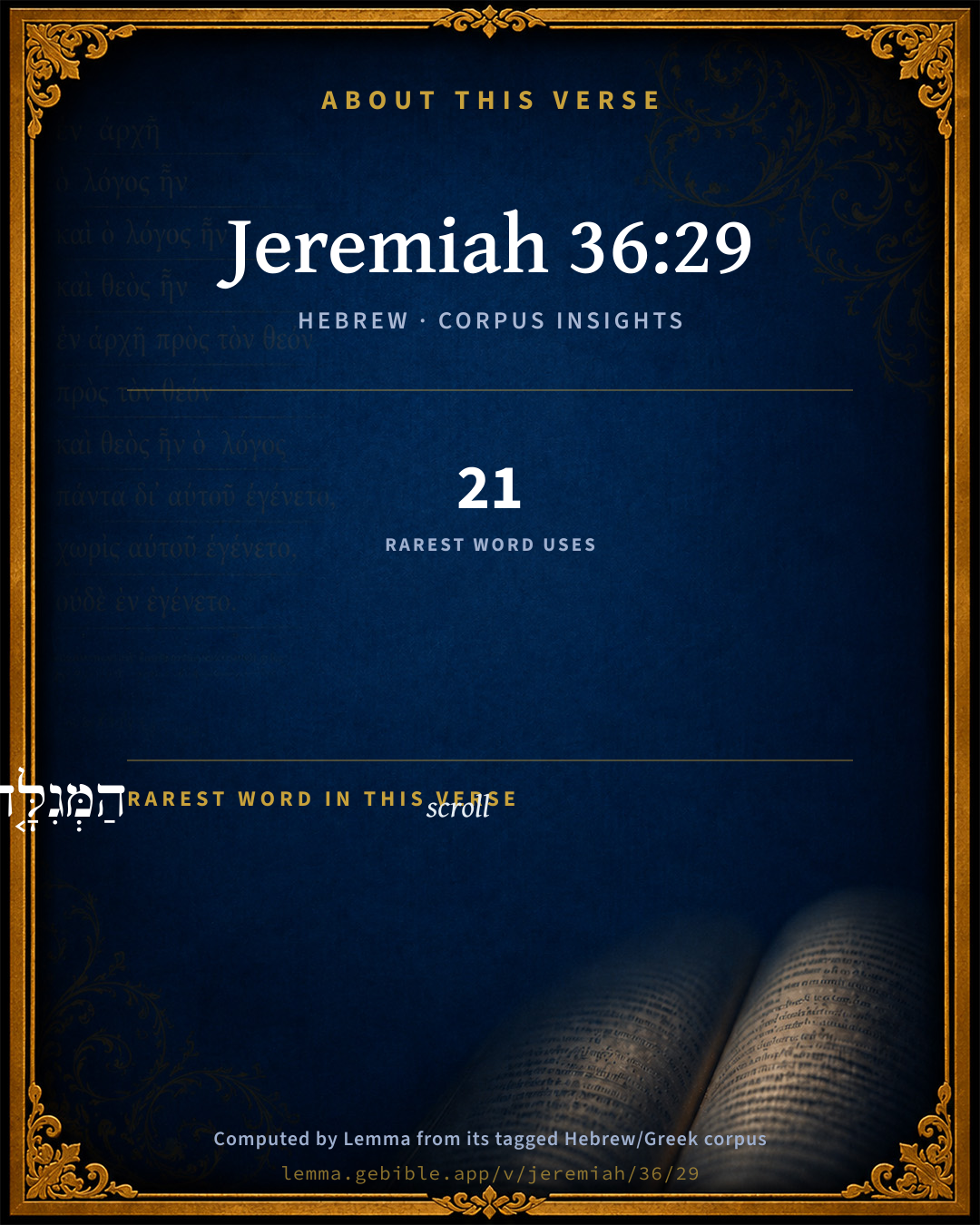
About this verse

These counts appear in no published source. They are computed here, from the morphology-tagged text and Lemma’s own curated glosses. What Lemma adds →

30
words
22
distinct lemmas
Prophets
section

Notable vocabulary

The rarest word here is הַמְּגִלָּ֤ה scroll H4039 — appearing just 21 times in the whole Hebrew Bible.

Shared distinctive vocabulary

הַמְּגִלָּ֤ה scroll H4039 occurs in 19 verses of the Hebrew Bible. Also found in:

Grammatical profile

  • 10 verbs
  • 10 nouns
  • 3 pronouns
  • 3 prepositions
  • 1 adverb
  • 3 particles

Verb forms

  • תֹּאמַ֔ר Qal · Imperfect
  • אָמַ֣ר Qal · Perfect
  • שָׂרַ֜פְתָּ Qal · Perfect
  • לֵאמֹ֔ר Qal · Infinitive Construct
  • כָּתַ֨בְתָּ Qal · Perfect
  • לֵאמֹ֗ר Qal · Infinitive Construct
  • בֹּֽא Qal · Infinitive Absolute
  • יָב֤וֹא Qal · Imperfect
  • וְהִשְׁחִית֙ Hiphil · Sequential Perfect
  • וְהִשְׁבִּ֥ית Hiphil · Sequential Perfect

Repetition

Words recur within this verse — often emphatic in Hebrew:

  • תֹּאמַ֔ר to say H559 ×4
  • וְעַל upon H5921 ×2
  • מֶֽלֶךְ king H4428 ×2
  • בֹּֽא to enter H935 ×2
  • הַזֹּאת֙ this H2063 ×2

Cross-references

16

Topical passages linked to Jeremiah 36:29 in the Treasury of Scripture Knowledge — connected by theme and wording, ordered by reader-vote popularity; previews shown in the World English Bible.

  • Isaiah 30:10 who tell the seers, "Don't see;" and to the prophets, "Don't prophesy to us right things, speak to us smooth things, prophesy deceits,
  • Jeremiah 26:9 Why have you prophesied in the name of Yahweh, saying, This house shall be like Shiloh, and this city shall be desolate, without inhabitant? All the people were gathered to Jeremiah in the house of Yahweh.
  • Deuteronomy 29:19 and it happen, when he hears the words of this curse, that he bless himself in his heart, saying, I shall have peace, though I walk in the stubbornness of my heart, to destroy the moist with the dry.
  • Job 15:24 Distress and anguish make him afraid; They prevail against him, as a king ready to the battle.
  • Isaiah 29:21 that make a man an offender in [his] cause, and lay a snare for him who reproves in the gate, and turn aside the just with a thing of nothing.
  • Isaiah 45:9 Woe to him who strives with his Maker--a potsherd among the potsherds of the earth! Shall the clay ask him who fashions it, "What are you making?" or your work, "He has no hands?"
  • Jeremiah 32:3 For Zedekiah king of Judah had shut him up, saying, Why do you prophesy, and say, Thus says Yahweh, Behold, I will give this city into the hand of the king of Babylon, and he shall take it;
  • Job 40:8 Will you even annul my judgment? Will you condemn me, that you may be justified?
  • Jeremiah 21:4–7 Thus says Yahweh, the God of Israel, Behold, I will turn back the weapons of war that are in your hands, with which you fight against the king of Babylon, and against the Chaldeans who besiege you, without the walls; and I will gather them into the midst of this city.
  • Jeremiah 21:10 For I have set my face on this city for evil, and not for good, says Yahweh: it shall be given into the hand of the king of Babylon, and he shall burn it with fire.
  • Jeremiah 28:8 The prophets who have been before me and before you of old prophesied against many countries, and against great kingdoms, of war, and of evil, and of pestilence.
  • Jeremiah 32:28–30 Therefore thus says Yahweh: Behold, I will give this city into the hand of the Chaldeans, and into the hand of Nebuchadrezzar king of Babylon, and he shall take it:
  • Jeremiah 34:21–22 Zedekiah king of Judah and his princes will I give into the hand of their enemies, and into the hand of those who seek their life, and into the hand of the king of Babylon's army, who have gone away from you.
  • Acts 5:28 saying, "Didn't we strictly charge you not to teach in this name? Behold, you have filled Jerusalem with your teaching, and intend to bring this man's blood on us."
  • Acts 5:39 But if it is of God, you will not be able to overthrow it, and you would be found even to be fighting against God!"
  • 1 Corinthians 10:22 Or do we provoke the Lord to jealousy? Are we stronger than he?

Cross-references courtesy of OpenBible.info (CC BY 4.0).

Hebrew and Greek witnesses Masoretic Hebrew ↔ Greek Septuagint

The same verse in the two great witnesses to the Old Testament, shown verse-for-verse.

These are two independent witnesses, not word-aligned to each other, and the Septuagint is shown in lemma (dictionary) form.

Hebrew Jeremiah 36:29 Masoretic · Westminster Leningrad Codex

וְעַל יְהוֹיָקִ֤ים מֶֽלֶךְ יְהוּדָה֙ תֹּאמַ֔ר כֹּ֖ה אָמַ֣ר יְהוָ֑ה אַ֠תָּה שָׂרַ֜פְתָּ אֶת הַמְּגִלָּ֤ה הַזֹּאת֙ לֵאמֹ֔ר מַדּוּעַ֩ כָּתַ֨בְתָּ עָלֶ֜יהָ לֵאמֹ֗ר בֹּֽא יָב֤וֹא מֶֽלֶךְ בָּבֶל֙ וְהִשְׁחִית֙ אֶת הָאָ֣רֶץ הַזֹּ֔את וְהִשְׁבִּ֥ית מִמֶּ֖נָּה אָדָ֥ם וּבְהֵמָֽה

Concerning Jehoiakim king of Judah you shall say, Thus says Yahweh: You have burned this scroll, saying, Why have you written therein, saying, The king of Babylon shall certainly come and destroy this land, and shall cause to cease from there man and animal?

World English Bible · Public Domain

Greek LXX Structure differs

In the Septuagint, Jeremiah is about an eighth shorter than the Hebrew and arranges its material differently — the Oracles Against the Nations (Hebrew chapters 46–51) appear in the middle of the Greek book, after 25:13. Because the chapter and verse boundaries do not line up, a verse-for-verse comparison with the Hebrew is not shown.

A verse-for-verse comparison isn’t shown here because the chapters and verses don’t line up. Switch to the LXX edition with the MT / LXX toggle above to read the Greek directly.

Hebrew: Westminster Leningrad Codex (CC BY 4.0). Greek: Septuagint (public domain); English from a public-domain English Septuagint. How the Septuagint differs from the Hebrew →

Targum (Aramaic paraphrase)

1

The Targum is the ancient Jewish Aramaic paraphrase of the Hebrew Scriptures — an interpretive translation, not the Hebrew text itself. Onkelos (literal) and Pseudo-Jonathan (expansive) render the Torah, and Jonathan the Prophets. Coverage is partial: where no permissively-licensed English translation exists for a verse, only the Aramaic is shown. This is verse-level text, not a word-by-word alignment to the Hebrew.

  1. Targum Jonathan Prophets (Joshua–Malachi)
    וְעַל יְהוֹיָקִים מְלַךְ שִׁבְטָא דְבֵית יְהוּדָה תֵּימַר כִּדְנַן אֲמַר יְיָ אַתְּ אוֹקֵידְתָּא יַת מְגִלָתָא הָדָא לְמֵימָר מָא דַין כְּתַבְתָּא עֲלָהּ לְמֵימָר מֵיתֵי יֵיתֵי מַלְכָּא דְבָבֶל וִיחַבֵּל יַת אַרְעָא הָדָא וִיבַטֵל מִנָהּ אֱנָשָׁא וּבְעִירָא:

    (no public-domain English translation for this verse)

    Targum Jonathan — Aramaic: “Mikraot Gedolot” (public domain). English: “Sefaria Community Translation” (CC0 1.0 (public-domain dedication)); “London "Chaldee Paraphrase," 1871” (public domain). Text via Sefaria.

Commentary

Notes on Jeremiah 36:29 from classic Christian and Jewish commentators (each source and its license shown beneath its notes). The classic Christian expositions comment on the surrounding passage and are grouped to its opening verse, so a note may address several verses; the Jewish commentaries on the Tanakh (Rashi and others) are per-verse, so they appear only where the commentator wrote on this verse.

Lemma curates 59 commentaries, every one of them public domain or Creative Commons licensed, each selected and text-cleaned for this edition rather than reprinted as found. About our sources →

Trapp's Complete Commentary

John Trapp

Jer 36:29 And thou shalt say to Jehoiakim king of Judah, Thus saith the LORD; Thou hast burned this roll, saying, Why hast thou written therein, saying, The king of Babylon shall certainly come and destroy this land, and shall cause to cease from thence man and beast?

Ver. 29. And thou shalt say to Jehoiakim,] i.e., Add this doleful doom of his to the new written roll, and direct it to Jehoiakim. Some think the prophet told him these things to his face, like as Eliah presented himself to Ahab, whom before he had fled from, and dealt freely with him; but that is not so likely.

John Trapp, A Commentary or Exposition upon All the Books of the Old and New Testament (1647–1656) — public domain. Text from a community e-Sword module.

Tyndale Open Study Notes

Tyndale Open Resources

36:29-31 To die without heirs or a decent burial was to suffer the worst imaginable fate (see 22:19; Eccl 6:3). Jehoiakim’s son Jehoiachin ruled for just three months. Unlike his father, Jehoiachin took Jeremiah’s warning seriously and surrendered to the Babylonians, who took him and others to Babylon as captives (Jer 22:24-30; 2 Kgs 24:8-16).

Tyndale Open Study Notes — © Tyndale Open Resources, licensed CC BY-SA 4.0. Text via the HelloAO Bible API.

Geneva Bible (1599)

Geneva Bible translators

These are Jehoiakim’s words.

Geneva Bible (1599) marginal notes — public domain. Text via Bolls.life.

Jamieson, Fausset & Brown

Robert Jamieson, A. R. Fausset & David Brown

say to Jehoiakim--not in person, as Jeremiah was "hidden" (Jer 36:26), but by the written word of prophecy.

saying, Why--This is what the king had desired to be said to Jeremiah if he should be found; kings often dislike the truth to be told them.

Jamieson, Fausset & Brown — Commentary Critical and Explanatory on the Whole Bible (1871) — public domain (CC PDM 1.0). Text via the HelloAO Bible API.

John Calvin's Commentaries

We now see what reward Jehoiakim brought on himself, by his impiety and perverseness. But there are two clauses; in the first, God reproves him for having insolently dared to impose silence on the Prophet; and in the second, he adds a punishment.

Thou shalt say to Jeholakim We are to take על ol, here for אל, al, as it appears from the context; it indeed properly means concerning, or upon, as in the next verse, God thus speaks of Jehoiakim. But as the Prophet is here bidden in the second person to address him, the other meaning, to, is better, even that he was bidden to address the king, and to address him by name: Then it is, “Thou shalt speak to Jehoiakim, the king of Judah.” The word king, is mentioned not so much for honor’s sake, as to shew that he in vain gloried in honor, or in a title of dignity; for as we have elsewhere seen, the Prophet had been sent to reprove mountains and hills, and not to spare kings or kingdoms. (Micah 6:1; Jeremiah 1:10) It had then been said to him,

“I have set thee over nations and kingdoms.”

As then Jehoiakim could not be so filled with pride as to think that everything was lawful to him, God intimates that there was no reason that royal splendor should dazzle his mind and his senses, for he made no account of such masks, and that no elevation in the world could intercept the course of prophetic truth. In a word, Jeremiah is here encouraged to persevere, lest the high position of the king should terrify him, or enervate his mind, so as not to declare faithfully the commands of God.

A twofold admonition may be hence gathered. The first belongs to kings, and to those who are great in wealth or power on the earth; they are warned to submit reverently to God’s word, and not to think themselves exempted from what is common to all, or absolved, on account of their dignity, for God has no respect of persons. The other admonition belongs to teachers, and that is, that they are, with closed eyes, to do whatever God commands them, without shewing any respect of persons; and thus they are to fear no offenses, nor even the name of a king, nor a drawn sword, nor any dangers.

The crime is in the first place mentioned, Thou hast burnt the book, saying, Why hast thou written in it, By coming come shall the king of Babylon, and shall destroy this city Here God shews what especially was the reason why Jehoiakim cast the book into the fire, even because he could not endure the free reproofs and the threatenings contained in it. When God spares hypocrites, or does not touch their vices, they can bear prophetic teaching; but when the sore is touched, immediately they become angry; and this was the continual contest which God’s Prophets had with the ungodly: for if they had flattered them and spoken smooth words to them, if they had always promised something joyful and prosperous to the ungodly, they would have been received with great favor and applause; but the word of God was unpleasant and bitter; and it exasperated their minds when they heard that God was displeased and angry with them.

This passage then ought to be carefully noticed; for the Spirit of God points out, as by the finger, the fountain of all contumacy, even because hypocrites wish to agree or to make a covenant with God, that he should not deal severely with them, and that his Prophets should only speak smoothly. But it is necessary that God’s word should correspond with the nature of its author. For, as God knows the heart, he penetrates into the inmost recesses; and so also his word is a two-edged sword, and thus it pierces men even to the very marrow, and discerns between the thoughts and the affections, as the Apostle teaches us. (Hebrews 4:12) Hence it is, that hypocrites become mad, when God summons them to judgment. When any one handles gently a man full of ulcers, there is no sign of uneasiness given; but when a surgeon presses the ulcers, then he becomes irritated, and then also comes out what was before hidden. Similar is the case with hypocrites; for as it has been said, they do not clamor against God, nor even make any complaints, when the simple truth is declared; but when they are urged with reproofs and with threatenings, then their rage is kindled, then they manifest in every way their virulence. And this is set forth here, when the Prophet says, that the book was burnt, because it was written in it that the king of Babylon would come to destroy or lay waste the land, and to remove from it both man and beast

So we see that the prophecy of Micah exasperated all the Jews, when he said that Jerusalem would be reduced into heaps of stones. (Micah 3:12)

John Calvin's Commentaries (1540-1563) — public domain. Text from the Calvin Translation Society English edition (1840s-50s) via the Christian Classics Ethereal Library (ccel.org). Calvin's coverage is partial (roughly two-thirds of the Bible); uncommented books and verses are honest gaps, never fabricated. The 19th-century editor's footnotes and remarks are omitted so the notes are faithfully Calvin's own voice.

The Cambridge Bible for Schools and Colleges

gen. ed. J. J. S. Perowne

29. Why hast thou written, etc.] a quotation, though not verbatim, from Jer_25:9 f.

The Cambridge Bible for Schools and Colleges (gen. ed. J. J. S. Perowne; Cambridge University Press, 1878–1918) — public domain. Text from a community e-Sword module.

John Gill's Exposition

And thou shall say to Jehoiakim king of Judah,.... Or, "concerning" (w) him; since the prophet was hid, and he was in quest of him; nor was it safe for him to appear in person before him; though this may be understood as what should be put into the second roll, and in that he addressed to him:

thus saith the Lord, thou hast burnt this roll; or "that roll"; or had suffered or ordered it to be burnt, giving this as a reason for it:

saying, why hast thou therein written; what the king would have to be a great falsehood, and which he thought never came from the Lord; but was a device of Jeremiah, to whom he ascribed the writing of them, though it was Baruch's, because dictated by him:

saying, the king of Babylon shall certainly come and destroy this land,

and shall cause to cease from thence man and beast? by killing some, and carrying off others, so that the destruction should be complete. He takes no notice of himself and his family, as if his concern was only for the nation; and that he took it ill that anything should be said which expressed the ruin of that, and might dishearten the inhabitants of it.

(w) "de", Junius & Tremellius, Piscator, Cocceius, Schmidt.

John Gill's Exposition of the Whole Bible (1746–1763) — public domain (CC PDM 1.0). Text via the HelloAO Bible API.

Albert Barnes' Notes on the Bible

The king of Babylon ... - These words do not prove that Nebuchadnezzar had not already come, and compelled Jehoiakim to become his vassal. The force lies in the last words, which predict such a coming as would make the land utterly desolate: and this would be the result of the king throwing off the Chaldaean yoke.

Albert Barnes' Notes on the Bible (1834–1885) — public domain. Text from a community e-Sword/MySword module.

Matthew Poole's English Annotations

It speaketh nothing but the impotency, and passion, and debauchery of human nature, to swell against any revelations of the Divine-will; the counsels of the Lord shall stand, and men only further entangle themselves by struggling in the Lord’s net. Jehoiakim burns one roll, God will have the same thing wrote in another. We learn here both what was the matter of Jeremiah’s prophecy, and the cause of the king’s anger; he had prophesied that the king of Babylon should come, take Jerusalem; and lay the country waste, which, as to Jehoiakim’s part, was fulfilled within six years after this, more fully in eighteen years; but corrupt princes can endure nothing that shall make their lives uneasy.

Matthew Poole's English Annotations on the Holy Bible (1683–1685) — public domain. Text from a community e-Sword/MySword module.

The Pulpit Commentary

Thou shalt say to Jehoiakim; rather, concerning Jehoiakim. Intercourse between Jehoiakim and the prophet was broken off by the preceding scene. The speech begins in the oratio directa, but soon passes into the Obliqua. cause to cease... man and beast. A forcible description of the completeness of the devastation.

The Pulpit Commentary (1880–1919), ed. H.D.M. Spence-Jones & Joseph S. Exell — public domain. Text from a community e-Sword module.

Lesson kit

Teaching starters — assembled from the data on this page, not authored interpretation. Every prompt links to the verse data it draws on. Edit before teaching.

Jeremiah, in the Prophets, opens this verse with 30 words (22 distinct Hebrew lemmas). Its most distinctive word is mᵉgillâh (“scroll”). A historical commentator’s framing appears above. Read the whole chapter for the surrounding context.

Discussion questions

  1. The word mᵉgillâh carries the sense “scroll.” How does it shape the verse?
  2. How does Psalms 40:7, which shares the word «scroll», read alongside this verse?
  3. What does the repetition of “to say” (4× in this one verse) do in this verse?
  4. The translations on this page render this verse differently — a whole-verse word diff, not a word-by-word alignment. What might account for the different wordings?
  5. «תֹּאמַ֔ר» is a Qal Imperfect verb. How does that grammatical form shape the action described?
  6. Compare how Trapp's Complete Commentary and Tyndale Open Study Notes read this verse. Where do they agree or differ?

Things to notice

Reading settings

Reading text

Shown beneath each verse's original-language words.

Old Testament
Old Testament edition

Read the OT as the Masoretic Hebrew (MT) or the Greek Septuagint (LXX).

English shown for the Greek Septuagint (in the Hebrew ↔ Greek comparison).

Comparing translations? Open the Compare panel on any verse page to stack up to four side by side.