
Ezekiel 37:16

Hebrew (Westminster Leningrad Codex) Ezekiel 37:16 appears in the Hebrew Old Testament. The text above is from the Westminster Leningrad Codex. Each word links to its Strong’s number, a concise gloss, and parsing drawn from the Open Scriptures Hebrew Bible morphology. Click any word for its full Brown-Driver-Briggs (BDB) entry.
Download image
Cite this verse

Ezekiel 37:16 (World English Bible). Public Domain. Lemma interlinear Bible study tool, https://lemma.gebible.app/v/ezekiel/37/16.

Show BibTeX & RIS
BibTeX
RIS
English Translation
You, son of man, take one stick, and write on it, For Judah, and for the children of Israel his companions: then take another stick, and write on it, For Joseph, the stick of Ephraim, and [for] all the house of Israel his companions:
World English Bible · Public Domain
Download a study sheet

One document with this verse’s original text, its word-by-word gloss line, the meaning frame, cross-references with their text, attributed commentary, and full source and license credits — printable, and it pastes into notes with its structure intact.

This verse Autodidact and up

Study sheet (.html) Plain text (.txt)

A passage Seminary Student

Up to 50 verses in one chapter. A passage sheet keeps up to 6 commentary sources and 12 cross-references per verse, in the order this page ranks them, and says so on the sheet whenever that leaves anything out. Ask for a single verse and you get the Autodidact verse sheet above.

Everything on this page stays free to read, with no account — the sheet is a download of what is already on screen, not access to it.

Want to remove ads? Support Godless Engineer
Compare translations 3

The same verse in 3 English versions, stacked beneath the original-language interlinear above. Click any original word for its lexicon entry.

Each is an independent rendering of the whole verse — the interlinear is not word-aligned to these translations.

Highlighted words mark where these versions differ — a whole-verse word diff, not a word-by-word alignment.

  • World English Bible Public Domain
    You, son of man, take one stick, and write on it, For Judah, and for the children of Israel his companions: then take another stick, and write on it, For Joseph, the stick of Ephraim, and [for] all the house of Israel his companions:
  • King James Version Public Domain
    Moreover, thou son of man, take thee one stick, and write upon it, For Judah, and for the children of Israel his companions: then take another stick, and write upon it, For Joseph, the stick of Ephraim and for all the house of Israel his companions:
  • unfoldingWord Literal Text CC BY-SA 4.0
    “So now you, son of man, take one stick for yourself and write on it, ‘For Judah and for the people of Israel, his companions.’ Then take another stick and write on it, ‘For Joseph, the branch of Ephraim, and for all the people of Israel, their companions.’

unfoldingWord Literal Text — © unfoldingWord, licensed CC BY-SA 4.0. Word-aligned USFM3 via Door43 (git.door43.org/unfoldingWord/en_ult).

Versions to compare (up to 4)

3 of 4 selected

Show all 18 translations

Every available English version of this verse, each an independent rendering of the whole verse.

  • World English Bible Public Domain
    You, son of man, take one stick, and write on it, For Judah, and for the children of Israel his companions: then take another stick, and write on it, For Joseph, the stick of Ephraim, and [for] all the house of Israel his companions:
  • Berean Standard Bible Public Domain
    “And you, son of man, take a single stick and write on it: ‘Belonging to Judah and to the Israelites associated with him.’ Then take another stick and write on it: ‘Belonging to Joseph—the stick of Ephraim—and to all the house of Israel associated with him.’
  • Majority Standard Bible Public Domain
    “And you, son of man, take a single stick and write on it: ‘Belonging to Judah and to the Israelites associated with him.’ Then take another stick and write on it: ‘Belonging to Joseph—the stick of Ephraim—and to all the house of Israel associated with him.’
  • King James Version Public Domain
    Moreover, thou son of man, take thee one stick, and write upon it, For Judah, and for the children of Israel his companions: then take another stick, and write upon it, For Joseph, the stick of Ephraim and for all the house of Israel his companions:
  • American Standard Version (1901) Public Domain
    And thou, son of man, take thee one stick, and write upon it, For Judah, and for the children of Israel his companions: then take another stick, and write upon it, For Joseph, the stick of Ephraim, and `for' all the house of Israel his companions:
  • Revised Version (1885) Public Domain
    And thou, son of man, take thee one stick, and write upon it, For Judah, and for the children of Israel his companions: then take another stick, and write upon it, For Joseph, the stick of Ephraim, and for all the house of Israel his companions:
  • Geneva Bible (1599) Public Domain
    Moreouer thou sonne of man, take thee a piece of wood, and write vpon it, Vnto Iudah, and to the children of Israel his companions the take another piece of wood, and write vpon it, Vnto Ioseph the tree of Ephraim, and to al the house of Israel his companions.
  • Douay-Rheims (1899) Public Domain
    And thou son of man, take thee a stick: and write upon it: Of Juda, and of the children of Israel his associates: and take another stick and write upon it: For Joseph the stick of Ephraim, and for all the house of Israel, and of his associates.
  • Young's Literal Translation Public Domain
    `And thou, son of man, take to thee one stick, and write on it, For Judah, and for the sons of Israel, his companions; and take another stick, and write on it, For Joseph, the stick of Ephraim, and all the house of Israel, his companions,
  • Literal Standard Version CC BY-SA 4.0
    “And you, son of man, take one stick for yourself, and write on it, || For Judah, and for the sons of Israel, his companions; and take another stick, and write on it, || For Joseph, the stick of Ephraim, and all the house of Israel, his companions,
  • Unlocked Literal Bible CC BY-SA 4.0
    “So now you, son of man, take one stick for yourself and write on it, 'For Judah and for the people of Israel, his companions.' Then take another stick and write on it, 'For Joseph, the branch of Ephraim, and for all the people of Israel, their companions.'
  • unfoldingWord Literal Text CC BY-SA 4.0
    “So now you, son of man, take one stick for yourself and write on it, ‘For Judah and for the people of Israel, his companions.’ Then take another stick and write on it, ‘For Joseph, the branch of Ephraim, and for all the people of Israel, their companions.’
  • Darby Bible Public Domain
    And thou, son of man, take thee one stick, and write upon it, For Judah, and for the children of Israel, his companions. And take another stick, and write upon it, For Joseph, the stick of Ephraim and all the house of Israel, his companions.
  • World Messianic Bible Public Domain
    “You, son of man, take one stick and write on it, ‘For Judah, and for the children of Israel his companions.’ Then take another stick, and write on it, ‘For Joseph, the stick of Ephraim, and for all the house of Israel his companions.’
  • Webster's Bible Public Domain
    Moreover, thou son of man, take thee one stick, and write upon it, For Judah, and for the children of Israel his companions: then take another stick, and write upon it, For Joseph, the stick of Ephraim, and for all the house of Israel his companions:
  • Free Bible Version CC BY-SA 4.0
    “Son of man, get one piece of wood and write on it: ‘This belongs to Judah and the Israelite tribes allied to them.’ Then get another piece of wood and write on it: ‘This belongs to Joseph. This is Ephraim's piece of wood, and to the Israelite tribes allied to them.’
  • Bible in Basic English Public Domain
    And you, son of man, take one stick, writing on it, For Judah and for the children of Israel who are in his company: then take another stick, writing on it, For Joseph, the stick of Ephraim, and all the children of Israel who are in his company:
  • JPS Tanakh (1917) Public Domain
    'And thou, son of man, take thee one stick, and write upon it: For Judah, and for the children of Israel his companions; then take another stick, and write upon it: For Joseph, the stick of Ephraim, and of all the house of Israel his companions;

Literal Standard Version (2020), Covenant Press — licensed CC BY-SA 4.0. Text via the HelloAO Bible API (eBible.org). Unlocked Literal Bible (unfoldingWord) — licensed CC BY-SA 4.0. Text via the HelloAO Bible API (eBible.org). unfoldingWord Literal Text — © unfoldingWord, licensed CC BY-SA 4.0. Word-aligned USFM3 via Door43 (git.door43.org/unfoldingWord/en_ult). Free Bible Version, Dr. Jonathan Gallagher — licensed CC BY-SA 4.0. Text via the HelloAO Bible API (eBible.org).

Word by word

More ways to search: Search by grammar → Find every occurrence → Compare this word →

Practice this passage: Drill this verse → Learn its vocabulary →

חברו
châbêr
H2270
“companion · his”
Noun, Common, Masculine, Singular, Construct + Suffix, Personal, 3rd Person, Masculine, Singular
Part of Speech
Noun
Type
Common
Gender
Masculine
Number
Singular
State
Construct
Full BDB Definition

Origin: from H2266

TWOT: 598c

united (adjective) - associate, fellow, worshippers (noun masculine) - companion (noun masculine)
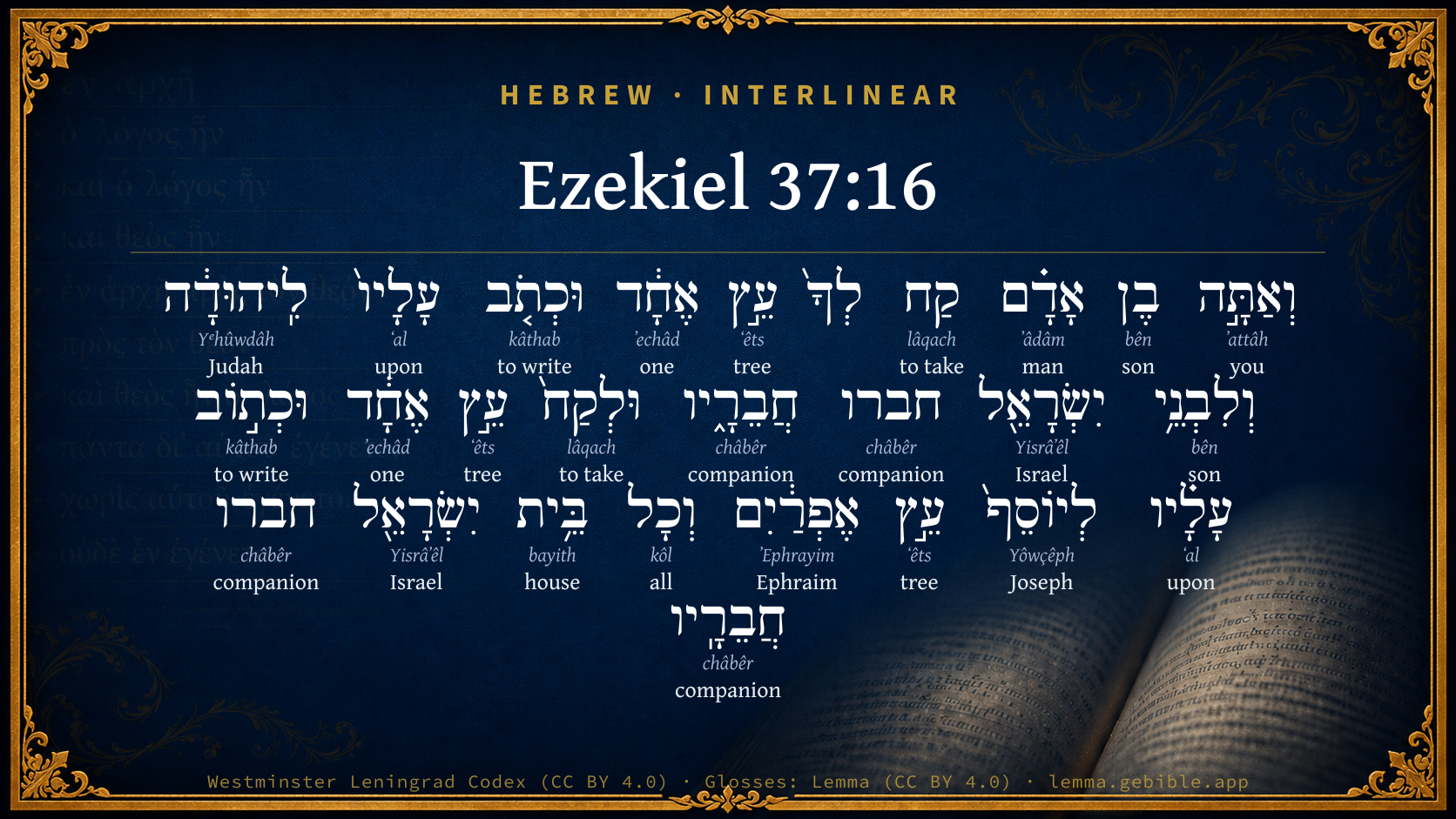
  1. וְאַתָּ֣ה ʼattâh H859 “and · you” Conjunction + Pronoun, Personal, 2nd Person, Masculine, Singular
  2. בֶן bên H1121 “son of” Noun, Common, Masculine, Singular, Construct
  3. אָדָ֗ם ʼâdâm H120 “man” Noun, Common, Masculine, Singular, Absolute
  4. קַח lâqach H3947 “take” Verb, Qal, Imperative, 2nd Person, Masculine, Singular
  5. עֵ֣ץ ʻêts H6086 “tree” Noun, Common, Masculine, Singular, Absolute
  6. אֶחָ֔ד ʼechâd H259 “one” Adjective, Cardinal number, Masculine, Singular, Absolute
  7. וּכְתֹ֤ב kâthab H3789 “and · write” Conjunction + Verb, Qal, Imperative, 2nd Person, Masculine, Singular
  8. עָלָיו֙ ʻal H5921 “upon · him” Preposition + Suffix, Personal, 3rd Person, Masculine, Singular
  9. לִֽיהוּדָ֔ה Yᵉhûwdâh H3063 “to/for · Judah” Preposition + Noun, Proper
  10. וְלִבְנֵ֥י bên H1121 “and · to/for · sons of” Conjunction + Preposition + Noun, Common, Masculine, Plural, Construct
  11. יִשְׂרָאֵ֖ל Yisrâʼêl H3478 “Israel” Noun, Proper
  12. חֲבֵרָ֑יו châbêr H2270 “companions · his” Noun, Common, Masculine, Plural, Construct + Suffix, Personal, 3rd Person, Masculine, Singular
  13. וּלְקַח֙ lâqach H3947 “and · take” Conjunction + Verb, Qal, Imperative, 2nd Person, Masculine, Singular
  14. עֵ֣ץ ʻêts H6086 “tree” Noun, Common, Masculine, Singular, Absolute
  15. אֶחָ֔ד ʼechâd H259 “one” Adjective, Cardinal number, Masculine, Singular, Absolute
  16. וּכְת֣וֹב kâthab H3789 “and · write” Conjunction + Verb, Qal, Imperative, 2nd Person, Masculine, Singular
  17. עָלָ֗יו ʻal H5921 “upon · him” Preposition + Suffix, Personal, 3rd Person, Masculine, Singular
  18. לְיוֹסֵף֙ Yôwçêph H3130 “to/for · Joseph” Preposition + Noun, Proper
  19. עֵ֣ץ ʻêts H6086 “tree of” Noun, Common, Masculine, Singular, Construct
  20. אֶפְרַ֔יִם ʼEphrayim H669 “Ephraim” Noun, Proper
  21. וְכָל kôl H3605 “and · all of” Conjunction + Noun, Common, Masculine, Singular, Construct
  22. בֵּ֥ית bayith H1004 “house of” Noun, Common, Masculine, Singular, Construct
  23. יִשְׂרָאֵ֖ל Yisrâʼêl H3478 “Israel” Noun, Proper
  24. חברו châbêr H2270 “companion · his” Noun, Common, Masculine, Singular, Construct + Suffix, Personal, 3rd Person, Masculine, Singular
  25. חֲבֵרָֽיו châbêr H2270 “companions · his” Noun, Common, Masculine, Plural, Construct + Suffix, Personal, 3rd Person, Masculine, Singular

About this verse

These counts appear in no published source. They are computed here, from the morphology-tagged text and Lemma’s own curated glosses. What Lemma adds →

27
words
15
distinct lemmas
Prophets
section

Notable vocabulary

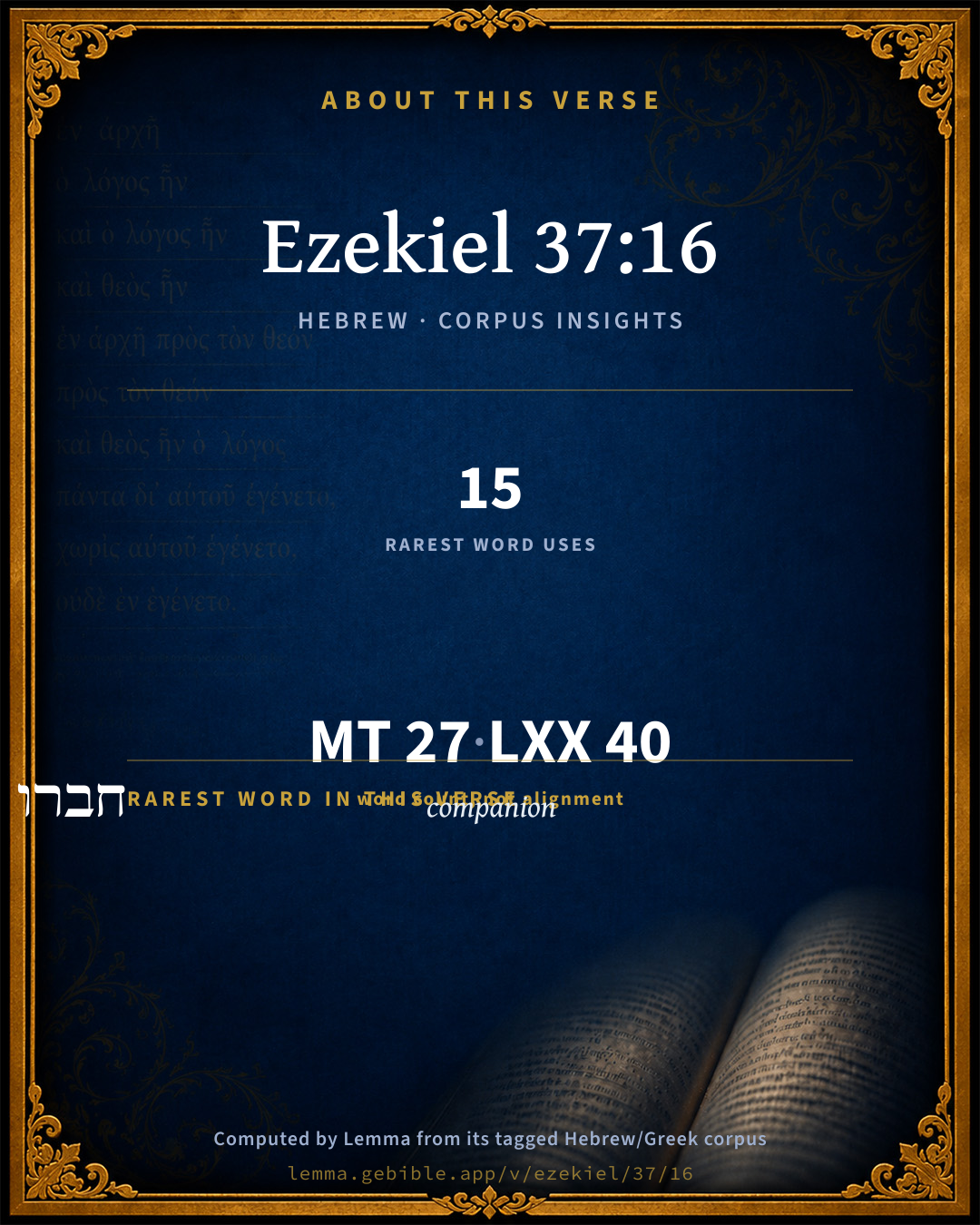
The rarest word here is חברו companion H2270 — appearing just 15 times in the whole Hebrew Bible.

Shared distinctive vocabulary

חברו companion H2270 occurs in 11 verses of the Hebrew Bible. Also found in:

Grammatical profile

  • 4 verbs
  • 17 nouns
  • 2 adjectives
  • 1 pronoun
  • 3 prepositions

Verb forms

  • קַח Qal · Imperative
  • וּכְתֹ֤ב Qal · Imperative
  • וּלְקַח֙ Qal · Imperative
  • וּכְת֣וֹב Qal · Imperative

Repetition

Words recur within this verse — often emphatic in Hebrew:

  • חברו companion H2270 ×4
  • עֵ֣ץ tree H6086 ×3
  • בֶן son H1121 ×2
  • קַח to take H3947 ×2
  • אֶחָ֔ד one H259 ×2
  • וּכְתֹ֤ב to write H3789 ×2
  • עָלָיו֙ upon H5921 ×2
  • יִשְׂרָאֵ֖ל Israel H3478 ×2

Hebrew & Septuagint length

In English translation the verse runs 44 words from the Hebrew and 49 from the Septuagint (LXX English) — closely comparable.

A rough comparison of the two English renderings, which tokenize alike — not a word-level alignment.

Word counts can differ between the Hebrew and the Greek without any difference in meaning — e.g. the Hebrew direct-object marker אֵת has no separate Greek word, and Greek often adds the article ὁ.

In the original languages it is 27 Hebrew tokens and 40 Greek tokens — but the two are counted differently (Hebrew bundles its prefixes and suffixes into one token; the Greek is in lemma form), so that isn’t a like-for-like length.

Cross-references

7

Topical passages linked to Ezekiel 37:16 in the Treasury of Scripture Knowledge — connected by theme and wording, ordered by reader-vote popularity; previews shown in the World English Bible.

  • 2 Chronicles 10:19 So Israel rebelled against the house of David to this day.
  • 2 Chronicles 15:9 He gathered all Judah and Benjamin, and those who sojourned with them out of Ephraim and Manasseh, and out of Simeon: for they fell to him out of Israel in abundance, when they saw that Yahweh his God was with him.
  • 2 Chronicles 10:17 But as for the children of Israel who lived in the cities of Judah, Rehoboam reigned over them.
  • Numbers 17:2–3 Speak to the children of Israel, and take of them rods, one for each fathers' house, of all their princes according to their fathers' houses, twelve rods: write you every man's name on his rod.
  • 1 Kings 12:16–20 When all Israel saw that the king didn't listen to them, the people answered the king, saying, What portion have we in David? neither have we inheritance in the son of Jesse: to your tents, Israel: now see to your own house, David. So Israel departed to their tents.
  • 2 Chronicles 11:11–17 He fortified the strongholds, and put captains in them, and stores of food, and oil and wine.
  • 2 Chronicles 30:11–18 Nevertheless certain men of Asher and Manasseh and of Zebulun humbled themselves, and came to Jerusalem.

Cross-references courtesy of OpenBible.info (CC BY 4.0).

Hebrew and Greek witnesses Masoretic Hebrew ↔ Greek Septuagint

The same verse in the two great witnesses to the Old Testament, shown verse-for-verse.

These are two independent witnesses, not word-aligned to each other, and the Septuagint is shown in lemma (dictionary) form.

Hebrew Ezekiel 37:16 Masoretic · Westminster Leningrad Codex

וְאַתָּ֣ה בֶן אָדָ֗ם קַח לְךָ֙ עֵ֣ץ אֶחָ֔ד וּכְתֹ֤ב עָלָיו֙ לִֽיהוּדָ֔ה וְלִבְנֵ֥י יִשְׂרָאֵ֖ל חברו חֲבֵרָ֑יו וּלְקַח֙ עֵ֣ץ אֶחָ֔ד וּכְת֣וֹב עָלָ֗יו לְיוֹסֵף֙ עֵ֣ץ אֶפְרַ֔יִם וְכָל בֵּ֥ית יִשְׂרָאֵ֖ל חברו חֲבֵרָֽיו

You, son of man, take one stick, and write on it, For Judah, and for the children of Israel his companions: then take another stick, and write on it, For Joseph, the stick of Ephraim, and [for] all the house of Israel his companions:

World English Bible · Public Domain

Greek LXX Ezekiel 37:16 Septuagint · lemma form

υἱός ἄνθρωπος λαμβάνω σεαυτοῦ ῥάβδος καί γράφω ἐπί αὐτός ὁ ἰούδας καί ὁ υἱός ἰσραήλ ὁ προςκεῖμαι ἐπί αὐτός καί ῥάβδος δεύτερος λαμβάνω σεαυτοῦ καί γράφω αὐτός ὁ ιωσηφ ῥάβδος ἐφράιμ καί πᾶς ὁ υἱός ἰσραήλ ὁ προςτίθημι πρός αὐτός

Son of man, take for yourself a rod, and write upon it, Juda, and the children of Israel his adherents; and you shall take for yourself another rod, and you shall inscribe it for Joseph, the rod of Ephraim, and all the children of Israel that belong to him.

LXX2012 (modern English Septuagint) · Public Domain

On this verse, John Gill's Exposition discusses the Septuagint’s reading. Read the note in Commentary ↓

Hebrew: Westminster Leningrad Codex (CC BY 4.0). Greek: Septuagint (public domain); English from LXX2012 (modern English Septuagint) (Public Domain). How the Septuagint differs from the Hebrew →

Targum (Aramaic paraphrase)

1

The Targum is the ancient Jewish Aramaic paraphrase of the Hebrew Scriptures — an interpretive translation, not the Hebrew text itself. Onkelos (literal) and Pseudo-Jonathan (expansive) render the Torah, and Jonathan the Prophets. Coverage is partial: where no permissively-licensed English translation exists for a verse, only the Aramaic is shown. This is verse-level text, not a word-by-word alignment to the Hebrew.

  1. Targum Jonathan Prophets (Joshua–Malachi)
    וְאַתְּ בַּר אָדָם סַב לָךְ לוּחָא חֲדָא וּכְתוֹב עֲלוֹהִי לְשִׁבְטָא דִיהוּדָה וְלִבְנֵי יִשְׂרָאֵל אַחֵיהוֹן וְסַב לוּחָא חֲדָא וּכְתוֹב עֲלוֹהִי לְשִׁבְטָא דְיוֹסֵף דִי הוּא שִׁבְטָא דְאֶפְרַיִם וְכָל בֵּית יִשְׂרָאֵל אֲחֵיהוֹן:

    (no public-domain English translation for this verse)

    Targum Jonathan — Aramaic: “Mikraot Gedolot” (public domain). English: “Sefaria Community Translation” (CC0 1.0 (public-domain dedication)); “London "Chaldee Paraphrase," 1871” (public domain). Text via Sefaria.

Commentary

Notes on Ezekiel 37:16 from classic Christian and Jewish commentators (each source and its license shown beneath its notes). The classic Christian expositions comment on the surrounding passage and are grouped to its opening verse, so a note may address several verses; the Jewish commentaries on the Tanakh (Rashi and others) are per-verse, so they appear only where the commentator wrote on this verse.

Lemma curates 59 commentaries, every one of them public domain or Creative Commons licensed, each selected and text-cleaned for this edition rather than reprinted as found. About our sources →

Trapp's Complete Commentary

John Trapp

Eze 37:16 Moreover, thou son of man, take thee one stick, and write upon it, For Judah, and for the children of Israel his companions: then take another stick, and write upon it, For Joseph, the stick of Ephraim, and [for] all the house of Israel his companions:

Ver. 16. Take thee one stick.] A cleft stick, which is res vilis et exilis, a poor business in itself; but if God please to make use of so slender a thing, it may serve for very great purpose; as here by the uniting of two sorry sticks in the hand of the prophet is prefigured the uniting of Judah and Israel, yea, of Jews and Gentiles, "in the hand of the Lord," that is, in Christ Jesus, who is the hand, the right hand, and the arm of God the Father.

His companions,] i.e., Benjamin and Levi. {2Ch 11:12-13}

John Trapp, A Commentary or Exposition upon All the Books of the Old and New Testament (1647–1656) — public domain. Text from a community e-Sword module.

Albert Barnes' Notes on the Bible

A prophecy of the reunion of Israel and Judah, the incorporation of Israel under one Ruler, the kingdom of Messiah upon earth and in heaven.

Eze 37:16

One stick - So in the marginal reference the names of the tribes had been written on rods or sticks.

For Judah ... - To the house of David had remained faithful, not only Judah, but also Benjamin, Levi, and part of Simeon, and individual members of various tribes 2Ch 11:12-16. Compare the marginal references.

Joseph ... Ephraim - Compare Psa 78:67; Hos 5:5 ff “Joseph” is the general name here for the ten tribes, including “Ephraim,” the chief tribe, and his companions. Omit “for” before “all.” “All the house of Israel” is here the ten tribes.

Eze 37:19

In the hand of Ephraim - Because Ephraim was the ruling tribe; the words are contrasted with “in mine hand.”

Eze 37:20

This sign was literally enacted in the presence of the people, not, like some signs, merely in vision (see the Eze 3:1 note).

Eze 37:21

The gathering together of the children of Israel was to take effect in the first place in the return from Babylon, when the distinction of Israel and Judah should cease. The full completion concerns times still future, when all Israel shall come in to acknowledge the rule of Christ.

Eze 37:22

One king - The restoration of Israel to their native soil will lead the way to the coming of the promised King, the Son of David, who will gather into His kingdom the true Israel, all who shall by faith be acknowledged as the Israel of God. The reign of the One King David is the reign of Christ in His kingdom, the Church.

Eze 37:25, Eze 37:26

An enlargement of the promises. The kingdom is to be “forever,” the covenant “everlasting.” This looks forward to the consummation of all God’s promises 1Co 15:24, 1Co 15:28.

Eze 37:27

This gives a final blessing reserved for God’s accepted servants. The tabernacle and temple were outward symbols of His presence. The re-erection of the temple by Zerubbabel was the first step to a restoration of the presence of God. The second step was the presence of Christ, first in the flesh, then in His Church, and finally the eternal presence of God and of the Lamb in the New Jerusalem Rev. 21.

Albert Barnes' Notes on the Bible (1834–1885) — public domain. Text from a community e-Sword/MySword module.

Joseph Benson's Commentary

Eze 37:16-17. Take thee one stick — That is, one rod. The expression seems to allude to Num 17:2; where Moses was commanded to take twelve rods, one for each tribe, and to write the name of the tribe upon the rod; for Judah, and the children of Israel his companions — That is, the tribe of Benjamin, and a part of that of Levi, who adhered to the tribe of Judah. Then take another stick — A second, such as the first was; and write upon it, For Joseph, the stick of Ephraim — Upon Reuben’s forfeiting his birthright, that privilege was conferred upon the sons of Joseph, of whom Ephraim had the precedence: see 1Ch 5:1; Gen 48:20; which made him to be reckoned the head of the ten tribes; Samaria, the seat of that kingdom, being likewise situate in the tribe of Ephraim. Upon these accounts the name of Ephraim, in the prophets, often signifies the whole kingdom of Israel, as distinct from that of Judah. All the rest of the tribes were the companions of Ephraim, as the tribes of Benjamin and Levi were the companions of Judah. And join them into one stick — A rod was an emblem of power, (see Psa 110:2,) so joining these two rods, or sticks, together, denoted uniting the two kingdoms under one prince, or governor.

Joseph Benson's Commentary on the Old and New Testaments (1811–1818) — public domain. Text from a community e-Sword module.

Geneva Bible (1599)

Geneva Bible translators

Which signifieth the joining together of the two houses, of Israel, and Judah.

Geneva Bible (1599) marginal notes — public domain. Text via Bolls.life.

Jamieson, Fausset & Brown

Robert Jamieson, A. R. Fausset & David Brown

stick--alluding to Num 17:2, the tribal rod. The union of the two rods was a prophecy in action of the brotherly union which is to reunite the ten tribes and Judah. As their severance under Jeroboam was fraught with the greatest evil to the covenant-people, so the first result of both being joined by the spirit of life to God is that they become joined to one another under the one covenant King, Messiah-David.

Judah, and . . . children of Israel his companions--that is, Judah and, besides Benjamin and Levi, those who had joined themselves to him of Ephraim, Manasseh, Simeon, Asher, Zebulun, Issachar, as having the temple and lawful priesthood in his borders (Ch2 11:12-13, Ch2 11:16; Ch2 15:9; Ch2 30:11, Ch2 30:18). The latter became identified with Judah after the carrying away of the ten tribes, and returned with Judah from Babylon, and so shall be associated with that tribe at the future restoration.

For Joseph, the stick of Ephraim--Ephraim's posterity took the lead, not only of the other descendants of Joseph (compare Eze 37:19), but of the ten tribes of Israel. For four hundred years, during the period of the judges, with Manasseh and Benjamin, its dependent tribes, it had formerly taken the lead: Shiloh was its religious capital; Shechem, its civil capital. God had transferred the birthright from Reuben (for dishonoring his father's bed) to Joseph, whose representative, Ephraim, though the younger, was made (Gen 48:19; Ch1 5:1). From its pre-eminence "Israel" is attached to it as "companions." The "all" in this case, not in that of Judah, which has only attached as "companions" the children of Israel" (that is, some of them, namely, those who followed the fortunes of Judah), implies that the bulk of the ten tribes did not return at the restoration from Babylon, but are distinct from Judah, until the coming union with it at the restoration.

Jamieson, Fausset & Brown — Commentary Critical and Explanatory on the Whole Bible (1871) — public domain (CC PDM 1.0). Text via the HelloAO Bible API.

Adam Clarke's Commentary

Verse 16. Son of man, take thee one stick] The two sticks mentioned in this symbolical transaction represented, as the text declares, the two kingdoms of Israel and Judah, which vere formed in the days of Rehoboam, and continued distinct till the time of the captivity. The kingdom of Judah was composed of the tribes of Judah and Benjamin, with the Levites; all the rest went off in the schism with Jeroboam, and formed the kingdom of Israel. Though some out of those tribes did rejoin themselves to Judah, yet no whole tribe ever returned to that kingdom. Common sufferings in their captivity became the means of reviving a kinder feeling; and to encourage this, God promises that he will reunite them, and restore them to their own land; and that there shall no more be any divisions or feuds among them. To represent this in such a way as would make it a subject of thought, reflection, and inquiry, the prophet is ordered to take the two sticks mentioned above, to write on them the distinguishing names of the divided kingdoms, and then by a notch, dovetail, glue, or some such method, to unite them both before the people. He did so, and on their inquiry, showed them the full meaning of this symbolical action.

Adam Clarke's Commentary on the Bible (1810–1826) — public domain. Text from a community e-Sword/MySword module.

Ellicott's Commentary for English Readers

(16) One stick . . . another stick.—These are not rods, as in Num_17:6-9, although Ezekiel may have had that event in mind; the word here is an entirely different one, and means simply a piece of wood. The two pieces were, no doubt, so shaped that being firmly held together they would appear as one.

For Judah, and for the children of Israel his companions.—The object is to represent by the two pieces of wood the two kingdoms. It would be insufficient, therefore, to mention Judah only; for with him Benjamin had been always associated, and also considerable fragments of the other tribes (2Ch_11:16; 2Ch_15:9). After the fall of the northern kingdom, individual members of the ten tribes who had not been carried into captivity joined themselves more or less completely to the kingdom of Judah (2Ch_30:11-18; 2Ch_31:1).

For Joseph, the stick of Ephraim.—Joseph, as including the two great tribes of Ephraim and Manasseh, is put for the whole of the ten tribes, and Ephraim is specified as being the leading tribe, and this makes necessary the addition, “and all the house of Israel his companions,” to show that the whole northern kingdom is included. The word for, in italics, should be omitted.

A Bible Commentary for English Readers, edited by Charles John Ellicott (1878–1897) — public domain. Text from a community e-Sword module.

The Cambridge Bible for Schools and Colleges

gen. ed. J. J. S. Perowne

16. one stick] i.e. staff, or rod, equivalent to sceptre, Num_17:2; so Eze_37:17; Eze_37:19-20.

children of Israel] After the fall of the northern kingdom the name Israel was often used of Judah, the only remaining part of it. Here Israel of the north is called Joseph or Ephraim.

The Cambridge Bible for Schools and Colleges (gen. ed. J. J. S. Perowne; Cambridge University Press, 1878–1918) — public domain. Text from a community e-Sword module.

John Gill's Exposition

Moreover, thou son of man, take thee one stick,.... Or "wood" (a); a stick of wood; or table, as the Targum; a board or plank. The Septuagint version renders it a "rod"; and so the Arabic; an emblem of a kingdom or government, as this was:

and write upon it; the following words:

for Judah, and the children of Israel his companions; for the tribe of Judah, and the tribe of Benjamin, which adhered together, and as many of the other tribes which joined them; the godly and religious of the rest of the tribes, who could not give into the idolatry of Jeroboam:

then take another stick; like the former:

and write upon it; these words:

for Joseph, the stick of Ephraim, and for all the house of Israel his companions; for the tribe of Ephraim, and the other nine tribes, which together made up one kingdom. It should be observed, that in the times of Rehoboam, the son of Solomon, there was a division in the kingdom of Israel; ten tribes revolted from him, and only the two whole tribes of Judah and Benjamin continued with him; and from that time to the captivity, and even during that, as it seems, there were continual animosities and bickerings between the two kingdoms, on account both of their political and religious affairs, especially the latter; and an union between them this emblem is designed to signify, as will hereafter appear. Jeroboam, the first king of the ten tribes, was of the tribe of Ephraim; and Samaria, the metropolis of the kingdom, was in that tribe; hence Ephraim often stands for all the ten tribes, for the kingdom of Israel, as distinct from that of Judah. Writing words on sticks or rods seems to be in allusion to what was done Num 17:2.

(a) "lignum unuin", V. L. Pagninus, Montanus, &c.

John Gill's Exposition of the Whole Bible (1746–1763) — public domain (CC PDM 1.0). Text via the HelloAO Bible API.

Haydock's Catholic Bible Commentary

Associates. When Jeroboam caused the division, some of Israel adhered to Juda. The prophet glued the pieces of wood together, or engrafted them one into the other, to shew that all the people should be united, and the Jews and Gentiles concur to form one church. (Calmet) (Romans xi. 17.) --- Before the latter event took place God united the two kingdoms, to teach us that when we labour for the conversion of heretics, as in England, Catholics must first agree among themselves, that so all may more easily become one fold under one shepherd. (Worthington)

George Leo Haydock (1774–1849), Haydock's Catholic Family Bible and Commentary, 1859 edition — public domain. Excludes Psalms (Douay-Rheims chapter numbering differs from Protestant) and Deuterocanonical books (Catholic canon only).

Matthew Poole's English Annotations

One stick; tablet, i.e. a writing tablet or a tally, such as is fitted to be written upon, or a rod, or staff, on which thou mayst write; the Hebrew calls it wood, without describing its form and fashion; but whatever its fashion was, it must be but one.

Write upon it; the inscription is not only commanded, but the words also in which it is to be written.

For Judah; the tribe, or possibly the kingdom; if the latter, then the companions mentioned will be such as in process of time fell off from the ten tribes, and united with the kingdom of the house of David; if the former, which is most likely, then

the children of Israel, his companions, are Benjamin and Levi in part, who kept, with the tribe of Judah, their obedience to David’s seed.

Then; when thou hast written on the first stick, then take

another stick; a second stick, such as the first was.

For Joseph; he was father of two tribes, one of which was chief of the ten tribes, and is therefore mentioned here.

The stick of Ephraim; Ephraim was the son of Joseph, whom his grandfather blessed, and by prophetic Spirit foretold and promised that he should be one of the chief of all the tribes; and Ephraim was most considerable in the kingdom of Israel when divided from the other two.

All the house of Israel; the other nine tribes.

His companions; who did at first side, and have continued still, with Ephraim. Some say Ephraim was the whole kingdom of the ten tribes, and that his companions were the Gentiles converted to the faith of Christ, which I wish were well proved.

Matthew Poole's English Annotations on the Holy Bible (1683–1685) — public domain. Text from a community e-Sword/MySword module.

The Pulpit Commentary

Take thee one stick, and write. The symbolic action thus prescribed to the prophet was manifestly based on the well-known historical fact that the tribes of Israel, in Mosaic times, had been represented by a rod, on which was inscribed the name of the tribe; (Num_17:2) but whether the stick Ezekiel was instructed to take was a staff, rJabdov (LXX, Hirernick, Hitzig, Kliefoth, and Smend), or a block (Ewald), or simply a piece (Keil, Schroder) of wood on which a few words might be traced, cannot be decided. On the first stick the prophet was directed to write, For Judah, and the house of his companions; i.e. for the southern kingdom and those of the northern tribes who adhered to it, as e.g. Benjamin, Levi, and part of Simeon, with those devout Jehovah-worshippers who from time to time emigrated from other tribes and settled in the land of Judah. (2Ch_11:12-16 2Ch_15:9 2Ch_30:11, 2Ch_30:18, 31 31:1; though by Wellhausen, Smend, and others, such passages are pronounced unhistorical) On the second stick also the prophet was directed to write; but whether For Joseph, the stick of Ephraim and for (or, of) all the house of Israel his companions (Authorized and Revised Versions), or "For Joseph and the whole house of Israel" (Keil), or simply "For Joseph" (Ewald, Havernick, Smend), cannot be determined. Each interpretation can be supported by quite reasonable considerations. For the first may be pleaded that it best accords with the natural sense of the text; for the second, that the phrase, the stick of Ephraim, appears to be explanatory of and in opposition to "For Joseph;" for the third, that all the house of Israel stands, like "Ephraim," under the regimen of "stick." The introduction of Joseph as the representative of the northern kingdom rests, not on the fact that Joseph"s was the most honorable name among the ten tribes (Havernick), but on the circumstance that the tribe of Joseph, as represented by Ephraim and Manasseh, constituted the main body of the northern kingdom. The addition of Ephraim"s name is best accounted for by remembering that in his hand lay the hegemony of the kingdom. "All the house of Israel his companions" signified the rest of the ten tribes. That the two sticks, when joined together in the prophet"s hand, were to become one cannot signify that they were then and there to be miraculously united.

The Pulpit Commentary (1880–1919), ed. H.D.M. Spence-Jones & Joseph S. Exell — public domain. Text from a community e-Sword module.

John Wesley's Explanatory Notes

One stick - A writing tablet or a tally, such as is fit to be written upon. His companions - Benjamin and part of Levi, who kept with the tribe of Judah. Ephraim - Ephraim was the most considerable tribe in the kingdom of Israel, when divided from the other two. The house of Israel - The other nine tribes, who continued with Ephraim.

John Wesley, Explanatory Notes Upon the Whole Bible (1754–1765) — public domain. Text via the GEBible commentary corpus.

Rashi

Rabbi Shlomo Yitzchaki (Rashi)

And you, son of man, take for yourself one stick and write upon it, ‘For Judah and for the children of Israel his companions’ These four words write upon it, to say that this stick is Judah’s and the tribe of Benjamin’s, who joined him.

and take one stick and write upon it This is for Joseph: the stick of Ephraim and the remaining nine tribes, which followed Jeroboam, who was of the tribe of Ephraim.

Rashi on the Tanakh — English translations: “The Judaica Press complete Tanach with Rashi, translated by A. J. Rosenberg” (CC BY 4.0); “Pentateuch with Rashi's commentary by M. Rosenbaum and A.M. Silbermann, 1929-1934” (public domain); “The Metsudah Tanach series, Lakewood, N.J” (CC BY 4.0); and “The Book of Joshua, Metsudah Publications, 1997” (CC BY 4.0). Text via Sefaria.

Lesson kit

Teaching starters — assembled from the data on this page, not authored interpretation. Every prompt links to the verse data it draws on. Edit before teaching.

Ezekiel, in the Prophets, opens this verse with 27 words (15 distinct Hebrew lemmas). Its most distinctive word is châbêr (“companion”). A historical commentator’s framing appears above. Read the whole chapter for the surrounding context.

Discussion questions

  1. How does “companion” (châbêr) shape what this verse is saying?
  2. Judges 20:11 shares the word «companion» with this verse. How do the two illuminate each other?
  3. “companion” occurs 4× in this one verse. What is the effect of the repetition?
  4. The translations on this page render this verse differently — a whole-verse word diff, not a word-by-word alignment. What might account for the different wordings?
  5. The verb «קַח» is Qal Imperative. How does its form color the action?
  6. Reading how Trapp's Complete Commentary and Albert Barnes' Notes on the Bible read this verse, where do the two commentators agree and where do they part?

Things to notice

Reading settings

Reading text

Shown beneath each verse's original-language words.

Old Testament
Old Testament edition

Read the OT as the Masoretic Hebrew (MT) or the Greek Septuagint (LXX).

English shown for the Greek Septuagint (in the Hebrew ↔ Greek comparison).

Comparing translations? Open the Compare panel on any verse page to stack up to four side by side.