
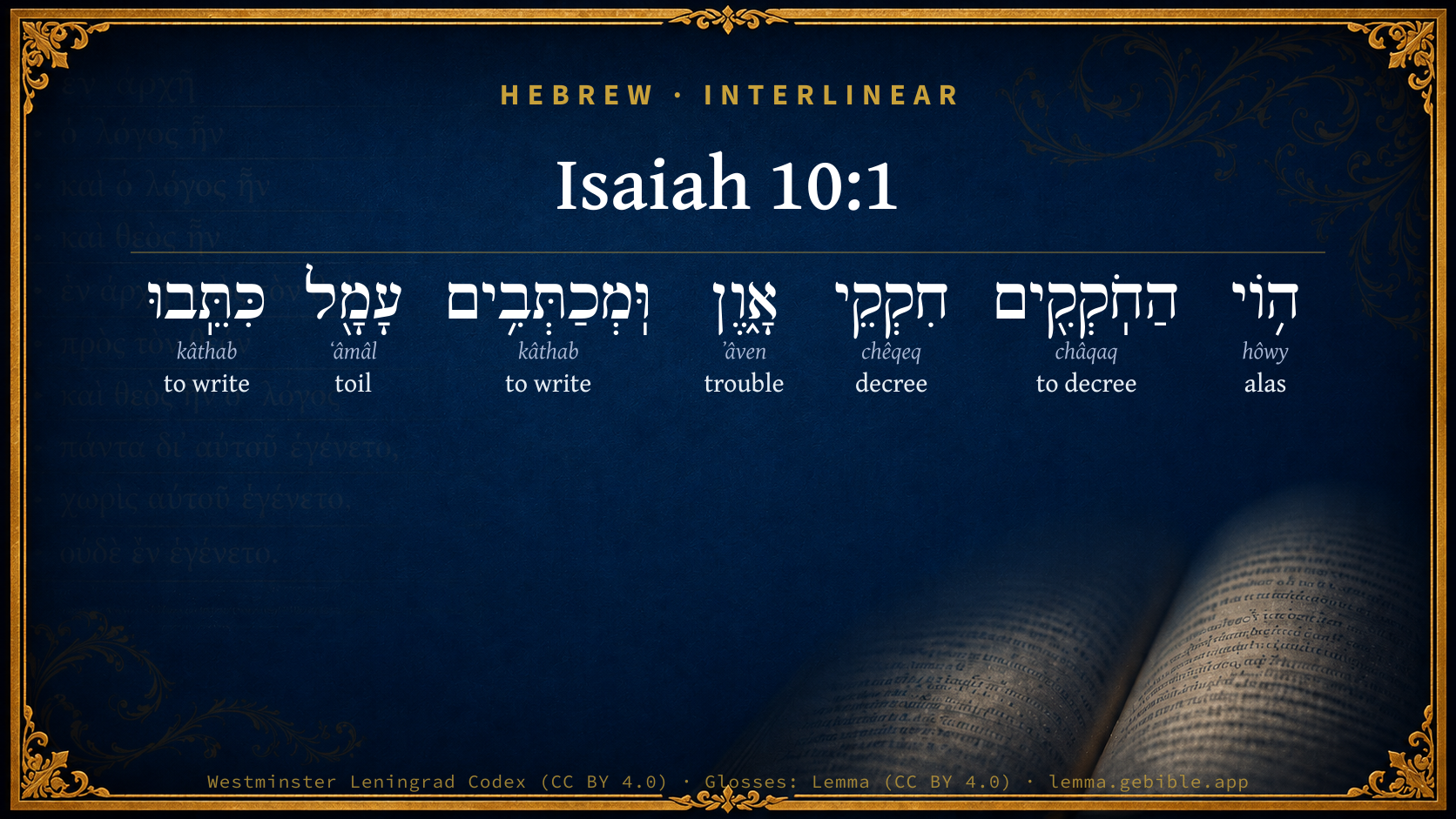
Isaiah 10:1

Hebrew (Westminster Leningrad Codex) Isaiah 10:1 appears in the Hebrew Old Testament. The text above is from the Westminster Leningrad Codex. Each word links to its Strong’s number, a concise gloss, and parsing drawn from the Open Scriptures Hebrew Bible morphology. Click any word for its full Brown-Driver-Briggs (BDB) entry.
Download image
Cite this verse

Isaiah 10:1 (World English Bible). Public Domain. Lemma interlinear Bible study tool, https://lemma.gebible.app/v/isaiah/10/1.

Show BibTeX & RIS
BibTeX
RIS
English Translation
Woe to those who decree unrighteous decrees, and to the writers who write perverseness;
World English Bible · Public Domain
Download a study sheet

One document with this verse’s original text, its word-by-word gloss line, the meaning frame, cross-references with their text, attributed commentary, and full source and license credits — printable, and it pastes into notes with its structure intact.

This verse Autodidact and up

Study sheet (.html) Plain text (.txt)

A passage Seminary Student

Up to 50 verses in one chapter. A passage sheet keeps up to 6 commentary sources and 12 cross-references per verse, in the order this page ranks them, and says so on the sheet whenever that leaves anything out. Ask for a single verse and you get the Autodidact verse sheet above.

Everything on this page stays free to read, with no account — the sheet is a download of what is already on screen, not access to it.

Want to remove ads? Support Godless Engineer
Compare translations 3

The same verse in 3 English versions, stacked beneath the original-language interlinear above. Click any original word for its lexicon entry.

Each is an independent rendering of the whole verse — the interlinear is not word-aligned to these translations.

Highlighted words mark where these versions differ — a whole-verse word diff, not a word-by-word alignment.

  • World English Bible Public Domain
    Woe to those who decree unrighteous decrees, and to the writers who write perverseness;
  • King James Version Public Domain
    Woe unto them that decree unrighteous decrees, and that write grievousness which they have prescribed;
  • unfoldingWord Literal Text CC BY-SA 4.0
    Woe to the ones decreeing decrees of iniquity and the writers, they write oppression,

unfoldingWord Literal Text — © unfoldingWord, licensed CC BY-SA 4.0. Word-aligned USFM3 via Door43 (git.door43.org/unfoldingWord/en_ult).

Versions to compare (up to 4)

3 of 4 selected

Show all 18 translations

Every available English version of this verse, each an independent rendering of the whole verse.

  • World English Bible Public Domain
    Woe to those who decree unrighteous decrees, and to the writers who write perverseness;
  • Berean Standard Bible Public Domain
    Woe to those who enact unjust statutes and issue oppressive decrees,
  • Majority Standard Bible Public Domain
    Woe to those who enact unjust statutes and issue oppressive decrees,
  • King James Version Public Domain
    Woe unto them that decree unrighteous decrees, and that write grievousness which they have prescribed;
  • American Standard Version (1901) Public Domain
    Woe unto them that decree unrighteous decrees, and to the writers that write perverseness;
  • Revised Version (1885) Public Domain
    Woe unto them that decree unrighteous decrees, and to the writers that write perverseness:
  • Geneva Bible (1599) Public Domain
    Woe vnto them that decree wicked decrees, and write grieuous things,
  • Douay-Rheims (1899) Public Domain
    Woe to them that make wicked laws: and when they write, write injustice:
  • Young's Literal Translation Public Domain
    Wo `to' those decreeing decrees of iniquity, And writers who have prescribed perverseness.
  • Literal Standard Version CC BY-SA 4.0
    “Woe [to] those decreeing decrees of iniquity, || And writers who have prescribed perverseness,
  • Unlocked Literal Bible CC BY-SA 4.0
    Woe to those who enact unjust laws and write unfair decrees.
  • unfoldingWord Literal Text CC BY-SA 4.0
    Woe to the ones decreeing decrees of iniquity and the writers, they write oppression,
  • Darby Bible Public Domain
    Woe unto them that decree iniquitous decrees, and to the writers that prescribe oppression,
  • World Messianic Bible Public Domain
    Woe to those who decree unrighteous decrees, and to the writers who write oppressive decrees
  • Webster's Bible Public Domain
    Woe to them that decree unrighteous decrees, and that write grievousness which they have prescribed;
  • Free Bible Version CC BY-SA 4.0
    Tragedy is coming to those who pass evil decrees and who write laws to harm people.
  • Bible in Basic English Public Domain
    Cursed are those who make evil decisions, and the writers who make the records of their cruel acts:
  • JPS Tanakh (1917) Public Domain
    Woe unto them that decree unrighteous decrees, and to the writers that write iniquity;

Literal Standard Version (2020), Covenant Press — licensed CC BY-SA 4.0. Text via the HelloAO Bible API (eBible.org). Unlocked Literal Bible (unfoldingWord) — licensed CC BY-SA 4.0. Text via the HelloAO Bible API (eBible.org). unfoldingWord Literal Text — © unfoldingWord, licensed CC BY-SA 4.0. Word-aligned USFM3 via Door43 (git.door43.org/unfoldingWord/en_ult). Free Bible Version, Dr. Jonathan Gallagher — licensed CC BY-SA 4.0. Text via the HelloAO Bible API (eBible.org).

Word by word

More ways to search: Search by grammar → Find every occurrence → Compare this word →

Practice this passage: Drill this verse → Learn its vocabulary →

About this verse

These counts appear in no published source. They are computed here, from the morphology-tagged text and Lemma’s own curated glosses. What Lemma adds →

7
words
6
distinct lemmas
Prophets
section

Notable vocabulary

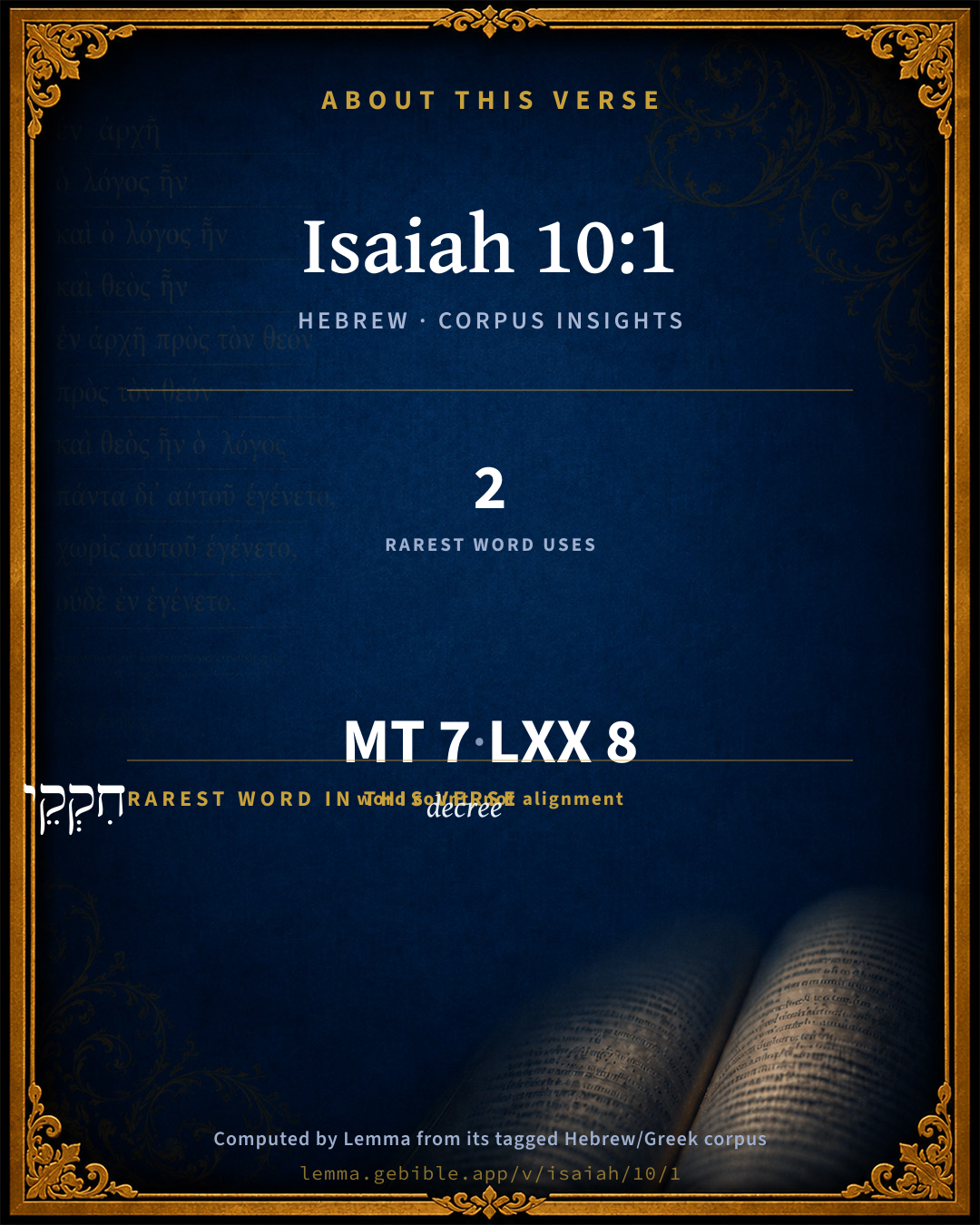
The rarest word here is חִקְקֵי decree H2711 — appearing just 2 times in the whole Hebrew Bible.

Shared distinctive vocabulary

חִקְקֵי decree H2711 occurs in 2 verses of the Hebrew Bible. Also found in:

Grammatical profile

  • 3 verbs
  • 3 nouns
  • 1 particle

Verb forms

  • הַחֹֽקְקִ֖ים Qal · Participle Active
  • וּֽמְכַתְּבִ֥ים Piel · Participle Active
  • כִּתֵּֽבוּ Piel · Perfect

Repetition

A word recurs within this verse — often emphatic in Hebrew:

  • וּֽמְכַתְּבִ֥ים to write H3789 ×2

Hebrew & Septuagint length

In English translation the verse runs 14 words from the Hebrew and 14 from the Septuagint (LXX English) — the same length.

A rough comparison of the two English renderings, which tokenize alike — not a word-level alignment.

Word counts can differ between the Hebrew and the Greek without any difference in meaning — e.g. the Hebrew direct-object marker אֵת has no separate Greek word, and Greek often adds the article ὁ.

In the original languages it is 7 Hebrew tokens and 8 Greek tokens — but the two are counted differently (Hebrew bundles its prefixes and suffixes into one token; the Greek is in lemma form), so that isn’t a like-for-like length.

Cross-references

30

Topical passages linked to Isaiah 10:1 in the Treasury of Scripture Knowledge — connected by theme and wording, ordered by reader-vote popularity; previews shown in the World English Bible.

  • Luke 11:52 Woe to you lawyers! For you took away the key of knowledge. You didn't enter in yourselves, and those who were entering in, you hindered."
  • Micah 3:1–4 I said, "Please listen, you heads of Jacob, And rulers of the house of Israel: Isn't it for you to know justice?
  • Psalms 94:20–21 Shall the throne of wickedness have fellowship with you, Which brings about mischief by statute?
  • Matthew 23:23 "Woe to you, scribes and Pharisees, hypocrites! For you tithe mint, dill, and cumin, and have left undone the weightier matters of the law: justice, mercy, and faith. But you ought to have done these, and not to have left the other undone.
  • Habakkuk 2:6 Won't all these take up a parable against him, and a taunting proverb against him, and say, 'Woe to him who increases that which is not his, and who enriches himself by extortion! How long?'
  • Luke 11:42–44 But woe to you Pharisees! For you tithe mint and rue and every herb, but you bypass justice and the love of God. You ought to have done these, and not to have left the other undone.
  • John 9:22 His parents said these things because they feared the Jews; for the Jews had already agreed that if any man would confess him as Christ, he would be put out of the synagogue.
  • John 19:6 When therefore the chief priests and the officers saw him, they shouted, saying, "Crucify! Crucify!" Pilate said to them, "Take him yourselves, and crucify him, for I find no basis for a charge against him."
  • Isaiah 5:8 Woe to those who join house to house, Who lay field to field, until there is no room, And you are made to dwell alone in the midst of the land!
  • Isaiah 5:18 Woe to those who draw iniquity with cords of falsehood, And wickedness as with cart rope;
  • Micah 6:16 For the statutes of Omri are kept, And all the works of the house of Ahab. You walk in their counsels, That I may make you a ruin, And her inhabitants a hissing; And you will bear the reproach of my people."
  • Habakkuk 2:9 Woe to him who gets an evil gain for his house, that he may set his nest on high, that he may be delivered from the hand of evil!
  • Habakkuk 2:12 Woe to him who builds a town with blood, and establishes a city by iniquity!
  • Matthew 23:27 "Woe to you, scribes and Pharisees, hypocrites! For you are like whitened tombs, which outwardly appear beautiful, but inwardly are full of dead men's bones, and of all uncleanness.
  • Matthew 23:29 "Woe to you, scribes and Pharisees, hypocrites! For you build the tombs of the prophets, and decorate the tombs of the righteous,
  • Matthew 26:24 The Son of Man goes, even as it is written of him, but woe to that man through whom the Son of Man is betrayed! It would be better for that man if he had not been born."
  • Luke 11:46–47 He said, "Woe to you lawyers also! For you load men with burdens that are difficult to carry, and you yourselves won't even lift one finger to help carry those burdens.
  • Jude 1:11 Woe to them! For they went in the way of Cain, and ran riotously in the error of Balaam for hire, and perished in Korah's rebellion.
  • Esther 3:10–13 The king took his ring from his hand, and gave it to Haman the son of Hammedatha the Agagite, the Jews' enemy.
  • Psalms 58:2 No, in your heart you plot injustice. You measure out the violence of your hands in the earth.
  • Isaiah 3:11 Woe to the wicked! Disaster is upon them; For the deeds of his hands will be paid back to him.
  • Jeremiah 22:13 Woe to him who builds his house by unrighteousness, and his chambers by injustice; who uses his neighbor's service without wages, and doesn't give him his hire;
  • Daniel 6:8–9 Now, O king, establish the interdict, and sign the writing, that it not be changed, according to the law of the Medes and Persians, which doesn't alter.
  • Micah 3:9–11 Please listen to this, you heads of the house of Jacob, And rulers of the house of Israel, Who abhor justice, And pervert all equity.
  • Habakkuk 2:15 "Woe to him who gives his neighbor drink, pouring your inflaming wine until they are drunk, so that you may gaze at their naked bodies!
  • Habakkuk 2:19 Woe to him who says to the wood, 'Awake!' or to the mute stone, 'Arise!' Shall this teach? Behold, it is overlaid with gold and silver, and there is no breath at all in the midst of it.
  • Matthew 11:21 "Woe to you, Chorazin! Woe to you, Bethsaida! For if the mighty works had been done in Tyre and Sidon which were done in you, they would have repented long ago in sackcloth and ashes.
  • Matthew 23:13–16 "Woe to you, scribes and Pharisees, hypocrites! For you devour widows' houses, and as a pretense you make long prayers. Therefore you will receive greater condemnation.
  • 1 Kings 21:13 The two men, the base fellows, came in and sat before him: and the base fellows bore witness against him, even against Naboth, in the presence of the people, saying, Naboth did curse God and the king. Then they carried him forth out of the city, and stoned him to death with stones.
  • Isaiah 5:11 Woe to those who rise up early in the morning, that they may follow strong drink; Who stay late into the night, until wine inflames them!

Cross-references courtesy of OpenBible.info (CC BY 4.0).

Hebrew and Greek witnesses Masoretic Hebrew ↔ Greek Septuagint

The same verse in the two great witnesses to the Old Testament, shown verse-for-verse.

These are two independent witnesses, not word-aligned to each other, and the Septuagint is shown in lemma (dictionary) form.

Hebrew Isaiah 10:1 Masoretic · Westminster Leningrad Codex

ה֥וֹי הַחֹֽקְקִ֖ים חִקְקֵי אָ֑וֶן וּֽמְכַתְּבִ֥ים עָמָ֖ל כִּתֵּֽבוּ

Woe to those who decree unrighteous decrees, and to the writers who write perverseness;

World English Bible · Public Domain

Greek LXX Isaiah 10:1 Septuagint · lemma form

οὐαί ὁ γράφω πονηρία γράφω γάρ πονηρία γράφω

Woe to them that write wickedness; for when they write they do write wickedness,

LXX2012 (modern English Septuagint) · Public Domain

Hebrew: Westminster Leningrad Codex (CC BY 4.0). Greek: Septuagint (public domain); English from LXX2012 (modern English Septuagint) (Public Domain). How the Septuagint differs from the Hebrew →

Targum (Aramaic paraphrase)

1

The Targum is the ancient Jewish Aramaic paraphrase of the Hebrew Scriptures — an interpretive translation, not the Hebrew text itself. Onkelos (literal) and Pseudo-Jonathan (expansive) render the Torah, and Jonathan the Prophets. Coverage is partial: where no permissively-licensed English translation exists for a verse, only the Aramaic is shown. This is verse-level text, not a word-by-word alignment to the Hebrew.

  1. Targum Jonathan Prophets (Joshua–Malachi)
    וַוי דְרַשְׁמִין רִשְׁמִין דְמֵינַס וּכְתַב דְלֵיאוּ כָּתְבִין:

    Woe unto them that sign oppressive decrees, and to those who write a grievous enactment.

    Targum Jonathan — Aramaic: “Mikraot Gedolot” (public domain). English: “Sefaria Community Translation” (CC0 1.0 (public-domain dedication)); “London "Chaldee Paraphrase," 1871” (public domain). Text via Sefaria.

Commentary

Notes on Isaiah 10:1 from classic Christian and Jewish commentators (each source and its license shown beneath its notes). The classic Christian expositions comment on the surrounding passage and are grouped to its opening verse, so a note may address several verses; the Jewish commentaries on the Tanakh (Rashi and others) are per-verse, so they appear only where the commentator wrote on this verse.

Lemma curates 59 commentaries, every one of them public domain or Creative Commons licensed, each selected and text-cleaned for this edition rather than reprinted as found. About our sources →

Matthew Henry's Commentary

Whether they were the princes and judges of Israel of Judah, or both, that the prophet denounced this woe against, is not certain: if those of Israel, these verses are to be joined with the close of the foregoing chapter, which is probable enough, because the burden of that prophecy (for all this his anger is not turned away) is repeated here (Isa 10:4); if those of Judah, they then show what was the particular design with which God brought the Assyrian army upon them - to punish their magistrates for mal-administration, which they could not legally be called to account for. To them he speaks woes before he speaks comfort to God's own people. Here is,

I. The indictment drawn up against these oppressors, Isa 10:1, Isa 10:2. They are charged, 1. With making wicked laws and edicts: They decree unrighteous decrees, contrary to natural equity and the law of God: and what mischief they prescribe those under them write it, enrol it, and put it into the formality of a law. "Woe to the superior powers that devise and decree these decrees! they are not too high to be under the divine check. And woe to the inferior officers that draw them up, and enter them upon record - the writers that write the grievousness, they are not too mean to be within the divine cognizance. Principal and accessaries shall fall under the same woe." Note, It is bad to do hurt, but it is worse to do it with design and deliberation, to do wrong to many, and to involve many in the guilt of doing wrong. 2. With perverting justice in the execution of the laws that were made. No people had statutes and judgments to righteous as they had, and yet corrupt judges found ways to turn aside the needy from judgment, to hinder them from coming at their right and recovering what was their due, because they were needy and poor, and such as they could get nothing by nor expect any bribes from. 3. With enriching themselves by oppressing those that lay at their mercy, whom they ought to have protected. They make widows' houses and estates their prey, and they rob the fatherless of the little that is left them, because they have no friend to appear for them. Not to relieve them if they had wanted, not to right them if they were wronged, would have been crime enough in men that had wealth and power; but to rob them because on the side of the oppressors there was power, and the oppressed had no comforter (Ecc 4:1), was such apiece of barbarity as one would think none could ever be guilty of that had either the nature of a man or the name of an Israelite.

II. A challenge given them with all their pride and power to outface the judgments of God (Isa 10:3): "What will you do? To whom will you flee? You can trample upon the widows and fatherless; but what will you do when God riseth up?" Job 31:14. Great men, who tyrannise over the poor, think they shall never be called to account for their tyranny, shall never hear of it again, or fare the worse for it; but shall not God visit for these things? Jer 5:29. Will there not come a desolation upon those that have made others desolate? Perhaps it may come from far, and therefore may be long in coming; but it will come at last (reprieves are not pardons), and coming from far, from a quarter whence it was least expected, it will be the greater surprise and the more terrible. What will then become of these unrighteous judges? Now they see their help in the gate (Job 31:21); but to whom will they then flee for help? Note, 1. There is a day of visitation coming, a day of enquiry and discovery, a searching day, which will bring to light, to a true light, every man, and every man's work. 2. The day of visitation will be a day of desolation to all wicked people, when all their comforts and hopes will be lost and gone, and buried in ruin, and themselves left desolate. 3. Impenitent sinners will be utterly at a loss, and will no know what to do in the day of visitation and desolation. They cannot fly and hide themselves, cannot fight it out and defend themselves; they have no refuge in which either to shelter themselves from the present evil (to whom will you flee for help?) or to secure to themselves better times hereafter: "Where will you leave your glory, to find it again when the storm is over?" The wealth they had got was their glory, and they had no place of safety in which to deposit that, but they should certainly see it flee away. If our souls be our glory, as they ought to be, and we make them our chief care, we know where to leave them, and into whose hands to commit them, even those of a faithful Creator. 4. It concerns us all seriously to consider what we shall do in the day of visitation, in a day of affliction, in the day of death and judgment, and to provide that we may do well.

III. Sentence passed upon them, by which they are doomed, some to imprisonment and captivity (they shall bow down among the prisoners, or under them - those that were most highly elevated in sin shall be most heavily loaded and most deeply sunk in trouble), others to death: they shall fall first, and so shall fall under the rest of the slain. Those that had trampled upon the widows and fatherless shall themselves be trodden down, Isa 10:4. "This it will come to," says God, "without me, that is, because you have deserted me and driven me away from you." Nothing but utter ruin can be expected by those that live without God in the world, that cast him behind their back, and so cast themselves out of his protection.

And yet, for all this, his anger is not turned away, which intimates not only that God will proceed in his controversy with them, but that they shall be in a continual dread of it; they shall, to their unspeakable terror, see his hand still stretched out against them, and there shall remain nothing but a fearful looking for of judgment.

Matthew Henry's Commentary on the Whole Bible (1708–1710) — public domain (CC PDM 1.0). Text via the HelloAO Bible API.

Ellicott's Commentary for English Readers

X.

(1) Woe unto them that decree unrighteous decrees . . .—The division of the chapters is again misleading. Isa_10:1-4 continue the discourse of Isaiah 9, and end with the final knell, “For all this . . .” With Isa_10:5 a new section begins, and is carried on to Isa_12:6, which deals, for the first time in the collection of Isaiah’s writings, exclusively with Assyria, and is followed in its turn by utterances that deal with Babylon and other nations. The formula with which the section opens reminds us of that of Isa_5:8; Isa_5:11; Isa_5:18; Isa_5:22, and suggests the thought that the prophet is speaking not only or chiefly of the northern kingdom, as in Isa_9:21, but of Israel as including Judah. The evils the prophet denounces are, it will be noted, identical with those in Isa_1:23; Isa_5:23. For the second clause of the verse, read, “and the scribes who register oppression.” All the formalities of justice were observed punctiliously. The decision of the unjust judge was duly given and recorded, but the outcome of it all was that the poor, the widow, and the fatherless got no redress. The words for “prey” and “rob” are those used in the mysterious name of Isa_8:1. They occur again in Isa_10:6. It would seem as if the prophet sought in this way to impress the thought of the great law of divine retribution. Men were reaping as they had sown.

A Bible Commentary for English Readers, edited by Charles John Ellicott (1878–1897) — public domain. Text from a community e-Sword module.

Trapp's Complete Commentary

John Trapp

Isa 10:1 Woe unto them that decree unrighteous decrees, and that write grievousness [which] they have prescribed;

Ver. 1. Woe unto them that decree unrighteous decrees.] Having denounced woe to wicked of all sorts, the prophet here threateneth wicked princes in particular, as the chief causes of God’s judgments by their misgovernment. Periculosissimum prophetae factum, et cui seditionis dica scribi poterat! {a} This was boldly done of the prophet, and there wanted not those doubtless that would say it was sedition. Luther, for like cause, was called the trumpet of rebellion; sc., for declaring against the Pope’s decrees and decretals, though never so unrighteous and vexatious; not much short of that made by Nero, Whosoever confesseth himself a Christian - so a Protestant - let him, without further defence of himself, be put to death as a convicted enemy of mankind!

And that write grievousness.] Or, And to the writers that write grievous things - viz., the public notaries, registrars, and other under officers; such as were those Persian scribes and posts, {Est 3:12-13} who should, in such a case, have obeyed God rather than men.

{a} Scultet.

John Trapp, A Commentary or Exposition upon All the Books of the Old and New Testament (1647–1656) — public domain. Text from a community e-Sword module.

Albert Barnes' Notes on the Bible

Wo unto them that decree unrighteous decrees - To those who frame statutes that are oppressive and iniquitous. The prophet here refers, doubtless, to the rulers and judges of the land of Judea. A similar description he had before given; Isa 1:10, Isa 1:23, ...

And that write ... - Hebrew, ‘And to the writers who write violence.’ The word translated “grievousness,” עמל ‛âmâl, denotes properly “wearisome labor, trouble, oppression, injustice.” Here, it evidently refers to the judges who declared oppressive and unjust sentences, and caused them to be recorded. It does not refer to the mere scribes, or recorders of the judicial opinions, but to the judges themselves, who pronounced the sentence, and caused it to be recorded. The manner of making Eastern decrees differs from ours: they are first written, and then the magistrate authenticates them, or annuls them. This, I remember, is the Arab manner, according to D’Arvieux. When an Arab wanted a favor of the emir, the way was to apply to the secretary, who drew up a decree according to the request of the party; if the emir granted the favor, he printed his seal upon it; if not, he returned it torn to the petitioner. Sir John Chardin confirms this account, and applies it, with great propriety, to the illustration of a passage which I never thought of when I read over D’Arvieux. After citing Isa 10:1, ‘Wo unto them that decree unrighteous decrees, and to the writers that write grievousness,’ for so our translators have rendered the latter part of the verse in the margin, much more agreeably than in the body of the version, Sir John goes on, ‘The manner of making the royal acts and ordinances hath a relation to this; they are always drawn up according to the request; the first minister, or he whose office it is, writes on the side of it, “according to the king’s will,” and from thence it is sent to the secretary of state, who draws up the order in form.’ - Harmer.

Albert Barnes' Notes on the Bible (1834–1885) — public domain. Text from a community e-Sword/MySword module.

The Biblical Illustrator

Joseph S. Exell

Isa_10:1-4

Woe unto them that decree unrighteous decrees

Crime under colour of law

The prophet has described the sins of Ephraim in a general manner; but on the mention of Judah he proceeds to denounce what we know from the whole tenor of his discourses he felt to be the worst form of the guilt of his own people, with a particularity which it is perhaps not fanciful to attribute to his thoughts being now directed homewards.

The Ten Tribes were far more ferocious and anarchical than the men of Judah; there are more indications in the latter of that national respect for law which so characterises the English, that it has been observed (by Lord Campbell), that though history attributes to us our share in national wickedness, our crimes have almost always been committed under colour of law, and not by open violence,--as in the series of judicial murders in the reigns of Henry VIII, Charles II, and James II. And thus Isaiah, recurring to Judah, denounces the utmost severity of Gods wrath in the day in which He, the righteous Judge, shall come to visit an hypocritical nation, whose nobles and magistrates decree, and execute, unrighteous decrees,--to turn aside the needy from judgment, etc. (verse 2). They are satisfied, that they are safe in their heartless selfishness, with peace at home and protection abroad restored by their statecraft and their alliance with Assyria. But while they thus rejoice at home, desolation cometh from afar. To whom will they fly for help when God has abandoned them? Under whose protection will they leave their wealth, their dignities, their glory, which they have been heaping up for themselves? Captivity or death are the only prospects before them. And yet, as though no judgments could sufficiently condemn and punish their utter wickedness, me prophet repeats--For all this His anger is not turned away, but His hand stretched out still. (Sir E. Strachey, Bart.)

God against all unrighteousness

The Lords voice is always for righteousness, What is it that is denounced? It the very thing that is to be denounced evermore. There is nothing local or temporary in this cause of Divine offence. The Lord is against all unrighteous decrees, unnatural alliances, and evil compacts. This is the very glory of the majesty of omnipotence, that it is enlisted against even form of evil and wrong. Then, Woe unto them that decree unrighteous decrees, and that write grievousness which they have prescribed--scribes or registrars who preserve all the forms of the court, and keep their pens busy upon the court register, writing down every case, and appearing to do the business correctly and thoughtfully; and yet, all the while, these very registrars were themselves plotting to take away the right from the poor, that widows may be their prey, and that they may rob the fatherless. The court of law was turned into a means of robbery, as it is in nearly every country under the sun. The scribes who wrote down the law were men who secretly or overtly broke it; the judge used his ermine as a cloak, that under its concealment he might thrust his hand farther into the property of those who had no helper. For all this His auger is not turned away. Blessed be His name! Oh, burn Thou against us all; mighty, awful, holy God, burn more and more, until we learn by fire what we can never learn by pity. The Lord speaks evermore for the poor, for the widow, for the fatherless, for the helpless. (J. Parker, D. D.)

Oppressors of the poor and needy

I. THE INDICTMENT drawn up against these oppressors (Isa_10:1-2). They are charged--

1. With making wicked laws and edicts. Woe to the superior powers that devise and decree these decrees; they are not too high to be under the Divine check; and woe to the inferior officers that draw them up, and enter them upon record, the writers that write the grievousness, they are not too mean to be within the Divine cognisance. Principal and accessories shall fall under the same woe.

2. With perverting justice in the execution of the laws that were made. No people had statutes and judgments so righteous as they had; and yet corrupt judges found ways to turn aside the needy from judgment, to hinder them from coming at their right.

3. With enriching themselves by oppressing those that lay at their mercy, whom they ought to have protected.

II. A CHALLENGE given them, with all their pride and power, to outface the judgments of God (Isa_10:3). Will there not come a desolation upon those that have made others desolate? Perhaps it may come from far, and therefore may he long in coming, but it will come at last. Reprieves are not pardons.

1. There is a day of visitation coming, a day of inquiry and discovery, a searching day which will bring to light, to a true light, every man and every mans work.

2. The day of visitation will be a day of desolation to all wicked people, when all their comforts and hopes will be lost and gone.

3. Impenitent sinners will be utterly at a loss, and will not know what to do in the day of visitation and desolation.

4. It concerns us all seriously to consider what we shall do in the day of visitation--in a day of affliction, in the day of death and judgment, and to provide that we may do well.

III. SENTENCE PASSED UPON THEM, by which they are doomed, some to imprisonment and captivity. (Matthew Henry.)

Legalised injustice

I. MAGISTRATES AND RULERS ARE ANSWERABLE TO GOD.

II. THEIR DECISIONS WILL BE REVISED.

III. THEIR DECISIONS WILL IN MANY INSTANCES BE REVERSED.

IV. THE CONSEQUENCES OF THEIR INJUSTICE WILL RETURN BACK UPON THEMSELVES. (J. Lyth, D. D.)

Oppression resisted

(Taxation of Henry VIII):--In every county a tenth was demanded from the laity and a fourth from the clergy by the royal commissioners. But the demand was met by a general resistance . . . A revolt actually broke out among the weavers of Suffolk; the men of Cambridge banded for resistance; the Norwich clothiers, though they yielded at first, soon threatened to rise. Who is your captain? the Duke of Norfolk asked the crowd. His name is Poverty, was the answer, for he and his cousin Necessity have brought us to this doing. There was, in fact, a general strike of the employers. Cloth makers discharged their workers, farmers put away their servants. They say the king asketh so much that they be not able to do as they have done before this time. Such a peasant insurrection as was raging in Germany was only prevented by the unconditional withdrawal of the royal demand. (J. R. Greens English People.)

The Biblical Illustrator, edited by Joseph S. Exell (c. 1880s–1900s) — public domain. Text from a community e-Sword module.

Joseph Benson's Commentary

Isa 10:1-2. Wo, &c. — The first four verses of this chapter are closely connected with the foregoing, and ought to have been joined thereto, being a continuation of the subject treated of in it. We have here the fourth evil charged on the people, and the punishment of it. The sin complained of is the injustice of the magistrates and judges, who decreed unrighteous decrees — That is, made unjust laws, and gave forth unjust sentences, which is termed in the next clause, writing grievousness, or grievous things, edicts which caused grief and vexation to their subjects. To turn aside the needy from judgment — From obtaining a just sentence, because these rulers and judges either denied or delayed to hear their causes, or when they heard them decided unjustly; to take away the right from the poor — Whom I have, in a special manner, committed to your care; of my people — Whom I had taken into covenant with myself; and therefore this is an injury, not only to them, but also to me. The punishment assigned to this iniquity is, that they should be absolutely deserted and deprived of all help and protection from God, whose laws they had so shamefully perverted; and should perish miserably before their enemies, who should come from far.

Joseph Benson's Commentary on the Old and New Testaments (1811–1818) — public domain. Text from a community e-Sword module.

The Preacher's Complete Homiletical Commentary

Joseph S. Exell (gen. ed.)

LEGALISED INJUSTICE

Isa_10:1-4. Woe unto them that decree unrighteous decrees, &c.

I. An indictment against wicked magistrates. II. A challenge. III. A sentence.

I. Magistrates and rulers are answerable to God. II. Their decisions will be revised. III. Will in many instances be reversed. IV. The consequences of their injustice will return back upon themselves [967]J. Lyth, D.D.: Homiletic Treasury, Part I. p. 16.

[967] See Outlines: OPPRESSION OF THE POOR, pp. 94, 95; and THE PLEADER AND THE JUDGE, pp. 95–97.

The Preacher's Complete Homiletical Commentary (gen. ed. Joseph S. Exell; Funk & Wagnalls, c. 1892) — public domain (pre-1929). A full-Bible homiletical/sermon-outline anthology covering 65 of 66 books (2 John is absent from the source module). Text from a community e-Sword module.

Lange's Commentary on the Holy Scriptures

4. INJUSTICE AND VIOLENCE FILL UP THE MEASURE AND PRECIPITATE ISRAEL INTO THE HORRORS OF EXILE

Isa_10:1-4

1          Woe unto them that decree unrighteous decrees,

1And 2that write grievousness which they have prescribed;

2     To turn aside the needy from judgment,

And to take away the right from the poor of my people,

That widows may be their prey,

And that they may rob the fatherless!

3     And what will ye do in the day of visitation,

And in the desolation which shall come from far?

To whom will ye flee for help?

And where will ye leave your glory?

4     Without3 me they shall bow down 4under the prisoners,

And they shall fall cunder the slain.

For all this his anger is not turned away,

But his hand is stretched out still.

TEXTUAL AND GRAMMATICAL

On Isa_10:1. הוי comp. on Isa_1:4. Because of this הוי, which seems to correspond to that in Isa_10:5, this last section has been incorporated in the chap. 10—חָקַק is “to hoe, hoe into, hew into, dig into” (Isa_30:8; Isa_49:16), then (mediately, through the notion of digging or graving in decrees into the tables of the laws) “to establish, decree” (Isa_33:22). The participle הֹקֵק occurs again Isa_22:16 and Jdg_5:9—חֲקָקִים (again only Jdg_5:15) means the same as חֻקִּים. As to the form, see Ewald, § 186 sq.—אָוֶז frequent in Isa_1:13; Isa_29:20; Isa_31:2; Isa_58:9; Isa_59:6-7, etc.——The second clause of Isa_10:1 can be variously construed: Either, “And writing harm they write,” or: “And (woe to) the writers that write harm.” I prefer the former [which Aben Ezra and J. A. Alexander adopt because the accents require עמל to be governed by מכתבים]. 1) Because the quick return to the temp. finitum is a peculiarity of Hebrew (comp. the second clause of Isa_10:2 b); 2) because, otherwise, one might expect וְהַמְּכַתְּבִים. Moreover, according to this explanation, הוֹי relates equally to the second clause of the verse: only it is to be subordinated to the first. כִּתֵּב Piel, which is found only here, is evidently intensive, meaning an occupation of writing significant for quality as well as quantity. We might conjecture that we have here a trace of mischievous, bureaucratic clerical administration.

On Isa_10:2. הטות מדיו only here; it is commoner to say הַטּוֹת מִשְׁכָּט Exo_23:6; Deu_16:19, etc., הט׳ אָרְ חוֹת מ׳ Pro_17:23 הט׳ צַדִּיק במ׳ Pro_18:5, or simply הט׳ צדיק Amo_5:12; comp. Isa_29:21—נָּזַל only here in Isaiah.—עניי עם again Isa_14:32.

On Isa_10:3. The וְ before מַה has evidently an adversative sense: ye are shrewd and busy in violence and robbery (comp. Piel כִּתֵּב above) but what will ye do, etc.—לְ before יוֹם has more than a temporal sense. The inquiry is evidently what sort of action will they develop to ward off the day of visitation and impending ruin. כּקה found again Isa_15:7; Isa_60:17.—שׁוֹאָה is procella, tempestas, and is found again Isa_47:11. The word is usually joined with בּוֹא, Pro_1:26; Pro_3:25; Eze_38:9—על־מי for אֶל־מִי, a usage very frequent in Jeremiah (comp. Isa_10:1) and not unusual in Isa. (comp. Isa_10:25; Isa_11:8; Isa_22:15; Isa_24:22; Isa_29:11-12; Isa_36:12).

On Isa_10:4 בלתי (found again Isa_14:6; Isa_48:9) after a foregoing negation, which must be supplied here as a negative reply to מה תעשׂו Isa_10:3, is equivalent to praeter, nisi, “except” (Gen_21:26; Gen_47:18 Exo_22:19, etc., Ewald, § 356.—כָּרַע impersonal, “one bows himself” (comp. Isa_6:10).—The phrase הר׳ נפל תחח cannot mean either: “lie among the fallen,” nor, “fall under one slain,” for the latter is hardly conceivable. It must mean “fall among the slain.” One knocked dead may precipitate himself on one still living, and, when this happens wholesale, the situation of those alive under the slain is frightful. In this trait, too, there seems to me presented a contrast with the former glory (Isa_10:3) and power (Isa_10:1-2) of those addressed.

EXEGETICAL AND CRITICAL

1. Woe unto them——the fatherless.

Isa_10:1-2. We might suppose that we have here a trace of mischievous, bureaucratic clerical administration. See above in Text. and Gramm.

Isa_10:2 names the object that bureaucratic administration pursues. It is a negative and a positive. First they aim at excluding the lowly from justice as much as possible, or to rob them of the benefits of justice that are their rights. This negative proceeding has the further aim of making themselves possessors of the property of widows and orphans. For substance comp. Isa_1:21 sq.; Isa_3:13 sq.

2. And what will ye do——stretched out still.

Isa_10:3-4. The storm is described as coming from a distance, because the Prophet, as Isa_10:4 shows, means by this figure the exile, whose agent will be a people that comes from far (Isa_5:26; Isa_6:11 sq.; Jer_5:15, etc.). “To whom will ye flee,” is an allusion to the disposition so often reproved by the Prophet to seek aid from foreign nations. כבוד, according to the context, can only mean what those addressed, i.e., the powerful among the people, regard as their “glory,” i.e., the ornament and adornment of their life, viz., their treasures, valuables, etc. The description is drastic: the hostile storm bursts, the panic-stricken flee, their valuables they seek to leave behind in a secure place. The reply to the question “what will ye do?” etc. is given ironically in Isa_10:4. Ye can do nothing, says the Prophet, except, etc. The lot of those addressed here will be worse than that of the other captives and slain. Whether in prison or in the train of those led away, the other captives will tread them under foot. Once they were honorable and powerful. Then they were dreaded (Isa_10:1-2). Now the first that comes, in whose way they stand, treads them under foot. Others of them fall in war, and the slain fall on them and cover them with their bodies. Though in some sense the exile is the greatest theocratic punishment, still that catastrophe is in itself not the extreme. For the question arises: how long will the exile last? To Judah restoration is promised after 70 years (Jer_25:11). In the case of Israel there is no certain mention of the sort.

DOCTRINAL AND ETHICAL

1. On Isa_7:1. “Hierosolyma oppugnatur, etc. Jerusalem is assaulted but not conquered. The church is pressed but not oppressed.”—Foerster.

2. On Isa_7:2. “Quando ecclesia, etc. When the Church is assaulted and Christ crucified over again in His elect, Rezin and Pekah, Herod and Pilate are wont to form alliance and enter into friendly relations. There are, so to speak, the foxes of Samson, joined indeed by the tails, but their heads are disconnected.”—Foerster.—“He that believes flees not (Isa_28:16). ‘The righteous is bold as a lion’ (Pro_28:1). Hypocrites and those that trust in works (work-saints) have neither reason nor faith. Therefore they cannot by any means quiet their heart. In prosperity they are, indeed, overweening, but in adversity they fall away (Jer_17:9).” Cramer.

3. On Isa_7:9. (“If ye will not believe, surely ye shall not be established.”) “Insignis sententia, etc. A striking sentiment that may be adapted generally to all temptation, because all earnest endeavor after anything, as you know, beguiles us in temptation. But only faith in the word of promise makes us abide and makes sure whatever we would execute. He warns Ahaz, therefore, as if he said: I now promise you by the word, it shall be that those two kings shall not hurt you. Believe this word! For if you do not, whatever you afterwards devise will deceive you: because all confidence is vain which is not supported by the word of God.”—Luther.

4. On Isa_7:10-12. “Wicked Ahaz pretends to great sanctity in abstaining from asking a sign through fear of God. Thus hypocrites are most conscientious where there is no need for it: on the other hand, when they ought to be humble, they are the most insolent. But where God commands to be bold, one must be bold. For to be obedient to the word is not tempting God. That is rather tempting God when one proposes something without having the word for it. It is, indeed, the greatest virtue to rest only in the word, and desire nothing more. But where God would add something more than the word, then it must not be thought a virtue to reject it as superfluous. We must therefore exercise such a faith in the word of God that we will not despise the helps that are given in addition to it as aids to faith. For example the Lord offers us in the gospel all that is necessary to salvation. Why then Baptism and the Lord’s Supper? Are they to be treated as superfluous? By no means. For if one believes the word he will at the same time exhibit an entire obedience toward God. We ought therefore to learn to join the sign with the word, for no man has the power to sever the two.

But do you ask: is it permitted to ask God for a sign? We have an example of this in Gideon. Answer: Although Gideon was not told of God to ask a sign, yet he did it by the impulse of the Holy Spirit, and not according to his own fancy. We must not therefore abuse his example, and must be content with the sign that is offered by the Lord. But there are extraordinary signs or miracles, like that of the text, and ordinary ones like Baptism and the Lord’s Supper. Yet both have the same object and use. For as Gideon was strengthened by that miraculous event, so, too, are we strengthened by Baptism and the Lord’s Supper, although no miracle appears before our eyes.” Heim and Hoffmann after Luther. Eliezer, the servant of Abraham, also asked the Lord to show him the right wife for Isaac by means of a sign of His own choosing, (Gen_24:14).

It ought to be said that this asking a sign (opening the Bible at a venture, or any other book) does not suit Christian perfection (Heb_6:1). A Christian ought to be inwardly sensible of the divine will. He ought to content himself with the guarantees that God Himself offers. Only one must have open eyes and ears for them. This thing of demanding a sign, if it is not directly an effect of superstition (Mat_12:39; Mat_16:4; 1Co_1:22), is certainly childish, and, because it easily leads to superstitious abuses, it is dangerous.

5. On Isa_7:13. “Non caret, etc. That the Prophet calls God his God is not without a peculiar emphasis. In Zec_2:12 it is said, that whoever touches the servants of God touches the pupil of God’s eye. Whoever opposes teacher and preacher will have to deal with God in heaven or with the Lord who has put them into office.”—Foerster.

6. On Isa_7:14. “The name Immanuel is one of the most beautiful and richest in contents of all the Holy Scripture. ‘God with us’ comprises God’s entire plan of salvation with sinful humanity. In a narrower sense it means ‘God-man’ (Mat_1:23), and points to the personal union of divinity and humanity, in the double nature of the Son of God become man. Jesus Christ was a God-with-us, however, in this, that for about 33 years He dwelt among us sinners (Joh_1:11; Joh_1:14). In a deeper and wider sense still He was such by the Immanuel’s work of the atonement (2Co_5:19; 1Ti_2:3). He will also be such to every one that believes on Him by the work of regeneration and sanctification and the daily renewal of His holy and divine communion of the Spirit (Joh_17:23; Joh_17:26; Joh_14:19-21; Joh_14:23). He is such now by His high-priestly and royal administration and government for His whole Church (Mat_28:20; Heb_7:25). He will be snch in the present time of the Church in a still more glorious fashion (Joh_10:16). The entire and complete meaning of the name Immanuel, however, will only come to light in the new earth, and in the heavenly Jerusalem (Rev_21:3; Rev_21:23; Rev_22:5).”—Wilh. Fried. Roos.

Isa_8:7. On Isa_8:5 sqq. “Like boastful swimmers despise small and quiet waters, and on the other hand, for the better display of their skill, boast of the great sea and master it, but often are lost in it,—thus, too, did the hypocrites that despised the small kingdom of Judah, and bragged much and great things of the power and splendor of the kingdom of Israel and of the Syrians; such hypocrites are still to be found now-a-days—such that bear in their eye the admiranda Romae, the splendor, riches, power, ceremonies and pomp of the Romish church, and thereupon ‘set their bushel by the bigger-heap.’ It is but the devil’s temptation over again: ‘I will give all this to thee.’ ”—Cramer.—“Fons Siloa,” etc. “The fountain of Siloam, near the temple, daily reminded the Jews that Christ was coming.”—Calvin on Joh_9:7.

8. On Isa_8:10. “When the great Superlatives sit in their council chambers and have determined everything, how it ought to be, and especially how they will extinguish the gospel, then God sends the angel Gabriel to them, who must look through the window and say: nothing will come of it.”—Luther.—“Christ, who is our Immanuel, is with us by His becoming man, for us by His office of Mediator, in us by the work of His sanctification, by us by His personal, gracious presence.”—Cramer.

9. On Isa_8:14-15. Christ alone is set by God to be a stone by which we are raised up. That He is, however, an occasion of offence to many is because of their purpose, petulance and contempt (1Pe_2:8). Therefore we ought to fear lest we take offence at Him. For whoever falls on this stone will shatter to pieces (Mat_21:44).” Cramer.

10. On Isa_8:16 sqq. He warns His disciples against heathenish superstition, and exhorts them to show respect themselves always to law and testimony. “They must not think that God must answer them by visions and signs, therefore He refers them to the written word, that they may not become altogether too spiritual, like those now-a-days who cry: spirit! spirit! … Christ says, Luke 16 : They have Moses and the prophets, and again Joh_5:39 : Search the Scriptures. So Paul says, 2Ti_3:16 : The Scripture is profitable for doctrine. So says Peter, 2Pe_1:9 : We have a sure word of prophecy. It is the word that changes hearts and moves them. But revelations puff people up and make them insolent.” Heim and Hoffmann after Luther.

Chap. 9–11. On Isa_9:1 sqq. (2). “Postrema pars, etc. The latter part of chap. 8 was νομικὴ καὶ ἀπειλητική (legal and threatening) so, on the other hand, the first and best part of chap. 9 is εὐαγγελικὴ καὶ παραμυθητική, (evangelical and comforting). Thus must ever law and gospel, preaching wrath and grace, words of reproof and words of comfort, a voice of alarm and a voice of peace follow one another in the church.” Foerster.

12. On Isa_9:1 (2). Both in the Old Testament and New Testament Christ is often called light. Thus Isaiah calls Him “a light to the gentiles,” Isa_42:6; Isa_49:6. The same Prophet says: “Arise, shine (make thyself light), for thy light is come,” Isa_60:1. And again Isa_9:19 : “The Lord shall be unto thee an everlasting light.” In the New Testament it is principally John that makes use of this expression: “The life was the light of men,” Joh_1:4, “and the light shined in the darkness,” Joh_9:5. John was not that light, but bore testimony to the light, Joh_9:8. “That was the true light that lighteth every man that cometh into the world,” Joh_9:9. And further: “And this is the condemnation that light is come into the world, and men loved darkness rather than light,” Joh_3:19. “I am the light of the world,” (Joh_8:12; Joh_9:5; comp. Joh_12:35).

13. On Isa_9:1 (2). The people that sit in darkness may be understood to comprise three grades. First, the inhabitants of Zebulon and Naphtali are called so (Isaiah 8:23), for the Prophet’s gaze is fixed first on that region lying in the extreme end of Palestine, which was neighbor to the heathen and mixed with them, and on this account was held in low esteem by the dwellers in Judah. The night that spreads over Israel in general is darkest there. But all Israel partakes of this night, therefore all Israel, too, may be understood, as among the people sitting in darkness. Finally, no one can deny that this night extends over the borders of Israel to the whole human race. For far as men dwell extends the night which Christ, as light of the world, came to dispel, Luk_1:76 sqq.

14. On Isa_9:5 (6). Many lay stress on the notion “child,” inasmuch as they see in that the reason for the reign of peace spoken of afterwards. It is not said a man, a king, a giant is given to us. But this is erroneous. For the child does not remain a child. He becomes a man: and the six names that are ascribed to Him and also the things predicted of His kingdom apply to Him, not as a child, but as a man. That His birth as a child is made prominent, has its reason in this, that thereby His relation to human kind should be designated as an organic one. He does not enter into humanity as a man, i.e. as one whose origin was outside of it, but He was born from it, and especially from the race of David. He is Son of man and Son of David. He is a natural offshoot, but also the crowning bloom of both. Precisely because He was to be conceived, carried and born of a human mother, and indeed of a virgin, this prophecy belongs here as the completion and definition of the two prophetic pictures Isa_7:10 sqq.; Isa_8:1 sqq.—“He came down from heaven for the sake of us men, and for our bliss (1Ti_1:15; Luk_2:7). For our advantage: for He undertook not for the seed of angels, but for the seed of Abraham (Heb_2:16). Not sold to us by God out of great love, but given (Rom_5:15; Joh_3:16). Therefore every one ought to make an application of the word ‘to us’ to himself, and to learn to say: this child was given to me, conceived for me, born to me.”—Cramer.—“Cur oportuit, etc. Why did it become the Redeemer of human kind to be not merely man nor merely God, but God and man conjoined or θεάνθρωπον? Anselm replies briefly, indeed, but pithily: Deum qui posset, hominem, qui deberet.” Foerster.

15. On Isa_9:5 (6). “You must not suppose here that He is to be named and called according to His person, as one usually calls another by his name; but these are names that one must preach, praise and celebrate on account of His act, works and office.” Luther.

16. On Isa_9:6. “Verba pauca, etc. A few words, but to be esteemed great, not for their number but for their weight.” Augustine. “Admirabilis in, etc. Wonderful in birth, counsellor in what He preaches, God in working, strong in suffering, father of the world to come in resurrection, Prince of peace in bliss perpetual.” Bernard of Clairvaux. In reference to “a child is born,” and “a son is given,” Joh. Cocceius remarks in his Heb. Lex. s. v. יֶלֶד: “respectu, etc., in respect to His human nature He is said to be born, and in respect to His divine nature and eternal generation not indeed born, but given, as, Joh_3:16, it reads God gave His only begotten Son.”

“In the application of this language all depends on the words is born to us, is given to us.” The angels are, in this matter, far from being as blessed as we are. They do not say: To us a Saviour is born this day, but; to you. As long as we do not regard Christ as ours, so long we shall have little joy in Him. But when we know Him as our wisdom, righteousness, sanctification and redemption, as a gift that our heavenly Father designed for us, we will appropriate Him to ourselves in humble faith, and take possession of all His redeeming effects that He has acquired. For giving and taking go together. The Son is given to us; we must in faith receive Him.” J. J. Rambach, Betracht. über das Ev. Esaj., Halle, 1724.

On Isa_9:6 (7). “The government is on His shoulders.” “It is further shown how Christ differs in this respect from worldly kings. They remove from themselves the burden of government and lay it on the shoulders of the privy counsellors. But He does not lay His dominion as a burden on any other; He needs no prime minister and vicegerent to help Him bear the burden of administration, but He bears all by the word of His power as He to whom all things are given of the Father. Therefore He says to the house of Jacob (Isa_46:3 sq.): Hearken unto me ye who were laid on my shoulders from your mothers’ womb. I will carry you to old age. I will do it, I will lift, and carry and deliver,—on the contrary the heathen must bear and lift up their idols, (Isa_46:1; Isa_46:7).”—Rambach. “In the first place we must keep in mind His first name: He is called Wonderful. This name affects all the following.” “All is wonderful that belongs to this king: wonderfully does He counsel and comfort; wonderfully He helps to acquire and conquer, and all this in suffering and want of strength. (Luther, Jen. germ. Tom. III. Fol. 184 b.). ” “He uses weakness as a means of subduing all things to Himself. A wretched reed, a crown of thorns and an infamous cross, are the weapons of this almighty God, by means of which He achieves such great things. In the second place, He was a hero and conqueror in that just by death, He robbed him of his might who had the power of death, i.e., the devil (Heb_2:14); in that He, like Samson, buried His enemies with Himself, yea, became poison to death itself, and a plague to hell (Hos_13:14) and more gloriously resumed His life so freely laid down, which none of the greatest heroes can emulate.”—Rambach.

17. On Isa_9:18 (19) sqq. True friendship can never exist among the wicked. For every one loves only himself. Therefore they are enemies one of another; and they are in any case friends to each other, only as long as it concerns making war on a third party.

Isaiah 10-18. On Isa_10:4. (Comp. the same expression in chap. 10). God’s quiver is well filled. If one arrow does not attain His object, He takes another, and so on, until the rights of God, and justice have conquered.

19. On Isa_10:5-7. “God works through men in a threefold way. First, we all live, move and have our being in Him, in that all activity is an outflow of His power. Then, He uses the services of the wicked so that they mutually destroy each other, or He chastises His people by their hand. Of this sort the Prophet speaks here. In the third place, by governing His people by the Spirit of sanctification: and this takes place only in the elect.”—Heim and Hoffmann.

20. On Isa_10:5 sqq. “Ad hunc, etc. Such places are to be turned to uses of comfort. Although the objects of temptation vary and enemies differ, yet the effects are the same, and the same spirit works in the pious. We are therefore to learn not to regard the power of the enemy nor our own weakness, but to look steadily and simply into the word, that will assuredly establish our minds that they despair not, but expect help of God. For God will not subdue our enemies, either spiritual or corporal, by might and power, but by weakness, as says the text: my strength is made perfect in weakness.” (2Co_12:9).—Luther.

21. On Isa_10:15. “Efficacia agendi penes Deum est, homines ministerium tantum praebent. Quare nunc sibilo suo se illos evocaturum minabatur (cap. Isa_5:26; Isa_7:18); nunc instar sagenae sibi fore ad irretiendos, nunc mallei instar ad feriendos Israelitas. Sed praecipue tum declaravit, quod non sit otiosus in illis, dum Sennacherib securim vocat, quae ad secandum manu sua et destinata fuit et impacta. Non male alicubi Augustinus ita definit, quod ipsi peccant, eorum esse; quod peccando hoc vel illud agant, ex virtute Dei esse, tenebras prout visum est dividentis (De praedest Sanctt.).”—Calvin Inst. II. 4, 4.

22. On Isa_10:20-27. “In time of need one ought to look back to the earlier great deliverances of the children of God, as to the deliverance of Israel out of Egypt, or later, from the hand of the Midianites. Israel shall again grow out of the yoke.”—Diedrich.

Isaiah 11-23. On Isa_11:4. “The staff of His mouth.” “Evidence that the kingdom of Christ will not be like an earthly kingdom, but consist in the power of the word and of the sacraments; not in leathern, golden or silver girdles, but in girdles of righteousness and faith.”—Cramer.

24. On Isa_11:10 sqq. If the Prophet honors the heathen in saying that they will come to Christ before Israel, he may be the more readily believed, when Isa_11:11 sqq., he gives the assurance that the return out of the first, the Egyptian exile, shall be succeeded by a return out of the second, the Assyrian exile, (taking this word in the wider sense of Isaiah). It is manifest that the return that took place under Zerubbabel and Ezra was only an imperfect beginning of that promised return. For according to our passage this second return can only take place after the Messiah has appeared. Farthermore, all Israelites that belong to “the remnant of Israel,” in whatever land they may dwell, shall take part in it. It will be, therefore, a universal, not a partial return. If now the Prophet paints this return too with the colors of the present (Isa_11:13 sqq.), still that is no reason for questioning the reality of the matter. Israel will certainly not disappear, but arise to view in the church of the new covenant. But if the nation is to be known among the nations as a whole, though no more as a hostile contrast, but in fraternal harmony, why then shall not the land, too, assume a like position among the lands? But the nation can neither assume its place among nations, nor the land its place among lands, if they are not both united: the people Israel in the land of their fathers.

25. On Isaiah 11 “We may here recall briefly the older, so-called spiritual interpretation. Isa_11:1-5 were understood of Christ’s prophetic office that He exercised in the days of His flesh, then of the overthrow of the Roman Empire and of Antichrist, who was taken to be the Pope. But the most thorough-going of those old expositors must acknowledge, at Isa_11:4, that the Antichrist is not yet enough overthrown, and must be yet more overthrown. If such is the state of the case, then this interpretation is certainly false, for Isa_11:4 describes not a gradual judgment, but one accomplished at once. There have been many Antichrists, and among the Popes too, but the genuine Antichrist described 2 Thessalonians 2, is yet to be expected, and also the fulfillment of Isa_11:4 of our chapter. Thereby is proved at the same time that the peaceful state of things in the brute world and the return of the Jews to their native land are still things of the future, for they must happen in that period when the Antichristian world, and its head shall be judged by Christ. But then, too, the dwelling together of tame and wild beasts is not the entrance of the heathen into the church, to which they were heretofore hostile, and the return of the Jews is not the conversion of a small part of Israel that took place at Pentecost and after. The miracles and signs too, contained in Isa_11:15-16 did not take place then. We see just here how one must do violence to the word if he will not take it as it stands. But if we take it as we have done, then the whole chapter belongs to the doctrine of hope (Hoffnungslehre) of the Scripture, and constitutes an important member of it. The Lord procures right and room for His church. He overthrows the world-kingdom, together with Antichrist. He makes of the remnant of Israel a congregation of believers filled with the Spirit, to whom He is near in an unusual way, and from it causes His knowledge to go out into all the world. He creates peace in the restless creatures, and shows us here in advance what more glorious things we may look for in the new earth. He presents to the world a church which, united in itself, unmolested by neighbors, stands under God’s mighty protection. All these facts are parts of a chain of hope that must be valuable and dear to our hearts. The light of this future illumines the obscurity of the present; the comfort of that day makes the heart fresh.” Weber, der Prophet Jesaja, 1875.

Chap. 12–26. On Isa_12:4 sq. “These will not be the works of the New Testament: sacrificing and slaying, and make pilgrimage to Jerusalem and to the Holy Sepulchre, but praising God and giving thanks, preaching and hearing, believing with the heart and confessing with the mouth. For to praise our God is good; such praise is pleasant and lovely” (Psa_147:1). Cramer.

27. On Chap. 12 “With these words conclude the prophetic discourses on Immanuel. Through what obscurity of history have we not had to go, until we came to the bright light of the kingdom of Christ! How Israel and the nations had to pass through the fire of judgment before the sun arises in Israel and the entire gentile world is illumined! It is the, same way that every Christian has to travel. In and through the fire we become blessed. Much must be burnt up in us, before we press to the full knowledge of God and of His Son, before we become entirely one with Him, entirely glad and joyful in Him. Israel was brought up and is still brought up for glory, and we too. O that our end too were such a psalm of praise as this psalm!” Weber, Der Pr. Jes. 1875.

Footnotes:

[1]And writing evil they write.

[2]Or, to the writers that write grievousness.

[3](Nothing) except to bow among.

[4]among.

[5]Or, Woe to the Assyrian.

Lange's Commentary on the Holy Scriptures (Critical, Doctrinal, and Homiletical), ed. John Peter Lange, English translation edited by Philip Schaff (1864–1880) — public domain. Text from a community e-Sword module.

Tyndale Open Study Notes

Tyndale Open Resources

10:1-4 This prophecy was directed against Judah’s leaders, who used their positions to enrich themselves at the people’s expense.

10:1 What sorrow introduces a threat of divine judgment.

Tyndale Open Study Notes — © Tyndale Open Resources, licensed CC BY-SA 4.0. Text via the HelloAO Bible API.

Geneva Bible (1599)

Geneva Bible translators

Which write and pronounce a wicked sentence to oppress the poor: meaning, that the wicked magistrates, which were the chief cause of mischief, should be first punished.

Geneva Bible (1599) marginal notes — public domain. Text via Bolls.life.

Adam Clarke's Commentary

CHAPTER X

God's judgments against oppressive rulers, 1-4.

The prophet foretells the invasion of Sennacherib, and the

destruction of his army. That mighty monarch is represented as

a rod in the hand of God to correct his people for their sins;

and his ambitious purposes, contrary to his own intentions, are

made subservient to the great desires of Providence, 5-11.

Having accomplished this work, the Almighty takes account of

his impious vauntings, 12-14;

and threatens utter destruction to the small and great of his

army, represented by the thorns, and the glory of the forest,

15-19.

This leads the prophet to comfort his countrymen with the

promise of the signal interposition of God in their favour,

24-27.

Brief description of the march of Sennarherib towards

Jerusalem, and of the alarm and terror which he spread every

where as he hastened forward, 28-32.

The spirit and rapidity of the description is admirably suited

to the subject. The affrighted people are seen fleeing, and

the eager invader pursuing; the cries of one city are heard by

those of another; and groan swiftly succeeds to groan, till at

length the rod is lifted over the last citadel. In this

critical situation, however, the promise of a Divine

interposition is seasonably renewed. The scene instantly

changes; the uplifted arm of this mighty conqueror is at once

arrested and laid low by the hand of heaven; the forest of

Lebanon, (a figure by which the immense Assyrian host is

elegantly pointed out, is hewn down by the axe of the Divine

vengeance; and the mind is equally pleased with the equity of

the judgment, and the beauty and majesty of the description,

33, 34.

NOTES ON CHAP. X

Adam Clarke's Commentary on the Bible (1810–1826) — public domain. Text from a community e-Sword/MySword module.

The Cambridge Bible for Schools and Colleges

gen. ed. J. J. S. Perowne

1. that decree unrighteous decrees, &c.] Better perhaps, that draw up mischievous ordinances and are continually writing oppression. The magnates are addressed not as judges but as legislators; their offence is that they embody injustice in arbitrary written enactments, which enable them to perpetrate the most grievous wrongs under legal forms.

and that write … prescribed] The construction is peculiar. The intensive form of the verb “to write” occurs only here.

1–4. Fourth strophe. Most critics consider that at this point the scene changes from Samaria to Jerusalem; (1) because the internal condition of Ephraim has already been depicted in the last stages of dissolution and (2) because the abuses here denounced are a constant feature of Isaiah’s prophecies against Judah. In the absence of positive indications these reasons are hardly sufficient to justify so abrupt a transition. It would be more plausible to hold with Giesebrecht and others that the strophe had its place originally among the “woes” of ch. 5; but this also seems unnecessary.

The Cambridge Bible for Schools and Colleges (gen. ed. J. J. S. Perowne; Cambridge University Press, 1878–1918) — public domain. Text from a community e-Sword module.

John Gill's Exposition

Woe unto them that decree unrighteous decrees,.... Or, "O ye that decree", &c. being a sign of the vocative case, and an interjection of calling, as Aben Ezra observes; though the Targum and other versions understand it of a threatening denounced; and is to be understood as lying against lawgivers and judges, political rulers and governors of the people, that made unrighteous laws; laws which were not agreeable to the law of God, nor right reason; and were injurious to the persons and properties of men; and which were calculated for the oppression of good men, especially the poor, and for the protection of wicked men, who made no conscience of spoiling them:

and that write grievousness which they have prescribed; laws grievous and intolerable being made by them, they wrote them, or ordered them to be written, to be engrossed and promulgated, published them, and obliged the people to be subject to them. This some understand of the scribes of judges, who sat in court, and wrote out the decrees and sentences made by them; but it rather intends the same persons as before; and not ecclesiastical but political governors are meant, and such as lived before the Babylonish captivity; or otherwise the whole is applicable to the Scribes and Pharisees, to the Misnic doctors, the authors of the oral law, the fathers of tradition, whose decisions and decrees were unrighteous and injurious, and contrary to the commands of God; heavy burdens, and grievous to be borne, and very oppressive of the poor, the fatherless, and the widow; for which they are reproved by Christ, Mat 15:3 Jarchi says it is an Arabic (g) word, which signifies scribes.

(g) So and Scriba, Golius, col. 1999; so the word is used in the Chaldee and Syriac languages. See Castel. col. 1828, 1829.

John Gill's Exposition of the Whole Bible (1746–1763) — public domain (CC PDM 1.0). Text via the HelloAO Bible API.

Haydock's Catholic Bible Commentary

Injustice. These great ones excite God’s indignation. (Calmet) --- Jeroboam forbidding any to go to Jerusalem; and the Pharisees establishing their wicked traditions, ruined all. (Worthington)

George Leo Haydock (1774–1849), Haydock's Catholic Family Bible and Commentary, 1859 edition — public domain. Excludes Psalms (Douay-Rheims chapter numbering differs from Protestant) and Deuterocanonical books (Catholic canon only).

Matthew Poole's English Annotations

Woe unto them that decree unrighteous decrees! unto those magistrates who make unjust laws, and give unjust sentences.

That write; either,

1. The scribes, who were assistant to the magistrates, and ofttimes did promote or execute such decrees; or,

2. The unjust magistrates, whose decrees were usually written. So the same thing is repeated in other words. Only this writing may note their obstinacy or perseverance in their unjust decrees, and their proceeding to the execution of them.

Grievousness; grievous things, such unjust decrees as cause grief and vexation to their subjects.

Matthew Poole's English Annotations on the Holy Bible (1683–1685) — public domain. Text from a community e-Sword/MySword module.

Whedon's Commentary on the Bible

Daniel D. Whedon

1-4. Is not this last strophe the moral of the previous three? It is directed against unjust authorities and judges. The prophet had stood, as it were, at the end of the calamities he had described as befalling the nation of Israel for sins such as he here inveighs against. A woe is uttered against framers of decrees to defraud the needy, the widows, and the fatherless, and the question is asked in the third verse, What will be the result to these wicked authorities in the visitations already described? The answer is plain, as given in Isa_10:4.

1. Decree unrighteous decrees — Unjust lawmakers. “Making of Eastern decrees differs from ours. They are first written, then the magistrate authenticates or annuls them.” So is the Arab manner. “When an Arab wanted a favour of the Emir he applied to the secretary, who drew up a decree according to the request of the party. If the Emir granted the favour he printed his seal upon it; if not, he returned it torn to the petitioner.” — Sir John Chardin, in Harmer. The above may help to explain the remainder of the verse.

That write grievousness… prescribed — Iniquitous decisions prescribing oppression, injustice, and the like.

Daniel D. Whedon (gen. ed.), Commentary on the Old and New Testaments (1874–1909) — public domain. Text from a community e-Sword module.

The Pulpit Commentary

Vers. 1-4. The prophecy begun in Isa_9:8 terminates with this stanza, which contains a warning against injustice and oppression, addressed to Israel and Judah equally, and accompanied by the threat of a "day of desolation," when those who have refused to make God their Refuge will have no resource, but to go into captivity with the "prisoners," or to perish with the "slain." A foreign conquest, accompanied by slaughter, and the deportation of captives, is not obscurely intimated.

Woe unto them that decree unrighteous decrees. (comp. Isa_1:17, Isa_1:20, 26 5:23, etc.) The perversion of judgment from the judgment-seat is the sin rebuked. It was certainly prevalent in Judah, it may also have been practiced in Israel. And that write grievousness, etc. Translate, and unto the writers that enregister oppression. The decrees of courts were, it is clear, carefully engrossed by the officials, probably upon parchment, every outward formality being observed, while justice itself was set at naught.

HOMILIES BY W. CLARKSON Vers. 1-4. The helplessness of man under the wrath of God.

The anger of the Lord is here expressly declared against the oppressor. We are again reminded:

1. That God judges those who are in authority over men; that however these may be placed above the reach of human justice, they will not escape Divine retribution.

2. That God especially requires an account of our treatment of the suffering and the dependent. Whoso wrongs the widow or the orphan must expect a fearful reckoning with the pitiful and righteous One. (Mat_18:6) But the special truth which is provided for us in this passage is the utter impotence of man, and the certainty and severity of his doom when God "arises to judgment." We learn

I THAT SIN IS MOVING ON TO A DAY OF DIVINE JUDGMENT. "The day of visitation" (ver. 3) is sure to come. The desolation that is in store may have to "come from far;" it may be out of sight now; it may come "as one that travelleth," may be hidden by intervening days and weeks; but it is on its way. Not more surely does the sun move to the western sky, does the spring move toward the summer, does youth move toward manhood and manhood toward age and death, than does sin move on to a day of wrath, of Divine visitation. All sin takes this sad course; not only such daring and presumptuous sin as that of the text cruel wrong at the hand of those appointed to administer justice but all departure from the revealed will of God, and also the deliberate and persistent refusal to enter his service.

II THAT IN THAT DAY SIN WILL LEAN IN VAIN ON ITS OLD SUPPORTS. Not only will national alliances fail the nation which God is visiting with his displeasure, but all the supports and consolations with which individual souls have surrounded themselves will prove to be of no avail then. "To whom will ye flee for help?" (ver. 3). What human arm will arrest the uplifted hand of God? Of what avail then human friendships, abundant resources," magnificent estates, royal or princely patronage, the devices of the cunning counselor? How will these be brushed away by the tempest of his holy indignation!

III THAT SIN WILL THEN BE EXPOSED TO A THREEFOLD PENALTY.

1. Irreparable loss. "Where will ye leave your glory?" (ver. 3). Our earthly treasures, our bodily powers, our worldly honors and positions, these are things which God"s punitive providence will take away from us; and where is the custodian to whose hands we can confide them? Who will receive them from us and restore them to us?

2. Spiritual bondage. "They shall bow down under the prisoners," or "bow down among the captives" (ver. 4). Sin leads down to a cruel bondage. Evil dispositions, bad habits, shameful lusts, "have dominion over us". (Rom_6:16)

3. Spiritual death. "They shall fall under the slain." We add the welcome truth, not stated or even hinted here, but elsewhere revealed

IV THAT THERE IS AN UNFAILING REFUGE NOW FOR THE PENITENT AND BELIEVING SPIRIT. C.

The Pulpit Commentary (1880–1919), ed. H.D.M. Spence-Jones & Joseph S. Exell — public domain. Text from a community e-Sword module.

John Wesley's Explanatory Notes

The woe of unjust oppressors, ver. 1-4. Of Assyria for their pride and ambition, his folly in it, ver. 5-19. A remnant of Israel shall be saved, and that speedily, ver. 20-27. Sennacherib marching toward Jerusalem, ver. 28-31. His judgment, ver. 32-34.

Woe - Unto those magistrates who make unjust laws, and give unjust sentences. Grievousness - Grievous things, such unjust decrees as cause grief and vexation to their subjects.

John Wesley, Explanatory Notes Upon the Whole Bible (1754–1765) — public domain. Text via the GEBible commentary corpus.

Keil & Delitzsch

C. F. Keil & F. Delitzsch

Strophe 4. "Woe unto them that decree unrighteous decrees, and to the writers who prepare trouble to force away the needy from demanding justice, and to rob the suffering of my people of their rightful claims, that widows may become their prey, and they plunder orphans! And what will ye do in the day of visitation, and in the storm that cometh from afar? To whom will ye flee for help? and where will ye deposit your glory? There is nothing left but to bow down under prisoners, and they fall under the slain. With all this His anger is not turned away, but His hand is stretched out still." This last strophe is directed against the unjust authorities and judges. The woe pronounced upon them is, as we have already frequently seen, Isaiah's Ceterum censeo. Châkak is their decisive decree (not, however, in a denominative sense, but in the primary sense of hewing in, recording in official documents, Isa 30:8; Job 19:23); and Cittēb (piel only occurring here, and a perfect, according to Gesenius, 126, 3) their official signing and writing. Their decrees are Chikekē 'aven (an open plural, as in Jdg 5:15, for Chukkē, after the analogy of גללי, עממי, with an absolute Chăkâkim underlying it: Ewald, 186-7), inasmuch as their contents were worthlessness, i.e., the direct opposite of morality; and what they wrote out was ‛âmâl, trouble, i.e., an unjust oppression of the people (compare πόνος and πονηρός).

(Note: The current accentuation, ומכתבים mercha, עמל tiphchah, is wrong. The true accentuation would be the former with tiphchah (and metheg), the latter with mercha; for ‛âmâl cittēbu is an attributive (an elliptical relative) clause. According to its etymon, ‛âmâl seems to stand by the side of μῶλος, moles, molestus (see Pott in Kuhn's Zeitschrift, ix. 202); but within the Semitic itself it stands by the side of אמל, to fade, marcescere, which coincides with the Sanscrit root mlâ and its cognates (see Leo Meyer, Vergleichende Grammatik, i. 353), so that ‛âmâl is, strictly speaking, to wear out or tire out (vulg. to worry).)

Poor persons who wanted to commence legal proceedings were not even allowed to do so, and possessions to which widows and orphans had a well-founded claim were a welcome booty to them (for the diversion into the finite verb, see Isa 5:24; Isa 8:11; Isa 49:5; Isa 58:5). For all this they could not escape the judgment of God. This is announced to them in Isa 10:3, in the form of three distinct questions (commencing with ūmâh, quid igitur). The noun pekuddah in the first question always signifies simply a visitation of punishment; sho'âh is a confused, dull, desolate rumbling, hence confusion (turba), desolation: here it is described as "coming from afar," because a distant nation (Asshur) was the instrument of God's wrath. Second question: "Upon whom will ye throw yourselves in your search for help then" (nūs ‛al, a constr. praegnans, only met with here)? Third question: "Where, i.e., in whose hand, will ye deposit your wealth in money and possessions" (câbōd, what is weighty in value and imposing in appearance); ‛âzab with b'yad (Gen 39:6), or with Lamed (Job 39:14), to leave anything with a person as property in trust. No one would relieve them of their wealth, and hold it as a deposit; it was irrecoverably lost. To this negative answer there is appended the following bilti, which, when used as a preposition after a previous negation, signifies praeter; when used as a conjunction, nisi (bilti 'im, Jdg 7:14); and where it governs the whole sentence, as in this case, nisi quod (cf., Num 11:6; Dan 11:18). In the present instance, where the previous negation is to be supplied in thought, it has the force of nil reliquum est nisi quod (there is nothing left but). The singular verb (câra‛) is used contemptuously, embracing all the high persons as one condensed mass; and tachath does not mean aeque ac or loco (like, or in the place of), as Ewald (217, k) maintains, but is used in the primary and local sense of infra (below). Some crouch down to find room at the feet of the prisoners, who are crowded closely together in the prison; or if we suppose the prophet to have a scene of transportation in his mind, they sink down under the feet of the other prisoners, in their inability to bear such hardships, whilst the rest fall in war; and as the slaughter is of long duration, not only become corpses themselves, but are covered with corpses of the slain (cf., Isa 14:19). And even with this the wrath of God is not satisfied. The prophet, however, does not follow out the terrible gradation any further. Moreover, the captivity, to which this fourth strophe points, actually formed the conclusion of a distinct period.

Keil & Delitzsch — Biblical Commentary on the Old Testament (1861–1891) — public domain (CC PDM 1.0). Text via the HelloAO Bible API. (Old Testament only.)

J. A. Alexander on Isaiah

Joseph Addison Alexander

In these four verses, as in the different divisions of the ninth chapter, there is an accusation followed by a threatening of punishment. The sin denounced in the first two verses is that of oppression and injustice. The punishment threatened is desolation by a foreign foe, and its effect, captivity and death. “Woe unto them that decree decrees of injustice, and that write oppression which they have prescribed.” The metaphor of writing is used elsewhere to describe the decrees and providential purposes of God (Isa 65:6; Job 13:26). Here the terms may include both legislative and judicial functions, which are not so nicely distinguished in ancient as in modern theories of government. The divine displeasure is expressed against all abuse of power.

Joseph Addison Alexander, The Prophecies of Isaiah (1846–1847; New York: Scribner, 1870–1878) — public domain. Text from a community e-Sword module.

The Annotated Bible

Arno C. Gaebelein

CHAPTER 10

The Assyrian, His invasion of Immanuel’s land, and His end

1. The first four verses belong to the preceding chapter. A description of the Assyrian enemy (Isa 10:5-11) 2. The overthrow of his army announced (Isa 10:12-15) 3. The punishment (Isa 10:16-19) 4. The return of the remnant (Isa 10:20-23) 5. The faithful remnant comforted (Isa 10:24-27) 6. The Assyrians march against Jerusalem (Isa 10:28-32) 7. Jehovah’s intervention (Isa 10:33-34)This is an interesting and important chapter. The Assyrian enemy was used by God to punish his people. In chapters 7 and 8 his coming was announced. In this chapter we read a fuller description of this great troubler and how he invaded the land of Israel. God addresses him as the rod He uses in anger against His people. While all this had a past fulfillment a similar invasion of the land of Palestine will be enacted before the times of the Gentiles close and the King of Kings appears. The Assyrian of the end time comes from the North; therefore he is called in Daniel’s prophecy “the King of the North.” Antiochus Epiphanes is a type of this final outward foe of Israel. Study carefully with this chapter Isa 14:24-25; Isa 30:31-33; Mic 5:1-15; Dan 8:23-27; Dan 11:40-45; Psa 74:1-23; Psa 89:1-52. Jehovah shall suddenly make an end of him. Isa 10:33-34 compare with Dan 11:45.

Arno C. Gaebelein, The Annotated Bible (1913–1922) — public domain. Text from a community e-Sword module.

Kretzmann's Popular Commentary

Paul E. Kretzmann

Woe Upon Tyrants

v. 1. Woe unto them that decree unrighteous decrees, in tyrannical legislation, and that write grievousness which they have prescribed, making and enforcing laws which bring unbearable oppressions to the poorer people of the land,

v. 2. to turn aside the needy from judgment, that is, to deprive them of their rights, of the justice due them, and to take away the right from the poor of My people, willfully and maliciously taking it from them, that widows may be their prey, and that they may rob the fatherless, the tyrants making themselves possessors of the property of the defenseless. They have reached the very heights of oppression and injustice.

v. 8. And what will ye do in the day of visitation, when God will visit their injustice upon them, and in the desolation, the sudden storm, crash, and collapse, which shall come from far? It is here hinted that God would send the enemy, who should avenge the poor by destroying their oppressors, from a far country. To whom will ye flee for help? this being a reference to Israel’s custom of seeking help from foreign nations. And where will ye leave your glory? that is, the treasures, valuables which they had piled up in practicing injustice and in treading down the poor.

v. 4. Without Me, rather, Nothing remains but that they shall bow down under the prisoners, their lot being even worse than that of other captives, and they shall fall under the slain, trodden under foot by others, hewn down in cold blood by their captors. Such is the lot of those who were formerly honorable and powerful, but abused their authority by tyrannical measures. For all this His anger is not turned away, but His hand is stretched out still, for it is impossible to escape the punishment of the Lord when once He sets out to avenge the wrongs committed against the poor and defenseless.

Paul E. Kretzmann, Popular Commentary of the Bible (1921–1924) — public domain. Text from a community e-Sword module.

The Sermon Bible

William Robertson Nicoll (ed.)

Isa 10:3

What the world’s glory consists of is readily apprehended. That a man be conspicuous among and above his fellow-mortals;—be a more important object, as if a larger measure of being, than a number of them estimated collectively;—be much observed, admired, even envied, as being that which they cannot be;—be often in people’s thoughts and in their discourse. The man of glory is to be such a one, that it shall seem as if it were chiefly on his account that many other men and things exist.

I. "Where will ye leave your glory?" What! then, it is to be left, the object of all this ardour and idolatry—all this anxiety and exertion—all this elation and pride,—is to be left. Men must leave their glory. (1) Where will they leave it, that it can in any sense continue to be theirs? (2) Where will they leave it, that it shall be anything to them? What becomes of it next? (3) Where will they leave their glory, to be kept that they may obtain it again?

II. Apply these remarks to several of the kinds, the forms, of this world’s glory. (1) The material splendour of life-; (2) riches; (3) elevated rank in society; (4) the possession of power; (5) martial glory; (6) intellectual glory. "Where will ye leave your glory?" Contrast with all these forms of folly the predominant aim of a Christian, which is "glory" still; but a glory which he will not have to leave, a glory accumulated for him in the world to which he is going.

J. Foster, Lectures, 2nd series, p. 40.

References: Isa 10:5.—Clergyman’s Magazine, vol. ii., p. 209. Isa 10:20-23.—H. W. Beecher, Christian World Pulpit, vol. iii., p. 43. Isa 11:1-9.—Ibid., vol. xxiii., p. 281.

The Sermon Bible, ed. William Robertson Nicoll (1888–1900) — public domain. Text from a community e-Sword module.

unfoldingWord translationNotes

Door43 World Missions Community

to those who enact unjust laws and write unfair decrees

These two phrases mean basically the same thing. AT: "to those who make laws and decrees that are not fair to everyone" (See: Parallelism)

They deprive the needy of justice, rob the poor of my people of their rights

These two phrases mean basically the same thing. AT: "They are unjust to the poor and needy among my people" (See: Parallelism)

the needy

"poor people"

plunder widows

"take everything from women whose husbands have died"

make the fatherless their prey

Isaiah compares orphans to animals that other animals hunt and eat. This emphasizes that orphans are powerless and judges can easily harm them. AT: "harm children who do not have parents like an animal that goes after its prey" (See: Metaphor)

prey

Translated "prey" as in Isaiah 5:29.

translationWords

woe

just

law, laws

decree

just

unfoldingWord translationNotes — © Distant Shores Media and the Door43 World Missions Community, licensed CC BY-SA 4.0. Source: git.door43.org/Door43/en_tn.

Rashi

Rabbi Shlomo Yitzchaki (Rashi)

engravings of injustice Notes of injustice, forged notes.

letters Heb. מְכַתְּבִים. This is Arabic, like מִכְתָּבִים in Hebrew.

Rashi on the Tanakh — English translations: “The Judaica Press complete Tanach with Rashi, translated by A. J. Rosenberg” (CC BY 4.0); “Pentateuch with Rashi's commentary by M. Rosenbaum and A.M. Silbermann, 1929-1934” (public domain); “The Metsudah Tanach series, Lakewood, N.J” (CC BY 4.0); and “The Book of Joshua, Metsudah Publications, 1997” (CC BY 4.0). Text via Sefaria.

Ibn Ezra

Rabbi Abraham ibn Ezra

הוי Oh. Sign of the vocative; the prophet invokes the judges and their scribes.

ומכתבים And they that cause to write. A verb that governs two accusatives; it is participle Piel. עמל כתבו They cause to write grievousness. עמל is to be joined with.כתבו

Ibn Ezra on the Tanakh — English translations: “Sefaria Community Translation” (CC0 1.0 (public-domain dedication)); “Yalkut, Sifsei Chachomim Chumash, Metsudah Publications, 2009” (CC BY 4.0); and “Commentary of Ibn Ezra on Isaiah - trans. by M. Friedlander, 1873” (public domain). Text via Sefaria.

Lesson kit

Teaching starters — assembled from the data on this page, not authored interpretation. Every prompt links to the verse data it draws on. Edit before teaching.

Isaiah, in the Prophets, opens this verse with 7 words (6 distinct Hebrew lemmas). Its most distinctive word is chêqeq (“decree”). A historical commentator’s framing appears above. Read the whole chapter for the surrounding context.

Discussion questions

  1. How does “decree” (chêqeq) shape what this verse is saying?
  2. How does Judges 5:15, which shares the word «decree», read alongside this verse?
  3. What does the repetition of “to write” (2× in this one verse) do in this verse?
  4. These translations render this verse differently; the difference is in the English rendering, not the original. What questions does that raise?
  5. «הַחֹֽקְקִ֖ים» is a Qal Participle Active verb. How does that grammatical form shape the action described?
  6. Compare how Matthew Henry's Commentary and Ellicott's Commentary for English Readers read this verse. Where do they agree or differ?

Things to notice

Reading settings

Reading text

Shown beneath each verse's original-language words.

Old Testament
Old Testament edition

Read the OT as the Masoretic Hebrew (MT) or the Greek Septuagint (LXX).

English shown for the Greek Septuagint (in the Hebrew ↔ Greek comparison).

Comparing translations? Open the Compare panel on any verse page to stack up to four side by side.