
Jeremiah 22:30

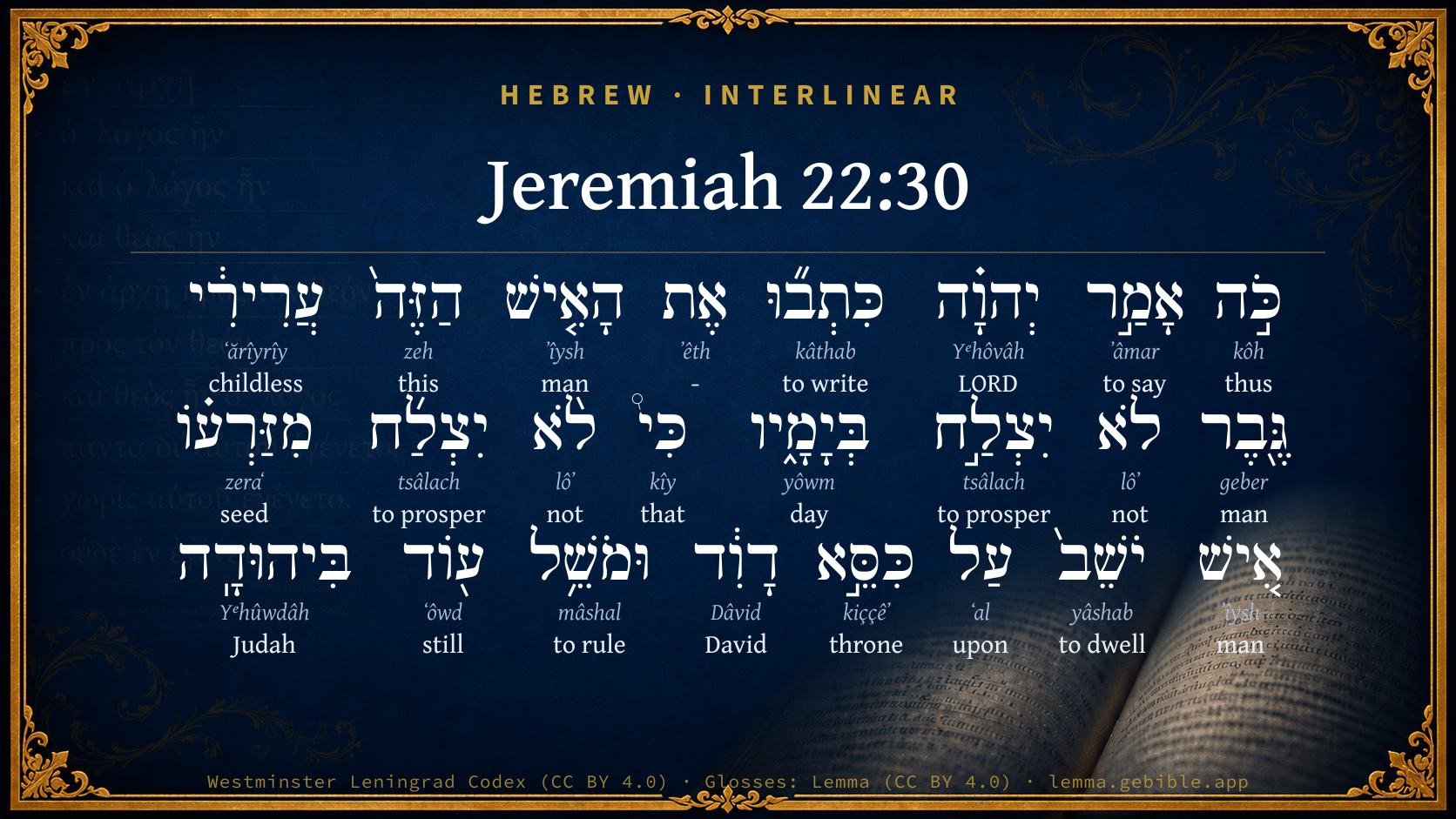
Hebrew (Westminster Leningrad Codex) Jeremiah 22:30 appears in the Hebrew Old Testament. The text above is from the Westminster Leningrad Codex. Each word links to its Strong’s number, a concise gloss, and parsing drawn from the Open Scriptures Hebrew Bible morphology. Click any word for its full Brown-Driver-Briggs (BDB) entry.
Download image
Cite this verse

Jeremiah 22:30 (World English Bible). Public Domain. Lemma interlinear Bible study tool, https://lemma.gebible.app/v/jeremiah/22/30.

Show BibTeX & RIS
BibTeX
RIS
English Translation
Thus says Yahweh, Write you this man childless, a man who shall not prosper in his days; for no more shall a man of his seed prosper, sitting on the throne of David, and ruling in Judah.
World English Bible · Public Domain
Download a study sheet

One document with this verse’s original text, its word-by-word gloss line, the meaning frame, cross-references with their text, attributed commentary, and full source and license credits — printable, and it pastes into notes with its structure intact.

This verse Autodidact and up

Study sheet (.html) Plain text (.txt)

A passage Seminary Student

Up to 50 verses in one chapter. A passage sheet keeps up to 6 commentary sources and 12 cross-references per verse, in the order this page ranks them, and says so on the sheet whenever that leaves anything out. Ask for a single verse and you get the Autodidact verse sheet above.

Everything on this page stays free to read, with no account — the sheet is a download of what is already on screen, not access to it.

Want to remove ads? Support Godless Engineer
Compare translations 3

The same verse in 3 English versions, stacked beneath the original-language interlinear above. Click any original word for its lexicon entry.

Each is an independent rendering of the whole verse — the interlinear is not word-aligned to these translations.

Highlighted words mark where these versions differ — a whole-verse word diff, not a word-by-word alignment.

  • World English Bible Public Domain
    Thus says Yahweh, Write you this man childless, a man who shall not prosper in his days; for no more shall a man of his seed prosper, sitting on the throne of David, and ruling in Judah.
  • King James Version Public Domain
    Thus saith the LORD, Write ye this man childless, a man that shall not prosper in his days: for no man of his seed shall prosper, sitting upon the throne of David, and ruling any more in Judah.
  • unfoldingWord Literal Text CC BY-SA 4.0
    Thus says Yahweh: “Write down this man childless, a man will not prosper in his days, for no man from his seed shall prosper, sitting on the throne of David and ruling again in Judah.”

unfoldingWord Literal Text — © unfoldingWord, licensed CC BY-SA 4.0. Word-aligned USFM3 via Door43 (git.door43.org/unfoldingWord/en_ult).

Versions to compare (up to 4)

3 of 4 selected

Show all 18 translations

Every available English version of this verse, each an independent rendering of the whole verse.

  • World English Bible Public Domain
    Thus says Yahweh, Write you this man childless, a man who shall not prosper in his days; for no more shall a man of his seed prosper, sitting on the throne of David, and ruling in Judah.
  • Berean Standard Bible Public Domain
    This is what the LORD says: “Enroll this man as childless, a man who will not prosper in his lifetime. None of his descendants will prosper to sit on the throne of David or to rule again in Judah.”
  • Majority Standard Bible Public Domain
    This is what the LORD says: “Enroll this man as childless, a man who will not prosper in his lifetime. None of his descendants will prosper to sit on the throne of David or to rule again in Judah.”
  • King James Version Public Domain
    Thus saith the LORD, Write ye this man childless, a man that shall not prosper in his days: for no man of his seed shall prosper, sitting upon the throne of David, and ruling any more in Judah.
  • American Standard Version (1901) Public Domain
    Thus saith Jehovah, Write ye this man childless, a man that shall not prosper in his days; for no more shall a man of his seed prosper, sitting upon the throne of David, and ruling in Judah.
  • Revised Version (1885) Public Domain
    Thus saith the LORD, Write ye this man childless, a man that shall not prosper in his days: for no man of his seed shall prosper, sitting upon the throne of David, and ruling any more in Judah.
  • Geneva Bible (1599) Public Domain
    Thus saith the Lord, Write this man destitute of children, a man that shall not prosper in his dayes: for there shall be no man of his seede that shall prosper and sit vpon the throne of Dauid, or beare rule any more in Iudah.
  • Douay-Rheims (1899) Public Domain
    Thus saith the Lord: Write this man barren, a man that shall not prosper in his days: for there shall not be a man of his seed that shall sit upon the throne of David, and have power any more in Juda.
  • Young's Literal Translation Public Domain
    Thus said Jehovah: Write ye this man childless, A man -- he doth not prosper in his days, For none of his seed doth prosper, Sitting on the throne of David, And ruling again in Judah!
  • Literal Standard Version CC BY-SA 4.0
    Thus said YHWH: “Write this man down [as] childless, || A man—he does not prosper in his days, || For none of his seed prospers, || Sitting on the throne of David, || And ruling in Judah again!”
  • Unlocked Literal Bible CC BY-SA 4.0
    Yahweh says this, 'Write about this man Jehoiachin: He will be childless. He will not prosper during his days, and no one among his descendants will achieve success or ever again sit on David's throne and rule over Judah.'”
  • unfoldingWord Literal Text CC BY-SA 4.0
    Thus says Yahweh: “Write down this man childless, a man will not prosper in his days, for no man from his seed shall prosper, sitting on the throne of David and ruling again in Judah.”
  • Darby Bible Public Domain
    Thus saith Jehovah: Write this man childless, a man that shall not prosper in his days; for no man of his seed shall prosper, sitting upon the throne of David, and ruling any more in Judah.
  • World Messianic Bible Public Domain
    The LORD says, “Record this man as childless, a man who will not prosper in his days; for no more will a man of his offspring prosper, sitting on David’s throne and ruling in Judah.”
  • Webster's Bible Public Domain
    Thus saith the LORD, Write ye this man childless, a man that shall not prosper in his days: for no man of his seed shall prosper, sitting upon the throne of David, and ruling any more in Judah.
  • Free Bible Version CC BY-SA 4.0
    This is what the Lord says: Put this man down as having no children. He's a man who won't ever be successful in his whole life. None of his children will ever be successful either. None of them will sit on David's throne or be king in Judah.
  • Bible in Basic English Public Domain
    The Lord has said, Let this man be recorded as having no children, a man who will not do well in all his life: for no man of his seed will do well, seated on the seat of the kingdom of David and ruling again in Judah.
  • JPS Tanakh (1917) Public Domain
    Thus saith the LORD: Write ye this man childless, a man that shall not prosper in his days; for no man of his seed shall prosper, sitting upon the throne of David, and ruling any more in Judah.

Literal Standard Version (2020), Covenant Press — licensed CC BY-SA 4.0. Text via the HelloAO Bible API (eBible.org). Unlocked Literal Bible (unfoldingWord) — licensed CC BY-SA 4.0. Text via the HelloAO Bible API (eBible.org). unfoldingWord Literal Text — © unfoldingWord, licensed CC BY-SA 4.0. Word-aligned USFM3 via Door43 (git.door43.org/unfoldingWord/en_ult). Free Bible Version, Dr. Jonathan Gallagher — licensed CC BY-SA 4.0. Text via the HelloAO Bible API (eBible.org).

Word by word

More ways to search: Search by grammar → Find every occurrence → Compare this word →

Practice this passage: Drill this verse → Learn its vocabulary →

עֲרִירִ֔י
ʻărîyrîy
H6185
“childless”
Adjective, Adjective, Masculine, Singular, Absolute
Part of Speech
Adjective
Type
Adjective
Gender
Masculine
Number
Singular
State
Absolute
Full BDB Definition

Origin: from H6209

TWOT: 1705a

stripped, childless, bare of children
  1. כֹּ֣ה kôh H3541 “thus” Adverb
  2. אָמַ֣ר ʼâmar H559 “to say” Verb, Qal, Perfect, 3rd Person, Masculine, Singular
  3. יְהוָ֗ה Yᵉhôvâh H3068 “LORD” Noun, Proper
  4. כִּתְב֞וּ kâthab H3789 “write” Verb, Qal, Imperative, 2nd Person, Masculine, Plural
  5. אֶת ʼêth H853 “-” Particle, Direct Object
  6. הָאִ֤ישׁ ʼîysh H376 “the · man” Particle, Definite Article + Noun, Common, Masculine, Singular, Absolute
  7. הַזֶּה֙ zeh H2088 “the · this” Particle, Definite Article + Pronoun, Demonstrative, Masculine, Singular
  8. גֶּ֖בֶר geber H1397 “man” Noun, Common, Masculine, Singular, Absolute
  9. לֹא lôʼ H3808 “not” Particle, Negative
  10. יִצְלַ֣ח tsâlach H6743 “to prosper” Verb, Qal, Imperfect, 3rd Person, Masculine, Singular
  11. בְּיָמָ֑יו yôwm H3117 “in/at · days · his” Preposition + Noun, Common, Masculine, Plural, Construct + Suffix, Personal, 3rd Person, Masculine, Singular
  12. כִּי֩ kîy H3588 “that” Conjunction
  13. לֹ֨א lôʼ H3808 “not” Particle, Negative
  14. יִצְלַ֜ח tsâlach H6743 “to prosper” Verb, Qal, Imperfect, 3rd Person, Masculine, Singular
  15. מִזַּרְע֗וֹ zeraʻ H2233 “from · seed · his” Preposition + Noun, Common, Masculine, Singular, Construct + Suffix, Personal, 3rd Person, Masculine, Singular
  16. אִ֚ישׁ ʼîysh H376 “man” Noun, Common, Masculine, Singular, Absolute
  17. יֹשֵׁב֙ yâshab H3427 “dwelling” Verb, Qal, Participle Active, Masculine, Singular, Absolute
  18. עַל ʻal H5921 “upon” Preposition
  19. כִּסֵּ֣א kiççêʼ H3678 “throne of” Noun, Common, Masculine, Singular, Construct
  20. דָוִ֔ד Dâvid H1732 “David” Noun, Proper
  21. וּמֹשֵׁ֥ל mâshal H4910 “and · ruling” Conjunction + Verb, Qal, Participle Active, Masculine, Singular, Absolute
  22. ע֖וֹד ʻôwd H5750 “still” Adverb
  23. בִּיהוּדָֽה Yᵉhûwdâh H3063 “in/at · Judah” Preposition + Noun, Proper

About this verse

These counts appear in no published source. They are computed here, from the morphology-tagged text and Lemma’s own curated glosses. What Lemma adds →

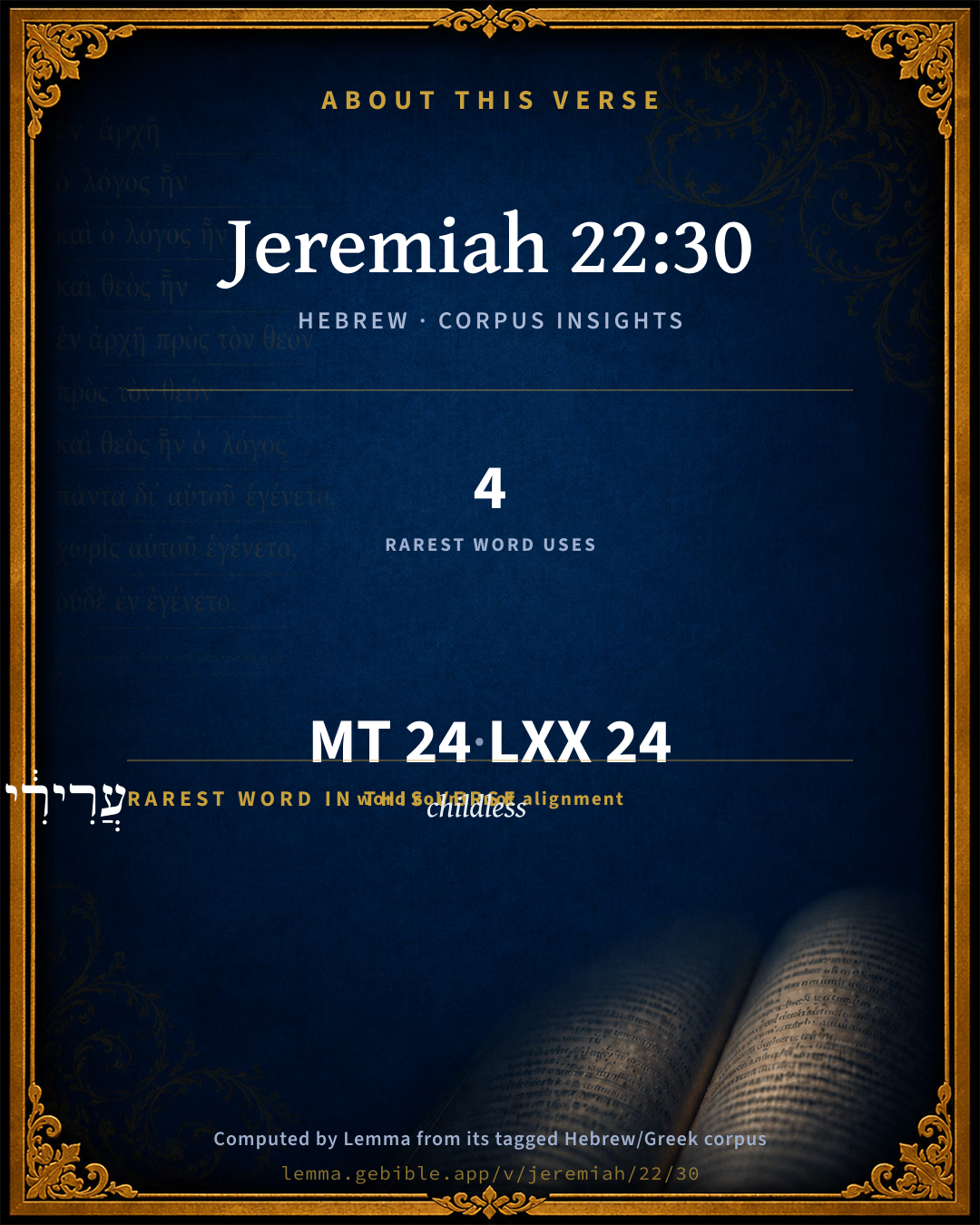
24
words
21
distinct lemmas
Prophets
section

Notable vocabulary

The rarest word here is עֲרִירִ֔י childless H6185 — appearing just 4 times in the whole Hebrew Bible.

Shared distinctive vocabulary

עֲרִירִ֔י childless H6185 occurs in 4 verses of the Hebrew Bible. Also found in:

Grammatical profile

  • 6 verbs
  • 9 nouns
  • 1 adjective
  • 1 pronoun
  • 1 preposition
  • 1 conjunction
  • 2 adverbs
  • 3 particles

Verb forms

  • אָמַ֣ר Qal · Perfect
  • כִּתְב֞וּ Qal · Imperative
  • יִצְלַ֣ח Qal · Imperfect
  • יִצְלַ֜ח Qal · Imperfect
  • יֹשֵׁב֙ Qal · Participle Active
  • וּמֹשֵׁ֥ל Qal · Participle Active

Repetition

Words recur within this verse — often emphatic in Hebrew:

  • הָאִ֤ישׁ man H376 ×2
  • יִצְלַ֣ח to prosper H6743 ×2
  • לֹא not H3808 ×2

Hebrew & Septuagint length

In the original languages it is 24 Hebrew tokens and 24 Greek tokens — but the two are counted differently (Hebrew bundles its prefixes and suffixes into one token; the Greek is in lemma form), so that isn’t a like-for-like length.

Cross-references

6

Topical passages linked to Jeremiah 22:30 in the Treasury of Scripture Knowledge — connected by theme and wording, ordered by reader-vote popularity; previews shown in the World English Bible.

  • Jeremiah 36:30 Therefore thus says Yahweh concerning Jehoiakim king of Judah: He shall have none to sit on the throne of David; and his dead body shall be cast out in the day to the heat, and in the night to the frost.
  • Psalms 94:20 Shall the throne of wickedness have fellowship with you, Which brings about mischief by statute?
  • Matthew 1:11–16 Josiah became the father of Jechoniah and his brothers, at the time of the exile to Babylon.
  • 1 Chronicles 3:16–17 The sons of Jehoiakim: Jeconiah his son, Zedekiah his son.
  • Jeremiah 10:21 For the shepherds are become brutish, and have not inquired of Yahweh: therefore they have not prospered, and all their flocks are scattered.
  • Luke 1:32–33 He will be great, and will be called the Son of the Most High. The Lord God will give him the throne of his father, David,

Cross-references courtesy of OpenBible.info (CC BY 4.0).

Hebrew and Greek witnesses Masoretic Hebrew ↔ Greek Septuagint

The same verse in the two great witnesses to the Old Testament, shown verse-for-verse.

These are two independent witnesses, not word-aligned to each other, and the Septuagint is shown in lemma (dictionary) form.

Hebrew Jeremiah 22:30 Masoretic · Westminster Leningrad Codex

כֹּ֣ה אָמַ֣ר יְהוָ֗ה כִּתְב֞וּ אֶת הָאִ֤ישׁ הַזֶּה֙ עֲרִירִ֔י גֶּ֖בֶר לֹא יִצְלַ֣ח בְּיָמָ֑יו כִּי֩ לֹ֨א יִצְלַ֜ח מִזַּרְע֗וֹ אִ֚ישׁ יֹשֵׁב֙ עַל כִּסֵּ֣א דָוִ֔ד וּמֹשֵׁ֥ל ע֖וֹד בִּיהוּדָֽה

Thus says Yahweh, Write you this man childless, a man who shall not prosper in his days; for no more shall a man of his seed prosper, sitting on the throne of David, and ruling in Judah.

World English Bible · Public Domain

Greek LXX Structure differs

In the Septuagint, Jeremiah is about an eighth shorter than the Hebrew and arranges its material differently — the Oracles Against the Nations (Hebrew chapters 46–51) appear in the middle of the Greek book, after 25:13. Because the chapter and verse boundaries do not line up, a verse-for-verse comparison with the Hebrew is not shown.

A verse-for-verse comparison isn’t shown here because the chapters and verses don’t line up. Switch to the LXX edition with the MT / LXX toggle above to read the Greek directly.

On this verse, Trapp's Complete Commentary discusses the Septuagint’s reading. Read the note in Commentary ↓

Hebrew: Westminster Leningrad Codex (CC BY 4.0). Greek: Septuagint (public domain); English from a public-domain English Septuagint. How the Septuagint differs from the Hebrew →

Targum (Aramaic paraphrase)

1

The Targum is the ancient Jewish Aramaic paraphrase of the Hebrew Scriptures — an interpretive translation, not the Hebrew text itself. Onkelos (literal) and Pseudo-Jonathan (expansive) render the Torah, and Jonathan the Prophets. Coverage is partial: where no permissively-licensed English translation exists for a verse, only the Aramaic is shown. This is verse-level text, not a word-by-word alignment to the Hebrew.

  1. Targum Jonathan Prophets (Joshua–Malachi)
    כִּדְנַן אֲמַר יְיָ כְּתוּבוּ יַת גַבְרָא הָדֵין דְלָא וְלַד גַבְרָא דְלָא יִצְלַח בְּיוֹמוֹהִי אֲרֵי לָא יִצְלַח מִזַרְעֵיהּ גְבַר יָתֵיב עַל כּוּרְסֵי דָוִד וְעָבֵיד שׁוּלְטַן עַל דְבֵית יְהדָה:

    (no public-domain English translation for this verse)

    Targum Jonathan — Aramaic: “Mikraot Gedolot” (public domain). English: “Sefaria Community Translation” (CC0 1.0 (public-domain dedication)); “London "Chaldee Paraphrase," 1871” (public domain). Text via Sefaria.

Commentary

Notes on Jeremiah 22:30 from classic Christian and Jewish commentators (each source and its license shown beneath its notes). The classic Christian expositions comment on the surrounding passage and are grouped to its opening verse, so a note may address several verses; the Jewish commentaries on the Tanakh (Rashi and others) are per-verse, so they appear only where the commentator wrote on this verse.

Lemma curates 59 commentaries, every one of them public domain or Creative Commons licensed, each selected and text-cleaned for this edition rather than reprinted as found. About our sources →

Trapp's Complete Commentary

John Trapp

Jer 22:30 Thus saith the LORD, Write ye this man childless, a man [that] shall not prosper in his days: for no man of his seed shall prosper, sitting upon the throne of David, and ruling any more in Judah.

Ver. 30. Write ye this man childless] {a} As to succession in the royal dignity, as well as to success in his reign. The Septuagint render it, A man abdicated or proscribed. This God would have to be written - that is, to be put upon public record for the use of posterity. Our chronicles tell us of John Dudley, that great Duke of Northumberland, in King Edward VI’s days - who endeavoured by all means to engrand his posterity, reaching at the crown also, which cost him his head - that though he had six sons, all men, all married, yet none of them left any issue behind them. "Be wise now, therefore, O ye kings; serve the Lord with fear."

{a} Ariri - i.e., orbus vel solus, sicut in deserto myrica. - Fuller.

John Trapp, A Commentary or Exposition upon All the Books of the Old and New Testament (1647–1656) — public domain. Text from a community e-Sword module.

Tyndale Open Study Notes

Tyndale Open Resources

22:30 Although Jehoiachin had seven sons (see 1 Chr 3:17), he was called childless because none of them ever sat on the throne of Judah. His uncle Zedekiah later reigned as king of Judah, but many Israelites regarded Jehoiachin as the last legitimate king of David’s dynasty (see study note on Ezek 1:2).

Tyndale Open Study Notes — © Tyndale Open Resources, licensed CC BY-SA 4.0. Text via the HelloAO Bible API.

Geneva Bible (1599)

Geneva Bible translators

Not that he had no children (for after that he begat Shealtiel in the captivity, Matt. 1:12) but that none should reign after him as King.

Geneva Bible (1599) marginal notes — public domain. Text via Bolls.life.

Adam Clarke's Commentary

Verse 30. Write ye this man childless] Though he had seven sons, 1Ch 3:17, yet having no successor, he is to be entered on the genealogical tables as one without children, for none of his posterity ever sat on the throne of David.

Adam Clarke's Commentary on the Bible (1810–1826) — public domain. Text from a community e-Sword/MySword module.

John Calvin's Commentaries

Then he adds, Thus saith Jehovah, Write ye this man solitary, or childless. Some think that these words were addressed to angels or to prophets; but I regard not such a notion as well founded: this mode of speaking seems rather to me to have been taken from common practice, for decrees which were to continue in force for a long time were usually written. When an edict was proclaimed, and was to be in force only for a few days, it was not commonly recorded in the public monuments; but when a law was enacted, which was to be binding on posterity, it was written in the public tablets. Then the Prophet intimates that this judgment of God could not be rendered void, nor would be momentary like decrees which in a few days are disregarded and soon forgotten, but that it would be certain and permanent. Write ye, then, this man childless This bereavement is set in opposition to the promise of God, that there would be perpetual successors to David on his throne as long as the sun and moon were in the heavens. (Psalm 89:37.) And the Prophet shews here that this promise as to Jeconiah would not be fulfilled.

And he adds, Write ye this man as one who will not prosper in his days; nay, (for כי, seems to me to be emphatic here,) no one of his seed shall prosper; and then he adds an explanation, sitting on the throne of David, and ruling any more in Judah.

Now, it is no wonder that the Jews regarded this judgment of God with abhorrence, as though it was something monstrous, for God seemed to them to be inconsistent with himself, for he had testified that his covenant would never be rendered void, and had appealed to the sun and moon as witnesses. Hence, when the posterity of David failed, at least when his throne was subverted, and no one appeared as his successor, the truth of the promise seemed to have failed, which was very strange. But it was possible for God, who doeth wonders, to execute such punishment on Jeconiah and on such as were like him, and yet in a secret and incomprehensible manner to bring things about, so that the covenant which he had made should not wholly fail. The grace of God, then, was hidden for a time, but never extinguished; for at length a rod did grow up from the stem of Jesse, as it is said by Isaiah.

However, the words seem to imply otherwise, for Jeconiah is said to be solitary, and then unprosperous; and lastly, the Prophet declares that no one of his seed would sit on the royal throne. But we must bear in mind that these words are to be confined to a temporary punishment, and extend only to the coming of Christ, though the posterity of David, as we shall hereafter see, did begin to arise in Zerubbabel, but this was only an obscure and a small prelude. We must, therefore, come to the time of Christ if we would reconcile these two things which seem repugnant, — that Jeconiah became childless, and that a successor from the seed of David never failed; it was so, because this childlessness was only for a time; and this interruption of God’s grace was something like death; but in course of time it appeared that God was mindful of his covenant, even at a time when he seemed to have forgotten it. And this prophecy, therefore, ought; to be connected with that of Ezekiel,

“Remove ye, remove, remove the crown until he comes whose it is.” (Ezekiel 21:26, 27.)

There, also, Ezekiel repeats the word “remove” three times, as though he had said that there would be no kingdom of David, not only for a few months or years, but through a series of many ages.

There is no wonder, then, that the Prophet declares here that Jeconiah would be childless, for such a sad calamity for so many ages, as the throne of David trodden under foot with scorn and contempt, might have overwhelmed the faithful with despair. This, then, was the reason why he said that he would be childless, and also that his whole posterity would be under a curse. But we must bear in mind that exception, which is expressed by another Prophet,

“until he comes whose the crown is.” (Ezekiel 21:27)

For it was reserved for the head of Christ, though for a long time it had been exposed to dishonor and to the reproaches of all nations.

Now it is useful to know this, for we are taught that God is ever so consistent with himself, that his covenant, which he has made with Christ and with all his members, never fails, and that yet he punishes hypocrites even unto death. If any one, during a long period, had sought for the Church in the world, there was none in appearance; yet God shewed that he was faithful to his promises, for suddenly there arose a people regenerated by the Gospel, so that his covenant was not dead, but as it were for a time buried. The truth of God, then, was proved by the event; and yet he took a dreadful vengeance on the ingratitude of men when he thus blinded the whole world, now follows —

John Calvin's Commentaries (1540-1563) — public domain. Text from the Calvin Translation Society English edition (1840s-50s) via the Christian Classics Ethereal Library (ccel.org). Calvin's coverage is partial (roughly two-thirds of the Bible); uncommented books and verses are honest gaps, never fabricated. The 19th-century editor's footnotes and remarks are omitted so the notes are faithfully Calvin's own voice.

Ellicott's Commentary for English Readers

(30) Write ye this man childless.—The meaning of the prediction, as explained by the latter clause of the verse, was fulfilled in Jeconiah’s being the last kingly representative of the house of David, his uncle Zedekiah, who succeeded him, perishing before him (Jer_52:31). In him the sceptre departed, and not even Zerubbabel sat upon the throne of Judah. Whether he died actually childless is less certain. In 1Ch_3:17 Assir (possibly, however, the name should be translated “Jeconiah the prisoner”) appears as his son, and as the father of Salathiel, or Shealtiel; and in Mat_1:12 we find “Jechonias begat Salathiel.” In these genealogies, however, adoption or succession, or a Levirate marriage so constantly takes the place of parentage, that nothing certain can be inferred from these data, and St. Luke (Luk_3:27) places Salathiel among the descendants of Nathan, as though the line of Solomon became extinct in Jeconiah, and was replaced by the collateral branch of the house of David (see Note on Luk_3:23). The command, “write ye this man childless,” is apparently addressed to the “scribes who kept the register of the royal genealogies (Eze_13:9; Psa_69:28-29). They were told how, without waiting for his death, they were to enter Coniah’s name in that register.

A Bible Commentary for English Readers, edited by Charles John Ellicott (1878–1897) — public domain. Text from a community e-Sword module.

The Cambridge Bible for Schools and Colleges

gen. ed. J. J. S. Perowne

30. Write ye] For the word in the sense of enter in a register of citizens cp. Isa_4:3; Psa_87:6.

childless] In 1Ch_3:17, etc. he appears to have had children, and Shealtiel (Mat_1:12) is reckoned as his son. Shealtiel was, however, descended from David through his son Nathan (Luk_3:27-31) and not through the line of the kings (Solomon, Rehoboam, etc.), and thus was only counted to Jehoiachin (“Jechoniah” of Mat_1:12) according to the legal not the natural line. It was thus at any rate true that no child of Jehoiachin succeeded to the throne.

The Cambridge Bible for Schools and Colleges (gen. ed. J. J. S. Perowne; Cambridge University Press, 1878–1918) — public domain. Text from a community e-Sword module.

John Gill's Exposition

Thus saith the Lord, write ye this man childless,.... That is, Coniah, or Jeconiah; who though he had children in the captivity, yet they died in it, or however never succeeded him in the throne. This, to show the certainty of the thing, the Lord would have written. The speech is directed, as some think, to the angels, or to the prophets; though the words may be rendered impersonally, "let this man be written childless", it may be set down, and taken for a sure and certain thing, as though it was written with a pen of iron, that he shall be alone, and die without children, and have none to reign after him;

a man that shall not prosper in his days; he sat but three months and ten days upon the throne, and all the rest of his days he lived in captivity, Ch2 36:9; so that he was a very unfortunate prince;

for no man of his seed shall prosper, sitting on the throne of David,

and ruling any more in Judah; none of them were so prosperous and happy as to arrive to the royal dignity, or to sit on the throne of David, and be kings of Judah. Here ended the race of kings of the house of David, until the King Messiah came; for though there were of his line that were governors of Judah, as Zerubbabel, yet not kings. Moreover, Jeconiah was the last of the house of David in the line of Solomon. Salathiel, of whom was Zerubbabel governor of Judah, was the son of Neri, who descended from Nathan the son of David; see Luk 3:29, compared with Mat 1:12; and See Gill on Luk 3:29 and See Gill on Luk 3:31 and See Gill on Mat 1:12.

Next: Jeremiah Chapter 23

John Gill's Exposition of the Whole Bible (1746–1763) — public domain (CC PDM 1.0). Text via the HelloAO Bible API.

Albert Barnes' Notes on the Bible

Childless - No child to sit on David’s throne. See 1Ch 3:17 note.

Jeconiah was the last king of David’s line. His uncle indeed actually reigned after him, but perished with his sons long before Jeconiah’s death (literally 10): and yet from so dead a trunk, from a family so utterly fallen, that spiritual King came forth whose name is “Yahweh our righteousness” Jer 23:5-6.

Albert Barnes' Notes on the Bible (1834–1885) — public domain. Text from a community e-Sword/MySword module.

Haydock's Catholic Bible Commentary

Write this man barren. That is childless: not that he had no children, but that his children should never sit on the throne of Juda, (Challoner) ver. 28., Matthew i. 12., and Ezechiel xvii. 24. Zorobabel was of his seed, yet he never obtained the title or sovereign power of a king. The Machabees were of a different family. (St. Jerome) --- Joachin, or Jechonias, was restored indeed to some favour, (4 Kings xxv. 27.) but not to the kingdom, no more than any of his posterity, till Christ. (Worthington)

George Leo Haydock (1774–1849), Haydock's Catholic Family Bible and Commentary, 1859 edition — public domain. Excludes Psalms (Douay-Rheims chapter numbering differs from Protestant) and Deuterocanonical books (Catholic canon only).

Matthew Poole's English Annotations

The word translated

childless is but thrice read in holy writ, and by various interpreters translated barren, not increasing, empty, full of sorrow, wanting children, &c. It is thought to be interpreted by the next words,

no man of his seed shall prosper, sitting upon the throne of David, and ruling any more in Judah; for there are seven of his sons named 1Ch 3:17,18. So that he is said to be childless, either because all hies children died before their father, or (which is most probable) because he had no child that sat upon the throne, or ever had any ruler’s place in Judah, but only some that lived in a mean condition in captivity, amongst whom Salathiel is named, Mat 1:12, as a progenitor of Christ.

Matthew Poole's English Annotations on the Holy Bible (1683–1685) — public domain. Text from a community e-Sword/MySword module.

Whedon's Commentary on the Bible

Daniel D. Whedon

30. Childless — As one with whom his stock becomes extinct — who has no posterity. This may be as a man, or as a king; but the latter sense seems most strictly relevant. This would not preclude the fact of children, and they would seem to be implied by Jer_22:28, “his seed.”

Daniel D. Whedon (gen. ed.), Commentary on the Old and New Testaments (1874–1909) — public domain. Text from a community e-Sword module.

The Pulpit Commentary

Write ye this man childless; i.e. enter him in the register of the citizens (comp. Isa_4:3) as one who has no heirs. He may have children, but none of them shall succeed to his place in the community. This is all that the passage means; there is no discrepancy with history: how should there be, when Jeremiah himself has mentioned the posterity of Jehoiachin (ver. 28 and the latter part of this verse)? Yet the Septuagint thought it necessary to avoid the appearance of such a discrepancy by rendering, not "childless," but "one proscribed" (ekkhrukton ).

The Pulpit Commentary (1880–1919), ed. H.D.M. Spence-Jones & Joseph S. Exell — public domain. Text from a community e-Sword module.

John Wesley's Explanatory Notes

Childless - He is said to be childless, either because all his children died before their father; or because he had no child that sat upon the throne, or ever had any ruler's place in Judah.

John Wesley, Explanatory Notes Upon the Whole Bible (1754–1765) — public domain. Text via the GEBible commentary corpus.

Rashi

Rabbi Shlomo Yitzchaki (Rashi)

a man who will not prosper in his days Inscribe him.

Rashi on the Tanakh — English translations: “The Judaica Press complete Tanach with Rashi, translated by A. J. Rosenberg” (CC BY 4.0); “Pentateuch with Rashi's commentary by M. Rosenbaum and A.M. Silbermann, 1929-1934” (public domain); “The Metsudah Tanach series, Lakewood, N.J” (CC BY 4.0); and “The Book of Joshua, Metsudah Publications, 1997” (CC BY 4.0). Text via Sefaria.

Lesson kit

Teaching starters — assembled from the data on this page, not authored interpretation. Every prompt links to the verse data it draws on. Edit before teaching.

Jeremiah, in the Prophets, opens this verse with 24 words (21 distinct Hebrew lemmas). Its most distinctive word is ʻărîyrîy (“childless”). A historical commentator’s framing appears above. Read the whole chapter for the surrounding context.

Discussion questions

  1. How does “childless” (ʻărîyrîy) shape what this verse is saying?
  2. Genesis 15:2 shares the word «childless» with this verse. How do the two illuminate each other?
  3. “man” occurs 2× in this one verse. What is the effect of the repetition?
  4. These translations render this verse differently. What is at stake in choosing one wording over another?
  5. The verb «אָמַ֣ר» is Qal Perfect. How does its form color the action?
  6. Reading how Trapp's Complete Commentary and Tyndale Open Study Notes read this verse, where do the two commentators agree and where do they part?

Things to notice

Reading settings

Reading text

Shown beneath each verse's original-language words.

Old Testament
Old Testament edition

Read the OT as the Masoretic Hebrew (MT) or the Greek Septuagint (LXX).

English shown for the Greek Septuagint (in the Hebrew ↔ Greek comparison).

Comparing translations? Open the Compare panel on any verse page to stack up to four side by side.