Jeremiah 30:2

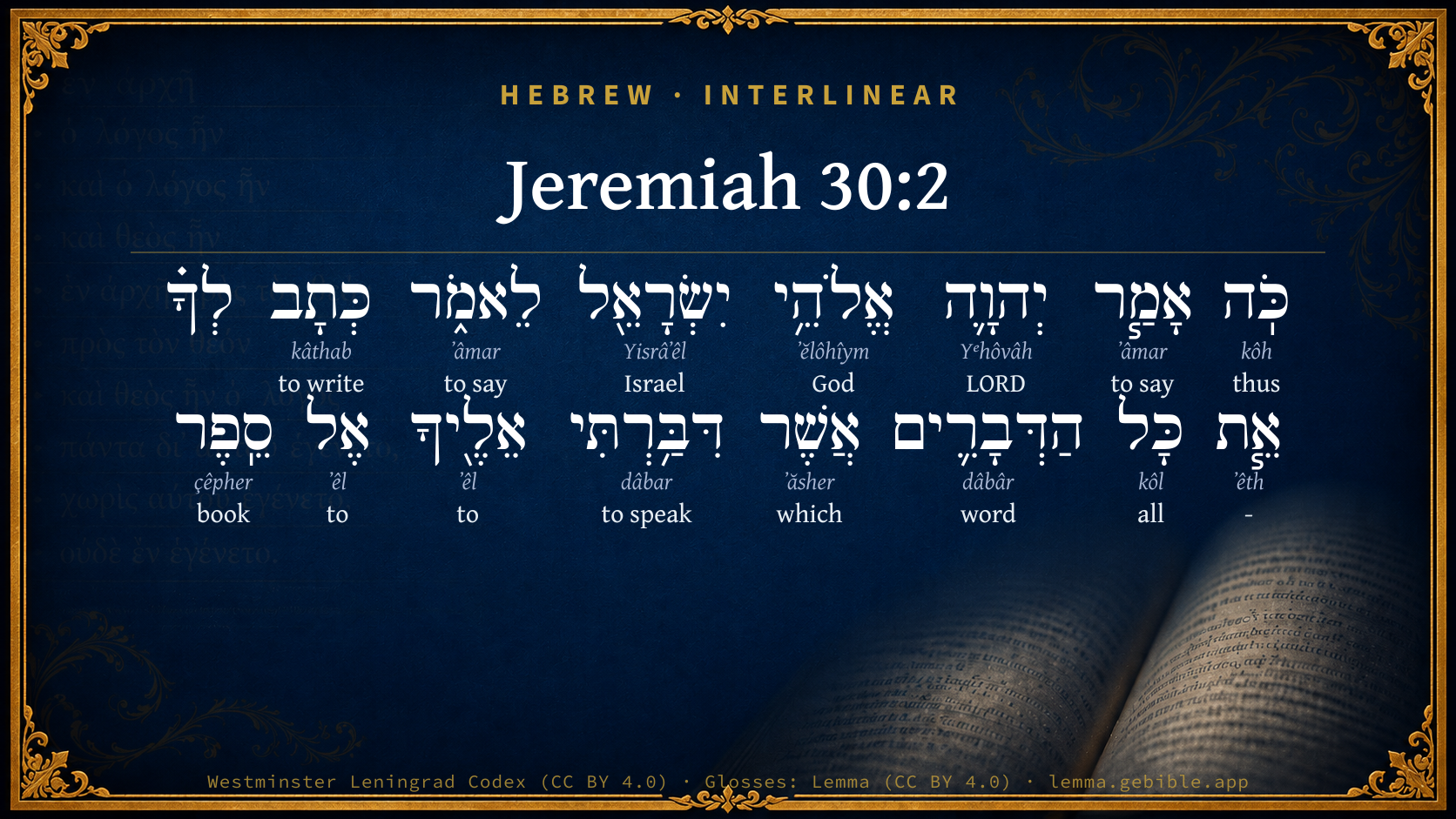
Hebrew (Westminster Leningrad Codex) Jeremiah 30:2 appears in the Hebrew Old Testament. The text above is from the Westminster Leningrad Codex. Each word links to its Strong’s number, a concise gloss, and parsing drawn from the Open Scriptures Hebrew Bible morphology. Click any word for its full Brown-Driver-Briggs (BDB) entry.
Download image
Cite this verse

Jeremiah 30:2 (World English Bible). Public Domain. Lemma interlinear Bible study tool, https://lemma.gebible.app/v/jeremiah/30/2.

Show BibTeX & RIS
BibTeX
RIS
English Translation
Thus speaks Yahweh, the God of Israel, saying, Write you all the words that I have spoken to you in a book.
World English Bible · Public Domain
Download a study sheet

One document with this verse’s original text, its word-by-word gloss line, the meaning frame, cross-references with their text, attributed commentary, and full source and license credits — printable, and it pastes into notes with its structure intact.

This verse Autodidact and up

Study sheet (.html) Plain text (.txt)

A passage Seminary Student

Up to 50 verses in one chapter. A passage sheet keeps up to 6 commentary sources and 12 cross-references per verse, in the order this page ranks them, and says so on the sheet whenever that leaves anything out. Ask for a single verse and you get the Autodidact verse sheet above.

Everything on this page stays free to read, with no account — the sheet is a download of what is already on screen, not access to it.

Want to remove ads? Support Godless Engineer
Compare translations 3

The same verse in 3 English versions, stacked beneath the original-language interlinear above. Click any original word for its lexicon entry.

Each is an independent rendering of the whole verse — the interlinear is not word-aligned to these translations.

Highlighted words mark where these versions differ — a whole-verse word diff, not a word-by-word alignment.

  • World English Bible Public Domain
    Thus speaks Yahweh, the God of Israel, saying, Write you all the words that I have spoken to you in a book.
  • King James Version Public Domain
    Thus speaketh the LORD God of Israel, saying, Write thee all the words that I have spoken unto thee in a book.
  • unfoldingWord Literal Text CC BY-SA 4.0
    “This is what Yahweh, God of Israel, says, ‘Write in a scroll all the words that I have spoken to you.

unfoldingWord Literal Text — © unfoldingWord, licensed CC BY-SA 4.0. Word-aligned USFM3 via Door43 (git.door43.org/unfoldingWord/en_ult).

Versions to compare (up to 4)

3 of 4 selected

Show all 18 translations

Every available English version of this verse, each an independent rendering of the whole verse.

  • World English Bible Public Domain
    Thus speaks Yahweh, the God of Israel, saying, Write you all the words that I have spoken to you in a book.
  • Berean Standard Bible Public Domain
    “This is what the LORD, the God of Israel, says: ‘Write in a book all the words that I have spoken to you.
  • Majority Standard Bible Public Domain
    “This is what the LORD, the God of Israel, says: ‘Write in a book all the words that I have spoken to you.
  • King James Version Public Domain
    Thus speaketh the LORD God of Israel, saying, Write thee all the words that I have spoken unto thee in a book.
  • American Standard Version (1901) Public Domain
    Thus speaketh Jehovah, the God of Israel, saying, Write thee all the words that I have spoken unto thee in a book.
  • Revised Version (1885) Public Domain
    Thus speaketh the LORD, the God of Israel, saying, Write thee all the words that I have spoken unto thee in a book.
  • Geneva Bible (1599) Public Domain
    Thus speaketh the Lord God of Israel, saying, Write thee all the wordes, that I haue spoken vnto thee in a booke.
  • Douay-Rheims (1899) Public Domain
    Thus saith the Lord, the God of Israel, saying: Write thee all the words that I have spoken to thee, in a book.
  • Young's Literal Translation Public Domain
    `Thus spake Jehovah, God of Israel, saying, Write for thee all the words that I have spoken unto thee on a book.
  • Literal Standard Version CC BY-SA 4.0
    “Thus spoke YHWH, God of Israel, saying, Write for yourself all the words that I have spoken to you on a scroll.
  • Unlocked Literal Bible CC BY-SA 4.0
    “This is what Yahweh, God of Israel, says, 'Write in a scroll all the words that I have spoken to you.
  • unfoldingWord Literal Text CC BY-SA 4.0
    “This is what Yahweh, God of Israel, says, ‘Write in a scroll all the words that I have spoken to you.
  • Darby Bible Public Domain
    Thus speaketh Jehovah the God of Israel, saying, Write thee in a book all the words that I have spoken unto thee.
  • World Messianic Bible Public Domain
    “The LORD, the God of Israel, says, ‘Write all the words that I have spoken to you in a book.
  • Webster's Bible Public Domain
    Thus speaketh the LORD God of Israel, saying, Write for thee all the words that I have spoken to thee in a book.
  • Free Bible Version CC BY-SA 4.0
    This is what the Lord, the God of Israel, says: Write down in a book everything I've told you.
  • Bible in Basic English Public Domain
    The Lord, the God of Israel, has said, Put down in a book all the words which I have said to you.
  • JPS Tanakh (1917) Public Domain
    'Thus speaketh the LORD, the God of Israel, saying: Write thee all the words that I have spoken unto thee in a book.

Literal Standard Version (2020), Covenant Press — licensed CC BY-SA 4.0. Text via the HelloAO Bible API (eBible.org). Unlocked Literal Bible (unfoldingWord) — licensed CC BY-SA 4.0. Text via the HelloAO Bible API (eBible.org). unfoldingWord Literal Text — © unfoldingWord, licensed CC BY-SA 4.0. Word-aligned USFM3 via Door43 (git.door43.org/unfoldingWord/en_ult). Free Bible Version, Dr. Jonathan Gallagher — licensed CC BY-SA 4.0. Text via the HelloAO Bible API (eBible.org).

Word by word

More ways to search: Search by grammar → Find every occurrence → Compare this word →

Practice this passage: Drill this verse → Learn its vocabulary →

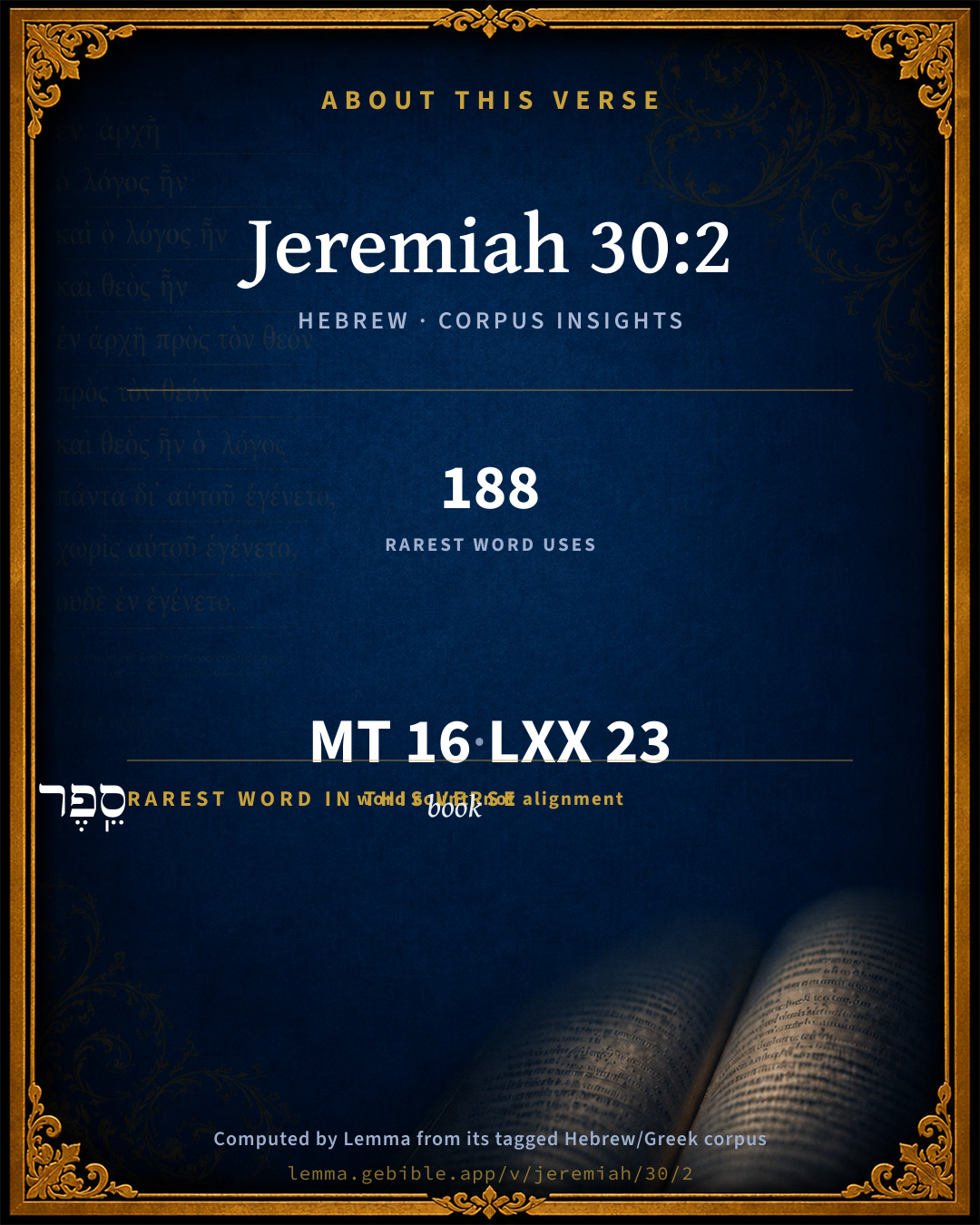
סֵֽפֶר
çêpher
H5612
“book”
Noun, Common, Masculine, Singular, Absolute
Part of Speech
Noun
Type
Common
Gender
Masculine
Number
Singular
State
Absolute
Full BDB Definition

Origin: from H5608

TWOT: 1540a , 1540b

book (noun feminine) - missive, document, writing, book (noun masculine) - missive - letter (of instruction), written order, commission, request, written decree - legal document, certificate of divorce, deed of purchase, indictment, sign - book, scroll - book of prophecies - genealogical register - law-book - book (of poems) - book (of kings) - books of the canon, scripture - record book (of God) - book-learning, writing - be able to read (after verb 'to know')
  1. כֹּֽה kôh H3541 “thus” Adverb
  2. אָמַ֧ר ʼâmar H559 “to say” Verb, Qal, Perfect, 3rd Person, Masculine, Singular
  3. יְהוָ֛ה Yᵉhôvâh H3068 “LORD” Noun, Proper
  4. אֱלֹהֵ֥י ʼĕlôhîym H430 “God(s) of” Noun, Common, Masculine, Plural, Construct
  5. יִשְׂרָאֵ֖ל Yisrâʼêl H3478 “Israel” Noun, Proper
  6. לֵאמֹ֑ר ʼâmar H559 “to say” Preposition + Verb, Qal, Infinitive Construct
  7. כְּתָב kâthab H3789 “write” Verb, Qal, Imperative, 2nd Person, Masculine, Singular
  8. אֵ֧ת ʼêth H853 “-” Particle, Direct Object
  9. כָּל kôl H3605 “all of” Noun, Common, Masculine, Singular, Construct
  10. הַדְּבָרִ֛ים dâbâr H1697 “the · words” Particle, Definite Article + Noun, Common, Masculine, Plural, Absolute
  11. אֲשֶׁר ʼăsher H834 “which” Particle, Relative
  12. דִּבַּ֥רְתִּי dâbar H1696 “to speak” Verb, Piel, Perfect, 1st Person, Common, Singular
  13. אֵלֶ֖יךָ ʼêl H413 “to · you” Preposition + Suffix, Personal, 2nd Person, Masculine, Singular
  14. אֶל ʼêl H413 “to” Preposition

About this verse

These counts appear in no published source. They are computed here, from the morphology-tagged text and Lemma’s own curated glosses. What Lemma adds →

16
words
13
distinct lemmas
Prophets
section

Grammatical profile

  • 4 verbs
  • 6 nouns
  • 3 prepositions
  • 1 adverb
  • 2 particles

Verb forms

  • אָמַ֧ר Qal · Perfect
  • לֵאמֹ֑ר Qal · Infinitive Construct
  • כְּתָב Qal · Imperative
  • דִּבַּ֥רְתִּי Piel · Perfect

Repetition

Words recur within this verse — often emphatic in Hebrew:

  • אָמַ֧ר to say H559 ×2
  • אֵלֶ֖יךָ to H413 ×2

Hebrew & Septuagint length

In the original languages it is 16 Hebrew tokens and 23 Greek tokens — but the two are counted differently (Hebrew bundles its prefixes and suffixes into one token; the Greek is in lemma form), so that isn’t a like-for-like length.

Cross-references

16

Topical passages linked to Jeremiah 30:2 in the Treasury of Scripture Knowledge — connected by theme and wording, ordered by reader-vote popularity; previews shown in the World English Bible.

  • Isaiah 30:8 Now go, write it before them on a tablet, and inscribe it in a book, that it may be for the time to come forever and ever.
  • Jeremiah 36:32 Then took Jeremiah another scroll, and gave it to Baruch the scribe, the son of Neriah, who wrote therein from the mouth of Jeremiah all the words of the book which Jehoiakim king of Judah had burned in the fire; and there were added besides to them many like words.
  • Jeremiah 36:2–4 Take a scroll of a book, and write therein all the words that I have spoken to you against Israel, and against Judah, and against all the nations, from the day I spoke to you, from the days of Josiah, even to this day.
  • Jeremiah 51:60–64 Jeremiah wrote in a book all the evil that should come on Babylon, even all these words that are written concerning Babylon.
  • Habakkuk 2:2–3 Yahweh answered me, "Write the vision, and make it plain on tablets, that he may run who reads it.
  • Romans 15:4 For whatever things were written before were written for our learning, that through patience and through encouragement of the Scriptures we might have hope.
  • 1 Corinthians 10:11 Now all these things happened to them by way of example, and they were written for our admonition, on whom the ends of the ages have come.
  • 2 Peter 1:21 For no prophecy ever came by the will of man: but holy men of God spoke, being moved by the Holy Spirit.
  • Revelation 1:11 saying, "What you see, write in a book and send to the seven assemblies: to Ephesus, Smyrna, Pergamum, Thyatira, Sardis, Philadelphia, and to Laodicea."
  • Revelation 1:19 Write therefore the things which you have seen, and the things which are, and the things which will happen hereafter;
  • Exodus 17:14 Yahweh said to Moses, "Write this for a memorial in a book, and rehearse it in the ears of Joshua: that I will utterly blot out the memory of Amalek from under the sky."
  • Deuteronomy 31:19 Now therefore write you this song for you, and teach you it the children of Israel: put it in their mouths, that this song may be a witness for me against the children of Israel.
  • Job 19:23–24 "Oh that my words were now written! Oh that they were inscribed in a book!
  • Isaiah 8:1 Yahweh said to me, "Take a large tablet, and write on it with a man's pen, 'For Maher Shalal Hash Baz;'
  • Daniel 12:4 But you, Daniel, shut up the words, and seal the book, even to the time of the end: many shall run back and forth, and knowledge shall be increased."
  • Deuteronomy 31:22–27 So Moses wrote this song the same day, and taught it the children of Israel.

Cross-references courtesy of OpenBible.info (CC BY 4.0).

Hebrew and Greek witnesses Masoretic Hebrew ↔ Greek Septuagint

The same verse in the two great witnesses to the Old Testament, shown verse-for-verse.

These are two independent witnesses, not word-aligned to each other, and the Septuagint is shown in lemma (dictionary) form.

Hebrew Jeremiah 30:2 Masoretic · Westminster Leningrad Codex

כֹּֽה אָמַ֧ר יְהוָ֛ה אֱלֹהֵ֥י יִשְׂרָאֵ֖ל לֵאמֹ֑ר כְּתָב לְךָ֗ אֵ֧ת כָּל הַדְּבָרִ֛ים אֲשֶׁר דִּבַּ֥רְתִּי אֵלֶ֖יךָ אֶל סֵֽפֶר

Thus speaks Yahweh, the God of Israel, saying, Write you all the words that I have spoken to you in a book.

World English Bible · Public Domain

Greek LXX Structure differs

In the Septuagint, Jeremiah is about an eighth shorter than the Hebrew and arranges its material differently — the Oracles Against the Nations (Hebrew chapters 46–51) appear in the middle of the Greek book, after 25:13. Because the chapter and verse boundaries do not line up, a verse-for-verse comparison with the Hebrew is not shown.

A verse-for-verse comparison isn’t shown here because the chapters and verses don’t line up. Switch to the LXX edition with the MT / LXX toggle above to read the Greek directly.

Hebrew: Westminster Leningrad Codex (CC BY 4.0). Greek: Septuagint (public domain); English from a public-domain English Septuagint. How the Septuagint differs from the Hebrew →

Targum (Aramaic paraphrase)

1

The Targum is the ancient Jewish Aramaic paraphrase of the Hebrew Scriptures — an interpretive translation, not the Hebrew text itself. Onkelos (literal) and Pseudo-Jonathan (expansive) render the Torah, and Jonathan the Prophets. Coverage is partial: where no permissively-licensed English translation exists for a verse, only the Aramaic is shown. This is verse-level text, not a word-by-word alignment to the Hebrew.

  1. Targum Jonathan Prophets (Joshua–Malachi)
    כִּדְנַן אֲמַר יְיָ אֱלָהָא דְיִשְׂרָאֵל לְמֵימָר כְּתַב לָךְ יַת כָּל פִּתְגָמַיָא דְמַלְלֵית עִמָךְ עַל סִפְרָא:

    (no public-domain English translation for this verse)

    Targum Jonathan — Aramaic: “Mikraot Gedolot” (public domain). English: “Sefaria Community Translation” (CC0 1.0 (public-domain dedication)); “London "Chaldee Paraphrase," 1871” (public domain). Text via Sefaria.

Commentary

Notes on Jeremiah 30:2 from classic Christian and Jewish commentators (each source and its license shown beneath its notes). The classic Christian expositions comment on the surrounding passage and are grouped to its opening verse, so a note may address several verses; the Jewish commentaries on the Tanakh (Rashi and others) are per-verse, so they appear only where the commentator wrote on this verse.

Lemma curates 59 commentaries, every one of them public domain or Creative Commons licensed, each selected and text-cleaned for this edition rather than reprinted as found. About our sources →

Trapp's Complete Commentary

John Trapp

Jer 30:2 Thus speaketh the LORD God of Israel, saying, Write thee all the words that I have spoken unto thee in a book.

Ver. 2. Write thee all the words that I have spoken to thee in a book.] For the use of posterity, {as Hab 2:2} and that the consolations may not be forgotten. {as Heb 12:5}

“ Vox audita perit: littera scripta manet. ”

John Trapp, A Commentary or Exposition upon All the Books of the Old and New Testament (1647–1656) — public domain. Text from a community e-Sword module.

Joseph Benson's Commentary

Jer 30:2-3. Thus speaketh the Lord, Write thee all the words that I have spoken, &c. — The following words contain a promise of the restoration of God’s people. These God commands to be committed to writing for the use of posterity, to be a support to the Jews, an encouragement to them to trust in God, and a proof of his prescience and overruling providence when the event foretold should be brought about. I will bring again the captivity of my people Israel and Judah — The people that returned from Babylon were only, or at least chiefly, the people of Judah, who had been carried away captive by Nebuchadnezzar; but here it is foretold, that not the captivity of Judah only should be restored, but that of Israel also, or of those ten tribes that were carried away before by Shalmaneser, king of Assyria; and who still remain in their several dispersions, having never returned, at least in a national capacity; but the terms of this prophecy entitle us to expect, not an obscure and partial, but a complete and universal, restoration, when God will manifest himself, as formerly, the God and patron of all the families of Israel, not of a few only. The reunion also of Judah and Israel, after their restoration, seems to be here clearly foretold.

Joseph Benson's Commentary on the Old and New Testaments (1811–1818) — public domain. Text from a community e-Sword module.

Geneva Bible (1599)

Geneva Bible translators

Because they should be assured and their posterity confirmed in the hope of this deliverance promised.

Geneva Bible (1599) marginal notes — public domain. Text via Bolls.life.

Adam Clarke's Commentary

Verse 2. Write thee all the words that I have spoken unto thee in a book.] The book here recommended I believe to be the thirtieth and thirty-first chapters; for among the Hebrews any portion of writing, in which the subject was finished, however small, was termed ספר sepher, a BOOK, a treatise or discourse.

Adam Clarke's Commentary on the Bible (1810–1826) — public domain. Text from a community e-Sword/MySword module.

John Calvin's Commentaries

He says that God had commanded him to write in a book all the words which he had heard; and the reason follows, For, behold, come shall the days, saith Jehovah, in which I will restore the captivity of my people Israel and Judah There is to be understood a contrast between the restoration mentioned here and that of which the false prophets had prattled when they animated the people with the hope of a return in a short time; for, as I have said, that false expectation, when the Jews sought unseasonably to return to their own country, was a sort of mental inebriety. But when they found that they had been deceived, despair only remained for them. Hence the Prophet recalls them here to a quietness of mind, even that they might know that God would prove faithful after they found out that they had rashly embraced what impostors had of themselves proclaimed We then see that there is here an implied comparison between the sure and certain deliverance which God had promised, and the false and stolid hope with which the people had been inebriated: come, then, shall the days Now it appears that two years had taken away every expectation; for they believed the false prophets who said that God would restore them in two years; after the end of that time all the hope of the people failed. Therefore the Prophet here removes that erroneous impression which had been made on their minds, and he says that the days would come in which God would redeem his people; and thus he indirectly derides the folly of the people, and condemns the impiety of those who had dared to promise so quick a return.

John Calvin's Commentaries (1540-1563) — public domain. Text from the Calvin Translation Society English edition (1840s-50s) via the Christian Classics Ethereal Library (ccel.org). Calvin's coverage is partial (roughly two-thirds of the Bible); uncommented books and verses are honest gaps, never fabricated. The 19th-century editor's footnotes and remarks are omitted so the notes are faithfully Calvin's own voice.

Ellicott's Commentary for English Readers

XXX.

(2) Write thee all the words . . .—The opening words emphasise the fact that what follows was not spoken at first, like Jeremiah 27, 28, in the presence of the people, but was from the first committed to writing. There is no definite point at which we may be certain that the section ends, and there is room for many conjectures as to interpolations here and there, but the opening of Jeremiah 32 suggests the conclusion that it takes in the whole of Jeremiah 30, 31. The general character of the prophecy, probably in part consequent on the acceptance of the prophet’s teaching by the exiles of Babylon, is one of blessing and restoration, and he is thus led on to the great utterance which, from one point of view, makes him more the prophet of the Gospel even than Isaiah. It is here that we find that promise of a New Covenant (Jer_31:31) which both as a word and a fact has been prominent in the history of Christendom.

A Bible Commentary for English Readers, edited by Charles John Ellicott (1878–1897) — public domain. Text from a community e-Sword module.

John Gill's Exposition

Thus speaketh the Lord God of Israel,.... Who is their covenant God; has not forgotten them; still has a regard for them; and speaks after the following comfortable manner concerning them:

saying, write thee all the words that I have spoken unto thee in a book; being things of consequence, that they might remain to after ages; and be read to the use, comfort, and edification of the Lord's people, in times to come; and be a support to their faith and hope, as well as be a testimony of the truth and faithfulness of God. Some think this charge refers to all the prophecies that go before, as well as follow after, to put them all together in a book or roll, that they might be preserved; though others think it refers only to the present prophecy; and so Kimchi interprets it, write all the words "that I am now speaking unto thee" (o) in a book; which should come to pass in the latter day. So John is bid to write in a book what he saw; the things that are, and shall be hereafter, Rev 1:11.

(o) "quibus alloquor te", Junius & Tremellius; "quae locutus fuero ad te", Piscator.

John Gill's Exposition of the Whole Bible (1746–1763) — public domain (CC PDM 1.0). Text via the HelloAO Bible API.

Albert Barnes' Notes on the Bible

Write ... in a book - To be read and meditated upon by them in private. This makes it exceedingly probable that the date of these two chapters was also the 10th year of Zedekiah, immediately after the purchase of the field from Hanameel.

All the words - i. e., the scroll was to be a summary of whatever of hope and mercy had been contained in previous predictions.

Albert Barnes' Notes on the Bible (1834–1885) — public domain. Text from a community e-Sword/MySword module.

Haydock's Catholic Bible Commentary

Book. This was spoken in the reign of Sedecias, for the people’s conviction. The prophet had received orders to write in the 4th year of Joakim, chap. xxxvi. 1. (Calmet)

George Leo Haydock (1774–1849), Haydock's Catholic Family Bible and Commentary, 1859 edition — public domain. Excludes Psalms (Douay-Rheims chapter numbering differs from Protestant) and Deuterocanonical books (Catholic canon only).

Matthew Poole's English Annotations

It is uncertain whether this was a command from God to Jeremiah to record all the revelations which God had made to him, or only the revelation contained in this and the following chapter, which consists chiefly of promises of the people’s restoration; and so God might command them to be written that they might not be forgotten, but be at hand for the people to read during their captivity, to keep up their faith and hope in God. A book, in the Hebrew dialect, signifieth any parchment or roll; God would have them recorded to testify his truth, and the truth of the prophet, when they should see the things accomplished.

Matthew Poole's English Annotations on the Holy Bible (1683–1685) — public domain. Text from a community e-Sword/MySword module.

Whedon's Commentary on the Bible

Daniel D. Whedon

2. Write… a book — Because these words were for the distant future, and for all God’s people, however widely scattered. He who speaks, addresses those who are present as to time and space: he who writes, takes a wider range in both respects. All the words, etc. — This phrase is limited to this prophecy, and is more fully defined in the next verse.

Daniel D. Whedon (gen. ed.), Commentary on the Old and New Testaments (1874–1909) — public domain. Text from a community e-Sword module.

The Pulpit Commentary

Write thee all the words... in a book. The form of expression leaves it doubtful whether a summary of all Jeremiah"s previous discourses is intended, or merely of the promises concerning Israel and Judah which he had just received. There are, no doubt, numerous allusions to preceding chapters, but ver. 5 seems rather to favour the latter view. The word rendered "book" will equally suit a short discourse like the present (comp. Jer_51:60) and a large collection of prophecies as in Jer_36:2. Observe, the discourse was to be written down at once, without having been delivered orally; it was to be laid up as a pledge that God would interpose for his people. (comp. Isa_30:8 Hab_2:2, Hab_2:3)

Ver. 2. "Scripture the written Word of God.

Jeremiah was required to write his prophecy in a book. Israel had received the Law first by a voice of thunder, but the voice was followed by the writing on the tables of stone. (Exo_34:1) St. John was commanded to write his vision in a book. (Rev_1:11) Without definite commands of this character, prophets and apostles, historians and evangelists, have committed to writing what they knew and taught. Thus we have a written revelation, a Bible. We may see the great value of this without becoming guilty of bibliolatry, or lowering our spiritual conceptions to slavish subservience to the "letter that killeth.

I CONSIDER THE VALUE OF SCRIPTURE, AS CONTAINING THE WORD OF GOD IN WRITING.

1. Accuracy. Words may be spoken in haste, under excitement; a book is presumably considered and reconsidered, its words weighed and measured. "Writing makes an exact man" (Bacon).

2. Permanence. The spoken word may soon be forgotten, or it may be recollected imperfectly with unconscious embellishments and deficiencies. The written word can be studied carefully and at leisure.

3. Publicity. The spoken word is heard only by one audience, present in one place, at one time. The written word is capable of being spread over a wider area. If but one copy is written, this can be sent about and frequently reread to various hearers, like the circular letters of the New Testament. But the book can be copied, and thus the area of its influence enlarged. Since the invention of printing, and with the facilities for multiplying and cheapening the production of books, this extensive influence of literature beyond that of speech has been immensely increased.

4. Transmission to the future. The spoken word dies with the breath that utters it; the written word can be treasured for ages, and transmitted to distant generations. The orator is peculiarly a man of his own age; the literary genius belongs to all time. If the Divine Word had been handed down only by tradition we know how terribly it must have been corrupted. We in these later days can enjoy its fresh power because it is crystallized in literature, because prophecy has become Scripture.

II CONSIDER THE WAY IN WHICH WE SHOULD DEAL WITH SCRIPTURE THAT CONTAINS THE WORD OF GOD. Several duties and wise courses of action are suggested by the fact that the Word of God is written in a book, viz.:

1. Care to preserve the purity of the text. Correct readings and accurate renderings of this are of first importance, since they guard the thoughts of God from perversion.

2. Reverence for the authority of Scripture. If we believe that it embodies the words and ideas of God, we shall feel that, even when it teaches spiritual principles which we cannot as yet see well established, it has a claim to be listened to with the reverence of the ignorant pupil for his wiser master. As far as it brings before us God"s thoughts, it must be read and examined and estimated by quite a different standard from that by which we decide questions of purely human literature.

3. Diligence in searching the Scriptures. The Bible is to be used. It is not to be treated as many men treat the classics, "without which no gentleman"s library can be complete," but as a text book, a book of daily reference. It must also be inquired into. There are mines of spiritual wealth to dig, things new as well as things old that a well furnished scribe can bring out of it. There is in it "milk for babes, and meat for strong men," and the latter needs to be "read, marked, learned, and inwardly digested," if we would profit by it.

4. Care to extract the spiritual thought from the visible letter. The letter is human, the form of speech is human. It is the spiritual idea that is Divine, and this is the most important thing to us. This is the real and eternal truth, the Word of life and power. We need an inspiration ourselves to help us to peel off the husk of speech, and find the precious kernel of Divine thought beneath.

The Pulpit Commentary (1880–1919), ed. H.D.M. Spence-Jones & Joseph S. Exell — public domain. Text from a community e-Sword module.

Scofield Reference Notes

C. I. Scofield

Write

Three "writings" by Jeremiah are to be distinguished:

(1) This is impersonal--a general prophecy, and probably the earliest. Jer 30:1 to Jer 31:40.

(2) The prophecy destroyed by Jehoiakim. Jer 1:1 to Jer 36:23.

(3) The destroyed writing re-written doubtless the writing preserved to us. Jer 36:27.

The Scofield Reference Bible (1917 edition), notes by C. I. Scofield — public domain. Text from a community e-Sword module.

Lesson kit

Teaching starters — assembled from the data on this page, not authored interpretation. Every prompt links to the verse data it draws on. Edit before teaching.

Jeremiah, in the Prophets, opens this verse with 16 words (13 distinct Hebrew lemmas). Its most distinctive word is çêpher (“book”). A historical commentator’s framing appears above. Read the whole chapter for the surrounding context.

Discussion questions

  1. What does “book” (çêpher) contribute to the verse as a whole?
  2. Isaiah 30:8 shares this passage’s theme. How do the two illuminate each other?
  3. “to say” occurs 2× in this one verse. What is the effect of the repetition?
  4. These translations render this verse differently; the difference is in the English rendering, not the original. What questions does that raise?
  5. The verb «אָמַ֧ר» is Qal Perfect. How does its form color the action?
  6. Reading how Trapp's Complete Commentary and Joseph Benson's Commentary read this verse, where do the two commentators agree and where do they part?

Things to notice

Reading settings

Reading text

Shown beneath each verse's original-language words.

Old Testament
Old Testament edition

Read the OT as the Masoretic Hebrew (MT) or the Greek Septuagint (LXX).

English shown for the Greek Septuagint (in the Hebrew ↔ Greek comparison).

Comparing translations? Open the Compare panel on any verse page to stack up to four side by side.