
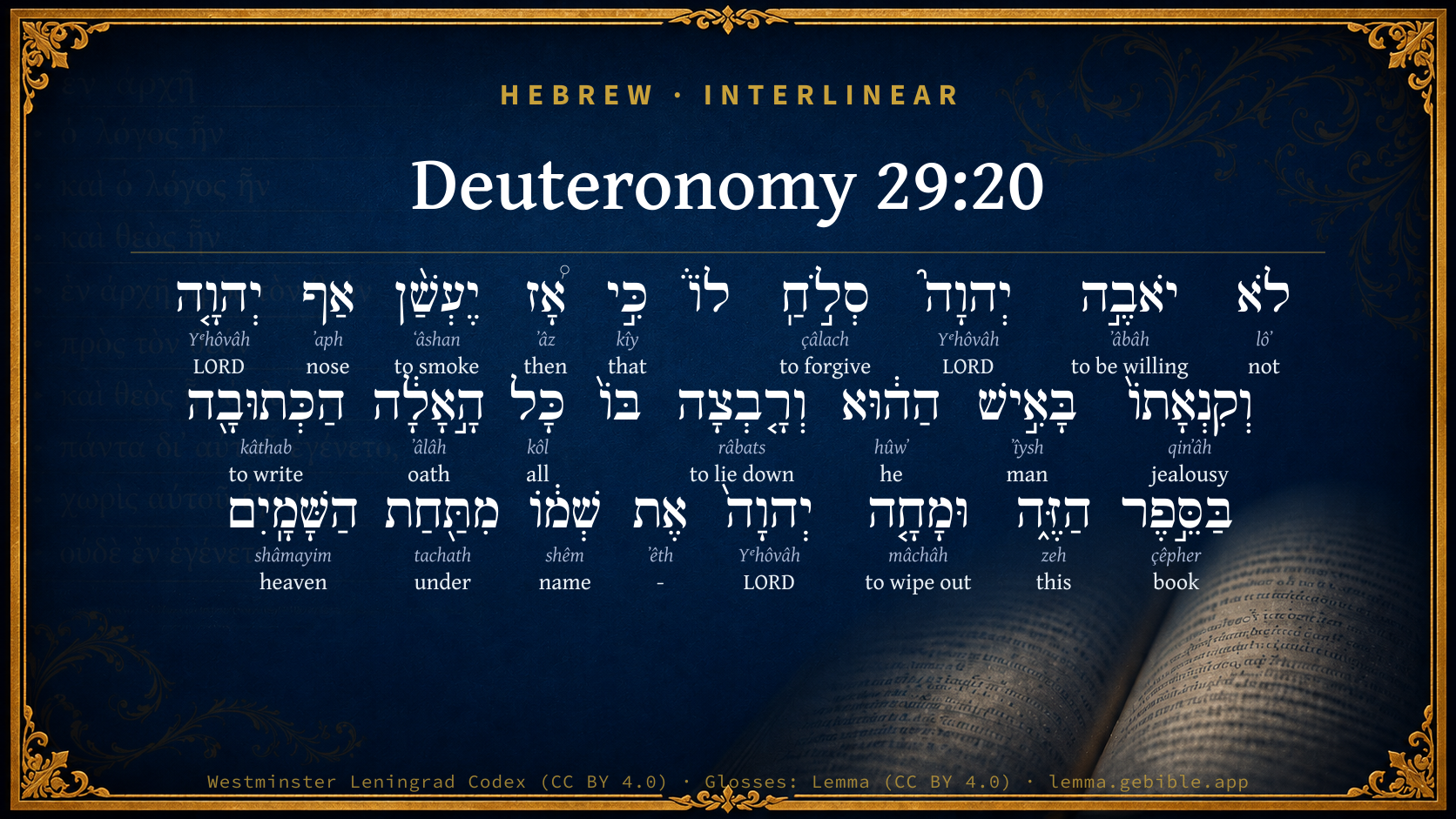
Deuteronomy 29:20

Hebrew (Westminster Leningrad Codex) Deuteronomy 29:20 appears in the Hebrew Old Testament. The text above is from the Westminster Leningrad Codex. Each word links to its Strong’s number, a concise gloss, and parsing drawn from the Open Scriptures Hebrew Bible morphology. Click any word for its full Brown-Driver-Briggs (BDB) entry.
Download image
Cite this verse

Deuteronomy 29:20 (World English Bible). Public Domain. Lemma interlinear Bible study tool, https://lemma.gebible.app/v/deuteronomy/29/20.

Show BibTeX & RIS
BibTeX
RIS
English Translation
Yahweh will not pardon him, but then the anger of Yahweh and his jealousy will smoke against that man, and all the curse that is written in this book shall lie on him, and Yahweh will blot out his name from under the sky.
World English Bible · Public Domain
Download a study sheet

One document with this verse’s original text, its word-by-word gloss line, the meaning frame, cross-references with their text, attributed commentary, and full source and license credits — printable, and it pastes into notes with its structure intact.

This verse Autodidact and up

Study sheet (.html) Plain text (.txt)

A passage Seminary Student

Up to 50 verses in one chapter. A passage sheet keeps up to 6 commentary sources and 12 cross-references per verse, in the order this page ranks them, and says so on the sheet whenever that leaves anything out. Ask for a single verse and you get the Autodidact verse sheet above.

Everything on this page stays free to read, with no account — the sheet is a download of what is already on screen, not access to it.

Want to remove ads? Support Godless Engineer
Compare translations 3

The same verse in 3 English versions, stacked beneath the original-language interlinear above. Click any original word for its lexicon entry.

Each is an independent rendering of the whole verse — the interlinear is not word-aligned to these translations.

Highlighted words mark where these versions differ — a whole-verse word diff, not a word-by-word alignment.

  • World English Bible Public Domain
    Yahweh will not pardon him, but then the anger of Yahweh and his jealousy will smoke against that man, and all the curse that is written in this book shall lie on him, and Yahweh will blot out his name from under the sky.
  • King James Version Public Domain
    The LORD will not spare him, but then the anger of the LORD and his jealousy shall smoke against that man, and all the curses that are written in this book shall lie upon him, and the LORD shall blot out his name from under heaven.
  • unfoldingWord Literal Text CC BY-SA 4.0
    Yahweh is not willing to forgive him. Instead, the nose of Yahweh and his jealousy will smolder against that man, and all the curses written in this book will rest on him, and Yahweh will wipe out his name from under the heavens.

unfoldingWord Literal Text — © unfoldingWord, licensed CC BY-SA 4.0. Word-aligned USFM3 via Door43 (git.door43.org/unfoldingWord/en_ult).

Versions to compare (up to 4)

3 of 4 selected

Show all 18 translations

Every available English version of this verse, each an independent rendering of the whole verse.

  • World English Bible Public Domain
    Yahweh will not pardon him, but then the anger of Yahweh and his jealousy will smoke against that man, and all the curse that is written in this book shall lie on him, and Yahweh will blot out his name from under the sky.
  • Berean Standard Bible Public Domain
    The LORD will never be willing to forgive him. Instead, His anger and jealousy will burn against that man, and every curse written in this book will fall upon him. The LORD will blot out his name from under heaven
  • Majority Standard Bible Public Domain
    The LORD will never be willing to forgive him. Instead, His anger and jealousy will burn against that man, and every curse written in this book will fall upon him. The LORD will blot out his name from under heaven
  • King James Version Public Domain
    The LORD will not spare him, but then the anger of the LORD and his jealousy shall smoke against that man, and all the curses that are written in this book shall lie upon him, and the LORD shall blot out his name from under heaven.
  • American Standard Version (1901) Public Domain
    Jehovah will not pardon him, but then the anger of Jehovah and his jealousy will smoke against that man, and all the curse that is written in this book shall lie upon him, and Jehovah will blot out his name from under heaven.
  • Revised Version (1885) Public Domain
    the LORD will not pardon him, but then the anger of the LORD and his jealousy shall smoke against that man, and all the curse that is written in this book shall lie upon him, and the LORD shall blot out his name from under heaven.
  • Geneva Bible (1599) Public Domain
    The Lord will not be mercifull vnto him, but then the wrath of the Lord and his ielousie shall smoke against that man, and euery curse that is written in this booke, shall light vpon him, and the Lord shall put out his name from vnder heauen,
  • Douay-Rheims (1899) Public Domain
    And the Lord should not forgive him: but his wrath and jealousy against that man should be exceedingly enkindled at that time, and all the curses that are written in this volume should light upon him: and the Lord should blot out his name from under heaven,
  • Young's Literal Translation Public Domain
    Jehovah is not willing to be propitious to him, for then doth the anger of Jehovah smoke, also His zeal, against that man, and lain down on him hath all the oath which is written in this book, and Jehovah hath blotted out his name from under the heavens,
  • Literal Standard Version CC BY-SA 4.0
    YHWH is not willing to be propitious to him, for then the anger of YHWH smokes, also His zeal, against that man, and all the oath which is written in this scroll has lain down on him, and YHWH has blotted out his name from under the heavens,
  • Unlocked Literal Bible CC BY-SA 4.0
    Yahweh will not pardon him, but instead, the anger of Yahweh and his jealousy will smolder against that man, and all the curses that are written in this book will come on him, and Yahweh will blot out his name from under heaven.
  • unfoldingWord Literal Text CC BY-SA 4.0
    Yahweh is not willing to forgive him. Instead, the nose of Yahweh and his jealousy will smolder against that man, and all the curses written in this book will rest on him, and Yahweh will wipe out his name from under the heavens.
  • Darby Bible Public Domain
    Jehovah will not pardon him, but the anger of Jehovah and his jealousy will then smoke against that man, and all the curse shall be upon him that is written in this book; and Jehovah will blot out his name from under the heavens;
  • World Messianic Bible Public Domain
    The LORD will not pardon him, but then the LORD’s anger and his jealousy will smoke against that man, and all the curse that is written in this book will fall on him, and the LORD will blot out his name from under the sky.
  • Webster's Bible Public Domain
    The LORD will not spare him, but then the anger of the LORD and his jealousy shall smoke against that man, and all the curses that are written in this book shall lie upon him, and the LORD shall blot out his name from under heaven.
  • Free Bible Version CC BY-SA 4.0
    The Lord would never want to pardon them. In fact, his passionate anger will burn against them, and every curse written in this book will fall on them. The Lord will erase their name from the earth,
  • Bible in Basic English Public Domain
    The Lord will have no mercy on him, but the wrath of the Lord will be burning against that man, and all the curses recorded in this book will be waiting for him, and the Lord will take away his name completely from the earth.
  • JPS Tanakh (1917) Public Domain
    (29-19) the LORD will not be willing to pardon him, but then the anger of the LORD and His jealousy shall be kindled against that man, and all the curse that is written in this book shall lie upon him, and the LORD shall blot out his name from under heaven;

Literal Standard Version (2020), Covenant Press — licensed CC BY-SA 4.0. Text via the HelloAO Bible API (eBible.org). Unlocked Literal Bible (unfoldingWord) — licensed CC BY-SA 4.0. Text via the HelloAO Bible API (eBible.org). unfoldingWord Literal Text — © unfoldingWord, licensed CC BY-SA 4.0. Word-aligned USFM3 via Door43 (git.door43.org/unfoldingWord/en_ult). Free Bible Version, Dr. Jonathan Gallagher — licensed CC BY-SA 4.0. Text via the HelloAO Bible API (eBible.org).

Word by word

More ways to search: Search by grammar → Find every occurrence → Compare this word →

Practice this passage: Drill this verse → Learn its vocabulary →

יֶעְשַׁ֨ן
ʻâshan
H6225
“to smoke”
Verb, Qal, Imperfect, 3rd Person, Masculine, Singular
Part of Speech
Verb
Stem
Qal
Form
Imperfect
Person
3rd Person
Gender
Masculine
Number
Singular
Full BDB Definition

Origin: a primitive root

TWOT: 1712

to smoke, be angry, be wroth - (Qal) - to smoke - to fume, be wroth, be furious
  1. לֹא lôʼ H3808 “not” Particle, Negative
  2. יֹאבֶ֣ה ʼâbâh H14 “to be willing” Verb, Qal, Imperfect, 3rd Person, Masculine, Singular
  3. יְהוָה֮ Yᵉhôvâh H3068 “LORD” Noun, Proper
  4. סְלֹ֣חַֽ çâlach H5545 “to forgive” Verb, Qal, Infinitive Construct
  5. כִּ֣י kîy H3588 “that” Conjunction
  6. אָ֠ז ʼâz H227 “then” Adverb
  7. אַף ʼaph H639 “nose” Particle, Accusative
  8. יְהוָ֤ה Yᵉhôvâh H3068 “LORD” Noun, Proper
  9. וְקִנְאָתוֹ֙ qinʼâh H7068 “and · jealousy · his” Conjunction + Noun, Common, Feminine, Singular, Construct + Suffix, Personal, 3rd Person, Masculine, Singular
  10. בָּאִ֣ישׁ ʼîysh H376 “in/at the · man” Preposition, Determined + Noun, Common, Masculine, Singular, Absolute
  11. הַה֔וּא hûwʼ H1931 “the · he” Particle, Definite Article + Pronoun, Personal, 3rd Person, Masculine, Singular
  12. וְרָ֤בְצָה râbats H7257 “and · to lie down” Conjunction + Verb, Qal, Sequential Perfect, 3rd Person, Feminine, Singular
  13. כָּל kôl H3605 “all of” Noun, Common, Masculine, Singular, Construct
  14. הָ֣אָלָ֔ה ʼâlâh H423 “the · oath” Particle, Definite Article + Noun, Common, Feminine, Singular, Absolute
  15. הַכְּתוּבָ֖ה kâthab H3789 “the · written” Particle, Definite Article + Verb, Qal, Participle Passive, Feminine, Singular, Absolute
  16. בַּסֵּ֣פֶר çêpher H5612 “in/at the · book” Preposition, Determined + Noun, Common, Masculine, Singular, Absolute
  17. הַזֶּ֑ה zeh H2088 “the · this” Particle, Definite Article + Pronoun, Demonstrative, Masculine, Singular
  18. וּמָחָ֤ה mâchâh H4229 “and · to wipe out” Conjunction + Verb, Qal, Sequential Perfect, 3rd Person, Masculine, Singular
  19. יְהוָה֙ Yᵉhôvâh H3068 “LORD” Noun, Proper
  20. אֶת ʼêth H853 “-” Particle, Direct Object
  21. שְׁמ֔וֹ shêm H8034 “name · his” Noun, Common, Masculine, Singular, Construct + Suffix, Personal, 3rd Person, Masculine, Singular
  22. מִתַּ֖חַת tachath H8478 “from · under” Preposition + Preposition
  23. הַשָּׁמָֽיִם shâmayim H8064 “the · heaven(s)” Particle, Definite Article + Noun, Common, Masculine, Plural, Absolute

About this verse

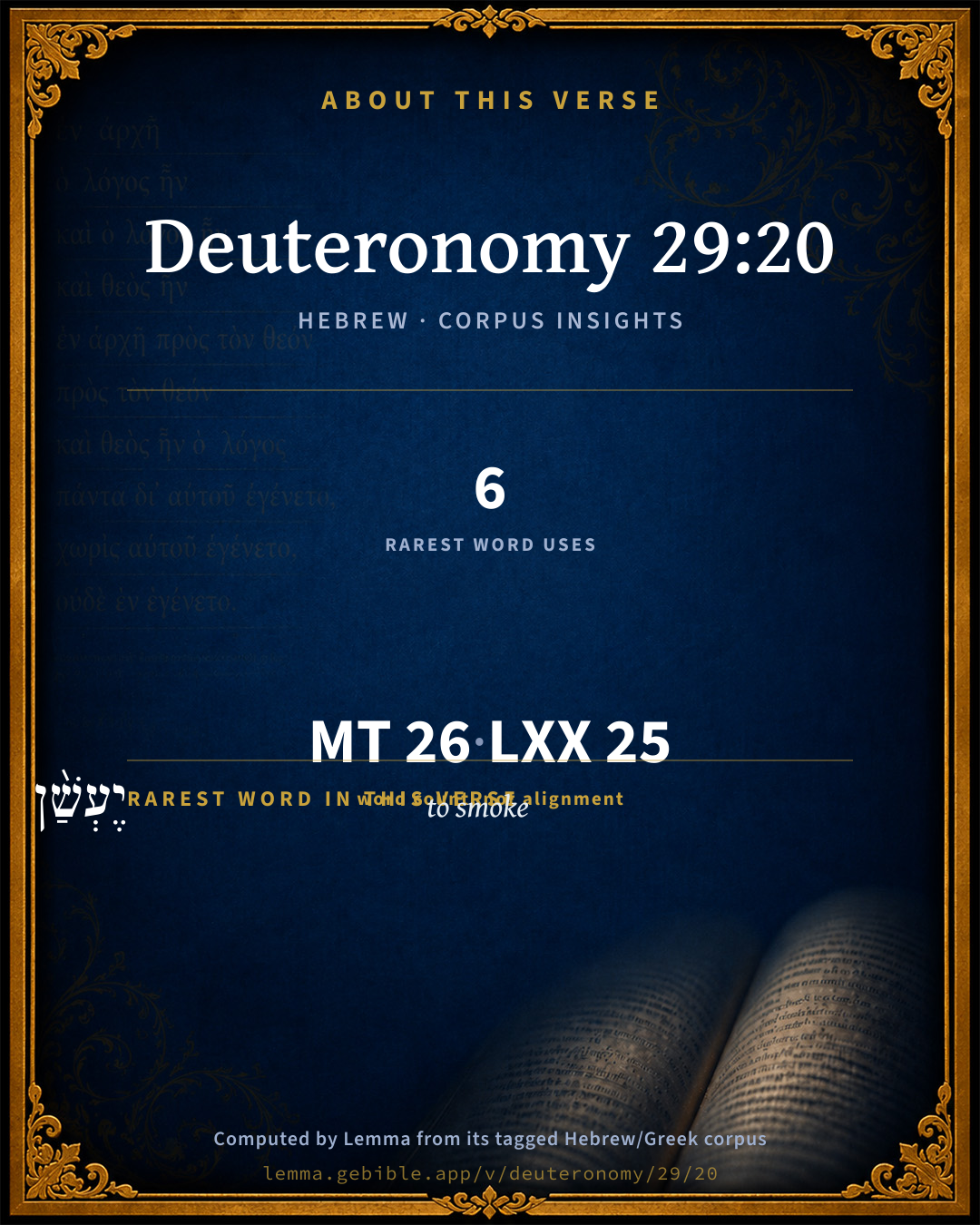
These counts appear in no published source. They are computed here, from the morphology-tagged text and Lemma’s own curated glosses. What Lemma adds →

26
words
22
distinct lemmas
Pentateuch
section

Notable vocabulary

The rarest word here is יֶעְשַׁ֨ן to smoke H6225 — appearing just 6 times in the whole Hebrew Bible.

Shared distinctive vocabulary

יֶעְשַׁ֨ן to smoke H6225 occurs in 6 verses of the Hebrew Bible. Also found in:

Grammatical profile

  • 6 verbs
  • 10 nouns
  • 2 pronouns
  • 3 prepositions
  • 1 conjunction
  • 1 adverb
  • 3 particles

Verb forms

  • יֹאבֶ֣ה Qal · Imperfect
  • סְלֹ֣חַֽ Qal · Infinitive Construct
  • יֶעְשַׁ֨ן Qal · Imperfect
  • וְרָ֤בְצָה Qal · Sequential Perfect
  • הַכְּתוּבָ֖ה Qal · Participle Passive
  • וּמָחָ֤ה Qal · Sequential Perfect

Repetition

A word recurs within this verse — often emphatic in Hebrew:

  • יְהוָה֮ LORD H3068 ×3

Hebrew & Septuagint length

In English translation the verse runs 44 words from the Hebrew and 55 from the Septuagint (LXX English) — closely comparable.

A rough comparison of the two English renderings, which tokenize alike — not a word-level alignment.

Word counts can differ between the Hebrew and the Greek without any difference in meaning — e.g. the Hebrew direct-object marker אֵת has no separate Greek word, and Greek often adds the article ὁ.

In the original languages it is 26 Hebrew tokens and 25 Greek tokens — but the two are counted differently (Hebrew bundles its prefixes and suffixes into one token; the Greek is in lemma form), so that isn’t a like-for-like length.

Cross-references

36

Topical passages linked to Deuteronomy 29:20 in the Treasury of Scripture Knowledge — connected by theme and wording, ordered by reader-vote popularity; previews shown in the World English Bible.

  • Psalms 74:1 God, why have you rejected us forever? Why does your anger smolder against the sheep of your pasture?
  • Deuteronomy 9:14 let me alone, that I may destroy them, and blot out their name from under the sky; and I will make of you a nation mightier and greater than they.
  • Psalms 79:5 How long, Yahweh? Will you be angry forever? Will your jealousy burn like fire?
  • Ezekiel 14:7–8 For everyone of the house of Israel, or of the strangers who sojourn in Israel, who separates himself from me, and takes his idols into his heart, and puts the stumbling block of his iniquity before his face, and comes to the prophet to inquire for himself of me; I Yahweh will answer him by myself:
  • Ezekiel 23:25 I will set my jealousy against you, and they shall deal with you in fury; they shall take away your nose and your ears; and your residue shall fall by the sword: they shall take your sons and your daughters; and your residue shall be devoured by the fire.
  • Exodus 20:5 you shall not bow yourself down to them, nor serve them, for I, Yahweh your God, am a jealous God, visiting the iniquity of the fathers on the children, on the third and on the fourth generation of those who hate me,
  • Exodus 34:14 for you shall worship no other god: for Yahweh, whose name is Jealous, is a jealous God.
  • Psalms 18:8 Smoke went out of his nostrils. Consuming fire came out of his mouth. Coals were kindled by it.
  • Nahum 1:2 Yahweh is a jealous God and avenges. Yahweh avenges and is full of wrath. Yahweh takes vengeance on his adversaries, and he maintains wrath against his enemies.
  • Exodus 32:32–33 Yet now, if you will, forgive their sin-- and if not, please blot me out of your book which you have written."
  • Deuteronomy 25:19 Therefore it shall be, when Yahweh your God has given you rest from all your enemies round about, in the land which Yahweh your God gives you for an inheritance to possess it, that you shall blot out the memory of Amalek from under the sky; you shall not forget.
  • Deuteronomy 27:15–26 Cursed be the man who makes an engraved or molten image, an abomination to Yahweh, the work of the hands of the craftsman, and sets it up in secret. All the people shall answer and say, Amen.
  • Deuteronomy 28:15–68 But it shall come to pass, if you will not listen to the voice of Yahweh your God, to observe to do all his commandments and his statutes which I command you this day, that all these curses shall come on you, and overtake you.
  • Psalms 69:28 Let them be blotted out of the book of life, And not be written with the righteous.
  • Psalms 78:50 He made a path for his anger. He didn't spare their soul from death, But gave their life over to the pestilence,
  • Psalms 78:58 For they provoked him to anger with their high places, And moved him to jealousy with their engraved images.
  • Proverbs 6:34 For jealousy arouses the fury of the husband. He won't spare in the day of vengeance.
  • Song of Solomon 8:6 Set me as a seal on your heart, As a seal on your arm; For love is strong as death. Jealousy is as cruel as Sheol; Its flashes are flashes of fire, A very flame of Yahweh.
  • Isaiah 27:11 When the boughs of it are withered, they shall be broken off; the women shall come, and set them on fire; for it is a people of no understanding: therefore he who made them will not have compassion on them, and he who formed them will show them no favor.
  • Jeremiah 13:14 I will dash them one against another, even the fathers and the sons together, says Yahweh: I will not pity, nor spare, nor have compassion, that I should not destroy them.
  • Ezekiel 5:11 Therefore, as I live, says the Lord Yahweh, surely, because you have defiled my sanctuary with all your detestable things, and with all your abominations, therefore will I also diminish [you]; neither shall my eye spare, and I also will have no pity.
  • Ezekiel 7:4 My eye shall not spare you, neither will I have pity; but I will bring your ways on you, and your abominations shall be in the midst of you: and you shall know that I am Yahweh.
  • Ezekiel 7:9 My eye shall not spare, neither will I have pity: I will bring on you according to your ways; and your abominations shall be in the midst of you; and you shall know that I, Yahweh, do strike.
  • Ezekiel 8:3 He put forth the form of a hand, and took me by a lock of my head; and the Spirit lifted me up between earth and the sky, and brought me in the visions of God to Jerusalem, to the door of the gate of the inner [court] that looks toward the north; where was the seat of the image of jealousy, which provokes to jealousy.
  • Ezekiel 8:5 Then said he to me, Son of man, lift up your eyes now the way toward the north. So I lifted up my eyes the way toward the north, and see, northward of the gate of the altar this image of jealousy in the entry.
  • Ezekiel 8:18 Therefore will I also deal in wrath; my eye shall not spare, neither will I have pity; and though they cry in my ears with a loud voice, yet will I not hear them.
  • Ezekiel 9:10 As for me also, my eye shall not spare, neither will I have pity, but I will bring their way on their head.
  • Ezekiel 24:14 I, Yahweh, have spoken it: it shall happen, and I will do it: I will not go back, neither will I spare, neither will I repent; according to your ways, and according to your doings, shall they judge you, says the Lord Yahweh.
  • Ezekiel 36:5 therefore thus says the Lord Yahweh: Surely in the fire of my jealousy have I spoken against the residue of the nations, and against all Edom, that have appointed my land to themselves for a possession with the joy of all their heart, with despite of soul, to cast it out for a prey.
  • Zephaniah 1:18 Neither their silver nor their gold will be able to deliver them in the day of Yahweh's wrath, but the whole land will be devoured by the fire of his jealousy; for he will make an end, yes, a terrible end, of all those who dwell in the land.
  • Romans 8:32 He who didn't spare his own Son, but delivered him up for us all, how would he not also with him freely give us all things?
  • Romans 11:21 for if God didn't spare the natural branches, neither will he spare you.
  • 1 Corinthians 10:22 Or do we provoke the Lord to jealousy? Are we stronger than he?
  • Hebrews 12:29 for our God is a consuming fire.
  • 2 Peter 2:4–5 For if God didn't spare angels when they sinned, but cast them down to Tartarus, and committed them to pits of darkness, to be reserved to judgment;
  • Revelation 3:5 He who overcomes will be arrayed in white garments, and I will in no way blot his name out of the book of life, and I will confess his name before my Father, and before his angels.

Cross-references courtesy of OpenBible.info (CC BY 4.0).

Hebrew and Greek witnesses Masoretic Hebrew ↔ Greek Septuagint

The same verse in the two great witnesses to the Old Testament, shown verse-for-verse.

These are two independent witnesses, not word-aligned to each other, and the Septuagint is shown in lemma (dictionary) form.

Hebrew Deuteronomy 29:20 Masoretic · Westminster Leningrad Codex

לֹא יֹאבֶ֣ה יְהוָה֮ סְלֹ֣חַֽ לוֹ֒ כִּ֣י אָ֠ז יֶעְשַׁ֨ן אַף יְהוָ֤ה וְקִנְאָתוֹ֙ בָּאִ֣ישׁ הַה֔וּא וְרָ֤בְצָה בּוֹ֙ כָּל הָ֣אָלָ֔ה הַכְּתוּבָ֖ה בַּסֵּ֣פֶר הַזֶּ֑ה וּמָחָ֤ה יְהוָה֙ אֶת שְׁמ֔וֹ מִתַּ֖חַת הַשָּׁמָֽיִם

Yahweh will not pardon him, but then the anger of Yahweh and his jealousy will smoke against that man, and all the curse that is written in this book shall lie on him, and Yahweh will blot out his name from under the sky.

World English Bible · Public Domain

Greek LXX Deuteronomy 29:20 Septuagint · lemma form

καί διαστέλλω αὐτός κύριος εἰς κακός ἐκ πᾶς ὁ υἱός ἰσραήλ κατά πᾶς ὁ ἀρά ὁ διαθήκη ὁ γράφω ἐν ὁ βιβλίον ὁ νόμος οὗτος

God shall by no means be willing to pardon him, but then the wrath of the Lord and his jealousy shall flame out against that man; and all the curses of this covenant shall attach themselves to him, which are written in this book, and the Lord shall blot out his name from under heaven.

LXX2012 (modern English Septuagint) · Public Domain

On this verse, The Cambridge Bible for Schools and Colleges discusses the Septuagint’s reading. Read the note in Commentary ↓

Hebrew: Westminster Leningrad Codex (CC BY 4.0). Greek: Septuagint (public domain); English from LXX2012 (modern English Septuagint) (Public Domain). How the Septuagint differs from the Hebrew →

Targum (Aramaic paraphrase)

2

The Targum is the ancient Jewish Aramaic paraphrase of the Hebrew Scriptures — an interpretive translation, not the Hebrew text itself. Onkelos (literal) and Pseudo-Jonathan (expansive) render the Torah, and Jonathan the Prophets. Coverage is partial: where no permissively-licensed English translation exists for a verse, only the Aramaic is shown. This is verse-level text, not a word-by-word alignment to the Hebrew.

  1. Targum Onkelos Torah (Genesis–Deuteronomy)
    וְיַפְרְשִׁנֵהּ יְיָ לְבִישָׁא מִכֹּל שִׁבְטַיָא דְיִשְׂרָאֵל כְּכֹל לְוָטֵי קְיָמָא דִכְתִיבִין בְּסִפְרָא דְאוֹרַיְתָא הָדֵין

    (no public-domain English translation for this verse)

    Targum Onkelos — Aramaic: “Onkelos Genesis” (public domain); “Onkelos Exodus” (public domain); “Onkelos Leviticus” (public domain); “Onkelos Numbers” (public domain); “Onkelos Deuteronomy” (public domain). English: “Sefaria Community Translation” (CC0 1.0 (public-domain dedication)); “J.W. Etheridge. The Targums of Onkelos and Jonathan Ben Uzziel on the Pentateuch. London: Longmans, Green, 1862” (public domain). Text via Sefaria.

  2. Targum Pseudo-Jonathan Torah (Genesis–Deuteronomy)
    וְיַפְרִישִׁינֵיהּ יְיָ לְבִישָׁא מִכָּל שִׁבְטַיָא דְיִשְרָאֵל הֵי כְּכָל לְוָוטֵי קְיָימָא דִכְתִיבִין בְּסִפְרָא הָדֵין

    And the Lord will separate him unto evil, from all the tribes of Israel, according to all the maledictions of the covenant which are written in this book.

    Targum Pseudo-Jonathan — Aramaic: “Targum Jonathan on Genesis” (public domain); “Targum Jonathan on Exodus” (public domain); “Targum Jonathan on Leviticus” (public domain); “Targum Jonathan on Numbers” (public domain); “Targum Jonathan on Deuteronomy” (public domain). English: “The Targum of Jonathan ben Uzziel, trans. J. W. Etheridge, London, 1862” (public domain). Text via Sefaria.

Commentary

Notes on Deuteronomy 29:20 from classic Christian and Jewish commentators (each source and its license shown beneath its notes). The classic Christian expositions comment on the surrounding passage and are grouped to its opening verse, so a note may address several verses; the Jewish commentaries on the Tanakh (Rashi and others) are per-verse, so they appear only where the commentator wrote on this verse.

Lemma curates 59 commentaries, every one of them public domain or Creative Commons licensed, each selected and text-cleaned for this edition rather than reprinted as found. About our sources →

Trapp's Complete Commentary

John Trapp

Deu 29:20 The LORD will not spare him, but then the anger of the LORD and his jealousy shall smoke against that man, and all the curses that are written in this book shall lie upon him, and the LORD shall blot out his name from under heaven.

Ver. 20. The Lord will not spare him.] God cannot satisfy himself in threatening this heinous sin, as if the very naming of it had enraged his jealousy. Yea, when he threateneth it, he useth here no qualifications, as he doth in other cases, but is absolute in threatening, to show that he will be resolute in punishing. See the like in Isa 22:12-14 Eze 24:13. It is better, therefore, to have a sore than a seared conscience; as a burning fever is more hopeful than a lethargy.

John Trapp, A Commentary or Exposition upon All the Books of the Old and New Testament (1647–1656) — public domain. Text from a community e-Sword module.

Joseph Benson's Commentary

Deu 29:20-21. His jealousy shall smoke against that man — Shall burn and break forth like flame and smoke from a furnace. None shall be punished more exemplarily than those who abuse the goodness of God, and turn his grace into wantonness. Shall blot out his name — Shall destroy his person and the remembrance of him from among men, suffering no posterity to survive him, to perpetuate his name or memory. Shall separate him unto evil — Unto some exemplary plague; he will make him a monument of his displeasure to the whole land. According to all the curses of the covenant — For the covenant made with them, though a covenant of grace, had curses as well as blessings belonging to it, however averse the person here referred to might be to believe it.

Joseph Benson's Commentary on the Old and New Testaments (1811–1818) — public domain. Text from a community e-Sword module.

Tyndale Open Study Notes

Tyndale Open Resources

29:20 erase their names: To forget the name of a people resulted in eventually forgetting their very existence. The most unspeakable tragedy would be for God to treat the people of Israel as though they had never existed (see 7:24; Exod 32:32-33; 2 Kgs 14:27).

Tyndale Open Study Notes — © Tyndale Open Resources, licensed CC BY-SA 4.0. Text via the HelloAO Bible API.

Ellicott's Commentary for English Readers

(20) Shall smoke.—Comp. Psa_80:4; Psa_74:1. Mount Sinai was altogether “on a smoke” because the Lord descended on it in fire.

Shall lie upon him.—As the beasts lie down in their lairs. The only other place which we can at all compare with this is the difficult expression in Gen_4:7, “Sin lieth at the door.”

A Bible Commentary for English Readers, edited by Charles John Ellicott (1878–1897) — public domain. Text from a community e-Sword module.

The Cambridge Bible for Schools and Colleges

gen. ed. J. J. S. Perowne

20. the Lord will not consent to pardon him] There are two vbs as in Deu_1:26 q.v.

his jealousy] See on Deu_4:24; with this and the vb. smoke cp. Deu_32:21 f., Psa_74:1.

shall lie] Or crouch, cp. Gen_4:7. But LXX and Targ. read cleave unto, perhaps rightly.

blot out his name, etc.] Deu_7:2, Deu_9:14.

The Cambridge Bible for Schools and Colleges (gen. ed. J. J. S. Perowne; Cambridge University Press, 1878–1918) — public domain. Text from a community e-Sword module.

John Gill's Exposition

And the Lord shall separate him unto evil out of all the tribes of Israel,.... Unto the evil of punishment, devote and consign him to it, and make him a visible and distinguished mark of his displeasure and vengeance. So some men are righteously separated from others, and preordained unto condemnation, being wicked and ungodly men; for such God has made or appointed for the day of evil; see Pro 16:4,

according to all the curses of the covenant that are written in this book of the law; the evil of punishment he shall be separated unto shall be according to them, or include them all; the sense is, that the wrath of God, and the whole curse of the law due to him for his sin, shall come upon him; see Deu 28:16, &c.

John Gill's Exposition of the Whole Bible (1746–1763) — public domain (CC PDM 1.0). Text via the HelloAO Bible API.

Haydock's Catholic Bible Commentary

Enkindled, (fumet.) Literally, "smoke." (Haydock) --- Hebrew, "the anger (literally, nose)....smoke." The Greeks and Romans adopt similar expressions, to denote the wrath and eagerness with which a person is actuated. "Fierce anger always sits upon his nose." (Theocrit.) So Persius says, Disce, sed ira cadat naso, rugosaque sanna.

George Leo Haydock (1774–1849), Haydock's Catholic Family Bible and Commentary, 1859 edition — public domain. Excludes Psalms (Douay-Rheims chapter numbering differs from Protestant) and Deuterocanonical books (Catholic canon only).

Matthew Poole's English Annotations

Shall smoke, i.e. shall burn and break forth with flame and smoke as it were from a furnace. Compare Psa 18:8.

Blot out his name from under heaven, i.e. destroy his person and memory from amongst men.

Matthew Poole's English Annotations on the Holy Bible (1683–1685) — public domain. Text from a community e-Sword/MySword module.

Whedon's Commentary on the Bible

Daniel D. Whedon

20. The Lord will not spare him — He may go on in fancied security; but, in the graphic language of the original, the indignation of Jehovah will smoke and he will be utterly destroyed. How sad must have been the scene that lies in thought before the great lawgiver and prophet! He sees the nation as going away from Jehovah, worshipping strange gods. He sees the terrible retribution that is to come upon them.

Daniel D. Whedon (gen. ed.), Commentary on the Old and New Testaments (1874–1909) — public domain. Text from a community e-Sword module.

The Pulpit Commentary

Vers. 20, 21. Though the sinner fancies all is well with him, and is hardened in his iniquity, and is leading others astray by his example, the Lord will not suffer him to rest in impunity, but will send on him terrible punishments. The anger of the Lord and his jealousy shall smoke, i.e. shall break forth in destructive fire (cf. Psa_74:1; Isa_65:5; Psa_18:8) The Lord shall blot out his name from under heaven (Deu_25:19; Exo_17:14) The Lord shall separate him unto evil out of all the tribes of Israel, so that, excluded from the covenant nation, and placed beyond the sphere over which rests the salvation of the Lord, they will be exposed to destructionaccording to all the curses of the covenant that are written in this book of the law; rather, as in the margin, is written; the participle agrees with "covenant."

The Pulpit Commentary (1880–1919), ed. H.D.M. Spence-Jones & Joseph S. Exell — public domain. Text from a community e-Sword module.

John Wesley's Explanatory Notes

Shall smoke - Shall burn and break forth with flame and smoke as it were from a furnace.

John Wesley, Explanatory Notes Upon the Whole Bible (1754–1765) — public domain. Text via the GEBible commentary corpus.

Keil & Delitzsch

C. F. Keil & F. Delitzsch

"For the Lord will not forgive him (who thinks or speaks in this way); but then will His anger smoke (break forth in fire; vid., (Psa 74:1), and His jealousy against that man, and the whole curse of the law will lie upon him, that his name may be blotted out under heaven (vid., Deu 25:19; Exo 17:14). "The Lord will separate him unto evil from all the tribes, - so that he will be shut out from the covenant nation, and from its salvation, and be exposed to destruction - according to all the curses of the covenant." Although the pronominal suffix refers primarily to the man, it also applies, according to Deu 29:18, to the woman, the family, and the tribe. "That is written," etc., as in Deu 28:58, Deu 28:61.

Keil & Delitzsch — Biblical Commentary on the Old Testament (1861–1891) — public domain (CC PDM 1.0). Text via the HelloAO Bible API. (Old Testament only.)

unfoldingWord translationNotes

Door43 World Missions Community

the anger of Yahweh and his jealousy will smolder

Just as a fire can grow in intensity, so can God's anger and Jealousy grow in intensity. AT: "Yahweh's jealous anger will grow like a fire" (See: Metaphor)

the anger of Yahweh and his jealousy

Here the word "jealousy" describes "the anger of Yahweh." AT: Yahweh's jealous anger" (See: Hendiadys)

that are written

This can be stated in active form. AT: "that I have written" (See: Active or Passive)

the curses that are written in this book will come on him

Moses describes the curses as a person who would attack them by surprise. See how you translated these words in Deuteronomy 28:15. AT: "Yahweh will curse him with the curses written in this book in ways that will completely surprise him" (See: Metaphor and Personification)

Yahweh will blot out his name from under heaven

This means God will completely destroy the person and his family. In the future people will not remember him. A similar phrase appears in Deuteronomy 7:24.

translationWords

forgive

anger

jealous

curse

blot out

name

heaven

tribe

Israel

covenant

law

unfoldingWord translationNotes — © Distant Shores Media and the Door43 World Missions Community, licensed CC BY-SA 4.0. Source: git.door43.org/Door43/en_tn.

Rashi

Rabbi Shlomo Yitzchaki (Rashi)

הכתובה בספר התורה הזה — Above, however, (Deuteronomy 28:61) it says: And every sickness and every plague … [which is not written] הזאת) בספר התורה הזאת the feminine form, whilst here we have הזה, the masculine)?! But the explanation is: הזאת, the feminine form, refers to the feminine word התורה, whilst הזה, the masculine form, refers to the masculine word הספר in our text. Through the division into clauses by means of the tonic accents (which serve also as marks of interpunctuation) they (the two phrases) are shown to be two different expressions: in the chapter containing the curses (ch. Deuteronomy 28:61) the Tipcha (a disjunctive accent) is placed beneath the word בספר, and the words התורה הזאת are connected one with the other, therefore it says הזאת, the feminine form, (since it has to be connected with a feminine noun), whilst here the Tipcha is placed beneath the word התורה, and consequently the words ספר התורה are connected one with the other (i.e. they form one phrase), — therefore it is a masculine word that is applicable after it, because the term (the pronoun) refers to הספר (which is masculine).

Rashi on the Tanakh — English translations: “The Judaica Press complete Tanach with Rashi, translated by A. J. Rosenberg” (CC BY 4.0); “Pentateuch with Rashi's commentary by M. Rosenbaum and A.M. Silbermann, 1929-1934” (public domain); “The Metsudah Tanach series, Lakewood, N.J” (CC BY 4.0); and “The Book of Joshua, Metsudah Publications, 1997” (CC BY 4.0). Text via Sefaria.

Ramban (Nachmanides)

Rabbi Moshe ben Nachman (Ramban / Nachmanides)

AND THE ETERNAL SHALL MARK HIM OFF FOR EVIL. This refers to a tribe from among the remaining tribes of Israel.

Ramban (Nachmanides) on the Tanakh — English translation: “Commentary on the Torah by Ramban (Nachmanides). Translated and annotated by Charles B. Chavel. New York, Shilo Pub. House, 1971-1976” (CC BY 4.0). Text via Sefaria.

Lesson kit

Teaching starters — assembled from the data on this page, not authored interpretation. Every prompt links to the verse data it draws on. Edit before teaching.

Deuteronomy, in the Pentateuch, opens this verse with 26 words (22 distinct Hebrew lemmas). Its most distinctive word is ʻâshan (“to smoke”). A historical commentator’s framing appears above. Read the whole chapter for the surrounding context.

Discussion questions

  1. What does “to smoke” (ʻâshan) contribute to the verse as a whole?
  2. Exodus 19:18 shares the word «to smoke» with this verse. How do the two illuminate each other?
  3. “LORD” occurs 3× in this one verse. What is the effect of the repetition?
  4. These translations render this verse differently. What is at stake in choosing one wording over another?
  5. The verb «יֹאבֶ֣ה» is Qal Imperfect. How does its form color the action?
  6. Reading how Trapp's Complete Commentary and Joseph Benson's Commentary read this verse, where do the two commentators agree and where do they part?

Things to notice

Reading settings

Reading text

Shown beneath each verse's original-language words.

Old Testament
Old Testament edition

Read the OT as the Masoretic Hebrew (MT) or the Greek Septuagint (LXX).

English shown for the Greek Septuagint (in the Hebrew ↔ Greek comparison).

Comparing translations? Open the Compare panel on any verse page to stack up to four side by side.