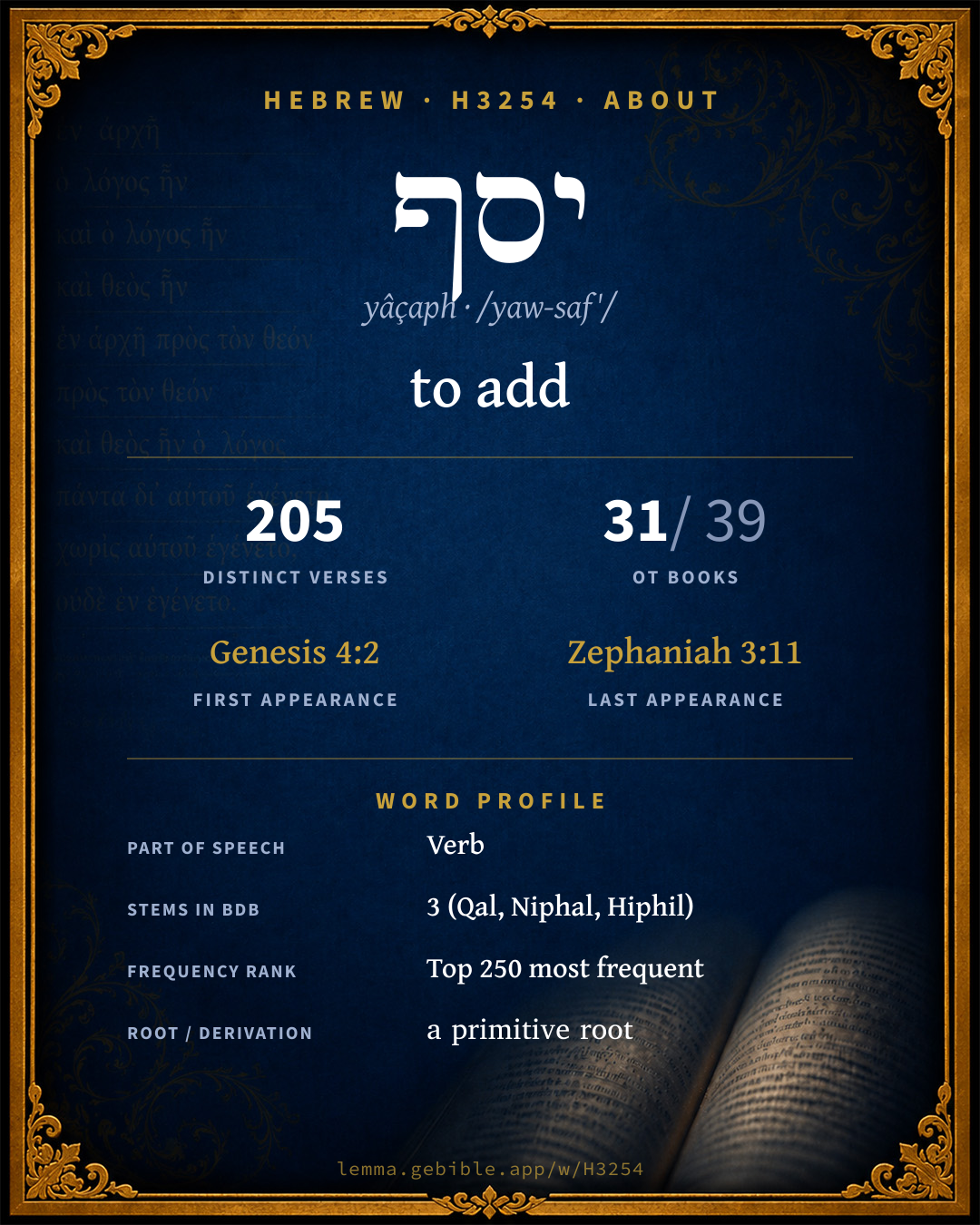
יָסַף
to add
also: increase, do again fuller range ↓
Full lexicon entry — Brown-Driver-Briggs (BDB)
From Brown-Driver-Briggs (BDB)
Where this word appears
See every Hiphil verb in the Hebrew Bible →
Grammar key — what these labels mean
Part of speech
- Verb
- An action or state-of-being word.
Stem
- Hiphil
- The causative active stem (“he caused / brought about”). Here: ‘add’
- Qal
- The basic, simple active stem — the plain form of the verb (“he wrote”).
- Niphal
- Usually the simple passive or reflexive of the Qal (“he was written”). Here: ‘join’
Form
- Imperfect
- An incomplete, ongoing, or future action (“he will / would write”).
- Sequential Imperfect
- An imperfect with prefixed waw — the standard past-narrative form (waw-consecutive imperfect).
- Jussive
- A third- or second-person volitional form expressing wish or command (“let him write”).
- Sequential Perfect
- A perfect with prefixed waw continuing a preceding imperfect or command (waw-consecutive perfect).
- Perfect
- A completed action or state — Hebrew marks aspect (completeness) more than strict tense (“he wrote”).
- Infinitive Construct
- A bound verbal noun, frequently with prepositions (“to write / in writing”).
- Participle Active
- A verbal adjective expressing ongoing or characteristic action (“writing / one who writes”).
- Cohortative
- A first-person volitional form expressing wish or resolve (“let me / let us write”).
State
- Absolute
- The independent form of a noun, not bound to a following word.
Person
- 3rd Person
- The one spoken about (“he / she / it / they”).
- 1st Person
- The speaker (“I / we”).
- 2nd Person
- The one addressed (“you”).
Gender
- Masculine
- Grammatically masculine.
- Common
- Either gender — not distinguished for this form.
- Feminine
- Grammatically feminine.
Number
- Singular
- One.
- Plural
- More than one (in Hebrew, generally three or more).
Grammatical forms 36 distinct
- Verb, Hiphil, Imperfect, 3rd Person, Masculine, Singular 34 times (16%)
- Verb, Hiphil, Sequential Imperfect, 3rd Person, Masculine, Singular 29 times (14%)
- Verb, Hiphil, Imperfect, 1st Person, Common, Singular 23 times (11%)
- Verb, Hiphil, Jussive, 3rd Person, Masculine, Singular 16 times (8%)
- Verb, Hiphil, Sequential Imperfect, 3rd Person, Masculine, Plural 11 times (5%)
- Verb, Hiphil, Imperfect, 3rd Person, Masculine, Plural 9 times (4%)
- Verb, Hiphil, Imperfect, 2nd Person, Masculine, Singular 8 times (4%)
- Verb, Hiphil, Imperfect, 2nd Person, Masculine, Plural 8 times (4%)
+28 more forms (72 occurrences)
Parsed forms decoded from the imported morphology (morphhb / Westminster Leningrad Codex — WLC text public domain, morphhb tagging CC BY 4.0), counted across 210 parsed occurrences — not distinct verses.
Page 1 of 2 — showing verses 1–200 of 205 distinct verses where H3254 appears, across 31 books. Click any verse to open its interlinear word-by-word view. Verse text shown in the World English Bible for context — . Each verse’s Hebrew form is shown with its reference; the English is not keyword-highlighted, since the data carries no word-level English alignment. Use “Compare translations” on any verse to read it across multiple English versions. This concordance covers the Hebrew Bible; Septuagint (Greek Old Testament) occurrences are not indexed here.
Genesis 13 verses
- Genesis 4:2 וַ/תֹּ֣סֶף conj + Hiphil wimpf 3fs Again she gave birth, to Cain's brother Abel. Abel was a keeper of sheep, but Cain was a tiller of the ground.
- Genesis 4:12 תֹסֵ֥ף Hiphil juss 3fs From now on, when you till the ground, it won't yield its strength to you. You shall be a fugitive and a wanderer in the earth."
- Genesis 8:10 וַ/יֹּ֛סֶף conj + Hiphil wimpf 3ms He stayed yet another seven days; and again he sent forth the dove out of the ark.
- Genesis 8:12 יָסְפָ֥ה Qal pf 3fs He stayed yet another seven days, and sent forth the dove; and she didn't return to him any more.
- Genesis 8:21 אֹ֠סִף אֹסִ֥ף Hiphil impf 1cs Hiphil impf 1cs Yahweh smelled the sweet savor. Yahweh said in his heart, "I will not again curse the ground any more for man's sake, because the imagination of man's heart is evil from his youth; neither will I ever again strike everything living, as I have done.
- Genesis 18:29 וַ/יֹּ֨סֶף conj + Hiphil wimpf 3ms He spoke to him yet again, and said, "What if there are forty found there?" He said, "I will not do it for the forty's sake."
- Genesis 25:1 וַ/יֹּ֧סֶף conj + Hiphil wimpf 3ms Abraham took another wife, and her name was Keturah.
- Genesis 30:24 יֹסֵ֧ף Hiphil impf 3ms She named him Joseph, saying, "May Yahweh add another son to me."
- Genesis 37:5 וַ/יּוֹסִ֥פוּ conj + Hiphil wimpf 3mp Joseph dreamed a dream, and he told it to his brothers, and they hated him all the more.
- Genesis 37:8 וַ/יּוֹסִ֤פוּ conj + Hiphil wimpf 3mp His brothers said to him, "Will you indeed reign over us? Or will you indeed have dominion over us?" They hated him all the more for his dreams and for his words.
- Genesis 38:5 וַ/תֹּ֤סֶף conj + Hiphil wimpf 3fs She yet again bore a son, and named him Shelah: and he was at Chezib, when she bore him.
- Genesis 38:26 יָסַ֥ף Qal pf 3ms Judah acknowledged them, and said, "She is more righteous than I, because I didn't give her to Shelah, my son." He knew her again no more.
- Genesis 44:23 תֹסִפ֖וּ/ן Hiphil impf 2mp + sfx n You said to your servants, 'Unless your youngest brother comes down with you, you will see my face no more.'
Exodus 9 verses
- Exodus 1:10 וְ/נוֹסַ֤ף conj + Niphal wpf 3ms Come, let us deal wisely with them, lest they multiply, and it happen that when any war breaks out, they also join themselves to our enemies, and fight against us, and escape out of the land."
- Exodus 5:7 תֹאסִפ֞וּ/ן Hiphil impf 2mp + sfx n "You shall no longer give the people straw to make brick, as before. Let them go and gather straw for themselves.
- Exodus 8:29 יֹסֵ֤ף Hiphil juss 3ms Moses said, "Behold, I go out from you, and I will pray to Yahweh that the swarms of flies may depart from Pharaoh, from his servants, and from his people, tomorrow; only don't let Pharaoh deal deceitfully any more in not letting the people go to sacrifice to Yahweh."
- Exodus 9:28 תֹסִפ֖וּ/ן Hiphil impf 2mp + sfx n Pray to Yahweh; for there has been enough of mighty thunderings and hail. I will let you go, and you shall stay no longer."
- Exodus 9:34 וַ/יֹּ֣סֶף conj + Hiphil wimpf 3ms When Pharaoh saw that the rain and the hail and the thunders were ceased, he sinned yet more, and hardened his heart, he and his servants.
- Exodus 10:28 תֹּ֨סֶף֙ Hiphil juss 2ms Pharaoh said to him, "Get away from me! Be careful to see my face no more; for in the day you see my face you shall die!"
- Exodus 10:29 אֹסִ֥ף Hiphil impf 1cs Moses said, "You have spoken well. I will see your face again no more."
- Exodus 11:6 תֹסִֽף Hiphil impf 3fs There shall be a great cry throughout all the land of Egypt, such as there has not been, nor shall be any more.
- Exodus 14:13 תֹסִ֛יפוּ Hiphil impf 2mp Moses said to the people, "Don't be afraid. Stand still, and see the salvation of Yahweh, which he will work for you today: for the Egyptians whom you have seen today, you shall never see them again.
Leviticus 11 verses
- Leviticus 5:16 יוֹסֵ֣ף Hiphil juss 3ms He shall make restitution for that which he has done wrong in the holy thing, and shall add a fifth part to it, and give it to the priest; and the priest shall make atonement for him with the ram of the trespass offering, and he will be forgiven.
- Leviticus 6:5 יֹסֵ֣ף Hiphil juss 3ms or any thing about which he has sworn falsely; he shall restore it even in full, and shall add a fifth part more to it. To him to whom it belongs he shall give it, in the day of his being found guilty.
- Leviticus 19:25 לְ/הוֹסִ֥יף prep + Hiphil inf.cs In the fifth year you shall eat its fruit, that it may yield its increase to you. I am Yahweh your God.
- Leviticus 22:14 וְ/יָסַ֤ף conj + Qal wpf 3ms "'If a man eats something holy unwittingly, then he shall add the fifth part of its value to it, and shall give the holy thing to the priest.
- Leviticus 26:18 וְ/יָסַפְתִּי֙ conj + Qal wpf 1cs "'If you in spite of these things will not listen to me, then I will chastise you seven times more for your sins.
- Leviticus 26:21 וְ/יָסַפְתִּ֤י conj + Qal wpf 1cs "'If you walk contrary to me, and won't listen to me, then I will bring seven times more plagues on you according to your sins.
- Leviticus 27:13 וְ/יָסַ֥ף conj + Qal wpf 3ms But if he will indeed redeem it, then he shall add the fifth part of it to its valuation.
- Leviticus 27:15 וְ֠/יָסַף conj + Qal wpf 3ms If he who dedicates it will redeem his house, then he shall add the fifth part of the money of your valuation to it, and it shall be his.
- Leviticus 27:19 וְ֠/יָסַף conj + Qal wpf 3ms If he who dedicated the field will indeed redeem it, then he shall add the fifth part of the money of your valuation to it, and it shall remain his.
- Leviticus 27:27 וְ/יָסַ֥ף conj + Qal wpf 3ms If it is an unclean animal, then he shall buy it back according to your valuation, and shall add to it the fifth part of it: or if it isn't redeemed, then it shall be sold according to your valuation.
- Leviticus 27:31 יֹסֵ֥ף Hiphil impf 3ms If a man redeems anything of his tithe, he shall add a fifth part to it.
Numbers 9 verses
- Numbers 5:7 יֹסֵ֣ף Hiphil impf 3ms then he shall confess his sin which he has done, and he shall make restitution for his guilt in full, and add to it the fifth part of it, and give it to him in respect of whom he has been guilty.
- Numbers 11:25 יָסָֽפוּ Qal pf 3cp Yahweh came down in the cloud, and spoke to him, and took of the Spirit that was on him, and put it on the seventy elders: and it happened that when the Spirit rested on them, they prophesied, but they did so no more.
- Numbers 22:15 וַ/יֹּ֥סֶף conj + Hiphil wimpf 3ms Balak sent yet again princes, more, and more honorable than they.
- Numbers 22:19 יֹּסֵ֥ף Hiphil impf 3ms Now therefore, please wait also here this night, that I may know what Yahweh will speak to me more.
- Numbers 22:25 וַ/יֹּ֖סֶף conj + Hiphil wimpf 3ms The donkey saw the angel of Yahweh, and she thrust herself to the wall, and crushed Balaam's foot against the wall: and he struck her again.
- Numbers 22:26 וַ/יּ֥וֹסֶף conj + Hiphil wimpf 3ms The angel of Yahweh went further, and stood in a narrow place, where was no way to turn either to the right hand or to the left.
- Numbers 32:15 וְ/יָסַ֣ף conj + Qal wpf 3ms For if you turn away from after him, he will yet again leave them in the wilderness; and you will destroy all this people.
- Numbers 36:3 וְ/נוֹסַ֕ף conj + Niphal wpf 3ms If they be married to any of the sons of the [other] tribes of the children of Israel, then will their inheritance be taken away from the inheritance of our fathers, and will be added to the inheritance of the tribe whereunto they shall belong: so will it be taken away from the lot of our inheritance.
- Numbers 36:4 וְ/נֽוֹסְפָה֙ conj + Niphal wpf 3fs When the jubilee of the children of Israel shall be, then will their inheritance be added to the inheritance of the tribe whereunto they shall belong: so will their inheritance be taken away from the inheritance of the tribe of our fathers.
Deuteronomy 14 verses
- Deuteronomy 1:11 יֹסֵ֧ף Hiphil juss 3ms Yahweh, the God of your fathers, make you a thousand times as many as you are, and bless you, as he has promised you!
- Deuteronomy 3:26 תּ֗וֹסֶף Hiphil juss 2ms But Yahweh was angry with me for your sakes, and didn't listen to me; and Yahweh said to me, Let it suffice you; speak no more to me of this matter.
- Deuteronomy 4:2 תֹסִ֗פוּ Hiphil impf 2mp You shall not add to the word which I command you, neither shall you diminish from it, that you may keep the commandments of Yahweh your God which I command you.
- Deuteronomy 5:22 יָסָ֑ף Qal pf 3ms These words Yahweh spoke to all your assembly on the mountain out of the midst of the fire, of the cloud, and of the thick darkness, with a great voice: and he added no more. He wrote them on two tables of stone, and gave them to me.
- Deuteronomy 5:25 יֹסְפִ֣ים Qal ptcp.act mp Now therefore why should we die? for this great fire will consume us: if we hear the voice of Yahweh our God any more, then we shall die.
- Deuteronomy 12:32 תֹסֵ֣ף Hiphil impf 2ms Whatever thing I command you, that shall you observe to do: you shall not add thereto, nor diminish from it.
- Deuteronomy 13:11 יוֹסִ֣פוּ Hiphil impf 3mp All Israel shall hear, and fear, and shall not do any more such wickedness as this is in the midst of you.
- Deuteronomy 17:16 תֹסִפ֗וּ/ן Hiphil impf 2mp + sfx n Only he shall not multiply horses to himself, nor cause the people to return to Egypt, to the end that he may multiply horses; because Yahweh has said to you, You shall henceforth return no more that way.
- Deuteronomy 18:16 אֹסֵ֗ף Hiphil impf 1cs according to all that you desired of Yahweh your God in Horeb in the day of the assembly, saying, Let me not hear again the voice of Yahweh my God, neither let me see this great fire any more, that I not die.
- Deuteronomy 19:9 וְ/יָסַפְתָּ֨ conj + Qal wpf 2ms if you shall keep all this commandment to do it, which I command you this day, to love Yahweh your God, and to walk ever in his ways; then shall you add three cities more for you, besides these three:
- Deuteronomy 19:20 יֹסִ֨פוּ Hiphil impf 3mp Those who remain shall hear, and fear, and shall henceforth commit no more any such evil in the midst of you.
- Deuteronomy 20:8 וְ/יָסְפ֣וּ conj + Qal wpf 3cp The officers shall speak further to the people, and they shall say, What man is there who is fearful and faint-hearted? let him go and return to his house, lest his brother's heart melt as his heart.
- Deuteronomy 25:3 יֹסִ֑יף יֹסִ֨יף Hiphil impf 3ms Hiphil impf 3ms Forty stripes he may give him, he shall not exceed; lest, if he should exceed, and beat him above these with many stripes, then your brother should seem vile to you.
- Deuteronomy 28:68 תֹסִ֥יף Hiphil impf 2ms Yahweh will bring you into Egypt again with ships, by the way of which I said to you, You shall see it no more again: and there you shall sell yourselves to your enemies for bondservants and for bondmaids, and no man shall buy you.
Joshua 2 verses
- Joshua 7:12 אוֹסִיף֙ Hiphil impf 1cs Therefore the children of Israel can't stand before their enemies; they turn their backs before their enemies, because they are become accursed: I will not be with you any more, except you destroy the devoted thing from among you.
- Joshua 23:13 יוֹסִ֜יף Hiphil impf 3ms know for a certainty that Yahweh your God will no more drive these nations from out of your sight; but they shall be a snare and a trap to you, and a scourge in your sides, and thorns in your eyes, until you perish from off this good land which Yahweh your God has given you.
Judges 13 verses
- Judges 2:21 אוֹסִ֔יף Hiphil impf 1cs I also will not henceforth drive out any from before them of the nations that Joshua left when he died;
- Judges 3:12 וַ/יֹּסִ֨פוּ֙ conj + Hiphil wimpf 3mp The children of Israel again did that which was evil in the sight of Yahweh: and Yahweh strengthened Eglon the king of Moab against Israel, because they had done that which was evil in the sight of Yahweh.
- Judges 4:1 וַ/יֹּסִ֨פוּ֙ conj + Hiphil wimpf 3mp The children of Israel again did that which was evil in the sight of Yahweh, when Ehud was dead.
- Judges 8:28 יָסְפ֖וּ Qal pf 3cp So Midian was subdued before the children of Israel, and they lifted up their heads no more. The land had rest forty years in the days of Gideon.
- Judges 9:37 וַ/יֹּ֨סֶף conj + Hiphil wimpf 3ms Gaal spoke again and said, Behold, there come people down by the middle of the land, and one company comes by the way of the oak of Meonenim.
- Judges 10:6 וַ/יֹּסִ֣פוּ conj + Hiphil wimpf 3mp The children of Israel again did that which was evil in the sight of Yahweh, and served the Baals, and the Ashtaroth, and the gods of Syria, and the gods of Sidon, and the gods of Moab, and the gods of the children of Ammon, and the gods of the Philistines; and they forsook Yahweh, and didn't serve him.
- Judges 10:13 אוֹסִ֖יף Hiphil impf 1cs Yet you have forsaken me, and served other gods: therefore I will save you no more.
- Judges 11:14 וַ/יּ֥וֹסֶף conj + Hiphil wimpf 3ms Jephthah sent messengers again to the king of the children of Ammon;
- Judges 13:1 וַ/יֹּסִ֨פוּ֙ conj + Hiphil wimpf 3mp The children of Israel again did that which was evil in the sight of Yahweh; and Yahweh delivered them into the hand of the Philistines forty years.
- Judges 13:21 יָ֤סַף Qal pf 3ms But the angel of Yahweh did no more appear to Manoah or to his wife. Then Manoah knew that he was the angel of Yahweh.
- Judges 20:22 וַ/יֹּסִ֨פוּ֙ conj + Hiphil wimpf 3mp The people, the men of Israel, encouraged themselves, and set the battle again in array in the place where they set themselves in array the first day.
- Judges 20:23 הַ/אוֹסִ֗יף ptcl inter + Hiphil impf 1cs The children of Israel went up and wept before Yahweh until even; and they asked of Yahweh, saying, Shall I again draw near to battle against the children of Benjamin my brother? Yahweh said, Go up against him.
- Judges 20:28 הַ/אוֹסִ֨ף ptcl inter + Hiphil impf 1cs and Phinehas, the son of Eleazar, the son of Aaron, stood before it in those days), saying, Shall I yet again go out to battle against the children of Benjamin my brother, or shall I cease? Yahweh said, Go up; for tomorrow I will deliver him into your hand.
Ruth 1 verse
1 Samuel 17 verses
- 1 Samuel 3:6 וַ/יֹּ֣סֶף conj + Hiphil wimpf 3ms Yahweh called yet again, Samuel. Samuel arose and went to Eli, and said, Here am I; for you called me. He answered, I didn't call, my son; lie down again.
- 1 Samuel 3:8 וַ/יֹּ֨סֶף conj + Hiphil wimpf 3ms Yahweh called Samuel again the third time. He arose and went to Eli, and said, Here am I; for you called me. Eli perceived that Yahweh had called the child.
- 1 Samuel 3:17 יוֹסִ֔יף Hiphil juss 3ms He said, "What is the thing that [Yahweh] has spoken to you? Please don't hide it from me. God do so to you, and more also, if you hide anything from me of all the things that he spoke to you."
- 1 Samuel 3:21 וַ/יֹּ֥סֶף conj + Hiphil wimpf 3ms Yahweh appeared again in Shiloh; for Yahweh revealed himself to Samuel in Shiloh by the word of Yahweh.
- 1 Samuel 7:13 יָסְפ֣וּ Qal pf 3cp So the Philistines were subdued, and they came no more within the border of Israel: and the hand of Yahweh was against the Philistines all the days of Samuel.
- 1 Samuel 9:8 וַ/יֹּ֤סֶף conj + Hiphil wimpf 3ms The servant answered Saul again, and said, Behold, I have in my hand the fourth part of a shekel of silver: that will I give to the man of God, to tell us our way.
- 1 Samuel 12:19 יָסַ֤פְנוּ Qal pf 1cp All the people said to Samuel, Pray for your servants to Yahweh your God, that we not die; for we have added to all our sins [this] evil, to ask us a king.
- 1 Samuel 14:44 יוֹסִ֑ף Hiphil juss 3ms Saul said, God do so and more also; for you shall surely die, Jonathan.
- 1 Samuel 15:35 יָסַ֨ף Qal pf 3ms Samuel came no more to see Saul until the day of his death; for Samuel mourned for Saul: and Yahweh repented that he had made Saul king over Israel.
- 1 Samuel 18:29 וַ/יֹּ֣אסֶף conj + Hiphil wimpf 3ms Saul was yet the more afraid of David; and Saul was David's enemy continually.
- 1 Samuel 19:8 וַ/תּ֥וֹסֶף conj + Hiphil wimpf 3fs There was war again: and David went out, and fought with the Philistines, and killed them with a great slaughter; and they fled before him.
- 1 Samuel 19:21 וַ/יֹּ֣סֶף conj + Hiphil wimpf 3ms When it was told Saul, he sent other messengers, and they also prophesied. Saul sent messengers again the third time, and they also prophesied.
- 1 Samuel 20:13 יֹסִ֗יף Hiphil juss 3ms Yahweh do so to Jonathan, and more also, should it please my father to do you evil, if I don't disclose it to you, and send you away, that you may go in peace: and Yahweh be with you, as he has been with my father.
- 1 Samuel 20:17 וַ/יּ֤וֹסֶף conj + Hiphil wimpf 3ms Jonathan caused David to swear again, for the love that he had to him; for he loved him as he loved his own soul.
- 1 Samuel 23:4 וַ/יּ֨וֹסֶף conj + Hiphil wimpf 3ms Then David inquired of Yahweh yet again. Yahweh answered him, and said, Arise, go down to Keilah; for I will deliver the Philistines into your hand.
- 1 Samuel 25:22 יֹסִ֑יף Hiphil juss 3ms God do so to the enemies of David, and more also, if I leave of all that belongs to him by the morning light so much as one man-child.
- 1 Samuel 27:4 יוסף יָסַ֥ף Qal ptcp.act ms Qal pf 3ms It was told Saul that David was fled to Gath: and he sought no more again for him.
2 Samuel 14 verses
- 2 Samuel 2:22 וַ/יֹּ֧סֶף conj + Hiphil wimpf 3ms Abner said again to Asahel, Turn you aside from following me: why should I strike you to the ground? how then should I hold up my face to Joab your brother?
- 2 Samuel 2:28 יָסְפ֥וּ Qal pf 3cp So Joab blew the trumpet; and all the people stood still, and pursued after Israel no more, neither fought they any more.
- 2 Samuel 3:9 יֹסִ֣יף Hiphil juss 3ms God do so to Abner, and more also, if, as Yahweh has sworn to David, I don't do even so to him;
- 2 Samuel 3:34 וַ/יֹּסִ֥פוּ conj + Hiphil wimpf 3mp Your hands were not bound, nor your feet put into fetters: As a man falls before the children of iniquity, so did you fall. All the people wept again over him.
- 2 Samuel 3:35 יֹסִ֔יף Hiphil juss 3ms All the people came to cause David to eat bread while it was yet day; but David swore, saying, God do so to me, and more also, if I taste bread, or anything else, until the sun be down.
- 2 Samuel 5:22 וַ/יֹּסִ֥פוּ conj + Hiphil wimpf 3mp The Philistines came up yet again, and spread themselves in the valley of Rephaim.
- 2 Samuel 7:10 יֹסִ֤יפוּ Hiphil impf 3mp I will appoint a place for my people Israel, and will plant them, that they may dwell in their own place, and be moved no more; neither shall the children of wickedness afflict them any more, as at the first,
- 2 Samuel 7:20 יּוֹסִ֥יף Hiphil impf 3ms What can David say more to you? for you know your servant, Lord Yahweh.
- 2 Samuel 12:8 וְ/אֹסִ֥פָה conj + Hiphil coh 1cs I gave you your master's house, and your master's wives into your bosom, and gave you the house of Israel and of Judah; and if that would have been too little, I would have added to you many more such things.
- 2 Samuel 14:10 יֹסִ֥יף Hiphil impf 3ms The king said, Whoever says anything to you, bring him to me, and he shall not touch you any more.
- 2 Samuel 18:22 וַ/יֹּ֨סֶף conj + Hiphil wimpf 3ms Then said Ahimaaz the son of Zadok yet again to Joab, But come what may, Please let me also run after the Cushite. Joab said, Why will you run, my son, seeing that you will have no reward for the news?
- 2 Samuel 19:13 יוֹסִ֔יף Hiphil juss 3ms Say you to Amasa, Aren't you my bone and my flesh? God do so to me, and more also, if you aren't captain of the host before me continually in the room of Joab.
- 2 Samuel 24:1 וַ/יֹּ֨סֶף֙ conj + Hiphil wimpf 3ms Again the anger of Yahweh was kindled against Israel, and he moved David against them, saying, Go, number Israel and Judah.
- 2 Samuel 24:3 וְ/יוֹסֵ֣ף conj + Hiphil juss 3ms Joab said to the king, Now Yahweh your God add to the people, however many they may be, one hundred times; and may the eyes of my lord the king see it: but why does my lord the king delight in this thing?
1 Kings 7 verses
- 1 Kings 2:23 יוֹסִ֔יף Hiphil juss 3ms Then king Solomon swore by Yahweh, saying, God do so to me, and more also, if Adonijah has not spoken this word against his own life.
- 1 Kings 10:7 הוֹסַ֤פְתָּ Hiphil pf 2ms However I didn't believe the words, until I came, and my eyes had seen it: and, behold, the half was not told me; your wisdom and prosperity exceed the fame which I heard.
- 1 Kings 12:11 אוֹסִ֣יף Hiphil impf 1cs Now whereas my father did lade you with a heavy yoke, I will add to your yoke: my father chastised you with whips, but I will chastise you with scorpions.
- 1 Kings 12:14 אֹסִ֣יף Hiphil impf 1cs and spoke to them after the counsel of the young men, saying, My father made your yoke heavy, but I will add to your yoke: my father chastised you with whips, but I will chastise you with scorpions.
- 1 Kings 16:33 וַ/יּ֨וֹסֶף conj + Hiphil wimpf 3ms Ahab made the Asherah; and Ahab did yet more to provoke Yahweh, the God of Israel, to anger than all the kings of Israel who were before him.
- 1 Kings 19:2 יוֹסִפ֔וּ/ן Hiphil juss 3mp + sfx n Then Jezebel send a messenger to Elijah, saying, So let the gods do to me, and more also, if I don't make your life as the life of one of them by tomorrow about this time.
- 1 Kings 20:10 יוֹסִ֑פוּ Hiphil juss 3mp Ben Hadad sent to him, and said, The gods do so to me, and more also, if the dust of Samaria shall suffice for handfuls for all the people who follow me.
2 Kings 6 verses
- 2 Kings 6:23 יָ֤סְפוּ Qal pf 3cp He prepared great provision for them; and when they had eaten and drunk, he sent them away, and they went to their master. The bands of Syria came no more into the land of Israel.
- 2 Kings 6:31 יוֹסִ֑ף Hiphil juss 3ms Then he said, God do so to me, and more also, if the head of Elisha the son of Shaphat shall stand on him this day.
- 2 Kings 19:30 וְ/יָ֨סְפָ֜ה conj + Qal pf 3fs The remnant that has escaped of the house of Judah shall again take root downward, and bear fruit upward.
- 2 Kings 20:6 וְ/הֹסַפְתִּ֣י conj + Hiphil wpf 1cs I will add to your days fifteen years; and I will deliver you and this city out of the hand of the king of Assyria; and I will defend this city for my own sake, and for my servant David's sake.
- 2 Kings 21:8 אֹסִ֗יף Hiphil impf 1cs neither will I cause the feet of Israel to wander any more out of the land which I gave their fathers, if only they will observe to do according to all that I have commanded them, and according to all the law that my servant Moses commanded them.
- 2 Kings 24:7 הֹסִ֥יף Hiphil pf 3ms The king of Egypt didn't come again out of his land any more; for the king of Babylon had taken, from the brook of Egypt to the river Euphrates, all that pertained to the king of Egypt.
1 Chronicles 5 verses
- 1 Chronicles 14:13 וַ/יֹּסִ֤יפוּ conj + Hiphil wimpf 3mp The Philistines yet again made a raid in the valley.
- 1 Chronicles 17:9 יוֹסִ֤יפוּ Hiphil impf 3mp I will appoint a place for my people Israel, and will plant them, that they may dwell in their own place, and be moved no more; neither shall the children of wickedness waste them any more, as at the first,
- 1 Chronicles 17:18 יּוֹסִ֨יף Hiphil impf 3ms What can David [say] yet more to you concerning the honor which is done to your servant? for you know your servant.
- 1 Chronicles 21:3 יוֹסֵף֩ Hiphil juss 3ms Joab said, Yahweh make his people a hundred times as many as they are: but, my lord the king, aren't they all my lord's servants? why does my lord require this thing? why will he be a cause of guilt to Israel?
- 1 Chronicles 22:14 תּוֹסִֽיף Hiphil impf 2ms Now, behold, in my affliction I have prepared for the house of Yahweh one hundred thousand talents of gold, and one thousand thousand talents of silver, and of brass and iron without weight; for it is in abundance: timber also and stone have I prepared; and you may add to them.
2 Chronicles 6 verses
- 2 Chronicles 9:6 יָסַ֕פְתָּ Qal pf 2ms However I didn't believe their words, until I came, and my eyes had seen it; and, behold, the half of the greatness of your wisdom was not told me: you exceed the fame that I heard.
- 2 Chronicles 10:11 אֹסִ֣יף Hiphil impf 1cs Now whereas my father did lade you with a heavy yoke, I will add to your yoke: my father chastised you with whips, but I [will chastise you] with scorpions.
- 2 Chronicles 10:14 אֹסִ֣יף Hiphil impf 1cs and spoke to them after the counsel of the young men, saying, My father made your yoke heavy, but I will add thereto: my father chastised you with whips, but I [will chastise you] with scorpions.
- 2 Chronicles 28:13 לְ/הֹסִ֥יף prep + Hiphil inf.cs and said to them, You shall not bring in the captives here: for you purpose that which will bring on us a trespass against Yahweh, to add to our sins and to our trespass; for our trespass is great, and there is fierce wrath against Israel.
- 2 Chronicles 28:22 וַ/יּ֖וֹסֶף conj + Hiphil wimpf 3ms In the time of his distress did he trespass yet more against Yahweh, this same king Ahaz.
- 2 Chronicles 33:8 אוֹסִ֗יף Hiphil impf 1cs neither will I any more remove the foot of Israel from off the land which I have appointed for your fathers, if only they will observe to do all that I have commanded them, even all the law and the statutes and the ordinances [given] by Moses.
Ezra 1 verse
Esther 1 verse
Job 11 verses
- Job 17:9 יֹסִ֥יף Hiphil impf 3ms Yet shall the righteous hold on his way. He who has clean hands shall grow stronger and stronger.
- Job 20:9 תוֹסִ֑יף Hiphil impf 3fs The eye which saw him shall see him no more, Neither shall his place any more see him.
- Job 27:1 וַ/יֹּ֣סֶף conj + Hiphil wimpf 3ms Job again took up his parable, and said,
- Job 29:1 וַ/יֹּ֣סֶף conj + Hiphil wimpf 3ms Job again took up his parable, and said,
- Job 34:32 אֹסִֽיף Hiphil impf 1cs Teach me that which I don't see. If I have done iniquity, I will do it no more'?
- Job 34:37 יֹ֘סִ֤יף Hiphil impf 3ms For he adds rebellion to his sin. He claps his hands among us, And multiplies his words against God."
- Job 36:1 וַ/יֹּ֥סֶף conj + Hiphil wimpf 3ms Elihu also continued, and said,
- Job 38:11 תֹסִ֑יף Hiphil impf 2ms And said, 'Here you may come, but no further; Here shall your proud waves be stayed?'
- Job 40:5 אוֹסִֽיף Hiphil impf 1cs I have spoken once, and I will not answer; Yes, twice, but I will proceed no further."
- Job 41:8 תּוֹסַֽף Hiphil juss 2ms Lay your hand on him. Remember the battle, and do so no more.
- Job 42:10 וַ֧/יֹּסֶף conj + Hiphil wimpf 3ms Yahweh turned the captivity of Job, when he prayed for his friends. Yahweh gave Job twice as much as he had before.
Psalms 8 verses
- Psalms 10:18 יוֹסִ֥יף Hiphil impf 3ms To judge the fatherless and the oppressed, That man who is of the earth may terrify no more.
- Psalms 41:8 יוֹסִ֥יף Hiphil impf 3ms "An evil disease," they say, "has afflicted him. Now that he lies he shall rise up no more."
- Psalms 61:6 תּוֹסִ֑יף Hiphil impf 2ms You will prolong the king's life; His years shall be for generations.
- Psalms 71:14 וְ֝/הוֹסַפְתִּ֗י conj + Hiphil wpf 1cs But I will always hope, And will add to all of your praise.
- Psalms 77:7 יֹסִ֖יף Hiphil impf 3ms "Will the Lord reject us forever? Will he be favorable no more?
- Psalms 78:17 וַ/יּוֹסִ֣יפוּ conj + Hiphil wimpf 3mp Yet they still went on to sin against him, To rebel against the Most High in the desert.
- Psalms 115:14 יֹסֵ֣ף Hiphil juss 3ms May Yahweh increase you more and more, You and your children.
- Psalms 120:3 יֹּסִ֥יף Hiphil impf 3ms What will be given to you, and what will be done more to you, You deceitful tongue?
Proverbs 14 verses
- Proverbs 1:5 וְ/י֣וֹסֶף conj + Hiphil impf 3ms That the wise man may hear, and increase in learning; That the man of understanding may attain to sound counsel:
- Proverbs 3:2 יוֹסִ֥יפוּ Hiphil impf 3mp For length of days, and years of life, And peace, will they add to you.
- Proverbs 9:9 וְ/י֣וֹסֶף conj + Hiphil impf 3ms Instruct a wise man, and he will be still wiser. Teach a righteous man, and he will increase in learning.
- Proverbs 9:11 וְ/יוֹסִ֥יפוּ conj + Hiphil impf 3mp For by me your days will be multiplied. The years of your life will be increased.
- Proverbs 10:22 יוֹסִ֖ף Hiphil impf 3ms Yahweh's blessing brings wealth, And he adds no trouble to it.
- Proverbs 10:27 תּוֹסִ֣יף Hiphil impf 3fs The fear of Yahweh prolongs days, But the years of the wicked shall be shortened.
- Proverbs 11:24 וְ/נוֹסָ֥ף conj + Niphal ptcp.act ms There is one who scatters, and increases yet more. There is one who withholds more than is appropriate, but gains poverty.
- Proverbs 16:21 יֹסִ֥יף Hiphil impf 3ms The wise in heart shall be called prudent. Pleasantness of the lips promotes instruction.
- Proverbs 16:23 יֹסִ֥יף Hiphil impf 3ms The heart of the wise instructs his mouth, And adds learning to his lips.
- Proverbs 19:4 יֹ֭סִיף Hiphil impf 3ms Wealth adds many friends, But the poor is separated from his friend.
- Proverbs 19:19 תּוֹסִֽף Hiphil impf 2ms A hot-tempered man must pay the penalty, For if you rescue him, you must do it again.
- Proverbs 23:28 תּוֹסִֽף Hiphil impf 3fs Yes, she lies in wait like a robber, And increases the unfaithful among men.
- Proverbs 23:35 א֝וֹסִ֗יף Hiphil impf 1cs "They hit me, and I was not hurt; They beat me, and I don't feel it! When will I wake up? I can do it again. I can find another."
- Proverbs 30:6 תּ֥וֹסְףְּ Hiphil juss 2ms Don't you add to his words, Lest he reprove you, and you be found a liar.
Ecclesiastes 4 verses
- Ecclesiastes 1:16 וְ/הוֹסַ֨פְתִּי֙ conj + Hiphil pf 1cs I said to myself, "Behold, I have obtained for myself great wisdom above all who were before me in Jerusalem. Yes, my heart has had great experience of wisdom and knowledge."
- Ecclesiastes 1:18 וְ/יוֹסִ֥יף יוֹסִ֥יף conj + Hiphil impf 3ms Hiphil impf 3ms For in much wisdom is much grief; and he who increases knowledge increases sorrow.
- Ecclesiastes 2:9 וְ/הוֹסַ֔פְתִּי conj + Hiphil pf 1cs So I was great, and increased more than all who were before me in Jerusalem. My wisdom also remained with me.
- Ecclesiastes 3:14 לְ/הוֹסִ֔יף prep + Hiphil inf.cs I know that whatever God does, it shall be forever. Nothing can be added to it, nor anything taken from it; and God has done it, that men should fear before him.
Isaiah 18 verses
- Isaiah 1:5 תּוֹסִ֣יפוּ Hiphil impf 2mp Why should you be beaten more, That you revolt more and more? The whole head is sick, And the whole heart faint.
- Isaiah 1:13 תוֹסִ֗יפוּ Hiphil impf 2mp Bring no more vain offerings. Incense is an abomination to me; New moons, Sabbaths, and convocations: I can't bear with evil assemblies.
- Isaiah 7:10 וַ/יּ֣וֹסֶף conj + Hiphil wimpf 3ms Yahweh spoke again to Ahaz, saying,
- Isaiah 8:5 וַ/יֹּ֣סֶף conj + Hiphil wimpf 3ms Yahweh spoke to me yet again, saying,
- Isaiah 10:20 יוֹסִ֨יף Hiphil impf 3ms It shall come to pass in that day, that the remnant of Israel, and those who are escaped of the house of Jacob, shall no more again lean on him who struck them, but shall lean on Yahweh, the Holy One of Israel, in truth.
- Isaiah 11:11 יוֹסִ֨יף Hiphil impf 3ms It shall happen in that day, that the Lord will set his hand again the second time to recover the remnant of his people, who shall remain, from Assyria, and from Egypt, and from Pathros, and from Cush, and from Elam, and from Shinar, and from Hamath, and from the islands of the sea.
- Isaiah 15:9 נוֹסָפ֑וֹת Niphal ptcp.act fp For the waters of Dimon are full of blood; for I will bring yet more on Dimon, a lion on them of Moab that escape, and on the remnant of the land.
- Isaiah 23:12 תוֹסִ֥יפִי Hiphil impf 2fs He said, You shall no more rejoice, you oppressed virgin daughter of Sidon: arise, pass over to Kittim; even there shall you have no rest.
- Isaiah 24:20 תֹסִ֥יף Hiphil impf 3fs The earth shall stagger like a drunken man, and shall sway back and forth like a hammock; and the disobedience of it shall be heavy on it, and it shall fall, and not rise again.
- Isaiah 26:15 יָסַ֤פְתָּ יָסַ֥פְתָּ Qal pf 2ms Qal pf 2ms You have increased the nation, O Yahweh, you have increased the nation; you are glorified; you have enlarged all the borders of the land.
- Isaiah 29:14 יוֹסִ֛ף Hiphil impf 3ms therefore, behold, I will proceed to do a marvelous work among this people, even a marvelous work and a wonder; and the wisdom of their wise men shall perish, and the understanding of their prudent men shall be hid.
- Isaiah 29:19 וְ/יָסְפ֧וּ conj + Qal wpf 3cp The humble also shall increase their joy in Yahweh, and the poor among men shall rejoice in the Holy One of Israel.
- Isaiah 37:31 וְ/יָ֨סְפָ֜ה conj + Qal pf 3fs The remnant that is escaped of the house of Judah shall again take root downward, and bear fruit upward.
- Isaiah 38:5 יוֹסִ֣ף Hiphil impf 3ms Go, and tell Hezekiah, Thus says Yahweh, the God of David your father, I have heard your prayer, I have seen your tears: behold, I will add to your days fifteen years.
- Isaiah 47:1 תוֹסִ֨יפִי֙ Hiphil impf 2fs Come down, and sit in the dust, virgin daughter of Babylon; sit on the ground without a throne, daughter of the Chaldeans: for you shall no more be called tender and delicate.
- Isaiah 47:5 תוֹסִ֨יפִי֙ Hiphil impf 2fs Sit you silent, and get you into darkness, daughter of the Chaldeans; for you shall no more be called The mistress of kingdoms.
- Isaiah 51:22 תוֹסִ֥יפִי Hiphil impf 2fs Thus says your Lord Yahweh, and your God who pleads the cause of his people, Behold, I have taken out of your hand the cup of staggering, even the bowl of the cup of my wrath; you shall no more drink it again:
- Isaiah 52:1 יוֹסִ֛יף Hiphil impf 3ms Awake, awake, put on your strength, Zion; put on your beautiful garments, Jerusalem, the holy city: for henceforth there shall no more come into you the uncircumcised and the unclean.
Jeremiah 3 verses
- Jeremiah 31:12 יוֹסִ֥יפוּ Hiphil impf 3mp They shall come and sing in the height of Zion, and shall flow to the goodness of Yahweh, to the grain, and to the new wine, and to the oil, and to the young of the flock and of the herd: and their soul shall be as a watered garden; and they shall not sorrow any more at all.
- Jeremiah 36:32 נוֹסַ֧ף Niphal pf 3ms Then took Jeremiah another scroll, and gave it to Baruch the scribe, the son of Neriah, who wrote therein from the mouth of Jeremiah all the words of the book which Jehoiakim king of Judah had burned in the fire; and there were added besides to them many like words.
- Jeremiah 45:3 יָסַ֧ף Qal pf 3ms You did say, Woe is me now! for Yahweh has added sorrow to my pain; I am weary with my groaning, and I find no rest.
Lamentations 3 verses
- Lamentations 4:15 יוֹסִ֖יפוּ Hiphil impf 3mp Depart you, they cried to them, Unclean! depart, depart, don't touch! When they fled away and wandered, men said among the nations, They shall no more sojourn [here].
- Lamentations 4:16 יוֹסִ֖יף Hiphil impf 3ms The anger of Yahweh has scattered them; he will no more regard them: They didn't respect the persons of the priests, they didn't favor the elders.
- Lamentations 4:22 יוֹסִ֖יף Hiphil impf 3ms The punishment of your iniquity is accomplished, daughter of Zion; he will no more carry you away into captivity: He will visit your iniquity, daughter of Edom; he will uncover your sins.
Ezekiel 3 verses
- Ezekiel 5:16 אֹסֵ֣ף Hiphil impf 1cs when I shall send on them the evil arrows of famine, that are for destruction, which I will send to destroy you: and I will increase the famine on you, and will break your staff of bread;
- Ezekiel 23:14 וַ/תּ֖וֹסֶף conj + Hiphil wimpf 3fs She increased her prostitution; for she saw men portrayed on the wall, the images of the Chaldeans portrayed with vermilion,
- Ezekiel 36:12 תוֹסִ֥ף Hiphil impf 2ms Yes, I will cause men to walk on you, even my people Israel; and they shall possess you, and you shall be their inheritance, and you shall no more henceforth bereave them of children.
Daniel 1 verse
Hosea 3 verses
- Hosea 1:6 אוֹסִ֜יף Hiphil impf 1cs She conceived again, and bore a daughter. Then he said to him, "Call her name Lo-Ruhamah; for I will no longer have mercy on the house of Israel, that I should in any way pardon them.
- Hosea 9:15 אוֹסֵף֙ Hiphil coh 1cs "All their wickedness is in Gilgal; For there I hated them. Because of the wickedness of their deeds I will drive them out of my house! I will love them no more. All their princes are rebels.
- Hosea 13:2 יוֹסִ֣פוּ Hiphil impf 3mp Now they sin more and more, And have made themselves molten images of their silver, Even idols according to their own understanding, All of them the work of the craftsmen. They say of them, "They offer human sacrifice and kiss the calves."
Joel 1 verse
Amos 4 verses
- Amos 5:2 תוֹסִ֣יף Hiphil impf 3fs "The virgin of Israel has fallen; She shall rise no more. She is cast down on her land; There is no one to raise her up."
- Amos 7:8 אוֹסִ֥יף Hiphil impf 1cs Yahweh said to me, "Amos, what do you see?" I said, "A plumb line." Then the Lord said, "Behold, I will set a plumb line in the midst of my people Israel. I will not again pass by them any more.
About this entry
At a glance — auto-summarized from this page’s data, not written by a person. Every figure links to its source below. This summary describes the numbers; it doesn’t interpret them.
At its core, יסף (yâçaph) means “to add.” Older and newer Bibles part ways — “again” in the King James Version, “and” (unfoldingWord Literal Text) in modern versions. See the renderings breakdown. It turns up in 205 verses across 31 books, a common footprint. Scripture first uses it in Genesis 4:2. Read the stem: it spans 3 stems, including Qal and Niphal. Dig into 205-verse concordance and the renderings breakdown below.
Gloss history
Strong's 1890 vs modern scholarship
About this word
Strong's H3254 catalogs a Hebrew word from the Hebrew Old Testament.
These counts are not copied from any lexicon or concordance. They are computed here, from the morphology-tagged Hebrew Old Testament. What Lemma adds →
- 205
- distinct verses
- The word appears in 205 distinct verses.
- 31 / 39
- OT books
- The word appears in 31 of 39 Old Testament books.
- #231
- by frequency
- Top 250 most frequent Hebrew words (rank 231 of 8,640 Hebrew words by occurrence).
View all 205 occurrences in the concordance →
Most concentrated in
- Isaiah 18 verses 9%
- 1 Samuel 17 verses 8%
- Deuteronomy 14 verses 7%
By section of the Old Testament
By traditional corpus
Conventional, traditional groupings — biblical authorship is debated, so this is a traditional corpus grouping, not an authorship claim. Each share is this word’s portion of its verses in that division of the Hebrew canon. Each figure is a share of the word’s 205 distinct verses.
- Prophets (Nevi'im) 94 verses · 46%
- Torah (Pentateuch) 56 verses · 27%
- Writings (Ketuvim) 55 verses · 27%
How translations render this word
Counts come from each version’s own published word-to-Strong’s tagging or interlinear alignment — an approximate guide to how each version renders this word, not a word-level alignment the data otherwise carries. Because each total is that version’s own tagged count, the per-version totals vary from one another and need not match the appearance or distinct-verse counts above. These counts may also differ from a printed concordance because Lemma counts each distinctly tagged rendering and does not collapse phrase taggings into a single head-word total. This is a fixed set of word-tagged versions (KJV, ASV, BSB, ULT) and does not change with the reading translation you choose elsewhere. Each version’s license is shown beside its name below (and on Sources).
- King James Version: Again 40×, More 28×, Any more 6×
- American Standard Version: Again 38×, More 23×, Me 9×
- Berean Standard Bible: Again 39×, Longer 19×, More 12×
- unfoldingWord Literal Text: And 32×, Continue 29×, Add 26×
King James Version Public Domain
Renders H3254 across 215 tagged occurrences — most commonly:
Plus other, less common renderings. Plus 89 renderings that appear only once — usually multi-word phrases or single function words the recovered tagging swept in, not distinct renderings. Not rendered by a distinct English word in 4 further occurrences.
American Standard Version Public Domain
Renders H3254 across 214 tagged occurrences — most commonly:
Plus other, less common renderings. Plus 82 renderings that appear only once — usually multi-word phrases or single function words the recovered tagging swept in, not distinct renderings.
Berean Standard Bible Public Domain
Renders H3254 across 201 tagged occurrences — most commonly:
Plus other, less common renderings. Plus 63 renderings that appear only once — usually multi-word phrases or single function words the recovered tagging swept in, not distinct renderings. Not rendered by a distinct English word in 11 further occurrences.
unfoldingWord Literal Text CC BY-SA 4.0
Renders H3254 across 320 tagged occurrences — most commonly:
Plus other, less common renderings. Plus 52 renderings that appear only once — usually multi-word phrases or single function words the recovered tagging swept in, not distinct renderings.
9 senses and sub-senses in the full BDB
Hebrew verbs can shift meaning by stem (binyan): Qal is the basic action, Niphal is often passive or reflexive, Piel often intensifies or makes it factitive, and Hiphil is typically causative. The senses below are grouped under the stem BDB assigns to each.
What do BDB’s symbols mean?
BDB uses these scholarly abbreviations:
| Symbol | Meaning |
|---|---|
| 𝔊 | the Septuagint (the ancient Greek translation, LXX) |
| 𝔙 | the Vulgate (the Latin translation) |
| 𝔖 | the Syriac version (the Peshitta) |
| 𝔗 | the Targum (the Aramaic translation) |
| ψ | the Psalms |
| √ | root (the underlying root or stem) |
| ‖ | parallel passage (a synonymous or contrasted parallel) |
| † | the dagger: every passage where the word occurs is cited |
The 9 senses and sub-senses the full Brown-Driver-Briggs lexicon distinguishes for this word, in lexicon order (not ranked by frequency), with BDB’s own verbatim wording and sub-sense lettering. Shown in Hebrew script with BDB’s own scholarly abbreviations. The condensed entry is in the Lexicon Entry tab. See also the Forms in the corpus table below.
Qal
- Pf. יָסַף Gn 38:26 +; יָֽסְפָה Gn 8:12; וְיָֽסְפָה consec. 2 K 19:30 = Is 37:31; יָסַ֫פְתָּ Is 26:15; 2 Ch 9:6; וְיָסַפְתָּ֫ Dt 19:9, etc.; Imv. סְפוּ Is 29:1; Je 7:21; + Inf. cstr. לָסֶ֫פֶת for MT לִסְפּוֹת Nu 32:14; Is 30:1 (Ges§ 69. 2. R); Pt. יוֹסִף (read יוֹסֵף) Is 29:14; 38:5 (Kö i 403 adds Ec 1:18 יוֹסִיף, from form and connexion less likely); pl. יֹסְפִים Dt 5:22;—add sq. acc. + על 1 S 12:19; Je 7:21; 45:3; Is 29:1; 30:1; 38:5; Dt 19:9 (+ עוד), Lv 22:14; 26:21; 27:13, 15, 19, 27; sq. acc. 2 K 19:30 = Is 37:31, Nu 32:14; 2 Ch 9:6 sq. על (no acc. יָסַפְתָּ עַל־הַשְּׁמוּעָה אֲשֶׁר שָׁמָ֑עְתִּי); sq. לְ (no acc.) = increase Is 26:15(×2) (יָסַפְתָּ לַגּוֹי); sq. acc. increase, have more 29:19 (וְיָסְֽפוּ עֲנָוִים ביהוה שִׂמְחָה); 14 times sq. inf. Gn 8:12 (לֹא יָסְֽפָה שׁוּב אליו עוֹד, i.e. it did not again return unto him), 38:26 (+ עוד), Lv 26:18 Nu 32:15 (+ עוד), Dt 5:22 (+ עוֹד), 20:8 Ju 8:28; 13:21 (+ עוד), 1 S 7:13 (+ עוד), 15:35; 27:4 (וְלאֹ יָו֯סַף עוֹד), 2 S 2:28 (+ עוד), 2 K 6:23 (+ עוֹד), Is 29:14; cf. Nu 11:25; Dt 5:19, where inf. not expressed, but implied from context; both c. לֹא and did not do it again. e.g. Genesis 38:26
Niphal
- Pf. נוֹסַף Je 36:32; וְנ׳ consec. Ex 1:10; Nu 36:3; 3 fs. וְנוֹסְפָה consec. Nu 36:4; Pt. וְנוֹסָף Pr 11:24; נוֹסָפוֹת Is 15:9;— e.g. Jeremiah 36:32
- 1. join (intr.), join oneself to (עַל) Ex 1:10. e.g. Exodus 1:10
- 2. be joined, added to (עַל) Nu 36:3, 4 Je 36:32; pt. abs. is increased Pr 11:24; pt. fem. pl. = things added, additions (i.e additional calamities) Is 15:9. e.g. Numbers 36:3
Hiphil
- Pf. הֹסִיף 2 K 24:7; הוֹסַ֫פְתָּ 1 K 10:7 etc.; Impf.164 יוֹסִיף Jos 23:13 +; juss. יוֹסֵף Gn 30:24 +; י֫וֹסֶף (bef. tone) Pr 1:5; 9:9; וַיּ֫וֹסֶף Is 7:10 +; וַיֹּ֫אסֶף 1 S 18:29; 2 ms. תּוֹסִיף Am 7:13 +; juss. תֹּסֵף Dt 13:1; תּוֹסַ֑ף Jb 40:32; תּוֹסְףִ Pr 30:6; אוֹסִיף Ho 1:6 +; volunt. אוֹסֵף 9:15; אֹסֵף Dt 18:16 + Ez 5:16 (del. Co); אֹסִ֫פָה 2 S 12:8 + prob. Dt 32:23 (for MT אַסְפֶּה); 3 mpl. יוֹסִפ֫וּן 1 K 19:2; 2 mpl. תּוֹסִ֫יפוּ Is 1:5 +; תֹּסִפ֫וּן Gn 44:23 + 2 times; תֹּאסִפ֫וּן Ex 5:7 (per contr. 2 S 6:1 ψ 104:29, cf. sub אסף), etc.; Pt. pl. מוֹסִיפִים Ne 13:18; Inf. cstr. הוֹסִיף Lv 19:25 + 3 times;— e.g. 2 Kings 24:7
- 1. add (= Qal) sq. acc. + עַל 2 K 20:6; Lv 5:16, 24; 27:31; Nu 5:7; Jb 34:37 (Elihu), ψ 61:7; Pr 16:23; Ez 5:16 (v. supr.), Ne 13:18 + Dt 32:23; sq. acc. + לְ Gn 30:24; Pr 3:2; 9:11; sq. acc. + אֶל 1 K 10:7 (i.e. thou hast more wisdom and prosperity than is reported); sq. acc. + עִם Pr 10:22; cf. וְהוֹסַפְתִּ֫י עַל־כָּל־תְּהִלָּֽתְךָ ψ 71:14 (i.e. increase); וְהוֹסַ֫פְתִּי חכמה על כל־אשׁר־היה לְפָנַי Ec 1:16 (‖ הִגְדַּ֫לְתִּי) (i.e. gain more); cf. 2:9 (‖ וְגָדַ֫לְתִּי); ה׳ לכם תבואתו Lv 19:25 (i.e. yield more); וַיּ֫וֹסֶף אַחְאָב לַעֲשׂוֹת לְהַכְעִים אֶת־יהוה … מִכֹּל וגו׳ 1 K 16:33 (did more to provoke); add to, increase (sq. על) no obj. expr. ה׳ על־חטאתנו 2 Ch 28:13; ה׳ על־אשׁמת ישׂראל Ezr 10:10; עליו אֵין להוס֔יף Ec 3:14 (opp. לִגְרֹעַ), cf. Dt 4:2; 13:1; 1 K 12:11, 14; 1 Ch 22:14; 2 Ch 10:11, 14; Pr 30:6; ψ 115:14; sq. אֶל (no other obj. expr.) Ez 23:14; = give in addition וְאֹסִפָה לך 2 S 12:8; מַה־יֹּסִיף לָךְ ψ 120:4 (‖ מַה־יִּתֵּן לְךָ); especially in phr. כה יעשׂה אלהים (י׳) לך (לי) וכה יוסיף 1 S 3:17 so may God do to thee and more also, 14:44; 20:13; 25:22; 2 S 3:9 (וכה יוסיף לו), v 35; 19:14; 1 K 2:23; 2 K 6:31; Ru 1:17; subj. heathen gods 1 K 19:2; 20:10; c. acc. ה׳ אֹמֶץ add strength = grow stronger Jb 17:9, cf. Pr 1:5; 9:9; Ec 1:18(×2), also Is 1:5 Pr 16:21; also, where subj. different from indirect obj. Pr 10:27 (יראת י׳ יוסיף ימים), 19:4; 23:28; = multiply ה׳ עליכם כָּכֶם אלף פעמים Dt 1:11 cf. 1 Ch 21:3; וְיוֹסֵף י׳ אלהיךָ אל־העם כָּהֵם וְכָהֵם מֵאָה פְעָמִים 2 S 24:3; cf. וַיֹּסֶף י׳ את־כל־אשׁר לְאִיּוֹב לְמִשְׁנֶה Jb 42:10. e.g. 2 Kings 20:6
- 2.
- a. sq. inf. (with or without לְ) add to do = do again or more (in Hex only JE & D); + עוֹד Gn 8:21(×2); 18:29; 37:5, 8; Ex 10:29; 14:13; Nu 25:13 Dt 3:26; 17:16; 19:20; 28:68; Ju 9:37; 20:28; 1 S 3:6; 18:29 (increase), 23:4; 27:4 (Kt), 2 S 2:22; 5:22; 7:20 (inf. om. in ‖ 1 Ch 17:18), 14:10; 18:22 2 K 24:7 Am 7:8, 13; 8:2; Is 8:5; 10:20; 23:12; 51:22; Na 2:1; Zp 3:11; Je 31:12; Ez 36:12; ψ 10:18; 77:8; 78:17; inf. om. Pr 19:19; 1 Ch 17:18; עוֹד om. Gn 4:2, 12; 8:10; 44:23; Ex 5:7; 8:25; 9:28, 34; 10:28; Nu 25:19, 25; Dt 13:12; 18:16; 25:3; Jos 7:12; 23:13; Ju 2:21; 3:12; 4:1; 10:6, 13; 13:1; 20:22, 23; 1 S 3:8, 21; 9:8; 19:8; 20:17; 2 S 3:34; 7:10; 24:1; 2 K 21:8; Is 1:13; 7:10; 24:20; Ho 9:15; 13:2; Am 5:2; 1 Ch 17:9; 2 Ch 28:22; 33:8; Jb 27:1; 29:1; ψ 41:9; La 4:15, 16, 22; Jon 2:5; inf. om. Ex 11:6; Dt 25:3; Jb 20:9; 34:32 (Elihu), 38:11; 40:5, 32; Jo 2:2; cf. also ה׳ עֲבוֹר Nu 22:26 i.e. went on further. e.g. Genesis 8:21
- b. sq. Impf. c. וַ· (of past time) Gn 25:1; 1 S 19:21; Est 8:3; Jb 36:1 (Elihu), Dn 10:18; + עוֹד Gn 38:5; Ju 11:14; 1 Ch 14:13. e.g. Genesis 25:1
- c. sq. Impf. asynd. (Ges§ 120, 1 b, 2b) לא תוסיפי יקראו־לָךְ Is 47:1, 5; אוסיף אֲבַקְשֶׁנּוּ עוֹד Pr 23:35; לא אוסיף עוֹד אֲרַחֵם אֶת־בֵּית ישׂראל Ho 1:6; לא יוסיף יָבֹא־בך עוד Is 52:1. e.g. Isaiah 47:1
Senses from the full Brown-Driver-Briggs lexicon (Brown, Driver, Briggs; Oxford 1906 — public domain), digitized via Sefaria, supplemented by the OpenScriptures HebrewLexicon (CC BY 4.0). Full attribution on Sources.
Word origin
vb. add (NH id., Hiph.; Aramaic Aph. אוֹסִיף, ܐܰܘܣܶܦ; Ph. יסף; MI29 יספתי, 1:21 לספת; Sab. וסף Hom ZMG 1892, 530; Assyrian esêpu dub. (eṣêpu Dl)—
— Brown-Driver-Briggs (Oxford 1906, public domain), digitized via Sefaria, supplemented by the OpenScriptures HebrewLexicon (CC BY 4.0). See Sources.
Origin: a primitive root
Jastrow Dictionary
A second Hebrew/Aramaic lexicon for comparison, covering Aramaic and post-biblical (Talmudic, Targumic, Midrashic) usage that the biblical-Hebrew BDB does not. Matched by lemma rather than by Strong’s number, so a lemma may carry more than one Jastrow headword (shown separately below), and the entries cover usage well beyond the Bible.
יָסַף
- , Hif. הוֹסִיף to heap up, to add (with על). Snh. XI, 3 להוֹסִיף על דברי וכ׳ thus adding to the words of the Scribes (against Deut. IV, 2). Ib. 88ᵇ ויש בו להו׳ when there is a possibility to add. Ib. ואם ה׳ גורע and if he did add, he diminishes (violates the law). Ib. 29ᵃ המוֹסִיף, v. גָּרַע I. Tosef. Sabb. VI (VII), 17 והאומר הוֹסִיפוּ על השולחן (not ואומר) and who (from superstition) says, Add (put one more) to the table; a. fr.—Yalk. Lev. 559 מוֹסַפְנִי על וכ׳ (Sifra Metsora beg. מוסיף אני) I will add to what thou saidst. e.g. Deuteronomy 4:2
- , Hithpa. הִתּוֹסַף to be added; to be added to, increase, wax. Mekh. Bo. s. 16; Yalk. Ex. 217 והשני נ׳ לו and the second name was added to the first (without abrogating the first). Ex. R. s. 7, beg. נ׳ לו עוד וכ׳ two additional years (of imprisonment) were given him. Sabb. 152ᵃ ת"ח … חכמתן מִתּוֹסֶפֶת עליהן Ms. M. (ed. חכמה נִיתּוֹסֶפֶת בהן) when scholars grow old, their wisdom grows with their age; ib. טפשותן מתוספת וכ׳, v. טִפְּשׁוּת.
יְסַף
- Af. אוֹסִיף, אוֹסֵף same, to add, increase; to do again. Targ. Deut. I, 11.—Targ. Gen. VIII, 10; a. fr.—Sabb. 116ᵇ אנא … אלא לאוֹסָפֵי וכ׳ Ms. M. (v. Rabb. D. S. a. l. note) I have not come to diminish from but to add to the law of Moses. Y. Ber. IV, 7ᶜ אוֹסְפוּן עליה add thereto.—Part. pass. מוֹסַף, f. מוֹסְפָא. Kidd. 20ᵃ והא מ׳ ואזלא but this (the debt on interest) is continually growing; a. fr.
- to be added. Targ. Gen. XLIX, 26; a. fr.—Ber. 28ᵃ אִתּוֹסְפוּ כמה ספסלי many forms had to be added (to accommodate the hearers). Ib. א׳ ד׳ מאהוכ׳ four hundred forms were added; a. e.
A Dictionary of the Targumim, the Talmud Babli and Yerushalmi, and the Midrashic Literature (Marcus Jastrow; London, Luzac, 1903) — Public Domain. Digitized via Sefaria. Digitized via Sefaria. Full attribution on Sources.
Forms in the corpus
The 159 distinct written forms H3254 takes in the Hebrew Bible, most frequent first — each parse links to that stem’s occurrences in the concordance. Hebrew forms include their vowel points and cantillation, so a single lemma takes many written forms.
The 60 most common forms are shown; 99 rarer forms follow in the full concordance.
Same root — word family
Other BDB entries built from the same root as H3254, grouped by Strong’s listed origin. These share a root / origin per the lexicon — not necessarily a shared meaning. Each links to that word’s own entry.
Derived from this word
Proper names from this root
People and places named from this root — a name, not an additional meaning of the word.
Compare all same-root words → Showing 4 of 5 — not the complete family. 3 of the same-root words are proper names (people or places). They share a root, not necessarily a meaning.
Septuagint verse parallels
This word appears in 197 verses that also exist in the Greek Old Testament (Septuagint), out of the 205 Hebrew verses it occurs in. You can read those verses in Greek by switching the Old Testament edition to the Septuagint.
Read these verses in the Septuagint
- Genesis 4:2
- Exodus 1:10
- Leviticus 5:16
- Numbers 5:7
- Deuteronomy 1:11
- Joshua 7:12
- Judges 2:21
- Ruth 1:17
- 1 Samuel 3:6
- 2 Samuel 2:22
- 1 Kings 2:23
- 2 Kings 6:23
This is a verse-level parallel only — the same verses exist in both the Hebrew and Greek Old Testaments. No word-level Hebrew↔Greek correspondence is claimed: the data carries no such alignment, so no Greek word is shown as this Hebrew word’s translation. Coverage is not total — the Septuagint omits the deuterocanon and renumbers the Psalms, so some Hebrew verses have no direct Greek parallel.