
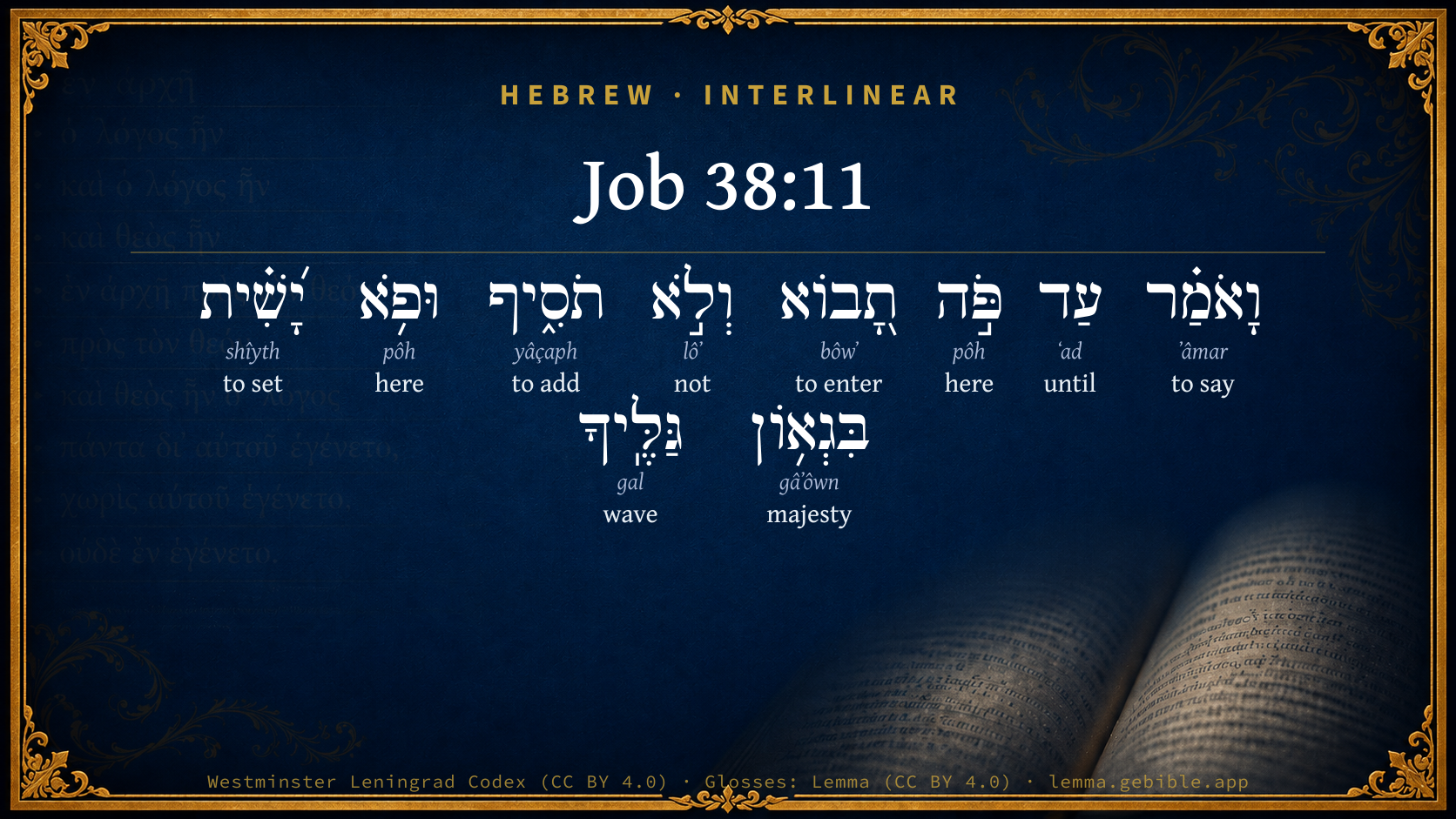
Job 38:11

Hebrew (Westminster Leningrad Codex) Job 38:11 appears in the Hebrew Old Testament. The text above is from the Westminster Leningrad Codex. Each word links to its Strong’s number, a concise gloss, and parsing drawn from the Open Scriptures Hebrew Bible morphology. Click any word for its full Brown-Driver-Briggs (BDB) entry.
Download image
Cite this verse

Job 38:11 (World English Bible). Public Domain. Lemma interlinear Bible study tool, https://lemma.gebible.app/v/job/38/11.

Show BibTeX & RIS
BibTeX
RIS
English Translation
And said, 'Here you may come, but no further; Here shall your proud waves be stayed?'
World English Bible · Public Domain
Download a study sheet

One document with this verse’s original text, its word-by-word gloss line, the meaning frame, cross-references with their text, attributed commentary, and full source and license credits — printable, and it pastes into notes with its structure intact.

This verse Autodidact and up

Study sheet (.html) Plain text (.txt)

A passage Seminary Student

Up to 50 verses in one chapter. A passage sheet keeps up to 6 commentary sources and 12 cross-references per verse, in the order this page ranks them, and says so on the sheet whenever that leaves anything out. Ask for a single verse and you get the Autodidact verse sheet above.

Everything on this page stays free to read, with no account — the sheet is a download of what is already on screen, not access to it.

Want to remove ads? Support Godless Engineer
Compare translations 3

The same verse in 3 English versions, stacked beneath the original-language interlinear above. Click any original word for its lexicon entry.

Each is an independent rendering of the whole verse — the interlinear is not word-aligned to these translations.

Highlighted words mark where these versions differ — a whole-verse word diff, not a word-by-word alignment.

  • World English Bible Public Domain
    And said, 'Here you may come, but no further; Here shall your proud waves be stayed?'
  • King James Version Public Domain
    And said, Hitherto shalt thou come, but no further: and here shall thy proud waves be stayed?
  • unfoldingWord Literal Text CC BY-SA 4.0
    and I said, ‘Unto here you will come, but you will not continue, and here one has set for the pride of your waves.’

unfoldingWord Literal Text — © unfoldingWord, licensed CC BY-SA 4.0. Word-aligned USFM3 via Door43 (git.door43.org/unfoldingWord/en_ult).

Versions to compare (up to 4)

3 of 4 selected

Show all 18 translations

Every available English version of this verse, each an independent rendering of the whole verse.

  • World English Bible Public Domain
    And said, 'Here you may come, but no further; Here shall your proud waves be stayed?'
  • Berean Standard Bible Public Domain
    and I declared: ‘You may come this far, but no farther; here your proud waves must stop’?
  • Majority Standard Bible Public Domain
    and I declared: ‘You may come this far, but no farther; here your proud waves must stop’?
  • King James Version Public Domain
    And said, Hitherto shalt thou come, but no further: and here shall thy proud waves be stayed?
  • American Standard Version (1901) Public Domain
    And said, Hitherto shalt thou come, but no further; And here shall thy proud waves be stayed?
  • Revised Version (1885) Public Domain
    And said, Hitherto shalt thou come, but no further; and here shall thy proud waves be stayed?
  • Geneva Bible (1599) Public Domain
    And said, Hitherto shalt thou come, but no farther, and here shall it stay thy proude waues.
  • Douay-Rheims (1899) Public Domain
    And I said: Hitherto thou shalt come, and shalt go no further, and here thou shalt break thy swelling waves.
  • Young's Literal Translation Public Domain
    And say, `Hitherto come thou, and add not, And a command is placed On the pride of thy billows.'
  • Literal Standard Version CC BY-SA 4.0
    And say, To here you come, and no more, || And a command is placed || On the pride of your billows.
  • Unlocked Literal Bible CC BY-SA 4.0
    and when I said to it, 'You may come this far, but no farther; here is where I will put a boundary to the pride of your waves.'
  • unfoldingWord Literal Text CC BY-SA 4.0
    and I said, ‘Unto here you will come, but you will not continue, and here one has set for the pride of your waves.’
  • Darby Bible Public Domain
    And said, Hitherto shalt thou come and no further, and here shall thy proud waves be stayed?
  • World Messianic Bible Public Domain
    and said, ‘You may come here, but no further. Your proud waves shall be stopped here’?
  • Webster's Bible Public Domain
    And said, Hitherto shalt thou come, but no further: and here shall thy proud waves be stayed.
  • Free Bible Version CC BY-SA 4.0
    I said, ‘You may come here, but no farther. Here is where your proud waves stop.’
  • Bible in Basic English Public Domain
    And said, So far you may come, and no farther; and here the pride of your waves will be stopped?
  • JPS Tanakh (1917) Public Domain
    And said: 'Thus far shalt thou come, but no further; and here shall thy proud waves be stayed'?

Literal Standard Version (2020), Covenant Press — licensed CC BY-SA 4.0. Text via the HelloAO Bible API (eBible.org). Unlocked Literal Bible (unfoldingWord) — licensed CC BY-SA 4.0. Text via the HelloAO Bible API (eBible.org). unfoldingWord Literal Text — © unfoldingWord, licensed CC BY-SA 4.0. Word-aligned USFM3 via Door43 (git.door43.org/unfoldingWord/en_ult). Free Bible Version, Dr. Jonathan Gallagher — licensed CC BY-SA 4.0. Text via the HelloAO Bible API (eBible.org).

Word by word

More ways to search: Search by grammar → Find every occurrence → Compare this word →

Practice this passage: Drill this verse → Learn its vocabulary →

גַּלֶּֽיךָ
gal
H1530
“waves · your”
Noun, Common, Masculine, Plural, Construct + Suffix, Personal, 2nd Person, Masculine, Singular
Part of Speech
Noun
Type
Common
Gender
Masculine
Number
Plural
State
Construct
Full BDB Definition

Origin: from H1556

TWOT: 353a

heap, spring, wave, billow - heap (of stones) - over dead body - alone - used in ratifying a covenant - waves (figuratively of chastisement of Jehovah) - spring
  1. וָאֹמַ֗ר ʼâmar H559 “and · to say” Conjunction + Verb, Qal, Sequential Imperfect, 1st Person, Common, Singular
  2. עַד ʻad H5704 “until” Preposition
  3. פֹּ֣ה pôh H6311 “here” Adverb
  4. תָ֭בוֹא bôwʼ H935 “to enter” Verb, Qal, Imperfect, 2nd Person, Masculine, Singular
  5. וְלֹ֣א lôʼ H3808 “and · not” Conjunction + Particle, Negative
  6. תֹסִ֑יף yâçaph H3254 “to add” Verb, Hiphil, Imperfect, 2nd Person, Masculine, Singular
  7. וּפֹ֥א pôh H6311 “and · here” Conjunction + Adverb
  8. יָ֝שִׁ֗ית shîyth H7896 “to set” Verb, Qal, Imperfect, 3rd Person, Masculine, Singular
  9. בִּגְא֥וֹן gâʼôwn H1347 “in/at · majesty of” Preposition + Noun, Common, Masculine, Singular, Construct

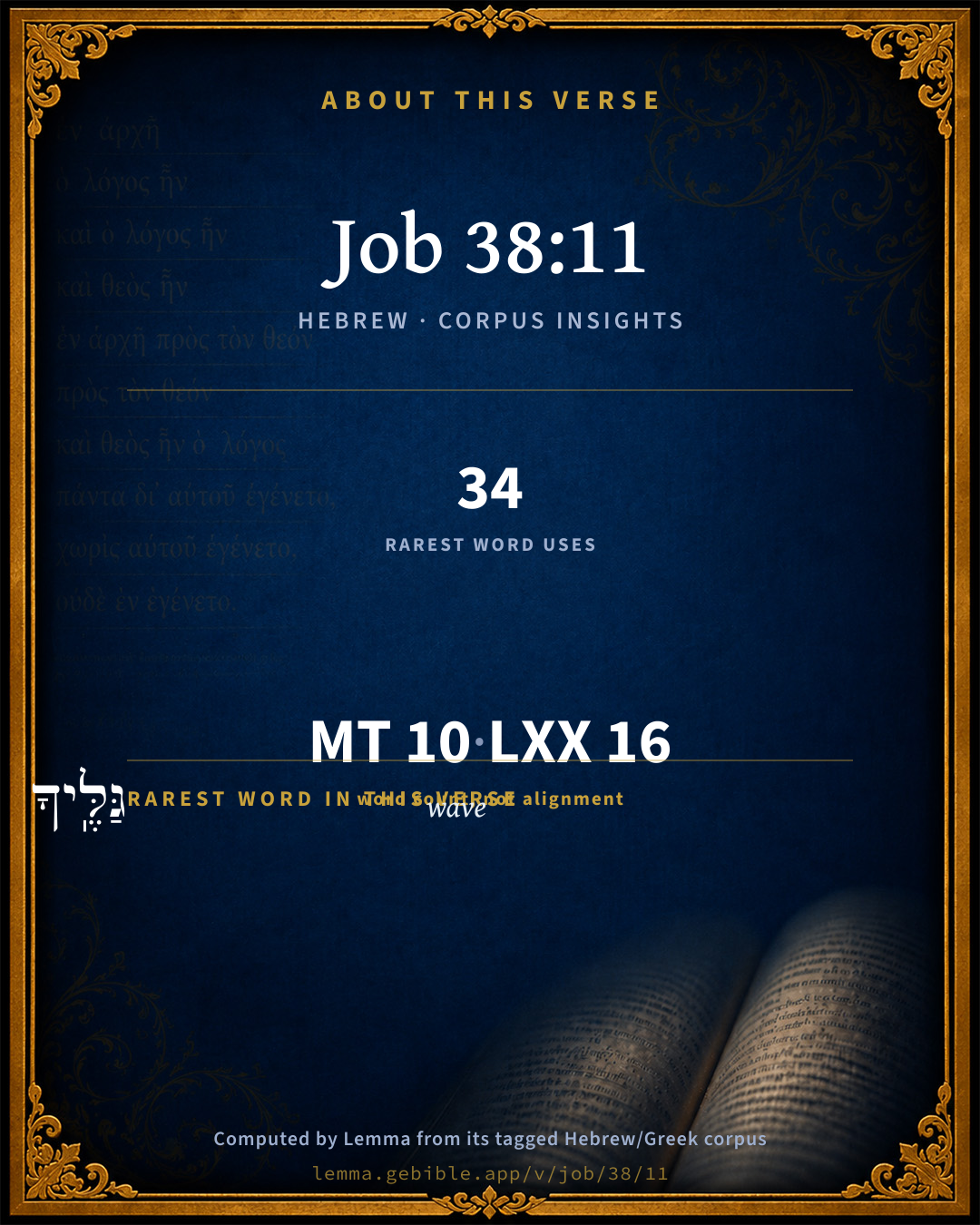
About this verse

These counts appear in no published source. They are computed here, from the morphology-tagged text and Lemma’s own curated glosses. What Lemma adds →

10
words
9
distinct lemmas
Wisdom
section

Shared distinctive vocabulary

גַּלֶּֽיךָ wave H1530 occurs in 31 verses of the Hebrew Bible. Also found in:

Grammatical profile

  • 4 verbs
  • 2 nouns
  • 1 preposition
  • 2 adverbs
  • 1 particle

Verb forms

  • וָאֹמַ֗ר Qal · Sequential Imperfect
  • תָ֭בוֹא Qal · Imperfect
  • תֹסִ֑יף Hiphil · Imperfect
  • יָ֝שִׁ֗ית Qal · Imperfect

Repetition

A word recurs within this verse — often emphatic in Hebrew:

  • פֹּ֣ה here H6311 ×2

Hebrew & Septuagint length

In English translation the verse runs 16 words from the Hebrew and 23 from the Septuagint (LXX English) — the Septuagint runs noticeably longer here. See the side-by-side →

A rough comparison of the two English renderings, which tokenize alike — not a word-level alignment.

Word counts can differ between the Hebrew and the Greek without any difference in meaning — e.g. the Hebrew direct-object marker אֵת has no separate Greek word, and Greek often adds the article ὁ.

In the original languages it is 10 Hebrew tokens and 16 Greek tokens — but the two are counted differently (Hebrew bundles its prefixes and suffixes into one token; the Greek is in lemma form), so that isn’t a like-for-like length.

Cross-references

12

Topical passages linked to Job 38:11 in the Treasury of Scripture Knowledge — connected by theme and wording, ordered by reader-vote popularity; previews shown in the World English Bible.

  • Psalms 89:9 You rule the pride of the sea. When its waves rise up, you calm them.
  • Proverbs 8:29 When he gave to the sea its boundary, That the waters should not violate his commandment, When he marked out the foundations of the earth;
  • Psalms 65:6–7 Who by his power forms the mountains, Having armed yourself with strength;
  • Mark 4:39–41 He awoke, and rebuked the wind, and said to the sea, "Peace! Be still!" The wind ceased, and there was a great calm.
  • Luke 8:32–33 Now there was there a herd of many pigs feeding on the mountain, and they begged him that he would allow them to enter into those. He allowed them.
  • Job 2:6 Yahweh said to Satan, "Behold, he is in your hand. Only spare his life."
  • Psalms 93:3–4 The floods have lifted up, Yahweh, The floods have lifted up their voice. The floods lift up their waves.
  • Isaiah 27:8 In measure, when you send them away, you do contend with them; he has removed [them] with his rough blast in the day of the east wind.
  • Job 1:22 In all this, Job did not sin, nor charge God with wrongdoing.
  • Psalms 76:10 Surely the wrath of man praises you. The survivors of your wrath are restrained.
  • Revelation 20:2–3 He seized the dragon, the old serpent, which is the devil and Satan, who deceives the whole inhabited earth, and bound him for a thousand years,
  • Revelation 20:7–8 And after the thousand years, Satan will be released from his prison,

Cross-references courtesy of OpenBible.info (CC BY 4.0).

Hebrew and Greek witnesses Masoretic Hebrew ↔ Greek Septuagint

The same verse in the two great witnesses to the Old Testament, shown verse-for-verse.

Here the Septuagint runs noticeably longer than the Hebrew — LXX2012 (modern English Septuagint) 23 words vs World English Bible 16. A rough length comparison of the two English translations, not a word-level alignment — read both below.

These are two independent witnesses, not word-aligned to each other, and the Septuagint is shown in lemma (dictionary) form.

Hebrew Job 38:11 Masoretic · Westminster Leningrad Codex

וָאֹמַ֗ר עַד פֹּ֣ה תָ֭בוֹא וְלֹ֣א תֹסִ֑יף וּפֹ֥א יָ֝שִׁ֗ית בִּגְא֥וֹן גַּלֶּֽיךָ

And said, 'Here you may come, but no further; Here shall your proud waves be stayed?'

World English Bible · Public Domain

Greek LXX Job 38:11 Septuagint · lemma form

εἶπον δέ αὐτός μέχρι οὗτος ἔρχομαι καί οὐ ὑπερβαίνω ἀλλά ἐν σεαυτοῦ συντρίβω σύ ὁ κῦμα

And I said to it, Hitherto shall you come, but you shall not go beyond, but your waves shall be confined within you.

LXX2012 (modern English Septuagint) · Public Domain

Hebrew: Westminster Leningrad Codex (CC BY 4.0). Greek: Septuagint (public domain); English from LXX2012 (modern English Septuagint) (Public Domain). How the Septuagint differs from the Hebrew →

Commentary

Notes on Job 38:11 from classic Christian and Jewish commentators (each source and its license shown beneath its notes). The classic Christian expositions comment on the surrounding passage and are grouped to its opening verse, so a note may address several verses; the Jewish commentaries on the Tanakh (Rashi and others) are per-verse, so they appear only where the commentator wrote on this verse.

Lemma curates 59 commentaries, every one of them public domain or Creative Commons licensed, each selected and text-cleaned for this edition rather than reprinted as found. About our sources →

Trapp's Complete Commentary

John Trapp

Job 38:11 And said, Hitherto shalt thou come, but no further: and here shall thy proud waves be stayed?

Ver. 11. And said, Hitherto shalt thou come, but no further] This God commanded, and it is done. If the sea at any time break its bounds, and overflow countries (as in Holland, Zealand, and other parts it hath done), that is to declare the power of God, and his just anger against sin.

And here shall thy proud waves be stayed?] Canute commanded such a thing, but the sea regarded him not. Xerxes beat the sea, and cast a pair of fetters into it to make it his prisoner, but to no purpose. God here chides it by an elegant ellipsis or aposiopesis, Illic ponet (sc. ventus) elationem fluctuum tuorum, and it is quieted immediately, as Jon 1:15 Mat 8:26 Think the same of the waters of afflictions.

John Trapp, A Commentary or Exposition upon All the Books of the Old and New Testament (1647–1656) — public domain. Text from a community e-Sword module.

The Biblical Illustrator

Joseph S. Exell

Job_38:11

Hitherto shalt thou come, but no further.

Drawing the line

Everybody draws the line somewhere or other.

1. The Lord Chancellor, speaking on the Burials Bill, remarked that we English people must draw the line as to the requirements of the religious ceremony in the churchyards of our country, by saying that it must be a Christian service. Every rational person will consent to that drawing of the line at the word Christian, by which I understand is meant a service which acknowledges God and a life beyond the grave.

2. We draw the line in giving evidence in Courts of Justice and in entering Parliament. A man cannot be believed and trusted unless he either takes an oath, or affirms that he will be truthful and faithful. It is absurd as well as insulting to an Englishman to make him swear that he is telling the truth; and I hope that, before long, in our courts of justice we shall simply affirm before giving evidence--I promise, on my word of honour, to tell the truth.

3. The line is also drawn in things of great social and moral importance. In questions of modesty. There are some books against which you have to draw the line of exclusion, and to say, No, I draw the line at these books; they shall not enter my house. It is right to draw the line somewhere. With all due deference to those who say, To the pure all things are pure, a line ought to be drawn in the admission of pictures to public exhibitions. A line ought to be drawn against such demoralising works of art, no matter if a prince were the artist. Draw the line too in your conversation. Do not join in any jokes or stories which go too far over the edge of modesty, but rebuke it in every shape and way. Modesty is womans sweetest glory, and mans richest crown.

4. Draw the right line in the respect due one to another. Let us not respect a man for his money, but for his manhood.

5. Draw the right line in questions of religion. Not a line of intolerance and exclusiveness. Some people presumptuously draw a line around Gods heart; they encroach on the prerogative of God, saying that He cannot save every man. What a libel on God. (W. Birch.)

The Biblical Illustrator, edited by Joseph S. Exell (c. 1880s–1900s) — public domain. Text from a community e-Sword module.

Geneva Bible (1599)

Geneva Bible translators

That is, God’s decree and commandment, as verse 10.

Geneva Bible (1599) marginal notes — public domain. Text via Bolls.life.

Jamieson, Fausset & Brown

Robert Jamieson, A. R. Fausset & David Brown

stayed--Hebrew, "a limit shall be set to."

Jamieson, Fausset & Brown — Commentary Critical and Explanatory on the Whole Bible (1871) — public domain (CC PDM 1.0). Text via the HelloAO Bible API.

Adam Clarke's Commentary

Verse 11. Hitherto shalt thou come] Thus far shall thy flux and reflux extend. The tides are marvellously limited and regulated, not only by the lunar and solar attractions, but by the quantum of time also which is required to remove any part of the earth's surface from under the immediate attractive influence of the sun and moon. And this regulation takes place by means of the rotation of the earth round its own axis, which causes one thousand and forty-two miles of its equator to pass from under any given point in the heavens in one hour; and about five hundred and eighty miles in the latitude of London: so that the attracted fluid parts are every moment passing from under the direct attractive influence, and thus the tides cannot generally be raised to any extraordinary height. The attraction of the sun and moon, and the gravitation of its own parts to its own centre, which prevent too great a flux on the one hand, and too great a reflux on the other; or, in other words, too high a tide, and too deep an ebb, are also some of those bars and doors by which its proud waves are stayed, and prevented from coming farther; all being regulated by these laws of attraction by the sun and moon, the gravitation of its own parts from the sun and moon, and the diurnal motion round its own axis, by which the fluid parts, easily yielding to the above attraction, are continually moving from under the direct attractive influence. Here a world of wisdom and management was necessary, in order to proportion all these things to each other, so as to procure the great benefits which result from the flux and reflux of the sea, and prevent the evils that must take place, at least occasionally, were not those bars and doors provided. It is well known that the spring-tides happen at the change and full of the moon, at which time she is in conjunction with and opposition to the sun. As these retire from their conjunction, the tides neap till about three days after the first quadrature, when the tides begin again to be more and more elevated, and arrive at their maximum about the third day after the opposition. From this time the tides neap as before till the third day after the last quadrature; and afterwards their daily elevations are continually increased till about the third day after the conjunction, when they recommence their neaping; the principal phenomena of the tides always taking place at or near the some points of every lunar synodic revolution.

Adam Clarke's Commentary on the Bible (1810–1826) — public domain. Text from a community e-Sword/MySword module.

John Gill's Exposition

And said, hitherto shalt thou come, but no further,.... The waters of the sea shall spread themselves to such and such shores, and wash them, but go no further; its rolling tides shall go up so far in rivers that go out of it, and then return, keeping exactly to time and place; this is said by Jehovah, the Word of God, and through his almighty power is tended to;

and here shall thy proud waves be stayed; so high and no higher shall they lift up themselves; so far and no farther shall they roll on, than to the boundaries fixed for them; and though they may toss up themselves as proud men toss up their heads, for which, reason pride is ascribed to them, yet they shall not prevail, Jer 5:22; all this may be accommodated to the afflictions of God's people, which are sometimes compared to the waves and billows of the sea, Psa 42:7; and these issue out of the womb of God's purposes and decrees, and are not the effects of chance; they are many, and threaten to overwhelm, but God is with his people in them, and preserves them from being overflowed by them; he has set the bounds and measures of them, beyond which they cannot go; see Isa 27:8; and also to the world, and to the men of it, who are like a troubled sea, Dan 7:2; and who rise, and swell, and dash against the people of God, being separated from them who were originally mixed with them; but the Lord restrains their wrath and fury, and suffers them not to do his people any harm; whom he has placed in the munition of rocks out of their reach, that those proud waters cannot go over them as they threaten to do; see Psa 76:10.

John Gill's Exposition of the Whole Bible (1746–1763) — public domain (CC PDM 1.0). Text via the HelloAO Bible API.

Albert Barnes' Notes on the Bible

And said, Hitherto shalt thou come - This is a most sublime expression, and its full force can be felt only by one who has stood on the shores of the ocean, and seen its mighty waves roll toward the beach as if in their pride they would sweep everything away, and how they are checked by the barrier which God has made. A voice seems to say to them that they may roll in their pride and grandeur so far, but no further. No increase of their force or numbers can sweep the barrier away, or make any impression on the limits which God has fixed.

And here shall they proud waves be stayed - Margin, as in Hebrew, “the pride of thy waves.” A beautiful image. The waves seem to advance in pride and self-confidence, as if nothing could stay them. They come as if exulting in the assurance that they will sweep everything away. In a moment they are arrested and broken, and they spread out humbly and harmlessly on the beach. God fixes the limit or boundary which they are not to pass, and they lie prostrate at his feet.

Albert Barnes' Notes on the Bible (1834–1885) — public domain. Text from a community e-Sword/MySword module.

Matthew Poole's English Annotations

To wit, at the sand and shore of the sea, Jer 5:22.

Thy proud waves; which rage and swell as if they would overwhelm all the earth.

Matthew Poole's English Annotations on the Holy Bible (1683–1685) — public domain. Text from a community e-Sword/MySword module.

Whedon's Commentary on the Bible

Daniel D. Whedon

11. Hitherto shalt thou come — No one would, a priori, have conceived that so vast and mighty a body of water as the ocean could be kept in place by so contemptible a barrier as a shore of sand. There may have been in the mind of the speaker a more enlarged conception than that of a mere coast girding the sea on every side. That conception may have embraced the wonderful forces which unite to secure the stability of the ocean, and maintain its equilibrium. “The mean depth of the sea, according to the calculations of Laplace, is four or five miles. On this supposition, the addition to the sea of one fourth of the existing waters would drown the whole of the globe, excepting a few chains of mountains. Whether this be exact or no, we can easily conceive the quantity of water which lies in the cavities of our earth to be greater or less than it at present is. With every such addition or subtraction the form and magnitude of the dry land would vary” — producing vastly important and destructive consequences, which Whewell proceeds to unfold. — Astronomy and General Physics, book i, chap. 4. The stability of the ocean is secured by numerous nicely adjusted forces, among which the mean specific gravity of the earth, as well as the specific gravities of the moon, planets, and sun, may be mentioned as the most important. To enlarge upon but one of these influences — the density of our earth: the simple circumstance that it is about five times that of water — an exact proportion, which needed a divine mind to establish — furnishes a restraint upon the immense fluid masses, by which they are held incumbent within their ocean bed. “The density of Jupiter is one fourth, that of Saturn less than one seventh, of that of the earth. If an ocean of water were poured into the cavities upon the surface of Saturn its equilibrium would not be stable. It would leave its bed on one side of the globe; and the planet would finally be composed of one hemisphere of water and one of land. If the earth had an ocean of a fluid six times as heavy as water, (quicksilver is thirteen times as heavy,) we should have in like manner a dry and fluid hemisphere” — WHEWELL, ibid., book ii, chap. 6. Be stayed — Literally, One shall set — “a bound” evidently being understood.

Daniel D. Whedon (gen. ed.), Commentary on the Old and New Testaments (1874–1909) — public domain. Text from a community e-Sword module.

The Pulpit Commentary

And said, Hitherto shalt thou corns, but no further. The law is not quite absolute. Wherever the sea washes a coast-line, there is a continual erosive action, whereby the land is, little by little, eaten away, and the line of the coast thrust back. But the action is so slow that millennia pass without any considerable effect being produced, and encroachments in some places are generally counterbalanced by retrenchment in others, so that the general contour of laud and water, with the proportion of the one to the other, remain probably very much the same at the present day as when the earth first became the habitation of man. And here shall thy proud waves be stayed. The waves of the sea "rage horribly," and every now and then topple down a rock or undermine a cliff, and seem proud of their achievements; but how little do they effect, even in thousands of years! The little islet of Psyttaleia still blocks the eastern end of the straits of Salamis. The Pharos island lies off the westernmost mouth of the Nile. Even the low, fiat Aradus, on the Syrian coast, has not been swept away. Everywhere the waves are practically "stayed," and all the menaces of the sea against the land come to nought.

The Pulpit Commentary (1880–1919), ed. H.D.M. Spence-Jones & Joseph S. Exell — public domain. Text from a community e-Sword module.

Lesson kit

Teaching starters — assembled from the data on this page, not authored interpretation. Every prompt links to the verse data it draws on. Edit before teaching.

Job, in the Wisdom, opens this verse with 10 words (9 distinct Hebrew lemmas). Its most distinctive word is gal (“wave”). The Greek Septuagint runs longer here. A historical commentator’s framing appears above. Read the whole chapter for the surrounding context.

Discussion questions

  1. How does “wave” (gal) shape what this verse is saying?
  2. Genesis 31:46 shares the word «wave» with this verse. How do the two illuminate each other?
  3. “here” occurs 2× in this one verse. What is the effect of the repetition?
  4. Compared with the Hebrew, the Septuagint runs longer here. What questions does that raise?
  5. These translations render this verse differently; the difference is in the English rendering, not the original. What questions does that raise?
  6. The verb «וָאֹמַ֗ר» is Qal Sequential Imperfect. How does its form color the action?
  7. Reading how Trapp's Complete Commentary and The Biblical Illustrator read this verse, where do the two commentators agree and where do they part?

Things to notice

Reading settings

Reading text

Shown beneath each verse's original-language words.

Old Testament
Old Testament edition

Read the OT as the Masoretic Hebrew (MT) or the Greek Septuagint (LXX).

English shown for the Greek Septuagint (in the Hebrew ↔ Greek comparison).

Comparing translations? Open the Compare panel on any verse page to stack up to four side by side.