
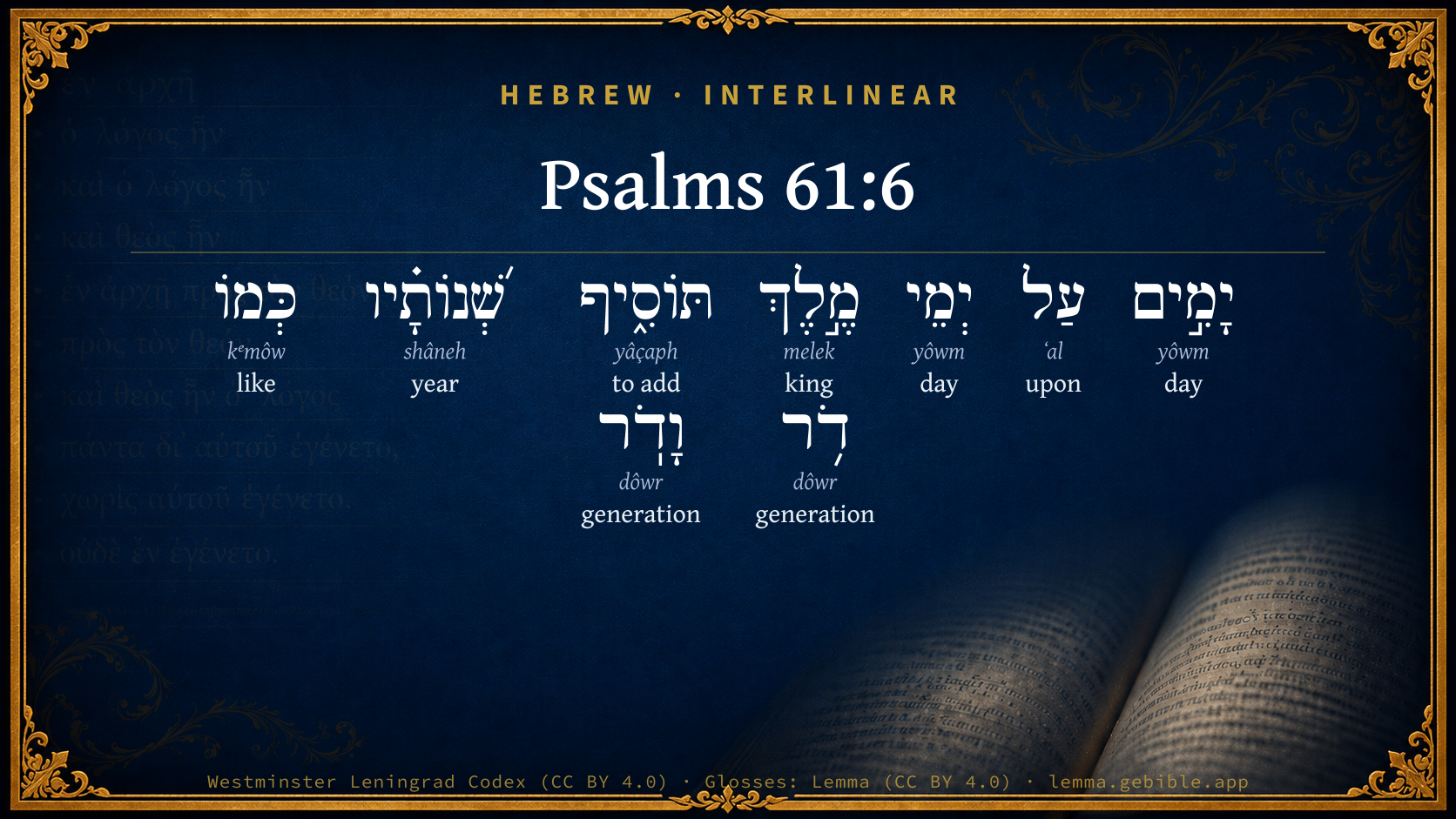
Psalms 61:6

Hebrew (Westminster Leningrad Codex) Psalms 61:6 appears in the Hebrew Old Testament. The text above is from the Westminster Leningrad Codex. Each word links to its Strong’s number, a concise gloss, and parsing drawn from the Open Scriptures Hebrew Bible morphology. Click any word for its full Brown-Driver-Briggs (BDB) entry.
Download image
Cite this verse

Psalms 61:6 (World English Bible). Public Domain. Lemma interlinear Bible study tool, https://lemma.gebible.app/v/psalms/61/6.

Show BibTeX & RIS
BibTeX
RIS
English Translation
You will prolong the king's life; His years shall be for generations.
World English Bible · Public Domain
Download a study sheet

One document with this verse’s original text, its word-by-word gloss line, the meaning frame, cross-references with their text, attributed commentary, and full source and license credits — printable, and it pastes into notes with its structure intact.

This verse Autodidact and up

Study sheet (.html) Plain text (.txt)

A passage Seminary Student

Up to 50 verses in one chapter. A passage sheet keeps up to 6 commentary sources and 12 cross-references per verse, in the order this page ranks them, and says so on the sheet whenever that leaves anything out. Ask for a single verse and you get the Autodidact verse sheet above.

Everything on this page stays free to read, with no account — the sheet is a download of what is already on screen, not access to it.

Want to remove ads? Support Godless Engineer
Compare translations 3

The same verse in 3 English versions, stacked beneath the original-language interlinear above. Click any original word for its lexicon entry.

Each is an independent rendering of the whole verse — the interlinear is not word-aligned to these translations.

Highlighted words mark where these versions differ — a whole-verse word diff, not a word-by-word alignment.

  • World English Bible Public Domain
    You will prolong the king's life; His years shall be for generations.
  • King James Version Public Domain
    Thou wilt prolong the king's life: and his years as many generations.
  • unfoldingWord Literal Text CC BY-SA 4.0
    Days upon days of the king, may you add his years, as generation and generation.

unfoldingWord Literal Text — © unfoldingWord, licensed CC BY-SA 4.0. Word-aligned USFM3 via Door43 (git.door43.org/unfoldingWord/en_ult).

Versions to compare (up to 4)

3 of 4 selected

Show all 18 translations

Every available English version of this verse, each an independent rendering of the whole verse.

  • World English Bible Public Domain
    You will prolong the king's life; His years shall be for generations.
  • Berean Standard Bible Public Domain
    Increase the days of the king’s life; may his years span many generations.
  • Majority Standard Bible Public Domain
    Increase the days of the king’s life; may his years span many generations.
  • King James Version Public Domain
    Thou wilt prolong the king's life: and his years as many generations.
  • American Standard Version (1901) Public Domain
    Thou wilt prolong the king's life; His years shall be as many generations.
  • Revised Version (1885) Public Domain
    Thou wilt prolong the king’s life: his years shall be as many generations.
  • Geneva Bible (1599) Public Domain
    Thou shalt giue the King a long life: his yeeres shalbe as many ages.
  • Douay-Rheims (1899) Public Domain
    For thou, my God, hast heard my prayer: thou hast given an inheritance to them that fear thy name.
  • Young's Literal Translation Public Domain
    Days to the days of the king Thou addest, His years as generation and generation.
  • Literal Standard Version CC BY-SA 4.0
    You add days to the days of the king, || His years as generation and generation.
  • Unlocked Literal Bible CC BY-SA 4.0
    You will prolong the king's life; his years will be like many generations.
  • unfoldingWord Literal Text CC BY-SA 4.0
    Days upon days of the king, may you add his years, as generation and generation.
  • Darby Bible Public Domain
    Thou wilt add days to the days of the king: his years shall be as many generations.
  • World Messianic Bible Public Domain
    You will prolong the king’s life. His years will be for generations.
  • Webster's Bible Public Domain
    \\61:5\\For thou, O God, hast heard my vows: thou hast given me the heritage of those that fear thy name.
  • Free Bible Version CC BY-SA 4.0
    Please give the king many extra years; may his reign last through generations.
  • Bible in Basic English Public Domain
    You will give the king long life; and make his years go on through the generations.
  • JPS Tanakh (1917) Public Domain
    (61-7) Mayest Thou add days unto the king's days! May his years be as many generations!

Literal Standard Version (2020), Covenant Press — licensed CC BY-SA 4.0. Text via the HelloAO Bible API (eBible.org). Unlocked Literal Bible (unfoldingWord) — licensed CC BY-SA 4.0. Text via the HelloAO Bible API (eBible.org). unfoldingWord Literal Text — © unfoldingWord, licensed CC BY-SA 4.0. Word-aligned USFM3 via Door43 (git.door43.org/unfoldingWord/en_ult). Free Bible Version, Dr. Jonathan Gallagher — licensed CC BY-SA 4.0. Text via the HelloAO Bible API (eBible.org).

Word by word

More ways to search: Search by grammar → Find every occurrence → Compare this word →

Practice this passage: Drill this verse → Learn its vocabulary →

About this verse

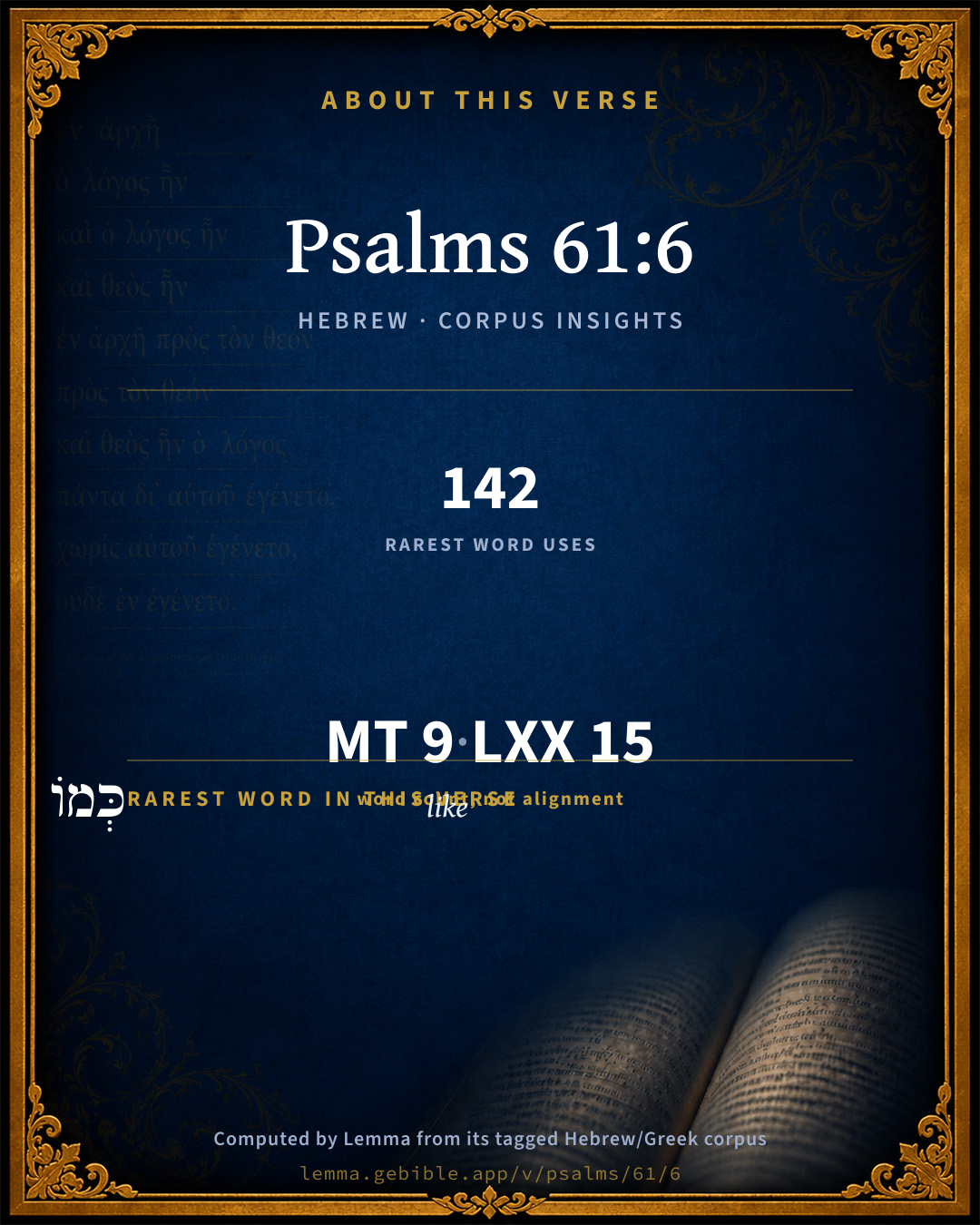
These counts appear in no published source. They are computed here, from the morphology-tagged text and Lemma’s own curated glosses. What Lemma adds →

9
words
7
distinct lemmas
Wisdom
section

Grammatical profile

  • 1 verb
  • 6 nouns
  • 2 prepositions

Verb forms

  • תּוֹסִ֑יף Hiphil · Imperfect

Repetition

Words recur within this verse — often emphatic in Hebrew:

  • יָמִ֣ים day H3117 ×2
  • דֹ֥ר generation H1755 ×2

Hebrew & Septuagint length

In English translation the verse runs 12 words from the Hebrew and 18 from the Septuagint (LXX English) — closely comparable.

A rough comparison of the two English renderings, which tokenize alike — not a word-level alignment.

Word counts can differ between the Hebrew and the Greek without any difference in meaning — e.g. the Hebrew direct-object marker אֵת has no separate Greek word, and Greek often adds the article ὁ.

In the original languages it is 9 Hebrew tokens and 15 Greek tokens — but the two are counted differently (Hebrew bundles its prefixes and suffixes into one token; the Greek is in lemma form), so that isn’t a like-for-like length.

Cross-references

5

Topical passages linked to Psalms 61:6 in the Treasury of Scripture Knowledge — connected by theme and wording, ordered by reader-vote popularity; previews shown in the World English Bible.

  • Psalms 21:4 He asked life of you, you gave it to him, Even length of days forever and ever.
  • Psalms 89:36–37 His seed will endure forever, His throne like the sun before me.
  • Psalms 21:6 For you make him most blessed forever. You make him glad with joy in your presence.
  • Psalms 72:15–17 They shall live, and to him shall be given of the gold of Sheba. Men shall pray for him continually. They shall bless him all day long.
  • Isaiah 53:10 Yet it pleased Yahweh to bruise him; he has put him to grief: when you shall make his soul an offering for sin, he shall see [his] seed, he shall prolong his days, and the pleasure of Yahweh shall prosper in his hand.

Cross-references courtesy of OpenBible.info (CC BY 4.0).

Hebrew and Greek witnesses Masoretic Hebrew ↔ Greek Septuagint

The same verse in the two great witnesses to the Old Testament, shown verse-for-verse.

You’re reading Greek Psalm 60 (Hebrew Psalm 61). The Septuagint counts the superscription, so verse numbers can differ from the Hebrew — chapter-level alignment, not verse-by-verse. Numbering follows Rahlfs.

These are two independent witnesses, not word-aligned to each other, and the Septuagint is shown in lemma (dictionary) form.

Hebrew Psalms 61:6 Masoretic · Westminster Leningrad Codex

יָמִ֣ים עַל יְמֵי מֶ֣לֶךְ תּוֹסִ֑יף שְׁ֝נוֹתָ֗יו כְּמוֹ דֹ֥ר וָדֹֽר

You will prolong the king's life; His years shall be for generations.

World English Bible · Public Domain

Greek LXX Greek Psalm 60:6 Septuagint · lemma form

ὅτι σύ ὁ θεός εἰςἀκούω ὁ εὐχή ἐγώ δίδωμι κληρονομία ὁ φοβέω ὁ ὄνομα σύ

You shall add days to the days of the king; you shall lengthen his years to all generations.

LXX2012 (modern English Septuagint) · Public Domain

Hebrew: Westminster Leningrad Codex (CC BY 4.0). Greek: Septuagint (public domain); English from LXX2012 (modern English Septuagint) (Public Domain). How the Septuagint differs from the Hebrew →

Commentary

Notes on Psalms 61:6 from classic Christian and Jewish commentators (each source and its license shown beneath its notes). The classic Christian expositions comment on the surrounding passage and are grouped to its opening verse, so a note may address several verses; the Jewish commentaries on the Tanakh (Rashi and others) are per-verse, so they appear only where the commentator wrote on this verse.

Lemma curates 59 commentaries, every one of them public domain or Creative Commons licensed, each selected and text-cleaned for this edition rather than reprinted as found. About our sources →

Trapp's Complete Commentary

John Trapp

Psa 61:6 Thou wilt prolong the king’s life: [and] his years as many generations.

Ver. 6. Thou wilt prolong the king’s life] The King Christ, saith the Chaldee, who shall see his seed, he shall prolong his days, and the pleasure of the Lord shah prosper in his hand, Isa 53:10. David himself also lived and reigned longer than most kings do, being old and full of days.

And his years as many generations] sc. In his sons and successors. So Psa 72:17, Filiabitur heroine eius. The name of Christ shall endure for ever, it shall be begotten as one generation is begotten of another, there shall be a succession of Christ’s name.

John Trapp, A Commentary or Exposition upon All the Books of the Old and New Testament (1647–1656) — public domain. Text from a community e-Sword module.

The Biblical Illustrator

Joseph S. Exell

Psa_61:6-8

Thou wilt prolong the kings life: and his years as many generations.

The perpetuity of Christs kingdom

He prophesieth not simply of the stability of the kingdom in his own person and posterity, but under the type; namely, he speaketh of the perpetuity of the kingdom of Christ, the true King of Israel, for which end he prayeth that mercy and truth may be forthcoming to subjects of Christ, that His kingdom may be prolonged; and so David in his time, and all the saints in their time, may joyfully praise God continually. Whence learn--

1. It is not unusual with God, together with present consolation, and the light of future salvation in Christ, to reveal also and give assurance of great things concerning Christs kingdom.

2. The glory of Christ and perpetuity of His kingdom is every subjects good and comfort, for this is comfort for David, that Christ shall live for ever, that He shall abide before God for ever.

3. The kingdom of Christ, and government of His subjects in His Church, shall be allowed of God, and be protected of God, and blessed of God for ever, however it be opposed by men in the world.

4. The perpetuity of Christs kingdom and preservation of His subjects in this life, till they be possessed of heaven, is by the merciful remedying the misery, and removing of the sin which they are subject unto, and by performing of what He hath promised and prepared through Christ to bestow upon them.

5. The best retreat that can be made after wrestling and victory over troubles is prayer and praises; as here David after his exercise prayeth, O prepare mercy and truth; and then saith, unto thee will I sing.

6. As the main matter of our vows is the moral duty of rejoicing in God, and hearty praising of Him, so renewed experience of Gods mercy and truth towards His people in Christ is the main matter of our joy in Him and praise unto Him: O prepare mercy and truth, etc. (D. Dickson.)

.

Psa_62:1-12

The Biblical Illustrator, edited by Joseph S. Exell (c. 1880s–1900s) — public domain. Text from a community e-Sword module.

Joseph Benson's Commentary

Psa 61:6-8. Thou wilt prolong the king’s life — My life. He calls himself king, either, 1st, Because, if this Psalm was composed before Saul’s death, yet even then he knew he was designed and appointed to be king; or, rather, 2d, Because it was not composed till Saul was dead, and he was actually crowned king, at least of Judah. And his years — The years of my life and reign; as many generations — As long as if I had a lease of it for many ages. Thus he speaks, because his kingdom was not like Saul’s, but established to him and his heirs; and because Christ, his Son and Heir, should actually, and in his own person, possess the kingdom for ever. We may observe further here, that the Chaldee Paraphrase adds the word Christ; thus, Thou shalt give unto Christ the King days upon days. His years shall be as the generations of this world, and the generations of the world to come. And so Theodoret observes, that the former part of the verse may very well agree with the psalmist, but that the latter part of it is by no means applicable to him, but only to Christ; who was, according to the flesh, to descend from him, and of whom the psalmist was an eminent type. He shall abide — Hebrew, ישׁב, jesheeb, he shall sit; namely, on the throne; before God for ever — Living and ruling as in God’s presence, serving him with his royal power, and worshipping him in his tabernacle. O prepare mercy and truth — Or, order, or appoint, as the word מן, man, here signifies, intending, either, 1st, The graces of mercy, or compassion and truth, or faithfulness, which are the great supporters of thrones; or rather, the effects of God’s mercy and truth. Thy truth, in giving me those mercies which thou hast promised to me; and thy mercy, in giving me such further blessings as I need, and thou seest fit to give me. So will I sing praise unto thy name for ever — I will never cease praising thee while I live, and after I die, I shall praise thee in eternity. Let us remember, we must make praising God the work of our time in this world; even to the last, as long as our lives are prolonged, we must continue praising him; and then it will be made the work of our eternity in the world to come, and we shall be praising him for ever. That 1 may daily perform my vows — That I may pay unto thee those services and oblations which I vowed to thee, when I was in trouble. David’s praising God was itself the performance of his vows, and it disposed his heart to the performance of them in other instances. Praising God, and paying our vows to him, must be our constant daily work; every day we must be doing something toward it; because it is all but little in comparison with what is due; because we daily receive fresh mercies, and because, if we think much to do it daily we cannot expect to be doing it eternally.

Joseph Benson's Commentary on the Old and New Testaments (1811–1818) — public domain. Text from a community e-Sword module.

J. A. Alexander on Psalms

Joseph Addison Alexander

7. (Psa 61:6). Days to the days of the king thou wilt add; his years (shall be, or, thou wilt multiply) like generation and generation. The preposition in the first clause strictly means upon, and suggests the idea not of mere addition but accumulation, which would also be conveyed in English by the literal translation, days upon days. His use of the third person shews that he does not mean himself alone, but the king of Israel as an ideal or collective person, comprehending his posterity. The life of this ideal person would of course not be restricted to a single generation, but continued through many, which is the meaning of the idiomatic expression in the last clause.

Joseph Addison Alexander, The Psalms Translated and Explained (1850) — public domain. Text from a community e-Sword module.

Geneva Bible (1599)

Geneva Bible translators

This chiefly is referred to Christ, who liveth eternally not only in himself, but also in his members.

Geneva Bible (1599) marginal notes — public domain. Text via Bolls.life.

Jamieson, Fausset & Brown

Robert Jamieson, A. R. Fausset & David Brown

the king--himself and his royal line ending in Christ. Mercy and truth personified, as in Psa 40:11; Psa 57:3.

Jamieson, Fausset & Brown — Commentary Critical and Explanatory on the Whole Bible (1871) — public domain (CC PDM 1.0). Text via the HelloAO Bible API.

Adam Clarke's Commentary

Verse 6. Thou wilt prolong the king's life] The words are very emphatic, and can refer to no ordinary person. Literally, "Days upon days thou wilt add to the king; and his years shall be like the generations of this world, and the generations of the world to come." This is precisely the paraphrase I had given to this text before I had looked into the Chaldee Version; and to which I need add nothing, as I am persuaded no earthly king is intended: and it is Christ, as Mediator, that "shall abide before God for ever," Ps 61:7. Neither to David, nor to any earthly sovereign, can these words be applied.

Adam Clarke's Commentary on the Bible (1810–1826) — public domain. Text from a community e-Sword/MySword module.

John Calvin's Commentaries

6. Thou shalt add days upon days to the king etc. David cannot be considered as using these words of gratulation with an exclusive reference to himself. It is true that he lived to an extreme old age, and died full of days, leaving the kingdom in a settled condition, and in the hands of his son, who succeeded him; but he did not exceed the period of one man’s life, and the greater part of it was spent in continued dangers and anxieties. There can be no doubt, therefore, that the series of years, and even ages, of which he speaks, extends prospectively to the coming of Christ, it being the very condition of the kingdom, as I have often remarked, that God maintained them as one people under one head, or, when scattered, united them again. The same succession still subsists in reference to ourselves. Christ must be viewed as living in his members to the end of the world. To this Isaiah alludes, when he says, “Who shall declare his generation or age?” — words in which he predicts that the Church would survive through all ages, notwithstanding the incessant danger of destruction to which it is exposed through the attacks of its enemies, and the many storms assailing it. So here David foretells the uninterrupted succession of the kingdom down to the time of Christ.

John Calvin's Commentaries (1540-1563) — public domain. Text from the Calvin Translation Society English edition (1840s-50s) via the Christian Classics Ethereal Library (ccel.org). Calvin's coverage is partial (roughly two-thirds of the Bible); uncommented books and verses are honest gaps, never fabricated. The 19th-century editor's footnotes and remarks are omitted so the notes are faithfully Calvin's own voice.

Ellicott's Commentary for English Readers

(6) See margin, and render as a prayer.

A Bible Commentary for English Readers, edited by Charles John Ellicott (1878–1897) — public domain. Text from a community e-Sword module.

The Cambridge Bible for Schools and Colleges

gen. ed. J. J. S. Perowne

6. Thou wilt prolong the king’s life] Lit., Thou wilt add days to the days of the king. Cp. 2Ki_20:6. From speaking of the people (Psa_61:5), David passes to speak of himself. His life had been in danger: but now the danger was over. At first sight the words may seem to be those of another, speaking of David, rather than those of David speaking of himself. But he thus uses the third person because he is speaking of himself in his capacity of king, referring to the promises made to the king as such. Cp. Jer_38:5, where Zedekiah says, “The king is not he that can do anything against you” = I, though king, cannot &c.

and his years] R.V., his years shall be as many generations. This verse is not a prayer, and the text ought not to be altered to turn it into a prayer. It is a confident appeal to God’s promise and purpose. The long life which was one of Jehovah’s special blessings under the old covenant (Exo_23:26; 1Ki_3:11; Pro_3:2, and often), and which was a natural object of desire when the hope of a future life was all but a blank, was promised specially to the king (Psa_21:4). The language is partly hyperbolical, like the salutation “Let the king live for ever” (1Ki_1:31; Neh_2:3); partly it thinks of the king as living on in his descendants (2Sa_7:13; 2Sa_7:16; 2Sa_7:29; Psa_89:29; Psa_89:36); but words which in their strict sense could apply to no human individual, become a prophecy of One greater than David; and thus the Targum here interprets ‘king’ by ‘King Messiah.’ See Introd. p. lxxiv ff; and Introd. to Psalms 21.

The Cambridge Bible for Schools and Colleges (gen. ed. J. J. S. Perowne; Cambridge University Press, 1878–1918) — public domain. Text from a community e-Sword module.

John Gill's Exposition

Thou wilt prolong the King's life,.... Or "add days to the days of the King" (a). Meaning either himself, who, though his life was in danger by fighting with the Syrians and Edomites, or rather through the conspiracy of his son; yet was assured that he should yet live many years more, and especially in his posterity; and that his kingdom would be established for ever, as was promised him, Sa2 7:12. Or rather the King Messiah, so the Targum: and Kimchi observes, that if this psalm respects the captivity, the King is the King Messiah: it may be understood of his life as man; who, though he died, rose again, and lives for evermore; and that, as to the glory of God the Father, so to the good of his people, for whom he makes intercession; and of the continuance of his spiritual seed, in whom he may be said to live, and his days be prolonged, Isa 53:10; and of the duration of his kingdom, of which there will be no end. For it is an everlasting one, as follows:

and his years as many generations; he living, and his posterity and kingdom continuing, age after age. The Targum is,

"his years as the generations of this world, and the generations of the world to, come.''

(a) "dies super dies regis adjicieo", V. L. Pagninus, Montanus, &c.

John Gill's Exposition of the Whole Bible (1746–1763) — public domain (CC PDM 1.0). Text via the HelloAO Bible API.

Albert Barnes' Notes on the Bible

Thou wilt prolong the king’s life - literally, “Days upon the days of the king thou wilt add;” that is, Thou wilt add days to those which thou hast already permitted him to live. The language does not necessarily mean that he would have a long life, but that he would still be permitted to live. He had apprehended death. He knew that his life was sought by those who were engaged with Absalom in the rebellion. At first it was uncertain what the issue would be. He had fled for his life. But now, in answer to prayer, he felt assured that his life would be preserved; that he would be permitted to return to his home and his throne; and that as king - as the sovereign of his people - he would be permitted to honor God.

And his years as many generations - Margin, as in Hebrew, generation and generation. This probably means that he would be permitted to live longer than the ordinary time of a generation; that he would live as if one generation - or as if one ordinary lifetime - were added to another, so that he would live through successive generations of men. The average life of a generation is about thirty years. David is supposed to have lived from 1085 before the Christian era to 1016 b.c., or 69 years, which would reach a third generation. This is a more natural interpretation of the passage than to suppose that he refers to an “ideal” king, or that his dynasty would continue for many generations.

Albert Barnes' Notes on the Bible (1834–1885) — public domain. Text from a community e-Sword/MySword module.

Matthew Poole's English Annotations

The king’s life, i.e. my life. He calls himself king, either,

1. Because he was actually king, though Absalom usurped the throne; or,

2. Because he was designed and anointed to be king; and by calling himself

king, he supports himself under his present straits, and declares his confidence in God’s promise of the kingdom to him. Yet we must not think that David did commonly and publicly call or own himself to be king, which had neither been true nor convenient for his affairs; but this Psalm either was not composed whilst Saul lived, or at least was penned only for his private use and comfort, and not

committed to the chief musician; which indeed it could not be till David had the kingdom, and the inspection of the sacred music and service of the tabernacle.

His years, i.e. the years of my life and reign.

As many generations; as long as if I had a lease of it for many ages. Thus he speaks, partly because his kingdom was not like Saul’s, a matter of one age, expiring with his life, but established to him and his heirs for ever; and partly because Christ, his Son and Heir, should actually and in his own person possess the kingdom for ever.

Matthew Poole's English Annotations on the Holy Bible (1683–1685) — public domain. Text from a community e-Sword/MySword module.

The Treasury of David

Charles H. Spurgeon

Ver. 6. Thou wilt prolong the king's life; or, better, "days to the days of the King thou wilt add." Death threatened, but God preserved his beloved. David, considering his many perils, enjoyed a long and prosperous reign.

And his years as many generations. He lived to see generation after generation personally; in his descendants he lived as king through a very long period; his dynasty continued for many generations; and in Christ Jesus, his seed and son, spiritually David reigns on evermore. Thus he who began at the foot of the rock, half drowned, and almost dead, is here led to the summit, and sings as a priest abiding in the tabernacle, a king ruling with God for ever, and a prophet foretelling good things to come. (Ps 61:7.) See the uplifting power of faith and prayer. None so low but they may yet be set on high.

Ver. 6. Thou wilt prolong the king's life, etc. David cannot be considered as using these words of gratulation with an exclusive reference to himself. It is true that he lived to an extreme old age, and died full of days, leaving the kingdom in a settled condition, and in the hands of his son, who succeeded him; but he did not exceed the period of one man's life, and the greater part of it was spent in continued dangers and anxieties. There can be no doubt, therefore, that the series of years, and even ages, of which he speaks, extends prospectively to the coming of Christ, it being the very condition of the kingdom, as I have often remarked, that God maintained them as one people under on head, or when scattered, united them again. The same succession still subsists in reference to ourselves. Christ must be viewed as living in his members to the end of the world. To this Isaiah alludes when he says, "Who shall declare his generation or age?" --words in which he predicts that the church would survive through all ages, notwithstanding the incessant danger of destruction to which it is exposed through the attacks of its enemies, and the many storms assailing it. So here David foretells the uninterrupted succession of the kingdom down to the time of Christ. John Calvin.

Ver. 6. The king's life: and his years. David speaks designedly of the days of the king instead of his own days, as might have been expected from what had been said, for the purpose of showing that he considered the promise of eternal dominion as relating not to himself personally, but to his family--the royal family of David. E. W. Hengstenberg.

Ver. 6. Our King, his eternal existence, our personal joy in this, and our joy for our descendants.

Psalms 61:7*

Charles H. Spurgeon's The Treasury of David (1869–1885) — public domain. Psalms only. Text from a community e-Sword/MySword module.

Whedon's Commentary on the Bible

Daniel D. Whedon

6. Thou wilt prolong the king’s life—The change from the first to the third person is a poetical liberty. The insurrection was a conspiracy against the life of the king. If it succeeded he must die, but faith assures to him the victory. The Hebrew is very simple, “thou shall add days upon the days of the king; his years as generation and generation.” See Psa_21:4-7; and compare 2Sa_7:16; 2Sa_7:19; 2Sa_7:25; 2Sa_7:29; from which it appears that the king’s “life,” here, includes his dynasty: perhaps, also, in a higher sense, the King Messiah.

Daniel D. Whedon (gen. ed.), Commentary on the Old and New Testaments (1874–1909) — public domain. Text from a community e-Sword module.

The Pulpit Commentary

Thou wilt prolong (or, mayest thou prolong) the king"s life. The question arises What king? Some answer that David prays for the extension of his own life; or, if not exactly of his own life, then for the prolongation of his dynasty upon the throne (Hengstenberg); others suggest that a distant exile, perhaps in Assyria, prays for the life of the reigning King of Judah, Josiah probably ("Four Friends," p. 117); but the Messianic interpretation is perhaps the best. The writer, lifted up above himself and above sublunary things, abiding, as he does, in the spiritual tabernacle under the shelter of God"s wings (ver. 4), prays for long continuance of days for the true King, the ideal King, Messiah, of whom David and his house are types: "Mayest thou add days to the days of the King," and make his years as many generations; or, as generation and generation; i.e. eternally continuous.

The Pulpit Commentary (1880–1919), ed. H.D.M. Spence-Jones & Joseph S. Exell — public domain. Text from a community e-Sword module.

John Wesley's Explanatory Notes

Prolong - The years of my life and reign. Thus he speaks because his kingdom was not like Saul's, but established to him and his heirs; and because Christ, his son and heir, should actually, and in his own person possess the kingdom forever. 7. Abide - In the throne. Before God - Living and ruling as in God's presence, serving God and worshipping him in his tabernacle. Truth - Thy truth in giving me those mercies which thou hast promised, and thy mercy in giving me such further blessings as I needs.

John Wesley, Explanatory Notes Upon the Whole Bible (1754–1765) — public domain. Text via the GEBible commentary corpus.

unfoldingWord translationNotes

Door43 World Missions Community

You will prolong ... many generations

These two clauses have similar meanings. The idea is repeated for emphasis. (See: Parallelism)

You will prolong the king's life

"You will extend the king's life" or "You will cause the king's life to last a long time"

his years will be like many generations

Here "years" refers to how long the king will live. AT: "he will live for many generations" (See: Metonymy)

He will remain before God forever

Here "to remain before God" means to be in God's presence or to be with God. This can be stated clearly in the translation. AT: "God will be with him forever" or "God will be with the king forever" (See: Assumed Knowledge and Implicit Information)

translationWords

king

life

generation

eternity

unfoldingWord translationNotes — © Distant Shores Media and the Door43 World Missions Community, licensed CC BY-SA 4.0. Source: git.door43.org/Door43/en_tn.

Rashi

Rabbi Shlomo Yitzchaki (Rashi)

You have given the heritage of those who fear Your name You have restored the cities of their heritage through me.

Rashi on the Tanakh — English translations: “The Judaica Press complete Tanach with Rashi, translated by A. J. Rosenberg” (CC BY 4.0); “Pentateuch with Rashi's commentary by M. Rosenbaum and A.M. Silbermann, 1929-1934” (public domain); “The Metsudah Tanach series, Lakewood, N.J” (CC BY 4.0); and “The Book of Joshua, Metsudah Publications, 1997” (CC BY 4.0). Text via Sefaria.

Lesson kit

Teaching starters — assembled from the data on this page, not authored interpretation. Every prompt links to the verse data it draws on. Edit before teaching.

Psalms, in the Wisdom, opens this verse with 9 words (7 distinct Hebrew lemmas). Its most distinctive word is kᵉmôw (“like”). A historical commentator’s framing appears above. Read the whole chapter for the surrounding context.

Discussion questions

  1. How does “like” (kᵉmôw) shape what this verse is saying?
  2. How does Psalms 21:4, which shares this passage’s theme, read alongside this verse?
  3. What does the repetition of “day” (2× in this one verse) do in this verse?
  4. These translations render this verse differently. What is at stake in choosing one wording over another?
  5. «תּוֹסִ֑יף» is a Hiphil Imperfect verb. How does that grammatical form shape the action described?
  6. Compare how Trapp's Complete Commentary and The Biblical Illustrator read this verse. Where do they agree or differ?

Things to notice

Reading settings

Reading text

Shown beneath each verse's original-language words.

Old Testament
Old Testament edition

Read the OT as the Masoretic Hebrew (MT) or the Greek Septuagint (LXX).

English shown for the Greek Septuagint (in the Hebrew ↔ Greek comparison).

Comparing translations? Open the Compare panel on any verse page to stack up to four side by side.