
Leviticus 6:5

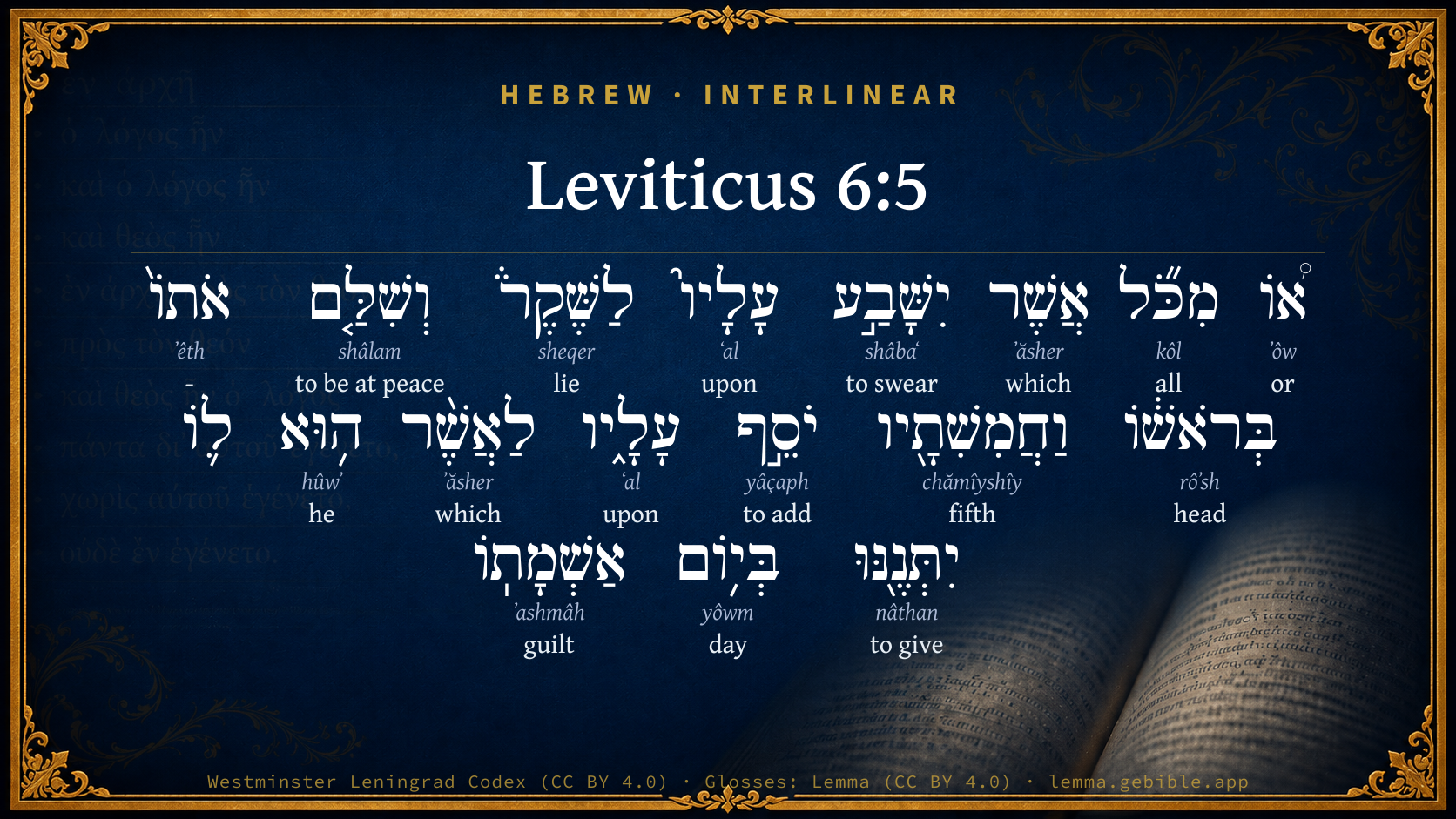
Hebrew (Westminster Leningrad Codex) Leviticus 6:5 appears in the Hebrew Old Testament. The text above is from the Westminster Leningrad Codex. Each word links to its Strong’s number, a concise gloss, and parsing drawn from the Open Scriptures Hebrew Bible morphology. Click any word for its full Brown-Driver-Briggs (BDB) entry.
Download image
Cite this verse

Leviticus 6:5 (World English Bible). Public Domain. Lemma interlinear Bible study tool, https://lemma.gebible.app/v/leviticus/6/5.

Show BibTeX & RIS
BibTeX
RIS
English Translation
or any thing about which he has sworn falsely; he shall restore it even in full, and shall add a fifth part more to it. To him to whom it belongs he shall give it, in the day of his being found guilty.
World English Bible · Public Domain
Download a study sheet

One document with this verse’s original text, its word-by-word gloss line, the meaning frame, cross-references with their text, attributed commentary, and full source and license credits — printable, and it pastes into notes with its structure intact.

This verse Autodidact and up

Study sheet (.html) Plain text (.txt)

A passage Seminary Student

Up to 50 verses in one chapter. A passage sheet keeps up to 6 commentary sources and 12 cross-references per verse, in the order this page ranks them, and says so on the sheet whenever that leaves anything out. Ask for a single verse and you get the Autodidact verse sheet above.

Everything on this page stays free to read, with no account — the sheet is a download of what is already on screen, not access to it.

Want to remove ads? Support Godless Engineer
Compare translations 3

The same verse in 3 English versions, stacked beneath the original-language interlinear above. Click any original word for its lexicon entry.

Each is an independent rendering of the whole verse — the interlinear is not word-aligned to these translations.

Highlighted words mark where these versions differ — a whole-verse word diff, not a word-by-word alignment.

  • World English Bible Public Domain
    or any thing about which he has sworn falsely; he shall restore it even in full, and shall add a fifth part more to it. To him to whom it belongs he shall give it, in the day of his being found guilty.
  • King James Version Public Domain
    Or all that about which he hath sworn falsely; he shall even restore it in the principal, and shall add the fifth part more thereto, and give it unto him to whom it appertaineth, in the day of his trespass offering.
  • unfoldingWord Literal Text CC BY-SA 4.0
    or from all that he swore concerning it as a lie, then he shall restore it in its principal, and he shall add the fifth of it to it. To whomever it to him, he shall give it on the day of his guilt.

unfoldingWord Literal Text — © unfoldingWord, licensed CC BY-SA 4.0. Word-aligned USFM3 via Door43 (git.door43.org/unfoldingWord/en_ult).

Versions to compare (up to 4)

3 of 4 selected

Show all 18 translations

Every available English version of this verse, each an independent rendering of the whole verse.

  • World English Bible Public Domain
    or any thing about which he has sworn falsely; he shall restore it even in full, and shall add a fifth part more to it. To him to whom it belongs he shall give it, in the day of his being found guilty.
  • Berean Standard Bible Public Domain
    or anything else about which he has sworn falsely. He must make restitution in full, add a fifth of the value, and pay it to the owner on the day he acknowledges his guilt.
  • Majority Standard Bible Public Domain
    or anything else about which he has sworn falsely. He must make restitution in full, add a fifth of the value, and pay it to the owner on the day he acknowledges his guilt.
  • King James Version Public Domain
    Or all that about which he hath sworn falsely; he shall even restore it in the principal, and shall add the fifth part more thereto, and give it unto him to whom it appertaineth, in the day of his trespass offering.
  • American Standard Version (1901) Public Domain
    or any thing about which he hath sworn falsely; he shall even restore it in full, and shall add the fifth part more thereto: unto him to whom it appertaineth shall he give it, in the day of his being found guilty.
  • Revised Version (1885) Public Domain
    or any thing about which he hath sworn falsely; he shall even restore it in full, and shall add the fifth part more thereto: unto him to whom it appertaineth shall he give it, in the day of his being found guilty.
  • Geneva Bible (1599) Public Domain
    Or for whatsoeuer he hath sworne falsely, he shall both restore it in the whole summe, and shall adde the fift parte more thereto, and giue it vnto him to whome perteyneth, the same day that he offreth for trespasse.
  • Douay-Rheims (1899) Public Domain
    All that he would have gotten by fraud, in the principal, and the fifth part besides to the owner, whom he wronged.
  • Young's Literal Translation Public Domain
    or all that concerning which he sweareth falsely, he hath even repaid it in its principal, and its fifth he is adding to it; to him whose it `is' he giveth it in the day of his guilt-offering.
  • Literal Standard Version CC BY-SA 4.0
    or all that concerning which he swears falsely, he has even repaid it in its principal, and he is adding to it its fifth; he gives it to him whose it [is] in the day of his guilt-offering.
  • Unlocked Literal Bible CC BY-SA 4.0
    In addition, in any matter in which he swore falsely, he must restore it in full and he must add one-fifth of the value of it and pay it all to the owner on the day that he is found guilty.
  • unfoldingWord Literal Text CC BY-SA 4.0
    or from all that he swore concerning it as a lie, then he shall restore it in its principal, and he shall add the fifth of it to it. To whomever it to him, he shall give it on the day of his guilt.
  • Darby Bible Public Domain
    or all that about which he hath sworn falsely; and he shall restore it in the principal, and shall add the fifth part more thereto; to [him to] whom it belongeth shall he give it, on the day of his trespass-offering.
  • World Messianic Bible Public Domain
    or any thing about which he has sworn falsely: he shall restore it in full, and shall add a fifth part more to it. He shall return it to him to whom it belongs in the day of his being found guilty.
  • Webster's Bible Public Domain
    \\6:12\\And the fire upon the altar shall be burning on it; it shall not be extinguished: and the priest shall burn wood on it every morning, and lay the burnt-offering in order upon it; and he shall burn on it the fat of the peace-offerings.
  • Free Bible Version CC BY-SA 4.0
    or anything else that must be given back that you lied about. You must pay full compensation plus a fifth of the value, and give it to the owner as soon as you accept that you are guilty of sin.
  • Bible in Basic English Public Domain
    The fire on the altar is to be kept burning; it is never to go out; every morning the priest is to put wood on it, placing the burned offering in order on it, and there the fat of the peace-offering is to be burned.
  • JPS Tanakh (1917) Public Domain
    (5-24) or any thing about which he hath sworn falsely, he shall even restore it in full, and shall add the fifth part more thereto; unto him to whom it appertaineth shall he give it, in the day of his being guilty.

Literal Standard Version (2020), Covenant Press — licensed CC BY-SA 4.0. Text via the HelloAO Bible API (eBible.org). Unlocked Literal Bible (unfoldingWord) — licensed CC BY-SA 4.0. Text via the HelloAO Bible API (eBible.org). unfoldingWord Literal Text — © unfoldingWord, licensed CC BY-SA 4.0. Word-aligned USFM3 via Door43 (git.door43.org/unfoldingWord/en_ult). Free Bible Version, Dr. Jonathan Gallagher — licensed CC BY-SA 4.0. Text via the HelloAO Bible API (eBible.org).

Word by word

More ways to search: Search by grammar → Find every occurrence → Compare this word →

Practice this passage: Drill this verse → Learn its vocabulary →

אַשְׁמָתֽוֹ
ʼashmâh
H819
“guilt · his”
Noun, Common, Feminine, Singular, Construct + Suffix, Personal, 3rd Person, Masculine, Singular
Part of Speech
Noun
Type
Common
Gender
Feminine
Number
Singular
State
Construct
Full BDB Definition

Origin: from H817

TWOT: 180c

guiltiness, guilt, offense, sin, wrong-doing - doing wrong, committing a trespass or offense - becoming guilty, guilt - bringing a guilt-offering
  1. א֠וֹ ʼôw H176 “or” Conjunction
  2. מִכֹּ֞ל kôl H3605 “from · all” Preposition + Noun, Common, Masculine, Singular, Absolute
  3. אֲשֶׁר ʼăsher H834 “which” Particle, Relative
  4. יִשָּׁבַ֣ע shâbaʻ H7650 “to swear” Verb, Niphal, Imperfect, 3rd Person, Masculine, Singular
  5. עָלָיו֮ ʻal H5921 “upon · him” Preposition + Suffix, Personal, 3rd Person, Masculine, Singular
  6. לַשֶּׁקֶר֒ sheqer H8267 “to/for the · lie” Preposition, Determined + Noun, Common, Masculine, Singular, Absolute
  7. וְשִׁלַּ֤ם shâlam H7999 “and · to be at peace” Conjunction + Verb, Piel, Sequential Perfect, 3rd Person, Masculine, Singular
  8. אֹתוֹ֙ ʼêth H853 “- · him” Particle, Direct Object + Suffix, Personal, 3rd Person, Masculine, Singular
  9. בְּרֹאשׁ֔וֹ rôʼsh H7218 “in/at · head · his” Preposition + Noun, Common, Masculine, Singular, Construct + Suffix, Personal, 3rd Person, Masculine, Singular
  10. וַחֲמִשִׁתָ֖יו chămîyshîy H2549 “and · fifth · his” Conjunction + Adjective, Ordinal number, Both, Plural, Construct + Suffix, Personal, 3rd Person, Masculine, Singular
  11. יֹסֵ֣ף yâçaph H3254 “to add” Verb, Hiphil, Jussive, 3rd Person, Masculine, Singular
  12. עָלָ֑יו ʻal H5921 “upon · him” Preposition + Suffix, Personal, 3rd Person, Masculine, Singular
  13. לַאֲשֶׁ֨ר ʼăsher H834 “to/for · which” Preposition + Particle, Relative
  14. ה֥וּא hûwʼ H1931 “he” Pronoun, Personal, 3rd Person, Masculine, Singular
  15. יִתְּנֶ֖נּוּ nâthan H5414 “to give · him” Verb, Qal, Imperfect, 3rd Person, Masculine, Singular + Suffix, Personal, 3rd Person, Masculine, Singular
  16. בְּי֥וֹם yôwm H3117 “in/at · day of” Preposition + Noun, Common, Masculine, Singular, Construct

About this verse

These counts appear in no published source. They are computed here, from the morphology-tagged text and Lemma’s own curated glosses. What Lemma adds →

18
words
15
distinct lemmas
Pentateuch
section

Notable vocabulary

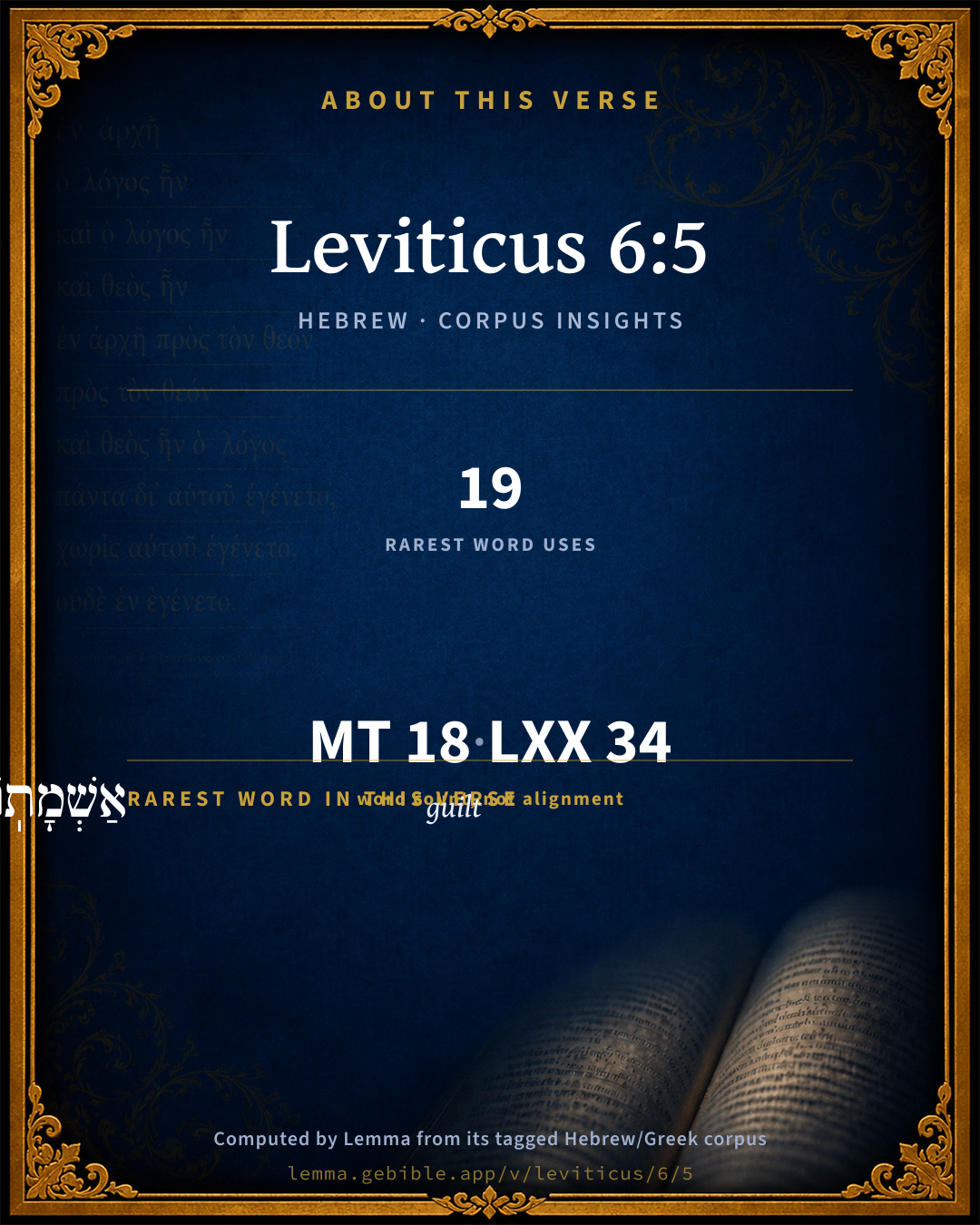
The rarest word here is אַשְׁמָתֽוֹ guilt H819 — appearing just 19 times in the whole Hebrew Bible.

Shared distinctive vocabulary

אַשְׁמָתֽוֹ guilt H819 occurs in 17 verses of the Hebrew Bible. Also found in:

Grammatical profile

  • 4 verbs
  • 5 nouns
  • 1 adjective
  • 1 pronoun
  • 3 prepositions
  • 1 conjunction
  • 3 particles

Verb forms

  • יִשָּׁבַ֣ע Niphal · Imperfect
  • וְשִׁלַּ֤ם Piel · Sequential Perfect
  • יֹסֵ֣ף Hiphil · Jussive
  • יִתְּנֶ֖נּוּ Qal · Imperfect

Repetition

Words recur within this verse — often emphatic in Hebrew:

  • עָלָיו֮ upon H5921 ×2
  • אֲשֶׁר which H834 ×2

Hebrew & Septuagint length

In English translation the verse runs 43 words from the Hebrew and 29 from the Septuagint (LXX English) — the Septuagint runs noticeably shorter here. See the side-by-side →

A rough comparison of the two English renderings, which tokenize alike — not a word-level alignment.

Word counts can differ between the Hebrew and the Greek without any difference in meaning — e.g. the Hebrew direct-object marker אֵת has no separate Greek word, and Greek often adds the article ὁ.

In the original languages it is 18 Hebrew tokens and 34 Greek tokens — but the two are counted differently (Hebrew bundles its prefixes and suffixes into one token; the Greek is in lemma form), so that isn’t a like-for-like length.

Cross-references

13

Topical passages linked to Leviticus 6:5 in the Treasury of Scripture Knowledge — connected by theme and wording, ordered by reader-vote popularity; previews shown in the World English Bible.

  • Leviticus 5:16 He shall make restitution for that which he has done wrong in the holy thing, and shall add a fifth part to it, and give it to the priest; and the priest shall make atonement for him with the ram of the trespass offering, and he will be forgiven.
  • Exodus 22:9 For every matter of trespass, whether it be for ox, for donkey, for sheep, for clothing, or for any kind of lost thing, about which one says, 'This is mine,' the cause of both parties shall come before God. He whom God condemns shall pay double to his neighbor.
  • Numbers 5:7–8 then he shall confess his sin which he has done, and he shall make restitution for his guilt in full, and add to it the fifth part of it, and give it to him in respect of whom he has been guilty.
  • 1 Samuel 12:3 Here I am: witness against me before Yahweh, and before his anointed: whose ox have I taken? or whose donkey have I taken? or whom have I defrauded? whom have I oppressed? or of whose hand have I taken a ransom to blind my eyes therewith? and I will restore it you.
  • 2 Samuel 12:6 He shall restore the lamb fourfold, because he did this thing, and because he had no pity!"
  • Luke 19:8 Zacchaeus stood and said to the Lord, "Behold, Lord, half of my goods I give to the poor. If I have wrongfully exacted anything of anyone, I restore four times as much."
  • Exodus 22:1 "If a man steals an ox or a sheep, and kills it, or sells it; he shall pay five oxen for an ox, and four sheep for a sheep.
  • Exodus 22:4 If the stolen property is found in his hand alive, whether it is ox, donkey, or sheep, he shall pay double.
  • Exodus 22:7 "If a man delivers to his neighbor money or stuff to keep, and it is stolen out of the man's house; if the thief is found, he shall pay double.
  • Proverbs 6:30–31 Men don't despise a thief, If he steals to satisfy himself when he is hungry:
  • Isaiah 58:6 Isn't this the fast that I have chosen: to loose the bonds of wickedness, to undo the bands of the yoke, and to let the oppressed go free, and that you break every yoke?
  • Isaiah 58:9 Then shall you call, and Yahweh will answer; you shall cry, and he will say, Here I am. If you take away from the midst of you the yoke, the putting forth of the finger, and speaking wickedly;
  • Matthew 5:23–24 "If therefore you are offering your gift at the altar, and there remember that your brother has anything against you,

Cross-references courtesy of OpenBible.info (CC BY 4.0).

Hebrew and Greek witnesses Masoretic Hebrew ↔ Greek Septuagint

The same verse in the two great witnesses to the Old Testament, shown verse-for-verse.

Here the Septuagint runs noticeably shorter than the Hebrew — LXX2012 (modern English Septuagint) 29 words vs World English Bible 43. A rough length comparison of the two English translations, not a word-level alignment — read both below.

These are two independent witnesses, not word-aligned to each other, and the Septuagint is shown in lemma (dictionary) form.

Hebrew Leviticus 6:5 Masoretic · Westminster Leningrad Codex

א֠וֹ מִכֹּ֞ל אֲשֶׁר יִשָּׁבַ֣ע עָלָיו֮ לַשֶּׁקֶר֒ וְשִׁלַּ֤ם אֹתוֹ֙ בְּרֹאשׁ֔וֹ וַחֲמִשִׁתָ֖יו יֹסֵ֣ף עָלָ֑יו לַאֲשֶׁ֨ר ה֥וּא ל֛וֹ יִתְּנֶ֖נּוּ בְּי֥וֹם אַשְׁמָתֽוֹ

or any thing about which he has sworn falsely; he shall restore it even in full, and shall add a fifth part more to it. To him to whom it belongs he shall give it, in the day of his being found guilty.

World English Bible · Public Domain

Greek LXX Leviticus 6:5 Septuagint · lemma form

καί πῦρ ἐπί ὁ θυσιαστήριον καίω ἀπό αὐτός καί οὐ σβέννυμι καί καίω ὁ ἱερεύς ἐπί αὐτός ξύλον ὁ πρωΐ καί στοιβάζω ἐπί αὐτός ὁ ὁλοκαύτωσις καί ἐπιτίθημι ἐπί αὐτός ὁ στέαρ ὁ σωτήριον

And he shall bring to the Lord for his trespass, a ram of the flock, without blemish, of value to the amount of the thing in which he trespassed.

LXX2012 (modern English Septuagint) · Public Domain

On this verse, Haydock's Catholic Bible Commentary discusses the Septuagint’s reading. Read the note in Commentary ↓

Hebrew: Westminster Leningrad Codex (CC BY 4.0). Greek: Septuagint (public domain); English from LXX2012 (modern English Septuagint) (Public Domain). How the Septuagint differs from the Hebrew →

Targum (Aramaic paraphrase)

2

The Targum is the ancient Jewish Aramaic paraphrase of the Hebrew Scriptures — an interpretive translation, not the Hebrew text itself. Onkelos (literal) and Pseudo-Jonathan (expansive) render the Torah, and Jonathan the Prophets. Coverage is partial: where no permissively-licensed English translation exists for a verse, only the Aramaic is shown. This is verse-level text, not a word-by-word alignment to the Hebrew.

  1. Targum Onkelos Torah (Genesis–Deuteronomy)
    וְאֶשָׁתָא עַל מַדְבְּחָא תְהֵי יָקְדָא בֵהּ לָא תִטְּפֵי וְיַבְעַר עֲלַהּ כַּהֲנָא אָעַיָא בִּצְפַר בִּצְפָר וְיַסְדַר עֲלַהּ עֲלָתָא וְיַסֵק עֲלַהּ תַּרְבֵּי נִכְסַת קוּדְשַׁיָא

    (no public-domain English translation for this verse)

    Targum Onkelos — Aramaic: “Onkelos Genesis” (public domain); “Onkelos Exodus” (public domain); “Onkelos Leviticus” (public domain); “Onkelos Numbers” (public domain); “Onkelos Deuteronomy” (public domain). English: “Sefaria Community Translation” (CC0 1.0 (public-domain dedication)); “J.W. Etheridge. The Targums of Onkelos and Jonathan Ben Uzziel on the Pentateuch. London: Longmans, Green, 1862” (public domain). Text via Sefaria.

  2. Targum Pseudo-Jonathan Torah (Genesis–Deuteronomy)
    וְאֵישָׁתָא עַל מַדְבְּחָא תְהֵי יוֹקְדָא בֵיהּ לָא תִטְפֵי וְיַלְפֵי עֲלָהּ כַּהֲנָא אָעִין בִּצְפַר בִּצְפַר עַד אַרְבַּע שְׁעִין דְיוֹמָא וִיסַדֵר עֲלָהּ עֲלָתָא וְיַסֵיק עֲלָהּ תַרְבֵּי נִכְסַת קוּדְשַׁיָא

    But the fire upon the altar shall burn upon it unextinguished, and the priest shall lay wood upon it from morning to morning, at four hours of the day, and shall set in order the burnt offering upon it, and burn upon it the fat of the sanctified oblations.

    Targum Pseudo-Jonathan — Aramaic: “Targum Jonathan on Genesis” (public domain); “Targum Jonathan on Exodus” (public domain); “Targum Jonathan on Leviticus” (public domain); “Targum Jonathan on Numbers” (public domain); “Targum Jonathan on Deuteronomy” (public domain). English: “The Targum of Jonathan ben Uzziel, trans. J. W. Etheridge, London, 1862” (public domain). Text via Sefaria.

Commentary

Notes on Leviticus 6:5 from classic Christian and Jewish commentators (each source and its license shown beneath its notes). The classic Christian expositions comment on the surrounding passage and are grouped to its opening verse, so a note may address several verses; the Jewish commentaries on the Tanakh (Rashi and others) are per-verse, so they appear only where the commentator wrote on this verse.

Lemma curates 59 commentaries, every one of them public domain or Creative Commons licensed, each selected and text-cleaned for this edition rather than reprinted as found. About our sources →

Trapp's Complete Commentary

John Trapp

Lev 6:5 Or all that about which he hath sworn falsely; he shall even restore it in the principal, and shall add the fifth part more thereto, [and] give it unto him to whom it appertaineth, in the day of his trespass offering.

Ver. 5. In the day of his trespass offering.] Before he compass God’s altar. See Mat 5:23, {See Trapp on "Mat 5:23"}

John Trapp, A Commentary or Exposition upon All the Books of the Old and New Testament (1647–1656) — public domain. Text from a community e-Sword module.

Joseph Benson's Commentary

Lev 6:5. In the day of his trespass-offering — It must not be delayed, but restitution to man must accompany repentance toward God. Wherever wrong has been done, restitution must be made, and till it is made, to the utmost of our power, we cannot look for forgiveness; for the keeping of what is unjustly gotten, avows the taking: and both together make but one continued act of unrighteousness.

Joseph Benson's Commentary on the Old and New Testaments (1811–1818) — public domain. Text from a community e-Sword module.

Tyndale Open Study Notes

Tyndale Open Resources

6:5 The instructions for the guilt offering assumed that a person’s conscience would induce voluntary reparation; when restitution was voluntary, the surcharge for loss of use to the owner was always 20 percent. Penalties were more severe in other cases (cp. Exod 22:1-15). There is a clear difference between voluntary confession and simply admitting sin after being caught.

Tyndale Open Study Notes — © Tyndale Open Resources, licensed CC BY-SA 4.0. Text via the HelloAO Bible API.

Rashi

Rabbi Shlomo Yitzchaki (Rashi)

והאש על המזבח תוקד בו AND THE FIRE ON THE ALTAR SHALL BE BLAZING IN IT — Scripture uses here (in this section) many expressions from the root יקד “to ignite”: (Leviticus 6:2) “on the fire-place (מוקדה); (Leviticus 6:2) “and the fire upon the altar shall be blazing (תוקד) on it”; (Leviticus 6:5) “and the fire upon the altar shall be blazing (תוקד) on it”; (Leviticus 6:6) “a continual fire shall be blazing (תוקד) upon the altar” — all these passages have been expounded in Treatise Yoma 45b where our Rabbis state their different opinions as to the number of מערכות (wood-piles — fire-places) that were there (on the altar).

וערך עליה העלה AND HE SHALL SET THE BURNT OFFERING IN ORDER UPON IT — The morning continual burnt offering had to come first (Menachot 49a; cf. also Sifra, Tzav, Chapter 2 10 and Rashi on Leviticus 3:5).

‎‎‏ השלמים‎חלבי [AND HE SHALL CAUSE TO ASCEND IN FUMES THERÈON] THE FAT OF THE PEACE OFFERINGS — if people are bringing peace offerings there that day (this is no command that peace offerings must be placed on the altar after the daily burnt offering; if, however, any are being sacrificed on a particular day, it must be done at this point of the day’s work). — Our Rabbis, however, derived from here the following Halacha, taking the word השלמים in the sense of השלם “to complete”, “to finish”: עליה upon it — upon the continual burnt offering of the morning — complete the offering of all sacrifices; it follows therefore that no thing should be offered later than the continual burnt offering brought in the afternoon (Yoma 33a; Pesachim 58).

Rashi on the Tanakh — English translations: “The Judaica Press complete Tanach with Rashi, translated by A. J. Rosenberg” (CC BY 4.0); “Pentateuch with Rashi's commentary by M. Rosenbaum and A.M. Silbermann, 1929-1934” (public domain); “The Metsudah Tanach series, Lakewood, N.J” (CC BY 4.0); and “The Book of Joshua, Metsudah Publications, 1997” (CC BY 4.0). Text via Sefaria.

Adam Clarke's Commentary

Verse 5. All that about which he hath sworn falsely] This supposes the case of a man who, being convicted by his own conscience, comes forward and confesses his sin.

Restore it in the principal] The property itself if still remaining, or the full value of it, to which a fifth part more was to be added.

Adam Clarke's Commentary on the Bible (1810–1826) — public domain. Text from a community e-Sword/MySword module.

Ellicott's Commentary for English Readers

(5) And shall add the fifth part more thereto.—The first thing the offender must do, when he realises and confesses his guilt, is to make restitution of the property which he had embezzled, if he still has it, or if that be impossible, he is to pay the value of it as estimated by the authorised tribunal. Besides this, the offender is to add a fifth part of the principal, to compensate for the loss which the owner sustained during the interval. It will be seen that in Exo_22:1-9, when a person was guilty of any of the offences here specified, the offender was condemned to make a four fold restitution, whilst in the passage before us the mulct is reduced to the restitution of the principal with the addition of a fifth part. The reason of this difference is that the law in Exodus deals with a culprit who is convicted of his crime in a court of justice by means of witnesses, whilst the law before us deals with an offender who, through compunction of mind, voluntarily confesses his offence, and to whom, without this voluntary confession, the offence could not be brought home. It is this difference which constitutes it a case for a trespass offering. (Comp. Num_5:7.)

In the day of his trespass offering.—Better, on the day of his guilt. That is, as soon as he acknowledges his guilt, and brings the sacrifice for his offence, he is to make the requisite restitution.

A Bible Commentary for English Readers, edited by Charles John Ellicott (1878–1897) — public domain. Text from a community e-Sword module.

John Gill's Exposition

Or all that about which he hath sworn falsely,.... In all and each of the above cases, in which he had committed a trespass and denied it, and to the denial adds a false oath, and yet after all acknowledges it:

he shall even restore it in the principal; whatsoever he has embezzled, or cheated another of, or detained from the right owner, the whole of that was to be restored:

and shall add the fifth part more thereto; to the principal, see Lev 5:16 but Maimonides (l) says, this was an instruction to add a fifth to a fifth; and Aben Ezra takes the word to be plural, and observes, that the least of many is two, and so two fifths were to be added to the principal, but the first sense seems best:

and give it unto him to whom appertaineth; as, to his neighbour, who had deposited anything in his hands; or his partner, he had any ways wronged; or whomsoever he had defrauded in any respect; or the proprietor of lost goods; Ben Gersom observes, it was not to be given to his son, nor to his messenger: in the case of taking anything away by violence, though but the value of a farthing, it is said, that he shall be obliged to bring it after him (from whom he has taken it) even unto Media (should he be there); he shall not give it to his son, nor to his messenger, but he may give it to the messenger of the sanhedrim; and if he dies, he must return it to his heirs (m):

in the day of his trespass offering; when he brings that, but restoration must first be made: the Targum of Jonathan renders it, in the day he repents of his sin: and so Aben Ezra interprets it,"in the day he returns from his trespass;''when he owns and confesses it, is sorry for it, and determines to do so no more. Maimonides observes (n), that one that takes away anything by violence (which is one of the cases supposed) is not fined so much as a thief; he only restores the principal; for the fifth part is for his false oath; the reasons of which are, because robbery is not so frequently, and is more easily committed, and is more open, and against which persons may guard and make resistance, and the robber is more known than a thief who steals secretly; see Exo 22:1.

(l) In Misn. Trumot, c. 6. sect. 1. (m) Misnah Bava Kama, c. 9. sect. 6. (n) Ut supra, (l)) c. 41.

John Gill's Exposition of the Whole Bible (1746–1763) — public domain (CC PDM 1.0). Text via the HelloAO Bible API.

Albert Barnes' Notes on the Bible

In the day of his trespass offering - The restitution was thus to be associated with the religious act by which the offender testified his penitence.

Albert Barnes' Notes on the Bible (1834–1885) — public domain. Text from a community e-Sword/MySword module.

Haydock's Catholic Bible Commentary

Wronged. Hebrew and Chaldean add, "in the day of his sin-offering;" and the Septuagint, "in which he has convicted." No unnecessary delay in making restitution can be allowed to the sincere penitent, who wishes to make his peace with God.

George Leo Haydock (1774–1849), Haydock's Catholic Family Bible and Commentary, 1859 edition — public domain. Excludes Psalms (Douay-Rheims chapter numbering differs from Protestant) and Deuterocanonical books (Catholic canon only).

Matthew Poole's English Annotations

It must not be delayed, but restitution to man must accompany repentance towards God. Compare Mat 5:23.

Matthew Poole's English Annotations on the Holy Bible (1683–1685) — public domain. Text from a community e-Sword/MySword module.

Whedon's Commentary on the Bible

Daniel D. Whedon

5. In the principal — The property itself or its full value must be restored, with the addition of the fifth part, as a compensation to the injured party, as a penalty for the unjust deed, and as a motive to honesty in the future.

In the day of his trespass offering — In the day his offering is to be presented. The reconciliation with the injured party must be made before the offering can be accepted. See note on Mat_5:23-24. The marginal reading of the Authorized Version, “in the day of his being found guilty,” is barely possible according to the Hebrew, but it is not suitable to this passage. No reference is had here to conviction by a criminal court, but to a conviction by the condemning voice of conscience.

Daniel D. Whedon (gen. ed.), Commentary on the Old and New Testaments (1874–1909) — public domain. Text from a community e-Sword module.

The Pulpit Commentary

In the day of his trespass offering is a better rendering than that of the margin, "in the day of his being found guilty," or" in the day of his trespass." The reparation is to take place, and immediately afterwards the offering is accepted.

Repentance, confession, satisfaction, absolution, follow each other in order. Without repentance confession is vain; without confession satisfaction is impracticable; without satisfaction there is no absolution. In the present case, the sense of absolution was conveyed to the soul of the sinner by the acceptance of his offering for trespass, after which he ceased to be, what he was before, virtually excommunicate from God"s people. The greater moral offenses were punished either by death, (Exo_21:12-17 Exo_31:15 Exo_32:27 Lev_20:9-16 Lev_24:23 Num_25:5 Deu_13:9 Deu_19:11Jo Deu_7:25) or by formal excommunication, when the offenders were cut off from the people of the Lord, though their lives were spared. (Lev_7:20, 21 Gen_17:14) But there was, and there is, an excommunication, not formally pronounced, when a man feels that his sin has separated between him and his God. In these cases the sin offering or the trespass offering restored to communion, but they might not be offered, that is, absolution might not be effected by them, unless preceded by repentance and confession, and, where the nature of the case admitted of it, by satisfaction for the wrong done.

The Pulpit Commentary (1880–1919), ed. H.D.M. Spence-Jones & Joseph S. Exell — public domain. Text from a community e-Sword module.

John Wesley's Explanatory Notes

In the day - It must not be delayed, but restitution to man must accompany repentance towards God. Wherever wrong has been done, restitution must be made, and till it is made to the utmost of our power we cannot look for forgiveness; for the keeping of what is unjustly got, avows the taking: And both together make but one continued act of unrighteousness.

John Wesley, Explanatory Notes Upon the Whole Bible (1754–1765) — public domain. Text via the GEBible commentary corpus.

unfoldingWord translationNotes

Door43 World Missions Community

in full

"fully" or "totally"

add one-fifth

This means the person must return what he owes to someone and pay an extra one-fifth of the value. See how you translated this in Leviticus 5:16. (See: Fractions)

pay it all to the owner

This can be translated in active form. AT: "to pay the person he owes" (See: Active or Passive)

he is found guilty

The person who stole is to be brought before the judge and be declared guilty. This can be stated in active form. AT: "the judge declares him guilty" (See: Assumed Knowledge and Implicit Information and Active or Passive)

worth the current value

This means the person must determine how many shekels the ram is worth by using the official standard of the sacred tent. You can make clear the understood information. See how this was translated in Leviticus 5:15. (See: Ellipsis)

The priest will make atonement for him

The abstract noun "atonement" can be stated as a verb. AT: "The priest will atone for him" (See: Abstract Nouns)

before Yahweh

"in the presence of Yahweh"

he will be forgiven

This means Yahweh will forgive the person, not the priest. This can be translated in active form. AT: "God will forgive him" (See: Active or Passive)

translationWords

restore

guilt

guilt offering

Yahweh

ewe

blemish

flocks

worthy

priest

atonement

forgive

unfoldingWord translationNotes — © Distant Shores Media and the Door43 World Missions Community, licensed CC BY-SA 4.0. Source: git.door43.org/Door43/en_tn.

Lesson kit

Teaching starters — assembled from the data on this page, not authored interpretation. Every prompt links to the verse data it draws on. Edit before teaching.

Leviticus, in the Pentateuch, opens this verse with 18 words (15 distinct Hebrew lemmas). Its most distinctive word is ʼashmâh (“guilt”). The Greek Septuagint runs shorter here. A historical commentator’s framing appears above. Read the whole chapter for the surrounding context.

Discussion questions

  1. The word ʼashmâh carries the sense “guilt.” How does it shape the verse?
  2. How does Leviticus 4:3, which shares the word «guilt», read alongside this verse?
  3. What does the repetition of “upon” (2× in this one verse) do in this verse?
  4. The Septuagint runs shorter here than the Hebrew. What might account for the difference?
  5. The translations on this page render this verse differently — a whole-verse word diff, not a word-by-word alignment. What might account for the different wordings?
  6. «יִשָּׁבַ֣ע» is a Niphal Imperfect verb. How does that grammatical form shape the action described?
  7. Compare how Trapp's Complete Commentary and Joseph Benson's Commentary read this verse. Where do they agree or differ?

Things to notice

Reading settings

Reading text

Shown beneath each verse's original-language words.

Old Testament
Old Testament edition

Read the OT as the Masoretic Hebrew (MT) or the Greek Septuagint (LXX).

English shown for the Greek Septuagint (in the Hebrew ↔ Greek comparison).

Comparing translations? Open the Compare panel on any verse page to stack up to four side by side.