
Ecclesiastes 3:14

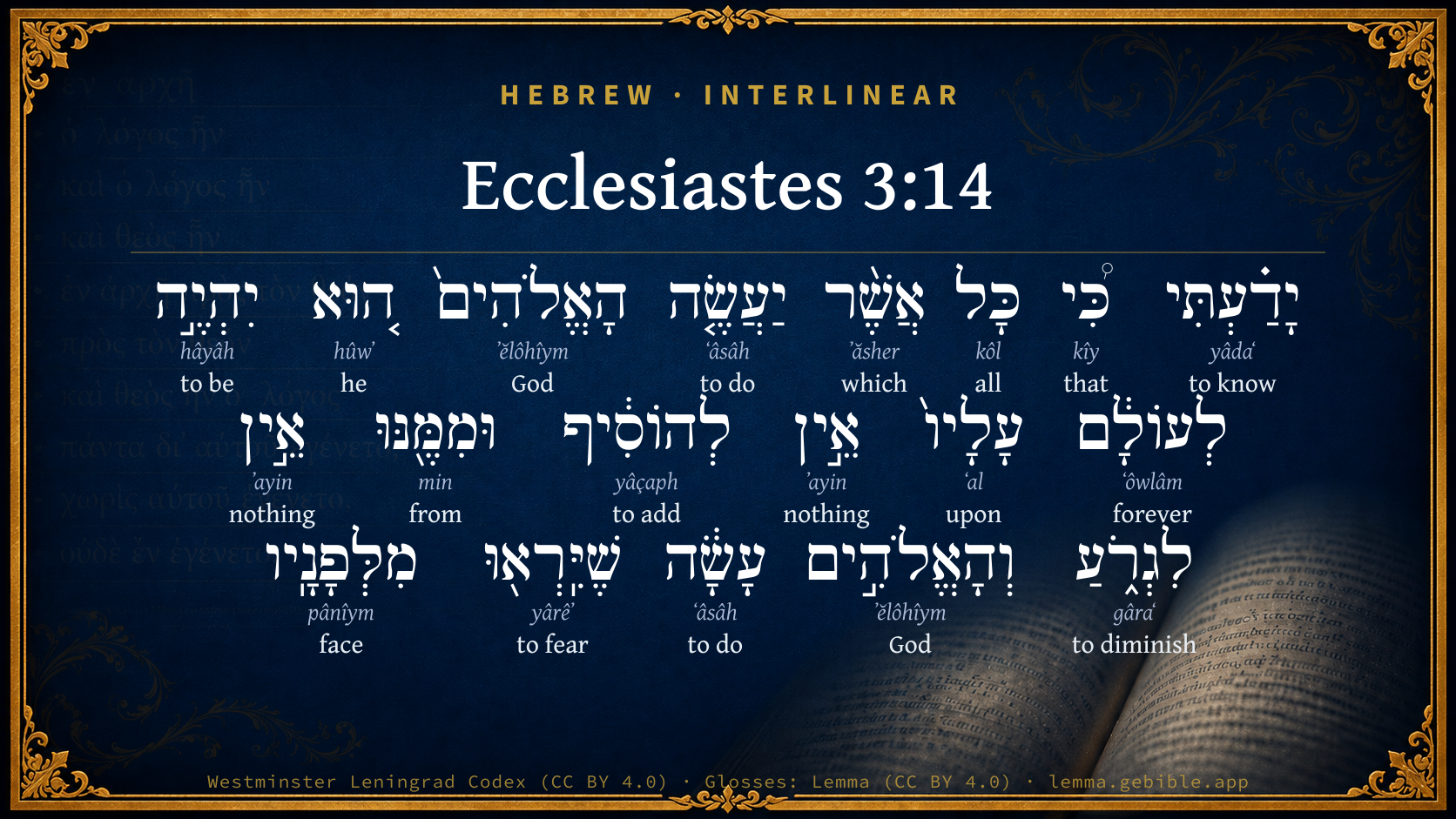
Hebrew (Westminster Leningrad Codex) Ecclesiastes 3:14 appears in the Hebrew Old Testament. The text above is from the Westminster Leningrad Codex. Each word links to its Strong’s number, a concise gloss, and parsing drawn from the Open Scriptures Hebrew Bible morphology. Click any word for its full Brown-Driver-Briggs (BDB) entry.
Download image
Cite this verse

Ecclesiastes 3:14 (World English Bible). Public Domain. Lemma interlinear Bible study tool, https://lemma.gebible.app/v/ecclesiastes/3/14.

Show BibTeX & RIS
BibTeX
RIS
English Translation
I know that whatever God does, it shall be forever. Nothing can be added to it, nor anything taken from it; and God has done it, that men should fear before him.
World English Bible · Public Domain
Download a study sheet

One document with this verse’s original text, its word-by-word gloss line, the meaning frame, cross-references with their text, attributed commentary, and full source and license credits — printable, and it pastes into notes with its structure intact.

This verse Autodidact and up

Study sheet (.html) Plain text (.txt)

A passage Seminary Student

Up to 50 verses in one chapter. A passage sheet keeps up to 6 commentary sources and 12 cross-references per verse, in the order this page ranks them, and says so on the sheet whenever that leaves anything out. Ask for a single verse and you get the Autodidact verse sheet above.

Everything on this page stays free to read, with no account — the sheet is a download of what is already on screen, not access to it.

Want to remove ads? Support Godless Engineer
Compare translations 3

The same verse in 3 English versions, stacked beneath the original-language interlinear above. Click any original word for its lexicon entry.

Each is an independent rendering of the whole verse — the interlinear is not word-aligned to these translations.

Highlighted words mark where these versions differ — a whole-verse word diff, not a word-by-word alignment.

  • World English Bible Public Domain
    I know that whatever God does, it shall be forever. Nothing can be added to it, nor anything taken from it; and God has done it, that men should fear before him.
  • King James Version Public Domain
    I know that, whatsoever God doeth, it shall be for ever: nothing can be put to it, nor any thing taken from it: and God doeth it, that men should fear before him.
  • unfoldingWord Literal Text CC BY-SA 4.0
    I know that everything that God does, it will be enduring. To it, there is nothing to add, and from it, there is nothing to remove. And God acts so that they fear from before his face.

unfoldingWord Literal Text — © unfoldingWord, licensed CC BY-SA 4.0. Word-aligned USFM3 via Door43 (git.door43.org/unfoldingWord/en_ult).

Versions to compare (up to 4)

3 of 4 selected

Show all 18 translations

Every available English version of this verse, each an independent rendering of the whole verse.

  • World English Bible Public Domain
    I know that whatever God does, it shall be forever. Nothing can be added to it, nor anything taken from it; and God has done it, that men should fear before him.
  • Berean Standard Bible Public Domain
    I know that everything God does endures forever; nothing can be added to it or taken from it. God does it so that they should fear Him.
  • Majority Standard Bible Public Domain
    I know that everything God does endures forever; nothing can be added to it or taken from it. God does it so that they should fear Him.
  • King James Version Public Domain
    I know that, whatsoever God doeth, it shall be for ever: nothing can be put to it, nor any thing taken from it: and God doeth it, that men should fear before him.
  • American Standard Version (1901) Public Domain
    I know that, whatsoever God doeth, it shall be for ever: nothing can be put to it, nor anything taken from it; and God hath done it, that men should fear before him.
  • Revised Version (1885) Public Domain
    I know that, whatsoever God doeth, it shall be for ever: nothing can be put to it, nor any thing taken from it: and God hath done it, that men should fear before him.
  • Geneva Bible (1599) Public Domain
    I knowe that whatsoeuer God shall doe, it shalbe for euer: to it can no man adde, and from it can none diminish: for God hath done it, that they should feare before him.
  • Douay-Rheims (1899) Public Domain
    I have learned that all the works which God hath made, continue for ever: we cannot add any thing, nor take away from those things which God hath made that he may be feared.
  • Young's Literal Translation Public Domain
    I have known that all that God doth is to the age, to it nothing is to be added, and from it nothing is to be withdrawn; and God hath wrought that they do fear before Him.
  • Literal Standard Version CC BY-SA 4.0
    I have known that all that God does is for all time, to it nothing is to be added, and from it nothing is to be withdrawn; and God has worked that they fear before Him.
  • Unlocked Literal Bible CC BY-SA 4.0
    I know that whatever God does lasts forever. Nothing can be added to it or taken away, because it is God who has done it so that people will approach him with honor.
  • unfoldingWord Literal Text CC BY-SA 4.0
    I know that everything that God does, it will be enduring. To it, there is nothing to add, and from it, there is nothing to remove. And God acts so that they fear from before his face.
  • Darby Bible Public Domain
    I know that whatever God doeth, it shall be for ever; there is nothing to be added to it, nor anything to be taken from it; and God doeth [it], that [men] should fear before him.
  • World Messianic Bible Public Domain
    I know that whatever God does, it shall be forever. Nothing can be added to it, nor anything taken from it; and God has done it, that men should fear before him.
  • Webster's Bible Public Domain
    I know that, whatever God doeth, it shall be for ever: nothing can be added to it, nor any thing taken from it: and God doeth it, that men should fear before him.
  • Free Bible Version CC BY-SA 4.0
    I also concluded that everything God does lasts forever: nothing can be added to it or taken away from it. God acts in this way so that people may stand in awe of him.
  • Bible in Basic English Public Domain
    I am certain that whatever God does will be for ever. No addition may be made to it, nothing may be taken from it; and God has done it so that man may be in fear before him.
  • JPS Tanakh (1917) Public Domain
    I know that, whatsoever God doeth, it shall be for ever; nothing can be added to it, nor any thing taken from it; and God hath so made it, that men should fear before Him.

Literal Standard Version (2020), Covenant Press — licensed CC BY-SA 4.0. Text via the HelloAO Bible API (eBible.org). Unlocked Literal Bible (unfoldingWord) — licensed CC BY-SA 4.0. Text via the HelloAO Bible API (eBible.org). unfoldingWord Literal Text — © unfoldingWord, licensed CC BY-SA 4.0. Word-aligned USFM3 via Door43 (git.door43.org/unfoldingWord/en_ult). Free Bible Version, Dr. Jonathan Gallagher — licensed CC BY-SA 4.0. Text via the HelloAO Bible API (eBible.org).

Word by word

More ways to search: Search by grammar → Find every occurrence → Compare this word →

Practice this passage: Drill this verse → Learn its vocabulary →

לִגְרֹ֑עַ
gâraʻ
H1639
“to diminish”
Preposition + Verb, Qal, Infinitive Construct
Part of Speech
Preposition + Verb
Stem
Qal
Form
Infinitive Construct
Full BDB Definition

Origin: a primitive root

TWOT: 384

to diminish, restrain, withdraw, abate, keep back, do away, take from, clip - (Qal) - to diminish - to restrain - to withdraw - (Niphal) - to be withdrawn - to be restrained - (Piel) to withdraw, draw up
  1. יָדַ֗עְתִּי yâdaʻ H3045 “to know” Verb, Qal, Perfect, 1st Person, Common, Singular
  2. כִּ֠י kîy H3588 “that” Conjunction
  3. כָּל kôl H3605 “all” Noun, Common, Masculine, Singular, Absolute
  4. אֲשֶׁ֨ר ʼăsher H834 “which” Particle, Relative
  5. יַעֲשֶׂ֤ה ʻâsâh H6213 “to do” Verb, Qal, Imperfect, 3rd Person, Masculine, Singular
  6. הָאֱלֹהִים֙ ʼĕlôhîym H430 “the · God(s)” Particle, Definite Article + Noun, Common, Masculine, Plural, Absolute
  7. ה֚וּא hûwʼ H1931 “he” Pronoun, Personal, 3rd Person, Masculine, Singular
  8. יִהְיֶ֣ה hâyâh H1961 “to be” Verb, Qal, Imperfect, 3rd Person, Masculine, Singular
  9. לְעוֹלָ֔ם ʻôwlâm H5769 “to/for · forever” Preposition + Noun, Common, Masculine, Singular, Absolute
  10. עָלָיו֙ ʻal H5921 “upon · him” Preposition + Suffix, Personal, 3rd Person, Masculine, Singular
  11. אֵ֣ין ʼayin H369 “nothing” Particle, Negative
  12. לְהוֹסִ֔יף yâçaph H3254 “to add” Preposition + Verb, Hiphil, Infinitive Construct
  13. וּמִמֶּ֖נּוּ min H4480 “and · from · him” Conjunction + Preposition + Suffix, Personal, 3rd Person, Masculine, Singular
  14. אֵ֣ין ʼayin H369 “nothing” Particle, Negative
  15. וְהָאֱלֹהִ֣ים ʼĕlôhîym H430 “and · the · God(s)” Conjunction + Particle, Definite Article + Noun, Common, Masculine, Plural, Absolute
  16. עָשָׂ֔ה ʻâsâh H6213 “to do” Verb, Qal, Perfect, 3rd Person, Masculine, Singular
  17. שֶׁיִּֽרְא֖וּ yârêʼ H3372 “who/which · to fear” Particle, Relative + Verb, Qal, Imperfect, 3rd Person, Masculine, Plural
  18. מִלְּפָנָֽיו pânîym H6440 “from · to/for · face(s) · his” Preposition + Preposition + Noun, Common, Both, Plural, Construct + Suffix, Personal, 3rd Person, Masculine, Singular

About this verse

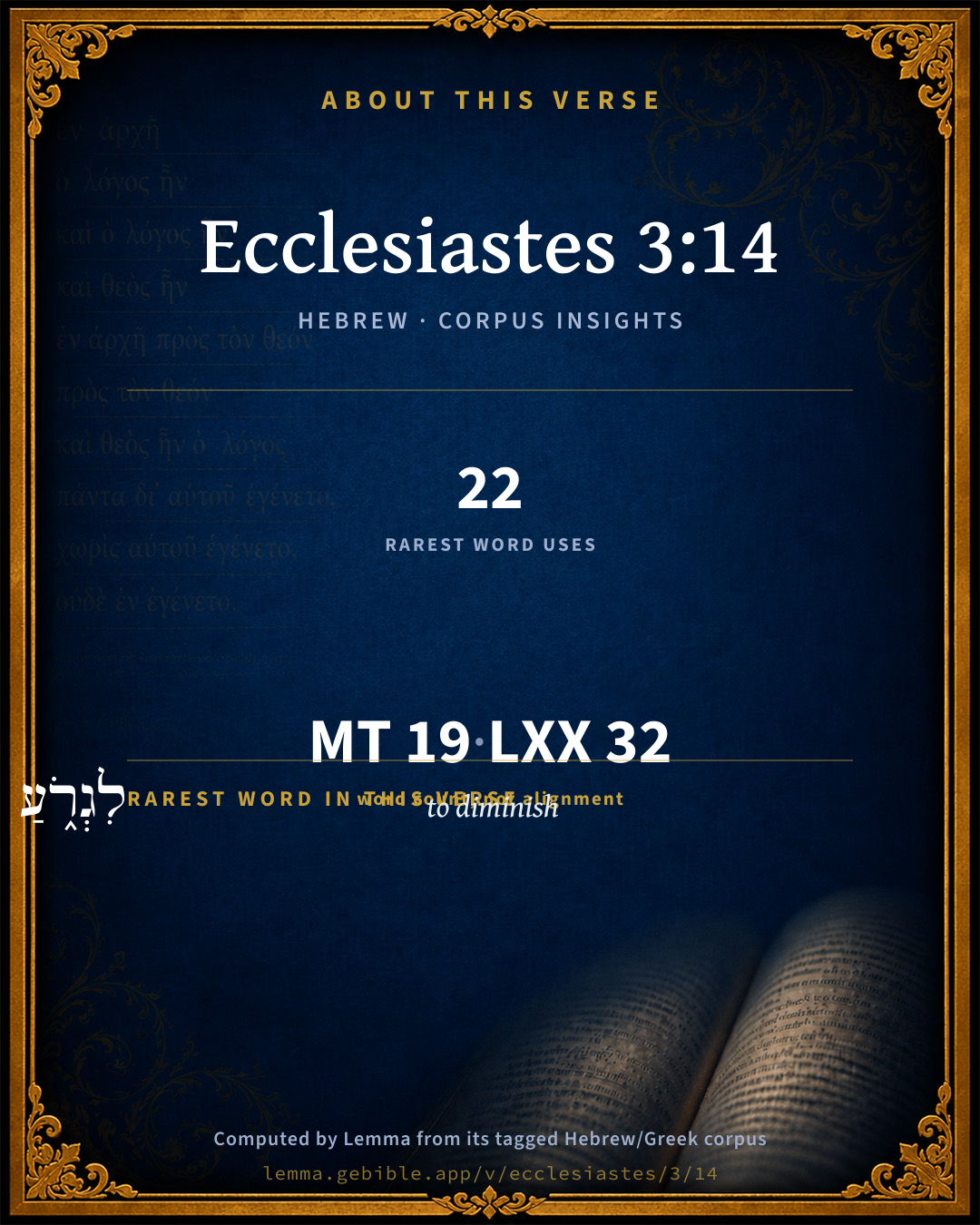
These counts appear in no published source. They are computed here, from the morphology-tagged text and Lemma’s own curated glosses. What Lemma adds →

19
words
16
distinct lemmas
Wisdom
section

Notable vocabulary

The rarest word here is לִגְרֹ֑עַ to diminish H1639 — appearing just 22 times in the whole Hebrew Bible.

Shared distinctive vocabulary

לִגְרֹ֑עַ to diminish H1639 occurs in 21 verses of the Hebrew Bible. Also found in:

Grammatical profile

  • 7 verbs
  • 5 nouns
  • 1 pronoun
  • 2 prepositions
  • 1 conjunction
  • 3 particles

Verb forms

  • יָדַ֗עְתִּי Qal · Perfect
  • יַעֲשֶׂ֤ה Qal · Imperfect
  • יִהְיֶ֣ה Qal · Imperfect
  • לְהוֹסִ֔יף Hiphil · Infinitive Construct
  • לִגְרֹ֑עַ Qal · Infinitive Construct
  • עָשָׂ֔ה Qal · Perfect
  • שֶׁיִּֽרְא֖וּ Qal · Imperfect

Repetition

Words recur within this verse — often emphatic in Hebrew:

  • יַעֲשֶׂ֤ה to do H6213 ×2
  • הָאֱלֹהִים֙ God H430 ×2
  • אֵ֣ין nothing H369 ×2

Hebrew & Septuagint length

In English translation the verse runs 32 words from the Hebrew and 40 from the Septuagint (LXX English) — closely comparable.

A rough comparison of the two English renderings, which tokenize alike — not a word-level alignment.

Word counts can differ between the Hebrew and the Greek without any difference in meaning — e.g. the Hebrew direct-object marker אֵת has no separate Greek word, and Greek often adds the article ὁ.

In the original languages it is 19 Hebrew tokens and 32 Greek tokens — but the two are counted differently (Hebrew bundles its prefixes and suffixes into one token; the Greek is in lemma form), so that isn’t a like-for-like length.

Cross-references

26

Topical passages linked to Ecclesiastes 3:14 in the Treasury of Scripture Knowledge — connected by theme and wording, ordered by reader-vote popularity; previews shown in the World English Bible.

  • James 1:17 Every good gift and every perfect gift is from above, coming down from the Father of lights, with whom can be no variation, nor turning shadow.
  • Psalms 33:11 The counsel of Yahweh stands fast forever, The thoughts of his heart to all generations.
  • Romans 11:36 For of him, and through him, and to him, are all things. To him be the glory for ever! Amen.
  • Acts 5:39 But if it is of God, you will not be able to overthrow it, and you would be found even to be fighting against God!"
  • Proverbs 30:6 Don't you add to his words, Lest he reprove you, and you be found a liar.
  • Titus 1:2 in hope of eternal life, which God, who can't lie, promised before eternal times;
  • Proverbs 21:30 There is no wisdom nor understanding Nor counsel against Yahweh.
  • Psalms 64:9 All mankind shall be afraid. They shall declare the work of God, And shall wisely ponder what he has done.
  • Psalms 76:10 Surely the wrath of man praises you. The survivors of your wrath are restrained.
  • Psalms 119:90–91 Your faithfulness is to all generations. You have established the earth, and it remains.
  • Proverbs 19:21 There are many plans in a man's heart, But Yahweh's counsel will prevail.
  • Ecclesiastes 5:7 For in the multitude of dreams there are vanities, as well as in many words: but you must fear God.
  • Ecclesiastes 7:18 It is good that you should take hold of this. Yes, also from that don't withdraw your hand; for he who fears God will come forth from them all.
  • Ecclesiastes 8:12–13 Though a sinner commits crimes a hundred times, and lives long, yet surely I know that it will be better with those who fear God, who are reverent before him.
  • Isaiah 46:10 declaring the end from the beginning, and from ancient times things that are not [yet] done; saying, My counsel shall stand, and I will do all my pleasure;
  • Isaiah 59:18–19 According to their deeds, accordingly he will repay, wrath to his adversaries, recompense to his enemies; to the islands he will repay recompense.
  • Daniel 4:34–35 At the end of the days I, Nebuchadnezzar, lifted up my eyes to heaven, and my understanding returned to me, and I blessed the Most High, and I praised and honored him who lives forever; for his dominion is an everlasting dominion, and his kingdom from generation to generation.
  • Daniel 11:2–4 Now will I show you the truth. Behold, there shall stand up yet three kings in Persia; and the fourth shall be far richer than they all: and when he has grown strong through his riches, he shall stir up all against the realm of Greece.
  • John 19:10–11 Pilate therefore said to him, "Aren't you speaking to me? Don't you know that I have power to release you, and have power to crucify you?"
  • Acts 2:23 him, being delivered up by the determined counsel and foreknowledge of God, you have taken by the hand of lawless men, crucified and killed;
  • Acts 4:28 to do whatever your hand and your council foreordained to happen.
  • Ephesians 3:11 according to the eternal purpose which he purposed in Christ Jesus our Lord;
  • Isaiah 10:12–15 Therefore it shall happen that, when the Lord has performed his whole work on Mount Zion and on Jerusalem, I will punish the fruit of the stout heart of the king of Assyria, and the glory of his high looks.
  • Daniel 8:8 The male goat magnified himself exceedingly: and when he was strong, the great horn was broken; and instead of it there came up four notable [horns] toward the four winds of the sky.
  • John 19:28–37 After this, Jesus, seeing that all things were now finished, that the Scripture might be fulfilled, said, "I am thirsty."
  • Revelation 15:4 Who wouldn't fear you, Lord, And glorify your name? For you only are holy. For all the nations will come and worship before you. For your righteous acts have been revealed."

Cross-references courtesy of OpenBible.info (CC BY 4.0).

Hebrew and Greek witnesses Masoretic Hebrew ↔ Greek Septuagint

The same verse in the two great witnesses to the Old Testament, shown verse-for-verse.

These are two independent witnesses, not word-aligned to each other, and the Septuagint is shown in lemma (dictionary) form.

Hebrew Ecclesiastes 3:14 Masoretic · Westminster Leningrad Codex

יָדַ֗עְתִּי כִּ֠י כָּל אֲשֶׁ֨ר יַעֲשֶׂ֤ה הָאֱלֹהִים֙ ה֚וּא יִהְיֶ֣ה לְעוֹלָ֔ם עָלָיו֙ אֵ֣ין לְהוֹסִ֔יף וּמִמֶּ֖נּוּ אֵ֣ין לִגְרֹ֑עַ וְהָאֱלֹהִ֣ים עָשָׂ֔ה שֶׁיִּֽרְא֖וּ מִלְּפָנָֽיו

I know that whatever God does, it shall be forever. Nothing can be added to it, nor anything taken from it; and God has done it, that men should fear before him.

World English Bible · Public Domain

Greek LXX Ecclesiastes 3:14 Septuagint · lemma form

γιγνώσκω ὅτι πᾶς ὅσος ποιέω ὁ θεός αὐτός εἰμί εἰς ὁ αἰών ἐπί αὐτός οὐ εἰμί προςτίθημι καί ἀπό αὐτός οὐ εἰμί ἀποαἱρέω καί ὁ θεός ποιέω ἵνα φοβέω ἀπό πρόσωπον αὐτός

I know that whatever things God has done, they shall be for ever: it is impossible to add to it, and it is impossible to take away from it: and God has done it, that men may fear before him.

LXX2012 (modern English Septuagint) · Public Domain

On this verse, The Pulpit Commentary discusses the Septuagint’s reading. Read the note in Commentary ↓

Hebrew: Westminster Leningrad Codex (CC BY 4.0). Greek: Septuagint (public domain); English from LXX2012 (modern English Septuagint) (Public Domain). How the Septuagint differs from the Hebrew →

Commentary

Notes on Ecclesiastes 3:14 from classic Christian and Jewish commentators (each source and its license shown beneath its notes). The classic Christian expositions comment on the surrounding passage and are grouped to its opening verse, so a note may address several verses; the Jewish commentaries on the Tanakh (Rashi and others) are per-verse, so they appear only where the commentator wrote on this verse.

Lemma curates 59 commentaries, every one of them public domain or Creative Commons licensed, each selected and text-cleaned for this edition rather than reprinted as found. About our sources →

Trapp's Complete Commentary

John Trapp

Ecc 3:14 I know that, whatsoever God doeth, it shall be for ever: nothing can be put to it, nor any thing taken from it: and God doeth [it], that [men] should fear before him.

Ver. 14. I know that whatsoever God doeth it shall be for ever,] i.e., That his decree is unchangeable, that his "counsel shall stand," {Pro 19:21} that the sun may sooner be stopped in his course than God hindered of his will or in his work, since his power and grace is irresistible. Nature, angels, devils, men, may all be resisted, and so miss their design. Not so God. For who hath resisted his will? Vain men, while (like proud and yet brittle clay) they will be knocking their sides against the solid and eternal decree of God, break themselves in pieces, as Adonijah did. {1Ki 1:5-9; 1Ki 1:41-43} And while, with Pompey, vanquished by Julius Caesar, they complain that there is a great mist upon the eye of Divine providence, they do but blame the sun, because of the soreness of their bleary eyes. Certain it is, and Solomon knows it - though the best of heathens doubted it when they saw good men suffer, bad men prosper - that every creature walks blindfold; only he that dwells in light sees whither they go; and that the chariots of all effects and actions come forth from between those "mountains of brass," God’s provident decrees and counsels most firm and immutable. {Zec 6:1}

That men should fear before him.] And not lay the reins on the neck, casting away all care upon pretence of God’s decree, as that French king did that thus desperately argued: Si salvabor, salvabor; si vero damnabor, damnabor: If I shall be saved, I shall be saved; and if I shall be damned, I shall be damned; therefore I will live as I wish. {a} This was to suck poison out of a sweet flower, to dash against the rock of ages, to fall into the pit (like a profane beast) which was digged for better purpose; to "stumble at the word" (an ill sign, and yet an ordinary sin) "whereunto also they were appointed." {1Pe 2:8} A bridge is made to give men safe passage over a dangerous river; but he that stumbleth on the bridge is in danger to fall into the river. So here.

{a} Ludovicus II

John Trapp, A Commentary or Exposition upon All the Books of the Old and New Testament (1647–1656) — public domain. Text from a community e-Sword module.

The Biblical Illustrator

Joseph S. Exell

Ecc_3:14

I know that, whatsoever God doeth, it shall be for ever.

The eternity and perfection of the Divine purposes and doings

Most important and consolatory truth is contained in these words. In it the Preacher seems to find refuge from the perplexity and uncertainty of human things; on it he seems to rest that conclusion of practical wisdom which he draws from the consideration of the vanities of human life; that it is the duty, and for the happiness of man, thankfully and confidingly to enjoy the good which he possesses, as bestowed at once, and secured by the merciful and unfailing providence of God. In this truth he seems to have found a rock, on which he might set his feet securely, being delivered by the light of Divine wisdom out of the unsteady and intricate paths of human short-sightedness and folly.

I. The very nature of man is transient and imperfect, much more the works in which he is engaged. Frail are they, and fugitive, mutable and perishable, uncertain and insecure, never continuing in one stay. This is the very property of a dependent and finite creature, who cannot set up a will of his own, or execute a work in opposition to the will, and exempt from the control of that Supreme Power who gave him his being, and to whom he is necessarily subject. But beside this essential insufficiency in man as a mere creature, sin has marred his limited powers, and induced corruptness, as well as imperfectness into all his works.

II. Consider, in opposition to this picture of man, the nature and works of god; more particularly as they have relation to, and affect mankind.

1. Whatsoever God doeth it shall be for ever.

(1) Because there is no change of purpose in God.

(2) Every singular decree of His will, and every several act of His power, humanly separated out of this great unity, is, in truth, for ever, and hath in it a perpetuity, being joined on,. indissolubly and eternally, to that one all-involving and everlasting design.

(3) It shall stand; because no created and superior power can interfere to overthrow it

2. But the purposes and works of God in relation to man are also perfect. They are entire, complete, and of finished excellence.

3. But especially, whatsoever He doeth in the covenant of His mercy, and in the salvation provided for man in His Son, our Lord Jesus Christ shall be for ever; nothing can be put to it, nor anything taken from it.

(1) It is eternal, unfailing, and unchangeable in Christ, by whom it hath been executed and accomplished.

(2) This salvation is also eternal in Gods purpose and decree of mercy.

(3) This salvation is also eternal in the work of grace and sanctification.

(4) But, moreover, His salvation is perfect in itself, complete, entire, wanting nothing, neither requiring nor admitting any addition, but providing all that is needful for every sinners recovery to everlasting life. It is a full and free salvation.

III. The end and motive which God hath in his doings, eternal and perfect as they are, is, that men may fear Him. Oh! what a holy and heavenly blending of gracious influences and sweet emotions is included in this godly fear; humble and awful reverence, bowing before the supreme greatness and goodness of the Lord God omnipotent; meek, and confiding trust, resting on His power and mercy, pledged, and engaged, and manifestly operating in behalf of fallen man; lively gratitude for surpassing grace, and redemption at once free and unfailing; pure and true love to infinite excellence of omnipotence and benevolence. This is sanctified, this is acceptable fear; this is that fear in which holiness must be perfected. (J. O. Parr, M. A.)

The Biblical Illustrator, edited by Joseph S. Exell (c. 1880s–1900s) — public domain. Text from a community e-Sword module.

Joseph Benson's Commentary

Ecc 3:14. Whatsoever God doeth, it shall be for ever — All God’s counsels or decrees are eternal and unchangeable. Nothing can be put to it — Men can neither do any thing against God’s counsel and providence, nor hinder any work or act of it. God doth it, that men should fear before him — That, by the consideration of his power, in the disposal of all persons and things, men should learn to trust in him, to submit to him, to fear to offend him, and more carefully study to please him.

Joseph Benson's Commentary on the Old and New Testaments (1811–1818) — public domain. Text from a community e-Sword module.

Tyndale Open Study Notes

Tyndale Open Resources

3:14 Knowing that whatever God does is final is a reason to fear him—to trust and revere God and respect all that he does.

Tyndale Open Study Notes — © Tyndale Open Resources, licensed CC BY-SA 4.0. Text via the HelloAO Bible API.

Geneva Bible (1599)

Geneva Bible translators

That is, man shall never be able to let God’s work, but as he hath determined, so it shall come to pass.

Geneva Bible (1599) marginal notes — public domain. Text via Bolls.life.

Jamieson, Fausset & Brown

Robert Jamieson, A. R. Fausset & David Brown

(Sa1 3:12; Sa2 23:5; Psa 89:34; Mat 24:35; Jam 1:17).

for ever--as opposed to man's perishing labors (Ecc 2:15-18).

any thing taken from it--opposed to man's "crooked and wanting" works (Ecc 1:15; Ecc 7:13). The event of man's labors depends wholly on God's immutable purpose. Man's part, therefore, is to do and enjoy every earthly thing in its proper season (Ecc 3:12-13), not setting aside God's order, but observing deep reverence towards God; for the mysteriousness and unchangeableness of God's purposes are designed to lead "man to fear before Him." Man knows not the event of each act: otherwise he would think himself independent of God.

Jamieson, Fausset & Brown — Commentary Critical and Explanatory on the Whole Bible (1871) — public domain (CC PDM 1.0). Text via the HelloAO Bible API.

Adam Clarke's Commentary

Verse 14. I know that whatsoever God doeth, it shall be for ever] לעולם leolam, for eternity; in reference to that grand consummation of men and things intimated in Ec 3:11. God has produced no being that he intends ultimately to destroy. He made every thing in reference to eternity; and, however matter may be changed and refined, animal and intellectual beings shall not be deprived of their existence. The brute creation shall be restored, and all human spirits shall live for ever; the pure in a state of supreme and endless blessedness, the impure in a state of indestructible misery.

Nothing can be put to it] No new order of beings, whether animate or inanimate, can be produced. God will not create more; man cannot add.

Nor any thing taken from it] Nothing can be annihilated; no power but that which can create can destroy. And whatever he has done, he intended to be a means of impressing a just sense of his being, providence, mercy, and judgments, upon the souls of men. A proper consideration of God's works has a tendency to make man a religious creature; that is, to impress his mind with a sense of the existence of the Supreme Being, and the reverence that is due to him. In this sense the fear of God is frequently taken in Scripture. The Hebrew of this clause is strongly emphatic: והאלהים עשה שייראו מלפניו vehaelohim asah sheiyireu millephanaiv;

"And the gods he hath done, that they might fear from before his faces." Even the doctrine of the eternal Trinity in Unity may be collected from numberless appearances in nature. A consideration of the herb trefoil is said to have been the means of fully convincing the learned Erasmus of the truth of the assertion, These Three are One: and yet three distinct. He saw the same root, the same fibres, the same pulpy substance, the same membraneous covering, the same colour, the same taste, the same smell, in every part; and yet the three leaves distinct: but each and all a continuation of the stem, and proceeding from the same root. Such a fact as this may at least illustrate the doctrine. An intelligent shepherd, whom he met upon the mountains, is said to have exhibited the herb, and the illustration while discoursing on certain difficulties in the Christian faith. When a child, I heard a learned man relate this fact.

Adam Clarke's Commentary on the Bible (1810–1826) — public domain. Text from a community e-Sword/MySword module.

The Cambridge Bible for Schools and Colleges

gen. ed. J. J. S. Perowne

14. I know that, whatsoever God doeth] We ask once again whether we are brought face to face with the thought of an iron destiny immutably fixing even the seeming accidents of life, and excluding man’s volition from any share in them, or whether the writer speaks of an order which men may, in the exercise of their freedom, transgress. And the answer, as before, is that the Debater, while he recognises man’s freedom, has come to see a purpose and an order even in those accidents. So Epicurus himself taught that it was better to hold even the popular belief as to the Gods than to be in bondage to the dogma of a destiny (Diog. Laert. x. 1, § 134). The Eternal Law fulfils itself “whether men will hear or whether they will forbear.” They cannot add to it or take from it, but they retain the power of obeying or resisting it. It partakes so far of the character which was afterwards ascribed to a special revelation (Rev_22:18-19).

God doeth it, that men should fear before him] There is a profound psychological truth in the thought thus expressed. Men may dream that they can propitiate or change an arbitrary will, but no reverential awe, no fear of God, is so deep as that which rises from the contemplation of a Righteousness that does not change. So, in like manner, the unchangeableness of the Divine Will is made a ground of confidence and hope in the midst of perturbations (Mal_3:6).

The Cambridge Bible for Schools and Colleges (gen. ed. J. J. S. Perowne; Cambridge University Press, 1878–1918) — public domain. Text from a community e-Sword module.

John Gill's Exposition

I know that whatsoever God doeth, it shall be for ever,.... Which some, as Jarchi, understand of the works of creation, the heavens and the earth, which are however of long standing and duration; and though they shall be dissolved and perish, as to their form and quality, yet not as to the substance of them: the earth particularly is said to abide for ever, Ecc 1:4; the sun and moon, and stars, keep their course or station; and the several seasons of the year have their constant revolution, and shall as long as the earth endures; see Gen 8:22; the several kinds of creatures God has made, in the earth, air, and sea, though the individuals die, their species remain; and man, the chief of creatures, though he dies, shall live again, and live for ever; so the Arabic version,

"I have learned that all the creatures which God hath made shall perpetually remain in the same order and condition:''

though Abarbinel (o) interprets this of the continuance of the world for a certain time, and then of the destruction of it; which he thinks is supported by Ecc 3:15, and which is to be understood of the creation of one world after another; and that which is past he explains of the world that is destroyed. But rather this is to be understood of the decrees of God, which are his works "ad intra"; the thoughts of his heart, that are to all generations; the counsel of his will, which always stands, and is performed; his mind, which is one, the same always, and invariable, and which he never changes; his pleasure he always does; his purposes and appointments, which are always accomplished, never frustrated and made void: for he is all wise in forming them, all knowing, and sees the end from the beginning, so that nothing unforeseen can turn up to hinder the execution of them; he is unchangeable, and never alters his will; and all powerful, able to effect his great designs; and faithful and true, cannot deny himself, nor ever lie nor repent. To this sense is the Targum,

"I know, by a spirit of prophecy, that all which the Lord does in the world, whether good or evil, after it is decreed from his mouth, it shall be for ever.''

This holds good of all his works, and acts of grace; election of persons to eternal life stands firm, not on the foot of works, but of grace, and has its certain effect; it can never be made void, nor be surer than it is; it will ever take place, and continue in its fruit and consequences: the covenant of grace, as it is made from everlasting, continues to everlasting; its promises never, fail, its blessings are the sure mercies of David: redemption by Christ is eternal; such as are redeemed from sin, Satan, and the law, are ever so, and shall never be brought into bondage to either again: the work of grace upon the heart being begun, shall be performed and perfected; the graces wrought in the soul, as faith, hope, and love, ever remain; the blessings of grace bestowed, as pardon, justification, adoption, and salvation, are never reversed, but ever continue; such as are regenerated, pardoned, justified, adopted, and saved, shall be ever so; and the work of God, as it is durable, so perfect;

nothing can be put to it, nor anything taken from it; the works of nature have been finished and perfected from the foundation of the world; the decrees of God are a complete system of his will, according to which he does all things invariably, in providence and grace; the covenant of grace is ordered in all things, and nothing wanting in it; the work of redemption is completely done by Christ, who is a rock, and his work is perfect; and the work of grace on the heart, though at present imperfect, shall be perfected; nor is it in the power of men to add anything to it, nor take anything from it;

and God doth it, that men should fear before him; his works of creation being done in so much wisdom, and giving such a display of his power and goodness, command art awe of him in his creatures, Psa 33:6; his works of providence, being all according to his wise purposes and decrees, should be patiently and quietly submitted to; and men should be still, and know that he is God, and humble themselves under his mighty hand: his decrees, respecting the present or future state of men, do not lead to despair, nor to a neglect of means, nor to a dissolute life, but tend to promote the fear of God and true holiness, which they are the source of; and the blessings of grace have a kind influence on the same; particularly the blessing of pardoning grace, which is with God, that he may be feared, Psa 130:4; and one principal part of the work of grace on the heart is the fear of God; and nothing more strongly engages to the whole worship of God, which is often meant by the fear of him, than his grace vouchsafed to men; see Heb 12:28. The Targum refers this to the vengeance of God in the world: and Jarchi, to the unusual phenomena in it; as the flood, the sun's standing still and going backward, and the like.

(o) Miphalot Elohim Tract. 8. c. 7. fol. 57. 4.

John Gill's Exposition of the Whole Bible (1746–1763) — public domain (CC PDM 1.0). Text via the HelloAO Bible API.

Albert Barnes' Notes on the Bible

The last clause of this verse goes beyond a declaration of the fact of God’s government of the world Ecc 2:26 by adding the moral effect which that fact is calculated to produce on those who see it. It is the first indication of the practical conclusion Ecc 12:13 of the book.

Albert Barnes' Notes on the Bible (1834–1885) — public domain. Text from a community e-Sword/MySword module.

Haydock's Catholic Bible Commentary

Feared. The order of the seasons, &c., teaches men to adore Providence. (St. Jerome) --- He has arranged every thing, how mutable soever. (St. Augustine, Confessions i. 6.)

George Leo Haydock (1774–1849), Haydock's Catholic Family Bible and Commentary, 1859 edition — public domain. Excludes Psalms (Douay-Rheims chapter numbering differs from Protestant) and Deuterocanonical books (Catholic canon only).

Matthew Poole's English Annotations

Whatsoever God doeth, it shall be for ever; all God’s counsels or decrees are eternal and unchangeable, and his providence works effectually, so as men cannot resist or hinder it.

Nothing can be put to it, nor any thing taken from it; men can neither do any thing besides or against God’s counsel and providence, nor hinder any work or act of it.

That men should fear before him; not that men should make this an occasion of despair, or idleness, or dissoluteness, as some abuse this doctrine, but that, by the consideration of his sovereign and irresistible power in the disposal of all persons and things as pleaseth him, men should learn to trust in him, to submit to him, to fear to offend or rebel against him, and more carefully and industriously to study to please him.

Matthew Poole's English Annotations on the Holy Bible (1683–1685) — public domain. Text from a community e-Sword/MySword module.

Whedon's Commentary on the Bible

Daniel D. Whedon

14. It shall be for ever — The order of nature and the scope of human life and destiny are alluded to as remaining uniform to the latest generation of men. The wants and woes, the pangs and passions, the joy and gladness, of our race are uniform. This uniformity becomes sublime and impressive when contrasted with the temporary and changeful arrangements of men. “Thou art the same.” “Thou changest not.”

Daniel D. Whedon (gen. ed.), Commentary on the Old and New Testaments (1874–1909) — public domain. Text from a community e-Sword module.

The Pulpit Commentary

I know that, whatsoever God doeth, it shall be forever. A second thing (see ver. 12) that Koheleth knew, learned from the truths adduced in vers. 1-9, is that behind man"s free action and volition stands the will of God, which orders events with a view to eternity, and that man can alter nothing of this providential arrangement. (comp. Isa_46:10; Psa_33:11) Nothing can be put to it, nor anything taken from it. We cannot hasten or retard God"s designs; we cannot add to or curtail his plans. Septuagint, "It is impossible to add (oujk esti prosqeinai) to it, and it is impossible to Lake away from it." Thus Ecc 18:6, "As for the wondrous works of the Lord, it is impossible to lessen or to add to them (oujk estin ejlattwsai oujde prosqeinai), neither can the ground of them be found out." God doeth it, that men should fear before him. There is a moral purpose in this disposal of events. Men feel this uniformity and unchangeableness in the working of Providence, and thence learn to cherish a reverential awe for the righteous government of which they are the subjects. It was this feeling which led ancient etymologists to derive Qeov and Deus from deov, "fear". (comp. Rev_15:3, Rev_15:4) This is also a ground of hope and confidence. Amid the jarring and fluctuating circumstances of men God holds the threads, and alters not his purpose. "I the Lord change not; therefore ye, O sons of Jacob, are not consumed". (Mal_3:6) The Vulgate is not very successful: Non possumus eis quid-quam addere, nec auferre, quae fecit Deus ut timeatur, "We cannot add anything unto, or take anything away from, those things which God hath made that he may be feared.

The purposes of Providence.

Different minds, observing and considering the same facts, are often very differently affected by them. The measure of previous experience and culture, the natural disposition, the tone and temper with which men address themselves to what is before them, all affect the conclusion at which they arrive. The conviction produced in the mind of the Preacher of Jerusalem is certainly deserving of attention; he saw the hand of God in nature and in life, where some see only chance or fate. To see God"s hand, to admire his wisdom, to appreciate his love, in our human life, this is an evidence of sincere and intelligent piety.

I GOD"S WORK IS PERFECT AND UNALTERABLE. "Nothing can be put to it, nor anything taken from it." This cannot be said to be the general conviction; on the contrary, men are always finding fault with the constitution of things. If they had been consulted in the creation of the universe, and in the management of human affairs, all would have been far better than it is! Now, all depends upon the end in view. The scientific man would make an optical instrument which should serve as both microscope and telescope a far more marvelous construction than the eye. The pleasure-seeker would eliminate pain and sorrow from human life, and would make it one prolonged rapture of enjoyment. But the Creator had no intention of making an instrument which should supersede human inventions; his aim was the production of a working, everyday, useful organ of vision. The Lord of all never aimed at making life one long series of gratification; he designed life to be a moral discipline, in which suffering, weakness, and distress fulfill their own service of ministering to man"s highest welfare. For the purposes intended, God"s work needs no apology and admits of no improvement.

II GOD"S WORK IS ETERNAL. All men"s works are both unstable and transitory. Fresh ends are ever being approved and sought by fresh means. The laws of nature know no change; the principles of moral government are the same from age to age. When we learn to distrust our own fickleness, and to weary of human uncertainty and mutability, then we fall back upon the unchanging counsels of him who is from everlasting to everlasting.

III GOD"S WORK HAS A PURPOSE WITH REFERENCE TO MAN. What God has done in this world he has done for the benefit of his spiritual family. Everything that is may be regarded as the vehicle of communication between the creating and the created mind. The intention of God is "that men should fear before him," i.e. venerate and glorify him. Our human probation and education as moral and accountable beings is his aim. Hence the obligation on our part to observe, inquire, and consider, to reverence, serve, and obey, and thus consciously and voluntarily secure the ends for which the Creator designed and fashioned us. T.

Vers. 14, 15.

Divine constancy and human piety.

With the outer world of nature and with our human nature and character before us, these words may somewhat surprise us; it is necessary to take a preliminary view of

I HUMAN ACTION UPON THE DIVINE.

1. There is a sense in which man has modified the Divine action according to the Divine purpose. God has given us the material, and he says to us, "Work with it and upon it; mould, fashion, transform, develop it as you will; make all possible use of it for bodily comfort, for mental enlargement, for social enjoyment, for spiritual growth." Man has made large use of this his opportunity, and, with the advance of knowledge and of science, he will make much more in the centuries to come. He cannot indeed "put to" or "take from" the substance with which God supplies him, but he can do much to change its form and to determine the service it shall render.

2. There is a sense in which man has tem porarily thwarted the Divine idea. For is not all sin, and are not all the dire consequences of sin, a sad and serious departure from the purpose of the Holy One? Surely infidelity, blasphemy, vice, cruelty, crime; surely poverty, misery, starvation, death; -all this is not what the heavenly Father meant for his human children when he breathed into man"s nostrils the breath of life. But the leading idea of the text is

II THE PERMANENCY OF THE DIVINE THOUGHT. This truth includes:

1. The fixedness of the Divine purpose. "The counsel of the Lord standeth for ever, the thoughts of his heart to all generations". (Psa_33:11) We believe that from the beginning God intended to work out the righteousness and the blessedness of the human race; and whatever has come between him and the realization of his gracious end will be cleared away. Man will one day be all that the Eternal One designed that he should become.

2. The constancy of the Divine Law. The same great moral laws, and the same physical laws also, which governed the action and the destiny of men in primeval times still prevail, and will always abide. Sin has meant suffering and sorrow, righteousness has worked out well-being and joy; diligence has been followed by fruitfulness, and idleness by destitution; generosity has been recompensed with love, and selfishness with leanness of soul, etc. As it was at the beginning, so will it be with the action of all Divine laws, even to the cud.

3. The permanency of the Divine attitude.

(1) What God always felt toward sin he feels today; it is the thing which he hates. In Jesus Christ, as fully and as emphatically as in the Law, his holy intolerance of sin is revealed, his Divine determination to conquer and to destroy it.

(2) What God always felt toward the sinner he feels today a Divine grief and an infinite compassion; a readiness to forgive and to restore the penitent.

III THE DIVINE DESIGN. "God doeth it, that men should fear before him." God"s one unchanging desire is that his children should live a reverential, holy life before him. All the manifestations of his character that he gives us are intended to lead up to and issue in this. And surely the Divine constancy is calculated to promote this as nothing else would. It is God"s desire and his design concerning us, because he knows

(1) that it is the only right relationship for us to sustain; and

(2) that it is the one condition of peace, purity, blessedness, life. C.

Vers. 14-17. An argument in support of the statement that A present use and enjoyment of the gifts of God is advisable, is found in the fact of the unchangeable character of the Divine purposes and government. He who has given may take away, and none can stay his hand. While, therefore, we are in possession of benefits he has bestowed on us, we should get the good of them, seeing that we know not how long we shall have them. Exception has been taken to this teaching. "The lesson to cheerfulness under such bidding seems a hard one. Men have recited it over the wine-cup in old times and new, in East and West. But the human heart, with such shadows gathering in the background, has recognized its hollowness, and again and again has put back the anodyne from its lips" (Bradley). But though the thought of the Divine unchangeableness may be regarded by some as a stimulus to a reckless enjoyment of the present, it is calculated to have a wholesome influence upon our views of life, and upon our conduct. Acquiescence in one"s lot, and reverential fear of God, leading to an avoidance of sin, are naturally suggested by it. The conviction that the will of God is righteous will prevent acquiescence in it becoming that apathetic resignation which characterizes the spirit of those who believe that over all the events of life an iron destiny rules, against which men strive in vain.

I THE CHARACTER OF THE DIVINE GOVERNMENT. (Ver. 14.) It is eternal and. unalterable. In the phenomena of the natural world, we see it manifested in laws which man cannot control or change; in the providential government of human affairs, the same rule of a higher Power over all the events of life is discernible; and in the revelations of the Divine will, recorded in the Scriptures, we see steady progress to an end foreseen and foretold from the beginning. What God does stands fast; no created power can nullify or change it (Psa_23:1; Isa_46:9, Isa_46:10; Dan_4:35)

II THE EFFECT WHICH THIS UNCHANGEABLENESS SHOULD PRODUCE. (Ver. 14b.) "That men should fear before him." It should fill our heart with reverence. This is, indeed, the purpose for which God has given this revelation of himself, and no other view of the Divine character is calculated to produce the same effect. The thought of God"s infinite power would not impress us in like manner if at the same time we believed that his will was variable, that it could be propitiated and changed. But the conviction that his will is righteous and immutable should lead us to "sanctify him in our hearts, and make him our Fear and our Dread", (Isa_8:13) and give us hope and confidence in the midst of thevicissitudes of life. (Mal_3:6) In the earlier part of his work (Ecc_1:9, Ecc_1:10) the Preacher had dwelt upon the uniformity of sequence in nature, as if he were impressed with a sense of monotony, as he watched the course of events happening and recurring in the same order. And now, as he looks upon human history, he sees the same regularity in the order of things. "That which hath been is now, and that which is to be hath already been." But the former feeling of weariness and oppression is modified by the thought of God"s perfection, and by the "fear" which it excites. He recognizes the fact of a personal will governing the events of history. It is no mechanical process of revolution that causes the repetition time after time of similar events, the same causes producing the same effects; no wheel of destiny alternately raising and depressing the fortunes of men. It is God who recalls, "who seeks again that which is passed away" (ver. 15b). "The past is thought of as vanishing, put to flight, receding into the dim distance. It might seem to be passing into the abyss of oblivion; but God recalls it, brings back the same order, or an analogous order of events, and so history repeats itself" (Plumptre). And out of this belief in God"s wise providence a healthy spirit should gather strength to bear patiently and cheerfully the difficulties and trials of life. The belief that our life is governed by an unalterable law is calculated, as I have said, to lead to a listless, hopeless state of mind, in which one ceases to strive against the inevitable. But that state of mind is very different from the resignation of those who believe that the government of the world is regular and unchangeable, because unerring wisdom guides him who is the Creator and Preserver of all things. Their faith can sustain them in the greatest trials, when God"s ways seem most inscrutable; they can hope against hope, and, in spite of all apparent contradictions, believe that "all things work together for good to them that love God. J.W.

The Pulpit Commentary (1880–1919), ed. H.D.M. Spence-Jones & Joseph S. Exell — public domain. Text from a community e-Sword module.

John Wesley's Explanatory Notes

For ever - All God's counsels or decrees are eternal and unchangeable. Nothing - Men can neither do any thing against God's counsel and providence, nor hinder any work or act of it. Fear - That by the consideration of his power in the disposal of all persons and things, men should learn to trust in him, to submit to him, to fear to offend him, and more carefully study to please him.

John Wesley, Explanatory Notes Upon the Whole Bible (1754–1765) — public domain. Text via the GEBible commentary corpus.

Keil & Delitzsch

C. F. Keil & F. Delitzsch

"Thus I discerned it then, that all that God will do exists for ever; nothing is to be added to it, and nothing taken from it: God has thus directed it, that men should fear before Him." This is a conclusion derived from the facts of experience, a truth that is valid for the present and for the time to come. We may with equal correctness render by quidquid facit and quidquid faciet. But the pred. shows that the fut. expression is also thought of as fut.; for הוּ יה לע does not mean: that is for ever (Hitz.), which would be expressed by the subst. clause הוּא לעולם; but: that shall be for ever (Zck.), i.e., will always assert its validity. That which is affirmed here is true of God's directing and guiding events in the natural world, as well as of the announcements of His will and His controlling and directing providence in the history of human affairs. All this is removed beyond the power of the creature to alter it. The meaning is not that one ought not to add to or to take from it (Deu 13:1; Pro 30:6), but that such a thing cannot be done (vid., Sir. 18:5). And this unchangeableness characterizing the arrangements of God has this as its aim, that men should fear Him who is the All-conditioning and is Himself unconditioned: he has done it that they (men) should fear before Him, אשׂה שׁ, fecit ut; cf. Eze 36:27. ποιεῖν ἳνα, Rev 13:15; and "fear before Him," as at Ecc 8:12.; cf. Ch1 16:30 with Psa 96:9. The unchangeableness of God's action shows itself in this, that in the course of history similar phenomena repeat themselves; for the fundamental principles, the causal connections, the norms of God's government, remain always the same.

Keil & Delitzsch — Biblical Commentary on the Old Testament (1861–1891) — public domain (CC PDM 1.0). Text via the HelloAO Bible API. (Old Testament only.)

Scofield Reference Notes

C. I. Scofield

fear

(See Scofield "Psa 19:9").

The Scofield Reference Bible (1917 edition), notes by C. I. Scofield — public domain. Text from a community e-Sword module.

unfoldingWord translationNotes

Door43 World Missions Community

Nothing can be added to it or taken away

This can be stated in active form. AT: "No one can add anything to or take anything away from it" (See: Active or Passive)

translationWords

God

eternity

honor

unfoldingWord translationNotes — © Distant Shores Media and the Door43 World Missions Community, licensed CC BY-SA 4.0. Source: git.door43.org/Door43/en_tn.

Rashi

Rabbi Shlomo Yitzchaki (Rashi)

I knew that everything that God made [i.e.,] that the Holy One, blessed be He, [made] in the Creation, is fit to exist forever, and it cannot be changed, either by adding or by diminishing, and when it is changed, God commanded and caused it to be changed, in order that they should fear Him. The ocean broke through its boundary in the generation of Enosh and inundated a third of the world, and God did this so that they would fear Him. For seven days, the course of the sun was changed in the Generation of the Flood, to rise in the west and set in the east, in order that they fear Him. The sun went back ten steps in the days of Hezekiah, and in the days of Ahaz his father, the day was shortened and the night was lengthened on the day of his death, so that he should not be eulogized. All this was so that they would fear Him. Therefore, there is nothing better for a man to occupy himself with than with His commandments and to fear Him.

Rashi on the Tanakh — English translations: “The Judaica Press complete Tanach with Rashi, translated by A. J. Rosenberg” (CC BY 4.0); “Pentateuch with Rashi's commentary by M. Rosenbaum and A.M. Silbermann, 1929-1934” (public domain); “The Metsudah Tanach series, Lakewood, N.J” (CC BY 4.0); and “The Book of Joshua, Metsudah Publications, 1997” (CC BY 4.0). Text via Sefaria.

Lesson kit

Teaching starters — assembled from the data on this page, not authored interpretation. Every prompt links to the verse data it draws on. Edit before teaching.

Ecclesiastes, in the Wisdom, opens this verse with 19 words (16 distinct Hebrew lemmas). Its most distinctive word is gâraʻ (“to diminish”). A historical commentator’s framing appears above. Read the whole chapter for the surrounding context.

Discussion questions

  1. What does “to diminish” (gâraʻ) contribute to the verse as a whole?
  2. Exodus 5:8 shares the word «to diminish» with this verse. How do the two illuminate each other?
  3. “to do” occurs 2× in this one verse. What is the effect of the repetition?
  4. These translations render this verse differently. What is at stake in choosing one wording over another?
  5. The verb «יָדַ֗עְתִּי» is Qal Perfect. How does its form color the action?
  6. Reading how Trapp's Complete Commentary and The Biblical Illustrator read this verse, where do the two commentators agree and where do they part?

Things to notice

Reading settings

Reading text

Shown beneath each verse's original-language words.

Old Testament
Old Testament edition

Read the OT as the Masoretic Hebrew (MT) or the Greek Septuagint (LXX).

English shown for the Greek Septuagint (in the Hebrew ↔ Greek comparison).

Comparing translations? Open the Compare panel on any verse page to stack up to four side by side.