Isaiah 23:12

Hebrew (Westminster Leningrad Codex) Isaiah 23:12 appears in the Hebrew Old Testament. The text above is from the Westminster Leningrad Codex. Each word links to its Strong’s number, a concise gloss, and parsing drawn from the Open Scriptures Hebrew Bible morphology. Click any word for its full Brown-Driver-Briggs (BDB) entry.
Download image
Cite this verse

Isaiah 23:12 (World English Bible). Public Domain. Lemma interlinear Bible study tool, https://lemma.gebible.app/v/isaiah/23/12.

Show BibTeX & RIS
BibTeX
RIS
English Translation
He said, You shall no more rejoice, you oppressed virgin daughter of Sidon: arise, pass over to Kittim; even there shall you have no rest.
World English Bible · Public Domain
Download a study sheet

One document with this verse’s original text, its word-by-word gloss line, the meaning frame, cross-references with their text, attributed commentary, and full source and license credits — printable, and it pastes into notes with its structure intact.

This verse Autodidact and up

Study sheet (.html) Plain text (.txt)

A passage Seminary Student

Up to 50 verses in one chapter. A passage sheet keeps up to 6 commentary sources and 12 cross-references per verse, in the order this page ranks them, and says so on the sheet whenever that leaves anything out. Ask for a single verse and you get the Autodidact verse sheet above.

Everything on this page stays free to read, with no account — the sheet is a download of what is already on screen, not access to it.

Want to remove ads? Support Godless Engineer
Compare translations 3

The same verse in 3 English versions, stacked beneath the original-language interlinear above. Click any original word for its lexicon entry.

Each is an independent rendering of the whole verse — the interlinear is not word-aligned to these translations.

Highlighted words mark where these versions differ — a whole-verse word diff, not a word-by-word alignment.

  • World English Bible Public Domain
    He said, You shall no more rejoice, you oppressed virgin daughter of Sidon: arise, pass over to Kittim; even there shall you have no rest.
  • King James Version Public Domain
    And he said, Thou shalt no more rejoice, O thou oppressed virgin, daughter of Zidon: arise, pass over to Chittim; there also shalt thou have no rest.
  • unfoldingWord Literal Text CC BY-SA 4.0
    And he said, “You will not add again to rejoice, oppressed virgin of the daughter of Sidon. Arise, cross over to the Kittim; even there it will not be rest for you.”

unfoldingWord Literal Text — © unfoldingWord, licensed CC BY-SA 4.0. Word-aligned USFM3 via Door43 (git.door43.org/unfoldingWord/en_ult).

Versions to compare (up to 4)

3 of 4 selected

Show all 18 translations

Every available English version of this verse, each an independent rendering of the whole verse.

  • World English Bible Public Domain
    He said, You shall no more rejoice, you oppressed virgin daughter of Sidon: arise, pass over to Kittim; even there shall you have no rest.
  • Berean Standard Bible Public Domain
    He said, “You shall rejoice no more, O oppressed Virgin Daughter of Sidon. Get up and cross over to Cyprus—even there you will find no rest.”
  • Majority Standard Bible Public Domain
    He said, “You shall rejoice no more, O oppressed Virgin Daughter of Sidon. Get up and cross over to Cyprus—even there you will find no rest.”
  • King James Version Public Domain
    And he said, Thou shalt no more rejoice, O thou oppressed virgin, daughter of Zidon: arise, pass over to Chittim; there also shalt thou have no rest.
  • American Standard Version (1901) Public Domain
    And he said, Thou shalt no more rejoice, O thou oppressed virgin daughter of Sidon: arise, pass over to Kittim; even there shalt thou have no rest.
  • Revised Version (1885) Public Domain
    And he said, Thou shalt no more rejoice, O thou oppressed virgin daughter of Zidon: arise, pass over to Kittim; even there shalt thou have no rest.
  • Geneva Bible (1599) Public Domain
    And he saide, Thou shalt no more reioyce when thou art oppressed: O virgin daughter of Zidon: rise vp, goe ouer vnto Chittim: yet there thou shalt haue no rest.
  • Douay-Rheims (1899) Public Domain
    And he said: Thou shalt glory no more, O virgin daughter of Sidon, who art oppressed: arise and sail over to Cethim, there also thou shalt have no, rest.
  • Young's Literal Translation Public Domain
    And He saith, `Thou dost not add any more to exult, O oppressed one, virgin daughter of Zidon, To Chittim arise, pass over, Even there -- there is no rest for thee.'
  • Literal Standard Version CC BY-SA 4.0
    And He says, “You do not add to exult anymore, || O oppressed one, virgin daughter of Sidon, || To Chittim arise, pass over, || Even there—there is no rest for you.”
  • Unlocked Literal Bible CC BY-SA 4.0
    He said, “You will not rejoice again, oppressed virgin daughter of Sidon; arise, pass over to Cyprus; but neither there you will have rest.”
  • unfoldingWord Literal Text CC BY-SA 4.0
    And he said, “You will not add again to rejoice, oppressed virgin of the daughter of Sidon. Arise, cross over to the Kittim; even there it will not be rest for you.”
  • Darby Bible Public Domain
    and hath said, Thou shalt no more exult, [thou] oppressed virgin, daughter of Sidon: get thee up, pass over to Chittim; even there shalt thou have no rest.
  • World Messianic Bible Public Domain
    He said, “You shall rejoice no more, you oppressed virgin daughter of Sidon. Arise, pass over to Kittim. Even there you will have no rest.”
  • Webster's Bible Public Domain
    And he said, Thou shalt no more rejoice, O thou oppressed virgin, daughter of Zidon: arise, pass over to Chittim; there also shalt thou have no rest.
  • Free Bible Version CC BY-SA 4.0
    He said, “Don't celebrate any more, mistreated virgin daughter of Sidon. Go and sail over to Cyprus—however, even there you won't find rest.”
  • Bible in Basic English Public Domain
    And he said, There is no more joy for you, O crushed virgin daughter of Zidon: up! go over to Kittim; even there you will have no rest.
  • JPS Tanakh (1917) Public Domain
    And He said: 'Thou shalt no more rejoice.' O thou oppressed virgin daughter of Zidon, arise, pass over to Kittim; even there shalt thou have no rest.

Literal Standard Version (2020), Covenant Press — licensed CC BY-SA 4.0. Text via the HelloAO Bible API (eBible.org). Unlocked Literal Bible (unfoldingWord) — licensed CC BY-SA 4.0. Text via the HelloAO Bible API (eBible.org). unfoldingWord Literal Text — © unfoldingWord, licensed CC BY-SA 4.0. Word-aligned USFM3 via Door43 (git.door43.org/unfoldingWord/en_ult). Free Bible Version, Dr. Jonathan Gallagher — licensed CC BY-SA 4.0. Text via the HelloAO Bible API (eBible.org).

Word by word

More ways to search: Search by grammar → Find every occurrence → Compare this word →

Practice this passage: Drill this verse → Learn its vocabulary →

כתיים
Kittîy
H3794
“Chittim”
Noun, Proper
Part of Speech
Noun
Type
Proper
Full BDB Definition

Origin: patrial from an unused name denoting Cyprus (only in the pl.)

TWOT: None

Chittim or Kittim = "bruisers" - a general term for all islanders of the Mediterranean Sea - the descendants of Javan, the son of Japheth and grandson of Noah
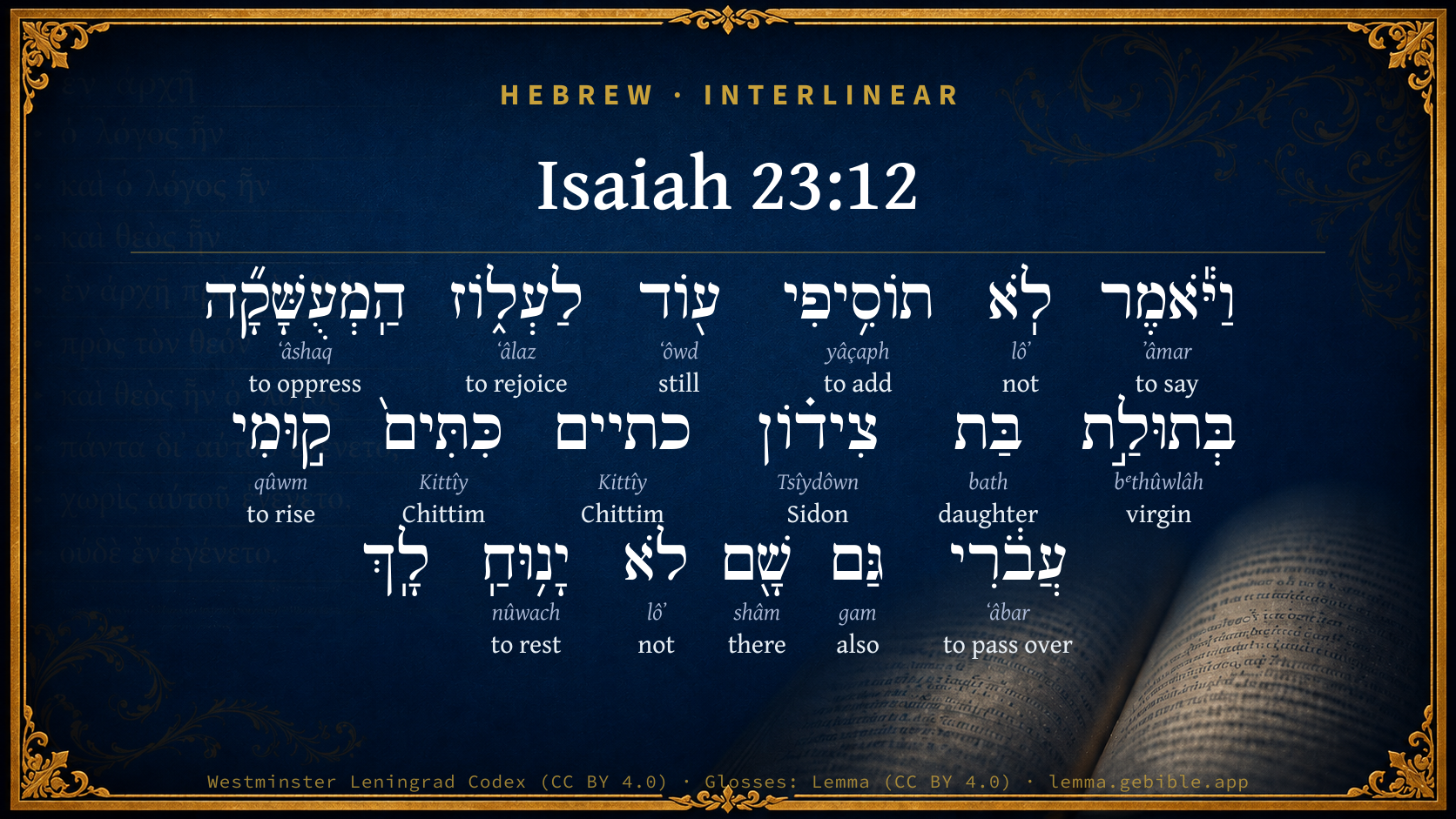
  1. וַיֹּ֕אמֶר ʼâmar H559 “and · to say” Conjunction + Verb, Qal, Sequential Imperfect, 3rd Person, Masculine, Singular
  2. לֹֽא lôʼ H3808 “not” Particle, Negative
  3. תוֹסִ֥יפִי yâçaph H3254 “to add” Verb, Hiphil, Imperfect, 2nd Person, Feminine, Singular
  4. ע֖וֹד ʻôwd H5750 “still” Adverb
  5. לַעְל֑וֹז ʻâlaz H5937 “to rejoice” Preposition + Verb, Qal, Infinitive Construct
  6. הַֽמְעֻשָּׁקָ֞ה ʻâshaq H6231 “the · oppressed” Particle, Definite Article + Verb, Pual, Participle Passive, Feminine, Singular, Absolute
  7. בְּתוּלַ֣ת bᵉthûwlâh H1330 “virgin of” Noun, Common, Feminine, Singular, Construct
  8. בַּת bath H1323 “daughter of” Noun, Common, Feminine, Singular, Construct
  9. צִיד֗וֹן Tsîydôwn H6721 “Sidon” Noun, Proper
  10. כִּתִּים֙ Kittîy H3794 “Chittim” Noun, Proper
  11. ק֣וּמִי qûwm H6965 “rise” Verb, Qal, Imperative, 2nd Person, Feminine, Singular
  12. עֲבֹ֔רִי ʻâbar H5674 “pass over” Verb, Qal, Imperative, 2nd Person, Feminine, Singular
  13. גַּם gam H1571 “also” Particle, Accusative
  14. שָׁ֖ם shâm H8033 “there” Adverb
  15. לֹא lôʼ H3808 “not” Particle, Negative
  16. יָנ֥וּחַֽ nûwach H5117 “to rest” Verb, Qal, Imperfect, 3rd Person, Masculine, Singular

About this verse

These counts appear in no published source. They are computed here, from the morphology-tagged text and Lemma’s own curated glosses. What Lemma adds →

18
words
15
distinct lemmas
Prophets
section

Notable vocabulary

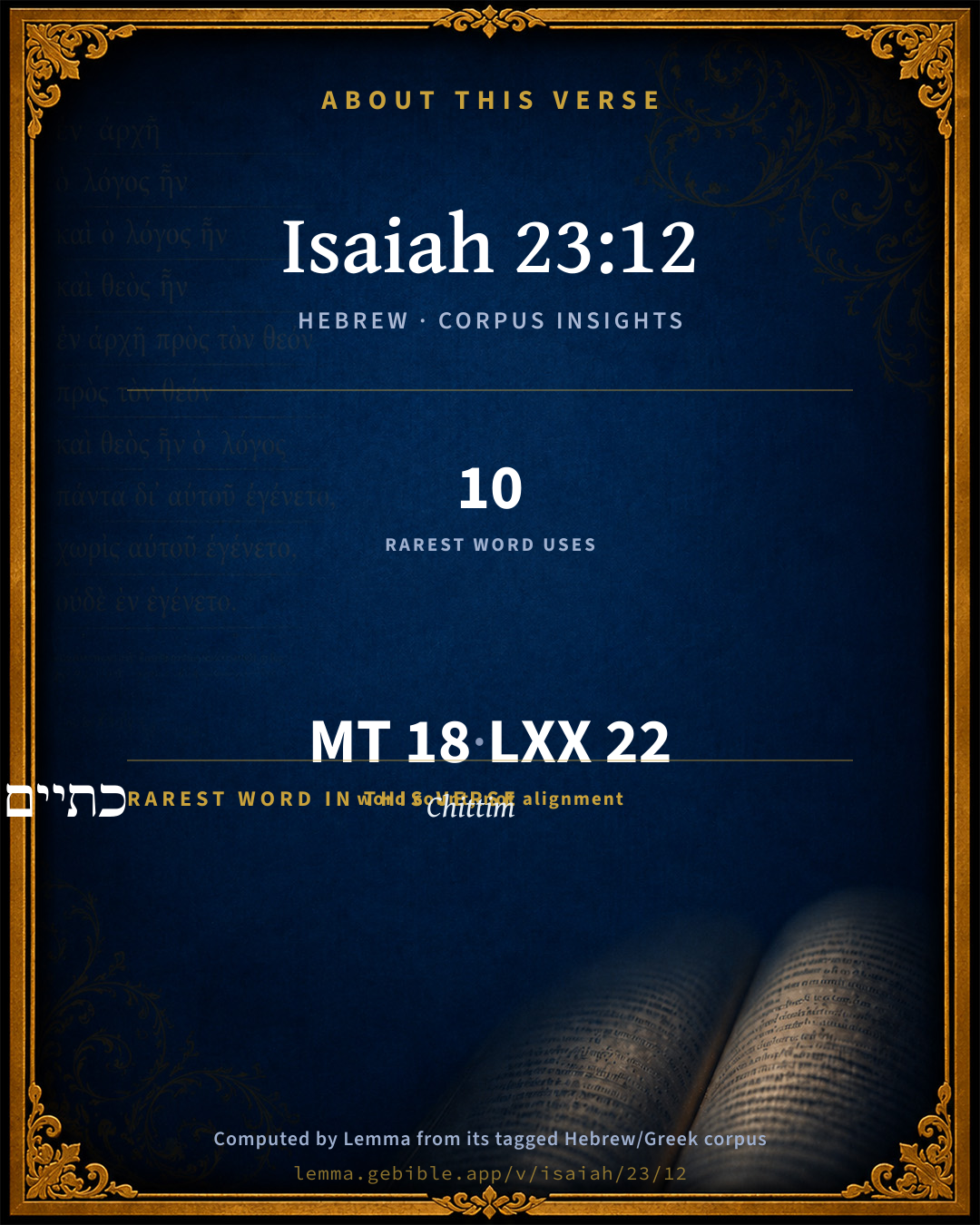
The rarest word here is כתיים Chittim H3794 — appearing just 10 times in the whole Hebrew Bible.

Shared distinctive vocabulary

כתיים Chittim H3794 occurs in 8 verses of the Hebrew Bible. Also found in:

Grammatical profile

  • 7 verbs
  • 5 nouns
  • 1 preposition
  • 2 adverbs
  • 3 particles

Verb forms

  • וַיֹּ֕אמֶר Qal · Sequential Imperfect
  • תוֹסִ֥יפִי Hiphil · Imperfect
  • לַעְל֑וֹז Qal · Infinitive Construct
  • הַֽמְעֻשָּׁקָ֞ה Pual · Participle Passive
  • ק֣וּמִי Qal · Imperative
  • עֲבֹ֔רִי Qal · Imperative
  • יָנ֥וּחַֽ Qal · Imperfect

Repetition

Words recur within this verse — often emphatic in Hebrew:

  • כתיים Chittim H3794 ×2
  • לֹֽא not H3808 ×2

Hebrew & Septuagint length

In English translation the verse runs 25 words from the Hebrew and 32 from the Septuagint (LXX English) — closely comparable.

A rough comparison of the two English renderings, which tokenize alike — not a word-level alignment.

Word counts can differ between the Hebrew and the Greek without any difference in meaning — e.g. the Hebrew direct-object marker אֵת has no separate Greek word, and Greek often adds the article ὁ.

In the original languages it is 18 Hebrew tokens and 22 Greek tokens — but the two are counted differently (Hebrew bundles its prefixes and suffixes into one token; the Greek is in lemma form), so that isn’t a like-for-like length.

Cross-references

18

Topical passages linked to Isaiah 23:12 in the Treasury of Scripture Knowledge — connected by theme and wording, ordered by reader-vote popularity; previews shown in the World English Bible.

  • Revelation 18:22 The voice of harpists, minstrels, flute players, and trumpeters will be heard no more at all in you. No craftsman, of whatever craft, will be found any more at all in you. The sound of a mill will be heard no more at all in you.
  • Isaiah 23:1–2 The burden of Tyre. Howl, you ships of Tarshish; for it is laid waste, so that there is no house, no entering in: from the land of Kittim it is revealed to them.
  • Isaiah 47:1 Come down, and sit in the dust, virgin daughter of Babylon; sit on the ground without a throne, daughter of the Chaldeans: for you shall no more be called tender and delicate.
  • Ezekiel 26:13–14 I will cause the noise of your songs to cease; and the sound of your harps shall be no more heard.
  • Genesis 10:15–19 Canaan became the father of Sidon (his firstborn), Heth,
  • Genesis 49:13 "Zebulun will dwell at the haven of the sea. He will be for a haven of ships. His border will be on Sidon.
  • Numbers 24:24 But ships [shall come] from the coast of Kittim, They shall afflict Asshur, and shall afflict Eber; He also shall come to destruction.
  • Deuteronomy 28:64–67 Yahweh will scatter you among all peoples, from the one end of the earth even to the other end of the earth; and there you shall serve other gods, which you have not known, you nor your fathers, even wood and stone.
  • Joshua 11:8 Yahweh delivered them into the hand of Israel, and they struck them, and chased them to great Sidon, and to Misrephoth Maim, and to the valley of Mizpeh eastward; and they struck them, until they left them none remaining.
  • Isaiah 23:7 Is this your joyous [city], whose antiquity is of ancient days, whose feet carried her afar off to sojourn?
  • Isaiah 37:22 this is the word which Yahweh has spoken concerning him: The virgin daughter of Zion has despised you and ridiculed you; the daughter of Jerusalem has shaken her head at you.
  • Isaiah 47:5 Sit you silent, and get you into darkness, daughter of the Chaldeans; for you shall no more be called The mistress of kingdoms.
  • Jeremiah 14:17 You shall say this word to them, Let my eyes run down with tears night and day, and let them not cease; for the virgin daughter of my people is broken with a great breach, with a very grievous wound.
  • Jeremiah 46:11 Go up into Gilead, and take balm, virgin daughter of Egypt: in vain do you use many medicines; there is no healing for you.
  • Lamentations 1:3 Judah is gone into captivity because of affliction, and because of great servitude; She dwells among the nations, she finds no rest: All her persecutors overtook her within the straits.
  • Lamentations 1:15 The Lord has set at nothing all my mighty men in the midst of me; He has called a solemn assembly against me to crush my young men: The Lord has trodden as in a winepress the virgin daughter of Judah.
  • Lamentations 4:15 Depart you, they cried to them, Unclean! depart, depart, don't touch! When they fled away and wandered, men said among the nations, They shall no more sojourn [here].
  • Ezekiel 27:6 Of the oaks of Bashan have they made your oars; they have made your benches of ivory inlaid in boxwood, from the isles of Kittim.

Cross-references courtesy of OpenBible.info (CC BY 4.0).

Hebrew and Greek witnesses Masoretic Hebrew ↔ Greek Septuagint

The same verse in the two great witnesses to the Old Testament, shown verse-for-verse.

These are two independent witnesses, not word-aligned to each other, and the Septuagint is shown in lemma (dictionary) form.

Hebrew Isaiah 23:12 Masoretic · Westminster Leningrad Codex

וַיֹּ֕אמֶר לֹֽא תוֹסִ֥יפִי ע֖וֹד לַעְל֑וֹז הַֽמְעֻשָּׁקָ֞ה בְּתוּלַ֣ת בַּת צִיד֗וֹן כתיים כִּתִּים֙ ק֣וּמִי עֲבֹ֔רִי גַּם שָׁ֖ם לֹא יָנ֥וּחַֽ לָֽךְ

He said, You shall no more rejoice, you oppressed virgin daughter of Sidon: arise, pass over to Kittim; even there shall you have no rest.

World English Bible · Public Domain

Greek LXX Isaiah 23:12 Septuagint · lemma form

καί εἶπον οὐκέτι μή προςτίθημι ὁ ὑβρίζω καί ἀδικέω ὁ θυγάτηρ σιδών καί ἐάν ἀποἔρχομαι εἰς κιτιεῖς οὐδέ ἐκεῖ σύ ἀνάπαυσις εἰμί

And men shall say, You⌃ shall no longer at all continue to insult and injure the daughter of Sidon: and if you depart to the Citians, neither there shall you have rest.

LXX2012 (modern English Septuagint) · Public Domain

Hebrew: Westminster Leningrad Codex (CC BY 4.0). Greek: Septuagint (public domain); English from LXX2012 (modern English Septuagint) (Public Domain). How the Septuagint differs from the Hebrew →

Targum (Aramaic paraphrase)

1

The Targum is the ancient Jewish Aramaic paraphrase of the Hebrew Scriptures — an interpretive translation, not the Hebrew text itself. Onkelos (literal) and Pseudo-Jonathan (expansive) render the Torah, and Jonathan the Prophets. Coverage is partial: where no permissively-licensed English translation exists for a verse, only the Aramaic is shown. This is verse-level text, not a word-by-word alignment to the Hebrew.

  1. Targum Jonathan Prophets (Joshua–Malachi)
    וַאֲמַר לָא תוֹסְפוּן עוֹד לְמִתְקַף דַהֲוֵיתוּן אָנְסִין לְעַמָא דִי בְצִידוֹן לְכִתִּים קוּמוּ גְלוֹ אַף לְתַמָן לָא יְהֵי לְכוֹן נְיָח:

    And he said, ye shall no more be strong, ye that did violence to the people which are in Zidon. Arise, pass over to Chittim; even there ye shall have no rest.

    Targum Jonathan — Aramaic: “Mikraot Gedolot” (public domain). English: “Sefaria Community Translation” (CC0 1.0 (public-domain dedication)); “London "Chaldee Paraphrase," 1871” (public domain). Text via Sefaria.

Commentary

Notes on Isaiah 23:12 from classic Christian and Jewish commentators (each source and its license shown beneath its notes). The classic Christian expositions comment on the surrounding passage and are grouped to its opening verse, so a note may address several verses; the Jewish commentaries on the Tanakh (Rashi and others) are per-verse, so they appear only where the commentator wrote on this verse.

Lemma curates 59 commentaries, every one of them public domain or Creative Commons licensed, each selected and text-cleaned for this edition rather than reprinted as found. About our sources →

Trapp's Complete Commentary

John Trapp

Isa 23:12 And he said, Thou shalt no more rejoice, O thou oppressed virgin, daughter of Zidon: arise, pass over to Chittim; there also shalt thou have no rest.

Ver. 12. Thou shalt no more rejoice.] Heb., Exult, revel.

O thou oppressed.] Or, Ravished damsel, daughter of Zidon, hactenus intacta vi hostili, never till now subdued.

Arise, pass.] Asyndeton, q.d., Haste, haste.

Over to Chittim.] To Cyprus, Greece, Italy.

There also shalt thou have no rest.] Safety or shelter. Cain’s curse was upon them; the visible vengeance of God followed them close at heels. See Deu 28:65-66.

John Trapp, A Commentary or Exposition upon All the Books of the Old and New Testament (1647–1656) — public domain. Text from a community e-Sword module.

Geneva Bible (1599)

Geneva Bible translators

For Tyre was never touched nor afflicted before.

Because Tyre was built by them of Sidon.

Geneva Bible (1599) marginal notes — public domain. Text via Bolls.life.

Jamieson, Fausset & Brown

Robert Jamieson, A. R. Fausset & David Brown

he--God.

rejoice--riotously (Isa 23:7).

oppressed--"deflowered"; laying aside the figure "taken by storm"; the Arabs compare a city never taken to an undefiled virgin (compare Nah 3:5, &c.).

daughter of Zidon--Tyre: or else, sons of Zidon, that is, the whole land and people of Phœnicia (see on Isa 23:2) [MAURER].

Chittim--Citium in Cyprus (Isa 23:1).

there also . . . no rest--Thy colonies, having been harshly treated by thee, will now repay thee in kind (see on Isa 23:10). But VITRINGA refers it to the calamities which befell the Tyrians in their settlements subsequently, namely, Sicily, Corcyra, Carthage, and Spain, all flowing from the original curse of Noah against the posterity of Canaan (Gen 9:25-27).

Jamieson, Fausset & Brown — Commentary Critical and Explanatory on the Whole Bible (1871) — public domain (CC PDM 1.0). Text via the HelloAO Bible API.

Ellicott's Commentary for English Readers

(12) Thou oppressed virgin.—Strictly speaking, the noun and adjective are incompatible, the latter conveying the sense of “defiled,” or “deflowered.” Till now Tyre had known no defeat. Her fortress was a virgin citadel. Now the barbarian conqueror was to rob her of that virginity.

Pass over to Chittim.—With a keen irony the prophet gives a counsel which he declares will be of no avail. They may flee to Chittim (Cyprus); but the power of the Assyrians would reach them even there. Once and again the inscriptions of the Assyrian kings record how they subdued and took tribute from “Yatnan,” the “island in the sea of the setting sun,” which can be none other than Cyprus (e.g., Sargon in Records of the Past, vii. 26).

A Bible Commentary for English Readers, edited by Charles John Ellicott (1878–1897) — public domain. Text from a community e-Sword module.

The Cambridge Bible for Schools and Colleges

gen. ed. J. J. S. Perowne

12. And he said] What follows may be regarded as the “commandment” referred to in Isa_23:11.

O thou oppressed (or ravished) virgin, daughter of Zidon] The epithet “virgin” is applied to Zidon as a fortress hitherto unviolated by a conqueror. It is an almost inevitable inference that the calamity here described is the first she has known, at least within living memory. This would apply to the campaign of Shalmaneser, but not to that of Sennacherib.

The Cambridge Bible for Schools and Colleges (gen. ed. J. J. S. Perowne; Cambridge University Press, 1878–1918) — public domain. Text from a community e-Sword module.

John Gill's Exposition

And he said, thou shalt no more rejoice,.... Not meaning that she should never more rejoice, but not for a long time, as Kimchi interprets it; when her calamity should come upon her, her jovial time, her time of mirth, jollity, and revelling, would be over for a time; for, at the end of seventy years, she should take her harp, and sing again, Isa 23:15 for the words seem to be spoken of Tyre, concerning whom the whole prophecy is; though some think Zidon is here meant, which, being near, suffered at the same time with Tyre, or quickly after:

O thou oppressed virgin! Tyre is called a "virgin", because of her beauty, pride, and lasciviousness, and because never before subdued and taken: and "oppressed", because now deflowered, ransacked, plundered, and ruined, by Nebuchadnezzar:

daughter of Zidon: some think Zidon itself is meant, just as daughter of Zion means Zion herself, &c.; but it may be also observed, that such cities that have sprung from others, or have their dependence on them, are called their daughters; so we read of Samaria and her daughters, and Sodom and her daughters, Eze 16:46 and so Tyre is called the daughter of Zidon, because it was a colony of the Zidonians (f); and at first built and supported by them, though now grown greater than its mother:

arise, pass over to Chittim; to the isle of Cyprus, which was near them, and in which was a city called Citium; or to Macedonia, which was called the land of Chittim, as in the Apocrypha:

"And it happened, after that Alexander son of Philip, the Macedonian, who came out of the land of Chettiim, had smitten Darius king of the Persians and Medes, that he reigned in his stead, the first over Greece,'' (1 Maccabees 1:1)

or to the isles of the Aegean and Ionian seas; or to Greece and Italy; which latter sense is approved by Vitringa, who thinks the islands of Corsica, and Sardinia, and Sicily, are meant, which were colonies of the Tyrians; and so in Isa 23:1,

there also shalt thou have no rest; since those countries would also fall into the enemy's hands, either the Babylonians, or the Medes and Persians, or the Romans; into whose hands Macedonia, Carthage, and other colonies of the Tyrians fell, so that they had no rest in any of them.

(f) Justin ex Trogo, l. 18. c. 3.

John Gill's Exposition of the Whole Bible (1746–1763) — public domain (CC PDM 1.0). Text via the HelloAO Bible API.

Albert Barnes' Notes on the Bible

And he said - God said Isa 23:9.

Thou shalt no more rejoice - The sense is, that Tyre was soon to be destroyed. It does not mean that it should never afterward exult or rejoice, for the prophet says Isa 23:17, that after its destruction it would be restored, and again be filled with exultation and joy.

O thou oppressed Virgin - Lowth renders this, ‘O thou deflowered virgin,’ expressing the sense of the word המעשׁקה hame‛ushâqâh.

O daughter of Zidon - Isa 23:4. “Pass over to Chittim” (see the note at Isa 23:1). The idea is, that under the siege the inhabitants of Tyre would seek refuge in her colonies, and the cities that were dependent on her.

There also shalt thou have no rest - It is not improbable that Nebuchadnezzar would carry his arms to Cyprus - on which the city of Citium was - where the Tyrians would take refuge first. Megasthenes, who lived about 300 years before Christ, says of Nebuchadnezzar that he subdued a great part of Africa and Spain, and that he carried his arms so far as the Pillars of Hercules (see Newton, On the Prophecies, xi. 11). But whether this refers to the oppressions which Nebuchadnezzar would bring on them or not, it is certain that the colonies that sprung from Phenicia were exposed to constant wars after this. Carthage was a colony of Tyre, and it is well known that this city was engaged in hostility with the Romans until it was utterly destroyed. Indeed all the dependent colonies of ancient Tyre became interested and involved in the agitations and commotions which were connected with the conquests of the Roman empire.

Albert Barnes' Notes on the Bible (1834–1885) — public domain. Text from a community e-Sword/MySword module.

Haydock's Catholic Bible Commentary

Daughter; colony. (Calmet) --- Oppressed. Literally, "calumniated." (Haydock)

George Leo Haydock (1774–1849), Haydock's Catholic Family Bible and Commentary, 1859 edition — public domain. Excludes Psalms (Douay-Rheims chapter numbering differs from Protestant) and Deuterocanonical books (Catholic canon only).

Matthew Poole's English Annotations

O thou oppressed virgin: so he calls her, either for her pride and beauty, and living in great ease and pleasure; or because she had hitherto never borne the yoke of a conquering enemy; though withal he declares that she should be oppressed or defloured very suddenly.

Daughter of Zidon; whereby he understands either,

1. Zidon herself, who suffered in and with Tyre: for so this phrase seems generally to be used,

the daughter of Zion, or of Jerusalem, or of Babel, or Egypt, &c., being nothing else but Zion, Jerusalem, Babel, Egypt, &c. Or rather,

2. Tyrus, as most interpreters, both Jewish and Christian, understand it, of whom this whole context and prophecy speaks; which may well be called the daughter of Zidon, because she was first built and possessed by a colony of the Sidonians; as Pliny calleth Carthage the daughter of Tyre, because she was built by a colony of Tyrians. And the title of daughter is ofttimes given in Scripture to towns or cities which had their being from or dependence upon other cities; in which sense we read of the daughter of Heshbon, Num 21:25, and of Rubbah, Jer 49:2,3, and of Sodom, and of Samaria, Eze 16:46,49,53. And the daughter of Tarshish here above, Isa 23:10, is not meant of Tarshish itself, but of Tyrus, which had a relation to and dependence upon Tarshish.

Pass over to Chittim; of which place See Poole "Isa 23:1". There also shalt thou have no rest; thither thine enemies shall pursue thee, and there shall they overtake thee, although thou wilt think thyself secure when thou art fled to remote parts beyond the sea.

Matthew Poole's English Annotations on the Holy Bible (1683–1685) — public domain. Text from a community e-Sword/MySword module.

Whedon's Commentary on the Bible

Daniel D. Whedon

12. He said — Jehovah said, as in Isa_23:9.

No more rejoice — Because doomed to be crippled; yes, nearly destroyed.

Daughter of Zidon — Zidon was the older city, hence addressed as the mother city.

To Chittim — To Tyrian colonies in Cyprus. Yet even there they would find no rest, because too near and too accessible to the conquering power.

Daniel D. Whedon (gen. ed.), Commentary on the Old and New Testaments (1874–1909) — public domain. Text from a community e-Sword module.

The Pulpit Commentary

He said. Jehovah continues his threatenings. The oppressed virgin, daughter of Sidon or rather, the oppressed virgin-daughter of Sidon may he either. Tyre, which, according to some, was built by fugitives from Zidon, or Phoenicia generally, of which Zidon, as the "firstborn", (Gen_10:15) was a sort of mother. Pass over to Chittim (comp. ver. 6). Chittim (Cyprus) was a nearer refuge than Tarshish, and far more easily reached; but, on the other hand, it was much less safe. Sargon and Esarhaddon both of them exercised dominion over it; and when Abdi-Milkut, King of Sidon, fled there in the reign of the latter, the Assyrian monarch pursued him, caught him, and "cut off his head" (G. Smith, "Eponym Canon," p. 137). Still, it was so often sought by princes flying from Phoenicia when attacked by Assyria, that cuneiform scholars call it "the usual refuge of the Phoenician kings" ("Transactions of Bibl. Archaeology Society," vol. 4. p. 86). There also shalt thou have no rest. Cyprus submitted to Sargon ("Records of the Past," vol. 7. p. 26), and again to Esarhaddon (ibid., vol. 8. p. 108). It was included in the dominions of Asshur-bani-pal (G. Smith, "History of Asshur-bani-pal," pp. 31, 32). After Nebuchadnezzar"s conquest of Tyre, it was annexed by Egypt (Herod., 2:182), on the conquest of which country by Cambyses it became Persian. The Phoenicians had "no rest" there after Assyria had once found her way to the island.

No escape from God"s judgments.

"There also shalt thou have no rest." Either the colonists would not receive them, or their enemies would still pursue after them, seeking them out even where they had found shelter. Reference is intended to those calamities which befell the Tyrians in their subsequent settlements Cyprus, Sicily, Carthage, and Spain. Cheyne illustrates the expression by showing that "the long arm of Assyria reached them even in Cyprus, where Lull, King of Zidon, had already sought refuge." The importance of Cyprus as a naval station was recognized by the Babylonians fifteen or sixteen centuries before Christ. The inscription of Sargon, King of Agane, relates how "the sea of the setting sun he crossed," and in the third year conquered a land which can hardly be any other than Cyprus. Cyprus was also conquered by the Assyrian Sargon. God"s judgments never exhaust themselves in acts which fail to accomplish the desired ends of humbling men"s pride and correcting men"s faults. They go on until their purpose is reached. The point to be illustrated here is that God"s judgments cannot be escaped by any fleeing from the place where God"s judgments are resting. The judgment was on the Tyrians, and it affected Tyre only for their sakes. So to escape from Tyre could not result in getting away from the afflicting and humbling hand of God. This may be efficiently illustrated from the story of Jonah, who hurried from the upland districts of Palestine to take ship at Joppa, flee across the great sea, and get away from the presence of the Lord. He could not. God holdeth "the winds in his fists, and the waters in the hollow of his hand," and can send these to execute his judgments. And still it is a fixed idea of men, out of which they need to be driven, that they can get free of their disabilities, and of Divine judgment as correction of sin, by changing their circumstances, or going from one place to another. Never. God deals with theft, and only in a secondary sense with their circumstances. As long as we sin we come into the Divine judgment. If we suffer, and yet the evil is not cured, the Divine judgments must continue. "For all this his anger is not turned away, but his hand is stretched out still." And sometimes the freedom we have sought by changing our place is changed to an even more humiliating form of chastisement, as the Tyrians endured worse things in their escape than if they had remained at home. However we flee from troubles, we can never flee from ourselves, and never rice from God. R.T.

The Pulpit Commentary (1880–1919), ed. H.D.M. Spence-Jones & Joseph S. Exell — public domain. Text from a community e-Sword module.

John Wesley's Explanatory Notes

Virgin - So he calls her, because she had hitherto never born the yoke of a conquering enemy. Zidon - Tyre may be called the daughter of Zidon, because she was first built and possessed by a colony of the Zidonians. No rest - Thither thine enemies shall pursue thee, and there shall they overtake the.

John Wesley, Explanatory Notes Upon the Whole Bible (1754–1765) — public domain. Text via the GEBible commentary corpus.

J. A. Alexander on Isaiah

Joseph Addison Alexander

“And he said, Thou shalt not add longer (or continue) to triumph, oppressed (or violated) virgin daughter of Zidon; to Chittim arise, pass over; there also there shall be no rest to thee.” The address is not to Chittim, nor to Tyre as a daughter of the older city, but to Zidon itself. Zidon is here put for Phoenicia in general. This exhortation corresponds exactly to the one in v. 6, Tarshish and Chittim being both Phoenician colonies. The last clause implies, either that the colonists would not receive them, or that the enemy would still pursue them, probably the latter.

Joseph Addison Alexander, The Prophecies of Isaiah (1846–1847; New York: Scribner, 1870–1878) — public domain. Text from a community e-Sword module.

Rashi

Rabbi Shlomo Yitzchaki (Rashi)

to Kittim to the land of Kittim, arise and cross; even there you shall have no rest. Why do I say, “Arise and cross over?” ([According to our reading, that of the printed editions, we find no answer to this question. According to some manuscripts, however, the reading is as follows:] to Kittim to the land of Kittim, arise and cross, even there you shall have no rest. Why? Behold the land of the Chaldees They shall exile you from there.

Rashi on the Tanakh — English translations: “The Judaica Press complete Tanach with Rashi, translated by A. J. Rosenberg” (CC BY 4.0); “Pentateuch with Rashi's commentary by M. Rosenbaum and A.M. Silbermann, 1929-1934” (public domain); “The Metsudah Tanach series, Lakewood, N.J” (CC BY 4.0); and “The Book of Joshua, Metsudah Publications, 1997” (CC BY 4.0). Text via Sefaria.

Ibn Ezra

Rabbi Abraham ibn Ezra

And He said. And God said.

המעשקה O robbed city. The wealth of her merchants in Tyre will be taken away.

Pass over to Chittim. To trade there.

Ibn Ezra on the Tanakh — English translations: “Sefaria Community Translation” (CC0 1.0 (public-domain dedication)); “Yalkut, Sifsei Chachomim Chumash, Metsudah Publications, 2009” (CC BY 4.0); and “Commentary of Ibn Ezra on Isaiah - trans. by M. Friedlander, 1873” (public domain). Text via Sefaria.

Lesson kit

Teaching starters — assembled from the data on this page, not authored interpretation. Every prompt links to the verse data it draws on. Edit before teaching.

Isaiah, in the Prophets, opens this verse with 18 words (15 distinct Hebrew lemmas). Its most distinctive word is Kittîy (“Chittim”). A historical commentator’s framing appears above. Read the whole chapter for the surrounding context.

Discussion questions

  1. The word Kittîy carries the sense “Chittim.” How does it shape the verse?
  2. How does Genesis 10:4, which shares the word «Chittim», read alongside this verse?
  3. What does the repetition of “Chittim” (2× in this one verse) do in this verse?
  4. These translations render this verse differently; the difference is in the English rendering, not the original. What questions does that raise?
  5. «וַיֹּ֕אמֶר» is a Qal Sequential Imperfect verb. How does that grammatical form shape the action described?
  6. Compare how Trapp's Complete Commentary and Geneva Bible (1599) read this verse. Where do they agree or differ?

Things to notice

Reading settings

Reading text

Shown beneath each verse's original-language words.

Old Testament
Old Testament edition

Read the OT as the Masoretic Hebrew (MT) or the Greek Septuagint (LXX).

English shown for the Greek Septuagint (in the Hebrew ↔ Greek comparison).

Comparing translations? Open the Compare panel on any verse page to stack up to four side by side.