Judges 9:37

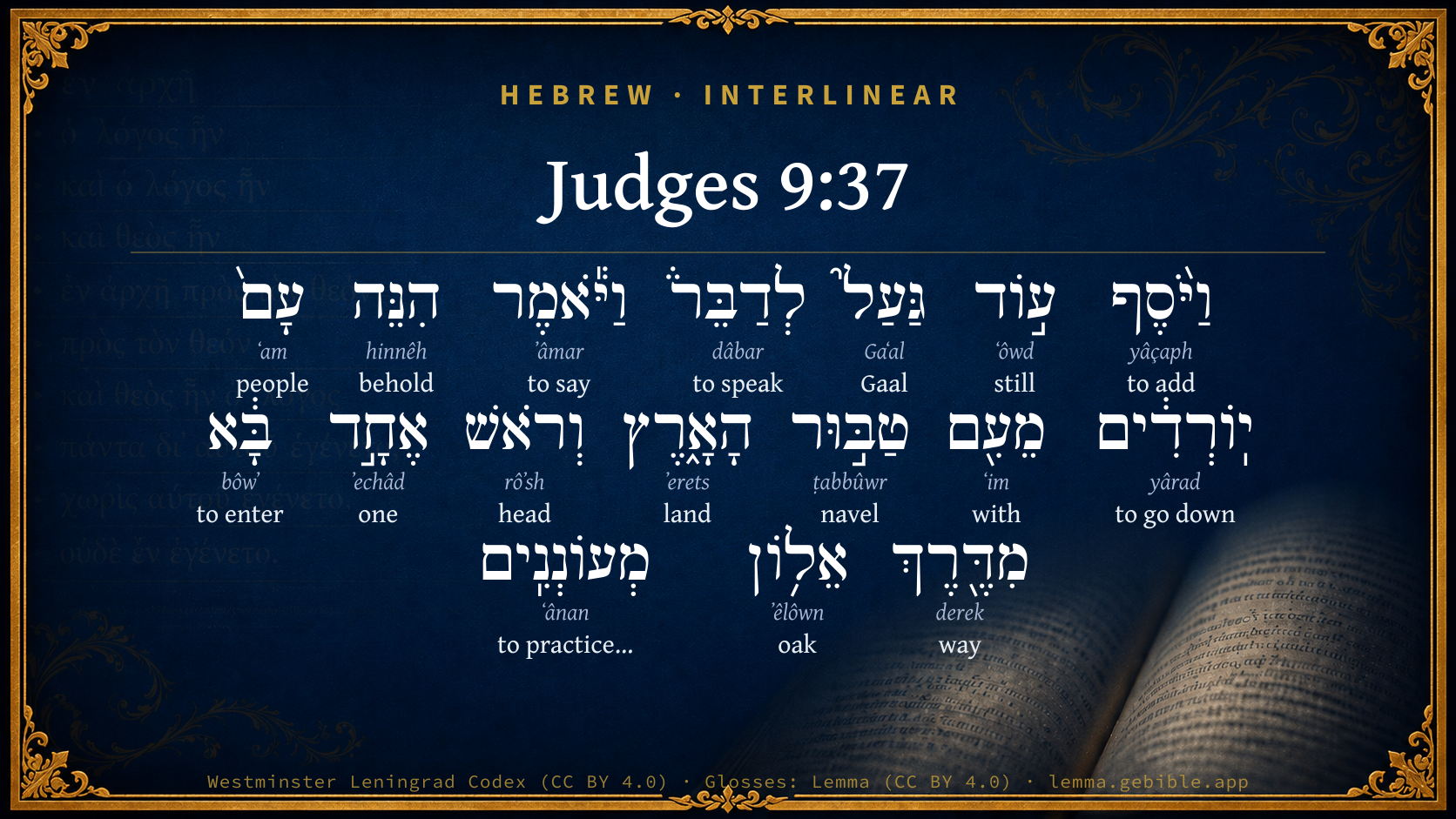
Hebrew (Westminster Leningrad Codex) Judges 9:37 appears in the Hebrew Old Testament. The text above is from the Westminster Leningrad Codex. Each word links to its Strong’s number, a concise gloss, and parsing drawn from the Open Scriptures Hebrew Bible morphology. Click any word for its full Brown-Driver-Briggs (BDB) entry.
Download image
Cite this verse

Judges 9:37 (World English Bible). Public Domain. Lemma interlinear Bible study tool, https://lemma.gebible.app/v/judges/9/37.

Show BibTeX & RIS
BibTeX
RIS
English Translation
Gaal spoke again and said, Behold, there come people down by the middle of the land, and one company comes by the way of the oak of Meonenim.
World English Bible · Public Domain
Highlights
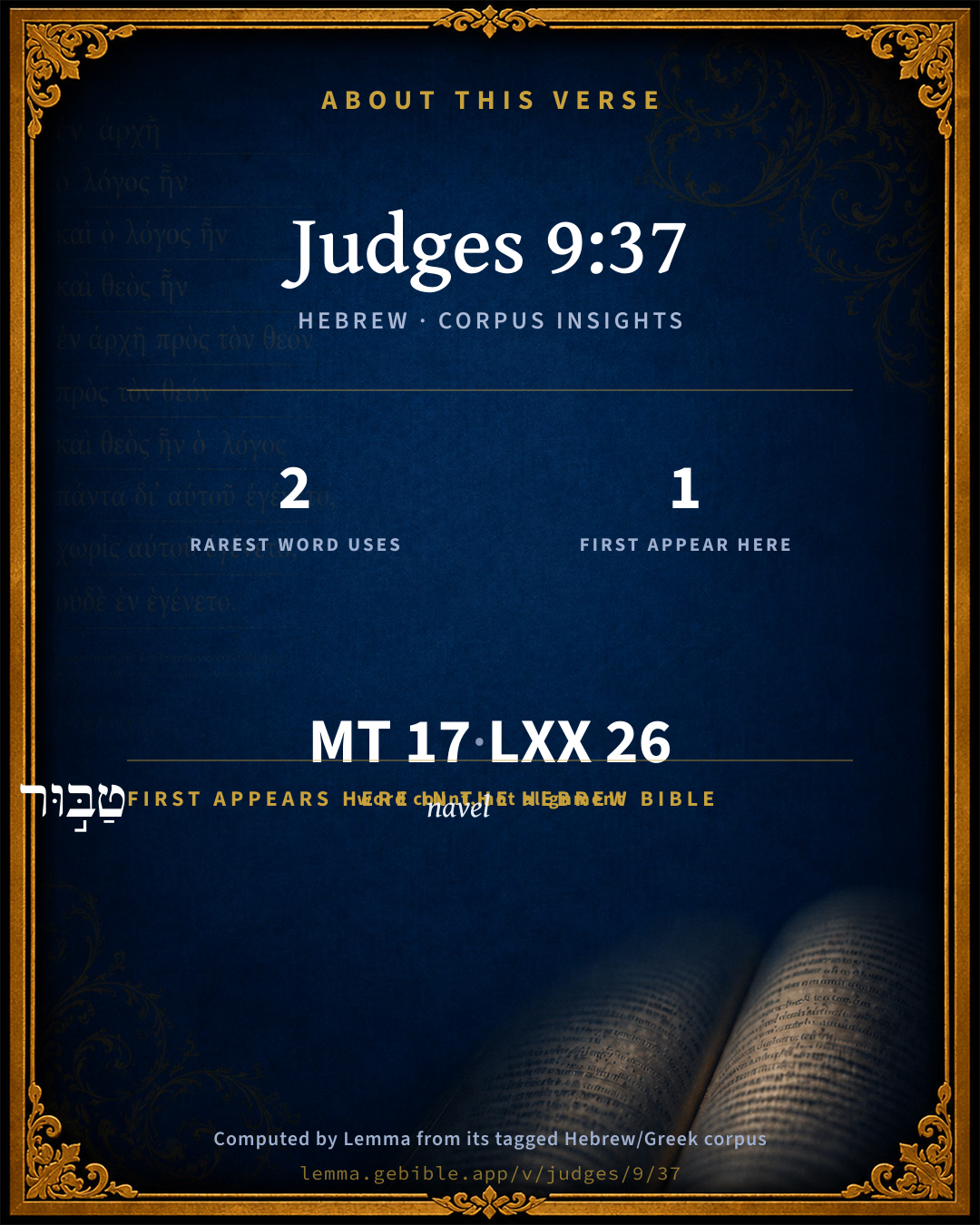
  • 1 first appearance in the Hebrew Bible
Full analysis ↓
Download a study sheet

One document with this verse’s original text, its word-by-word gloss line, the meaning frame, cross-references with their text, attributed commentary, and full source and license credits — printable, and it pastes into notes with its structure intact.

This verse Autodidact and up

Study sheet (.html) Plain text (.txt)

A passage Seminary Student

Up to 50 verses in one chapter. A passage sheet keeps up to 6 commentary sources and 12 cross-references per verse, in the order this page ranks them, and says so on the sheet whenever that leaves anything out. Ask for a single verse and you get the Autodidact verse sheet above.

Everything on this page stays free to read, with no account — the sheet is a download of what is already on screen, not access to it.

Want to remove ads? Support Godless Engineer
Compare translations 3

The same verse in 3 English versions, stacked beneath the original-language interlinear above. Click any original word for its lexicon entry.

Each is an independent rendering of the whole verse — the interlinear is not word-aligned to these translations.

Highlighted words mark where these versions differ — a whole-verse word diff, not a word-by-word alignment.

  • World English Bible Public Domain
    Gaal spoke again and said, Behold, there come people down by the middle of the land, and one company comes by the way of the oak of Meonenim.
  • King James Version Public Domain
    And Gaal spake again, and said, See there come people down by the middle of the land, and another company come along by the plain of Meonenim.
  • unfoldingWord Literal Text CC BY-SA 4.0
    And Gaal resumed to speak more and he said, “Behold, people coming down from the navel of the land, and one company coming along the way of the Oak of the Diviners.”

unfoldingWord Literal Text — © unfoldingWord, licensed CC BY-SA 4.0. Word-aligned USFM3 via Door43 (git.door43.org/unfoldingWord/en_ult).

Versions to compare (up to 4)

3 of 4 selected

Show all 18 translations

Every available English version of this verse, each an independent rendering of the whole verse.

  • World English Bible Public Domain
    Gaal spoke again and said, Behold, there come people down by the middle of the land, and one company comes by the way of the oak of Meonenim.
  • Berean Standard Bible Public Domain
    Then Gaal spoke up again, “Look, people are coming down from the center of the land, and one company is coming by way of the Diviners’ Oak.”
  • Majority Standard Bible Public Domain
    Then Gaal spoke up again, “Look, people are coming down from the center of the land, and one company is coming by way of the Diviners’ Oak.”
  • King James Version Public Domain
    And Gaal spake again, and said, See there come people down by the middle of the land, and another company come along by the plain of Meonenim.
  • American Standard Version (1901) Public Domain
    And Gaal spake again and said, See, there come people down by the middle of the land, and one company cometh by the way of the oak of Meonenim.
  • Revised Version (1885) Public Domain
    And Gaal spake again and said, See, there come people down by the middle of the land, and one company cometh by the way of the oak of Meonenim.
  • Geneva Bible (1599) Public Domain
    And Gaal spake againe, and said, See, there come folke downe by the middle of the land, and another bande commeth by the way of the plaine of Meonenim.
  • Douay-Rheims (1899) Public Domain
    Again Gaal said: Behold there cometh people down from the middle of the land, and one troop cometh by the way that looketh towards the oak.
  • Young's Literal Translation Public Domain
    And Gaal addeth yet to speak, and saith, `Lo, people are coming down from the high part of the land, and another detachment is coming by the way of the oak of Meonenim.'
  • Literal Standard Version CC BY-SA 4.0
    And Gaal adds yet to speak and says, “Behold, people are coming down from the high part of the land, and another detachment is coming by the way of the oak of Meonenim.”
  • Unlocked Literal Bible CC BY-SA 4.0
    Gaal spoke again and said, “Look, men are coming down in the middle of the land, and one unit is coming by way of the oak of the diviners.”
  • unfoldingWord Literal Text CC BY-SA 4.0
    And Gaal resumed to speak more and he said, “Behold, people coming down from the navel of the land, and one company coming along the way of the Oak of the Diviners.”
  • Darby Bible Public Domain
    Ga'al spoke again and said, "Look, men are coming down from the center of the land, and one company is coming from the direction of the Diviners' Oak."
  • World Messianic Bible Public Domain
    Gaal spoke again and said, “Behold, people are coming down by the middle of the land, and one company comes by the way of the oak of Meonenim.”
  • Webster's Bible Public Domain
    And Gaal spoke again, and said, See, there come people down by the middle of the land, and another company come along by the plain of Meonenim.
  • Free Bible Version CC BY-SA 4.0
    “No really, people are coming down from the high ground,” Gaal repeated. “Plus, there's another company coming down the road that passes the diviners' oak tree.”
  • Bible in Basic English Public Domain
    And Gaal said again, See! people are coming down from the middle of the land, and one band is coming by way of the oak-tree of the Seers.
  • JPS Tanakh (1917) Public Domain
    And Gaal spoke again and said: 'See, there come people down by the middle of the land, and one company cometh by the way of Elon-meonenim.'

Literal Standard Version (2020), Covenant Press — licensed CC BY-SA 4.0. Text via the HelloAO Bible API (eBible.org). Unlocked Literal Bible (unfoldingWord) — licensed CC BY-SA 4.0. Text via the HelloAO Bible API (eBible.org). unfoldingWord Literal Text — © unfoldingWord, licensed CC BY-SA 4.0. Word-aligned USFM3 via Door43 (git.door43.org/unfoldingWord/en_ult). Free Bible Version, Dr. Jonathan Gallagher — licensed CC BY-SA 4.0. Text via the HelloAO Bible API (eBible.org).

Word by word

More ways to search: Search by grammar → Find every occurrence → Compare this word →

Practice this passage: Drill this verse → Learn its vocabulary →

טַבּ֣וּר
ṭabbûwr
H2872
“navel of”
Noun, Common, Masculine, Singular, Construct
Part of Speech
Noun
Type
Common
Gender
Masculine
Number
Singular
State
Construct
Full BDB Definition

Origin: from an unused root meaning to pile up; properly, accumulated

TWOT: 790a

centre, midst, navel, highest part
  1. וַיֹּ֨סֶף yâçaph H3254 “and · to add” Conjunction + Verb, Hiphil, Sequential Imperfect, 3rd Person, Masculine, Singular
  2. ע֣וֹד ʻôwd H5750 “still” Adverb
  3. גַּעַל֮ Gaʻal H1603 “Gaal” Noun, Proper
  4. לְדַבֵּר֒ dâbar H1696 “to speak” Preposition + Verb, Piel, Infinitive Construct
  5. וַיֹּ֕אמֶר ʼâmar H559 “and · to say” Conjunction + Verb, Qal, Sequential Imperfect, 3rd Person, Masculine, Singular
  6. הִנֵּה hinnêh H2009 “behold” Particle, Demonstrative
  7. עָם֙ ʻam H5971 “people” Noun, Common, Masculine, Singular, Absolute
  8. יֽוֹרְדִ֔ים yârad H3381 “going down” Verb, Qal, Participle Active, Masculine, Plural, Absolute
  9. מֵעִ֖ם ʻim H5973 “from · with” Preposition + Preposition
  10. הָאָ֑רֶץ ʼerets H776 “the · land” Particle, Definite Article + Noun, Common, Both, Singular, Absolute
  11. וְרֹאשׁ rôʼsh H7218 “and · head” Conjunction + Noun, Common, Masculine, Singular, Absolute
  12. אֶחָ֣ד ʼechâd H259 “one” Adjective, Cardinal number, Masculine, Singular, Absolute
  13. בָּ֔א bôwʼ H935 “entering” Verb, Qal, Participle Active, Masculine, Singular, Absolute
  14. מִדֶּ֖רֶךְ derek H1870 “from · way of” Preposition + Noun, Common, Both, Singular, Construct
  15. אֵל֥וֹן ʼêlôwn H436 “oak of” Noun, Common, Masculine, Singular, Construct
  16. מְעוֹנְנִֽים ʻânan H6049 “practicing sorcery” Verb, Poel, Participle Active, Masculine, Plural, Absolute

About this verse

These counts appear in no published source. They are computed here, from the morphology-tagged text and Lemma’s own curated glosses. What Lemma adds →

17
words
17
distinct lemmas
Historical
section

Notable vocabulary

The rarest word here is טַבּ֣וּר navel H2872 — appearing just 2 times in the whole Hebrew Bible.

First appearance in Scripture

This word makes its first canonical appearance in the Hebrew Bible here:

  • טַבּ֣וּר navel H2872

Shared distinctive vocabulary

טַבּ֣וּר navel H2872 occurs in 2 verses of the Hebrew Bible. Also found in:

Grammatical profile

  • 6 verbs
  • 7 nouns
  • 1 adjective
  • 1 preposition
  • 1 adverb
  • 1 particle

Verb forms

  • וַיֹּ֨סֶף Hiphil · Sequential Imperfect
  • לְדַבֵּר֒ Piel · Infinitive Construct
  • וַיֹּ֕אמֶר Qal · Sequential Imperfect
  • יֽוֹרְדִ֔ים Qal · Participle Active
  • בָּ֔א Qal · Participle Active
  • מְעוֹנְנִֽים Poel · Participle Active

Hebrew & Septuagint length

In English translation the verse runs 28 words from the Hebrew and 33 from the Septuagint (LXX English) — closely comparable.

A rough comparison of the two English renderings, which tokenize alike — not a word-level alignment.

Word counts can differ between the Hebrew and the Greek without any difference in meaning — e.g. the Hebrew direct-object marker אֵת has no separate Greek word, and Greek often adds the article ὁ.

In the original languages it is 17 Hebrew tokens and 26 Greek tokens — but the two are counted differently (Hebrew bundles its prefixes and suffixes into one token; the Greek is in lemma form), so that isn’t a like-for-like length.

Cross-references

1

Topical passages linked to Judges 9:37 in the Treasury of Scripture Knowledge — connected by theme and wording, ordered by reader-vote popularity; previews shown in the World English Bible.

  • Deuteronomy 18:14 For these nations, that you shall dispossess, listen to those who practice sorcery, and to diviners; but as for you, Yahweh your God has not allowed you so to do.

Cross-references courtesy of OpenBible.info (CC BY 4.0).

Hebrew and Greek witnesses Masoretic Hebrew ↔ Greek Septuagint

The same verse in the two great witnesses to the Old Testament, shown verse-for-verse.

These are two independent witnesses, not word-aligned to each other, and the Septuagint is shown in lemma (dictionary) form.

Hebrew Judges 9:37 Masoretic · Westminster Leningrad Codex

וַיֹּ֨סֶף ע֣וֹד גַּעַל֮ לְדַבֵּר֒ וַיֹּ֕אמֶר הִנֵּה עָם֙ יֽוֹרְדִ֔ים מֵעִ֖ם טַבּ֣וּר הָאָ֑רֶץ וְרֹאשׁ אֶחָ֣ד בָּ֔א מִדֶּ֖רֶךְ אֵל֥וֹן מְעוֹנְנִֽים

Gaal spoke again and said, Behold, there come people down by the middle of the land, and one company comes by the way of the oak of Meonenim.

World English Bible · Public Domain

Greek LXX Judges 9:37 Septuagint · lemma form

καί προςτίθημι ἔτι γααλ ὁ λαλέω καί εἶπον ἰδού λαός καταβαίνω κατά θάλασσα ἀπό ὁ ἔχω ὀμφαλός ὁ γῆ καί ἀρχή ἕτερος ἔρχομαι διά ὁδός ηλωνμαωνενιμ

And Gaal continued to speak and said, Behold, a people comes down westward from the part bordering on the middle of the land, and another company comes by the way of Helon Maonenim.

LXX2012 (modern English Septuagint) · Public Domain

On this verse, Ellicott's Commentary for English Readers discusses the Septuagint’s reading. Read the note in Commentary ↓

Hebrew: Westminster Leningrad Codex (CC BY 4.0). Greek: Septuagint (public domain); English from LXX2012 (modern English Septuagint) (Public Domain). How the Septuagint differs from the Hebrew →

Targum (Aramaic paraphrase)

1

The Targum is the ancient Jewish Aramaic paraphrase of the Hebrew Scriptures — an interpretive translation, not the Hebrew text itself. Onkelos (literal) and Pseudo-Jonathan (expansive) render the Torah, and Jonathan the Prophets. Coverage is partial: where no permissively-licensed English translation exists for a verse, only the Aramaic is shown. This is verse-level text, not a word-by-word alignment to the Hebrew.

  1. Targum Jonathan Prophets (Joshua–Malachi)
    וְאוֹסֵף עוֹד גַעַל לְמַלָלָא וַאֲמַר הָא עַמָא נָחְתִין מִן תּוּקְפָא דְאַרְעָא וּמַשְׁרִיתָא חֲדָא אַתְיָא מֵאוֹרַח מֵישַׁר מְעוֹנְנַיָא:

    (no public-domain English translation for this verse)

    Targum Jonathan — Aramaic: “Mikraot Gedolot” (public domain). English: “Sefaria Community Translation” (CC0 1.0 (public-domain dedication)); “London "Chaldee Paraphrase," 1871” (public domain). Text via Sefaria.

Commentary

Notes on Judges 9:37 from classic Christian and Jewish commentators (each source and its license shown beneath its notes). The classic Christian expositions comment on the surrounding passage and are grouped to its opening verse, so a note may address several verses; the Jewish commentaries on the Tanakh (Rashi and others) are per-verse, so they appear only where the commentator wrote on this verse.

Lemma curates 59 commentaries, every one of them public domain or Creative Commons licensed, each selected and text-cleaned for this edition rather than reprinted as found. About our sources →

Trapp's Complete Commentary

John Trapp

Jdg 9:37 And Gaal spake again and said, See there come people down by the middle of the land, and another company come along by the plain of Meonenim.

Ver. 37. By the plain of Meonenim.] Or, Of the soothsayers. It may be rendered, By the oak of the oraculous diviners. The oak was consecrated to Jupiter: and of the Dodonaean oak much is spoken by the poets: but what meant such places or such doings among the people of Israel, who were flatly forbidden them? {Deu 18:9-14}

John Trapp, A Commentary or Exposition upon All the Books of the Old and New Testament (1647–1656) — public domain. Text from a community e-Sword module.

Geneva Bible (1599)

Geneva Bible translators

Or, charmers.

Hebrew, by the navel.

Geneva Bible (1599) marginal notes — public domain. Text via Bolls.life.

Adam Clarke's Commentary

Verse 37. By the plain of Meonenim.] Some translate, by the way of the oaks, or oaken groves; others, by the way of the magicians, or regarders of the times, as in our margin. Probably it was a place in which augurs and soothsayers dwelt.

Adam Clarke's Commentary on the Bible (1810–1826) — public domain. Text from a community e-Sword/MySword module.

Ellicott's Commentary for English Readers

(37) By the middle of the land.—Literally, by the navel of the land. Probably the expression means some gently-swelling hill, but it perplexed the translators. The Chaldee renders it “the strength,” and the Svriac “the fortification of the land.” In Eze_38:12 it is rendered “in the midst of the land.” The LXX. here have the strangely blundering addition, “by sea.”

Another company.—Literally, one head (Vulg., cuneus unus).

By the plain of Meonenim.—Rather, from the way to the Enchanters’ Terebinth (LXX., “of the oak of those that look away;” Vulg., “which looks toward the oak;” Luther, more correctly, “zur Zaubereiche”). Meonen in Lev_19:28 is rendered “enchantment,” and means especially the kind of “enchantment” which affects the eye (the “evil eye,” &c.), and therefore implies the use of amulets, &c. Hence, though the terebinth is nowhere else mentioned by this particular name, it is at least a probable conjecture that it may be the ancient tree under which Jacob’s family had buried their idolatrous amulets (Gen_35:4).

A Bible Commentary for English Readers, edited by Charles John Ellicott (1878–1897) — public domain. Text from a community e-Sword module.

The Cambridge Bible for Schools and Colleges

gen. ed. J. J. S. Perowne

37. the middle of the land] the Navel of the land; this is the traditional meaning of the word, Talm., LXX ὀμφαλός, Vulgate umbilicus. The word only occurs again in Eze_38:12 of the mountains of Israel, apparently as central and prominent in the earth. Some hill near Shechem was called the Navel, perhaps because it was supposed to be midway between the sea and the Jordan (cf. the navel of Italy, Sicily, Greece, in Latin authors).

the oak of Meonenim] the augurs’ terebinth (marg.), the seat of a Canaanite tree-oracle, administered by priests here called augurs or soothsayers, cf. Deu_18:10, Mic_5:12; the omens were taken, it seems, from the rustling leaves or waving boughs (2Sa_5:24), or by the “ordinary processes of divination performed in the presence of the sacred object” (R. Smith, Rel. of Sem., p. 178). The allusions to a sacred terebinth at or near Shechem (Jdg_9:6, Gen_12:6; Gen_35:4, Deu_11:30, Jos_24:26) need not all refer to the same tree. See further on Jdg_9:6 and Jdg_6:11.

The Cambridge Bible for Schools and Colleges (gen. ed. J. J. S. Perowne; Cambridge University Press, 1878–1918) — public domain. Text from a community e-Sword module.

John Gill's Exposition

Then said Zebul unto him,.... Not being able to put him off any longer, and willing to take the opportunity to upbraid him with what he had said:

where is now thy mouth, wherewith thou saidst, who is Abimelech, that we should serve him? darest thou say the same thou hast done, and utter the contemptuous language concerning Abimelech, asking who he was, that he should be served? Here he is, speak to his face; what are become of those boasts and brags, and great swelling words, what thou wouldest do if thou hadst the command of this city?

is not this the people thou hast despised? as small and insignificant, bidding Abimelech increase his army, and come out and fight:

go out, I pray thee, now, and fight with them; and show thyself to be a man of courage, and not a mere blusterer, a man that can use his sword as well as his tongue.

John Gill's Exposition of the Whole Bible (1746–1763) — public domain (CC PDM 1.0). Text via the HelloAO Bible API.

Albert Barnes' Notes on the Bible

The plain of Meonenim - Translate “the oak of the soothsayers” (see the margin). Some well-known oak, so called, but which is not mentioned elsewhere.

Albert Barnes' Notes on the Bible (1834–1885) — public domain. Text from a community e-Sword/MySword module.

Haydock's Catholic Bible Commentary

Midst. Hebrew Tabur, here signifies "a little hill, or the navel," which title is given to places which are elevated and in the centre of the country, Ezechiel xxxviii. 12. (Josephus, Jewish Wars iii. 2.) Varro mentions the lake of Cutilia, as the navel of Italy. The wood of Enna and Etolia are styled the navel of Sicily and of Greece, by Cicero and Livy. (Bonfrere; Calmet) --- Oak, which is probably mentioned, ver. 6. (Menochius) --- Hebrew, "another company comes by the oak or plain of Mehonenim," which may signify, "of the augurs." Septuagint, "of those who make observations," apobleponton. (Calmet)

George Leo Haydock (1774–1849), Haydock's Catholic Family Bible and Commentary, 1859 edition — public domain. Excludes Psalms (Douay-Rheims chapter numbering differs from Protestant) and Deuterocanonical books (Catholic canon only).

Matthew Poole's English Annotations

By the middle of the land, Heb. by the navel of the land. So he calls either, first, The middle of it, as the middle part of Greece and of Sicily are called the navel of them by the Roman writers, because the navel is in the midst of man’s body; or, secondly, The higher part of it, called the mountains, Jdg 9:36, and here the navel, because it was raised above the other ground, as the navel is above the rest of the body.

Matthew Poole's English Annotations on the Holy Bible (1683–1685) — public domain. Text from a community e-Sword/MySword module.

Whedon's Commentary on the Bible

Daniel D. Whedon

37. Middle of the land — Rather, height of the land, some neighbouring summit.

The plain of Meonenim — Rather, By the way of the oak of the magicians, a place (no longer known) in the vicinity of Shechem, that was probably noted as a favourite haunt of diviners and soothsayers.

Daniel D. Whedon (gen. ed.), Commentary on the Old and New Testaments (1874–1909) — public domain. Text from a community e-Sword module.

The Pulpit Commentary

Gaal spake again, etc. Of course, as the men got nearer, it was impossible to mistake them for anything but men. Gaal could see two bands distinctly, one coming down the hill-side, the other marching by the road of the soothsayers" oak. The middle of the land. The word rendered middle only occurs again in Eze_38:12, "the midst of the land," A.V It is so rendered from the notion of the old interpreters that it was connected with a word meaning the navel. " It is usually explained now to mean the height. There may have been some particular height in the ridge called Tabbur ha-aretz. The plain of Meonenim. Rather, the oak (or terebinth tree) of the soothsayers , some large terebinth or turpentine tree under which the soothsayers used to take their auguries. Dean Stanley would identify it with the oak of the pillar in ver. 6, where see note.

The Pulpit Commentary (1880–1919), ed. H.D.M. Spence-Jones & Joseph S. Exell — public domain. Text from a community e-Sword module.

Keil & Delitzsch

C. F. Keil & F. Delitzsch

But Gaal said again, "Behold, people come down from the navel of the land," i.e., from the highest point of the surrounding country, "and a crowd comes by the way of the wizard's terebinths," - a place in the neighbourhood of Shechem that is not mentioned anywhere else, and therefore is not more precisely known.

Keil & Delitzsch — Biblical Commentary on the Old Testament (1861–1891) — public domain (CC PDM 1.0). Text via the HelloAO Bible API. (Old Testament only.)

Rashi

Rabbi Shlomo Yitzchaki (Rashi)

From the promontory of the land. "From the pre-eminence of the land." From the highest summit of all.

Elon Meonenim. The plain of Meonenim

Rashi on the Tanakh — English translations: “The Judaica Press complete Tanach with Rashi, translated by A. J. Rosenberg” (CC BY 4.0); “Pentateuch with Rashi's commentary by M. Rosenbaum and A.M. Silbermann, 1929-1934” (public domain); “The Metsudah Tanach series, Lakewood, N.J” (CC BY 4.0); and “The Book of Joshua, Metsudah Publications, 1997” (CC BY 4.0). Text via Sefaria.

Lesson kit

Teaching starters — assembled from the data on this page, not authored interpretation. Every prompt links to the verse data it draws on. Edit before teaching.

Judges, in the Historical, opens this verse with 17 words (17 distinct Hebrew lemmas). Its most distinctive word is ṭabbûwr (“navel”). A historical commentator’s framing appears above. Read the whole chapter for the surrounding context.

Discussion questions

  1. What does “navel” (ṭabbûwr) contribute to the verse as a whole?
  2. This is the first place “navel” appears in Scripture (first appears here). What does its debut here establish?
  3. How does Ezekiel 38:12, which shares the word «navel», read alongside this verse?
  4. These translations render this verse differently; the difference is in the English rendering, not the original. What questions does that raise?
  5. «וַיֹּ֨סֶף» is a Hiphil Sequential Imperfect verb. How does that grammatical form shape the action described?
  6. Compare how Trapp's Complete Commentary and Geneva Bible (1599) read this verse. Where do they agree or differ?

Things to notice

Reading settings

Reading text

Shown beneath each verse's original-language words.

Old Testament
Old Testament edition

Read the OT as the Masoretic Hebrew (MT) or the Greek Septuagint (LXX).

English shown for the Greek Septuagint (in the Hebrew ↔ Greek comparison).

Comparing translations? Open the Compare panel on any verse page to stack up to four side by side.