

Psalms 71:14

Hebrew (Westminster Leningrad Codex) Psalms 71:14 appears in the Hebrew Old Testament. The text above is from the Westminster Leningrad Codex. Each word links to its Strong’s number, a concise gloss, and parsing drawn from the Open Scriptures Hebrew Bible morphology. Click any word for its full Brown-Driver-Briggs (BDB) entry.
Download image
Cite this verse

Psalms 71:14 (World English Bible). Public Domain. Lemma interlinear Bible study tool, https://lemma.gebible.app/v/psalms/71/14.

Show BibTeX & RIS
BibTeX
RIS
English Translation
But I will always hope, And will add to all of your praise.
World English Bible · Public Domain
Download a study sheet

One document with this verse’s original text, its word-by-word gloss line, the meaning frame, cross-references with their text, attributed commentary, and full source and license credits — printable, and it pastes into notes with its structure intact.

This verse Autodidact and up

Study sheet (.html) Plain text (.txt)

A passage Seminary Student

Up to 50 verses in one chapter. A passage sheet keeps up to 6 commentary sources and 12 cross-references per verse, in the order this page ranks them, and says so on the sheet whenever that leaves anything out. Ask for a single verse and you get the Autodidact verse sheet above.

Everything on this page stays free to read, with no account — the sheet is a download of what is already on screen, not access to it.

Want to remove ads? Support Godless Engineer
Compare translations 3

The same verse in 3 English versions, stacked beneath the original-language interlinear above. Click any original word for its lexicon entry.

Each is an independent rendering of the whole verse — the interlinear is not word-aligned to these translations.

Highlighted words mark where these versions differ — a whole-verse word diff, not a word-by-word alignment.

  • World English Bible Public Domain
    But I will always hope, And will add to all of your praise.
  • King James Version Public Domain
    But I will hope continually, and will yet praise thee more and more.
  • unfoldingWord Literal Text CC BY-SA 4.0
    But I, I will hope continually, and I will add to all of your praise.

unfoldingWord Literal Text — © unfoldingWord, licensed CC BY-SA 4.0. Word-aligned USFM3 via Door43 (git.door43.org/unfoldingWord/en_ult).

Versions to compare (up to 4)

3 of 4 selected

Show all 18 translations

Every available English version of this verse, each an independent rendering of the whole verse.

  • World English Bible Public Domain
    But I will always hope, And will add to all of your praise.
  • Berean Standard Bible Public Domain
    But I will always hope and will praise You more and more.
  • Majority Standard Bible Public Domain
    But I will always hope and will praise You more and more.
  • King James Version Public Domain
    But I will hope continually, and will yet praise thee more and more.
  • American Standard Version (1901) Public Domain
    But I will hope continually, And will praise thee yet more and more.
  • Revised Version (1885) Public Domain
    But I will hope continually, and will praise thee yet more and more.
  • Geneva Bible (1599) Public Domain
    But I will waite continually, and will praise thee more and more.
  • Douay-Rheims (1899) Public Domain
    But I will always hope; and will add to all thy praise.
  • Young's Literal Translation Public Domain
    And I continually do wait with hope, And have added unto all Thy praise.
  • Literal Standard Version CC BY-SA 4.0
    And I continually wait with hope, || And have added to all Your praise.
  • Unlocked Literal Bible CC BY-SA 4.0
    But I will always hope in you and will praise you more and more.
  • unfoldingWord Literal Text CC BY-SA 4.0
    But I, I will hope continually, and I will add to all of your praise.
  • Darby Bible Public Domain
    But as for me, I will hope continually, and will praise thee yet more and more.
  • World Messianic Bible Public Domain
    But I will always hope, and will add to all of your praise.
  • Webster's Bible Public Domain
    But I will hope continually, and will yet praise thee more and more.
  • Free Bible Version CC BY-SA 4.0
    As for me, I will go on hoping in you, and I will praise you more and more.
  • Bible in Basic English Public Domain
    But I will go on ever hoping, and increasing in all your praise.
  • JPS Tanakh (1917) Public Domain
    But as for me, I will hope continually, and will praise Thee yet more and more.

Literal Standard Version (2020), Covenant Press — licensed CC BY-SA 4.0. Text via the HelloAO Bible API (eBible.org). Unlocked Literal Bible (unfoldingWord) — licensed CC BY-SA 4.0. Text via the HelloAO Bible API (eBible.org). unfoldingWord Literal Text — © unfoldingWord, licensed CC BY-SA 4.0. Word-aligned USFM3 via Door43 (git.door43.org/unfoldingWord/en_ult). Free Bible Version, Dr. Jonathan Gallagher — licensed CC BY-SA 4.0. Text via the HelloAO Bible API (eBible.org).

Word by word

More ways to search: Search by grammar → Find every occurrence → Compare this word →

Practice this passage: Drill this verse → Learn its vocabulary →

About this verse

These counts appear in no published source. They are computed here, from the morphology-tagged text and Lemma’s own curated glosses. What Lemma adds →

7
words
7
distinct lemmas
Wisdom
section

Shared distinctive vocabulary

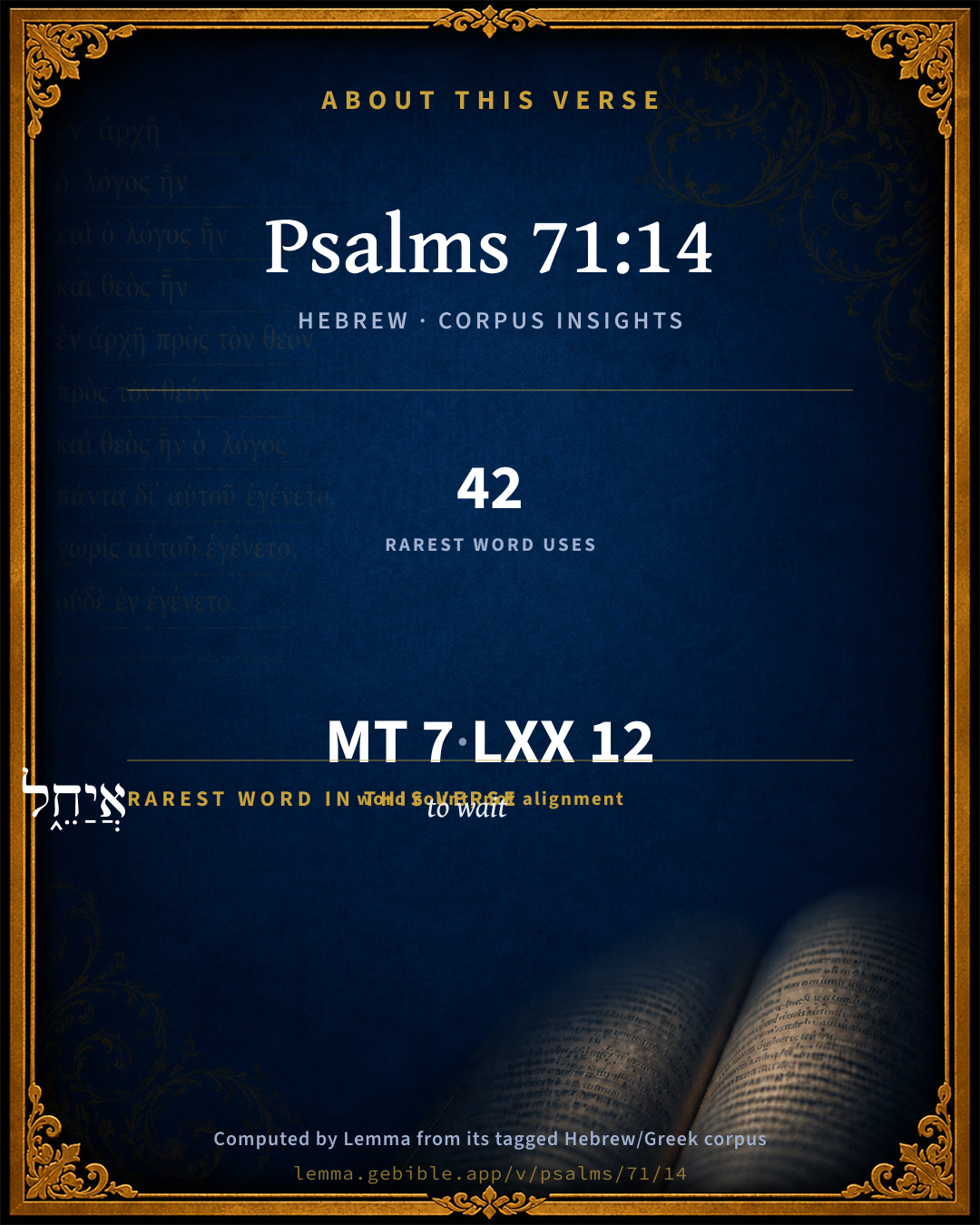
אֲיַחֵ֑ל to wait H3176 occurs in 41 verses of the Hebrew Bible. Also found in:

Grammatical profile

  • 2 verbs
  • 3 nouns
  • 1 pronoun
  • 1 preposition

Verb forms

  • אֲיַחֵ֑ל Piel · Imperfect
  • וְ֝הוֹסַפְתִּ֗י Hiphil · Sequential Perfect

Hebrew & Septuagint length

In English translation the verse runs 13 words from the Hebrew and 12 from the Septuagint (LXX English) — closely comparable.

A rough comparison of the two English renderings, which tokenize alike — not a word-level alignment.

Word counts can differ between the Hebrew and the Greek without any difference in meaning — e.g. the Hebrew direct-object marker אֵת has no separate Greek word, and Greek often adds the article ὁ.

In the original languages it is 7 Hebrew tokens and 12 Greek tokens — but the two are counted differently (Hebrew bundles its prefixes and suffixes into one token; the Greek is in lemma form), so that isn’t a like-for-like length.

Cross-references

12

Topical passages linked to Psalms 71:14 in the Treasury of Scripture Knowledge — connected by theme and wording, ordered by reader-vote popularity; previews shown in the World English Bible.

  • 1 John 3:3 Everyone who has this hope set on him purifies himself, even as he is pure.
  • Psalms 130:7 Israel, hope in Yahweh, For with Yahweh there is loving kindness. With him is abundant redemption.
  • Lamentations 3:26 It is good that a man should hope and quietly wait for the salvation of Yahweh.
  • Psalms 43:5 Why are you in despair, my soul? Why are you disturbed within me? Hope in God! For I shall still praise him: My Savior, my helper, and my God.
  • Psalms 71:6 I have relied on you from the womb. You are he who took me out of my mother's womb. I will always praise you.
  • Hebrews 10:35 Therefore don't throw away your boldness, which has a great reward.
  • Lamentations 3:21 This I recall to my mind; therefore have I hope.
  • 1 Peter 1:13 Therefore, prepare your minds for action, be sober and set your hope fully on the grace that will be brought to you at the revelation of Jesus Christ--
  • Job 13:15 Behold, he will kill me; I have no hope. Nevertheless, I will maintain my ways before him.
  • Philippians 1:9 This I pray, that your love may abound yet more and more in knowledge and all discernment;
  • 1 Thessalonians 4:10 for indeed you do it toward all the brothers who are in all Macedonia. But we exhort you, brothers, that you abound more and more;
  • 2 Peter 3:18 But grow in the grace and knowledge of our Lord and Savior Jesus Christ. To him be the glory both now and forever. Amen.

Cross-references courtesy of OpenBible.info (CC BY 4.0).

Hebrew and Greek witnesses Masoretic Hebrew ↔ Greek Septuagint

The same verse in the two great witnesses to the Old Testament, shown verse-for-verse.

You’re reading Greek Psalm 70 (Hebrew Psalm 71). The Septuagint counts the superscription, so verse numbers can differ from the Hebrew — chapter-level alignment, not verse-by-verse. Numbering follows Rahlfs.

These are two independent witnesses, not word-aligned to each other, and the Septuagint is shown in lemma (dictionary) form.

Hebrew Psalms 71:14 Masoretic · Westminster Leningrad Codex

וַ֭אֲנִי תָּמִ֣יד אֲיַחֵ֑ל וְ֝הוֹסַפְתִּ֗י עַל כָּל תְּהִלָּתֶֽךָ

But I will always hope, And will add to all of your praise.

World English Bible · Public Domain

Greek LXX Greek Psalm 70:14 Septuagint · lemma form

ἐγώ δέ διά πᾶς ἐλπίζω καί προςτίθημι ἐπί πᾶς ὁ αἴνεσις σύ

But I will hope continually, and will praise you more and more.

LXX2012 (modern English Septuagint) · Public Domain

Hebrew: Westminster Leningrad Codex (CC BY 4.0). Greek: Septuagint (public domain); English from LXX2012 (modern English Septuagint) (Public Domain). How the Septuagint differs from the Hebrew →

Commentary

Notes on Psalms 71:14 from classic Christian and Jewish commentators (each source and its license shown beneath its notes). The classic Christian expositions comment on the surrounding passage and are grouped to its opening verse, so a note may address several verses; the Jewish commentaries on the Tanakh (Rashi and others) are per-verse, so they appear only where the commentator wrote on this verse.

Lemma curates 59 commentaries, every one of them public domain or Creative Commons licensed, each selected and text-cleaned for this edition rather than reprinted as found. About our sources →

Matthew Henry's Commentary

David is here in a holy transport of joy and praise, arising from his faith and hope in God; we have both together Psa 71:14, where there is a sudden and remarkable change of his voice; his fears are all silenced, his hopes raised, and his prayers turned into thanksgivings. "Let my enemies say what they will, to drive me to despair, I will hope continually, hope in all conditions, in the most cloudy and dark day; I will live upon hope and will hope to the end." Since we hope in one that will never fail us, let not our hope in him fail us, and then we shall praise him yet more and more. "The more they reproach me the more closely will I cleave to thee; I will praise thee more and better than ever I have done yet." The longer we live the more expert we should grow in praising God and the more we should abound in it. I will add over and above all thy praise, all the praise I have hitherto offered, for it is all too little. When we have said all we can, to the glory of God's grace, there is still more to be said; it is a subject that can never be exhausted, and therefore we should never grow weary of it. Now observe, in these verses,

I. How his heart is established in faith and hope; and it is a good thing that the heart be so established. Observe,

1. What he hopes in, Psa 71:16. (1.) In the power of God: "I will go in the strength of the Lord God, not sit down in despair, but stir up myself to and exert myself in my work and warfare, will go forth and go on, not in any strength of my own, but in God's strength - disclaiming my own sufficiency and depending on him only as all-sufficient - in the strength of his providence and in the strength of his grace." We must always go about God's work in his strength, having our eyes up unto him to work in us both to will and to do. (2.) In the promise of God: "I will make mention of thy righteousness, that is, thy faithfulness to every word which thou hast spoken, the equity of thy disposals, and thy kindness to thy people that trust in thee. This I will make mention of as my plea in prayer for thy mercy." We may very fitly apply it to the righteousness of Christ, which is called the righteousness of God by faith, and which is witnessed by the law and the prophets; we must depend upon God's strength for assistance and upon Christ's righteousness for acceptance. In the Lord have I righteousness and strength, Isa 45:24.

2. What he hopes for.

(1.) He hopes that God will not leave him in his old age, but will be the same to him to the end that he had been all along, Psa 71:17, Psa 71:18. Observe here, [1.] What God had done for him when he was young: Thou hast taught me from my youth. The good education and good instructions which his parents gave him when he was young he owns himself obliged to give God thanks for as a great favour. It is a blessed thing to be taught of God from our youth, from our childhood to know the holy scriptures, and it is what we have reason to bless God for. [2.] What he had done for God when he was middle-aged: He had declared all God's wondrous works. Those that have not good when they are young must be doing good when they are grown up, and must continue to communicate what they have received. We must own that all the works of God's goodness to us are wondrous works, admiring he should do so much for us who are so undeserving, and we must make it our business to declare them, to the glory of God and the good of others. [3.] What he desired of God now that he was old: Now that I am old and gray-headed, dying to this world and hastening to another, O God! forsake me not. This is what he earnestly desires and confidently hopes for. Those that have been taught of God from their youth, and have made it the business of their lives to honour him, may be sure that he will not leave them when they are old and gray-headed, will not leave them helpless and comfortless, but will make the evil days of old age their best days, and such as they shall have occasion to say they have pleasure in. [4.] What he designed to do for God in his old age: "I will not only show thy strength, by my own experience of it, to this generation, but I will leave my observations upon record for the benefit of posterity, and so who it to every one that is to come." As long as we live we should be endeavouring to glorify God and edify one another; and those that have had the largest and longest experience of the goodness of God to them should improve their experiences for the good of their friends. It is a debt which the old disciples of Christ owe to the succeeding generations to leave behind them a solemn testimony to the power, pleasure, and advantage of religion, and the truth of God's promises.

(2.) He hopes that God would revive him and raise him up out of his present low and disconsolate condition (Psa 71:20): Thou who hast made me to see and feel great and sore troubles, above most men, shalt quicken me again. Note, [1.] The best of God's saints and servants are sometimes exercised with great and sore troubles in this world. [2.] God's hand is to be eyed in all the troubles of the saints, and that will help to extenuate them and make them seem light. He does not say, "Thou hast burdened me with those troubles," but "shown them to me," as the tender father shows the child the rod to keep him in awe. [3.] Though God's people be brought ever so low he can revive them and raise them up. Are they dead? he can quicken them again. See Co2 1:9. Are they buried, as dead men out of mind? he can bring them up again from the depths of the earth, can cheer the most drooping spirit and raise the most sinking interest. [4.] If we have a due regard to the hand of God in our troubles, we may promise ourselves, in due time, a deliverance out of them. Our present troubles, though great and sore, shall be no hindrance to our joyful resurrection from the depths of the earth, witness our great Master, to whom this may have some reference; his Father showed him great and sore troubles, but quickened him and brought him up from the grave.

(3.) He hopes that God would not only deliver him out of his troubles, but would advance his honour and joy more than ever (Psa 71:21): "Thou shalt not only restore me to my greatness again, but shalt increase it, and give me a better interest, after this shock, than before; thou shalt not only comfort me, but comfort me on every side, so that I shall see nothing black or threatening on any side." Note, Sometimes God makes his people's troubles contribute to the increase of their greatness, and their sun shines the brighter for having been under a cloud. If he make them contribute to the increase of their goodness, that will prove in the end the increase of their greatness, their glory; and if he comfort them on every side, according to the time and degree wherein he has afflicted them on every side, they will have no reason to complain. When our Lord Jesus was quickened again, and brought back from the depths of the earth, his greatness was increased, and he entered on the joy set before him.

(4.) He hopes that all his enemies would be put to confusion, Psa 71:24. He speaks of it with the greatest assurance as a thing done, and triumphs in it accordingly: They are confounded, they are brought to shame, that seek my hurt. His honour would be their disgrace and his comfort their vexation.

II. Let us now see how his heart is enlarged in joy and praises, how he rejoices in hope, and sings in hope for we are saved by hope.

1. He will speak of God's righteousness and his salvation, as great things, things which he was well acquainted with, and much affected with, which he desired God might have the glory of and others might have the comfortable knowledge of (Psa 71:15): My mouth shall show forth thy righteousness and thy salvation; and again (Psa 71:24), My tongue shall talk of thy righteousness, and this all the day. God's righteousness, which David seems here to be in a particular manner affected with, includes a great deal: the rectitude of his nature, the equity of his providential disposals, the righteous laws he has given us to be ruled by, the righteous promises he has given us to depend upon, and the everlasting righteousness which his Son has brought in for our justification. God's righteousness and his salvation are here joined together; let no man think to put them asunder, nor expect salvation without righteousness, Psa 50:23. If these two are made the objects of our desire, let them be made the subjects of our discourse all the day, for they are subjects that can never be exhausted.

2. He will speak of them with wonder and admiration, as one astonished at the dimensions of divine love and grace, the height and depth, the length and breadth, of it: "I know not the numbers thereof, Psa 71:15. Though I cannot give a particular account of thy favours to me, they are so many, so great (if I would count them, they are more in number than the sand, Psa 40:5), yet, knowing them to be numberless, I will be still speaking of them, for in them I shall find new matter," Psa 71:19. The righteousness that is in God is very high; that which is done by him for his people is very great: put both together, and we shall say, O God! who is like unto thee? This is praising God, acknowledging his perfections and performances to be, (1.) Above our conception; they are very high and great, so high that we cannot apprehend them, so great that we cannot comprehend them. (2.) Without any parallel; no being like him, no works like his: O God! who is like unto thee? None in heaven, none on earth, no angel, no king. God is a non-such; we do not rightly praise him if we do not own him to be so.

3. He will speak of them with all the expressions of joy and exultation, Psa 71:22, Psa 71:23. Observe,

(1.) How he would eye God in praising him. [1.] As a faithful God: I will praise thee, even thy truth. God is made known by his word; if we praise that, and the truth of that, we praise him. By faith we set to our seal that God is true; and so we praise his truth. [2.] As a God in covenant with him: "O my God! whom I have consented to and avouched for mine." As in our prayers, so in our praises, we must look up to God as our God, and give him the glory of our interest in him and relation to him. [3.] As the Holy One of Israel, Israel's God in a peculiar manner, glorious in his holiness among that people and faithful to his covenant with them. It is God's honour that he is a Holy One; it is his people's honour that he is the Holy One of Israel.

(2.) How he will express his joy and exultation. [1.] With his hand, in sacred music - with the psaltery, with the harp; at these David excelled, and the best of his skill shall be employed in setting forth God's praises to such advantage as might affect others. [2.] With his lips, in sacred songs: "Unto thee will I sing, to thy honour, and with a desire to be accepted of thee. My lips shall greatly rejoice when I sing unto thee, knowing they cannot be better employed." [3.] In both with his heart: "My soul shall rejoice which thou hast redeemed." Note, First, Holy joy is the very heart and life of thankful praise. Secondly, We do not make melody to the Lord, in singing his praises, if we do not do it with our hearts. My lips shall rejoice, but that is nothing; lip-labour, though ever so well laboured, if that be all, is but lost labour in serving God; the soul must be at work, and with all that is within us we must bless his holy name, else all about us is worth little. Thirdly, Redeemed souls ought to be joyful thankful souls. The work of redemption ought, above all God's works, to be celebrated by us in our praises. The Lamb that was slain, and has redeemed us to God, must therefore be counted worthy of all blessing and praise.

Matthew Henry's Commentary on the Whole Bible (1708–1710) — public domain (CC PDM 1.0). Text via the HelloAO Bible API.

Trapp's Complete Commentary

John Trapp

Psa 71:14 But I will hope continually, and will yet praise thee more and more.

Ver. 14. But I will hope continually] I will lengthen out mine hope, as a line drawn out. Tremellius renders it, I am in expectation still of completing thy praise, and will go on therein, viz. when thou shalt have completed my deliverance

John Trapp, A Commentary or Exposition upon All the Books of the Old and New Testament (1647–1656) — public domain. Text from a community e-Sword module.

The Biblical Illustrator

Joseph S. Exell

Psa_71:14

But I. . . will yet praise Thee more and more.

More and more

When sin conquered the realm of manhood, it slew all the minstrels except those of the race of Hope. For humanity, amid all its sorrows and sins, hope sings on. To believers in Jesus there remains a royal race of bards, for we have a hope of glory, a lively hope, a hope eternal and divine.

I. Our first business shall be, to urge ourselves to this resolution.

1. It is humbling to remember that we may very well praise God more than we have done, for we have praised Him very little as yet. What we have done, as believers, in glorifying God falls far, far short of His due.

2. Another argument which presses upon my mind is this: that wherein we have praised God up till now, we have not found the service to be a weariness to ourselves, but it has ever been to us both a profit and a delight. I would not speak falsely even for God, but I bear my testimony that the happiest moments I have ever spent have been occupied with the worship of God. I have never been so near heaven as when adoring before the eternal throne. I think every Christian will bear like witness.

3. We ought surely to praise God more to-day than at any other previous day, because we have received more mercies. Even of temporal favours we have been large partakers. Begin with these, and then rise higher.

4. We have been proving through a series of years the faithfulness, immutability, and veracity of our God--proving these attributes by our sinning against God, and their bearing the strain of our misbehaviour--proving them by the innumerable benefits which the Lord has bestowed upon us. Shall all this experience end in no result? Shall there be no advance in gratitude where there is such an increase of obligation? God is so good that every moment of His love demands a life of praise.

5. It should never be forgotten that every Christian as he grows in grace should have a loftier idea of God. Our highest conception of God falls infinitely short of His glory, but an advanced Christian enjoys a far clearer view of what God is than he had at the first, Now, the greatness of God is ever a claim for praise. Great is the Lord, and--what follows?--greatly to be praised. If, then, God is greater to me than He was, let my praise be greater.

6. It is a good reason for praising God more that we are getting nearer to the place where we hope to praise Him, world without end, after a perfect sort.

II. Let us in the Spirits strength drive away that which hinders us from praising God more and more.

1. One of the deadliest things is dreaminess, sleepiness. A Christian readily falls into this state. I notice it even in the public congregation. Very often the whole service is gone through mechanically. A sleepy seraph before the throne of Jehovah, or a cherub nodding during sacred song, it were ridiculous to imagine. And shall such an insult to the majesty of heaven be seen on earthy No! Let us say to all that is within us, Awake! awake!

2. The next hindrance would be divided objects. We cannot, however we may resolve, praise God more and more, if, as we grow older, we allow this world to take up our thoughts. If I say, I will praise God more and more, and yet I am striking out right and left with projects of amassing wealth, or I am plunging myself into greater business cares unnecessarily, my actions belie my resolutions.

3. To rest on the past is another danger as to this matter.

III. Let us apply ourselves to the practical carrying out of this resolution. How shall I begin to praise God more and mercy Earnestness says: I shall undertake some fresh duty this afternoon. Stop just a minute. If you want to praise God, would not it be as well first to begin with yourself? The musician said: I will praise God better; but the pipes of his instrument were foul; he had better look to them first. If the strings have slipped from their proper tension, it will be well to correct them before beginning the tune. No; prepare yourself; make your heart ready. Thou needest the Spirits aid to make thy soul fit for praising God. Go then to thy chamber, confess the sins of the past, and ask the Lord to give thee much more grace that thou mayest begin to praise Him. These inner matters being considered, let us go on to increase our actual and direct service of God. Let us quicken our speed. Or suppose we are already doing so much that all the time we can possibly spare is fully occupied, let us do what we do better. We should praise God much more if we threw more of His praise into our common conversation--if we spoke more of Him when we are by the way or when we sit in the house. We should praise Him more and more if we fulfilled our consecration, and obeyed the precept, Whether therefore ye eat, or drink, or whatsoever ye do, do all to the glory of God. (C. H. Spurgeon.)

The Biblical Illustrator, edited by Joseph S. Exell (c. 1880s–1900s) — public domain. Text from a community e-Sword module.

Joseph Benson's Commentary

Psa 71:14-16. But I will hope continually — Although in the greatest straits and difficulties; and will yet praise thee more and more — For which I know thou wilt yet give me abundant occasion. My mouth shall show forth thy righteousness — Thy truth, justice, and mercy, manifested in all thy dispensations toward me; and thy salvation — Temporal and spiritual, wrought out for me; all the day long — It shall be the subject of all my songs, and my continual employment to publish it abroad. For I know not the number thereof — Of the instances in which thou hast manifested thy righteousness, that is, thy mercy and truth in delivering me. I will go — I will not sit down in despair, but I will go on in my work and warfare; in the strength of the Lord God — Relying, not on any strength of my own, or any efforts I can make, but disclaiming my own sufficiency, and depending on God only as all-sufficient: looking to and trusting in his providence and grace. Observe, reader, we must always go about God’s work in his strength, having our eyes up unto him, to work in us both to will and to do. I will make mention of thy righteousness — Of thy mercy and goodness; or, rather, of thy faithfulness in making good all thy promises, of thy equity in all thy dispensations, and of thy kindness to thy people that trust in thee. Of this righteousness, including these thy perfections, I will make mention, partly to praise and celebrate it, and partly to support and comfort myself with the remembrance of it, and what it implies.

Joseph Benson's Commentary on the Old and New Testaments (1811–1818) — public domain. Text from a community e-Sword module.

J. A. Alexander on Psalms

Joseph Addison Alexander

Psa 71:14. And I will always hope, and add to (literally add upon, accumulate, increase) all thy praise. To all thy praise which I have uttered hitherto, I will continue still to add.

Joseph Addison Alexander, The Psalms Translated and Explained (1850) — public domain. Text from a community e-Sword module.

Tyndale Open Study Notes

Tyndale Open Resources

71:14 The psalmist contrasts his own goodness with his enemies’ evil; he centers his life in the Lord, even during hard times (see 9:17-18; 27:13-14).

Tyndale Open Study Notes — © Tyndale Open Resources, licensed CC BY-SA 4.0. Text via the HelloAO Bible API.

Adam Clarke's Commentary

Verse 14. I will hope continually] I shall expect deliverance after deliverance, and blessing after blessing; and, in consequence, I will praise thee more and more. As thy blessings abound, so shall my praises.

Adam Clarke's Commentary on the Bible (1810–1826) — public domain. Text from a community e-Sword/MySword module.

John Calvin's Commentaries

14. But I will hope continually. David again, as having obtained the victory, prepares himself for thanksgiving. There is, however, no doubt, that during the time when the wicked derided his simplicity, he struggled manfully amidst his distresses, as may be gathered from the word hope. Although, to outward appearance, there was no prospect of deliverance from his troubles, and although the wicked ceased not proudly to pour contempt upon his trust in God, he nevertheless determined to persevere in the exercise of hope; even as it is a genuine proof of faith, to look exclusively to the Divine promise, in order to be guided by its light alone amidst the thickest darkness of afflictions. The strength, then, of the hope of which David speaks, is to be estimated by the conflicts which he at that time sustained. In saying, I will add to all thy praises, he shows the confidence with which he anticipated a desirable escape from his troubles. It is as if he had said — Lord, I have been long accustomed to receive benefits from thee, and this fresh accession to them, I doubt not, will furnish me with new matter for celebrating thy grace.

John Calvin's Commentaries (1540-1563) — public domain. Text from the Calvin Translation Society English edition (1840s-50s) via the Christian Classics Ethereal Library (ccel.org). Calvin's coverage is partial (roughly two-thirds of the Bible); uncommented books and verses are honest gaps, never fabricated. The 19th-century editor's footnotes and remarks are omitted so the notes are faithfully Calvin's own voice.

The Cambridge Bible for Schools and Colleges

gen. ed. J. J. S. Perowne

14. But as for me, I will hope continually,

And will praise thee yet more and more.

He contrasts his own future with that of his enemies.

14–16. Vows of praise and thanksgiving.

The Cambridge Bible for Schools and Colleges (gen. ed. J. J. S. Perowne; Cambridge University Press, 1878–1918) — public domain. Text from a community e-Sword module.

John Gill's Exposition

But I will hope continually,.... For deliverance and salvation from present outward troubles, for; more grace here and glory hereafter: it is the excellency of the grace of hope to be exercised in times of affliction and distress, and with Abraham to believe in hope against hope; and then it is that this grace is eminently and remarkably useful: it is an anchor to the soul when in distress, which keeps it firm and steadfast; and an helmet, which covers the head in the day of battle; in the exercise of which the believer glories in tribulation: it is an abiding grace, and should be continually exercised by those that have it, which is to abound in it; but this must be through the power of the Holy Ghost, Rom 15:13;

and will yet praise thee more and more; or "will add to all thy praise" (b); to former praises and thanksgivings, fresh ones, as his mercies were renewed to him, and he was daily loaded with benefits.

(b) "omnibus laudibus tuis adjiciam", Tigurine version.

John Gill's Exposition of the Whole Bible (1746–1763) — public domain (CC PDM 1.0). Text via the HelloAO Bible API.

Albert Barnes' Notes on the Bible

But I will hope continually - I will always cherish hope; I will not give up to despair. I will trust in God whatever may be the number, the power, and the confidence of my enemies. None of these things shall make me despair, for as long as I have a God, I have every ground for hope. No man should despair who has God for his Friend. Compare Psa 42:5, Psa 42:11; Psa 43:5.

And will yet praise thee more and more - literally, “I will add upon all thy praise.” That is, I will accumulate it; I will increase it. He saw abundant cause in the past for praising God; he had such confidence in him, and he felt such an assurance that he would interpose in his behalf, that he did not doubt that in the future dealings of God with him, he would have every reason to “add” to that praise.

Albert Barnes' Notes on the Bible (1834–1885) — public domain. Text from a community e-Sword/MySword module.

Matthew Poole's English Annotations

For which I know thou wilt yet give me abundant occasion.

Matthew Poole's English Annotations on the Holy Bible (1683–1685) — public domain. Text from a community e-Sword/MySword module.

The Treasury of David

Charles H. Spurgeon

Ver. 14. The holy faith of the persecuted saint comes to the front in these three verses.

But I will hope continually. When I cannot rejoice in what I have, I will look forward to what shall be mine, and will still rejoice. Hope will live on a bare common, and sing on a branch laden down with snow. No date and no place are unsuitable for hope. Hell alone excepted, hope is a dweller in all regions. We may always hope, for we always have grounds for it: we will always hope, for it is a never failing consolation.

And will yet praise thee more and more. He was not slack in thanksgiving; in fact, no man was ever more diligent in it; yet he was not content with all his former praises, but vowed to become more and more a grateful worshipper. When good things are both continual and progressive with us, we are on the right tack. We ought to be misers in going good, and our motto should be "more and more." While we do not disdain to "rest and be thankful, "we cannot settle down into resting in our thankfulness. "Superior" cries the eagle, as he mounts towards the sun: higher and yet higher is also our aim, as we soar aloft in duty and devotion. It is our continual hope that we shall be able more and more to magnify the Lord.

Ver. 14. But I will hope continually. Behold, O Lord, I have prayed to thee, and I am comforted. Hope has thus taught me. I am glad; because in thee have I trusted, I shall never be confounded. Sorrow returned, equipped with vast array, fortified at all points with swords and spears, and with great clamour beleaguered my city. The din of his horsemen terrified me; and, standing at the gates, he commanded silence, and thus loudly spake: "Behold the man who trusted in God; who said, I shall not be confounded for ever; who took hope for a consoler." And, when he observed me blushing at these words, he drew nearer, and said: "Where are the promises which were thy trust? Where the consolation? Where the deliverance? What have thy tears availed thee? What help have thy prayers brought thee from heaven? Thou hast cried, and no one has answered; thou hast wept, and who have been moved with pity for thee? Thou hast called upon thy God, and he has been silent. Thou hast prayed to him, and he has hidden himself from thee: there has come no voice nor sound... Arise, therefore, and flee for help to man, that he may free thee from thy prison." With these words, there arose such a din of arms in the camp--such a clamour of men and sounding of trumpets--that I could hardly keep up heart; and, unless my beloved Hope had brought me help, Sorrow would have seized and carried me off in chains to his own place. Comes Hope to me, gleaming in divine brightness, and, smiling, said: "O soldier of Christ, how is thy heart? What is this struggle in thy mind?" At these words, I began to blush. "Fear not, "she said, "Evil shall not capture thee; thou shalt never perish. Behold, I am with thee, to deliver thee. Dost thou not know what is written (Psalm 12), `The fool hath said in his heart, there is no God.' As one of the foolish women hath this Sorrow spoken; never shall he be able to persuade thee that there is no God, or that God does not exercise a providence over all." Girolamo Savonarola. 1452-1498.

Ver. 14. And I will always hope, and add to (literally, add upon, accumulate, increase) all thy praise. To all thy praise which I have uttered hitherto, I will continue still to add. Joseph Addison Alexander.

Ver. 14. I will expect continually. But what did he expect? That for which he prayed in the ninth verse--the preservation of his prosperity, the presence and the help of God to the very end of life. Wherefore, he adds, continually, in perpetuity, in the time of old age, --usque ad mortem. Hermann Venema.

Ver. 14. As there is no end to the lovingkindness of Jehovah, there should be none to our gratitude. The hope of a Christian enableth him to be thankful, even in the dark season of affliction. Mrs. Thomson.

Ver. 14. See "Spurgeon's Sermons, "No. 998; "More and More."

Psalms 71:15*

Charles H. Spurgeon's The Treasury of David (1869–1885) — public domain. Psalms only. Text from a community e-Sword/MySword module.

The Pulpit Commentary

Vers. 14-24. Regarding his prayers as heard, and their fulfilment as certain, the psalmist now betakes himself to praise and thanksgiving, He will never cease to hope; he will praise God more and more (ver. 14). He will spend the whole day in telling of God"s righteousness and salvation (ver. 15). The mighty acts of the Lord shall form his theme, together with the righteousness of God, and of none other (ver. 16). As God has enabled him to declare his praise in the past (ver. 17), so he trusts to be still upheld and enabled to proclaim the same to the new generation (ver. 18). God"s righteousness is "very high," and there is none like him (ver. 19). When he. brings men into trouble, it is only to "turn again and comfort them" (vers. 20, 21). In conclusion, the writer promises that his hymns of praise shall not only be said, but sung, and accompanied with the melody of music (ver. 22). His lips and soul shall both rejoice together (ver. 23); and the praise of God shall employ his tongue without ceasing (ver. 24).

But I will hope continually; literally, but as for me, I will hope, etc. The phrase, "as for me," almost always marks a transition. And will yet praise thee more and more; literally, I will add to all thy praise; i.e. "I will add to all my past praises of thee further praises in the future.

Vers. 14-24. Persistent hope and increasing praise.

Upon these the psalmist resolves in this second half of the psalm. Let us distinguish the topics of his hope and praise.

I GOD"S WORKS OF RIGHTEOUSNESS ARE INNUMERABLE. (Ver. 15) They cannot be reckoned up. All his works are right, both in nature and towards man.

II GOD"S WORKS OF RIGHTEOUSNESS ARE MIGHTY WORKS. (Ver. 16) "I will come with the mighty deeds of the Lord the temple, with all the great and mighty deeds which God has done on my behalf, as my subject of grateful praise." What a tale each life history could tell!

III GOD"S WONDROUS WORKS HAVE BEEN THE THEME OF HIS YOUTH, AND SHALL BE OF HIS OLD AGE. (Vers. 17, 18) He has been taught them from his youth, and now that he is old he will tell them to the coming generation. We should he wise teachers in old age, having the experiences of a whole life to draw from.

IV GOD IN HIS WORKS OF RIGHTEOUSNESS IS AN INCOMPARABLE BEING. (Ver. 19) None like unto the infinite and eternal Bring. His righteousness is perfect and exalted.

V THE AFFLICTIONS WHICH GOD SENDS ARE TO HAVE A QUICKENING AND EXALTING EFFECT. (Vers. 20, 21) By such means God increases our greatness, and manifests himself to us as the comforting God.

VI UPON THESE GROUNDS HE WILL PRAISE GOD BY ALL THE MEANS HE CAN COMMAND. (Vers. 22-24) With the lute and the harp; his lips shall shout for joy, and his soul and his tongue shall talk all day of his righteousness which has caused him to triumph over his foes. "Unto him that loved us, and washed us from our sins in his own blood, and hath made us kings and priests unto God and his Father; to him be glory and dominion forever and ever." This will be the eternal song of the redeemed creation of God. S.

The Pulpit Commentary (1880–1919), ed. H.D.M. Spence-Jones & Joseph S. Exell — public domain. Text from a community e-Sword module.

unfoldingWord translationNotes

Door43 World Missions Community

more and more

"more all the time" or "always more than I have before"

My mouth will tell about your righteousness and your salvation all the day, although I cannot understand it

"I do not completely understand your righteousness and your salvation, but my mouth will tell about them all the day"

My mouth will tell

The mouth is synecdoche for the whole person. AT: "I will tell" or "I will speak with my mouth and tell" (See: Synecdoche)

your righteousness

This can be restated to remove the abstract noun "righteousness." AT: "how righteous you are" or "all the good things you do" (See: Abstract Nouns)

your salvation

The abstract noun "salvation" can be stated as an action. AT: "how you have saved me" or "how you save people" (See: Abstract Nouns)

I will come

Possible meanings are 1) "I will go to where people worship Yahweh" or 2) "I will go to my enemies" (See: Go and Come)

with the mighty acts of the Lord Yahweh

Possible meanings are 1) "I will tell them of the mighty deeds the Lord Yahweh has done" or 2) "because the Lord Yahweh has given me strength to do mighty acts."

will make mention of

"will talk about"

translationWords

hope

righteous

save

might

Lord Yahweh

unfoldingWord translationNotes — © Distant Shores Media and the Door43 World Missions Community, licensed CC BY-SA 4.0. Source: git.door43.org/Door43/en_tn.

Rashi

Rabbi Shlomo Yitzchaki (Rashi)

As for me, I shall constantly hope for Your salvation, and when You save me, I will add to Your praise.

Rashi on the Tanakh — English translations: “The Judaica Press complete Tanach with Rashi, translated by A. J. Rosenberg” (CC BY 4.0); “Pentateuch with Rashi's commentary by M. Rosenbaum and A.M. Silbermann, 1929-1934” (public domain); “The Metsudah Tanach series, Lakewood, N.J” (CC BY 4.0); and “The Book of Joshua, Metsudah Publications, 1997” (CC BY 4.0). Text via Sefaria.

Lesson kit

Teaching starters — assembled from the data on this page, not authored interpretation. Every prompt links to the verse data it draws on. Edit before teaching.

Psalms, in the Wisdom, opens this verse with 7 words (7 distinct Hebrew lemmas). Its most distinctive word is yâchal (“to wait”). A historical commentator’s framing appears above. Read the whole chapter for the surrounding context.

Discussion questions

  1. What does “to wait” (yâchal) contribute to the verse as a whole?
  2. How does Genesis 8:12, which shares the word «to wait», read alongside this verse?
  3. These translations render this verse differently. What is at stake in choosing one wording over another?
  4. «אֲיַחֵ֑ל» is a Piel Imperfect verb. How does that grammatical form shape the action described?
  5. Compare how Matthew Henry's Commentary and Trapp's Complete Commentary read this verse. Where do they agree or differ?

Things to notice

Reading settings

Reading text

Shown beneath each verse's original-language words.

Old Testament
Old Testament edition

Read the OT as the Masoretic Hebrew (MT) or the Greek Septuagint (LXX).

English shown for the Greek Septuagint (in the Hebrew ↔ Greek comparison).

Comparing translations? Open the Compare panel on any verse page to stack up to four side by side.