
Judges 8:28

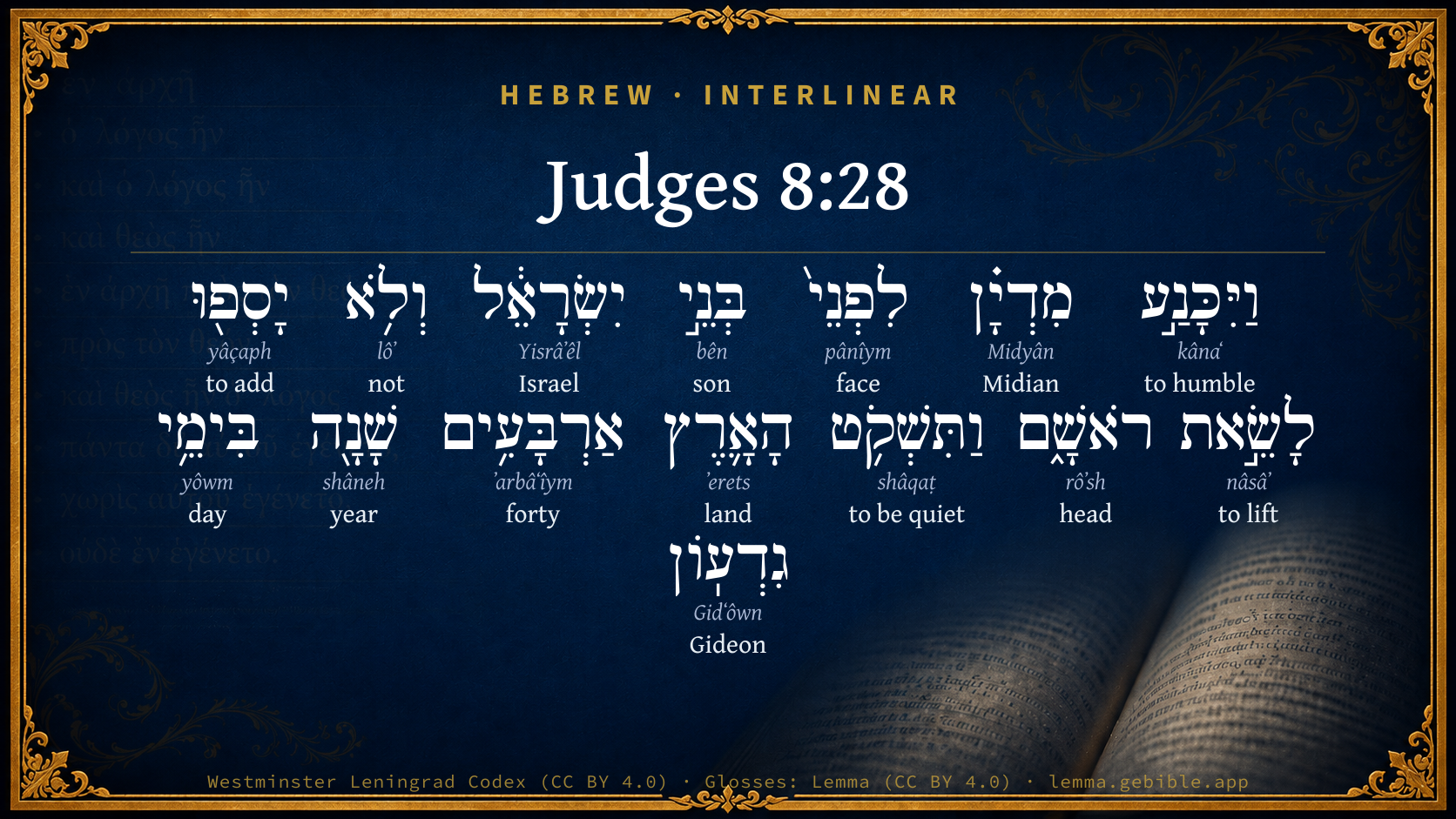
Hebrew (Westminster Leningrad Codex) Judges 8:28 appears in the Hebrew Old Testament. The text above is from the Westminster Leningrad Codex. Each word links to its Strong’s number, a concise gloss, and parsing drawn from the Open Scriptures Hebrew Bible morphology. Click any word for its full Brown-Driver-Briggs (BDB) entry.
Download image
Cite this verse

Judges 8:28 (World English Bible). Public Domain. Lemma interlinear Bible study tool, https://lemma.gebible.app/v/judges/8/28.

Show BibTeX & RIS
BibTeX
RIS
English Translation
So Midian was subdued before the children of Israel, and they lifted up their heads no more. The land had rest forty years in the days of Gideon.
World English Bible · Public Domain
Download a study sheet

One document with this verse’s original text, its word-by-word gloss line, the meaning frame, cross-references with their text, attributed commentary, and full source and license credits — printable, and it pastes into notes with its structure intact.

This verse Autodidact and up

Study sheet (.html) Plain text (.txt)

A passage Seminary Student

Up to 50 verses in one chapter. A passage sheet keeps up to 6 commentary sources and 12 cross-references per verse, in the order this page ranks them, and says so on the sheet whenever that leaves anything out. Ask for a single verse and you get the Autodidact verse sheet above.

Everything on this page stays free to read, with no account — the sheet is a download of what is already on screen, not access to it.

Want to remove ads? Support Godless Engineer
Compare translations 3

The same verse in 3 English versions, stacked beneath the original-language interlinear above. Click any original word for its lexicon entry.

Each is an independent rendering of the whole verse — the interlinear is not word-aligned to these translations.

Highlighted words mark where these versions differ — a whole-verse word diff, not a word-by-word alignment.

  • World English Bible Public Domain
    So Midian was subdued before the children of Israel, and they lifted up their heads no more. The land had rest forty years in the days of Gideon.
  • King James Version Public Domain
    Thus was Midian subdued before the children of Israel, so that they lifted up their heads no more. And the country was in quietness forty years in the days of Gideon.
  • unfoldingWord Literal Text CC BY-SA 4.0
    So Midian was subdued to the face of the sons of Israel, and they did not continue to lift their head. And the land rested forty years in the days of Gideon.

unfoldingWord Literal Text — © unfoldingWord, licensed CC BY-SA 4.0. Word-aligned USFM3 via Door43 (git.door43.org/unfoldingWord/en_ult).

Versions to compare (up to 4)

3 of 4 selected

Show all 18 translations

Every available English version of this verse, each an independent rendering of the whole verse.

  • World English Bible Public Domain
    So Midian was subdued before the children of Israel, and they lifted up their heads no more. The land had rest forty years in the days of Gideon.
  • Berean Standard Bible Public Domain
    In this way Midian was subdued before the Israelites and did not raise its head again. So the land had rest for forty years in the days of Gideon,
  • Majority Standard Bible Public Domain
    In this way Midian was subdued before the Israelites and did not raise its head again. So the land had rest for forty years in the days of Gideon,
  • King James Version Public Domain
    Thus was Midian subdued before the children of Israel, so that they lifted up their heads no more. And the country was in quietness forty years in the days of Gideon.
  • American Standard Version (1901) Public Domain
    So Midian was subdued before the children of Israel, and they lifted up their heads no more. And the land had rest forty years in the days of Gideon.
  • Revised Version (1885) Public Domain
    So Midian was subdued before the children of Israel, and they lifted up their heads no more. And the land had rest forty years in the days of Gideon.
  • Geneva Bible (1599) Public Domain
    Thus was Midian brought lowe before the children of Israel, so that they lift vp their heads no more: and the countrey was in quietnes fourtie yeeres in the dayes of Gideon.
  • Douay-Rheims (1899) Public Domain
    But Madian was humbled before the children of Israel, neither could they any more lift up their beads: but the land rested for forty years, while Gedeon presided.
  • Young's Literal Translation Public Domain
    And Midian is humbled before the sons of Israel, and have not added to lift up their head; and the land resteth forty years in the days of Gideon.
  • Literal Standard Version CC BY-SA 4.0
    And Midian is humbled before the sons of Israel, and have not added to lift up their head; and the land rests [for] forty years in the days of Gideon.
  • Unlocked Literal Bible CC BY-SA 4.0
    So Midian was subdued before the people of Israel and they did not raise their heads up again. So the land had peace for forty years in the days of Gideon.
  • unfoldingWord Literal Text CC BY-SA 4.0
    So Midian was subdued to the face of the sons of Israel, and they did not continue to lift their head. And the land rested forty years in the days of Gideon.
  • Darby Bible Public Domain
    So Mid'ian was subdued before the people of Israel, and they lifted up their heads no more. And the land had rest forty years in the days of Gideon.
  • World Messianic Bible Public Domain
    So Midian was subdued before the children of Israel, and they lifted up their heads no more. The land had rest forty years in the days of Gideon.
  • Webster's Bible Public Domain
    Thus was Midian subdued before the children of Israel, so that they raised their heads no more. And the country was in quietness forty years in the days of Gideon.
  • Free Bible Version CC BY-SA 4.0
    This is how the Midianites were subjugated before the Israelites and did not gain power again. So the land was at peace for forty years during the lifetime of Gideon.
  • Bible in Basic English Public Domain
    So Midian was broken before the children of Israel and the Midianites never got back their strength. And the land had peace for forty years, in the days of Gideon.
  • JPS Tanakh (1917) Public Domain
    So Midian was subdued before the children of Israel, and they lifted up their heads no more. And the land had rest forty years in the days of Gideon.

Literal Standard Version (2020), Covenant Press — licensed CC BY-SA 4.0. Text via the HelloAO Bible API (eBible.org). Unlocked Literal Bible (unfoldingWord) — licensed CC BY-SA 4.0. Text via the HelloAO Bible API (eBible.org). unfoldingWord Literal Text — © unfoldingWord, licensed CC BY-SA 4.0. Word-aligned USFM3 via Door43 (git.door43.org/unfoldingWord/en_ult). Free Bible Version, Dr. Jonathan Gallagher — licensed CC BY-SA 4.0. Text via the HelloAO Bible API (eBible.org).

Word by word

More ways to search: Search by grammar → Find every occurrence → Compare this word →

Practice this passage: Drill this verse → Learn its vocabulary →

וַיִּכָּנַ֣ע
kânaʻ
H3665
“and · to humble”
Conjunction + Verb, Niphal, Sequential Imperfect, 3rd Person, Masculine, Singular
Part of Speech
Conjunction + Verb
Stem
Niphal
Form
Sequential Imperfect
Person
3rd Person
Gender
Masculine
Number
Singular
Full BDB Definition

Origin: a primitive root

TWOT: 1001

to be humble, be humbled, be subdued, be brought down, be low, be under, be brought into subjection - (Niphal) - to humble oneself - to be humbled, be subdued - (Hiphil) - to humble - to subdue
  1. מִדְיָ֗ן Midyân H4080 “Midian” Noun, Proper
  2. לִפְנֵי֙ pânîym H6440 “to/for · face(s) of” Preposition + Noun, Common, Both, Plural, Construct
  3. בְּנֵ֣י bên H1121 “sons of” Noun, Common, Masculine, Plural, Construct
  4. יִשְׂרָאֵ֔ל Yisrâʼêl H3478 “Israel” Noun, Proper
  5. וְלֹ֥א lôʼ H3808 “and · not” Conjunction + Particle, Negative
  6. יָסְפ֖וּ yâçaph H3254 “to add” Verb, Qal, Perfect, 3rd Person, Common, Plural
  7. לָשֵׂ֣את nâsâʼ H5375 “to lift” Preposition + Verb, Qal, Infinitive Construct
  8. רֹאשָׁ֑ם rôʼsh H7218 “head · their” Noun, Common, Masculine, Singular, Construct + Suffix, Personal, 3rd Person, Masculine, Plural
  9. וַתִּשְׁקֹ֥ט shâqaṭ H8252 “and · to be quiet” Conjunction + Verb, Qal, Sequential Imperfect, 3rd Person, Feminine, Singular
  10. הָאָ֛רֶץ ʼerets H776 “the · land” Particle, Definite Article + Noun, Common, Both, Singular, Absolute
  11. אַרְבָּעִ֥ים ʼarbâʻîym H705 “forty” Adjective, Cardinal number, Both, Plural, Absolute
  12. שָׁנָ֖ה shâneh H8141 “year” Noun, Common, Feminine, Singular, Absolute
  13. בִּימֵ֥י yôwm H3117 “in/at · days of” Preposition + Noun, Common, Masculine, Plural, Construct
  14. גִדְעֽוֹן Gidʻôwn H1439 “Gideon” Noun, Proper

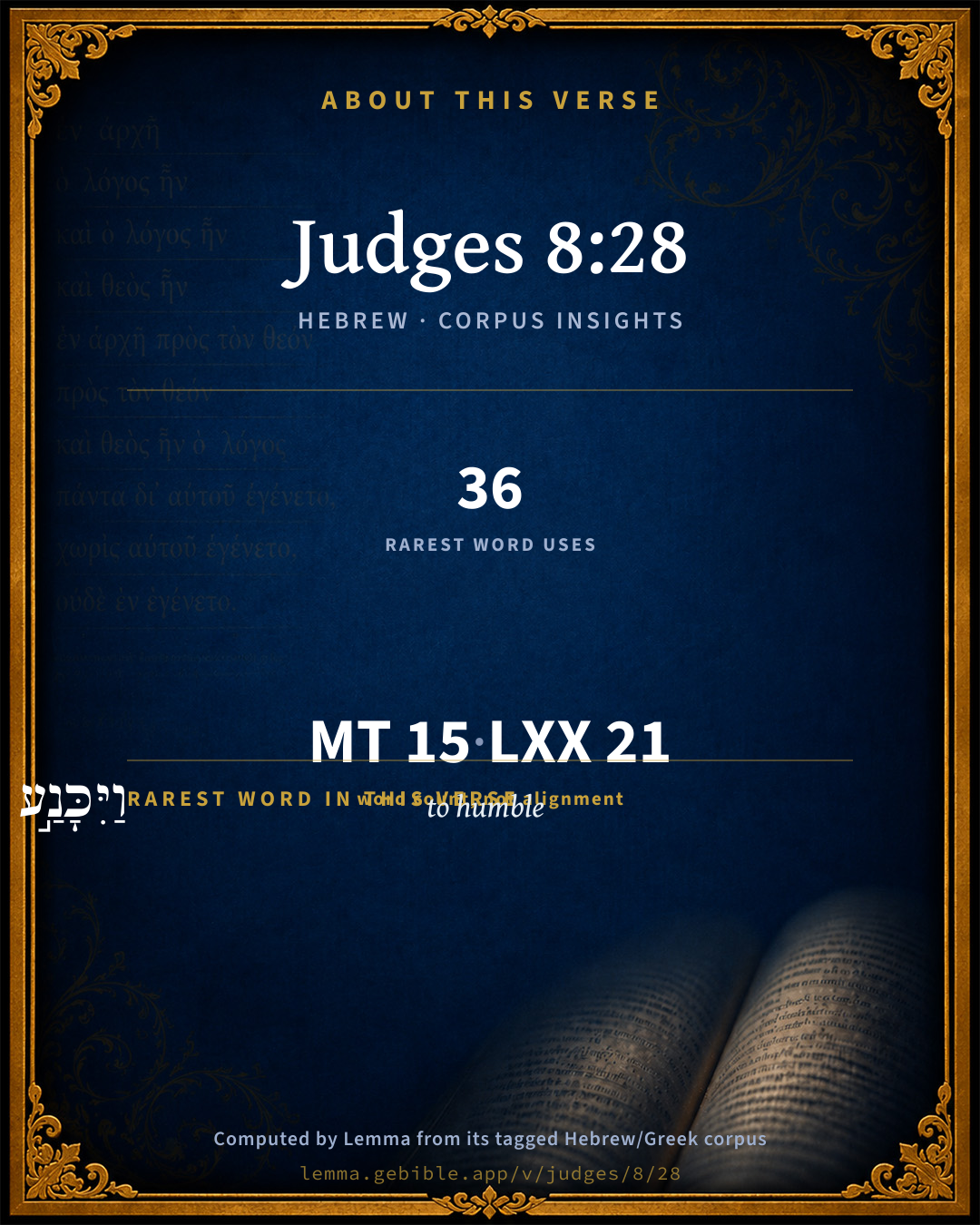
About this verse

These counts appear in no published source. They are computed here, from the morphology-tagged text and Lemma’s own curated glosses. What Lemma adds →

15
words
15
distinct lemmas
Historical
section

Shared distinctive vocabulary

וַיִּכָּנַ֣ע to humble H3665 occurs in 32 verses of the Hebrew Bible. Also found in:

Grammatical profile

  • 4 verbs
  • 9 nouns
  • 1 adjective
  • 1 particle

Verb forms

  • וַיִּכָּנַ֣ע Niphal · Sequential Imperfect
  • יָסְפ֖וּ Qal · Perfect
  • לָשֵׂ֣את Qal · Infinitive Construct
  • וַתִּשְׁקֹ֥ט Qal · Sequential Imperfect

Hebrew & Septuagint length

In English translation the verse runs 28 words from the Hebrew and 31 from the Septuagint (LXX English) — closely comparable.

A rough comparison of the two English renderings, which tokenize alike — not a word-level alignment.

Word counts can differ between the Hebrew and the Greek without any difference in meaning — e.g. the Hebrew direct-object marker אֵת has no separate Greek word, and Greek often adds the article ὁ.

In the original languages it is 15 Hebrew tokens and 21 Greek tokens — but the two are counted differently (Hebrew bundles its prefixes and suffixes into one token; the Greek is in lemma form), so that isn’t a like-for-like length.

Cross-references

6

Topical passages linked to Judges 8:28 in the Treasury of Scripture Knowledge — connected by theme and wording, ordered by reader-vote popularity; previews shown in the World English Bible.

  • Judges 5:31 So let all your enemies perish, Yahweh: But let those who love him be as the sun when he goes forth in his might. The land had rest forty years.
  • Judges 3:11 The land had rest forty years. Othniel the son of Kenaz died.
  • Judges 3:30 So Moab was subdued that day under the hand of Israel. The land had rest eighty years.
  • Psalms 83:9–12 Do to them as you did to Midian, As to Sisera, as to Jabin, at the river Kishon;
  • Isaiah 9:4 For the yoke of his burden, and the staff of his shoulder, the rod of his oppressor, you have broken as in the day of Midian.
  • Isaiah 10:26 Yahweh of Hosts will stir up against him a scourge, as in the slaughter of Midian at the rock of Oreb: and his rod will be over the sea, and he will lift it up after the manner of Egypt.

Cross-references courtesy of OpenBible.info (CC BY 4.0).

Hebrew and Greek witnesses Masoretic Hebrew ↔ Greek Septuagint

The same verse in the two great witnesses to the Old Testament, shown verse-for-verse.

These are two independent witnesses, not word-aligned to each other, and the Septuagint is shown in lemma (dictionary) form.

Hebrew Judges 8:28 Masoretic · Westminster Leningrad Codex

וַיִּכָּנַ֣ע מִדְיָ֗ן לִפְנֵי֙ בְּנֵ֣י יִשְׂרָאֵ֔ל וְלֹ֥א יָסְפ֖וּ לָשֵׂ֣את רֹאשָׁ֑ם וַתִּשְׁקֹ֥ט הָאָ֛רֶץ אַרְבָּעִ֥ים שָׁנָ֖ה בִּימֵ֥י גִדְעֽוֹן

So Midian was subdued before the children of Israel, and they lifted up their heads no more. The land had rest forty years in the days of Gideon.

World English Bible · Public Domain

Greek LXX Judges 8:28 Septuagint · lemma form

καί συνστέλλω μαδιαμ ἐνώπιον υἱός ἰσραήλ καί οὐ προςτίθημι αἴρω κεφαλή αὐτός καί ἡσυχάζω ὁ γῆ τεσσαράκοντα ἔτος ἐν ἡμέρα γεδεων

And Madiam, was straitened before the children of Israel, and they did not lift up their head any more; and the land had rest forty years in the days of Gedeon.

LXX2012 (modern English Septuagint) · Public Domain

Hebrew: Westminster Leningrad Codex (CC BY 4.0). Greek: Septuagint (public domain); English from LXX2012 (modern English Septuagint) (Public Domain). How the Septuagint differs from the Hebrew →

Targum (Aramaic paraphrase)

1

The Targum is the ancient Jewish Aramaic paraphrase of the Hebrew Scriptures — an interpretive translation, not the Hebrew text itself. Onkelos (literal) and Pseudo-Jonathan (expansive) render the Torah, and Jonathan the Prophets. Coverage is partial: where no permissively-licensed English translation exists for a verse, only the Aramaic is shown. This is verse-level text, not a word-by-word alignment to the Hebrew.

  1. Targum Jonathan Prophets (Joshua–Malachi)
    וְאִתְּבַרוּ מִדְיָנָאֵי קֳדָם בְּנֵי יִשְׂרָאֵל וְלָא אוֹסִיפוּ לַאֲרָמָא רֵישֵׁיהוֹן וּשְׁדוֹכַת אַרְעָא דְיִשְׂרָאֵל אַרְבְּעִין שְׁנִין בְּיוֹמֵי גִדְעוֹן:

    (no public-domain English translation for this verse)

    Targum Jonathan — Aramaic: “Mikraot Gedolot” (public domain). English: “Sefaria Community Translation” (CC0 1.0 (public-domain dedication)); “London "Chaldee Paraphrase," 1871” (public domain). Text via Sefaria.

Commentary

Notes on Judges 8:28 from classic Christian and Jewish commentators (each source and its license shown beneath its notes). The classic Christian expositions comment on the surrounding passage and are grouped to its opening verse, so a note may address several verses; the Jewish commentaries on the Tanakh (Rashi and others) are per-verse, so they appear only where the commentator wrote on this verse.

Lemma curates 59 commentaries, every one of them public domain or Creative Commons licensed, each selected and text-cleaned for this edition rather than reprinted as found. About our sources →

Jamieson, Fausset & Brown

Robert Jamieson, A. R. Fausset & David Brown

MIDIAN SUBDUED. (Jdg 8:28)

Thus was Midian subdued before the children of Israel--This invasion of the Arab hordes into Canaan was as alarming and desolating as the irruption of the Huns into Europe. It was the severest scourge ever inflicted upon Israel; and both it and the deliverance under Gideon lived for centuries in the minds of the people (Psa 83:11).

Next: Judges Chapter 9

Jamieson, Fausset & Brown — Commentary Critical and Explanatory on the Whole Bible (1871) — public domain (CC PDM 1.0). Text via the HelloAO Bible API.

Trapp's Complete Commentary

John Trapp

Jdg 8:28 Thus was Midian subdued before the children of Israel, so that they lifted up their heads no more. And the country was in quietness forty years in the days of Gideon.

Ver. 28. Forty years.] Beginning the computation at those forty years mentioned in Jdg 5:31.

John Trapp, A Commentary or Exposition upon All the Books of the Old and New Testament (1647–1656) — public domain. Text from a community e-Sword module.

Joseph Benson's Commentary

Jdg 8:28. They lifted up their heads no more — That is, they recovered not their former strength or courage, so as to conquer or oppress others. The country was in quietness forty years — To the fortieth year from the beginning of the Midianitish oppression; in the days of Gideon — As long as Gideon lived.

Joseph Benson's Commentary on the Old and New Testaments (1811–1818) — public domain. Text from a community e-Sword module.

Keil & Delitzsch

C. F. Keil & F. Delitzsch

The history of Gideon is concluded in Jdg 8:28-32. - Jdg 8:28. The Midianites had been so humiliated that they lifted up their head no more, and the land of Israel had rest forty years "in the days of Gideon," i.e., as long as Gideon lived.

Jdg 8:29-31

Before the account of his death, a few other notices respecting his family are introduced for the purpose of preparing the way for the following history of the doings of his sons, in which the sin of Gideon came to a head, and the judgment burst upon his house. "And Jerubbaal, the son of Joash, went and dwelt in his house." Both the word ויּלך, which simply serves to bring out the fact more vividly (see the remarks on Exo 2:1), and also the choice of the name Jerubbaal, merely serve to give greater prominence to the change, from the heat of the war against the Midianites to the quiet retirement of domestic life. Instead of accepting the crown that was offered him and remaining at the head of the nation, the celebrated Baal-fighter retired into private life again. In addition to the seventy sons of his many wives, there was a son born to him by a concubine, who lived at Shechem and is called his maid-servant in Jdg 9:18, and to this son he gave the name of Abimelech, i.e., king's father. את־שׁמו ויּשׂם is not the same as את־שׁמו קרא, to give a person a name, but signifies to add a name, or give a surname (see Neh 9:7, and Dan 5:12 in the Chaldee). It follows from this, that Abimelech received this name from Gideon as a cognomen answering to his character, and therefore not at the time of his birth, but when he grew up and manifested such qualities as led to the expectation that he would be a king's father.

Jdg 8:32

Gideon died at a good old age (see Gen 15:15; Gen 25:8), and therefore also died a peaceful death (not so his sons; see Judg 9), and was buried in his father's grave at Ophrah (Jdg 6:11).

Keil & Delitzsch — Biblical Commentary on the Old Testament (1861–1891) — public domain (CC PDM 1.0). Text via the HelloAO Bible API. (Old Testament only.)

Adam Clarke's Commentary

Verse 28. Forty years in the days of Gideon.] The Midianites were so completely humbled that they could make head no more against Israel during the forty years in which the government of Gideon lasted.

Adam Clarke's Commentary on the Bible (1810–1826) — public domain. Text from a community e-Sword/MySword module.

Ellicott's Commentary for English Readers

(28) Thus was Midian subdued.—This verse closes the second great epoch of Gideon’s life. The separate phrases occur in Jdg_1:2; Jdg_4:23-24; Jdg_5:31. The remaining verses of the chapter furnish us with a few notices of the third and last period of his life.

A Bible Commentary for English Readers, edited by Charles John Ellicott (1878–1897) — public domain. Text from a community e-Sword module.

The Cambridge Bible for Schools and Colleges

gen. ed. J. J. S. Perowne

28. The Deuteronomic editor’s conclusion of the story; cf. Jdg_3:30 n. and Jdg_3:11 n.

The Cambridge Bible for Schools and Colleges (gen. ed. J. J. S. Perowne; Cambridge University Press, 1878–1918) — public domain. Text from a community e-Sword module.

John Gill's Exposition

Thus was Midian subdued before the children of Israel,.... By the hand of Gideon humbled and brought under, their power over Israel was broken, and they delivered out of their hands:

so that they lifted up their heads no more; in a proud and haughty manner to insult them, and in an hostile way to invade and oppress them; such a blow was given them that they could not recover themselves, nor do we read of any effort of theirs ever after, or of their giving or attempting to give any disturbance to Israel, or any other nation:

and the country was in quietness forty years in the days of Gideon; that is, the land of Canaan; it was free from wars with Midian, or any other people, and enjoyed undisturbed peace and tranquillity. According to Bishop Usher (m), this was the fortieth year from the rest restored by Deborah and Barak; and, according to Abarbinel and others, these forty years are to be reckoned from the beginning of the servitude; that is, the seven years' oppression under the Midianites are included in them; but I cannot see that in this instance, and in others before met with, years of bondage can be counted with years of peace and prosperity, and go under that general name. The true sense seems to be, that after the Israelites had been in subjection to the Midianites for seven years, and Gideon had delivered them, that from thenceforward they had rest and quietness forty years, which in all probability was the time Gideon lived after his victories.

(m) Annal. Vet. Test. p. 43.

John Gill's Exposition of the Whole Bible (1746–1763) — public domain (CC PDM 1.0). Text via the HelloAO Bible API.

Matthew Poole's English Annotations

Lifted up their heads no more, i.e. recovered not their former strength or courage, so as to conquer or oppress others, as they had done.

Forty years, i.e. to the fortieth year, from the beginning of the Midianitish oppression: see on Jdg 3:11.

In the days of Gideon, i.e. as long as Gideon lived.

Matthew Poole's English Annotations on the Holy Bible (1683–1685) — public domain. Text from a community e-Sword/MySword module.

The Pulpit Commentary

Lifted up their heads no more. Thus showing the wisdom of Gideon"s perseverance in pushing on his victory to completeness. (see Homiletics on Jud 8:4-12) The narrative goes back to ver. 26, or perhaps rather to ver. 21.

The Pulpit Commentary (1880–1919), ed. H.D.M. Spence-Jones & Joseph S. Exell — public domain. Text from a community e-Sword module.

John Wesley's Explanatory Notes

Lifted up their head - That is, recovered not their former strength or courage, so as to conquer or oppress others. Forty years - To the fortieth year, from the beginning of the Midianitish oppression. The days, &c. - As long as Gideon lived.

John Wesley, Explanatory Notes Upon the Whole Bible (1754–1765) — public domain. Text via the GEBible commentary corpus.

Lesson kit

Teaching starters — assembled from the data on this page, not authored interpretation. Every prompt links to the verse data it draws on. Edit before teaching.

Judges, in the Historical, opens this verse with 15 words (15 distinct Hebrew lemmas). Its most distinctive word is kânaʻ (“to humble”). A historical commentator’s framing appears above. Read the whole chapter for the surrounding context.

Discussion questions

  1. The word kânaʻ carries the sense “to humble.” How does it shape the verse?
  2. Leviticus 26:41 shares the word «to humble» with this verse. How do the two illuminate each other?
  3. The translations on this page render this verse differently — a whole-verse word diff, not a word-by-word alignment. What might account for the different wordings?
  4. The verb «וַיִּכָּנַ֣ע» is Niphal Sequential Imperfect. How does its form color the action?
  5. Reading how Jamieson, Fausset & Brown and Trapp's Complete Commentary read this verse, where do the two commentators agree and where do they part?

Things to notice

Reading settings

Reading text

Shown beneath each verse's original-language words.

Old Testament
Old Testament edition

Read the OT as the Masoretic Hebrew (MT) or the Greek Septuagint (LXX).

English shown for the Greek Septuagint (in the Hebrew ↔ Greek comparison).

Comparing translations? Open the Compare panel on any verse page to stack up to four side by side.