
1 Kings 12:11

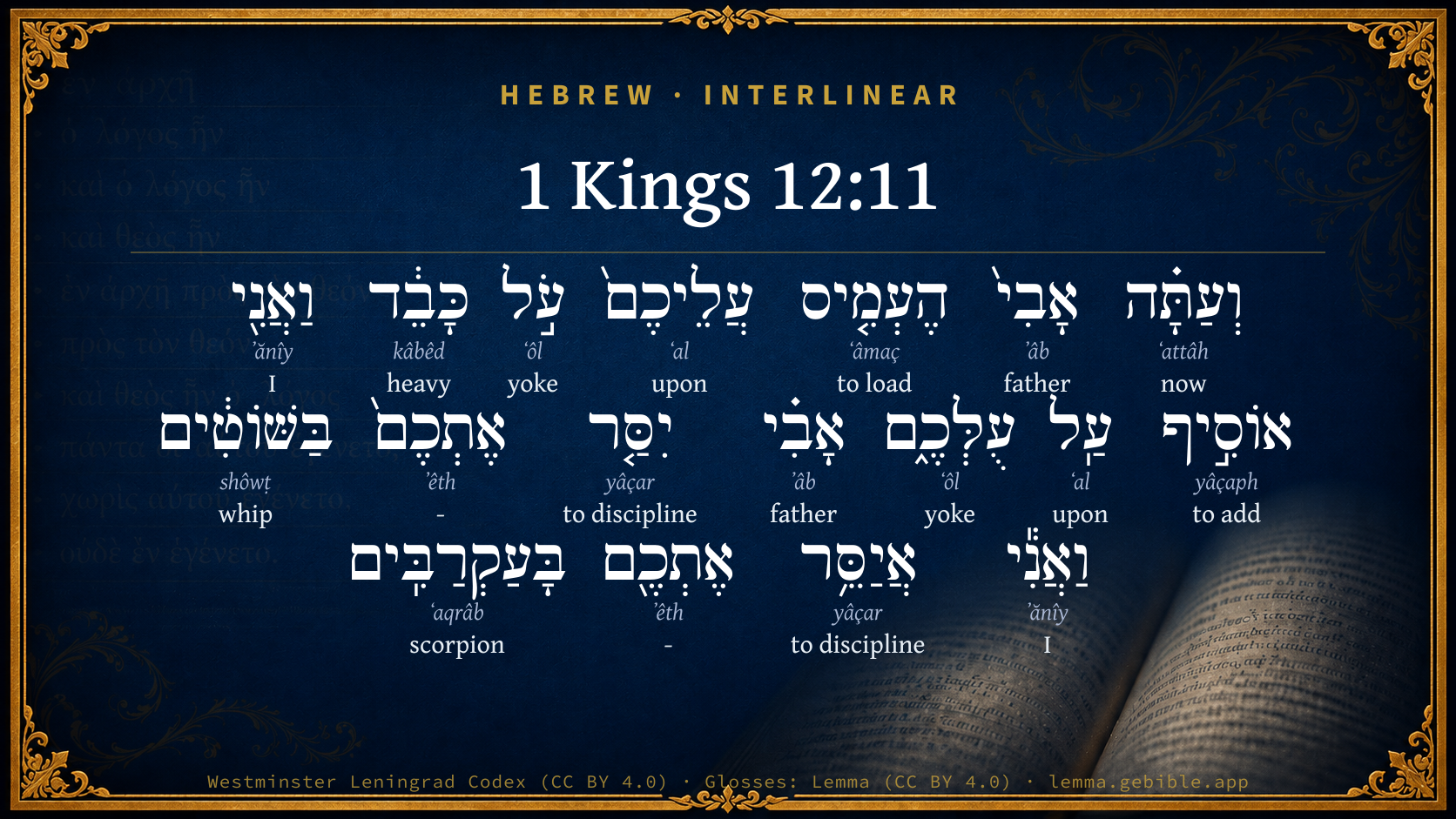
Hebrew (Westminster Leningrad Codex) 1 Kings 12:11 appears in the Hebrew Old Testament. The text above is from the Westminster Leningrad Codex. Each word links to its Strong’s number, a concise gloss, and parsing drawn from the Open Scriptures Hebrew Bible morphology. Click any word for its full Brown-Driver-Briggs (BDB) entry.
Download image
Cite this verse

1 Kings 12:11 (World English Bible). Public Domain. Lemma interlinear Bible study tool, https://lemma.gebible.app/v/1-kings/12/11.

Show BibTeX & RIS
BibTeX
RIS
English Translation
Now whereas my father did lade you with a heavy yoke, I will add to your yoke: my father chastised you with whips, but I will chastise you with scorpions.
World English Bible · Public Domain
Highlights
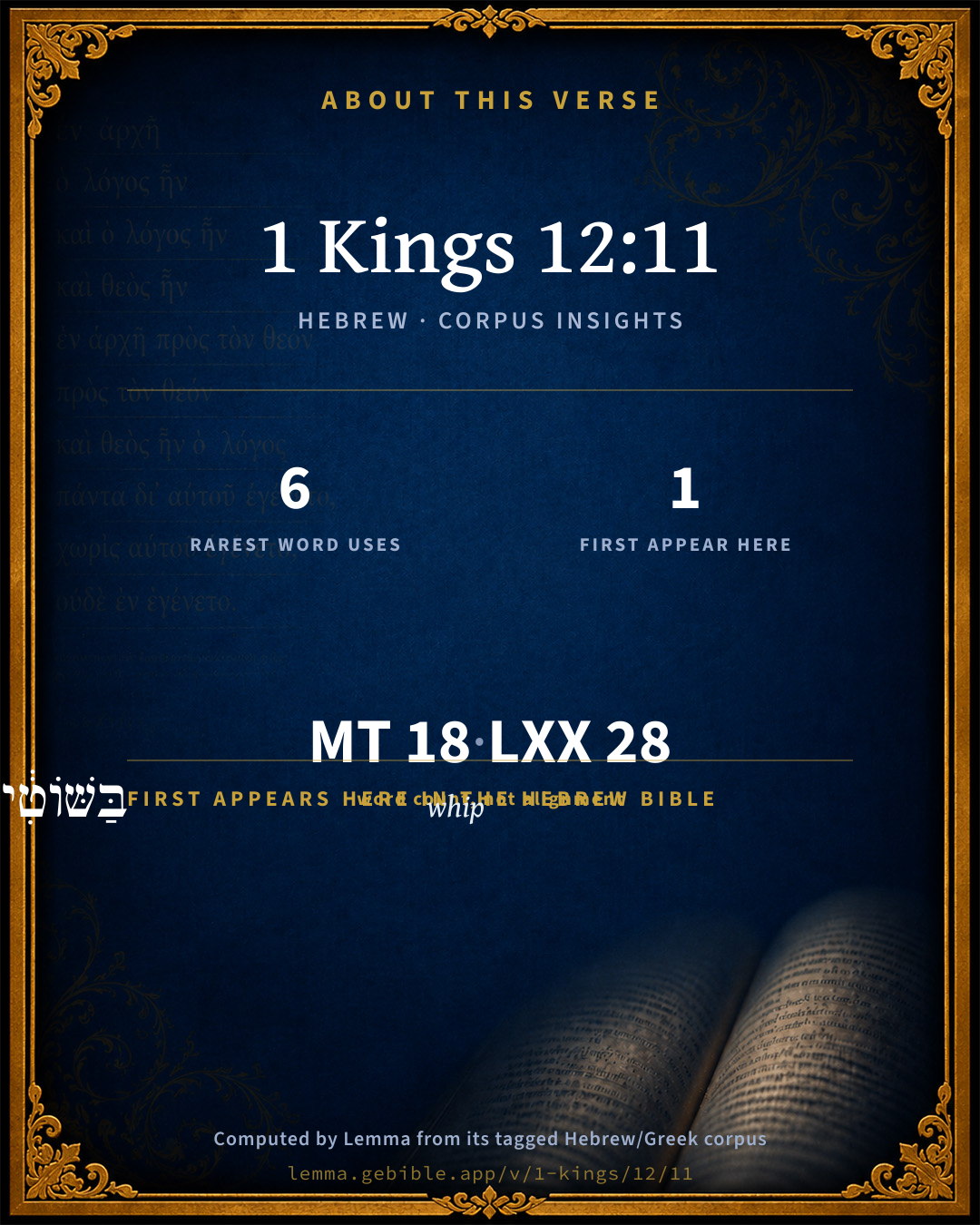
  • 1 first appearance in the Hebrew Bible
Full analysis ↓
Download a study sheet

One document with this verse’s original text, its word-by-word gloss line, the meaning frame, cross-references with their text, attributed commentary, and full source and license credits — printable, and it pastes into notes with its structure intact.

This verse Autodidact and up

Study sheet (.html) Plain text (.txt)

A passage Seminary Student

Up to 50 verses in one chapter. A passage sheet keeps up to 6 commentary sources and 12 cross-references per verse, in the order this page ranks them, and says so on the sheet whenever that leaves anything out. Ask for a single verse and you get the Autodidact verse sheet above.

Everything on this page stays free to read, with no account — the sheet is a download of what is already on screen, not access to it.

Want to remove ads? Support Godless Engineer
Compare translations 3

The same verse in 3 English versions, stacked beneath the original-language interlinear above. Click any original word for its lexicon entry.

Each is an independent rendering of the whole verse — the interlinear is not word-aligned to these translations.

Highlighted words mark where these versions differ — a whole-verse word diff, not a word-by-word alignment.

  • World English Bible Public Domain
    Now whereas my father did lade you with a heavy yoke, I will add to your yoke: my father chastised you with whips, but I will chastise you with scorpions.
  • King James Version Public Domain
    And now whereas my father did lade you with a heavy yoke, I will add to your yoke: my father hath chastised you with whips, but I will chastise you with scorpions.
  • unfoldingWord Literal Text CC BY-SA 4.0
    And now, my father loaded a heavy yoke on you, but I, I will add to your yoke. My father disciplined you with whips, but I, I will discipline you with scorpions.’”

unfoldingWord Literal Text — © unfoldingWord, licensed CC BY-SA 4.0. Word-aligned USFM3 via Door43 (git.door43.org/unfoldingWord/en_ult).

Versions to compare (up to 4)

3 of 4 selected

Show all 18 translations

Every available English version of this verse, each an independent rendering of the whole verse.

  • World English Bible Public Domain
    Now whereas my father did lade you with a heavy yoke, I will add to your yoke: my father chastised you with whips, but I will chastise you with scorpions.
  • Berean Standard Bible Public Domain
    Whereas my father burdened you with a heavy yoke, I will add to your yoke. Whereas my father scourged you with whips, I will scourge you with scorpions.’”
  • Majority Standard Bible Public Domain
    Whereas my father burdened you with a heavy yoke, I will add to your yoke. Whereas my father scourged you with whips, I will scourge you with scorpions.’”
  • King James Version Public Domain
    And now whereas my father did lade you with a heavy yoke, I will add to your yoke: my father hath chastised you with whips, but I will chastise you with scorpions.
  • American Standard Version (1901) Public Domain
    And now whereas my father did lade you with a heavy yoke, I will add to your yoke: my father chastised you with whips, but I will chastise you with scorpions.
  • Revised Version (1885) Public Domain
    And now whereas my father did lade you with a heavy yoke, I will add to your yoke: my father chastised you with whips, but I will chastise you with scorpions.
  • Geneva Bible (1599) Public Domain
    Now where as my father did burden you with a grieuous yoke, I will yet make your yoke heauier: my father hath chastised you with rods, but I will correct you with scourges.
  • Douay-Rheims (1899) Public Domain
    And now my father put a, heavy yoke upon you, but I will add to your yoke: my father beat you with whips, but I will beat you with scorpions.
  • Young's Literal Translation Public Domain
    and now, my father laid on you a heavy yoke, and I add to your yoke; my father chastised you with whips, and I -- I chastise you with scorpions.'
  • Literal Standard Version CC BY-SA 4.0
    and now, my father laid a heavy yoke on you, and I add to your yoke; my father disciplined you with whips, and I discipline you with scorpions.”
  • Unlocked Literal Bible CC BY-SA 4.0
    So now, although my father burdened you with a heavy yoke, I will add to your yoke. My father punished you with whips, but I will punish you with scorpions.'”
  • unfoldingWord Literal Text CC BY-SA 4.0
    And now, my father loaded a heavy yoke on you, but I, I will add to your yoke. My father disciplined you with whips, but I, I will discipline you with scorpions.’”
  • Darby Bible Public Domain
    and whereas my father laid a heavy yoke upon you, *I* will add to your yoke: my father chastised you with whips, but *I* will chastise you with scorpions.
  • World Messianic Bible Public Domain
    Now my father burdened you with a heavy yoke, but I will add to your yoke. My father chastised you with whips, but I will chastise you with scorpions.’”
  • Webster's Bible Public Domain
    And now whereas my father burdened you with a heavy yoke, I will add to your yoke: my father hath chastised you with whips, but I will chastise you with scorpions.
  • Free Bible Version CC BY-SA 4.0
    My father placed a heavy burden on you, and I will make it even heavier. My father punished you with whips; I will punish you with scorpions.’”
  • Bible in Basic English Public Domain
    If my father put a hard yoke on you, I will make it harder: my father gave you punishment with whips, but I will give you blows with snakes.
  • JPS Tanakh (1917) Public Domain
    And now whereas my father did burden you with a heavy yoke, I will add to your yoke; my father chastised you with whips, but I will chastise you with scorpions.'

Literal Standard Version (2020), Covenant Press — licensed CC BY-SA 4.0. Text via the HelloAO Bible API (eBible.org). Unlocked Literal Bible (unfoldingWord) — licensed CC BY-SA 4.0. Text via the HelloAO Bible API (eBible.org). unfoldingWord Literal Text — © unfoldingWord, licensed CC BY-SA 4.0. Word-aligned USFM3 via Door43 (git.door43.org/unfoldingWord/en_ult). Free Bible Version, Dr. Jonathan Gallagher — licensed CC BY-SA 4.0. Text via the HelloAO Bible API (eBible.org).

Word by word

More ways to search: Search by grammar → Find every occurrence → Compare this word →

Practice this passage: Drill this verse → Learn its vocabulary →

בָּעַקְרַבִּֽים
ʻaqrâb
H6137
“in/at the · scorpions”
Preposition, Determined + Noun, Common, Masculine, Plural, Absolute
Part of Speech
Preposition + Noun
Type
Common
Gender
Masculine
Number
Plural
State
Absolute
Full BDB Definition

Origin: of uncertain derivation

TWOT: 1683

scorpion
  1. וְעַתָּ֗ה ʻattâh H6258 “and · now” Conjunction + Adverb
  2. אָבִי֙ ʼâb H1 “father · my” Noun, Common, Masculine, Singular, Construct + Suffix, Personal, 1st Person, Common, Singular
  3. הֶעְמִ֤יס ʻâmaç H6006 “to load” Verb, Hiphil, Perfect, 3rd Person, Masculine, Singular
  4. עֲלֵיכֶם֙ ʻal H5921 “upon · you” Preposition + Suffix, Personal, 2nd Person, Masculine, Plural
  5. עֹ֣ל ʻôl H5923 “yoke” Noun, Common, Masculine, Singular, Absolute
  6. כָּבֵ֔ד kâbêd H3515 “heavy” Adjective, Adjective, Masculine, Singular, Absolute
  7. וַאֲנִ֖י ʼănîy H589 “and · I” Conjunction + Pronoun, Personal, 1st Person, Common, Singular
  8. אוֹסִ֣יף yâçaph H3254 “to add” Verb, Hiphil, Imperfect, 1st Person, Common, Singular
  9. עַֽל ʻal H5921 “upon” Preposition
  10. עֻלְּכֶ֑ם ʻôl H5923 “yoke · your” Noun, Common, Masculine, Singular, Construct + Suffix, Personal, 2nd Person, Masculine, Plural
  11. אָבִ֗י ʼâb H1 “father · my” Noun, Common, Masculine, Singular, Construct + Suffix, Personal, 1st Person, Common, Singular
  12. יִסַּ֤ר yâçar H3256 “to discipline” Verb, Piel, Perfect, 3rd Person, Masculine, Singular
  13. אֶתְכֶם֙ ʼêth H853 “- · you” Particle, Direct Object + Suffix, Personal, 2nd Person, Masculine, Plural
  14. בַּשּׁוֹטִ֔ים shôwṭ H7752 “in/at the · whips” Preposition, Determined + Noun, Common, Masculine, Plural, Absolute
  15. וַאֲנִ֕י ʼănîy H589 “and · I” Conjunction + Pronoun, Personal, 1st Person, Common, Singular
  16. אֲיַסֵּ֥ר yâçar H3256 “to discipline” Verb, Piel, Imperfect, 1st Person, Common, Singular
  17. אֶתְכֶ֖ם ʼêth H853 “- · you” Particle, Direct Object + Suffix, Personal, 2nd Person, Masculine, Plural

About this verse

These counts appear in no published source. They are computed here, from the morphology-tagged text and Lemma’s own curated glosses. What Lemma adds →

18
words
12
distinct lemmas
Historical
section

Notable vocabulary

The rarest word here is בָּעַקְרַבִּֽים scorpion H6137 — appearing just 6 times in the whole Hebrew Bible.

First appearance in Scripture

This word makes its first canonical appearance in the Hebrew Bible here:

  • בַּשּׁוֹטִ֔ים whip H7752

Shared distinctive vocabulary

בָּעַקְרַבִּֽים scorpion H6137 occurs in 6 verses of the Hebrew Bible. Also found in:

Grammatical profile

  • 4 verbs
  • 6 nouns
  • 1 adjective
  • 2 pronouns
  • 2 prepositions
  • 1 adverb
  • 2 particles

Verb forms

  • הֶעְמִ֤יס Hiphil · Perfect
  • אוֹסִ֣יף Hiphil · Imperfect
  • יִסַּ֤ר Piel · Perfect
  • אֲיַסֵּ֥ר Piel · Imperfect

Repetition

Words recur within this verse — often emphatic in Hebrew:

  • אָבִי֙ father H1 ×2
  • עֲלֵיכֶם֙ upon H5921 ×2
  • עֹ֣ל yoke H5923 ×2
  • יִסַּ֤ר to discipline H3256 ×2
  • וַאֲנִ֖י I H589 ×2

Hebrew & Septuagint length

In English translation the verse runs 30 words from the Hebrew and 31 from the Septuagint (LXX English) — closely comparable.

A rough comparison of the two English renderings, which tokenize alike — not a word-level alignment.

Word counts can differ between the Hebrew and the Greek without any difference in meaning — e.g. the Hebrew direct-object marker אֵת has no separate Greek word, and Greek often adds the article ὁ.

In the original languages it is 18 Hebrew tokens and 28 Greek tokens — but the two are counted differently (Hebrew bundles its prefixes and suffixes into one token; the Greek is in lemma form), so that isn’t a like-for-like length.

Cross-references

11

Topical passages linked to 1 Kings 12:11 in the Treasury of Scripture Knowledge — connected by theme and wording, ordered by reader-vote popularity; previews shown in the World English Bible.

  • Exodus 1:13–14 The Egyptians ruthlessly made the children of Israel serve,
  • Exodus 5:5–9 Pharaoh said, "Behold, the people of the land are now many, and you make them rest from their burdens."
  • Exodus 5:18 Go therefore now, and work, for no straw shall be given to you, yet shall you deliver the same number of bricks!"
  • 1 Samuel 8:18 You shall cry out in that day because of your king whom you shall have chosen you; and Yahweh will not answer you in that day.
  • 1 Kings 12:14 and spoke to them after the counsel of the young men, saying, My father made your yoke heavy, but I will add to your yoke: my father chastised you with whips, but I will chastise you with scorpions.
  • 2 Chronicles 16:10 Then Asa was angry with the seer, and put him in the prison-house; for he was in a rage with him because of this thing. Asa oppressed some of the people at the same time.
  • Isaiah 58:6 Isn't this the fast that I have chosen: to loose the bonds of wickedness, to undo the bands of the yoke, and to let the oppressed go free, and that you break every yoke?
  • Jeremiah 27:11 But the nation that shall bring their neck under the yoke of the king of Babylon, and serve him, that [nation] will I let remain in their own land, says Yahweh; and they shall till it, and dwell therein.
  • Jeremiah 28:13–14 Go, and tell Hananiah, saying, Thus says Yahweh: You have broken the bars of wood; but you have made in their place bars of iron.
  • Ezekiel 2:6 You, son of man, don't be afraid of them, neither be afraid of their words, though briers and thorns are with you, and you do dwell among scorpions: don't be afraid of their words, nor be dismayed at their looks, though they are a rebellious house.
  • Revelation 9:3–10 Then out of the smoke came forth locusts on the earth, and power was given to them, as the scorpions of the earth have power.

Cross-references courtesy of OpenBible.info (CC BY 4.0).

Hebrew and Greek witnesses Masoretic Hebrew ↔ Greek Septuagint

The same verse in the two great witnesses to the Old Testament, shown verse-for-verse.

These are two independent witnesses, not word-aligned to each other, and the Septuagint is shown in lemma (dictionary) form.

Hebrew 1 Kings 12:11 Masoretic · Westminster Leningrad Codex

וְעַתָּ֗ה אָבִי֙ הֶעְמִ֤יס עֲלֵיכֶם֙ עֹ֣ל כָּבֵ֔ד וַאֲנִ֖י אוֹסִ֣יף עַֽל עֻלְּכֶ֑ם אָבִ֗י יִסַּ֤ר אֶתְכֶם֙ בַּשּׁוֹטִ֔ים וַאֲנִ֕י אֲיַסֵּ֥ר אֶתְכֶ֖ם בָּעַקְרַבִּֽים

Now whereas my father did lade you with a heavy yoke, I will add to your yoke: my father chastised you with whips, but I will chastise you with scorpions.

World English Bible · Public Domain

Greek LXX 1 Kings 12:11 Septuagint · lemma form

καί νῦν ὁ πατήρ ἐγώ ἐπισάττω σύ κλοιός βαρύς καΐἐγώ προςτίθημι ἐπί ὁ κλοιός σύ ὁ πατήρ ἐγώ παιδεύω σύ ἐν μάστιξ ἐγώ δέ παιδεύω σύ ἐν σκορπίος

And whereas my father did lade you with a heavy yoke, I also will add to your yoke: my father chastised you with whips, but I will chastise you with scorpions.

LXX2012 (modern English Septuagint) · Public Domain

Hebrew: Westminster Leningrad Codex (CC BY 4.0). Greek: Septuagint (public domain); English from LXX2012 (modern English Septuagint) (Public Domain). How the Septuagint differs from the Hebrew →

Targum (Aramaic paraphrase)

1

The Targum is the ancient Jewish Aramaic paraphrase of the Hebrew Scriptures — an interpretive translation, not the Hebrew text itself. Onkelos (literal) and Pseudo-Jonathan (expansive) render the Torah, and Jonathan the Prophets. Coverage is partial: where no permissively-licensed English translation exists for a verse, only the Aramaic is shown. This is verse-level text, not a word-by-word alignment to the Hebrew.

  1. Targum Jonathan Prophets (Joshua–Malachi)
    וּכְעַן אַבָּא רְמָא עֲלֵיכוֹן נִיר תַּקִיף וַאֲנָא אוֹסִיף עַל נִירֵכוֹן אַבָּא רְדָא יַתְכוֹן בְּשַׁרְבִיטִין וַאֲנָא אֶרְדֵי יַתְכוֹן בְּמַרְגְנִין:

    (no public-domain English translation for this verse)

    Targum Jonathan — Aramaic: “Mikraot Gedolot” (public domain). English: “Sefaria Community Translation” (CC0 1.0 (public-domain dedication)); “London "Chaldee Paraphrase," 1871” (public domain). Text via Sefaria.

Commentary

Notes on 1 Kings 12:11 from classic Christian and Jewish commentators (each source and its license shown beneath its notes). The classic Christian expositions comment on the surrounding passage and are grouped to its opening verse, so a note may address several verses; the Jewish commentaries on the Tanakh (Rashi and others) are per-verse, so they appear only where the commentator wrote on this verse.

Lemma curates 59 commentaries, every one of them public domain or Creative Commons licensed, each selected and text-cleaned for this edition rather than reprinted as found. About our sources →

Trapp's Complete Commentary

John Trapp

1Ki 12:11 And now whereas my father did lade you with a heavy yoke, I will add to your yoke: my father hath chastised you with whips, but I will chastise you with scorpions.

Ver. 11. I will chastise you with scorpions] {a} That is, With briers and thorns; as Gideon taught the men of Penuel: or, With torturing whips that sting like a scorpion; such as the Spaniards brought great store of, as it is said, in 1588; not sparing to sing of Queen Elizabeth and her England,

“ Tu quae suevisti Romanas temnere leges,

Hispano disces subdere colla iugo. ”

{a} Flagris aculeatis. - Vatab.

John Trapp, A Commentary or Exposition upon All the Books of the Old and New Testament (1647–1656) — public domain. Text from a community e-Sword module.

Tyndale Open Study Notes

Tyndale Open Resources

12:11 scorpions: This was probably a type of whip that contained barbs or nails; the wounds inflicted by this weapon were like a scorpion’s sting.

Tyndale Open Study Notes — © Tyndale Open Resources, licensed CC BY-SA 4.0. Text via the HelloAO Bible API.

Geneva Bible (1599)

Geneva Bible translators

Or, scorpions.

Geneva Bible (1599) marginal notes — public domain. Text via Bolls.life.

Jamieson, Fausset & Brown

Robert Jamieson, A. R. Fausset & David Brown

whips . . . scorpions--The latter [instruments], as contrasted with the former, are supposed to mean thongs thickly set with sharp iron points, used in the castigation of slaves.

Jamieson, Fausset & Brown — Commentary Critical and Explanatory on the Whole Bible (1871) — public domain (CC PDM 1.0). Text via the HelloAO Bible API.

Adam Clarke's Commentary

Verse 11. Chastise you with scorpions] Should you rebel, or become disaffected, my father's whip shall be a scorpion in my hand. His was chastisement, mine shall be punishment. St. Isidore, and after him Calmet and others, assert that the scorpion was a sort of severe whip, the lashes of which were armed with iron points, that sunk into and tore the flesh. We know that the scorpion was a military engine among the Romans for shooting arrows, which, being poisoned, were likened to the scorpion's sting, and the wound it inflicted.

Adam Clarke's Commentary on the Bible (1810–1826) — public domain. Text from a community e-Sword/MySword module.

Ellicott's Commentary for English Readers

(11) The scorpion is probably (like the Roman fiagellum) a whip, the lash of which is loaded with weights and sharp points.

A Bible Commentary for English Readers, edited by Charles John Ellicott (1878–1897) — public domain. Text from a community e-Sword module.

The Cambridge Bible for Schools and Colleges

gen. ed. J. J. S. Perowne

11. with whips] We have no record of such an act on the part of Solomon, and it may be the phrase is only metaphorical, to express a light degree of chastisement in comparison of what they might hereafter expect. But scourging men to urge them in compulsory labour is not unknown in despotic countries.

with scorpions] Most likely, if the words are to be taken literally, some sort of lash on which metal points were fixed so that each blow might wound like a scorpion’s sting.

The Cambridge Bible for Schools and Colleges (gen. ed. J. J. S. Perowne; Cambridge University Press, 1878–1918) — public domain. Text from a community e-Sword module.

John Gill's Exposition

So Jeroboam and all the people came to Rehoboam the third day,.... Jeroboam came to him at the head of the people, being the head of the faction, and designed for their king:

as the king had appointed, saying, come to me again the third day; see Kg1 12:5.

John Gill's Exposition of the Whole Bible (1746–1763) — public domain (CC PDM 1.0). Text via the HelloAO Bible API.

Albert Barnes' Notes on the Bible

Scorpions - By this word some understand whips having leaden balls at the ends of their lashes with hooks projecting from them; others the thorny stem of the eggplant, or “the scorpion plant.” But it seems best to regard the expression as a figure of speech.

Albert Barnes' Notes on the Bible (1834–1885) — public domain. Text from a community e-Sword/MySword module.

Haydock's Catholic Bible Commentary

Scorpions. Chaldean, "thorns." Hebrew has both significations. Like a tyrant, Roboam threatens to beat the people with sharp thorns. (Menochius)

George Leo Haydock (1774–1849), Haydock's Catholic Family Bible and Commentary, 1859 edition — public domain. Excludes Psalms (Douay-Rheims chapter numbering differs from Protestant) and Deuterocanonical books (Catholic canon only).

Matthew Poole's English Annotations

I will add to your yoke, i.e. make it heavier and stronger, both to punish your petulancy, and to curb and restrain you from seditious attempts.

With scorpions, i.e. with such whips as will sting you like scorpions: if you proceed in these courses, I will most severely punish you for it.

Matthew Poole's English Annotations on the Holy Bible (1683–1685) — public domain. Text from a community e-Sword/MySword module.

Whedon's Commentary on the Bible

Daniel D. Whedon

11. Whips… scorpions — As the scorpion — an instrument of torture with many lashes, like the legs of the animal of this name, and each lash armed with sharp points to lacerate the flesh — is a more terrible scourge than the common whip, so will my severity exceed my father’s.

Daniel D. Whedon (gen. ed.), Commentary on the Old and New Testaments (1874–1909) — public domain. Text from a community e-Sword module.

The Pulpit Commentary

And now whereas my father did lade you with or, lay upon you a heavy yoke, I will add to your yoke: my father chastised you with whips It is probable that the expression is not entirely figurative. It is quite possible that the levies of Amorites, Hittites, (1Ki_9:20) etc., had been kept at their toils by the lash, but I will chastise you with scorpions. "The very words have stings" (Hall). It is generally held that there is here "no allusion whatever to the animal, but to some instrument of scourging unless, indeed, the expression is a mere figure" (Dict. Bib. 3. p. 1161). Perhaps it is safer to understand it as a figure of speech, althoughthe scorpion, unlike the serpent, is little like, or adapted to use as, a lash. Probably it was in the pain the whip caused that the resemblance lay. (Rom_9:5) All the commentators mention that the later Romans used a whip called a "scorpio," and cite Isidore (Orig. 5, 27) in proof. Gesenius, Keil, al. understand "whips with barbed points, like the point of a scorpion"s sting;" the Rabbins, Virgae spinis instructae; others, the thorny stem of the eggplant, by some called the "scorpion plant." Compare our use of the word "cat." "The yoke and whips go together, and are the signs of labouring service (Ecc 30:26, or 33:27)" Bahr.

The Pulpit Commentary (1880–1919), ed. H.D.M. Spence-Jones & Joseph S. Exell — public domain. Text from a community e-Sword module.

Rashi

Rabbi Shlomo Yitzchaki (Rashi)

Thorns. Aiguillon, in O.F., That sting like scorpions.

Rashi on the Tanakh — English translations: “The Judaica Press complete Tanach with Rashi, translated by A. J. Rosenberg” (CC BY 4.0); “Pentateuch with Rashi's commentary by M. Rosenbaum and A.M. Silbermann, 1929-1934” (public domain); “The Metsudah Tanach series, Lakewood, N.J” (CC BY 4.0); and “The Book of Joshua, Metsudah Publications, 1997” (CC BY 4.0). Text via Sefaria.

Lesson kit

Teaching starters — assembled from the data on this page, not authored interpretation. Every prompt links to the verse data it draws on. Edit before teaching.

1 Kings, in the Historical, opens this verse with 18 words (12 distinct Hebrew lemmas). Its most distinctive word is ʻaqrâb (“scorpion”). A historical commentator’s framing appears above. Read the whole chapter for the surrounding context.

Discussion questions

  1. What does “scorpion” (ʻaqrâb) contribute to the verse as a whole?
  2. The word “whip” first appears here in Scripture. What is being introduced at this debut?
  3. Deuteronomy 8:15 shares the word «scorpion» with this verse. How do the two illuminate each other?
  4. “father” occurs 2× in this one verse. What is the effect of the repetition?
  5. These translations render this verse differently; the difference is in the English rendering, not the original. What questions does that raise?
  6. The verb «הֶעְמִ֤יס» is Hiphil Perfect. How does its form color the action?
  7. Reading how Trapp's Complete Commentary and Tyndale Open Study Notes read this verse, where do the two commentators agree and where do they part?

Things to notice

Reading settings

Reading text

Shown beneath each verse's original-language words.

Old Testament
Old Testament edition

Read the OT as the Masoretic Hebrew (MT) or the Greek Septuagint (LXX).

English shown for the Greek Septuagint (in the Hebrew ↔ Greek comparison).

Comparing translations? Open the Compare panel on any verse page to stack up to four side by side.