
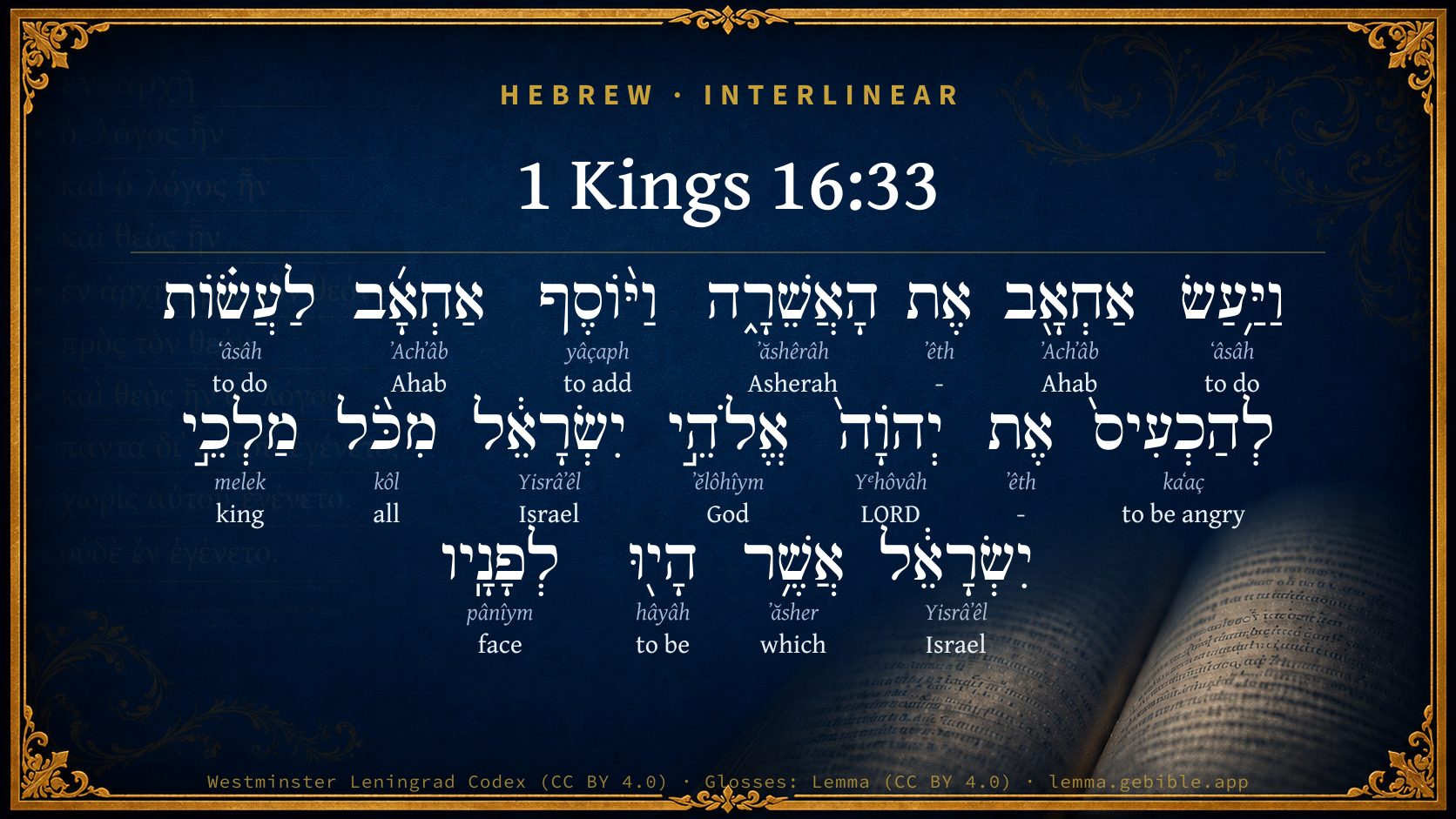
1 Kings 16:33

Hebrew (Westminster Leningrad Codex) 1 Kings 16:33 appears in the Hebrew Old Testament. The text above is from the Westminster Leningrad Codex. Each word links to its Strong’s number, a concise gloss, and parsing drawn from the Open Scriptures Hebrew Bible morphology. Click any word for its full Brown-Driver-Briggs (BDB) entry.
Download image
Cite this verse

1 Kings 16:33 (World English Bible). Public Domain. Lemma interlinear Bible study tool, https://lemma.gebible.app/v/1-kings/16/33.

Show BibTeX & RIS
BibTeX
RIS
English Translation
Ahab made the Asherah; and Ahab did yet more to provoke Yahweh, the God of Israel, to anger than all the kings of Israel who were before him.
World English Bible · Public Domain
Download a study sheet

One document with this verse’s original text, its word-by-word gloss line, the meaning frame, cross-references with their text, attributed commentary, and full source and license credits — printable, and it pastes into notes with its structure intact.

This verse Autodidact and up

Study sheet (.html) Plain text (.txt)

A passage Seminary Student

Up to 50 verses in one chapter. A passage sheet keeps up to 6 commentary sources and 12 cross-references per verse, in the order this page ranks them, and says so on the sheet whenever that leaves anything out. Ask for a single verse and you get the Autodidact verse sheet above.

Everything on this page stays free to read, with no account — the sheet is a download of what is already on screen, not access to it.

Want to remove ads? Support Godless Engineer
Compare translations 3

The same verse in 3 English versions, stacked beneath the original-language interlinear above. Click any original word for its lexicon entry.

Each is an independent rendering of the whole verse — the interlinear is not word-aligned to these translations.

Highlighted words mark where these versions differ — a whole-verse word diff, not a word-by-word alignment.

  • World English Bible Public Domain
    Ahab made the Asherah; and Ahab did yet more to provoke Yahweh, the God of Israel, to anger than all the kings of Israel who were before him.
  • King James Version Public Domain
    And Ahab made a grove; and Ahab did more to provoke the LORD God of Israel to anger than all the kings of Israel that were before him.
  • unfoldingWord Literal Text CC BY-SA 4.0
    And Ahab made an Asherah, and Ahab added to do to provoke Yahweh, the God of Israel, more than all of the kings of Israel who were to his face.

unfoldingWord Literal Text — © unfoldingWord, licensed CC BY-SA 4.0. Word-aligned USFM3 via Door43 (git.door43.org/unfoldingWord/en_ult).

Versions to compare (up to 4)

3 of 4 selected

Show all 18 translations

Every available English version of this verse, each an independent rendering of the whole verse.

  • World English Bible Public Domain
    Ahab made the Asherah; and Ahab did yet more to provoke Yahweh, the God of Israel, to anger than all the kings of Israel who were before him.
  • Berean Standard Bible Public Domain
    Then he set up an Asherah pole. Thus Ahab did more to provoke the LORD, the God of Israel, to anger than all the kings of Israel before him.
  • Majority Standard Bible Public Domain
    Then he set up an Asherah pole. Thus Ahab did more to provoke the LORD, the God of Israel, to anger than all the kings of Israel before him.
  • King James Version Public Domain
    And Ahab made a grove; and Ahab did more to provoke the LORD God of Israel to anger than all the kings of Israel that were before him.
  • American Standard Version (1901) Public Domain
    And Ahab made the Asherah; and Ahab did yet more to provoke Jehovah, the God of Israel, to anger than all the kings of Israel that were before him.
  • Revised Version (1885) Public Domain
    And Ahab made the Asherah; and Ahab did yet more to provoke the LORD, the God of Israel, to anger than all the kings of Israel that were before him.
  • Geneva Bible (1599) Public Domain
    And Ahab made a groue, and Ahab proceeded, and did prouoke the Lord God of Israel more then all the kings of Israel that were before him.
  • Douay-Rheims (1899) Public Domain
    And he planted a grove: and Achab did more to provoke the Lord the God of Israel, than all the kings of Israel that were before him.
  • Young's Literal Translation Public Domain
    and Ahab maketh the shrine, and Ahab addeth to do so as to provoke Jehovah, God of Israel, above all the kings of Israel who have been before him.
  • Literal Standard Version CC BY-SA 4.0
    and Ahab makes the Asherah, and Ahab adds to do so as to provoke YHWH, God of Israel, above all the kings of Israel who have been before him.
  • Unlocked Literal Bible CC BY-SA 4.0
    Ahab made an Asherah pole. Ahab did even more to provoke Yahweh, the God of Israel, to anger than all the kings of Israel who had been before him.
  • unfoldingWord Literal Text CC BY-SA 4.0
    And Ahab made an Asherah, and Ahab added to do to provoke Yahweh, the God of Israel, more than all of the kings of Israel who were to his face.
  • Darby Bible Public Domain
    And Ahab made the Asherah; and Ahab did more to provoke Jehovah the God of Israel to anger than all the kings of Israel that were before him.
  • World Messianic Bible Public Domain
    Ahab made the Asherah; and Ahab did more yet to provoke the LORD, the God of Israel, to anger than all the kings of Israel who were before him.
  • Webster's Bible Public Domain
    And Ahab made a grove; and Ahab did more to provoke the LORD God of Israel to anger than all the kings of Israel that were before him.
  • Free Bible Version CC BY-SA 4.0
    Then he put up an Asherah pole. In this way Ahab did more to anger the Lord, the God of Israel, than all the kings of Israel before him.
  • Bible in Basic English Public Domain
    And Ahab made an image of Asherah and did more than all the kings of Israel before him to make the Lord, the God of Israel, angry.
  • JPS Tanakh (1917) Public Domain
    And Ahab made the Asherah; and Ahab did yet more to provoke the LORD, the God of Israel, than all the kings of Israel that were before him.

Literal Standard Version (2020), Covenant Press — licensed CC BY-SA 4.0. Text via the HelloAO Bible API (eBible.org). Unlocked Literal Bible (unfoldingWord) — licensed CC BY-SA 4.0. Text via the HelloAO Bible API (eBible.org). unfoldingWord Literal Text — © unfoldingWord, licensed CC BY-SA 4.0. Word-aligned USFM3 via Door43 (git.door43.org/unfoldingWord/en_ult). Free Bible Version, Dr. Jonathan Gallagher — licensed CC BY-SA 4.0. Text via the HelloAO Bible API (eBible.org).

Word by word

More ways to search: Search by grammar → Find every occurrence → Compare this word →

Practice this passage: Drill this verse → Learn its vocabulary →

הָאֲשֵׁרָ֑ה
ʼăshêrâh
H842
“the · Asherah”
Particle, Definite Article + Noun, Proper
Part of Speech
Particle + Noun
Type
Proper
Full BDB Definition

Origin: from H833

TWOT: 183h

Ashera(h) = "groves (for idol worship)" - a Babylonian (Astarte)-Canaanite goddess (of fortune and happiness), the supposed consort of Baal, her images - the goddess, goddesses - her images - sacred trees or poles set up near an altar
  1. וַיַּ֥עַשׂ ʻâsâh H6213 “and · to do” Conjunction + Verb, Qal, Sequential Imperfect, 3rd Person, Masculine, Singular
  2. אַחְאָ֖ב ʼAchʼâb H256 “Ahab” Noun, Proper
  3. אֶת ʼêth H853 “-” Particle, Direct Object
  4. וַיּ֨וֹסֶף yâçaph H3254 “and · to add” Conjunction + Verb, Hiphil, Sequential Imperfect, 3rd Person, Masculine, Singular
  5. אַחְאָ֜ב ʼAchʼâb H256 “Ahab” Noun, Proper
  6. לַעֲשׂ֗וֹת ʻâsâh H6213 “to do” Preposition + Verb, Qal, Infinitive Construct
  7. לְהַכְעִיס֙ kaʻaç H3707 “to be angry” Preposition + Verb, Hiphil, Infinitive Construct
  8. אֶת ʼêth H853 “-” Particle, Direct Object
  9. יְהֹוָה֙ Yᵉhôvâh H3068 “LORD” Noun, Proper
  10. אֱלֹהֵ֣י ʼĕlôhîym H430 “God(s) of” Noun, Common, Masculine, Plural, Construct
  11. יִשְׂרָאֵ֔ל Yisrâʼêl H3478 “Israel” Noun, Proper
  12. מִכֹּ֨ל kôl H3605 “from · all of” Preposition + Noun, Common, Masculine, Singular, Construct
  13. מַלְכֵ֣י melek H4428 “kings of” Noun, Common, Masculine, Plural, Construct
  14. יִשְׂרָאֵ֔ל Yisrâʼêl H3478 “Israel” Noun, Proper
  15. אֲשֶׁ֥ר ʼăsher H834 “which” Particle, Relative
  16. הָי֖וּ hâyâh H1961 “to be” Verb, Qal, Perfect, 3rd Person, Common, Plural
  17. לְפָנָֽיו pânîym H6440 “to/for · face(s) · his” Preposition + Noun, Common, Both, Plural, Construct + Suffix, Personal, 3rd Person, Masculine, Singular

About this verse

These counts appear in no published source. They are computed here, from the morphology-tagged text and Lemma’s own curated glosses. What Lemma adds →

18
words
14
distinct lemmas
Historical
section

Shared distinctive vocabulary

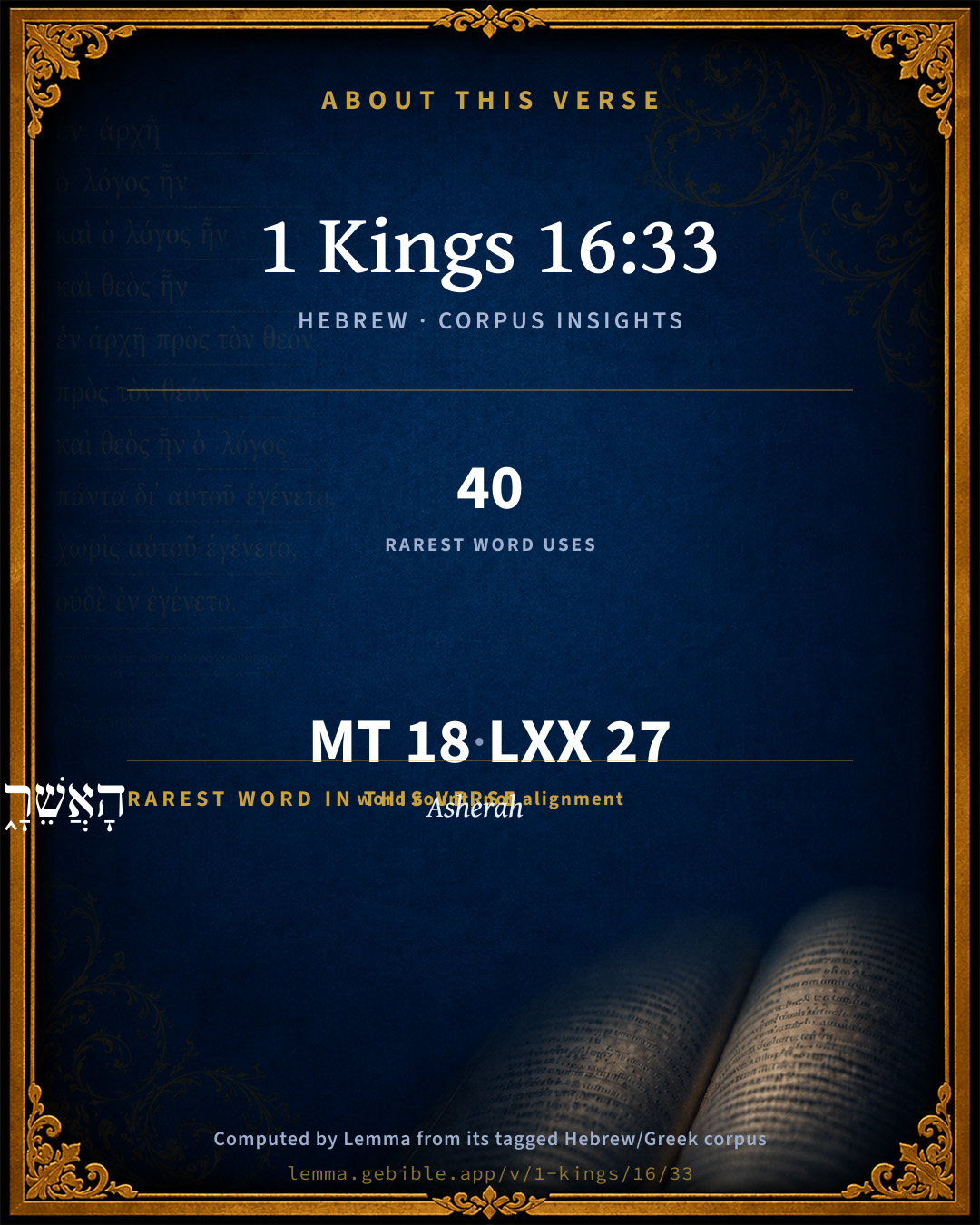
הָאֲשֵׁרָ֑ה Asherah H842 occurs in 40 verses of the Hebrew Bible. Also found in:

Grammatical profile

  • 5 verbs
  • 10 nouns
  • 3 particles

Verb forms

  • וַיַּ֥עַשׂ Qal · Sequential Imperfect
  • וַיּ֨וֹסֶף Hiphil · Sequential Imperfect
  • לַעֲשׂ֗וֹת Qal · Infinitive Construct
  • לְהַכְעִיס֙ Hiphil · Infinitive Construct
  • הָי֖וּ Qal · Perfect

Repetition

Words recur within this verse — often emphatic in Hebrew:

  • וַיַּ֥עַשׂ to do H6213 ×2
  • אַחְאָ֖ב Ahab H256 ×2
  • יִשְׂרָאֵ֔ל Israel H3478 ×2

Hebrew & Septuagint length

In English translation the verse runs 28 words from the Hebrew and 44 from the Septuagint (LXX English) — the Septuagint runs noticeably longer here. See the side-by-side →

A rough comparison of the two English renderings, which tokenize alike — not a word-level alignment.

Word counts can differ between the Hebrew and the Greek without any difference in meaning — e.g. the Hebrew direct-object marker אֵת has no separate Greek word, and Greek often adds the article ὁ.

In the original languages it is 18 Hebrew tokens and 27 Greek tokens — but the two are counted differently (Hebrew bundles its prefixes and suffixes into one token; the Greek is in lemma form), so that isn’t a like-for-like length.

Cross-references

11

Topical passages linked to 1 Kings 16:33 in the Treasury of Scripture Knowledge — connected by theme and wording, ordered by reader-vote popularity; previews shown in the World English Bible.

  • 2 Kings 13:6 Nevertheless they didn't depart from the sins of the house of Jeroboam, with which he made Israel to sin, but walked therein: and there remained the Asherah also in Samaria.)
  • 1 Kings 21:25 (But there was none like Ahab, who did sell himself to do that which was evil in the sight of Yahweh, whom Jezebel his wife stirred up.
  • Exodus 34:13 but you shall break down their altars, and dash in pieces their pillars, and you shall cut down their Asherim;
  • 2 Kings 21:3 For he built again the high places which Hezekiah his father had destroyed; and he reared up altars for Baal, and made an Asherah, as did Ahab king of Israel, and worshiped all the host of the sky, and served them.
  • 1 Kings 14:9 but have done evil above all who were before you, and have gone and made you other gods, and molten images, to provoke me to anger, and have cast me behind your back:
  • 1 Kings 16:29–30 In the thirty-eighth year of Asa king of Judah began Ahab the son of Omri to reign over Israel: and Ahab the son of Omri reigned over Israel in Samaria twenty-two years.
  • 1 Kings 21:19 You shall speak to him, saying, Thus says Yahweh, Have you killed and also taken possession? You shall speak to him, saying, Thus says Yahweh, In the place where dogs licked the blood of Naboth shall dogs lick your blood, even yours.
  • 1 Kings 22:6 Then the king of Israel gathered the prophets together, about four hundred men, and said to them, Shall I go against Ramoth-gilead to battle, or shall I forbear? They said, Go up; for the Lord will deliver it into the hand of the king.
  • 1 Kings 22:8 The king of Israel said to Jehoshaphat, there is yet one man by whom we may inquire of Yahweh, Micaiah the son of Imlah: but I hate him; for he does not prophesy good concerning me, but evil. Jehoshaphat said, "Don't let the king say so."
  • 2 Kings 17:16 They forsook all the commandments of Yahweh their God, and made them molten images, even two calves, and made an Asherah, and worshiped all the host of the sky, and served Baal.
  • Jeremiah 17:1–2 The sin of Judah is written with a pen of iron, [and] with the point of a diamond: it is engraved on the tablet of their heart, and on the horns of your altars;

Cross-references courtesy of OpenBible.info (CC BY 4.0).

Hebrew and Greek witnesses Masoretic Hebrew ↔ Greek Septuagint

The same verse in the two great witnesses to the Old Testament, shown verse-for-verse.

Here the Septuagint runs noticeably longer than the Hebrew — LXX2012 (modern English Septuagint) 44 words vs World English Bible 28. A rough length comparison of the two English translations, not a word-level alignment — read both below.

These are two independent witnesses, not word-aligned to each other, and the Septuagint is shown in lemma (dictionary) form.

Hebrew 1 Kings 16:33 Masoretic · Westminster Leningrad Codex

וַיַּ֥עַשׂ אַחְאָ֖ב אֶת הָאֲשֵׁרָ֑ה וַיּ֨וֹסֶף אַחְאָ֜ב לַעֲשׂ֗וֹת לְהַכְעִיס֙ אֶת יְהֹוָה֙ אֱלֹהֵ֣י יִשְׂרָאֵ֔ל מִכֹּ֨ל מַלְכֵ֣י יִשְׂרָאֵ֔ל אֲשֶׁ֥ר הָי֖וּ לְפָנָֽיו

Ahab made the Asherah; and Ahab did yet more to provoke Yahweh, the God of Israel, to anger than all the kings of Israel who were before him.

World English Bible · Public Domain

Greek LXX 1 Kings 16:33 Septuagint · lemma form

καί ποιέω αχααβ ἄλσος καί προςτίθημι αχααβ ὁ ποιέω παρόργισμα ὁ παραὀργίζω ὁ ψυχή αὐτός ὁ ἐκὀλεθρεύω κακοποιέω ὑπέρ πᾶς ὁ βασιλεύς ἰσραήλ ὁ γίγνομαι ἔμπροσθεν αὐτός

And Achaab made a grove; and Achaab did yet more abominably, to provoke the Lord God of Israel, and to sin against his own life so that he should be destroyed: he did evil above all the kings of Israel that were before him.

LXX2012 (modern English Septuagint) · Public Domain

On this verse, The Cambridge Bible for Schools and Colleges discusses the Septuagint’s reading. Read the note in Commentary ↓

Hebrew: Westminster Leningrad Codex (CC BY 4.0). Greek: Septuagint (public domain); English from LXX2012 (modern English Septuagint) (Public Domain). How the Septuagint differs from the Hebrew →

Targum (Aramaic paraphrase)

1

The Targum is the ancient Jewish Aramaic paraphrase of the Hebrew Scriptures — an interpretive translation, not the Hebrew text itself. Onkelos (literal) and Pseudo-Jonathan (expansive) render the Torah, and Jonathan the Prophets. Coverage is partial: where no permissively-licensed English translation exists for a verse, only the Aramaic is shown. This is verse-level text, not a word-by-word alignment to the Hebrew.

  1. Targum Jonathan Prophets (Joshua–Malachi)
    וַעֲבַד אַחְאָב יַת אֲשֵׁרָתָא וְאוֹסִיף אַחְאָב לְמֶעְבַּד לְאַרְגָזָא קֳדָם יְיָ אֱלָהָא דְיִשְׂרָאֵל מִכֹּל מַלְכֵי יִשְׂרָאֵל דַהֲווֹ קֳדָמוֹהִי:

    (no public-domain English translation for this verse)

    Targum Jonathan — Aramaic: “Mikraot Gedolot” (public domain). English: “Sefaria Community Translation” (CC0 1.0 (public-domain dedication)); “London "Chaldee Paraphrase," 1871” (public domain). Text via Sefaria.

Commentary

Notes on 1 Kings 16:33 from classic Christian and Jewish commentators (each source and its license shown beneath its notes). The classic Christian expositions comment on the surrounding passage and are grouped to its opening verse, so a note may address several verses; the Jewish commentaries on the Tanakh (Rashi and others) are per-verse, so they appear only where the commentator wrote on this verse.

Lemma curates 59 commentaries, every one of them public domain or Creative Commons licensed, each selected and text-cleaned for this edition rather than reprinted as found. About our sources →

Trapp's Complete Commentary

John Trapp

1Ki 16:33 And Ahab made a grove; and Ahab did more to provoke the LORD God of Israel to anger than all the kings of Israel that were before him.

Ver. 33. To provoke the Lord.] To defy him, and dare him do his worst.

John Trapp, A Commentary or Exposition upon All the Books of the Old and New Testament (1647–1656) — public domain. Text from a community e-Sword module.

Adam Clarke's Commentary

Verse 33. Ahab made a grove] אשרה Asherah, Astarte, or Venus; what the Syriac calls an idol, and the Arabic, a tall tree; probably meaning, by the last, an image of Priapus, the obscene keeper of groves, orchards, and gardens.

Adam Clarke's Commentary on the Bible (1810–1826) — public domain. Text from a community e-Sword/MySword module.

The Cambridge Bible for Schools and Colleges

gen. ed. J. J. S. Perowne

33. And Ahab made a grove] R.V. the Ashêrah. That is, the image which was to represent the female divinity, of which Baal was the male.

to provoke the Lord God of Israel to anger] Here the LXX. adds ‘and that his soul should be destroyed.’

The Cambridge Bible for Schools and Colleges (gen. ed. J. J. S. Perowne; Cambridge University Press, 1878–1918) — public domain. Text from a community e-Sword module.

Matthew Poole's English Annotations

Ahab made a grove, against God’s express prohibition, Deu 7:5.

Matthew Poole's English Annotations on the Holy Bible (1683–1685) — public domain. Text from a community e-Sword/MySword module.

Whedon's Commentary on the Bible

Daniel D. Whedon

33. Made a grove — Literally, made the Asherah; that is, he erected an idol-image of Asherah, another form of the name Ashtoreth or Astarte, the goddess of the Zidonians. See 1Ki_14:15. So he worshipped the male and female deities of Phenicia.

Daniel D. Whedon (gen. ed.), Commentary on the Old and New Testaments (1874–1909) — public domain. Text from a community e-Sword module.

The Pulpit Commentary

Ch. 1Ki_15:33)

1. Baasha"s crime. Behind the slaughter of his master and his master"s house lay the threatening of God. The Divine decree seemed to legalize the crime. But God"s command did not come to him, nor was he moved by righteous indignation against the sins of the house of Jeroboam. He served his own passions, and it was sin to him before God, "because he killed him." The iniquity of those who rush in to smite wrong and hypocritically veil their hatred and spite and greed under the plea of zeal for God and righteousness. (Rom_2:1)

2. His evil life. "He did evil in the sight of the Lord." State reforms are impossible for men whose own heart refuses God"s yoke. Our work can never rise higher than the level of our life. There is also a spiritual law of gravitation: the streams of our influence can only flow downward.

3. His hurtful reign. He "walked in the way of Jeroboam," etc. He may have condemned Jeroboam"s sin in regard to the calves, etc.; but when begirt with the same state exigencies he continued the course he himself had punished with death. It is easy to condemn the sins of others. God has nobler work for us: it is, when surrounded by their temptations to triumph over them, and to serve not by words only but by deeds.

II GOD"S MESSAGE TO BAASHA. (1Ki_16:1-7)

1. His exaltation was of God. "I exalted thee out of the dust." The throne was not secured by his wickedness. The Lord had stilled opposition and given him success.

1. It was great and unlooked for. His tribe had no claim to the throne, and his own place among his people was a mean one. But God had, step by step, advanced him, and was now enabling him to reign in peace. The Lord"s help is not withheld from those who do not know and do not serve Him. "Despisest thou the riches of His goodness and forbearance and long

2. suffering, not knowing that the goodness of God leadeth thee to repentance?" (Rom_2:4)

3. The return made to God. He had changed nothing. Israel was still being led down the path of darkness and judgment, "to provoke Me to anger with their sins." Every higher interest was sacrificed to the policy of keeping the ten tribes separated from the other two. Statesmen out of office condemn that which, when in office, they are afraid to change. And how many are there who are neglecting the trusts God has committed to them. Once they said, "If we had only place or wealth, etc., God would be served and men blessed." These have been given and what has been done? Has the vow been performed?

4. Baasha"s punishment worse than Jeroboam"s. "I will take away the posterity of Baasha and the posterity of his house" (see ver. 11, "Neither of his kindred nor of his friends"). The Divine justice is shown in the differing penalties of sin. J.U. And Ahab made a grove Heb. an Asherah, i.e., image of Astarte, a female figure corresponding to the male effigy just described. (See note on 1Ki_14:23) and Ahab did more to provoke the Lord God of Israel to anger than all the kings of Israel that were before him.

The Pulpit Commentary (1880–1919), ed. H.D.M. Spence-Jones & Joseph S. Exell — public domain. Text from a community e-Sword module.

Keil & Delitzsch

C. F. Keil & F. Delitzsch

"And Ahab made את־האשׁרה, i.e., the Asherah belonging to the temple of Baal" (see at Jdg 6:25 and Exo 34:13), an idol of Astarte (see at Kg1 14:23).

Keil & Delitzsch — Biblical Commentary on the Old Testament (1861–1891) — public domain (CC PDM 1.0). Text via the HelloAO Bible API. (Old Testament only.)

Rashi

Rabbi Shlomo Yitzchaki (Rashi)

An Asheirah. A tree that is worshiped..—Radak

Rashi on the Tanakh — English translations: “The Judaica Press complete Tanach with Rashi, translated by A. J. Rosenberg” (CC BY 4.0); “Pentateuch with Rashi's commentary by M. Rosenbaum and A.M. Silbermann, 1929-1934” (public domain); “The Metsudah Tanach series, Lakewood, N.J” (CC BY 4.0); and “The Book of Joshua, Metsudah Publications, 1997” (CC BY 4.0). Text via Sefaria.

Lesson kit

Teaching starters — assembled from the data on this page, not authored interpretation. Every prompt links to the verse data it draws on. Edit before teaching.

1 Kings, in the Historical, opens this verse with 18 words (14 distinct Hebrew lemmas). Its most distinctive word is ʼăshêrâh (“Asherah”). The Greek Septuagint runs longer here. A historical commentator’s framing appears above. Read the whole chapter for the surrounding context.

Discussion questions

  1. What does “Asherah” (ʼăshêrâh) contribute to the verse as a whole?
  2. Exodus 34:13 shares the word «Asherah» with this verse. How do the two illuminate each other?
  3. “to do” occurs 2× in this one verse. What is the effect of the repetition?
  4. Compared with the Hebrew, the Septuagint runs longer here. What questions does that raise?
  5. These translations render this verse differently. What is at stake in choosing one wording over another?
  6. The verb «וַיַּ֥עַשׂ» is Qal Sequential Imperfect. How does its form color the action?
  7. Reading how Trapp's Complete Commentary and Adam Clarke's Commentary read this verse, where do the two commentators agree and where do they part?

Things to notice

Reading settings

Reading text

Shown beneath each verse's original-language words.

Old Testament
Old Testament edition

Read the OT as the Masoretic Hebrew (MT) or the Greek Septuagint (LXX).

English shown for the Greek Septuagint (in the Hebrew ↔ Greek comparison).

Comparing translations? Open the Compare panel on any verse page to stack up to four side by side.