Isaiah 47:5

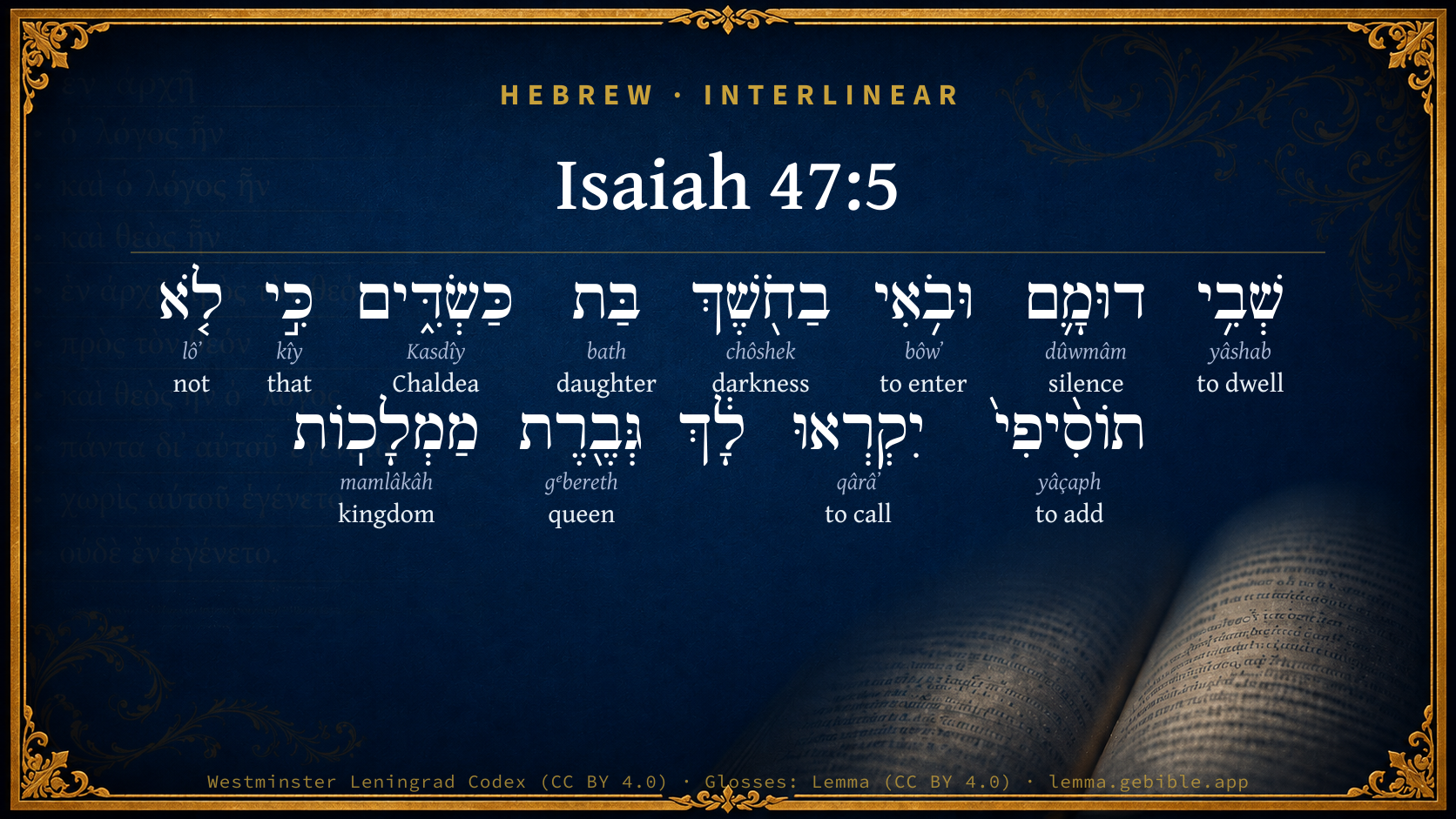
Hebrew (Westminster Leningrad Codex) Isaiah 47:5 appears in the Hebrew Old Testament. The text above is from the Westminster Leningrad Codex. Each word links to its Strong’s number, a concise gloss, and parsing drawn from the Open Scriptures Hebrew Bible morphology. Click any word for its full Brown-Driver-Briggs (BDB) entry.
Download image
Cite this verse

Isaiah 47:5 (World English Bible). Public Domain. Lemma interlinear Bible study tool, https://lemma.gebible.app/v/isaiah/47/5.

Show BibTeX & RIS
BibTeX
RIS
English Translation
Sit you silent, and get you into darkness, daughter of the Chaldeans; for you shall no more be called The mistress of kingdoms.
World English Bible · Public Domain
Highlights
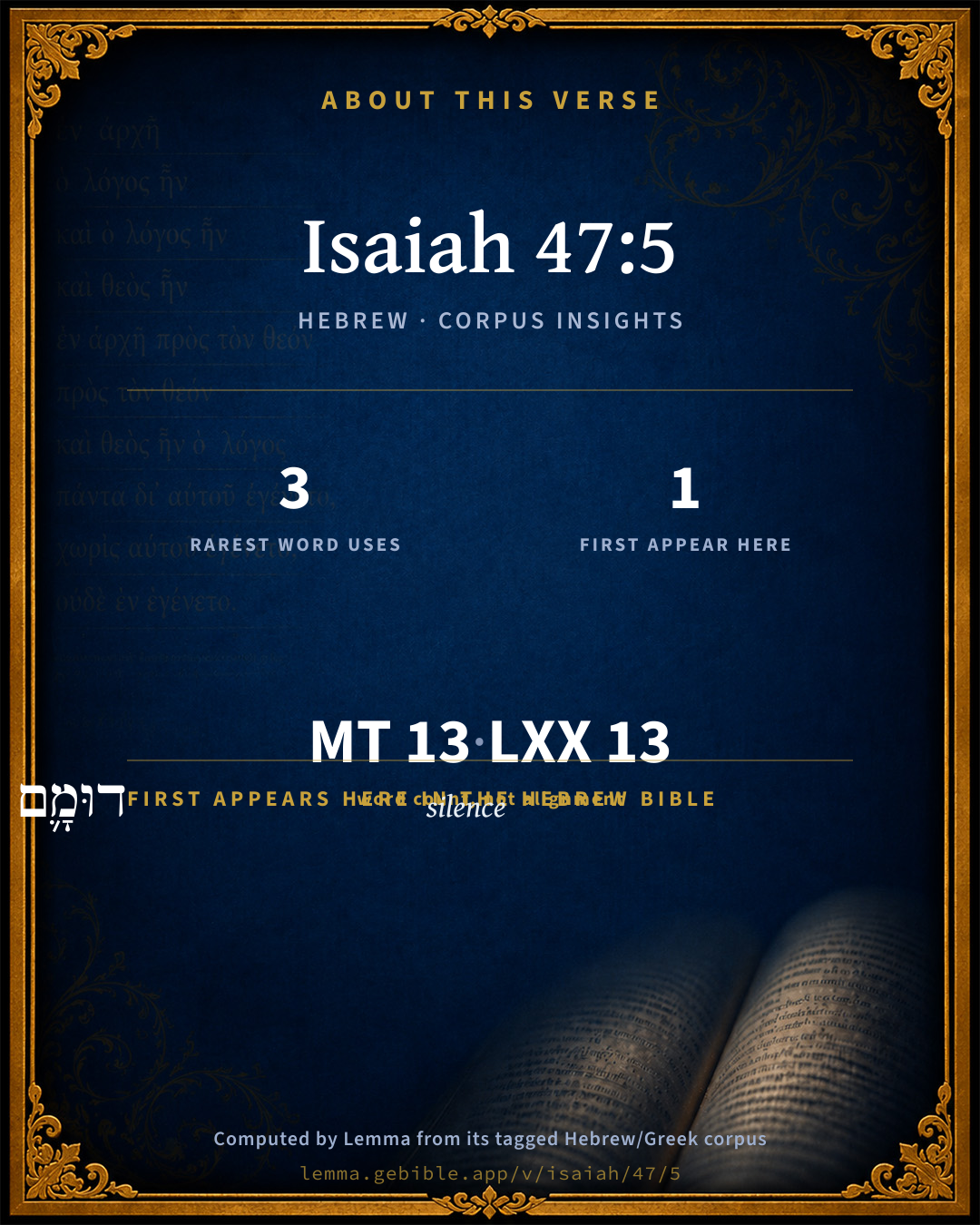
  • 1 first appearance in the Hebrew Bible
Full analysis ↓
Download a study sheet

One document with this verse’s original text, its word-by-word gloss line, the meaning frame, cross-references with their text, attributed commentary, and full source and license credits — printable, and it pastes into notes with its structure intact.

This verse Autodidact and up

Study sheet (.html) Plain text (.txt)

A passage Seminary Student

Up to 50 verses in one chapter. A passage sheet keeps up to 6 commentary sources and 12 cross-references per verse, in the order this page ranks them, and says so on the sheet whenever that leaves anything out. Ask for a single verse and you get the Autodidact verse sheet above.

Everything on this page stays free to read, with no account — the sheet is a download of what is already on screen, not access to it.

Want to remove ads? Support Godless Engineer
Compare translations 3

The same verse in 3 English versions, stacked beneath the original-language interlinear above. Click any original word for its lexicon entry.

Each is an independent rendering of the whole verse — the interlinear is not word-aligned to these translations.

Highlighted words mark where these versions differ — a whole-verse word diff, not a word-by-word alignment.

  • World English Bible Public Domain
    Sit you silent, and get you into darkness, daughter of the Chaldeans; for you shall no more be called The mistress of kingdoms.
  • King James Version Public Domain
    Sit thou silent, and get thee into darkness, O daughter of the Chaldeans: for thou shalt no more be called, The lady of kingdoms.
  • unfoldingWord Literal Text CC BY-SA 4.0
    “Sit silently and go into darkness, daughter of the Chaldeans, for you will not make add they should call you ‘The Mistress of Kingdoms.’

unfoldingWord Literal Text — © unfoldingWord, licensed CC BY-SA 4.0. Word-aligned USFM3 via Door43 (git.door43.org/unfoldingWord/en_ult).

Versions to compare (up to 4)

3 of 4 selected

Show all 18 translations

Every available English version of this verse, each an independent rendering of the whole verse.

  • World English Bible Public Domain
    Sit you silent, and get you into darkness, daughter of the Chaldeans; for you shall no more be called The mistress of kingdoms.
  • Berean Standard Bible Public Domain
    “Sit in silence and go into darkness, O Daughter of Chaldea. For you will no longer be called the queen of kingdoms.
  • Majority Standard Bible Public Domain
    “Sit in silence and go into darkness, O Daughter of the Chaldeans. For you will no longer be called the queen of kingdoms.
  • King James Version Public Domain
    Sit thou silent, and get thee into darkness, O daughter of the Chaldeans: for thou shalt no more be called, The lady of kingdoms.
  • American Standard Version (1901) Public Domain
    Sit thou silent, and get thee into darkness, O daughter of the Chaldeans; for thou shalt no more be called The mistress of kingdoms.
  • Revised Version (1885) Public Domain
    Sit thou silent, and get thee into darkness, O daughter of the Chaldeans: for thou shalt no more be called The lady of kingdoms.
  • Geneva Bible (1599) Public Domain
    Sit still, and get thee into darkenesse, O daughter of the Chaldeas: for thou shalt no more be called, The ladie of kingdomes.
  • Douay-Rheims (1899) Public Domain
    Sit thou silent, and get thee into darkness, O daughter of the Chaldeans: for thou shalt no more be called the lady of kingdoms.
  • Young's Literal Translation Public Domain
    Sit silent, and go into darkness, O daughter of the Chaldeans, For no more do they cry to thee, `Mistress of kingdoms.'
  • Literal Standard Version CC BY-SA 4.0
    “Sit silent, and go into darkness, || O daughter of the Chaldeans, || For they no longer cry to you, Mistress of kingdoms.
  • Unlocked Literal Bible CC BY-SA 4.0
    Sit in silence and go into darkness, daughter of the Chaldeans; for you will no longer be called queen of kingdoms.
  • unfoldingWord Literal Text CC BY-SA 4.0
    “Sit silently and go into darkness, daughter of the Chaldeans, for you will not make add they should call you ‘The Mistress of Kingdoms.’
  • Darby Bible Public Domain
    Sit silent, and get thee into darkness, daughter of the Chaldeans; for thou shalt no more be called, Mistress of kingdoms.
  • World Messianic Bible Public Domain
    “Sit in silence, and go into darkness, daughter of the Kasdim. For you shall no longer be called the mistress of kingdoms.
  • Webster's Bible Public Domain
    Sit thou silent, and get thee into darkness, O daughter of the Chaldeans: for thou shalt no more be called, The lady of kingdoms.
  • Free Bible Version CC BY-SA 4.0
    Sit quietly, and go into the darkness, daughter of Babylonia. Never again will you be called queen of all kingdoms.
  • Bible in Basic English Public Domain
    Be seated in the dark without a word, O daughter of the Chaldaeans: for you will no longer be named, The Queen of Kingdoms.
  • JPS Tanakh (1917) Public Domain
    Sit thou silent, and get thee into darkness, O daughter of the Chaldeans; for thou shalt no more be called the mistress of kingdoms.

Literal Standard Version (2020), Covenant Press — licensed CC BY-SA 4.0. Text via the HelloAO Bible API (eBible.org). Unlocked Literal Bible (unfoldingWord) — licensed CC BY-SA 4.0. Text via the HelloAO Bible API (eBible.org). unfoldingWord Literal Text — © unfoldingWord, licensed CC BY-SA 4.0. Word-aligned USFM3 via Door43 (git.door43.org/unfoldingWord/en_ult). Free Bible Version, Dr. Jonathan Gallagher — licensed CC BY-SA 4.0. Text via the HelloAO Bible API (eBible.org).

Word by word

More ways to search: Search by grammar → Find every occurrence → Compare this word →

Practice this passage: Drill this verse → Learn its vocabulary →

דוּמָ֛ם
dûwmâm
H1748
“silence”
Adverb
Part of Speech
Adverb
Full BDB Definition

Origin: from H1826

TWOT: 415c

silence (noun masculine) - in silence, silently (adverb)
  1. שְׁבִ֥י yâshab H3427 “dwell” Verb, Qal, Imperative, 2nd Person, Feminine, Singular
  2. וּבֹ֥אִי bôwʼ H935 “and · enter” Conjunction + Verb, Qal, Imperative, 2nd Person, Feminine, Singular
  3. בַחֹ֖שֶׁךְ chôshek H2822 “in/at the · darkness” Preposition, Determined + Noun, Common, Masculine, Singular, Absolute
  4. בַּת bath H1323 “daughter of” Noun, Common, Feminine, Singular, Construct
  5. כַּשְׂדִּ֑ים Kasdîy H3778 “Chaldea” Noun, Proper
  6. כִּ֣י kîy H3588 “that” Conjunction
  7. לֹ֤א lôʼ H3808 “not” Particle, Negative
  8. תוֹסִ֨יפִי֙ yâçaph H3254 “to add” Verb, Hiphil, Imperfect, 2nd Person, Feminine, Singular
  9. יִקְרְאוּ qârâʼ H7121 “to call” Verb, Qal, Imperfect, 3rd Person, Masculine, Plural
  10. גְּבֶ֖רֶת gᵉbereth H1404 “queen of” Noun, Common, Feminine, Singular, Construct
  11. מַמְלָכֽוֹת mamlâkâh H4467 “kingdoms” Noun, Common, Feminine, Plural, Absolute

About this verse

These counts appear in no published source. They are computed here, from the morphology-tagged text and Lemma’s own curated glosses. What Lemma adds →

13
words
12
distinct lemmas
Prophets
section

Notable vocabulary

The rarest word here is דוּמָ֛ם silence H1748 — appearing just 3 times in the whole Hebrew Bible.

First appearance in Scripture

This word makes its first canonical appearance in the Hebrew Bible here:

  • דוּמָ֛ם silence H1748

Shared distinctive vocabulary

דוּמָ֛ם silence H1748 occurs in 3 verses of the Hebrew Bible. Also found in:

Grammatical profile

  • 4 verbs
  • 5 nouns
  • 1 preposition
  • 1 conjunction
  • 1 adverb
  • 1 particle

Verb forms

  • שְׁבִ֥י Qal · Imperative
  • וּבֹ֥אִי Qal · Imperative
  • תוֹסִ֨יפִי֙ Hiphil · Imperfect
  • יִקְרְאוּ Qal · Imperfect

Hebrew & Septuagint length

In English translation the verse runs 23 words from the Hebrew and 25 from the Septuagint (LXX English) — closely comparable.

A rough comparison of the two English renderings, which tokenize alike — not a word-level alignment.

Word counts can differ between the Hebrew and the Greek without any difference in meaning — e.g. the Hebrew direct-object marker אֵת has no separate Greek word, and Greek often adds the article ὁ.

In the original languages it is 13 Hebrew tokens and 13 Greek tokens — but the two are counted differently (Hebrew bundles its prefixes and suffixes into one token; the Greek is in lemma form), so that isn’t a like-for-like length.

Cross-references

22

Topical passages linked to Isaiah 47:5 in the Treasury of Scripture Knowledge — connected by theme and wording, ordered by reader-vote popularity; previews shown in the World English Bible.

  • Isaiah 47:7 You said, I shall be mistress forever; so that you did not lay these things to your heart, neither did remember the latter end of it.
  • Habakkuk 2:20 But Yahweh is in his holy temple. Let all the earth be silent before him!"
  • Revelation 18:16–19 saying, 'Woe, woe, the great city, she who was dressed in fine linen, purple, and scarlet, and decked with gold and precious stones and pearls!
  • 1 Samuel 2:9 He will keep the feet of his holy ones; But the wicked shall be put to silence in darkness; For by strength shall no man prevail.
  • Psalms 31:17 Let me not be disappointed, Yahweh, for I have called on you. Let the wicked be disappointed. Let them be silent in Sheol.
  • Psalms 46:10 "Be still, and know that I am God. I will be exalted among the nations. I will be exalted in the earth."
  • Isaiah 13:10 For the stars of the sky and the constellations of it shall not give their light; the sun shall be darkened in its going forth, and the moon shall not cause its light to shine.
  • Isaiah 13:19–20 Babylon, the glory of kingdoms, the beauty of the Chaldeans' pride, shall be as when God overthrew Sodom and Gomorrah.
  • Isaiah 14:4 that you shall take up this parable against the king of Babylon, and say, How has the oppressor ceased! the golden city ceased!
  • Isaiah 14:23 I will also make it a possession for the porcupine, and pools of water: and I will sweep it with the broom of destruction, says Yahweh of Hosts.
  • Isaiah 47:1 Come down, and sit in the dust, virgin daughter of Babylon; sit on the ground without a throne, daughter of the Chaldeans: for you shall no more be called tender and delicate.
  • Jeremiah 8:14 Why do we sit still? assemble yourselves, and let us enter into the fortified cities, and let us be silent there; for Yahweh our God has put us to silence, and given us water of gall to drink, because we have sinned against Yahweh.
  • Jeremiah 25:10 Moreover I will take from them the voice of mirth and the voice of gladness, the voice of the bridegroom and the voice of the bride, the sound of the millstones, and the light of the lamp.
  • Lamentations 1:1 How does the city sit solitary, that was full of people! She has become as a widow, who was great among the nations! She who was a princess among the provinces is become tributary!
  • Daniel 2:37–38 You, O king, are king of kings, to whom the God of heaven has given the kingdom, the power, and the strength, and the glory;
  • Zechariah 2:13 Be silent, all flesh, before Yahweh; for he has roused himself from his holy habitation!"
  • Matthew 22:12–13 and he said to him, 'Friend, how did you come in here not wearing wedding clothing?' He was speechless.
  • Jude 1:13 wild waves of the sea, foaming out their own shame; wandering stars, for whom the blackness of darkness has been reserved forever.
  • Revelation 17:3–5 He carried me away in the Spirit into a wilderness. I saw a woman sitting on a scarlet-colored animal, full of blasphemous names, having seven heads and ten horns.
  • Revelation 17:18 The woman whom you saw is the great city, which reigns over the kings of the earth."
  • Revelation 18:7 However much she glorified herself, and grew wanton, so much give her of torment and mourning. For she says in her heart, 'I sit a queen, and am no widow, and will in no way see mourning.'
  • Revelation 18:21–24 A mighty angel took up a stone like a great millstone and cast it into the sea, saying, "Thus with violence will Babylon, the great city, be thrown down, and will be found no more at all.

Cross-references courtesy of OpenBible.info (CC BY 4.0).

Hebrew and Greek witnesses Masoretic Hebrew ↔ Greek Septuagint

The same verse in the two great witnesses to the Old Testament, shown verse-for-verse.

These are two independent witnesses, not word-aligned to each other, and the Septuagint is shown in lemma (dictionary) form.

Hebrew Isaiah 47:5 Masoretic · Westminster Leningrad Codex

שְׁבִ֥י דוּמָ֛ם וּבֹ֥אִי בַחֹ֖שֶׁךְ בַּת כַּשְׂדִּ֑ים כִּ֣י לֹ֤א תוֹסִ֨יפִי֙ יִקְרְאוּ לָ֔ךְ גְּבֶ֖רֶת מַמְלָכֽוֹת

Sit you silent, and get you into darkness, daughter of the Chaldeans; for you shall no more be called The mistress of kingdoms.

World English Bible · Public Domain

Greek LXX Isaiah 47:5 Septuagint · lemma form

καταἵζω κατανύσσω εἰςἔρχομαι εἰς ὁ σκότος θυγάτηρ χαλδαῖος οὐκέτι μή καλέω ἰσχύς βασιλεία

Sit you down pierced with woe, go into darkness, O daughter of the Chaldeans: you shall no more be called the strength of a kingdom.

LXX2012 (modern English Septuagint) · Public Domain

Hebrew: Westminster Leningrad Codex (CC BY 4.0). Greek: Septuagint (public domain); English from LXX2012 (modern English Septuagint) (Public Domain). How the Septuagint differs from the Hebrew →

Targum (Aramaic paraphrase)

1

The Targum is the ancient Jewish Aramaic paraphrase of the Hebrew Scriptures — an interpretive translation, not the Hebrew text itself. Onkelos (literal) and Pseudo-Jonathan (expansive) render the Torah, and Jonathan the Prophets. Coverage is partial: where no permissively-licensed English translation exists for a verse, only the Aramaic is shown. This is verse-level text, not a word-by-word alignment to the Hebrew.

  1. Targum Jonathan Prophets (Joshua–Malachi)
    תְּבִי שַׁתְקָא וְעוּלֵי בְקִבְלָא יְקַר מַלְכוּת כַּסְדָאֵי אֲרֵי לָא תּוֹסִיפִין דְיִקְרוֹן לִיךְ תְּקֵיפַת מַלְכְּוָן:

    Sit thou silent, and get thee into darkness, o glory of the kingdom of Chaldeans; thou shalt no more be called, The mighty one of the kingdoms.

    Targum Jonathan — Aramaic: “Mikraot Gedolot” (public domain). English: “Sefaria Community Translation” (CC0 1.0 (public-domain dedication)); “London "Chaldee Paraphrase," 1871” (public domain). Text via Sefaria.

Commentary

Notes on Isaiah 47:5 from classic Christian and Jewish commentators (each source and its license shown beneath its notes). The classic Christian expositions comment on the surrounding passage and are grouped to its opening verse, so a note may address several verses; the Jewish commentaries on the Tanakh (Rashi and others) are per-verse, so they appear only where the commentator wrote on this verse.

Lemma curates 59 commentaries, every one of them public domain or Creative Commons licensed, each selected and text-cleaned for this edition rather than reprinted as found. About our sources →

Trapp's Complete Commentary

John Trapp

Isa 47:5 Sit thou silent, and get thee into darkness, O daughter of the Chaldeans: for thou shalt no more be called, The lady of kingdoms.

Ver. 5. Sit thou silent.] Here he threateneth Babylon with loss of her former fame; she shall be buried in obscurity and oblivion, as out of sight and out of mind, no longer called the ‘lady of kingdoms,’ but a wretched drudge, ut de Hecuba tradunt tragici.

For thou shalt no more be called.] Heb., Thou shalt not add to be called. Oecolampadius senseth it thus, Thou wast wont to be called the lady of kingdoms, now they shall call thee, Non adiecies, as desperate and irrecoverable. And why?

John Trapp, A Commentary or Exposition upon All the Books of the Old and New Testament (1647–1656) — public domain. Text from a community e-Sword module.

Joseph Benson's Commentary

Isa 47:5-6. Sit thou silent — Through grief and shame, and as mourners used to do, Job 2:13. Cease thy vaunting and insolent speeches. And get thee into darkness — Thou shalt go into an obscure, disconsolate, and calamitous condition. Thou shalt no more be the lady of kingdoms — The chief and glory of all kingdoms; the most large, potent, and glorious empire of the world, as thou hast been. I was wroth with my people — “The metaphor in this verse,” says Vitringa, “is taken from a father, who, being angry with his children, delivers them up to chastisement; but his anger soon subsiding, and his affection reviving, he turns his indignation against those who had so executed his commands, as to punish immoderately and severely.” I have polluted mine inheritance — I cast them away as an unclean thing; I stained their glory; I removed them from the place of my presence and worship; I banished them into a polluted land, among unclean persons, by whom they were many ways defiled. And given them into thy hand — To punish them. Thou didst show them no mercy — Thou hast exceeded the bounds of thy commission, and, instead of that compassion which humanity teaches men to show to such as are in misery, thou didst exercise toward them the greatest cruelty. Upon the ancient — The old and feeble, whose venerable gray hairs should have been their sufficient protection; hast thou very heavily laid thy yoke — Not considering that, besides the calamity of being made captives, they were afflicted with the miseries of old age, and therefore required both thy pity and reverence. It is justly observed here by Bishop Lowth, that “God, in the course of his providence, makes use of great conquerors and tyrants, as his instruments, to execute his judgments in the earth: he employs one wicked nation to scourge another. The inflicter of the punishment may, perhaps, be as culpable as the sufferer, and may add to his guilt by indulging his cruelty in executing God’s justice. When he has fulfilled the work to which divine vengeance has ordained him, he will become himself the object of it: see Isa 10:5-12. God charges the Babylonians, though employed by himself to chastise his people, with cruelty in regard to them. They exceeded the bounds of justice and humanity in oppressing and destroying them; and though they were really executing the righteous decree of God, yet, as far as it regarded themselves, they were only indulging their own ambition and violence.”

Joseph Benson's Commentary on the Old and New Testaments (1811–1818) — public domain. Text from a community e-Sword module.

Tyndale Open Study Notes

Tyndale Open Resources

47:5-11 Babylon’s confidence and arrogance were well known (see 14:13-17; Dan 4:30). All of this nation’s charms, magic, and wisdom were useless against the disaster decreed for it.

Tyndale Open Study Notes — © Tyndale Open Resources, licensed CC BY-SA 4.0. Text via the HelloAO Bible API.

Geneva Bible (1599)

Geneva Bible translators

For very shame, and hide thyself.

Geneva Bible (1599) marginal notes — public domain. Text via Bolls.life.

Jamieson, Fausset & Brown

Robert Jamieson, A. R. Fausset & David Brown

Sit--the posture of mourning (Ezr 9:4; Job 2:13; Lam 2:10).

darkness--mourning and misery (Lam 3:2; Mic 7:8).

lady of kingdoms--mistress of the world (Isa 13:19).

Jamieson, Fausset & Brown — Commentary Critical and Explanatory on the Whole Bible (1871) — public domain (CC PDM 1.0). Text via the HelloAO Bible API.

The Cambridge Bible for Schools and Colleges

gen. ed. J. J. S. Perowne

5. get thee into darkness] Darkness may be a symbol either of imprisonment (ch. Isa_42:7) or, more generally, of misery; Lam_3:2.

lady of kingdoms] Lit. “mistress” (Isa_24:2). The word is used of the queen in Jer_13:18, in a connexion somewhat similar to this. Babylon is addressed as an imperial city holding the destinies of many kingdoms in her hands.

5–7. The second strophe commences anew with an apostrophe to Babylon. The keynote is struck in the words “mistress of kingdoms.” She is threatened with the loss of her imperial power, because she has so grossly abused it by her cruelty to Israel.

The Cambridge Bible for Schools and Colleges (gen. ed. J. J. S. Perowne; Cambridge University Press, 1878–1918) — public domain. Text from a community e-Sword module.

John Gill's Exposition

Sit thou silent,.... Here the speech is directed again to Babylon, which used to be a place of noise and hurry, as well as famous and much talked of all the world over; but now there should be a deep silence in it, no voice to be heard, the inhabitants being gone, and no discourse concerning it; no more talked of and celebrated for its magnificence and authority, trade and riches, but buried in oblivion. It is represented as sitting in silence, either as a mourner, or as one that is free among the dead, remembered no more:

and get thee into darkness, O daughter of the Chaldeans; meaning either captivity or imprisonment, prison houses being dark; or into the state of the dead, which is a state of darkness:

for thou shall no more be called the lady of kingdoms; the mistress or governess of them, as she had been, having subdued many kingdoms and nations, and added them to her monarchy, which now would be at an end. Thus mystical Babylon, or Rome, has reigned over the kings of the earth, and has been mistress over many nations; but the time is coming when she will sit in silence, and no voice will be heard in her; and when the kingdom of the beast will be full of darkness, Rev 17:15.

John Gill's Exposition of the Whole Bible (1746–1763) — public domain (CC PDM 1.0). Text via the HelloAO Bible API.

Albert Barnes' Notes on the Bible

Sit thou silent - The same general sentiment is expressed here as in the preceding verses, though the figure is changed. In Isa 47:1-3, Babylon is represented under the image of a frivolous and delicately-reared female, suddenly reduced from her exalted station, and compelled to engage in the most menial and laborious employment. Here she is represented as in a posture of mourning. To sit in silence is emblematic of deep sorrow, or affliction (see Lam 2:10): ‘The elders of the daughter of Zion sit upon the ground and keep silence, they have cast up dust upon their heads;’ - see the note at Isa 3:26 : ‘And she (Jerusalem) being desolate shall sit upon the ground;’ Job 2:13 : ‘So they (the three friends of Job) sat down with him upon the ground seven days and seven nights, and none spake a word unto him, for they saw that his grief was very great.’ Compare Ezr 9:4.

Get thee into darkness - That is, into a place of mourning. Persons greatly afflicted, almost as a matter of course, shut out the light from their dwellings, as emblematic of their feelings. This is common even in this country - and particularly in the city in which I write where the universal custom prevails of making a house dark during the time of mourning. Nature prompts to this, for there is an obvious similarity between darkness and sorrow. That this custom also prevailed in the East is apparent (see Lam 3:2): ‘He hath led me, and brought me into darkness, and not into light;’ Mic. 8:8: ‘When I sit in darkness, the Lord shall be a light unto me.’ The idea is, that Babylon would be brought to desolation, and have occasion of sorrow, like a delicately-trained female suddenly deprived of children Isa 47:9, and that she would seek a place of darkness and silence where she might fully indulge her grief.

O daughter of the Chaldeans - (See the notes at Isa 47:1).

For thou shalt no more be called The lady of kingdoms - The magnificence, splendor, beauty, and power, which have given occasion to this appellation, and which have led the nations by common consent to give it to thee, shall be entirely and forever removed. The appellation, ‘lady of kingdoms.’ is equivalent to that so often used of Rome, as ‘the mistress of the world;’ and the idea is, that Babylon sustained by its power and splendor the relation of mistress, and that all other cities were regarded as servants, or as subordinate.

Albert Barnes' Notes on the Bible (1834–1885) — public domain. Text from a community e-Sword/MySword module.

Matthew Poole's English Annotations

Sit thou silent, through grief and shame, and as mourners use to do, Job 2:13. Cease thy vaunting and insolent speeches; thou canst say nothing for thine own justification.

Get thee into darkness; thou shalt go into an obscure, disconsolate, and calamitous condition.

Thou shalt no more be called, The lady of kingdoms; the chief and glory of all kingdoms, as Isa 13:19, the most large, and potent, and glorious empire of the world, as thou hast been.

Matthew Poole's English Annotations on the Holy Bible (1683–1685) — public domain. Text from a community e-Sword/MySword module.

Whedon's Commentary on the Bible

Daniel D. Whedon

5. Sit thou silent — The prophet spoke, in preceding verse, in his own person. He now speaks in God’s name. He uses imperatives. Hebraistically these are predictives, the same as, Sit thou silent: lady (or mistress) of kingdoms thou shalt no more be called.

Daniel D. Whedon (gen. ed.), Commentary on the Old and New Testaments (1874–1909) — public domain. Text from a community e-Sword module.

The Pulpit Commentary

Sit thou silent, and get thee into darkness. The second strophe begins, like the first, with a double imperative. The fallen people is recommended to hide its shame in silence and darkness, as disgraced persons do who shrink from being seen by their fellows. Thou shalt no more be called The lady of kingdoms. Babylon can scarcely have borne this title in Isaiah"s time, or at any earlier period, unless it were a very remote one. She had been secondary to Assyria for at least six hundred years when Isaiah wrote, and under Sennacherib was ruled by viceroys of his appointment. But Isaiah"s prophetic foresight enables him to realize the later period of Babylon"s prosperity and glory under Nabopolassar and Nebuchadnezzar, when she became the inheritress of the greatness of Assyria, and exercised rule over a large portion of Western Asia. Nebuchadnezzar was, no doubt, as he is called by both Ezekiel (Eze_26:7) and Daniel, (Dan_2:37) a "king of kings;" and Babylon was then an empress-state, exercising authority over many minor kingdoms. It is clear that, both in the earlier and the later chapters, the prophet realizes this condition of things. (see Isa_13:19 Isa_14:4-6, Isa_14:12-17; as well as the present passage)

The Pulpit Commentary (1880–1919), ed. H.D.M. Spence-Jones & Joseph S. Exell — public domain. Text from a community e-Sword module.

John Wesley's Explanatory Notes

Silent - Thro' grief and shame, as mourners use to do. The lady - The chief and glory of all kingdoms.

John Wesley, Explanatory Notes Upon the Whole Bible (1754–1765) — public domain. Text via the GEBible commentary corpus.

Keil & Delitzsch

C. F. Keil & F. Delitzsch

In the second strophe the penal sentence of Jehovah is continued. "Sit silent, and creep into the darkness, O Chaldeans-daughter! for men no longer call thee lady of kingdoms. I was wroth with my people; I polluted mine inheritance, and gave them into thy hand: thou hast shown them no mercy; upon old men thou laidst thy yoke very heavily. And thou saidst, I shall be lady for ever; so that thou didst not take these things to heart: thou didst not consider the latter end thereof." Babylon shall sit down in silent, brooding sorrow, and take herself away into darkness, just as those who have fallen into disgrace shrink from the eyes of men. She is looked upon as an empress (Isa 13:9; the king of Babylon called himself the king of kings, Eze 26:7), who has been reduced to the condition of a slave, and durst not show herself for shame. This would happen to her, because at the time when Jehovah made use of her as His instrument for punishing His people, she went beyond the bounds of her authority, showing ho pity, and ill-treating even defenceless old men. According to Loppe, Gesenius, and Hitzig, Israel is here called zâqēn, as a decayed nation awakening sympathy; but according to the Scripture, the people of God is always young, and never decays; on the contrary, its ziqnâh, i.e., the latest period of its history (Isa 46:4), is to be like its youth. The words are to be understood literally, like Lam 4:16; Lam 5:12 : even upon old men, Babylon had placed the heavy yoke of prisoners and slaves. But in spite of this inhumanity, it flattered itself that it would last for ever. Hitzig adopts the reading עד גּברת, and renders it, "To all future times shall I continue, mistress to all eternity." This may possibly be correct, but it is by no means necessary, inasmuch as it can be shown from Sa1 20:41, and Job 14:6, that (ד is used as equivalent to אשׁר עד, in the sense of "till the time that;" and gebhereth, as the feminine of gâbhēr = gebher, may be the absolute quite as well as the construct. The meaning therefore is, that the confidence of Babylon in the eternal continuance of its power was such, that "these things," i.e., such punishments as those which were now about to fall upon it according to the prophecy, had never come into its mind; such, indeed, that it had not called to remembrance as even possible "the latter end of it," i.e., the inevitably evil termination of its tyranny and presumption.

Keil & Delitzsch — Biblical Commentary on the Old Testament (1861–1891) — public domain (CC PDM 1.0). Text via the HelloAO Bible API. (Old Testament only.)

J. A. Alexander on Isaiah

Joseph Addison Alexander

“Sit silent (or in silence), and go into darkness (or a dark place), daughter of Chasdim!” The allusion is to natural and usual expressions of sorrow and despondency. (See Lam 2:10; Lam 3:2; Lam 3:28). “For thou shalt not continue to be called (or they shall not continue to call thee) mistress of kingdoms.” This is an allusion to the Babylonian empire, as distinguished from Babylonia proper, and including many tributary states, which Xenophon enumerates. In like manner the Assyrian king is made to ask, (Isa 10:8), ‘Are not my princes altogether kings?’

Joseph Addison Alexander, The Prophecies of Isaiah (1846–1847; New York: Scribner, 1870–1878) — public domain. Text from a community e-Sword module.

Ibn Ezra

Rabbi Abraham ibn Ezra

יקראו לך Thou shalt be called. Lit. They, the people, will call thee. Comp. Num. 26:59; there are many other instances like it.

Ibn Ezra on the Tanakh — English translations: “Sefaria Community Translation” (CC0 1.0 (public-domain dedication)); “Yalkut, Sifsei Chachomim Chumash, Metsudah Publications, 2009” (CC BY 4.0); and “Commentary of Ibn Ezra on Isaiah - trans. by M. Friedlander, 1873” (public domain). Text via Sefaria.

Lesson kit

Teaching starters — assembled from the data on this page, not authored interpretation. Every prompt links to the verse data it draws on. Edit before teaching.

Isaiah, in the Prophets, opens this verse with 13 words (12 distinct Hebrew lemmas). Its most distinctive word is dûwmâm (“silence”). A historical commentator’s framing appears above. Read the whole chapter for the surrounding context.

Discussion questions

  1. How does “silence” (dûwmâm) shape what this verse is saying?
  2. This is the first place “silence” appears in Scripture (first appears here). What does its debut here establish?
  3. How does Lamentations 3:26, which shares the word «silence», read alongside this verse?
  4. These translations render this verse differently; the difference is in the English rendering, not the original. What questions does that raise?
  5. «שְׁבִ֥י» is a Qal Imperative verb. How does that grammatical form shape the action described?
  6. Compare how Trapp's Complete Commentary and Joseph Benson's Commentary read this verse. Where do they agree or differ?

Things to notice

Reading settings

Reading text

Shown beneath each verse's original-language words.

Old Testament
Old Testament edition

Read the OT as the Masoretic Hebrew (MT) or the Greek Septuagint (LXX).

English shown for the Greek Septuagint (in the Hebrew ↔ Greek comparison).

Comparing translations? Open the Compare panel on any verse page to stack up to four side by side.