
Ezekiel 5:16

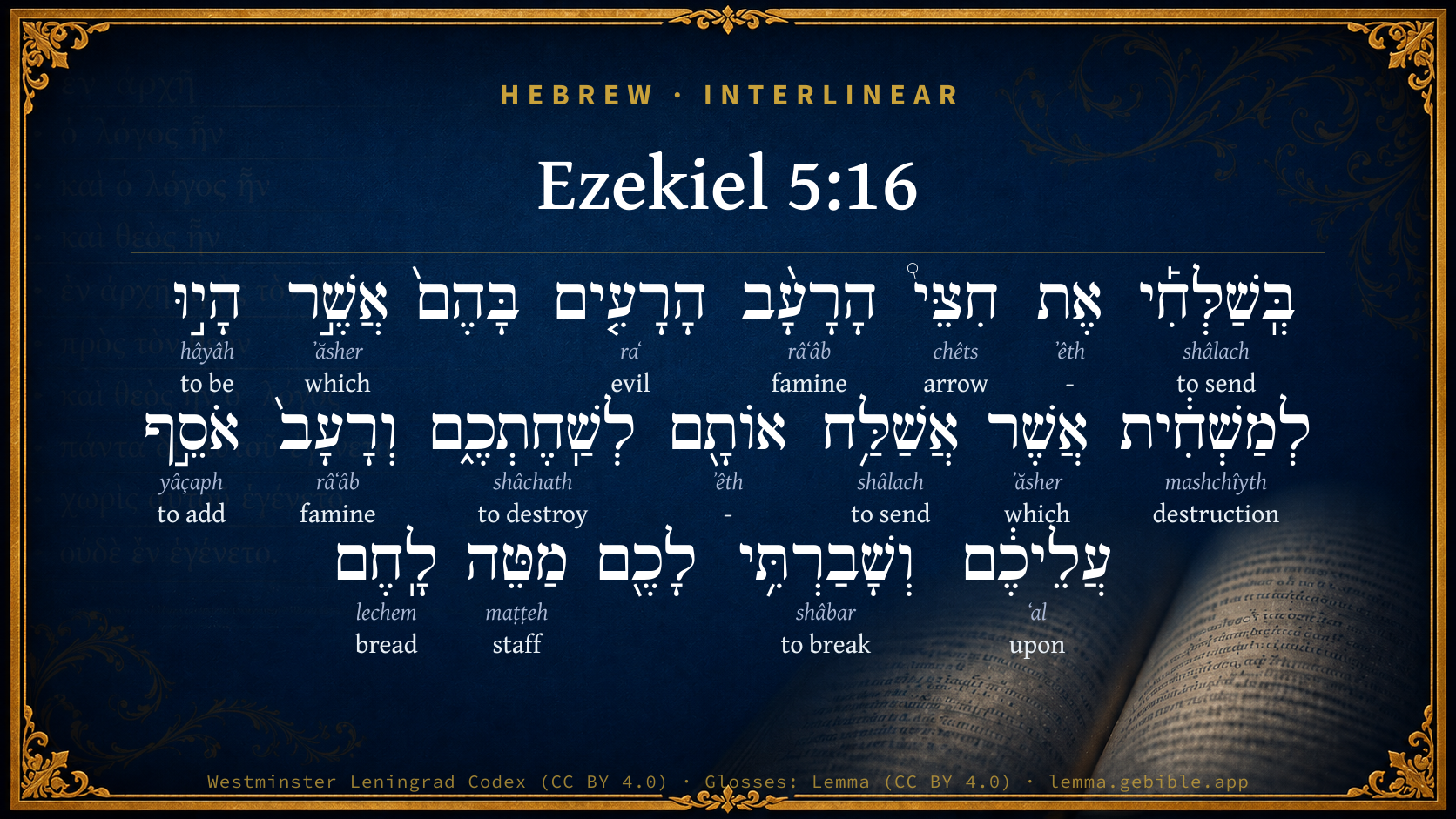
Hebrew (Westminster Leningrad Codex) Ezekiel 5:16 appears in the Hebrew Old Testament. The text above is from the Westminster Leningrad Codex. Each word links to its Strong’s number, a concise gloss, and parsing drawn from the Open Scriptures Hebrew Bible morphology. Click any word for its full Brown-Driver-Briggs (BDB) entry.
Download image
Cite this verse

Ezekiel 5:16 (World English Bible). Public Domain. Lemma interlinear Bible study tool, https://lemma.gebible.app/v/ezekiel/5/16.

Show BibTeX & RIS
BibTeX
RIS
English Translation
when I shall send on them the evil arrows of famine, that are for destruction, which I will send to destroy you: and I will increase the famine on you, and will break your staff of bread;
World English Bible · Public Domain
Download a study sheet

One document with this verse’s original text, its word-by-word gloss line, the meaning frame, cross-references with their text, attributed commentary, and full source and license credits — printable, and it pastes into notes with its structure intact.

This verse Autodidact and up

Study sheet (.html) Plain text (.txt)

A passage Seminary Student

Up to 50 verses in one chapter. A passage sheet keeps up to 6 commentary sources and 12 cross-references per verse, in the order this page ranks them, and says so on the sheet whenever that leaves anything out. Ask for a single verse and you get the Autodidact verse sheet above.

Everything on this page stays free to read, with no account — the sheet is a download of what is already on screen, not access to it.

Want to remove ads? Support Godless Engineer
Compare translations 3

The same verse in 3 English versions, stacked beneath the original-language interlinear above. Click any original word for its lexicon entry.

Each is an independent rendering of the whole verse — the interlinear is not word-aligned to these translations.

Highlighted words mark where these versions differ — a whole-verse word diff, not a word-by-word alignment.

  • World English Bible Public Domain
    when I shall send on them the evil arrows of famine, that are for destruction, which I will send to destroy you: and I will increase the famine on you, and will break your staff of bread;
  • King James Version Public Domain
    When I shall send upon them the evil arrows of famine, which shall be for their destruction, and which I will send to destroy you: and I will increase the famine upon you, and will break your staff of bread:
  • unfoldingWord Literal Text CC BY-SA 4.0
    I will send out harsh arrows of famine against you that will become the means with which I will destroy you. For I will increase the famine on you and break your staff of bread.

unfoldingWord Literal Text — © unfoldingWord, licensed CC BY-SA 4.0. Word-aligned USFM3 via Door43 (git.door43.org/unfoldingWord/en_ult).

Versions to compare (up to 4)

3 of 4 selected

Show all 18 translations

Every available English version of this verse, each an independent rendering of the whole verse.

  • World English Bible Public Domain
    when I shall send on them the evil arrows of famine, that are for destruction, which I will send to destroy you: and I will increase the famine on you, and will break your staff of bread;
  • Berean Standard Bible Public Domain
    When I shower you with the deadly arrows of famine and destruction that I will send to destroy you, I will intensify the famine against you and cut off your supply of food.
  • Majority Standard Bible Public Domain
    When I shower you with the deadly arrows of famine and destruction that I will send to destroy you, I will intensify the famine against you and cut off your supply of food.
  • King James Version Public Domain
    When I shall send upon them the evil arrows of famine, which shall be for their destruction, and which I will send to destroy you: and I will increase the famine upon you, and will break your staff of bread:
  • American Standard Version (1901) Public Domain
    when I shall send upon them the evil arrows of famine, that are for destruction, which I will send to destroy you: and I will increase the famine upon you, and will break your staff of bread;
  • Revised Version (1885) Public Domain
    when I shall send upon them the evil arrows of famine, that are for destruction, which I will send to destroy you; and I will increase the famine upon you, and will break your staff of bread;
  • Geneva Bible (1599) Public Domain
    When I shall sende vpon them the euill arrowes of famine, which shalbe for their destruction, and which I will sende to destroy you: and I will encrease the famine vpon you, and wil breake your staffe of bread.
  • Douay-Rheims (1899) Public Domain
    I the Lord have spoken it: When I shall send upon them the grievous arrows of famine, which shall bring death, and which I will send to destroy you: and I will gather together famine against you: and I will break among you the staff of bread.
  • Young's Literal Translation Public Domain
    In My sending the evil arrows of famine among them, That have been for destruction, That I send to destroy you, And famine I am adding upon you, And I have broken to you the staff of bread.
  • Literal Standard Version CC BY-SA 4.0
    In My sending the evil arrows of famine among them, || That have been for destruction, || That I send to destroy you, || And I am adding famine on you, || And I have broken your staff of bread.
  • Unlocked Literal Bible CC BY-SA 4.0
    I will send out harsh arrows of famine against you that will become the means with which I will destroy you. For I will increase the famine on you and break your staff of bread.
  • unfoldingWord Literal Text CC BY-SA 4.0
    I will send out harsh arrows of famine against you that will become the means with which I will destroy you. For I will increase the famine on you and break your staff of bread.
  • Darby Bible Public Domain
    When I send upon them the evil arrows of famine, that are for [their] destruction, which I send to destroy you, then will I increase the famine upon you, and will break your staff of bread.
  • World Messianic Bible Public Domain
    when I send on them the evil arrows of famine that are for destruction, which I will send to destroy you. I will increase the famine on you and will break your staff of bread.
  • Webster's Bible Public Domain
    When I shall send upon them the evil arrows of famine, which shall be for their destruction, and which I will send to destroy you: and I will increase the famine upon you, and will break your staff of bread:
  • Free Bible Version CC BY-SA 4.0
    When I pour down on you deadly arrows of famine and destruction they're intended to kill you. I will make your famine worse by stopping your food supply.
  • Bible in Basic English Public Domain
    When I send on you the evil arrows of disease, causing destruction, which I will send to put an end to you; and, further, I will take away your necessary food.
  • JPS Tanakh (1917) Public Domain
    when I shall send upon them the evil arrows of famine, that are for destruction, which I will send to destroy you; and I will increase the famine upon you, and will break your staff of bread;

Literal Standard Version (2020), Covenant Press — licensed CC BY-SA 4.0. Text via the HelloAO Bible API (eBible.org). Unlocked Literal Bible (unfoldingWord) — licensed CC BY-SA 4.0. Text via the HelloAO Bible API (eBible.org). unfoldingWord Literal Text — © unfoldingWord, licensed CC BY-SA 4.0. Word-aligned USFM3 via Door43 (git.door43.org/unfoldingWord/en_ult). Free Bible Version, Dr. Jonathan Gallagher — licensed CC BY-SA 4.0. Text via the HelloAO Bible API (eBible.org).

Word by word

More ways to search: Search by grammar → Find every occurrence → Compare this word →

Practice this passage: Drill this verse → Learn its vocabulary →

לְמַשְׁחִ֔ית
mashchîyth
H4889
“to/for · destruction”
Preposition + Noun, Common, Masculine, Singular, Absolute
Part of Speech
Preposition + Noun
Type
Common
Gender
Masculine
Number
Singular
State
Absolute
Full BDB Definition

Origin: from H7843

TWOT: 2370a

ruin, destruction
  1. בְּֽשַׁלְּחִ֡י shâlach H7971 “in/at · to send · me” Preposition + Verb, Piel, Infinitive Construct + Suffix, Personal, 1st Person, Common, Singular
  2. אֶת ʼêth H853 “-” Particle, Direct Object
  3. חִצֵּי֩ chêts H2671 “arrows of” Noun, Common, Masculine, Plural, Construct
  4. הָרָעָ֨ב râʻâb H7458 “the · famine” Particle, Definite Article + Noun, Common, Masculine, Singular, Absolute
  5. הָרָעִ֤ים raʻ H7451 “the · evil” Particle, Definite Article + Adjective, Adjective, Masculine, Plural, Absolute
  6. אֲשֶׁ֣ר ʼăsher H834 “which” Particle, Relative
  7. הָי֣וּ hâyâh H1961 “to be” Verb, Qal, Perfect, 3rd Person, Common, Plural
  8. אֲשֶׁר ʼăsher H834 “which” Particle, Relative
  9. אֲשַׁלַּ֥ח shâlach H7971 “to send” Verb, Piel, Imperfect, 1st Person, Common, Singular
  10. אוֹתָ֖ם ʼêth H853 “- · them” Particle, Direct Object + Suffix, Personal, 3rd Person, Masculine, Plural
  11. לְשַֽׁחֶתְכֶ֑ם shâchath H7843 “to destroy · you” Preposition + Verb, Piel, Infinitive Construct + Suffix, Personal, 2nd Person, Masculine, Plural
  12. וְרָעָב֙ râʻâb H7458 “and · famine” Conjunction + Noun, Common, Masculine, Singular, Absolute
  13. אֹסֵ֣ף yâçaph H3254 “to add” Verb, Hiphil, Imperfect, 1st Person, Common, Singular
  14. עֲלֵיכֶ֔ם ʻal H5921 “upon · you” Preposition + Suffix, Personal, 2nd Person, Masculine, Plural
  15. וְשָׁבַרְתִּ֥י shâbar H7665 “and · to break” Conjunction + Verb, Qal, Sequential Perfect, 1st Person, Common, Singular
  16. מַטֵּה maṭṭeh H4294 “staff of” Noun, Common, Masculine, Singular, Construct
  17. לָֽחֶם lechem H3899 “bread” Noun, Common, Both, Singular, Absolute

About this verse

These counts appear in no published source. They are computed here, from the morphology-tagged text and Lemma’s own curated glosses. What Lemma adds →

20
words
14
distinct lemmas
Prophets
section

Notable vocabulary

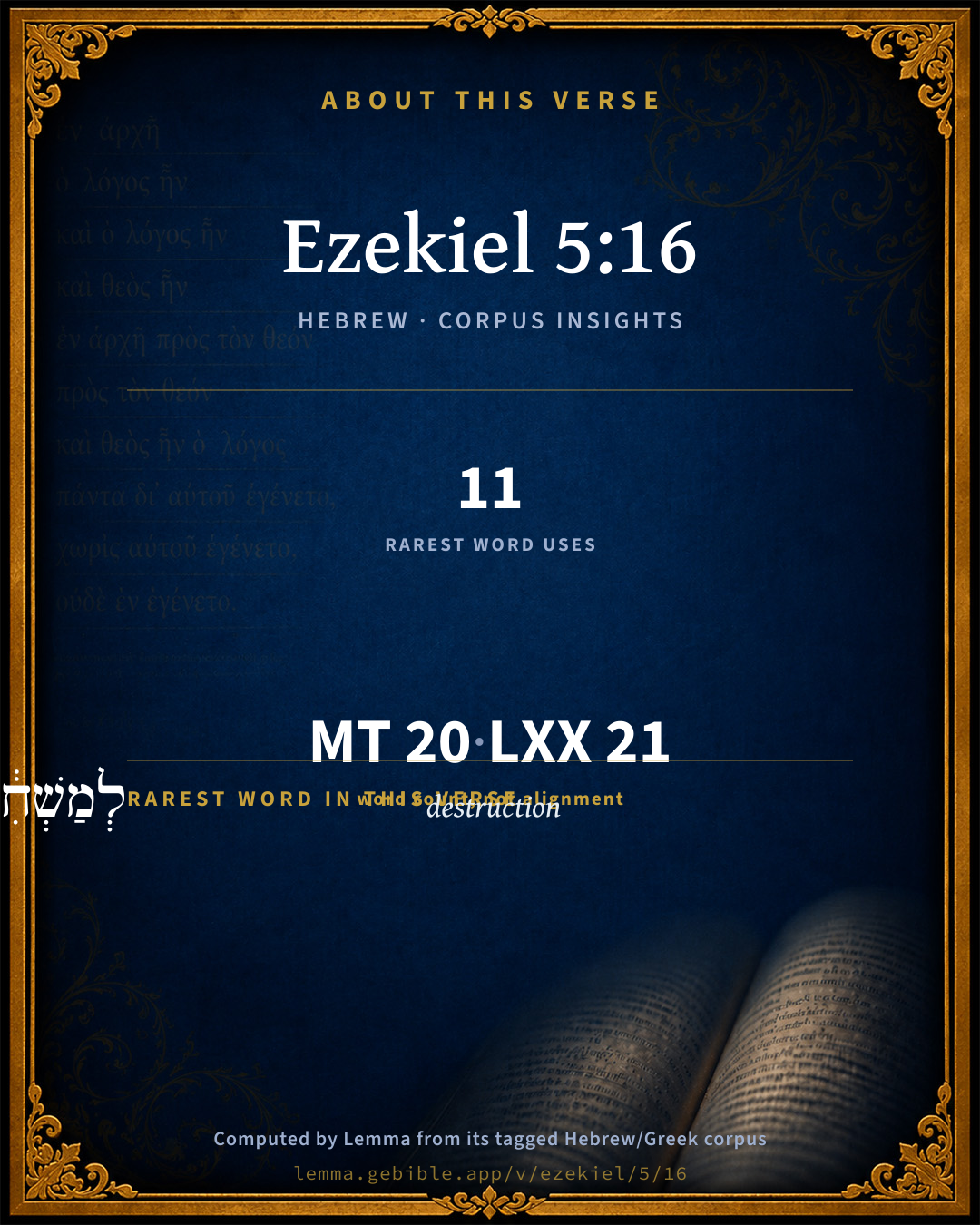
The rarest word here is לְמַשְׁחִ֔ית destruction H4889 — appearing just 11 times in the whole Hebrew Bible.

Shared distinctive vocabulary

לְמַשְׁחִ֔ית destruction H4889 occurs in 11 verses of the Hebrew Bible. Also found in:

Grammatical profile

  • 6 verbs
  • 6 nouns
  • 1 adjective
  • 3 prepositions
  • 4 particles

Verb forms

  • בְּֽשַׁלְּחִ֡י Piel · Infinitive Construct
  • הָי֣וּ Qal · Perfect
  • אֲשַׁלַּ֥ח Piel · Imperfect
  • לְשַֽׁחֶתְכֶ֑ם Piel · Infinitive Construct
  • אֹסֵ֣ף Hiphil · Imperfect
  • וְשָׁבַרְתִּ֥י Qal · Sequential Perfect

Repetition

Words recur within this verse — often emphatic in Hebrew:

  • בְּֽשַׁלְּחִ֡י to send H7971 ×2
  • הָרָעָ֨ב famine H7458 ×2
  • אֲשֶׁ֣ר which H834 ×2

Hebrew & Septuagint length

In English translation the verse runs 37 words from the Hebrew and 24 from the Septuagint (LXX English) — the Septuagint runs noticeably shorter here. See the side-by-side →

A rough comparison of the two English renderings, which tokenize alike — not a word-level alignment.

Word counts can differ between the Hebrew and the Greek without any difference in meaning — e.g. the Hebrew direct-object marker אֵת has no separate Greek word, and Greek often adds the article ὁ.

In the original languages it is 20 Hebrew tokens and 21 Greek tokens — but the two are counted differently (Hebrew bundles its prefixes and suffixes into one token; the Greek is in lemma form), so that isn’t a like-for-like length.

Cross-references

9

Topical passages linked to Ezekiel 5:16 in the Treasury of Scripture Knowledge — connected by theme and wording, ordered by reader-vote popularity; previews shown in the World English Bible.

  • Ezekiel 4:16 Moreover he said to me, Son of man, behold, I will break the staff of bread in Jerusalem: and they shall eat bread by weight, and with fearfulness; and they shall drink water by measure, and in dismay:
  • Deuteronomy 32:23–24 I will heap evils on them; I will spend my arrows on them:
  • Leviticus 26:26 When I break your staff of bread, ten women shall bake your bread in one oven, and they shall deliver your bread again by weight: and you shall eat, and not be satisfied.
  • 2 Kings 6:25 There was a great famine in Samaria: and, behold, they besieged it, until a donkey's head was sold for eighty [pieces] of silver, and the fourth part of a kab of dove's dung for five [pieces] of silver.
  • Psalms 7:13 He has also prepared for himself the instruments of death. He makes ready his flaming arrows.
  • Psalms 91:5–7 You shall not be afraid of the terror by night, Nor of the arrow that flies by day;
  • Isaiah 3:1 For, behold, the Lord, Yahweh of Hosts, takes away from Jerusalem and from Judah supply and support, The whole supply of bread, And the whole supply of water;
  • Lamentations 3:12 He has bent his bow, and set me as a mark for the arrow.
  • Ezekiel 14:13 Son of man, when a land sins against me by committing a trespass, and I stretch out my hand on it, and break the staff of the bread of it, and send famine on it, and cut off from it man and animal;

Cross-references courtesy of OpenBible.info (CC BY 4.0).

Hebrew and Greek witnesses Masoretic Hebrew ↔ Greek Septuagint

The same verse in the two great witnesses to the Old Testament, shown verse-for-verse.

Here the Septuagint runs noticeably shorter than the Hebrew — LXX2012 (modern English Septuagint) 24 words vs World English Bible 37. A rough length comparison of the two English translations, not a word-level alignment — read both below.

These are two independent witnesses, not word-aligned to each other, and the Septuagint is shown in lemma (dictionary) form.

Hebrew Ezekiel 5:16 Masoretic · Westminster Leningrad Codex

בְּֽשַׁלְּחִ֡י אֶת חִצֵּי֩ הָרָעָ֨ב הָרָעִ֤ים בָּהֶם֙ אֲשֶׁ֣ר הָי֣וּ לְמַשְׁחִ֔ית אֲשֶׁר אֲשַׁלַּ֥ח אוֹתָ֖ם לְשַֽׁחֶתְכֶ֑ם וְרָעָב֙ אֹסֵ֣ף עֲלֵיכֶ֔ם וְשָׁבַרְתִּ֥י לָכֶ֖ם מַטֵּה לָֽחֶם

when I shall send on them the evil arrows of famine, that are for destruction, which I will send to destroy you: and I will increase the famine on you, and will break your staff of bread;

World English Bible · Public Domain

Greek LXX Ezekiel 5:16 Septuagint · lemma form

ἐν ὁ ἐκ ἀποστέλλω ἐγώ ὁ βολίς ἐγώ ὁ λιμός ἐπί αὐτός καί εἰμί εἰς ἔκλειψις καί συντρίβω στήριγμα ἄρτος σύ

And when I have sent against them shafts of famine, then they shall be consumed, and I will break the strength of your bread.

LXX2012 (modern English Septuagint) · Public Domain

Hebrew: Westminster Leningrad Codex (CC BY 4.0). Greek: Septuagint (public domain); English from LXX2012 (modern English Septuagint) (Public Domain). How the Septuagint differs from the Hebrew →

Targum (Aramaic paraphrase)

1

The Targum is the ancient Jewish Aramaic paraphrase of the Hebrew Scriptures — an interpretive translation, not the Hebrew text itself. Onkelos (literal) and Pseudo-Jonathan (expansive) render the Torah, and Jonathan the Prophets. Coverage is partial: where no permissively-licensed English translation exists for a verse, only the Aramaic is shown. This is verse-level text, not a word-by-word alignment to the Hebrew.

  1. Targum Jonathan Prophets (Joshua–Malachi)
    בְּגָרָיוּתִי יַת מְחַת כַּפְנָא מַכְתָּשִׁין בִּישִׁין דִמְתַקְנִין לְחַבָּלָא דַאֲשַׁלַח יַתְהוֹן לְחַבָּלוּתְכוֹן וְכַפְנָא אוֹסִיף עֲלֵיכוֹן וְאִתְבַּר לְכוֹן סְעַד מֵיכְלָא:

    (no public-domain English translation for this verse)

    Targum Jonathan — Aramaic: “Mikraot Gedolot” (public domain). English: “Sefaria Community Translation” (CC0 1.0 (public-domain dedication)); “London "Chaldee Paraphrase," 1871” (public domain). Text via Sefaria.

Commentary

Notes on Ezekiel 5:16 from classic Christian and Jewish commentators (each source and its license shown beneath its notes). The classic Christian expositions comment on the surrounding passage and are grouped to its opening verse, so a note may address several verses; the Jewish commentaries on the Tanakh (Rashi and others) are per-verse, so they appear only where the commentator wrote on this verse.

Lemma curates 59 commentaries, every one of them public domain or Creative Commons licensed, each selected and text-cleaned for this edition rather than reprinted as found. About our sources →

Trapp's Complete Commentary

John Trapp

Eze 5:16 When I shall send upon them the evil arrows of famine, which shall be for [their] destruction, [and] which I will send to destroy you: and I will increase the famine upon you, and will break your staff of bread:

Ver. 16. When I shall send upon you the evil arrows of famine.] Not to warn you, as Jonathan’s arrows did David, but to wound you to the heart, and to lay you heaps upon heaps. {Deu 32:23-24}

And break your staff of bread.] See Eze 4:16. Penuria fiet pecuniae, saith Oecolampadius here; You shall want money to buy you bread.

John Trapp, A Commentary or Exposition upon All the Books of the Old and New Testament (1647–1656) — public domain. Text from a community e-Sword module.

Geneva Bible (1599)

Geneva Bible translators

Which were the grasshoppers, mildew, and whatsoever were occasions of famine.

Or, dangerous.

Geneva Bible (1599) marginal notes — public domain. Text via Bolls.life.

Jamieson, Fausset & Brown

Robert Jamieson, A. R. Fausset & David Brown

arrows of famine--hail, rain, mice, locusts, mildew (see Deu 32:23-24).

increase the famine--literally, "congregate" or "collect." When ye think your harvest safe because ye have escaped drought, mildew, &c., I will find other means [CALVIN], which I will congregate as the forces of an invading army, to bring famine on you.

Jamieson, Fausset & Brown — Commentary Critical and Explanatory on the Whole Bible (1871) — public domain (CC PDM 1.0). Text via the HelloAO Bible API.

Adam Clarke's Commentary

Verse 16. The evil arrows of famine] Famine and pestilence are represented as poisoned arrows, inflicting death wherever they wound. The ancients represented them in the same way.

Adam Clarke's Commentary on the Bible (1810–1826) — public domain. Text from a community e-Sword/MySword module.

John Calvin's Commentaries

He illustrates the sentiment which we have seen, but not after the manner of rhetoricians, who affect splendor and ornament of speech; but his only design was to penetrate the minds of the people, like stones or iron. This, then, is the reason why he uses such variety here, and adorns his teaching with various figures. For he now compares God to an archer, who points his arrows against them; but he speaks metaphorically concerning the arrows of God; for he calls them arrows of famine and evil, that is, deadly and death-bearing. Since, then, I shall hurl evil arrows against them, they shall cause their destruction, says he; that is, they shall not escape death, because they shall be struck with mortal wounds. A person might be struck by the blow of an arrow, and yet become convalescent; but God pronounces the arrows of which he speaks deadly, so that whoever is struck by them has no hope of safety left. Besides, by arrows of famine we may understand such barrenness of soil as flies, locusts, and other scourges of God — at one time scorching, at another mildew dries up the corn-field, now rains make the wheat rot, now heat burns it up, as many sources of corruption and pestilence as these are to the crops, so many are the arrows of God which transfix men’s hearts, and that too by a deadly wound. If so subtle an explanation does not please any one, he is at liberty to take it otherwise; yet if any one properly attends, he will confess that God darts his own arrows as often as he causes famine, or deprives men of sustenance. He adds, which shall become corruption He confirms what we said was denoted by the epithet הרעים, hergnim. He says, therefore, that these arrows would be destructive, because they should be for perdition and destruction. Another confirmation follows: which I will send, says he, against them to destroy them Here God distinctly affirms that he would dart forth those arrows, and repeats again what we saw before, and that, too, in the same verse. But we have taught you why the Prophet insists, in many words, on a matter by no means obscure. He adds, and I will multiply famine against them. Here he signifies that he was armed with different weapons, so that if men perceive themselves to have fallen, they may perceive that God has other hidden weapons, which he has not yet brought into use. By the word “multiply” the Prophet expresses what we have already seen, by means of arrows, for he uses the plural number, but the impious restrict as much as they can the power of God. “If God wills” they say, “he can indeed ruin the corn-fields with continual rain, he can also burn them up by too much heat, if we have escaped the frost and the hail, the storm, and the rain., and the drought, it will have already gone well with us.” Thus the impious harden themselves in their security. And why? because they restrict God’s arrows to a fixed and certain number. This is the reason why he says, I will multiply famine upon them; that is, when they think their yearly produce safe, because they have escaped drought, and rain, and mildew, and storm, and hail, I will find, says he, other modes unknown to them, by which I will bring famine upon them. And he expresses one manner of doing so — I will break the staff of bread, concerning which form of speaking we have spoken previously. I do not subscribe to their opinion who say, that the staff of bread is broken when God sends a deficiency of corn; for in the greatest plenty the staff of bread is broken, as we saw in Moses, when God takes away the nourishing quality of bread, and makes it vanish, (Deuteronomy 8:3,) because man lives not by bread alone, but by that secret inspiration which God has implanted in the bread. Hence we may eat more than fourfold the usual quantity, and yet not be satisfied, as this form of speech often occurs with the Prophets, which they take from Moses. Thou shalt eat, and not be satisfied, say they. (Leviticus 26:26; Isaiah 9:20; Ezekiel 7; Hosea 4:10; Micah 6:14.) So also here the Prophet repeats what we saw in the last chapter — that God breaks the staff of bread, that is, takes away its nourishing quality, so that he who feeds upon it does not feel that he has recovered new rigor. It follows —

John Calvin's Commentaries (1540-1563) — public domain. Text from the Calvin Translation Society English edition (1840s-50s) via the Christian Classics Ethereal Library (ccel.org). Calvin's coverage is partial (roughly two-thirds of the Bible); uncommented books and verses are honest gaps, never fabricated. The 19th-century editor's footnotes and remarks are omitted so the notes are faithfully Calvin's own voice.

The Cambridge Bible for Schools and Colleges

gen. ed. J. J. S. Perowne

16. arrows of famine] Cf. Deu_32:23-24.

shall be for their destruction] as R.V., that are for destruction.

I will increase] lit. add, i.e. send famine upon famine upon you. On “staff of bread” cf. ch. Eze_4:14.

The Cambridge Bible for Schools and Colleges (gen. ed. J. J. S. Perowne; Cambridge University Press, 1878–1918) — public domain. Text from a community e-Sword module.

John Gill's Exposition

When I shall send upon them the evil arrows of famines,.... Either famine itself, which is as an arrow; it is taken out of the quiver of the Lord of hosts, and is shot by him; and moves swiftly when it has a commission; and is very destructive: or arrows which bring on a famine, such as drought, excessive rains, blasting, mildew, locusts, &c. or arrows which the famine brings, as leanness, faintness, blackness, and death; and, in either sense, are evil ones; and are sent of God for the following end:

which shall be for their destruction, and which I will send to destroy you; God's design in sending them was to destroy, and that was answered; and a very destroying arrow famine is, and therefore called evil:

and I will increase the famine upon you; or "gather (y) it upon", or "against you"; as if it was an army with bows and arrows:

and will break your staff of bread: take away the virtue from the little they had, that that should not nourish and satisfy; See Gill on Eze 4:16.

(y) "famen congregabo, super vos", V. L. Pagninus; "famen colligam super vos", Montanus, Polanus, Starckius.

John Gill's Exposition of the Whole Bible (1746–1763) — public domain (CC PDM 1.0). Text via the HelloAO Bible API.

Haydock's Catholic Bible Commentary

Arrows; inclemency of the seasons, &c., which bring on famine. (Menochius)

George Leo Haydock (1774–1849), Haydock's Catholic Family Bible and Commentary, 1859 edition — public domain. Excludes Psalms (Douay-Rheims chapter numbering differs from Protestant) and Deuterocanonical books (Catholic canon only).

Matthew Poole's English Annotations

I shall send; it is a messenger that goes not till God sends, and ever goes when he sendeth; he sends cleanness of teeth.

The evil arrows; either because thunder, tempests, locusts, blastings, &c., which cause famine, are sent by him, and fly like arrows; or because, like arrows shot forth, they pierce deep and kill.

Shall be for their destruction; is mortal and destructive in its nature.

To destroy you; that it may be sure to destroy and attain that effect, I design it for that very end. To make sure work against such,

I will increase the famine, either by sweeping away the little supplies expected, or continuing it longer than ordinary. Or, I will summon in penury as an army against you.

Break your staff of bread; withdraw the strengthening property of your’ bread. See Eze 4:16.

Matthew Poole's English Annotations on the Holy Bible (1683–1685) — public domain. Text from a community e-Sword/MySword module.

The Pulpit Commentary

The evil arrows of famine, etc. The thought of the "arrows" of God"s judgment may have been taken from Deu_32:23, Deu_32:42, and occurs frequently also in the Psalms. (Psa_7:13 Psa_38:2, et al.) Clothed in the language of poetry, the attributes of Jehovah included those of the Far-darter of the Greeks. Which shall be for their destruction, etc.; better, as Revised Version, that are for destruction. Ewald looks on the noun as a personification, like Abaddon, also translated "destruction" in Job_28:22 and Pro_15:11, and renders the words, "that are from hell;" but there seems no special reason for assuming such a meaning here. It is noticable that, as in the symbolism of Eze_4:9-17, the laminae is more prominent in Ezekiel"s thoughts than the other punishments.

The Pulpit Commentary (1880–1919), ed. H.D.M. Spence-Jones & Joseph S. Exell — public domain. Text from a community e-Sword module.

Rashi

Rabbi Shlomo Yitzchaki (Rashi)

and I shall add a famine upon you This is the famine of the penny depleted from the pocket. So I heard.

your staff of bread Support of bread.

Rashi on the Tanakh — English translations: “The Judaica Press complete Tanach with Rashi, translated by A. J. Rosenberg” (CC BY 4.0); “Pentateuch with Rashi's commentary by M. Rosenbaum and A.M. Silbermann, 1929-1934” (public domain); “The Metsudah Tanach series, Lakewood, N.J” (CC BY 4.0); and “The Book of Joshua, Metsudah Publications, 1997” (CC BY 4.0). Text via Sefaria.

Lesson kit

Teaching starters — assembled from the data on this page, not authored interpretation. Every prompt links to the verse data it draws on. Edit before teaching.

Ezekiel, in the Prophets, opens this verse with 20 words (14 distinct Hebrew lemmas). Its most distinctive word is mashchîyth (“destruction”). The Greek Septuagint runs shorter here. A historical commentator’s framing appears above. Read the whole chapter for the surrounding context.

Discussion questions

  1. What does “destruction” (mashchîyth) contribute to the verse as a whole?
  2. How does Exodus 12:13, which shares the word «destruction», read alongside this verse?
  3. What does the repetition of “to send” (2× in this one verse) do in this verse?
  4. The Septuagint runs shorter here than the Hebrew. What might account for the difference?
  5. The translations on this page render this verse differently — a whole-verse word diff, not a word-by-word alignment. What might account for the different wordings?
  6. «בְּֽשַׁלְּחִ֡י» is a Piel Infinitive Construct verb. How does that grammatical form shape the action described?
  7. Compare how Trapp's Complete Commentary and Geneva Bible (1599) read this verse. Where do they agree or differ?

Things to notice

Reading settings

Reading text

Shown beneath each verse's original-language words.

Old Testament
Old Testament edition

Read the OT as the Masoretic Hebrew (MT) or the Greek Septuagint (LXX).

English shown for the Greek Septuagint (in the Hebrew ↔ Greek comparison).

Comparing translations? Open the Compare panel on any verse page to stack up to four side by side.