
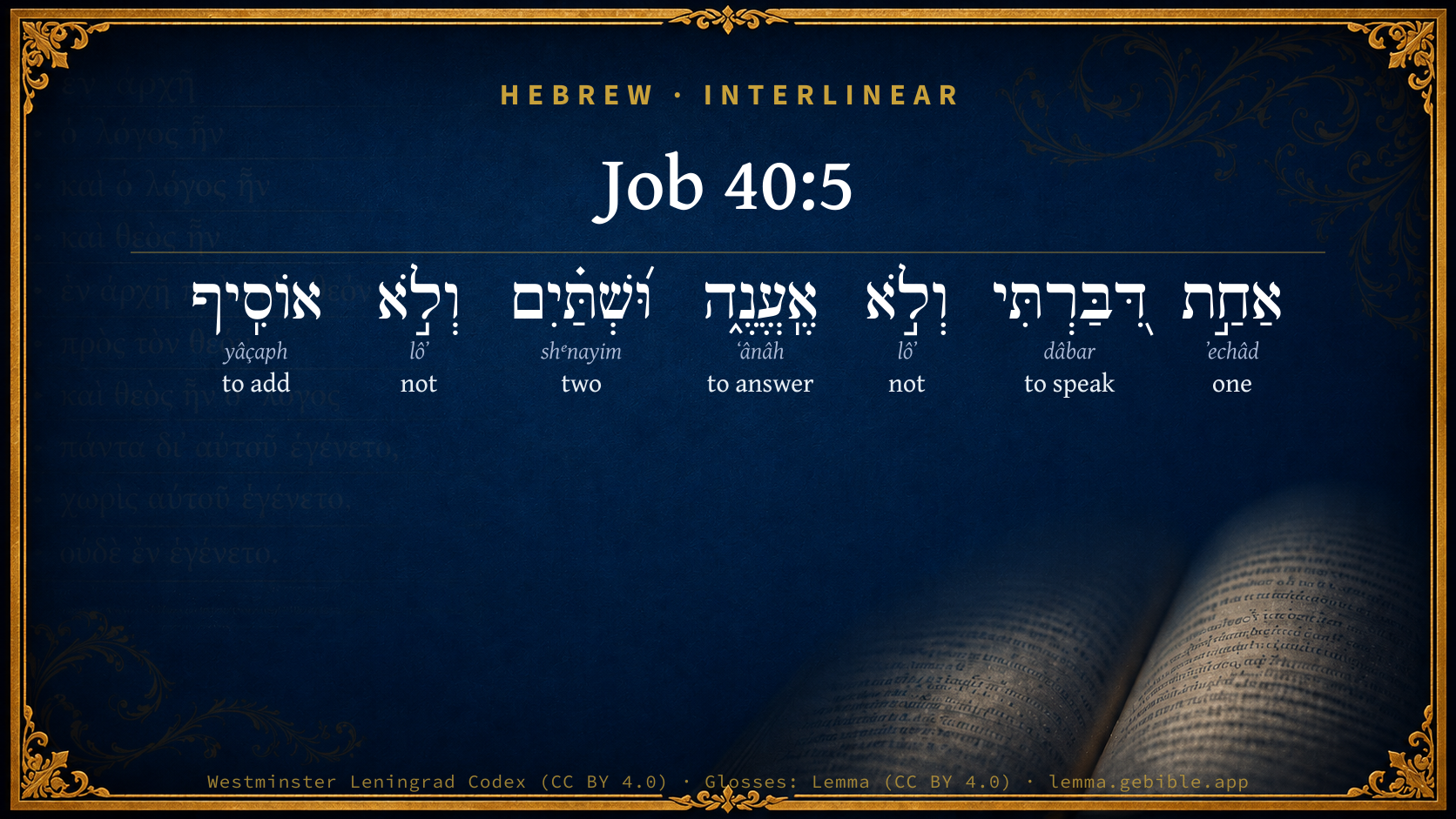
Job 40:5

Hebrew (Westminster Leningrad Codex) Job 40:5 appears in the Hebrew Old Testament. The text above is from the Westminster Leningrad Codex. Each word links to its Strong’s number, a concise gloss, and parsing drawn from the Open Scriptures Hebrew Bible morphology. Click any word for its full Brown-Driver-Briggs (BDB) entry.
Download image
Cite this verse

Job 40:5 (World English Bible). Public Domain. Lemma interlinear Bible study tool, https://lemma.gebible.app/v/job/40/5.

Show BibTeX & RIS
BibTeX
RIS
English Translation
I have spoken once, and I will not answer; Yes, twice, but I will proceed no further."
World English Bible · Public Domain
Download a study sheet

One document with this verse’s original text, its word-by-word gloss line, the meaning frame, cross-references with their text, attributed commentary, and full source and license credits — printable, and it pastes into notes with its structure intact.

This verse Autodidact and up

Study sheet (.html) Plain text (.txt)

A passage Seminary Student

Up to 50 verses in one chapter. A passage sheet keeps up to 6 commentary sources and 12 cross-references per verse, in the order this page ranks them, and says so on the sheet whenever that leaves anything out. Ask for a single verse and you get the Autodidact verse sheet above.

Everything on this page stays free to read, with no account — the sheet is a download of what is already on screen, not access to it.

Want to remove ads? Support Godless Engineer
Compare translations 3

The same verse in 3 English versions, stacked beneath the original-language interlinear above. Click any original word for its lexicon entry.

Each is an independent rendering of the whole verse — the interlinear is not word-aligned to these translations.

Highlighted words mark where these versions differ — a whole-verse word diff, not a word-by-word alignment.

  • World English Bible Public Domain
    I have spoken once, and I will not answer; Yes, twice, but I will proceed no further."
  • King James Version Public Domain
    Once have I spoken; but I will not answer: yea, twice; but I will proceed no further.
  • unfoldingWord Literal Text CC BY-SA 4.0
    I spoke once, but I will not answer, and twice, but I will not continue.”

unfoldingWord Literal Text — © unfoldingWord, licensed CC BY-SA 4.0. Word-aligned USFM3 via Door43 (git.door43.org/unfoldingWord/en_ult).

Versions to compare (up to 4)

3 of 4 selected

Show all 18 translations

Every available English version of this verse, each an independent rendering of the whole verse.

  • World English Bible Public Domain
    I have spoken once, and I will not answer; Yes, twice, but I will proceed no further."
  • Berean Standard Bible Public Domain
    I have spoken once, but I have no answer—twice, but I have nothing to add.”
  • Majority Standard Bible Public Domain
    I have spoken once, but I have no answer—twice, but I have nothing to add.”
  • King James Version Public Domain
    Once have I spoken; but I will not answer: yea, twice; but I will proceed no further.
  • American Standard Version (1901) Public Domain
    Once have I spoken, and I will not answer; Yea, twice, but I will proceed no further.
  • Revised Version (1885) Public Domain
    Once have I spoken, and I will not answer; yea twice, but I will proceed no further.
  • Geneva Bible (1599) Public Domain
    Decke thy selfe now with maiestie and excellencie, and aray thy selfe with beautie and glory.
  • Douay-Rheims (1899) Public Domain
    Clothe thyself with beauty, and set thyself up on high and be glorious, and put on goodly garments.
  • Young's Literal Translation Public Domain
    Once I have spoken, and I answer not, And twice, and I add not.
  • Literal Standard Version CC BY-SA 4.0
    I have spoken once, and I do not answer, || And twice, and I do not add.”
  • Unlocked Literal Bible CC BY-SA 4.0
    I spoke once, and I will not answer; indeed, twice, but I will proceed no further.”
  • unfoldingWord Literal Text CC BY-SA 4.0
    I spoke once, but I will not answer, and twice, but I will not continue.”
  • Darby Bible Public Domain
    Once have I spoken, and I will not answer; yea twice, but I will proceed no further.
  • World Messianic Bible Public Domain
    I have spoken once, and I will not answer; Yes, twice, but I will proceed no further.”
  • Webster's Bible Public Domain
    \\40:10\\Deck thyself now with majesty and excellence; and array thyself with glory and beauty.
  • Free Bible Version CC BY-SA 4.0
    I have already said far too much and I won't say anything more.”
  • Bible in Basic English Public Domain
    Put on the ornaments of your pride; be clothed with glory and power:
  • JPS Tanakh (1917) Public Domain
    Once have I spoken, but I will not answer again; yea, twice, but I will proceed no further.

Literal Standard Version (2020), Covenant Press — licensed CC BY-SA 4.0. Text via the HelloAO Bible API (eBible.org). Unlocked Literal Bible (unfoldingWord) — licensed CC BY-SA 4.0. Text via the HelloAO Bible API (eBible.org). unfoldingWord Literal Text — © unfoldingWord, licensed CC BY-SA 4.0. Word-aligned USFM3 via Door43 (git.door43.org/unfoldingWord/en_ult). Free Bible Version, Dr. Jonathan Gallagher — licensed CC BY-SA 4.0. Text via the HelloAO Bible API (eBible.org).

Word by word

More ways to search: Search by grammar → Find every occurrence → Compare this word →

Practice this passage: Drill this verse → Learn its vocabulary →

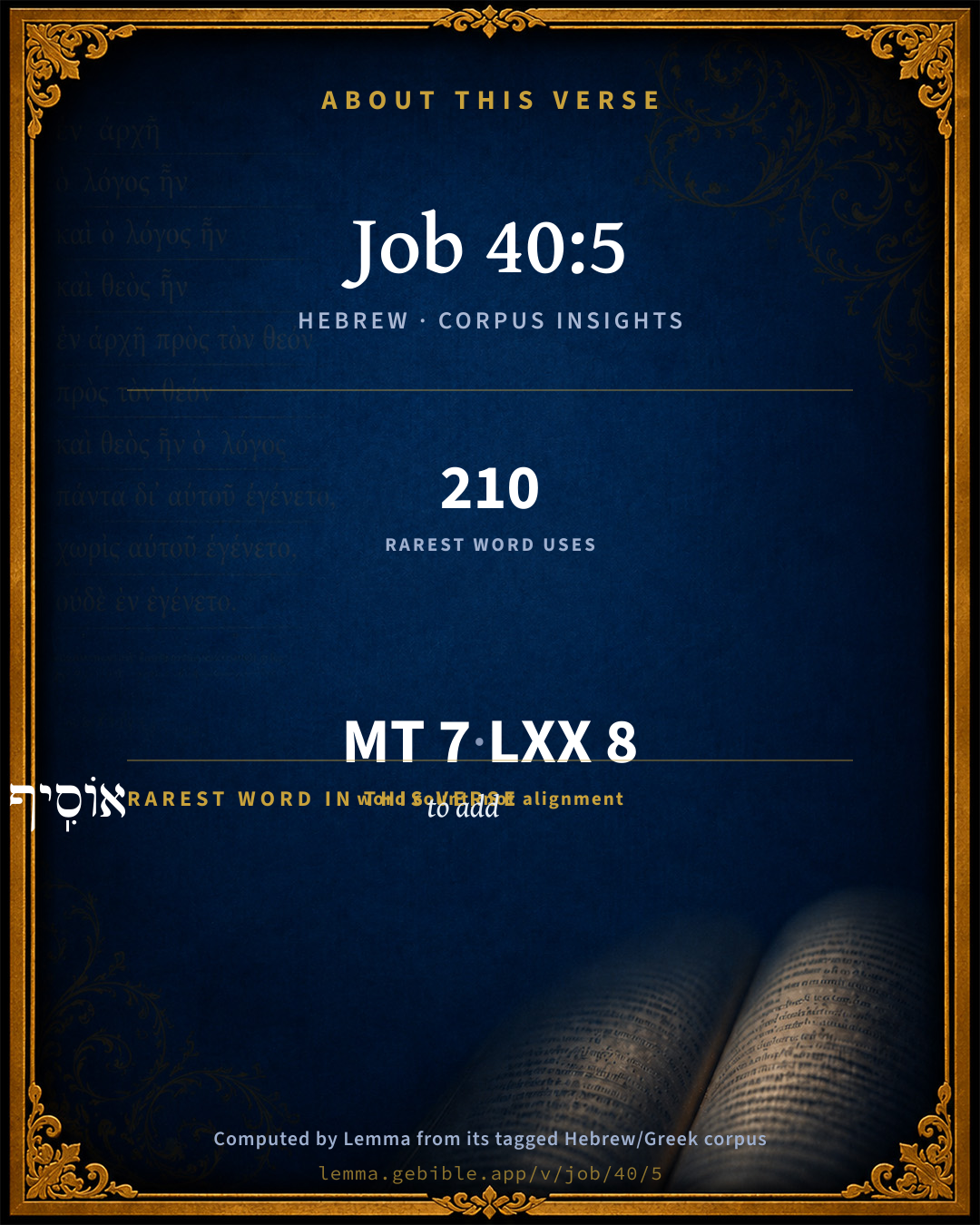
About this verse

These counts appear in no published source. They are computed here, from the morphology-tagged text and Lemma’s own curated glosses. What Lemma adds →

7
words
6
distinct lemmas
Wisdom
section

Grammatical profile

  • 3 verbs
  • 2 adjectives
  • 2 particles

Verb forms

  • דִּ֭בַּרְתִּי Piel · Perfect
  • אֶֽעֱנֶ֑ה Qal · Imperfect
  • אוֹסִֽיף Hiphil · Imperfect

Repetition

A word recurs within this verse — often emphatic in Hebrew:

  • וְלֹ֣א not H3808 ×2

Hebrew & Septuagint length

In English translation the verse runs 17 words from the Hebrew and 14 from the Septuagint (LXX English) — closely comparable.

A rough comparison of the two English renderings, which tokenize alike — not a word-level alignment.

Word counts can differ between the Hebrew and the Greek without any difference in meaning — e.g. the Hebrew direct-object marker אֵת has no separate Greek word, and Greek often adds the article ὁ.

In the original languages it is 7 Hebrew tokens and 8 Greek tokens — but the two are counted differently (Hebrew bundles its prefixes and suffixes into one token; the Greek is in lemma form), so that isn’t a like-for-like length.

Cross-references

8

Topical passages linked to Job 40:5 in the Treasury of Scripture Knowledge — connected by theme and wording, ordered by reader-vote popularity; previews shown in the World English Bible.

  • Job 33:14 For God speaks once, Yes twice, though man pays no attention.
  • Psalms 62:11 God has spoken once, Twice I have heard this, That power belongs to God.
  • Job 9:3 If he is pleased to contend with him, He can't answer him one time in a thousand.
  • Job 9:15 Whom, though I were righteous, yet would I not answer. I would make supplication to my judge.
  • 2 Kings 6:10 The king of Israel sent to the place which the man of God told him and warned him of; and he saved himself there, not once nor twice.
  • Job 34:31–32 "For has any said to God, 'I am guilty, but I will not offend any more.
  • Jeremiah 31:18–19 I have surely heard Ephraim bemoaning himself [thus], You have chastised me, and I was chastised, as a calf unaccustomed [to the yoke]: turn you me, and I shall be turned; for you are Yahweh my God.
  • Romans 3:19 Now we know that whatever things the law says, it speaks to those who are under the law, that every mouth may be closed, and all the world may be brought under the judgment of God.

Cross-references courtesy of OpenBible.info (CC BY 4.0).

Hebrew and Greek witnesses Masoretic Hebrew ↔ Greek Septuagint

The same verse in the two great witnesses to the Old Testament, shown verse-for-verse.

These are two independent witnesses, not word-aligned to each other, and the Septuagint is shown in lemma (dictionary) form.

Hebrew Job 40:5 Masoretic · Westminster Leningrad Codex

אַחַ֣ת דִּ֭בַּרְתִּי וְלֹ֣א אֶֽעֱנֶ֑ה וּ֝שְׁתַּ֗יִם וְלֹ֣א אוֹסִֽיף

I have spoken once, and I will not answer; Yes, twice, but I will proceed no further."

World English Bible · Public Domain

Greek LXX Job 40:5 Septuagint · lemma form

ἅπαξ λαλέω ἐπί δέ ὁ δεύτερος οὐ προςτίθημι

Assume now a lofty bearing and power; and clothe yourself with glory and honor.

LXX2012 (modern English Septuagint) · Public Domain

Hebrew: Westminster Leningrad Codex (CC BY 4.0). Greek: Septuagint (public domain); English from LXX2012 (modern English Septuagint) (Public Domain). How the Septuagint differs from the Hebrew →

Commentary

Notes on Job 40:5 from classic Christian and Jewish commentators (each source and its license shown beneath its notes). The classic Christian expositions comment on the surrounding passage and are grouped to its opening verse, so a note may address several verses; the Jewish commentaries on the Tanakh (Rashi and others) are per-verse, so they appear only where the commentator wrote on this verse.

Lemma curates 59 commentaries, every one of them public domain or Creative Commons licensed, each selected and text-cleaned for this edition rather than reprinted as found. About our sources →

Trapp's Complete Commentary

John Trapp

Job 40:5 Once have I spoken; but I will not answer: yea, twice; but I will proceed no further.

Ver. 5. Once have I spoken, but I will not answer] It is enough of that once: the saints, running out, and meeting with a bargain of sin, come back by weeping cross, and cry, What have I to do any more with wickedness? Hos 14:8. Judah knew his daughter Tamar no more, Gen 38:26. "If I have done iniquity, I will do no more," Job 34:31-32. That was Elihu’s counsel; and now it is Job’s practice.

Yea, twice] That is, often; so eager was I set upon a dispute. This was an aggravation of Job’s sin, the committing of it again and again. Numbers added to numbers are first ten times more; then a hundred; then a thousand, &c. "This hath been thy manner from thy youth," Jer 22:21; that was an ill business.

But I will proceed no further] sc. In this controversy. I will not come into the lists to contend with thee. I see there is no safety in such a contest. In many things we offend all, saith St James; and he is a perfect man who sinneth not with his tongue. But as he who hath drunk poison maketh haste to cast it up again, ere it get to the vitals; so should we deal by our daily misdoings. It is not falling into the water that drowns a man, but lying long under it. Bewail thy sin and hasten to get out of it.

John Trapp, A Commentary or Exposition upon All the Books of the Old and New Testament (1647–1656) — public domain. Text from a community e-Sword module.

Tyndale Open Study Notes

Tyndale Open Resources

40:5 Job had nothing more to say; he had no further charges against God, nor would he make a rebuttal.

Tyndale Open Study Notes — © Tyndale Open Resources, licensed CC BY-SA 4.0. Text via the HelloAO Bible API.

Geneva Bible (1599)

Geneva Bible translators

Meaning, that these were proper unto God, and belonged to no man.

Geneva Bible (1599) marginal notes — public domain. Text via Bolls.life.

Jamieson, Fausset & Brown

Robert Jamieson, A. R. Fausset & David Brown

Once . . . twice--oftentimes, more than once (Job 33:14, compare with Job 33:29; Psa 62:11):

I have spoken--namely, against God.

not answer--not plead against Thee.

Jamieson, Fausset & Brown — Commentary Critical and Explanatory on the Whole Bible (1871) — public domain (CC PDM 1.0). Text via the HelloAO Bible API.

Adam Clarke's Commentary

Verse 5. Once have I spoken] See on Job 42:3, c.

I will proceed no farther.] I shall attempt to justify myself no longer I have spoken repeatedly; and am confounded at my want of respect for my Maker, and at the high thoughts which I have entertained of my own righteousness. All is impurity in the presence of thy Majesty.

Adam Clarke's Commentary on the Bible (1810–1826) — public domain. Text from a community e-Sword/MySword module.

The Cambridge Bible for Schools and Colleges

gen. ed. J. J. S. Perowne

5. I will proceed no further] Or, but I will not again. The words “once”, “twice”, that is, sundry times, refer to what Job had often said in his speeches concerning the Almighty.

The purpose of making these wonders of creation pass before Job’s eyes was to display God before him, and to heal the presumption of his heart. Every one of these wonders utters the name of God with a louder emphasis in Job’s ears. It is not any attribute of God that is dwelt upon, it is God in all the manifoldness of His being that passes before Job’s mind. It is entirely to misinterpret the design of these visions of creation presented to Job when we suppose that what is aimed at is to impress on Job the incomprehensibility of the Creator’s works, or the mystery that lies in them all; as if he was bidden consider that not in his own life alone, but everywhere, beneath his feet and around him, there lay unfathomable mysteries. The Lord does not reason with Job after the manner of the author of the Analogy of Religion. He does not say “you complain of darkness in your own history, look into the world and behold darkness everywhere”. This would have been sorry reasoning on the part of the Father of lights. On the contrary, He bids Job look away from his own darkness to the world which is luminous with God; and the exceeding light about God there, breaking on Job, swallows up his own darkness.

It is scarcely just to say that what Jehovah demands of Job here is simple submission, that he should bow absolutely and unconditionally under God. If this had been the meaning of Jehovah’s speeches out of the storm there was no reason for His speaking. Silence would have been more effective; or if He had spoken, it should have been with the voice of the thunder, terrifying Job into the dust. That the Lord speaks at all implies that He says something that may be understood by the creature of His hand. His speaking may be indirect, and in parables, but it will contain meaning. It is true that the object of the Divine speeches is, partly at least, to bring Job’s heart to submission and cause him to assume his right place before the Creator. And this was necessary, for Job, as he acknowledges, had sinned against the majesty of God. But the Lord does not command Job to take this place; He induces him. And he does so by the only means that will ever induce any human spirit to put itself right with God, the revelation of Himself. This revelation given to Job was patient, broad, and manifold. It was anything but a categorical command. We, indeed, may feel now that the revelation might have been different, that it might have contained other traits. The traits which we desiderate could hardly, perhaps, have been exhibited on an Old Testament stage. It was not the design of the revelation, if it ever was the design of revelation, to communicate new truths to Job, but to make him feel the truth which he knew, and enable him to live aright before God.

The Cambridge Bible for Schools and Colleges (gen. ed. J. J. S. Perowne; Cambridge University Press, 1878–1918) — public domain. Text from a community e-Sword module.

John Gill's Exposition

Once have I spoken; but I will not answer,.... Some think this refers to what he had just now said of his vileness, he had owned that, and that was all he had to say, or would say, he would give no other answer; Jarchi says, some suppose he has respect to his words in Job 9:22;

yea, twice; but I will proceed no further; the meaning seems to be, that he who had once and again, or very often, at least in some instances, spoken very imprudently and indecently, for the future would take care not to speak in such a manner: for this confession was not quite free and full; and therefore the Lord takes him in hand again, to bring him to make a more full and ingenuous one, as he does in Job 42:1.

John Gill's Exposition of the Whole Bible (1746–1763) — public domain (CC PDM 1.0). Text via the HelloAO Bible API.

Albert Barnes' Notes on the Bible

Once have I spoken - That is, in vindicating myself. He had once spoken of God in an irreverent and improper manner, and he now saw it.

But I will not answer - I will not now answer, as I had expressed the wish to do. Job now saw that he had spoken in an improper manner, and he says that he would not repeat what he had said.

Yea, twice - He had not only offended once, as if in a thoughtless and hasty manner, but he had repeated it, showing deliberation, and thus aggravating his guilt. When a man is brought to a willingness to confess that he has done wrong once, he will be very likely to see that he has been guilty of more than one offence. One sin will draw on the remembrance of another; and the gate once open, a flood of sins will rush to the recollection. It is not common that a man can so isolate a sin as to repent of that alone, or so look at one offence against God as not to feel that he has been often guilty of the same crimes.

But I will proceed no further - Job felt doubtless that if he should allow himself to speak again, or to attempt now to vindicate himself, he would be in danger of committing the same error again. He now saw that God was right; that he had himself repeatedly indulged in an improper spirit, and that all that became him was a penitent confession in the fewest words possible. We may learn here:

(1) That a view of God is fitted to produce in us a deep sense of our own sins. No one can feel himself to be in the presence of God, or regard the Almighty as speaking to him, without saying, “Lo I am vile? There is nothing so much fitted to produce a sense of sinfulness and nothingness as a view of God.

(2) The world will be mute at the day of judgment. They who have been most loud and bold in vindicating themselves will then be silent, and will confess that they are vile, and the whole world “will become guilty before God.” If the presence and the voice of God produced such an effect on so good a man as Job, what will it not do on a wicked world?

(3) A true penitent is disposed to use but few words; “God be merciful to me a sinner,” or, “lo, I am vile,” is about all the language which the penitent employs. He does not go into long arguments, into metaphysical distinctions, into apologies and vindications, but uses the simplest language of confession, and then leaves the soul, and the cause, in the hands of God.

(4) Repentance consists in stopping where we are, and in resolving to add no more sin. “I have erred,” is its language. “I will not add to it, I will do so no more,” is the immediate response of the soul. A readiness to go into a vindication, or to expose oneself to the danger of sinning again in the same way, is an evidence that there is no true repentance. Job, a true penitent, would not allow himself even to speak again on the subject, lest he should be guilty of the sin which he had already committed.

(5) In repentance we must be willing to retract our errors, and confess that we were wrong - no matter what favorite opinions we have had, or how tenaciously and zealously we have defended and held them. Job had constructed many beautiful and eloquent arguments in defense of his opinions; he had brought to bear on the subject all the results of his observation, all his attainments in science, all the adages and maxims that he had derived from the ancients, and from a long contact with mankind, but he was now brought to a willingness to confess that his arguments were not solid, and that the opinions which he had cherished were erroneous. It is often more difficult to abandon opinions than vices; and the proud philosopher when he exercises repentance has a more difficult task than the victim of low and debasing sensuality. His opinions are his idols. They embody the results of his reading, his reflections, his conversation, his observation, and they become a part of himself. Hence, it is, that so many abandoned sinners are converted, and so few philosophers; that religion spreads often with so much success among the obscure and the openly wicked, while so few of the “wise men of the world” are called and saved.

Albert Barnes' Notes on the Bible (1834–1885) — public domain. Text from a community e-Sword/MySword module.

Matthew Poole's English Annotations

I will not answer, or speak again; answering being oft put for speaking. I will contend no more with thee.

Yea, twice, i.e. ofttimes, or again and again, the definite number being used indefinitely.

I will proceed no further in such bold and presumptuous expressions and accusations of thy providence towards me. Vain therefore are the excuses which some interpreters make for Job, as if he were faultless in his foregoing discourses, when both God chargeth him with faultiness therein, and Job himself confesseth it.

Matthew Poole's English Annotations on the Holy Bible (1683–1685) — public domain. Text from a community e-Sword/MySword module.

The Pulpit Commentary

Once have I spoken; but I will not answer: yea, twice; but l will proceed no further. The meaning is, "I have already spoken, not once, but more than once. Now I will be silent; I will say no more." There is a sort of recognition that the arguments used were futile, but not a full and complete confession, as in Job_42:3.

The Pulpit Commentary (1880–1919), ed. H.D.M. Spence-Jones & Joseph S. Exell — public domain. Text from a community e-Sword module.

John Wesley's Explanatory Notes

Answer - Speak again; I will contend no more with thee. Twice - Often, the definite number being used indefinitely.

John Wesley, Explanatory Notes Upon the Whole Bible (1754–1765) — public domain. Text via the GEBible commentary corpus.

Rashi

Rabbi Shlomo Yitzchaki (Rashi)

I said one [thing i.e., I have spoken little and I will add no more. Others explain: I said one What I said (above 9:22), “[It is all one; therefore I said,] ‘He destroys both the innocent and the wicked,’” I will no longer answer.

and two What I said (above 13:20), “Do not do two things to me,” I will not add.

Rashi on the Tanakh — English translations: “The Judaica Press complete Tanach with Rashi, translated by A. J. Rosenberg” (CC BY 4.0); “Pentateuch with Rashi's commentary by M. Rosenbaum and A.M. Silbermann, 1929-1934” (public domain); “The Metsudah Tanach series, Lakewood, N.J” (CC BY 4.0); and “The Book of Joshua, Metsudah Publications, 1997” (CC BY 4.0). Text via Sefaria.

Lesson kit

Teaching starters — assembled from the data on this page, not authored interpretation. Every prompt links to the verse data it draws on. Edit before teaching.

Job, in the Wisdom, opens this verse with 7 words (6 distinct Hebrew lemmas). Its most distinctive word is yâçaph (“to add”). A historical commentator’s framing appears above. Read the whole chapter for the surrounding context.

Discussion questions

  1. What does “to add” (yâçaph) contribute to the verse as a whole?
  2. Job 33:14 shares this passage’s theme. How do the two illuminate each other?
  3. “not” occurs 2× in this one verse. What is the effect of the repetition?
  4. The translations on this page render this verse differently — a whole-verse word diff, not a word-by-word alignment. What might account for the different wordings?
  5. The verb «דִּ֭בַּרְתִּי» is Piel Perfect. How does its form color the action?
  6. Reading how Trapp's Complete Commentary and Tyndale Open Study Notes read this verse, where do the two commentators agree and where do they part?

Things to notice

Reading settings

Reading text

Shown beneath each verse's original-language words.

Old Testament
Old Testament edition

Read the OT as the Masoretic Hebrew (MT) or the Greek Septuagint (LXX).

English shown for the Greek Septuagint (in the Hebrew ↔ Greek comparison).

Comparing translations? Open the Compare panel on any verse page to stack up to four side by side.