

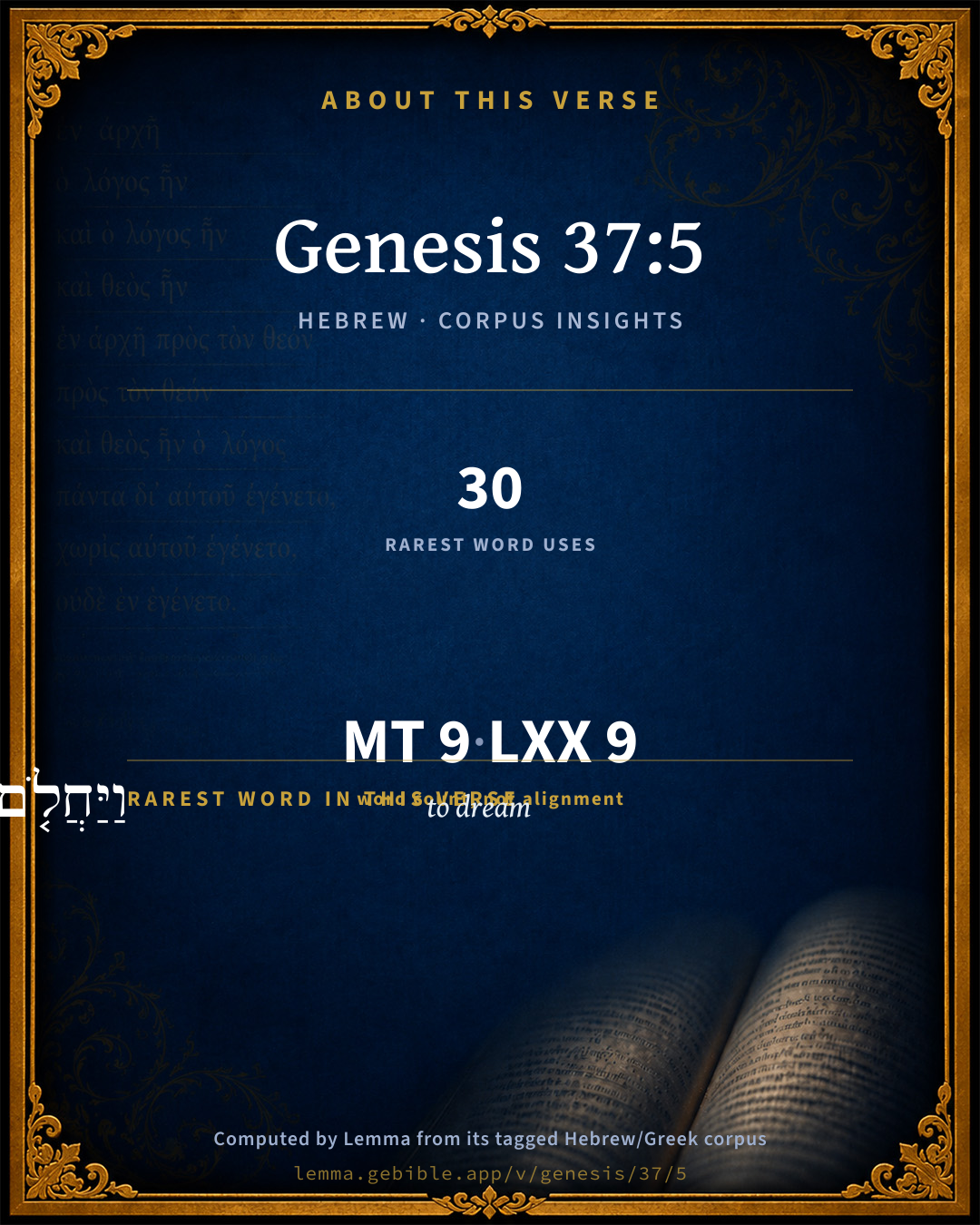
Genesis 37:5

Hebrew (Westminster Leningrad Codex) Genesis 37:5 appears in the Hebrew Old Testament. The text above is from the Westminster Leningrad Codex. Each word links to its Strong’s number, a concise gloss, and parsing drawn from the Open Scriptures Hebrew Bible morphology. Click any word for its full Brown-Driver-Briggs (BDB) entry.
Download image
Cite this verse

Genesis 37:5 (World English Bible). Public Domain. Lemma interlinear Bible study tool, https://lemma.gebible.app/v/genesis/37/5.

Show BibTeX & RIS
BibTeX
RIS
English Translation
Joseph dreamed a dream, and he told it to his brothers, and they hated him all the more.
World English Bible · Public Domain
Download a study sheet

One document with this verse’s original text, its word-by-word gloss line, the meaning frame, cross-references with their text, attributed commentary, and full source and license credits — printable, and it pastes into notes with its structure intact.

This verse Autodidact and up

Study sheet (.html) Plain text (.txt)

A passage Seminary Student

Up to 50 verses in one chapter. A passage sheet keeps up to 6 commentary sources and 12 cross-references per verse, in the order this page ranks them, and says so on the sheet whenever that leaves anything out. Ask for a single verse and you get the Autodidact verse sheet above.

Everything on this page stays free to read, with no account — the sheet is a download of what is already on screen, not access to it.

Want to remove ads? Support Godless Engineer
Compare translations 3

The same verse in 3 English versions, stacked beneath the original-language interlinear above. Click any original word for its lexicon entry.

Each is an independent rendering of the whole verse — the interlinear is not word-aligned to these translations.

Highlighted words mark where these versions differ — a whole-verse word diff, not a word-by-word alignment.

  • World English Bible Public Domain
    Joseph dreamed a dream, and he told it to his brothers, and they hated him all the more.
  • King James Version Public Domain
    And Joseph dreamed a dream, and he told it his brethren: and they hated him yet the more.
  • unfoldingWord Literal Text CC BY-SA 4.0
    Then Joseph dreamed a dream and told it to his brothers, and they continued to hate him even more.

unfoldingWord Literal Text — © unfoldingWord, licensed CC BY-SA 4.0. Word-aligned USFM3 via Door43 (git.door43.org/unfoldingWord/en_ult).

Versions to compare (up to 4)

3 of 4 selected

Show all 18 translations

Every available English version of this verse, each an independent rendering of the whole verse.

  • World English Bible Public Domain
    Joseph dreamed a dream, and he told it to his brothers, and they hated him all the more.
  • Berean Standard Bible Public Domain
    Then Joseph had a dream, and when he told it to his brothers, they hated him even more.
  • Majority Standard Bible Public Domain
    Then Joseph had a dream, and when he told it to his brothers, they hated him even more.
  • King James Version Public Domain
    And Joseph dreamed a dream, and he told it his brethren: and they hated him yet the more.
  • American Standard Version (1901) Public Domain
    And Joseph dreamed a dream, and he told it to his brethren: and they hated him yet the more.
  • Revised Version (1885) Public Domain
    And Joseph dreamed a dream, and he told it to his brethren: and they hated him yet the more.
  • Geneva Bible (1599) Public Domain
    And Ioseph dreamed a dreame, and told his brethren, who hated him so much the more.
  • Douay-Rheims (1899) Public Domain
    Now it fell out also that he told his brethren a dream, that he had dreamed: which occasioned them to hate him the more.
  • Young's Literal Translation Public Domain
    And Joseph dreameth a dream, and declareth to his brethren, and they add still more to hate him.
  • Literal Standard Version CC BY-SA 4.0
    And Joseph dreams a dream, and declares to his brothers, and they add still more to hate him.
  • Unlocked Literal Bible CC BY-SA 4.0
    Joseph dreamed a dream, and he told his brothers about it. They hated him even more.
  • unfoldingWord Literal Text CC BY-SA 4.0
    Then Joseph dreamed a dream and told it to his brothers, and they continued to hate him even more.
  • Darby Bible Public Domain
    And Joseph dreamed a dream, and told [it] to his brethren, and they hated him yet the more.
  • World Messianic Bible Public Domain
    Joseph dreamed a dream, and he told it to his brothers, and they hated him all the more.
  • Webster's Bible Public Domain
    And Joseph dreamed a dream, and he told it to his brethren: and they hated him yet the more.
  • Free Bible Version CC BY-SA 4.0
    Joseph had a dream, and when he told his brothers about it, they hated him even more.
  • Bible in Basic English Public Domain
    Now Joseph had a dream, and he gave his brothers an account of it, which made their hate greater than ever.
  • JPS Tanakh (1917) Public Domain
    And Joseph dreamed a dream, and he told it to his brethren; and they hated him yet the more.

Literal Standard Version (2020), Covenant Press — licensed CC BY-SA 4.0. Text via the HelloAO Bible API (eBible.org). Unlocked Literal Bible (unfoldingWord) — licensed CC BY-SA 4.0. Text via the HelloAO Bible API (eBible.org). unfoldingWord Literal Text — © unfoldingWord, licensed CC BY-SA 4.0. Word-aligned USFM3 via Door43 (git.door43.org/unfoldingWord/en_ult). Free Bible Version, Dr. Jonathan Gallagher — licensed CC BY-SA 4.0. Text via the HelloAO Bible API (eBible.org).

Word by word

More ways to search: Search by grammar → Find every occurrence → Compare this word →

Practice this passage: Drill this verse → Learn its vocabulary →

וַיַּחֲלֹ֤ם
châlam
H2492
“and · to dream”
Conjunction + Verb, Qal, Sequential Imperfect, 3rd Person, Masculine, Singular
Part of Speech
Conjunction + Verb
Stem
Qal
Form
Sequential Imperfect
Person
3rd Person
Gender
Masculine
Number
Singular
Full BDB Definition

Origin: a primitive root

TWOT: 662 , 663

to dream - (Qal) - to dream (ordinary) - to dream (prophetic) - to dream (of false prophets) - (Hiphil) to dream - to be healthy, be strong - (Qal) to be healthy - (Hiphil) to restore to health
  1. יוֹסֵף֙ Yôwçêph H3130 “Joseph” Noun, Proper
  2. חֲל֔וֹם chălôwm H2472 “dream” Noun, Common, Masculine, Singular, Absolute
  3. וַיַּגֵּ֖ד nâgad H5046 “and · to make known” Conjunction + Verb, Hiphil, Sequential Imperfect, 3rd Person, Masculine, Singular
  4. לְאֶחָ֑יו ʼâch H251 “to/for · brothers · his” Preposition + Noun, Common, Masculine, Plural, Construct + Suffix, Personal, 3rd Person, Masculine, Singular
  5. וַיּוֹסִ֥פוּ yâçaph H3254 “and · to add” Conjunction + Verb, Hiphil, Sequential Imperfect, 3rd Person, Masculine, Plural
  6. ע֖וֹד ʻôwd H5750 “still” Adverb
  7. שְׂנֹ֥א sânêʼ H8130 “to hate” Verb, Qal, Infinitive Construct
  8. אֹתֽוֹ ʼêth H853 “- · him” Particle, Direct Object + Suffix, Personal, 3rd Person, Masculine, Singular

About this verse

These counts appear in no published source. They are computed here, from the morphology-tagged text and Lemma’s own curated glosses. What Lemma adds →

9
words
9
distinct lemmas
Pentateuch
section

Shared distinctive vocabulary

וַיַּחֲלֹ֤ם to dream H2492 occurs in 25 verses of the Hebrew Bible. Also found in:

Grammatical profile

  • 4 verbs
  • 3 nouns
  • 1 adverb
  • 1 particle

Verb forms

  • וַיַּחֲלֹ֤ם Qal · Sequential Imperfect
  • וַיַּגֵּ֖ד Hiphil · Sequential Imperfect
  • וַיּוֹסִ֥פוּ Hiphil · Sequential Imperfect
  • שְׂנֹ֥א Qal · Infinitive Construct

Hebrew & Septuagint length

In English translation the verse runs 18 words from the Hebrew and 11 from the Septuagint (LXX English) — the Septuagint runs noticeably shorter here. See the side-by-side →

A rough comparison of the two English renderings, which tokenize alike — not a word-level alignment.

Word counts can differ between the Hebrew and the Greek without any difference in meaning — e.g. the Hebrew direct-object marker אֵת has no separate Greek word, and Greek often adds the article ὁ.

In the original languages it is 9 Hebrew tokens and 9 Greek tokens — but the two are counted differently (Hebrew bundles its prefixes and suffixes into one token; the Greek is in lemma form), so that isn’t a like-for-like length.

Cross-references

16

Topical passages linked to Genesis 37:5 in the Treasury of Scripture Knowledge — connected by theme and wording, ordered by reader-vote popularity; previews shown in the World English Bible.

  • Genesis 28:12 He dreamed. Behold, a stairway set up on the earth, and the top of it reached to heaven. Behold, the angels of God ascending and descending on it.
  • Genesis 42:9 Joseph remembered the dreams which he dreamed about them, and said to them, "You are spies! You have come to see the nakedness of the land."
  • Daniel 4:5 I saw a dream which made me afraid; and the thoughts on my bed and the visions of my head troubled me.
  • John 17:14 I have given them your word. The world hated them, because they are not of the world, even as I am not of the world.
  • Genesis 37:4 His brothers saw that their father loved him more than all his brothers, and they hated him, and couldn't speak peaceably to him.
  • Numbers 12:6 He said, Hear now my words: if there be a prophet among you, I Yahweh will make myself known to him in a vision, I will speak with him in a dream.
  • Amos 3:7 Surely the Lord Yahweh will do nothing, Unless he reveals his secret to his servants the prophets.
  • 1 Kings 3:5 In Gibeon Yahweh appeared to Solomon in a dream by night; and God said, Ask what I shall give you.
  • Joel 2:28 "It will happen afterward, that I will pour out my Spirit on all flesh; And your sons and your daughters will prophesy. Your old men will dream dreams. Your young men will see visions.
  • Genesis 37:8 His brothers said to him, "Will you indeed reign over us? Or will you indeed have dominion over us?" They hated him all the more for his dreams and for his words.
  • Genesis 40:5 They both dreamed a dream, each man his dream, in one night, each man according to the interpretation of his dream, the cupbearer and the baker of the king of Egypt, who were bound in the prison.
  • Genesis 41:1 It happened at the end of two full years, that Pharaoh dreamed: and, behold, he stood by the river.
  • Genesis 49:23 The archers have sorely grieved him, Shot at him, and persecute him:
  • Judges 7:13–14 When Gideon had come, behold, there was a man telling a dream to his fellow; and he said, Behold, I dreamed a dream; and, behold, a cake of barley bread tumbled into the camp of Midian, and came to the tent, and struck it so that it fell, and turned it upside down, so that the tent lay flat.
  • Psalms 25:14 The friendship of Yahweh is with those who fear him. He will show them his covenant.
  • Daniel 2:1 In the second year of the reign of Nebuchadnezzar, Nebuchadnezzar dreamed dreams; and his spirit was troubled, and his sleep went from him.

Cross-references courtesy of OpenBible.info (CC BY 4.0).

Hebrew and Greek witnesses Masoretic Hebrew ↔ Greek Septuagint

The same verse in the two great witnesses to the Old Testament, shown verse-for-verse.

Here the Septuagint runs noticeably shorter than the Hebrew — LXX2012 (modern English Septuagint) 11 words vs World English Bible 18. A rough length comparison of the two English translations, not a word-level alignment — read both below.

These are two independent witnesses, not word-aligned to each other, and the Septuagint is shown in lemma (dictionary) form.

Hebrew Genesis 37:5 Masoretic · Westminster Leningrad Codex

וַיַּחֲלֹ֤ם יוֹסֵף֙ חֲל֔וֹם וַיַּגֵּ֖ד לְאֶחָ֑יו וַיּוֹסִ֥פוּ ע֖וֹד שְׂנֹ֥א אֹתֽוֹ

Joseph dreamed a dream, and he told it to his brothers, and they hated him all the more.

World English Bible · Public Domain

Greek LXX Genesis 37:5 Septuagint · lemma form

ἐνὑπνιάζω δέ ιωσηφ ἐνύπνιον ἀποἀγγέλλω αὐτός ὁ ἀδελφός αὐτός

And Joseph dreamed a dream, and reported it to his brethren.

LXX2012 (modern English Septuagint) · Public Domain

On this verse, Keil & Delitzsch discusses the Septuagint’s reading. Read the note in Commentary ↓

Hebrew: Westminster Leningrad Codex (CC BY 4.0). Greek: Septuagint (public domain); English from LXX2012 (modern English Septuagint) (Public Domain). How the Septuagint differs from the Hebrew →

Targum (Aramaic paraphrase)

2

The Targum is the ancient Jewish Aramaic paraphrase of the Hebrew Scriptures — an interpretive translation, not the Hebrew text itself. Onkelos (literal) and Pseudo-Jonathan (expansive) render the Torah, and Jonathan the Prophets. Coverage is partial: where no permissively-licensed English translation exists for a verse, only the Aramaic is shown. This is verse-level text, not a word-by-word alignment to the Hebrew.

  1. Targum Onkelos Torah (Genesis–Deuteronomy)
    וַחֲלַם יוֹסֵף חֶלְמָא וְחַוִי לַאֲחוֹהִי וְאוֹסִיפוּ עוֹד סְנוֹ יָתֵהּ

    (no public-domain English translation for this verse)

    Targum Onkelos — Aramaic: “Onkelos Genesis” (public domain); “Onkelos Exodus” (public domain); “Onkelos Leviticus” (public domain); “Onkelos Numbers” (public domain); “Onkelos Deuteronomy” (public domain). English: “Sefaria Community Translation” (CC0 1.0 (public-domain dedication)); “J.W. Etheridge. The Targums of Onkelos and Jonathan Ben Uzziel on the Pentateuch. London: Longmans, Green, 1862” (public domain). Text via Sefaria.

  2. Targum Pseudo-Jonathan Torah (Genesis–Deuteronomy)
    וַחֲלָם יוֹסֵף חֵילְמָא וְתַנִי לְאָחוֹהִי וְאוֹסִיפוּ לְמִנְטַר תּוּב לֵיהּ בָּבוּ

    And Joseph dreamed a dream, and declared it to his brethren, and they added yet to keep enmity against him.

    Targum Pseudo-Jonathan — Aramaic: “Targum Jonathan on Genesis” (public domain); “Targum Jonathan on Exodus” (public domain); “Targum Jonathan on Leviticus” (public domain); “Targum Jonathan on Numbers” (public domain); “Targum Jonathan on Deuteronomy” (public domain). English: “The Targum of Jonathan ben Uzziel, trans. J. W. Etheridge, London, 1862” (public domain). Text via Sefaria.

Commentary

Notes on Genesis 37:5 from classic Christian and Jewish commentators (each source and its license shown beneath its notes). The classic Christian expositions comment on the surrounding passage and are grouped to its opening verse, so a note may address several verses; the Jewish commentaries on the Tanakh (Rashi and others) are per-verse, so they appear only where the commentator wrote on this verse.

Lemma curates 59 commentaries, every one of them public domain or Creative Commons licensed, each selected and text-cleaned for this edition rather than reprinted as found. About our sources →

Jamieson, Fausset & Brown

Robert Jamieson, A. R. Fausset & David Brown

THE DREAMS OF JOSEPH. (Gen. 37:5-36)

Joseph dreamed a dream--Dreams in ancient times were much attended to, and hence the dream of Joseph, though but a mere boy, engaged the serious consideration of his family. But this dream was evidently symbolical. The meaning was easily discerned, and, from its being repeated under different emblems, the fulfilment was considered certain (compare Gen 41:32), whence it was that "his brethren envied him, but his father observed the saying" [Gen 37:11].

Jamieson, Fausset & Brown — Commentary Critical and Explanatory on the Whole Bible (1871) — public domain (CC PDM 1.0). Text via the HelloAO Bible API.

Trapp's Complete Commentary

John Trapp

Gen 37:5 And Joseph dreamed a dream, and he told [it] his brethren: and they hated him yet the more.

Ver. 5. And Joseph dreamed.] Of divine dreams to be regarded as oracles, {See Trapp on "Gen 20:3"}

They hated him yet the more.] So the Jews did Jesus, for his parables; especially when he spake of his exaltation.

John Trapp, A Commentary or Exposition upon All the Books of the Old and New Testament (1647–1656) — public domain. Text from a community e-Sword module.

The Biblical Illustrator

Joseph S. Exell

Gen_37:5-11

Joseph dreamed a dream

The dreams of Joseph

Destined superiority to brethren and parents is the one grand idea that comes out in the strange visions of the night recorded here.

1. This idea was evidently a Divine communication.

2. This idea was expressed at different periods and in different symbols.

3. This idea was felt by all to have a Divine significance.

I. THE VISIONS OF YOUTH. The young generally create bright visions of the future. This tendency serves--

(1) To increase the amount of mans happiness on this earth.

(2) To supply a mighty stimulus to our mental powers.

(3) To intimate what human nature would have been had there been no sin.

II. THE JEALOUSIES OF SOCIETY. Jealousy is a passion that springs from the fear of a rival enjoying advantages which we desire for ourselves.

1. It is very general.

2. It is an unhappy feeling.

3. It is unchristian.

III. THE DESTINY OF VIRTUE.

1. There is much in a virtuous life itself to ensure advancement.

2. Advancement is pledged by God Himself to a virtuous life.

Learn:

1. The fate of eminence. To encounter jealousy. Heed it not. March on.

2. The path of glory. Virtue. The beginning may be difficult, but the end will be everlasting life. (Homilist.)

The favourite son

I. JOSEPHS DREAMS.

II. JOSEPHS DISTRESS.

III. JOSEPHS DISAPPEARANCE.

1. He was separate by a superior destiny, of which his youthful dreams were permitted to give a dim, indefinite glimpse.

2. He was separate by reason of the fondness of his father for aim, on the one side, and by the envy and enmity of his brethren, on the other.

3. He was separate by the banishment from his home in Canaan to the land of Egypt, where the Midianites sold him to an officer high in the service of the Egyptian king.

4. And over all the chances and changes of his life God ruled. Josephs history remarkably illustrates Pauls saying in Rom_8:28. Let us remember this, and try from our earliest youth to serve God faithfully, and to suffer our trials patiently, as Joseph did. (W. S. Smith, B. D.)

Lessons

1. Good souls whom men hate for their goodness, God chooseth to reveal His mind more graciously to them.

2. God hath by dreams, in time past, revealed His future providences about His Church unto men.

3. Young years, addicted to godliness, are made capable of great and sweet discoveries from God (Gen_37:5).

4. It is duty to declare Gods will revealed concerning His purposes to His Church, though it please not men (Gen_37:6).

5. Dark, but certain, have been the revelations of God in times past, concerning His providence to His Church (Gen_37:7; Gen_37:9).

6. God in bringing about the salvation of His Church, makes parents and brethren stoop to His instruments. Superiors to inferiors.

7. God maketh persons in themselves adverse to His providences, yet to be interpreters of His revelations (Gen_37:8).

8. The Lord hath usually foretold the salvation and advancement of His Church, but not the way; Joseph dreams not of prisons.

9. Carnal relations are apt to hate and envy their very brother, when God sets him up above them.

10. The way and means of comfort which man despiseth, God useth yet to do them good who hate it. So here.

11. Gracious souls that wait for the Churchs delivery may yet have regret against the means discovered (Gen_37:10).

12. Grace in those souls checks their regret, and makes them observe, and keep Gods discoveries to them (Gen_37:11). (G. Hughes, B. D.)

How to judge of a dream

When a person told his dream in relating religious experience, Rowland Hill said, we do not despise a good mans dreams, but we will judge of the dream after we have seen how you act when you are awake.

Ambitions brilliant dreams

A youth of rare promise was Joseph. From his aptitude in creating and divining dreams, we may infer his fondness for quiet contemplation. His mind was active; he lived much in the future; he loved to roam amid unseen realities. Yet Joseph was not a perfect man. As every rose has its attendant thorn, so blemishes appear on his young soul. A sense of superiority and self-importance was fast springing up, under the unwise partiality of his father It was a tiny rift which would soon spoil the music of his life; a little cloud that would soon cover the whole horizon.

I. OBSERVE THE RAW MATERIAL OF THESE DREAMS. Every part of the history proceeds in a manner the most natural. It was the season of summer, and Joseph had been sharing with his brethren the labours of the harvest-field; for in Syria corn comes to maturity much earlier than in England. Overwearied with the excitements of the harvest, what more natural than that a busy imagination would weave into his dreams the stirring scenes in which he had just played a part? Touching the second dream, we must remember that, in the East the vocation of shepherds require their presence, in turn, during the hours of night, when wild beasts seek their prey. In that translucent atmosphere, and amid those cloudless skies, the lamps of heaven gleam with a brilliance unknown in Western climes. Again, by the natural processes of human thought, such a scene would furnish fit elements for the young mans dreams. Even nature moulds a man.

II. OBSERVE THE ARTIFICER OF THESE DREAMS. Not only does mystery appertain to heavenly things, there is mystery unfathomed within ourselves. Who can expound to us the philosophy of our dreams, yet these are full of significance. Aspirations, ambitions, projects, which during the day were kept in reserve, locked in secret by the monarch Will, now freely disport themselves, and the mans real self is seen in the mirror of his dreams. The prospect of eminence and rule rose before his eye, awake or asleep, like a glittering imperial crown, until that which at first was a vague possibility grew into a mental certainty. The conviction was rooting itself that he was to be a king.

III. OBSERVE THE OVER-RULING PURPOSE OF GOD. Although Joseph was conscious that he was free to choose his own course in life, free to frame ambitions, yet he was free only within certain limits, within a fitting circle: choice and will could act. Nevertheless the will of God encompassed and controlled the whole. There is no such thing as fatalism. We are moulding our own destiny, both temporal and eternal. We can catch at times a whispering of Gods voice even in our dreams. (J. D. Davies, M. A.)

Joseph has clear intimations of his future greatness

We are told in these verses that Joseph had intimations given him of his future greatness; that God revealed to him by dreams that, notwithstanding his brethrens present hatred and envy, they should one day come and bow themselves down before him. The happy end of all his troubles was thus mercifully made known to him, that he might be supported under them, and be strengthened to endure the depths of affliction into which his brethren were soon to plunge him. These dreams would doubtless often recur to his memory as he lay in the Egyptian prison, and cheer and comfort him as he felt the iron enter into his soul. And Joseph, in thus having his high destiny revealed to him at the commencement of his career, was a type of our dear Saviour. In all his sufferings on earth he was sustained and cheered by the joy that was set before him. The Father gave him this for the same reason that He gave Joseph early intimations of his future dignity, to cheer and solace his depressed spirit while rudely buffeted and tossed to and fro on the billows of earthly sorrow. We have thus seen, that the Father made known to Jesus as He did to Joseph the greatness that awaited Him, in order to sustain Him as He passed through the dreary waste of trouble that stretched far away between Him and the promised glory. We have seen also that Jesus, as well as Joseph, made mention of His coming dignity to His brethren. We shall now see that the result was the same in both cases. They hated him yet the more for his words, and said to him, Shalt thou indeed reign over us? or shalt thou indeed have dominion over us? So far from receiving Jesus as the Saviour when He clearly intimated to them that He was the Messiah, and proved it most convincingly by a thousand miracles, they despised and rejected Him. (E. Dalton)

The sanguine temperament of youth

It is worthy of remark, that Josephs visions were such as predicted only advancement and honour; his perils and imprisonment formed no part of his dreams. At this stage of the history, we are reminded of the sanguine hopes and lively anticipations which usually animate the minds of the young. (T. Gibson.)

The Biblical Illustrator, edited by Joseph S. Exell (c. 1880s–1900s) — public domain. Text from a community e-Sword module.

Joseph Benson's Commentary

Gen 37:5. Joseph dreamed a dream — Which it is probable he did not understand at first, and therefore, in great simplicity, told it to his brethren; for, had he understood it, he certainly would not have mentioned it to them, for he could not but know they were likely to make an evil construction and use of it. But God’s special providence was seen both in giving him these dreams, and in causing him to reveal them, because hereby it was made manifest, when the things which they signified came to pass, that these events had not happened by chance, but were of God’s ordering. It must be observed, that though Joseph was so young, as is here stated, yet his piety and devotion were such, that he was fitted thereby for God’s gracious discoveries to him: and as he had a great deal of trouble before him, God, in his great goodness, was pleased betimes to give him this prospect of his advancement, to support and comfort him.

Joseph Benson's Commentary on the Old and New Testaments (1811–1818) — public domain. Text from a community e-Sword module.

Tyndale Open Study Notes

Tyndale Open Resources

37:5-11 God confirmed his choice of this faithful son as the eventual leader of the whole family through two symbolic dreams. This is the first of three dream sequences in chs 37–50 (see 40:1–41:36; cp. 15:13; 20:3; 28:12-15; 31:24). Dreams carried weight as a form of divine communication, especially if the dream revelation was given twice.

Tyndale Open Study Notes — © Tyndale Open Resources, licensed CC BY-SA 4.0. Text via the HelloAO Bible API.

Geneva Bible (1599)

Geneva Bible translators

God revealed to him by a dream what should come to pass.

Geneva Bible (1599) marginal notes — public domain. Text via Bolls.life.

Matthew Henry's Commentary

Here, I. Joseph relates the prophetical dreams he had, Gen 37:6, Gen 37:7, Gen 37:9, Gen 37:10. Though he was now very young (about seventeen years old), yet he was pious and devout, and well-inclined, and this fitted him for God's gracious discoveries of himself to him. Joseph had a great deal of trouble before him, and therefore God gave him betimes this prospect of his advancement, to support and comfort him under the long and grievous troubles with which he was to be exercised. Thus Christ had a joy set before him, and so have Christians. Note, God has ways of preparing his people beforehand for the trials which they cannot foresee, but which he has an eye to in the comforts with which he furnishes them. His dreams were, 1. That his brethren's sheaves all bowed to his, intimating upon what occasion they should be brought to do homage to him, namely, in seeking to him for corn; their empty sheaves should bow to his full one. 2. That the sun, and moon, and eleven stars, did obeisance to him, Gen 37:9. Joseph was more of a prophet than a politician, else he would have kept this to himself, when he could not but know that his brethren did already hate him and that this would but the more exasperate them. But, if he told it in his simplicity, yet God directed it for the mortification of his brethren. Observe, Joseph dreamed of his preferment, but he did not dream of his imprisonment. Thus many young people, when they are setting out in the world, think of nothing but prosperity and pleasure, and never dream of trouble.

II. His brethren take it very ill, and are more and more enraged against him (Gen 37:8): Shalt thou indeed reign over us? See here, 1. How truly they interpreted his dream, that he should reign over them. Those become the expositors of his dream who were enemies to the accomplishment of it, as in Gideon's story (Jdg 7:13, Jdg 7:14); they perceived that he spoke of them, Mat 21:45. The event exactly answered to this interpretation, Gen 42:6, etc. 2. How scornfully they resented it: "Shalt thou, who are but one, reign over us, who are many? Thou, who are the youngest, over us who are older?" Note, The reign and dominion of Jesus Christ, our Joseph, have been, and are, despised and striven against by a carnal and unbelieving world, who cannot endure to think that this man should reign over them. The dominion also of the upright, in the morning of the resurrection, is thought of with the utmost disdain.

III. His father gives him a gentle rebuke for it, yet observes the saying, Gen 37:10, Gen 37:11. Probably he checked him for it, to lessen the offence which his brethren would be apt to take at it; yet he took notice of it more than he seemed to do: he insinuated that it was but an idle dream, because his mother was brought in, who had been dead some time since; whereas the sun, moon, and eleven stars, signify no more than the whole family that should have a dependence upon him, and be glad to be beholden to him. Note, The faith of God's people in God's promises is often sorely shaken by their misunderstanding the promises and then suggesting the improbabilities that attend the performance; but God is doing his own work, and will do it, whether we understand him aright or no. Jacob, like Mary (Luk 2:51), kept these things in his heart, and no doubt remembered them long afterwards, when the event answered to the prediction.

Matthew Henry's Commentary on the Whole Bible (1708–1710) — public domain (CC PDM 1.0). Text via the HelloAO Bible API.

Ellicott's Commentary for English Readers

(5) Joseph dreamed a dream.—Though dreams as a rule do but arise from the mind being wearied with overmuch business (Ecc_5:3), or other trivial causes; yet as being from time to time used by God for providential purposes, they are occasionally described as a lower kind of prophecy (Num_12:6-8; Deu_13:1; 1Sa_28:15). In the life of Joseph they form the turning point in his history, and it is to be noticed that while revelations were frequently made to Jacob, we have henceforward no record of any such direct communication from God to man until the time of Moses. The utmost granted to Joseph was to dream dreams; and after this the children of Israel in Egypt were left entirely to natural laws and influences. (Comp. Note on Gen_26:2.)

A Bible Commentary for English Readers, edited by Charles John Ellicott (1878–1897) — public domain. Text from a community e-Sword module.

The Cambridge Bible for Schools and Colleges

gen. ed. J. J. S. Perowne

5–11 (E). Joseph’s Dreams

5. dreamed a dream] The influence of dreams in the E narrative is conspicuous; cf. Gen_20:3. Dreams were regarded by the Oriental as intimations from another world, and were invested with the sanctity of a divine oracle. The dream and its significance entered deeply into the religious conceptions of the ancient races.

The Cambridge Bible for Schools and Colleges (gen. ed. J. J. S. Perowne; Cambridge University Press, 1878–1918) — public domain. Text from a community e-Sword module.

John Gill's Exposition

And Joseph dreamed a dream, and he told it his brethren,.... As a dream, in the simplicity of his heart; not understanding it, or imagining there was any meaning in it; he told it not with any design to affront them, but as an amusement, and for their diversion, there being something in it odd and ridiculous, as he himself might think:

and they hated him yet the more; not only because he had carried an ill report of them to his father, and because he loved him more than they, but still more because of this dream; the meaning of which they at once understood, though he did not, which yet they supposed he did, and that he told them it in a boasting manner, and to irritate them.

John Gill's Exposition of the Whole Bible (1746–1763) — public domain (CC PDM 1.0). Text via the HelloAO Bible API.

Haydock's Catholic Bible Commentary

A dream. These dreams of Joseph were prophetical, and sent from God, as were also those which he interpreted, chap. xl. and xli.; otherwise, generally speaking, the observing of dreams is condemned in the Scripture, as superstitious and sinful. See Deuteronomy xviii. 10, and Ecclesiasticus xxxiv. 2, 3.

George Leo Haydock (1774–1849), Haydock's Catholic Family Bible and Commentary, 1859 edition — public domain. Excludes Psalms (Douay-Rheims chapter numbering differs from Protestant) and Deuterocanonical books (Catholic canon only).

Matthew Poole's English Annotations

The

dream it is probable he did not understand, for then he would never have told it to them, who, as he knew very well, were likely to make an evil construction and use of it.

Matthew Poole's English Annotations on the Holy Bible (1683–1685) — public domain. Text from a community e-Sword/MySword module.

Whedon's Commentary on the Bible

Daniel D. Whedon

5. And Joseph dreamed a dream, and he told it his brethren — “In normal sleep there is inactivity of the senses, and consequently of the powers of perception by the senses, (presentative powers,) as well as of continuous and rational thought, while there may, at the same time, be activity of memory and imagination, (representative powers,) reproducing and fantastically combining the waking thoughts, thus causing dreams. Our lower as well as higher powers — the sleeping as well as the waking mind — may become the vehicle of divine revelation. Yet the Scriptures refer to the revelations received in sleep as if inferior in grade and character to those which involve the higher faculties of perception, understanding, and reason. It is in dreams that God reveals himself to the heathen, (Abimelech, Pharaoh, Nebuchadnezzar,) but to the seers of the chosen people only, as a general rule, in the prophet’s preparatory or rudimentary period. See Blackie’s Iliad, iv, p. 12. These accounts cannot fairly lead us to consider our mental operations in sleep as any more supernaturally guided than those of our waking hours. Neither can have prophetic authority unless inspired.” — Newhall.

Daniel D. Whedon (gen. ed.), Commentary on the Old and New Testaments (1874–1909) — public domain. Text from a community e-Sword module.

The Pulpit Commentary

And Joseph dreamed a dream (in which, though, as the sequel shows, intended as a Divine communication, there was nothing to distinguish it from an ordinary product of the mind), and he told it to his brethren: not in pride, since there is no reason to suppose that Joseph as yet understood the celestial origin of his dream but in the simplicity of his heart (Kalisch, Murphy), though in doing so he was also guided, unconsciously it may be, but still really, by an overruling providence, who made use of this very telling of the dream as a step towards its fulfillment (Lawson)and they hated him yet the more literally, and they added again to hate him.

The Pulpit Commentary (1880–1919), ed. H.D.M. Spence-Jones & Joseph S. Exell — public domain. Text from a community e-Sword module.

John Wesley's Explanatory Notes

Though he was now very young, about seventeen years old, yet he was pious and devout, and this fitted him for God's gracious discoveries to him. Joseph had a great deal of trouble before him, and therefore God gave him betimes this prospect of his advancement, to support and comfort him.

John Wesley, Explanatory Notes Upon the Whole Bible (1754–1765) — public domain. Text via the GEBible commentary corpus.

Keil & Delitzsch

C. F. Keil & F. Delitzsch

This hatred was increased when Joseph told them of two dreams that he had had: viz., that as they were binding sheaves in the field, his sheaf "stood and remained standing," but their sheaves placed themselves round it and bowed down to it; and that the sun (his father), and the moon (his mother, "not Leah, but Rachel, who was neither forgotten nor lost"), and eleven stars (his eleven brethren) bowed down before him. These dreams pointed in an unmistakeable way to the supremacy of Joseph; the first to supremacy over his brethren, the second over the whole house of Israel. The repetition seemed to establish the thing as certain (cf. Gen 41:32); so that not only did his brethren hate him still more "on account of his dreams and words" (Gen 37:8), i.e., the substance of the dreams and the open interpretation of them, and become jealous and envious, but his father gave him a sharp reproof for the second, though he preserved the matter, i.e., retained it in his memory (שׁמר lxx διετήρησε, cf. συνετήρει, Luk 2:19). The brothers with their ill-will could not see anything in the creams but the suggestions of his own ambition and pride of heart; and even the father, notwithstanding his partiality, was grieved by the second dream. The dreams are not represented as divine revelations; yet they are not to be regarded as pure flights of fancy from an ambitious heart, but as the presentiments of deep inward feelings, which were not produced without some divine influence being exerted upon Joseph's mind, and therefore were of prophetic significance, though they were not inspired directly by God, inasmuch as the purposes of God were still to remain hidden from the eyes of men for the saving good of all concerned.

Keil & Delitzsch — Biblical Commentary on the Old Testament (1861–1891) — public domain (CC PDM 1.0). Text via the HelloAO Bible API. (Old Testament only.)

Kretzmann's Popular Commentary

Paul E. Kretzmann

The Dreams of Joseph

v. 5. And Joseph dreamed a dream, and he told it his brethren; and they hated him yet the more. Joseph, not realizing the situation in its full gravity, told his dream with boyish eagerness and frankness, the result being, however, that he poured oil upon the flames of the hatred against him.

v. 6. And he said unto them, Hear, I pray you, this dream which I have dreamed.

v. 7. For, behold, we were binding sheaves in the field, and, lo, my sheaf arose, and also stood upright; and, behold, your sheaves stood round about, and made obeisance to my sheaf. As Isaac had tilled the soil in addition to grazing his herds and flocks, Gen 26:12, so Jacob had at least some land under cultivation, and Joseph was familiar with the work, having been called upon to assist his brothers in binding the loose grain-stalks into sheaves, or bundles. The interpretation of his dream was obvious, namely, that he would be exalted above his brothers.

v. 8. And his brethren said to him, Shalt thou indeed reign over us, or shalt thou indeed have dominion over us, lord it over us as king?And they hated him yet the more for his dreams, and for his words. They added to their hatred of him, partly on account of the dream itself, which made them feel uneasy, partly because he told them of it.

v. 9. And he dreamed yet another dream, and told it his brethren, and said, Behold, I have dreamed a dream more: And, behold, the sun and the moon and the eleven stars made obeisance to me. Here Joseph was also entirely ingenuous, being half puzzled and half delighted, since the repetition of the same idea in the dream made its fulfillment probable.

v. 10. And he told it to his father and to his brethren; and his father rebuked him, and said unto him, What is this dream that thou hast dreamed? Shall I and thy mother, either Bilhah or Leah, and thy brethren indeed come to bow down ourselves to thee to the earth? There is a note of uneasiness in Jacob’s stern reproof, as if he could not quite persuade himself that the dream was merely the result of false ambition.

v. 11. And his brethren envied him; they continued their attitude of hateful aloofness;but his father observed the saying, he kept and remembered the words, recalling them, probably, when he was told of Joseph’s remarkable elevation some twenty-two years later. It was nothing unusual in those days for the Lord to make known His plans by means of dreams, and He often provided reliable interpreters as well. It is foolish for people in our days to set up arbitrary explanations of dreams.

Paul E. Kretzmann, Popular Commentary of the Bible (1921–1924) — public domain. Text from a community e-Sword module.

unfoldingWord translationNotes

Door43 World Missions Community

Joseph dreamed a dream, and he told his brothers about it. They hated him even more

This is a summary of the events that will happen in Gen 37:6-11.

They hated him even more

"And Joseph's brothers hated him even more than they hated him before"

Please listen to this dream which I dreamed

"Please listen to this dream that I had"

translationWords

dream

unfoldingWord translationNotes — © Distant Shores Media and the Door43 World Missions Community, licensed CC BY-SA 4.0. Source: git.door43.org/Door43/en_tn.

Radak

Rabbi David Kimhi (Radak)

ויחלום....ויאמר, he dreamed, and wanted to make them feel bad seeing that they had displayed jealousy of his father’s love for him, and had allowed that jealousy to deteriorate into hatred of him. Seeing that eventually, Joseph’s rise to power was due to his handling of the harvest in Egypt, the details of the dream were: והנה קמה אלומתי, the symbol of my success, i.e. my sheaf of grain remained erect, whereas your sheaves bowed down to me. It was a fact that in due course the grain harvest was the cause of the brothers prostrating themselves before Joseph.

Radak on the Tanakh — English translations: “Sefaria Community Translation” (CC0 1.0 (public-domain dedication)); “Eliyahu Munk, HaChut Hameshulash” (CC BY 4.0); “Rabbi Mike Feuer, Jerusalem Anthology” (CC BY 4.0); and “R. David Kimhi on the first book of Psalms, Translated by R.G. Finch, London, 1919” (public domain). Text via Sefaria.

Lesson kit

Teaching starters — assembled from the data on this page, not authored interpretation. Every prompt links to the verse data it draws on. Edit before teaching.

Genesis, in the Pentateuch, opens this verse with 9 words (9 distinct Hebrew lemmas). Its most distinctive word is châlam (“to dream”). The Greek Septuagint runs shorter here. A historical commentator’s framing appears above. Read the whole chapter for the surrounding context.

Discussion questions

  1. What does “to dream” (châlam) contribute to the verse as a whole?
  2. How does Genesis 28:12, which shares the word «to dream», read alongside this verse?
  3. The Septuagint runs shorter here than the Hebrew. What might account for the difference?
  4. The translations on this page render this verse differently — a whole-verse word diff, not a word-by-word alignment. What might account for the different wordings?
  5. «וַיַּחֲלֹ֤ם» is a Qal Sequential Imperfect verb. How does that grammatical form shape the action described?
  6. Compare how Jamieson, Fausset & Brown and Trapp's Complete Commentary read this verse. Where do they agree or differ?

Things to notice

Reading settings

Reading text

Shown beneath each verse's original-language words.

Old Testament
Old Testament edition

Read the OT as the Masoretic Hebrew (MT) or the Greek Septuagint (LXX).

English shown for the Greek Septuagint (in the Hebrew ↔ Greek comparison).

Comparing translations? Open the Compare panel on any verse page to stack up to four side by side.