Leviticus 27:15

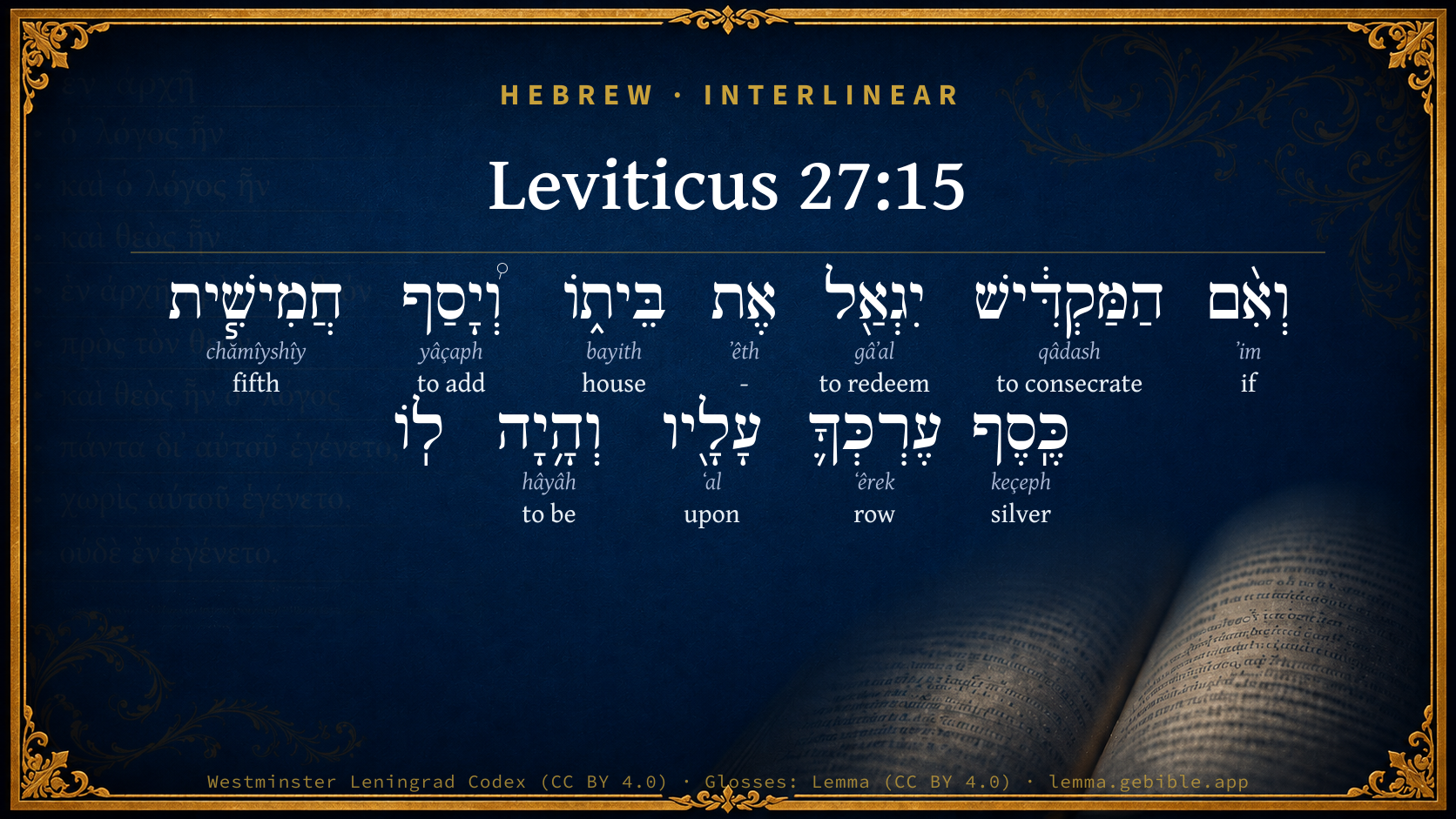
Hebrew (Westminster Leningrad Codex) Leviticus 27:15 appears in the Hebrew Old Testament. The text above is from the Westminster Leningrad Codex. Each word links to its Strong’s number, a concise gloss, and parsing drawn from the Open Scriptures Hebrew Bible morphology. Click any word for its full Brown-Driver-Briggs (BDB) entry.
Download image
Cite this verse

Leviticus 27:15 (World English Bible). Public Domain. Lemma interlinear Bible study tool, https://lemma.gebible.app/v/leviticus/27/15.

Show BibTeX & RIS
BibTeX
RIS
English Translation
If he who dedicates it will redeem his house, then he shall add the fifth part of the money of your valuation to it, and it shall be his.
World English Bible · Public Domain
Download a study sheet

One document with this verse’s original text, its word-by-word gloss line, the meaning frame, cross-references with their text, attributed commentary, and full source and license credits — printable, and it pastes into notes with its structure intact.

This verse Autodidact and up

Study sheet (.html) Plain text (.txt)

A passage Seminary Student

Up to 50 verses in one chapter. A passage sheet keeps up to 6 commentary sources and 12 cross-references per verse, in the order this page ranks them, and says so on the sheet whenever that leaves anything out. Ask for a single verse and you get the Autodidact verse sheet above.

Everything on this page stays free to read, with no account — the sheet is a download of what is already on screen, not access to it.

Want to remove ads? Support Godless Engineer
Compare translations 3

The same verse in 3 English versions, stacked beneath the original-language interlinear above. Click any original word for its lexicon entry.

Each is an independent rendering of the whole verse — the interlinear is not word-aligned to these translations.

Highlighted words mark where these versions differ — a whole-verse word diff, not a word-by-word alignment.

  • World English Bible Public Domain
    If he who dedicates it will redeem his house, then he shall add the fifth part of the money of your valuation to it, and it shall be his.
  • King James Version Public Domain
    And if he that sanctified it will redeem his house, then he shall add the fifth part of the money of thy estimation unto it, and it shall be his.
  • unfoldingWord Literal Text CC BY-SA 4.0
    And if the one consecrating would redeem his house, then he shall add a fifth of the silver of your valuation upon it, and it will be to him.

unfoldingWord Literal Text — © unfoldingWord, licensed CC BY-SA 4.0. Word-aligned USFM3 via Door43 (git.door43.org/unfoldingWord/en_ult).

Versions to compare (up to 4)

3 of 4 selected

Show all 18 translations

Every available English version of this verse, each an independent rendering of the whole verse.

  • World English Bible Public Domain
    If he who dedicates it will redeem his house, then he shall add the fifth part of the money of your valuation to it, and it shall be his.
  • Berean Standard Bible Public Domain
    But if he who consecrated his house redeems it, he must add a fifth to the assessed value, and it will belong to him.
  • Majority Standard Bible Public Domain
    But if he who consecrated his house redeems it, he must add a fifth to the assessed value, and it will belong to him.
  • King James Version Public Domain
    And if he that sanctified it will redeem his house, then he shall add the fifth part of the money of thy estimation unto it, and it shall be his.
  • American Standard Version (1901) Public Domain
    And if he that sanctified it will redeem his house, then he shall add the fifth part of the money of thy estimation unto it, and it shall be his.
  • Revised Version (1885) Public Domain
    And if he that sanctified it will redeem his house, then he shall add the fifth part of the money of thy estimation unto it, and it shall be his.
  • Geneva Bible (1599) Public Domain
    But if he that sanctified it, will redeeme his house, then hee shall giue thereto the fift part of money more then thy estimation, and it shalbe his.
  • Douay-Rheims (1899) Public Domain
    But if he that vowed, will redeem it, he shall give the fifth part of the estimation over and above, and shall have the house.
  • Young's Literal Translation Public Domain
    and if he who is sanctifying doth redeem his house, then he hath added a fifth of the money of thy valuation to it, and it hath become his.
  • Literal Standard Version CC BY-SA 4.0
    and if he who is sanctifying redeems his house, then he has added a fifth of the money of your valuation to it, and it has become his.
  • Unlocked Literal Bible CC BY-SA 4.0
    But if the owner who set apart his home wishes to redeem it, he must add a fifth of its value to its redemption price, and it will belong to him.
  • unfoldingWord Literal Text CC BY-SA 4.0
    And if the one consecrating would redeem his house, then he shall add a fifth of the silver of your valuation upon it, and it will be to him.
  • Darby Bible Public Domain
    And if he that halloweth it will redeem his house, he shall add the fifth of the money of thy valuation unto it, and it shall be his.
  • World Messianic Bible Public Domain
    If he who dedicates it will redeem his house, then he shall add the fifth part of the money of your valuation to it, and it shall be his.
  • Webster's Bible Public Domain
    And if he that sanctified it will redeem his house, then he shall add the fifth part of the money of thy estimation to it, and it shall be his.
  • Free Bible Version CC BY-SA 4.0
    But if you want to buy back your house, you have to add one-fifth to its value in payment. Then it will belong to you again.
  • Bible in Basic English Public Domain
    And if the owner has a desire to get back his house, let him give a fifth more than your value, and it will be his.
  • JPS Tanakh (1917) Public Domain
    And if he that sanctified it will redeem his house, then he shall add the fifth part of the money of thy valuation unto it, and it shall be his.

Literal Standard Version (2020), Covenant Press — licensed CC BY-SA 4.0. Text via the HelloAO Bible API (eBible.org). Unlocked Literal Bible (unfoldingWord) — licensed CC BY-SA 4.0. Text via the HelloAO Bible API (eBible.org). unfoldingWord Literal Text — © unfoldingWord, licensed CC BY-SA 4.0. Word-aligned USFM3 via Door43 (git.door43.org/unfoldingWord/en_ult). Free Bible Version, Dr. Jonathan Gallagher — licensed CC BY-SA 4.0. Text via the HelloAO Bible API (eBible.org).

Word by word

More ways to search: Search by grammar → Find every occurrence → Compare this word →

Practice this passage: Drill this verse → Learn its vocabulary →

עֶרְכְּךָ֛
ʻêrek
H6187
“row · your”
Noun, Common, Masculine, Singular, Construct + Suffix, Personal, 2nd Person, Masculine, Singular
Part of Speech
Noun
Type
Common
Gender
Masculine
Number
Singular
State
Construct
Full BDB Definition

Origin: from H6186

TWOT: 1694a

order, row, estimate, things that are set in order, layer, pile - order, row - estimate, valuation
  1. וְאִ֨ם ʼim H518 “and · if” Conjunction + Conjunction
  2. הַמַּקְדִּ֔ישׁ qâdash H6942 “the · consecrating” Particle, Definite Article + Verb, Hiphil, Participle Active, Masculine, Singular, Absolute
  3. יִגְאַ֖ל gâʼal H1350 “to redeem” Verb, Qal, Imperfect, 3rd Person, Masculine, Singular
  4. אֶת ʼêth H853 “-” Particle, Direct Object
  5. בֵּית֑וֹ bayith H1004 “house · his” Noun, Common, Masculine, Singular, Construct + Suffix, Personal, 3rd Person, Masculine, Singular
  6. וְ֠יָסַף yâçaph H3254 “and · to add” Conjunction + Verb, Qal, Sequential Perfect, 3rd Person, Masculine, Singular
  7. חֲמִישִׁ֧ית chămîyshîy H2549 “fifth” Adjective, Ordinal number, Feminine, Singular, Construct
  8. כֶּֽסֶף keçeph H3701 “silver of” Noun, Common, Masculine, Singular, Construct
  9. עָלָ֖יו ʻal H5921 “upon · him” Preposition + Suffix, Personal, 3rd Person, Masculine, Singular
  10. וְהָ֥יָה hâyâh H1961 “and · to be” Conjunction + Verb, Qal, Sequential Perfect, 3rd Person, Masculine, Singular

About this verse

These counts appear in no published source. They are computed here, from the morphology-tagged text and Lemma’s own curated glosses. What Lemma adds →

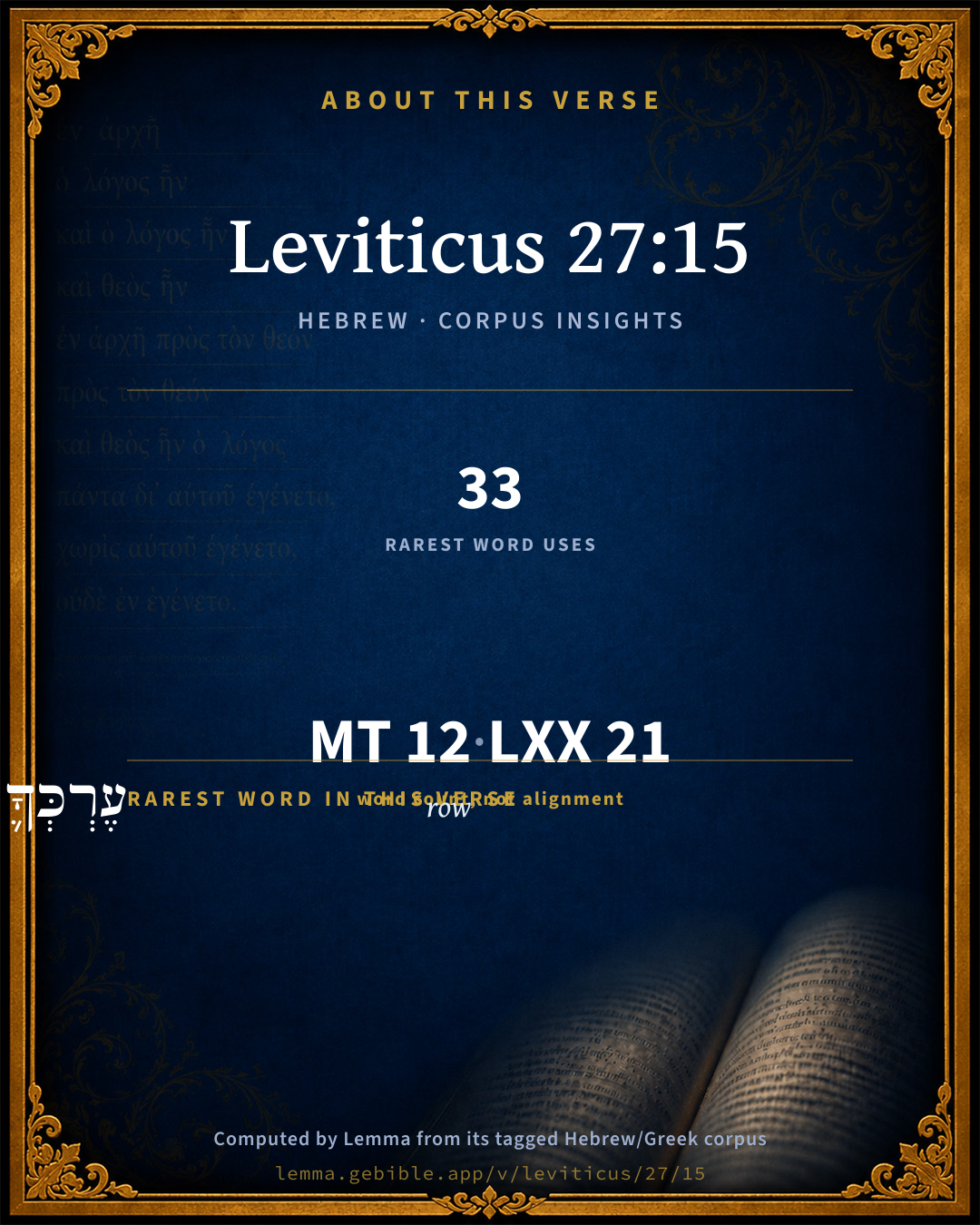
12
words
11
distinct lemmas
Pentateuch
section

Shared distinctive vocabulary

עֶרְכְּךָ֛ row H6187 occurs in 29 verses of the Hebrew Bible. Also found in:

Grammatical profile

  • 4 verbs
  • 3 nouns
  • 1 adjective
  • 2 prepositions
  • 1 conjunction
  • 1 particle

Verb forms

  • הַמַּקְדִּ֔ישׁ Hiphil · Participle Active
  • יִגְאַ֖ל Qal · Imperfect
  • וְ֠יָסַף Qal · Sequential Perfect
  • וְהָ֥יָה Qal · Sequential Perfect

Hebrew & Septuagint length

In English translation the verse runs 29 words from the Hebrew and 30 from the Septuagint (LXX English) — closely comparable.

A rough comparison of the two English renderings, which tokenize alike — not a word-level alignment.

Word counts can differ between the Hebrew and the Greek without any difference in meaning — e.g. the Hebrew direct-object marker אֵת has no separate Greek word, and Greek often adds the article ὁ.

In the original languages it is 12 Hebrew tokens and 21 Greek tokens — but the two are counted differently (Hebrew bundles its prefixes and suffixes into one token; the Greek is in lemma form), so that isn’t a like-for-like length.

Cross-references

1

Topical passages linked to Leviticus 27:15 in the Treasury of Scripture Knowledge — connected by theme and wording, ordered by reader-vote popularity; previews shown in the World English Bible.

  • Leviticus 27:13 But if he will indeed redeem it, then he shall add the fifth part of it to its valuation.

Cross-references courtesy of OpenBible.info (CC BY 4.0).

Hebrew and Greek witnesses Masoretic Hebrew ↔ Greek Septuagint

The same verse in the two great witnesses to the Old Testament, shown verse-for-verse.

These are two independent witnesses, not word-aligned to each other, and the Septuagint is shown in lemma (dictionary) form.

Hebrew Leviticus 27:15 Masoretic · Westminster Leningrad Codex

וְאִ֨ם הַמַּקְדִּ֔ישׁ יִגְאַ֖ל אֶת בֵּית֑וֹ וְ֠יָסַף חֲמִישִׁ֧ית כֶּֽסֶף עֶרְכְּךָ֛ עָלָ֖יו וְהָ֥יָה לֽוֹ

If he who dedicates it will redeem his house, then he shall add the fifth part of the money of your valuation to it, and it shall be his.

World English Bible · Public Domain

Greek LXX Leviticus 27:15 Septuagint · lemma form

ἐάν δέ ὁ ἁγιάζω αὐτός λυτρόω ὁ οἰκία αὐτός προςτίθημι ἐπί αὐτός ὁ ἐπίπεμπτος ὁ ἀργύριον ὁ τιμή καί εἰμί αὐτός

And if he that has sanctified it should redeem his house, he shall add to it the fifth part of the money of the valuation, and it shall be his.

LXX2012 (modern English Septuagint) · Public Domain

Hebrew: Westminster Leningrad Codex (CC BY 4.0). Greek: Septuagint (public domain); English from LXX2012 (modern English Septuagint) (Public Domain). How the Septuagint differs from the Hebrew →

Targum (Aramaic paraphrase)

2

The Targum is the ancient Jewish Aramaic paraphrase of the Hebrew Scriptures — an interpretive translation, not the Hebrew text itself. Onkelos (literal) and Pseudo-Jonathan (expansive) render the Torah, and Jonathan the Prophets. Coverage is partial: where no permissively-licensed English translation exists for a verse, only the Aramaic is shown. This is verse-level text, not a word-by-word alignment to the Hebrew.

  1. Targum Onkelos Torah (Genesis–Deuteronomy)
    וְאִם דְאַקְדֵשׁ יִפְרוֹק יָת בֵּיתֵהּ וְיוֹסֵף חוֹמֶשׁ כְּסַף פֻּרְסָנֵהּ עֲלוֹהִי וִיהֵי לֵהּ

    (no public-domain English translation for this verse)

    Targum Onkelos — Aramaic: “Onkelos Genesis” (public domain); “Onkelos Exodus” (public domain); “Onkelos Leviticus” (public domain); “Onkelos Numbers” (public domain); “Onkelos Deuteronomy” (public domain). English: “Sefaria Community Translation” (CC0 1.0 (public-domain dedication)); “J.W. Etheridge. The Targums of Onkelos and Jonathan Ben Uzziel on the Pentateuch. London: Longmans, Green, 1862” (public domain). Text via Sefaria.

  2. Targum Pseudo-Jonathan Torah (Genesis–Deuteronomy)
    וְאִם דֵין דְמַקְדִישׁ יִפְרוֹק יַת בֵּיתֵיהּ וְיוֹסֵף חוֹמֶשׁ כְּסַף עֲלוֹיֵיהּ עֲלוֹי וִיהֵי דִילֵיהּ

    And if he who hath consecrated would redeem his house, let him add a fifth of the price of its valuation thereunto, and it shall be his.

    Targum Pseudo-Jonathan — Aramaic: “Targum Jonathan on Genesis” (public domain); “Targum Jonathan on Exodus” (public domain); “Targum Jonathan on Leviticus” (public domain); “Targum Jonathan on Numbers” (public domain); “Targum Jonathan on Deuteronomy” (public domain). English: “The Targum of Jonathan ben Uzziel, trans. J. W. Etheridge, London, 1862” (public domain). Text via Sefaria.

Commentary

Notes on Leviticus 27:15 from classic Christian and Jewish commentators (each source and its license shown beneath its notes). The classic Christian expositions comment on the surrounding passage and are grouped to its opening verse, so a note may address several verses; the Jewish commentaries on the Tanakh (Rashi and others) are per-verse, so they appear only where the commentator wrote on this verse.

Lemma curates 59 commentaries, every one of them public domain or Creative Commons licensed, each selected and text-cleaned for this edition rather than reprinted as found. About our sources →

Ellicott's Commentary for English Readers

(15) And if he that sanctified it will redeem his house.—Though the net price thus fixed by the priest is all that anyone else who wishes to buy it has to pay for the house, yet if the former owner of it, or, according to the practice which obtained during the second Temple, his son, wife, or nearest of kin, wishes to redeem it, he is to add one-fifth more than the valuation price, just as in the case of animals, and for the same reason, that is, for taking back a thing which he once promised to the Lord. (See Lev_27:13.)

A Bible Commentary for English Readers, edited by Charles John Ellicott (1878–1897) — public domain. Text from a community e-Sword module.

John Gill's Exposition

And if a man shall sanctify unto the Lord some part of a field of his possession,.... That which he enjoyed by inheritance from his father, to distinguish it from a field of his own purchase, as in Lev 27:22; and which might be devoted, not all of it, but a part of it; partly that he might have something to live upon, or to improve for a livelihood for himself and family, and partly that estates might not be alienated entirely from their families and tribes in which they were:

then thy estimation shall be according to the seed thereof; not according to the field, the goodness or badness of that, one field being good and another bad, as Jarchi observes, but according to the quantity of seed which it produced, or rather which it required for the sowing of it:

an homer of barley seed shall be valued at fifty shekels of silver; which was near six pounds of our money; and here we must carefully distinguish between an "omer", beginning with an "o", and an "homer", beginning with an "h"; not observing this has led some learned men into mistakes in their notes on this place, for an "omer" was the tenth part of an "ephah", Exo 16:36; and an "ephah" is but the tenth part of an "homer", Eze 45:11; which makes a very great difference in this measure of barley, for an homer of it contained ten ephahs or bushels; and even according to this account a bushel of barley is rated very high, for ten bushels at fifty shekels, reckoning a shekel half a crown, or them at six pounds five shillings, are at the rate of twelve shillings and sixpence a bushel, which is too high a price for barley; wherefore as an ephah, the tenth part of an homer, contained three seahs or pecks, and which some call bushels, then an homer consisted of thirty bushels, which brings down the value of it to little more than two shillings a bushel, which is much nearer the true value of barley; but the truth of the matter is, that the value of barley for sowing is not ascertained, as our version leads us to think; for the words should be rendered, if the "seed be an homer of barley", it, the field, shall be valued "at fifty shekels of silver": if the field take so much seed to sow it as the quantity of an homer of barley, then it was to be rated at fifty shekels of silver; and if it took two homers, then it was to be rated at an hundred shekels, and so on.

John Gill's Exposition of the Whole Bible (1746–1763) — public domain (CC PDM 1.0). Text via the HelloAO Bible API.

Haydock's Catholic Bible Commentary

House. The Rabbins say this fifth part went towards repairing the temple. We may suppose it was laid on to indemnify the priests, for the loss which they sustained by selling a house, or a field, (ver. 16,) to the former owner; since if any other had purchased them, the priests would have been able to sell them again at the return of every jubilee. At that period, even the former proprietor would not obtain a title to possess them for ever; (ver. 21,) and therefore he would not need to pay any more than the stated value. (Tostat) (Calmet)

George Leo Haydock (1774–1849), Haydock's Catholic Family Bible and Commentary, 1859 edition — public domain. Excludes Psalms (Douay-Rheims chapter numbering differs from Protestant) and Deuterocanonical books (Catholic canon only).

Matthew Poole's English Annotations

He shall add the fifth part, which he might the better do, because the priests did usually put a moderate rate upon it.

Matthew Poole's English Annotations on the Holy Bible (1683–1685) — public domain. Text from a community e-Sword/MySword module.

John Wesley's Explanatory Notes

The fifth part - Which he might the better do, because the priests did usually put a moderate rate upon it.

John Wesley, Explanatory Notes Upon the Whole Bible (1754–1765) — public domain. Text via the GEBible commentary corpus.

Scofield Reference Notes

C. I. Scofield

redeem

Heb. "goel," Redemp. (Kinsman type). (See Scofield "Isa 59:20").

The Scofield Reference Bible (1917 edition), notes by C. I. Scofield — public domain. Text from a community e-Sword module.

Lesson kit

Teaching starters — assembled from the data on this page, not authored interpretation. Every prompt links to the verse data it draws on. Edit before teaching.

Leviticus, in the Pentateuch, opens this verse with 12 words (11 distinct Hebrew lemmas). Its most distinctive word is ʻêrek (“row”). A historical commentator’s framing appears above. Read the whole chapter for the surrounding context.

Discussion questions

  1. What does “row” (ʻêrek) contribute to the verse as a whole?
  2. How does Exodus 40:4, which shares the word «row», read alongside this verse?
  3. The translations on this page render this verse differently — a whole-verse word diff, not a word-by-word alignment. What might account for the different wordings?
  4. «הַמַּקְדִּ֔ישׁ» is a Hiphil Participle Active verb. How does that grammatical form shape the action described?
  5. Compare how Ellicott's Commentary for English Readers and John Gill's Exposition read this verse. Where do they agree or differ?

Things to notice

Reading settings

Reading text

Shown beneath each verse's original-language words.

Old Testament
Old Testament edition

Read the OT as the Masoretic Hebrew (MT) or the Greek Septuagint (LXX).

English shown for the Greek Septuagint (in the Hebrew ↔ Greek comparison).

Comparing translations? Open the Compare panel on any verse page to stack up to four side by side.