
Proverbs 16:23

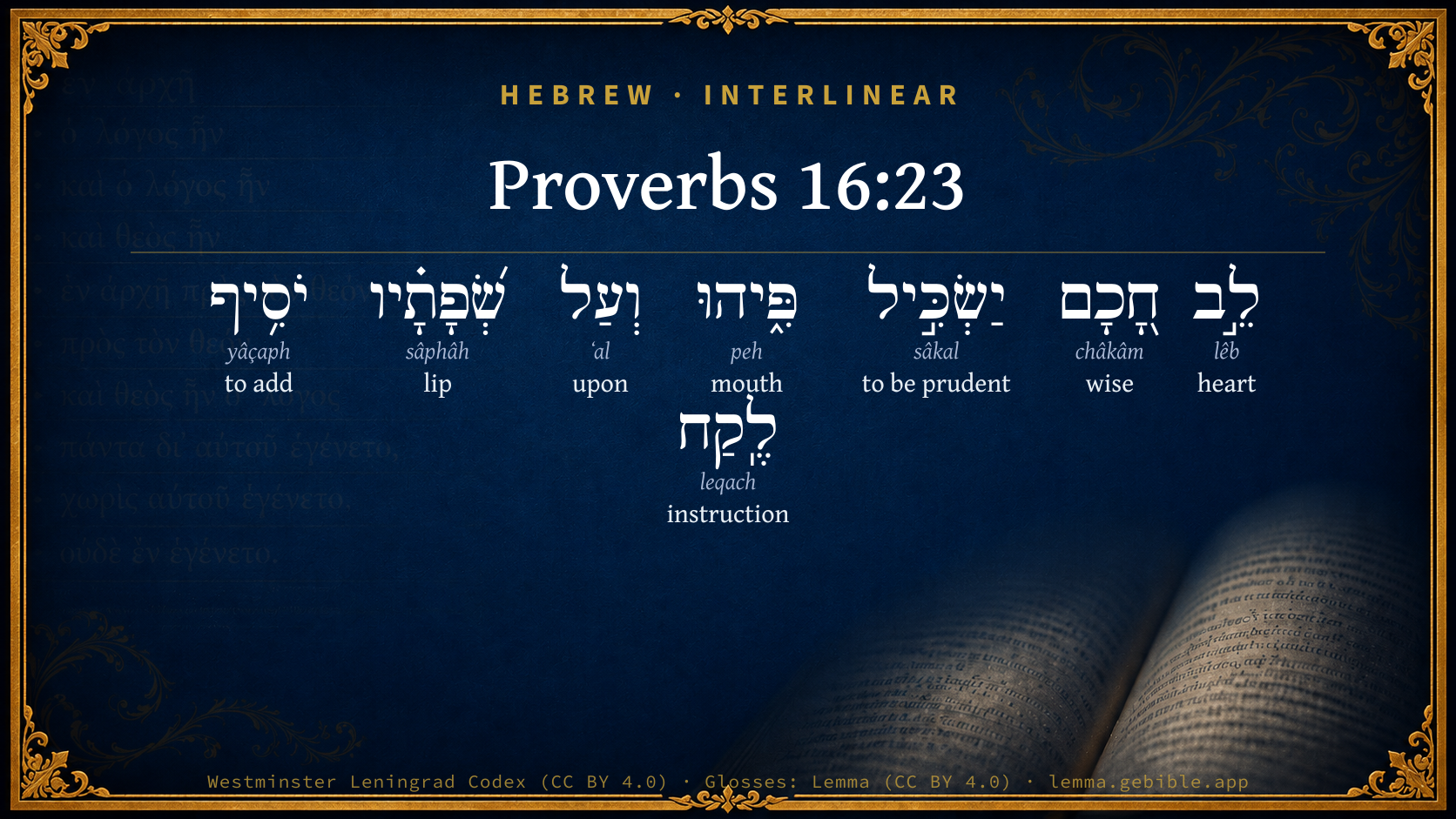
Hebrew (Westminster Leningrad Codex) Proverbs 16:23 appears in the Hebrew Old Testament. The text above is from the Westminster Leningrad Codex. Each word links to its Strong’s number, a concise gloss, and parsing drawn from the Open Scriptures Hebrew Bible morphology. Click any word for its full Brown-Driver-Briggs (BDB) entry.
Download image
Cite this verse

Proverbs 16:23 (World English Bible). Public Domain. Lemma interlinear Bible study tool, https://lemma.gebible.app/v/proverbs/16/23.

Show BibTeX & RIS
BibTeX
RIS
English Translation
The heart of the wise instructs his mouth, And adds learning to his lips.
World English Bible · Public Domain
Download a study sheet

One document with this verse’s original text, its word-by-word gloss line, the meaning frame, cross-references with their text, attributed commentary, and full source and license credits — printable, and it pastes into notes with its structure intact.

This verse Autodidact and up

Study sheet (.html) Plain text (.txt)

A passage Seminary Student

Up to 50 verses in one chapter. A passage sheet keeps up to 6 commentary sources and 12 cross-references per verse, in the order this page ranks them, and says so on the sheet whenever that leaves anything out. Ask for a single verse and you get the Autodidact verse sheet above.

Everything on this page stays free to read, with no account — the sheet is a download of what is already on screen, not access to it.

Want to remove ads? Support Godless Engineer
Compare translations 3

The same verse in 3 English versions, stacked beneath the original-language interlinear above. Click any original word for its lexicon entry.

Each is an independent rendering of the whole verse — the interlinear is not word-aligned to these translations.

Highlighted words mark where these versions differ — a whole-verse word diff, not a word-by-word alignment.

  • World English Bible Public Domain
    The heart of the wise instructs his mouth, And adds learning to his lips.
  • King James Version Public Domain
    The heart of the wise teacheth his mouth, and addeth learning to his lips.
  • unfoldingWord Literal Text CC BY-SA 4.0
    The heart of the wise makes his mouth insightful, and on his lips it increases learning.

unfoldingWord Literal Text — © unfoldingWord, licensed CC BY-SA 4.0. Word-aligned USFM3 via Door43 (git.door43.org/unfoldingWord/en_ult).

Versions to compare (up to 4)

3 of 4 selected

Show all 18 translations

Every available English version of this verse, each an independent rendering of the whole verse.

  • World English Bible Public Domain
    The heart of the wise instructs his mouth, And adds learning to his lips.
  • Berean Standard Bible Public Domain
    The heart of the wise man instructs his mouth and adds persuasiveness to his lips.
  • Majority Standard Bible Public Domain
    The heart of the wise man instructs his mouth and adds persuasiveness to his lips.
  • King James Version Public Domain
    The heart of the wise teacheth his mouth, and addeth learning to his lips.
  • American Standard Version (1901) Public Domain
    The heart of the wise instructeth his mouth, And addeth learning to his lips.
  • Revised Version (1885) Public Domain
    The heart of the wise instructeth his mouth, and addeth learning to his lips.
  • Geneva Bible (1599) Public Domain
    The heart of the wise guideth his mouth wisely, and addeth doctrine to his lippes.
  • Douay-Rheims (1899) Public Domain
    The heart of the wise shall instruct his mouth: and shall add grace to his lips.
  • Young's Literal Translation Public Domain
    The heart of the wise causeth his mouth to act wisely, And by his lips he increaseth learning,
  • Literal Standard Version CC BY-SA 4.0
    The heart of the wise causes his mouth to act wisely, || And he increases learning by his lips,
  • Unlocked Literal Bible CC BY-SA 4.0
    The heart of a wise person gives insight to his mouth and adds persuasiveness to his lips.
  • unfoldingWord Literal Text CC BY-SA 4.0
    The heart of the wise makes his mouth insightful, and on his lips it increases learning.
  • Darby Bible Public Domain
    The heart of the wise maketh his mouth intelligent, and upon his lips increaseth learning.
  • World Messianic Bible Public Domain
    The heart of the wise instructs his mouth, and adds learning to his lips.
  • Webster's Bible Public Domain
    The heart of the wise teacheth his mouth, and addeth learning to his lips.
  • Free Bible Version CC BY-SA 4.0
    A wise mind makes sure to say sensible things; the words spoken are persuasive.
  • Bible in Basic English Public Domain
    The heart of the wise man is the teacher of his mouth, and gives increased learning to his lips.
  • JPS Tanakh (1917) Public Domain
    The heart of the wise teacheth his mouth, and addeth learning to his lips.

Literal Standard Version (2020), Covenant Press — licensed CC BY-SA 4.0. Text via the HelloAO Bible API (eBible.org). Unlocked Literal Bible (unfoldingWord) — licensed CC BY-SA 4.0. Text via the HelloAO Bible API (eBible.org). unfoldingWord Literal Text — © unfoldingWord, licensed CC BY-SA 4.0. Word-aligned USFM3 via Door43 (git.door43.org/unfoldingWord/en_ult). Free Bible Version, Dr. Jonathan Gallagher — licensed CC BY-SA 4.0. Text via the HelloAO Bible API (eBible.org).

Word by word

More ways to search: Search by grammar → Find every occurrence → Compare this word →

Practice this passage: Drill this verse → Learn its vocabulary →

About this verse

These counts appear in no published source. They are computed here, from the morphology-tagged text and Lemma’s own curated glosses. What Lemma adds →

8
words
8
distinct lemmas
Wisdom
section

Notable vocabulary

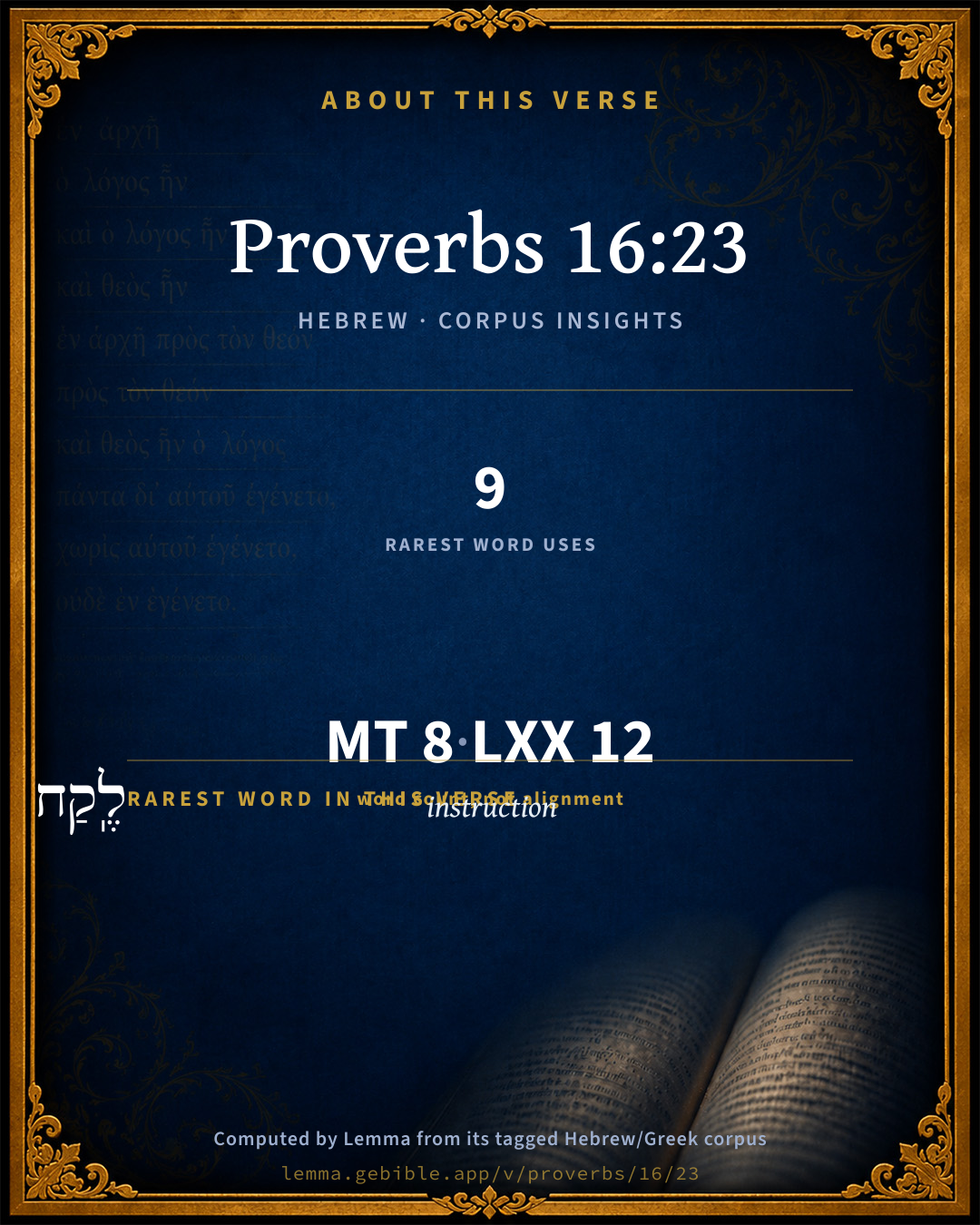
The rarest word here is לֶֽקַח instruction H3948 — appearing just 9 times in the whole Hebrew Bible.

Shared distinctive vocabulary

לֶֽקַח instruction H3948 occurs in 9 verses of the Hebrew Bible. Also found in:

Grammatical profile

  • 2 verbs
  • 4 nouns
  • 1 adjective
  • 1 preposition

Verb forms

  • יַשְׂכִּ֣יל Hiphil · Imperfect
  • יֹסִ֥יף Hiphil · Imperfect

Hebrew & Septuagint length

In English translation the verse runs 14 words from the Hebrew and 23 from the Septuagint (LXX English) — the Septuagint runs noticeably longer here. See the side-by-side →

A rough comparison of the two English renderings, which tokenize alike — not a word-level alignment.

Word counts can differ between the Hebrew and the Greek without any difference in meaning — e.g. the Hebrew direct-object marker אֵת has no separate Greek word, and Greek often adds the article ὁ.

In the original languages it is 8 Hebrew tokens and 12 Greek tokens — but the two are counted differently (Hebrew bundles its prefixes and suffixes into one token; the Greek is in lemma form), so that isn’t a like-for-like length.

Cross-references

6

Topical passages linked to Proverbs 16:23 in the Treasury of Scripture Knowledge — connected by theme and wording, ordered by reader-vote popularity; previews shown in the World English Bible.

  • Proverbs 15:28 The heart of the righteous weighs answers, But the mouth of the wicked gushes out evil.
  • Matthew 12:34–35 You offspring of vipers, how can you, being evil, speak good things? For out of the abundance of the heart, the mouth speaks.
  • Proverbs 22:17–18 Turn your ear, and listen to the words of the wise. Apply your heart to my teaching.
  • Colossians 3:16 Let the word of Christ dwell in you richly; in all wisdom teaching and admonishing one another with psalms, hymns, and spiritual songs, singing with grace in your heart to the Lord.
  • Psalms 37:30–31 The mouth of the righteous talks of wisdom. His tongue speaks justice.
  • Psalms 45:1 My heart overflows with a noble theme. I recite my verses for the king. My tongue is like the pen of a skillful writer.

Cross-references courtesy of OpenBible.info (CC BY 4.0).

Hebrew and Greek witnesses Masoretic Hebrew ↔ Greek Septuagint

The same verse in the two great witnesses to the Old Testament, shown verse-for-verse.

Here the Septuagint runs noticeably longer than the Hebrew — LXX2012 (modern English Septuagint) 23 words vs World English Bible 14. A rough length comparison of the two English translations, not a word-level alignment — read both below.

These are two independent witnesses, not word-aligned to each other, and the Septuagint is shown in lemma (dictionary) form.

Hebrew Proverbs 16:23 Masoretic · Westminster Leningrad Codex

לֵ֣ב חָ֭כָם יַשְׂכִּ֣יל פִּ֑יהוּ וְעַל שְׂ֝פָתָ֗יו יֹסִ֥יף לֶֽקַח

The heart of the wise instructs his mouth, And adds learning to his lips.

World English Bible · Public Domain

Greek LXX Proverbs 16:23 Septuagint · lemma form

ἀνήρ ἄφρων ὀρύσσω ἑαυτοῦ κακός ἐπί δέ ὁ ἑαυτοῦ χεῖλος θησαυρίζω πῦρ

The heart of the wise will discern the things which proceed from his own mouth; and on his lips he will wear knowledge.

LXX2012 (modern English Septuagint) · Public Domain

On this verse, The Pulpit Commentary discusses the Septuagint’s reading. Read the note in Commentary ↓

Hebrew: Westminster Leningrad Codex (CC BY 4.0). Greek: Septuagint (public domain); English from LXX2012 (modern English Septuagint) (Public Domain). How the Septuagint differs from the Hebrew →

Commentary

Notes on Proverbs 16:23 from classic Christian and Jewish commentators (each source and its license shown beneath its notes). The classic Christian expositions comment on the surrounding passage and are grouped to its opening verse, so a note may address several verses; the Jewish commentaries on the Tanakh (Rashi and others) are per-verse, so they appear only where the commentator wrote on this verse.

Lemma curates 59 commentaries, every one of them public domain or Creative Commons licensed, each selected and text-cleaned for this edition rather than reprinted as found. About our sources →

Trapp's Complete Commentary

John Trapp

Pro 16:23 The heart of the wise teacheth his mouth, and addeth learning to his lips.

Ver. 23. The heart of the wise teacheth his mouth.] Frameth his speech for him, and seasoneth it with salt of grace, ere it sets it as a dish before the hearers. Nescit poeuitenda loqui qui proferenda prius suo tradidit examini, saith Cassiodore. {a} He cannot lightly speak amiss that weighs his words before he utters them. The voice which is made in the mouth is nothing so melodious as that which comes from the depth of the breast Heart sprung speech hath weight and worth in it.

And addeth learning to his lips.] By restraining talkativeness, and making him as willing to hear as to speak, to learn as to teach, to be an auditor as an orator.

{a} Lib. x. Eph 4:1-32.

John Trapp, A Commentary or Exposition upon All the Books of the Old and New Testament (1647–1656) — public domain. Text from a community e-Sword module.

The Biblical Illustrator

Joseph S. Exell

Pro_16:23-24

The heart of the wise teacheth his mouth, and addeth learning to his lips.

Ideal eloquence

These two verses lead us to infer several things concerning true eloquence.

I. It is the utterance of the true heart. The heart of the wise teacheth his mouth.

1. It is when the genuinely patriotic heart teacheth the mouth of the statesman that his speeches are really eloquent, and that his voice bends the senate to his will.

2. It is when the genuinely justice-loving heart teacheth the mouth of the counsel that his address is really eloquent, and that he carries the jury with him, and makes the cause of his client triumphant.

3. It is when the genuinely Christ-loving heart teaches the mouth of the preacher that his sermons become eloquent, and mighty through God.

II. It is the means of useful instruction. It addeth learning to his lips. True eloquence does more than awaken mere emotion in the hearer. It instructs. Its spirit is in such vital alliance with eternal reality that its very sounds echo such truths as start the highest trains of thought. Who is the best religious teacher? Not the mere theologian, however vast his learning, Scriptural his theory, or perfect his language; but the Christ-loving man, however untutored his intellect and ungrammatical his speech. He dispenses the best learning, learning which teaches men rightly to live and triumphantly to die.

III. It is a source of soul-refreshment. Honey was prized by those of old times, not only as a luxury to the palate, but also on account of its medicinal and salutary properties. To this there is an allusion here. The words express the twofold idea of pleasantness and of benefit. Many things have the one quality which have not the other. Many a poison is like honey, sweet to the taste, but instead of being health to the bones, is laden with death. Words of true eloquence, indeed, fall as drops of honey on the soul, not only delicious to the taste but a tonic to the heart. (Homilist.)

The Biblical Illustrator, edited by Joseph S. Exell (c. 1880s–1900s) — public domain. Text from a community e-Sword module.

Matthew Henry's Commentary

Solomon had commended eloquence, or the sweetness of the lips (Pro 16:21), and seemed to prefer it before wisdom; but here he corrects himself, as it were, and shows that unless there be a good treasure within to support the eloquence it is worth little. Wisdom in the heart is the main matter. 1. It is this that directs us in speaking, that teaches the mouth what to speak, and when, and how, so that what is spoken may be proper, and pertinent, and seasonable; otherwise, though the language be ever so fine, it had better be unsaid. 2. It is this that gives weight to what we speak and adds learning to it, strength of reason and force of argument, without which, let a thing be ever so well worded, it will be rejected, when it comes to be considered, as trifling. Quaint expressions please the ear, and humour the fancy, but it is learning in the lips that must convince the judgment, and sway that, to which wisdom in the heart is necessary.

Matthew Henry's Commentary on the Whole Bible (1708–1710) — public domain (CC PDM 1.0). Text via the HelloAO Bible API.

Jamieson, Fausset & Brown

Robert Jamieson, A. R. Fausset & David Brown

The heart is the source of wisdom flowing from the mouth.

Jamieson, Fausset & Brown — Commentary Critical and Explanatory on the Whole Bible (1871) — public domain (CC PDM 1.0). Text via the HelloAO Bible API.

Adam Clarke's Commentary

Verse 23. The heart of the wise teacheth his mouth] He has a wise heart; he speaks as it dictates; and therefore his speeches are all speeches of wisdom.

Adam Clarke's Commentary on the Bible (1810–1826) — public domain. Text from a community e-Sword/MySword module.

Ellicott's Commentary for English Readers

(23)Addeth learning to his lips.—His wisdom and learning do not remain hidden in his heart, but continually rise to his lips, like the waters of an everflowing fountain, for the instruction of others.

A Bible Commentary for English Readers, edited by Charles John Ellicott (1878–1897) — public domain. Text from a community e-Sword module.

John Gill's Exposition

The heart of the wise teacheth his mouth,.... That is, a man that is wise in heart, as in Pro 16:21; his heart will teach his mouth what to say, when to say it, and before whom; it will prompt him to matter, that he shall not be at a loss what to say, nor how to say; it will furnish him with words and things; out of the abundance of the heart the mouth speaketh, Mat 12:34;

and addeth learning to his lips: so that he does not deliver out mere words, but solid learning along with them, instructive to himself and others. The Targum is,

"and by his lips he addeth doctrine;''

or increases knowledge.

John Gill's Exposition of the Whole Bible (1746–1763) — public domain (CC PDM 1.0). Text via the HelloAO Bible API.

Haydock's Catholic Bible Commentary

Heart. Or knowledge. (Haydock) --- Wisdom gives beauty to eloquence.

George Leo Haydock (1774–1849), Haydock's Catholic Family Bible and Commentary, 1859 edition — public domain. Excludes Psalms (Douay-Rheims chapter numbering differs from Protestant) and Deuterocanonical books (Catholic canon only).

Matthew Poole's English Annotations

Teacheth his mouth; directeth him what, and when, and how to speak, and keepeth him from speaking rashly and foolishly.

Addeth learning to his lips, i.e. enableth him to speak learnedly and wisely. Or, increaseth learning (in himself and others) by (as this Hebrew particle oft signifies, and is by some rendered here) his lips, i.e. by his wise speeches; that this may agree with the latter clause of Pro 16:21, where this same phrase is used.

Matthew Poole's English Annotations on the Holy Bible (1683–1685) — public domain. Text from a community e-Sword/MySword module.

Whedon's Commentary on the Bible

Daniel D. Whedon

23. Teacheth his mouth — Makes it prudent, skilful, wise.

Addeth learning, etc. — Increases the instruction upon his lips; that is, makes his discourse more edifying.

Daniel D. Whedon (gen. ed.), Commentary on the Old and New Testaments (1874–1909) — public domain. Text from a community e-Sword module.

The Pulpit Commentary

The heart of the wise teacheth his mouth. Out of the abundance of his heart the wise man speaks; the spirit within him finds fit utterance. Pectus est quod disertos facit. The thought and mind control the outward expression and make it eloquent and persuasive. (comp. Pro_15:2) And addeth learning to his lips; Vulgate, "addeth grace." But lekach, which means properly "reception," "taking in," is best rendered "learning," as in ver. 21; Pro_1:5, etc. The intellect and knowledge of the wise display themselves in their discourse. Delitzsch, "Learning mounteth up to his lips." Ecc 21:26, "The heart of fools is in their mouth; but the mouth of the wise is in their heart." Septuagint, "The heart of the wise will consider what proceedeth from his mouth; and on his lips he will carry prudence (epignwmosunhn )."

The Pulpit Commentary (1880–1919), ed. H.D.M. Spence-Jones & Joseph S. Exell — public domain. Text from a community e-Sword module.

John Wesley's Explanatory Notes

Teacheth - Directs him what to speak, and keeps him from speaking foolishly. Addeth - Enables him to speak learnedly and wisely.

John Wesley, Explanatory Notes Upon the Whole Bible (1754–1765) — public domain. Text via the GEBible commentary corpus.

Keil & Delitzsch

C. F. Keil & F. Delitzsch

23 The heat of the wise maketh his mouth wise,

And learning mounteth up to his lips.

Regarding השׂכּיל as causative: to put into the possession of intelligence, vid., at Gen 3:6. Wisdom in the heart produceth intelligent discourse, and, as the parallel member expresses it, learning mounteth up to the lips, i.e., the learning which the man taketh into his lips (Pro 22:18; cf. Psa 16:4) to communicate it to others, for the contents of the learning, and the ability to communicate it, are measured by the wisdom of the heart of him who possesses it. One can also interpret הוסיף as extens. increasing: the heart of the wise increaseth, i.e., spreads abroad learning, but then בּשׂפתיו (Psa 119:13) would have been more suitable; על־שׂפתיו calls up the idea of learning as hovering on the lips, and thus brings so much nearer, for הוסיף, the meaning of the exaltation of its worth and impression.

Keil & Delitzsch — Biblical Commentary on the Old Testament (1861–1891) — public domain (CC PDM 1.0). Text via the HelloAO Bible API. (Old Testament only.)

Bridges on Proverbs

Charles Bridges

The well-spring of life, however silently it may flow, cannot be concealed. The weighty instruction, pouring out from a Divinely-instructed heart, shews the heavenly source, from whence the well-spring is supplied. While the "talk of the lips impoverishes" (Pro 14:23 ), the teaching of the heart addeth learning. Who does not know the difference between one, who speaks of what he has read or heard, and one, who speaks of what he has felt and tasted? The one has the knowledge of the gospel — dry and spiritless. The other has "the savor of this knowledge" (2Co 2:14 ) — fragrant and invigorating. The theorist may exceed in the quantum (for Satan — as an angel of light — is a fearful proof, how much knowledge may be consistent with ungodliness;) but the real difference applies, not to the extent, but to the character, of knowledge; not to the matter known, but to the mode of knowing it. ’Unbelievers’ — as Dr. Owen admirably observes — ’may know more of God, than many believers; but they know nothing as they ought; nothing in a right manner; nothing with an holy and heavenly light. The excellency of a believer is, not that he hath a large apprehension of things; but that what he doth apprehend (which perhaps may be very little) he sees it in the light of the Spirit of God, in a saving, soul-transforming light. And this is that, which gives us communion with God.’†1 It is not therefore the intellectual knowledge of Divine truth that makes the Divine. The only true Divine is he, who knows holy things in a holy manner; because he only is gifted with a spiritual taste and relish for them. His apprehensions therefore are manifestly of God. His object has a real existence. Without any theological aid, he comes to the enjoyment of "all the riches of the full assurance of understanding" (Col 2:2 ); to a clearer certainty of the truth, than by the most demonstrable theorism. (1Jn 2:27 ; 1Jn 5:20 .) And this experimental theology gives a rich unction to his communications. Divinity is not said by rote. The heart teacheth the mouth.

Take as an illustration the doctrine of the Trinity — that mystery, of which every letter is mysterious. The disputant of the schools, in attempting to expound it, only "darkens counsel by words without knowledge." (Job 38:2 .) The heart of the wise — heaven-taught — realizes the indwelling of the three sacred persons in undivided essence; and every act of prayer is through God — by God — to God. (Eph 2:18 .) Conscious weakness needs Divine breath. Conscious guilt trusts in Divine advocacy. The heart, thus taught in the school of experience, expounds the doctrine in simplicity, and addeth learning to the lips. How much better is faith understood in the practical exercise, than in the accurate definition! He who lives most simply "a life of faith on the Son of God" (Gal 2:20 . 1Jn 5:10 ) will explain most clearly its office and influence. Contrast also proud reasoning man replying to the Sovereignty of God, with the heart humbled, and teaching the mouth the adoration of wonder and praise. (Rom 9:19-20 ; Rom 11:33 .)

This heart-teaching gives the Minister "the tongue of the learned" for the refreshment of the weary soul, when he "declares," not only "what he has seen and heard" (Isa 50:4, with 2Co 1:4 ), but "what his hands have handled of the Word of life." (1Jn 1:1-3 .) He then speaks, not only the message of God, but from the mouth of God; and his "gospel comes not in word only, but in power, and in the Holy Ghost, and in much assurance." (1Th 1:5 .)

In fine — man’s religion begins with the head; God’s with the heart. "Out of the heart are the issues of life." (Pro 4:23 .) Let me be careful, in what atmosphere, under what teaching I live. The vivid theory brings me into the icy zone; cold, and clear and cold.†2 The experimental application realizes the glow of evangelical light and warmth. Let me look mainly, not to intellectual or theological attainments, but to heavenly teaching. Let me seek that my heart be first taught. Then let it teach my mouth, and add learning to my lips for the praise of my God, and the edifying of his Church.

Footnotes:

†1 On the Mortification of Sin in Believers, Proverbs xii

†2 ’Going over the theory of virtue in one’s thoughts, talking well, and drawing fine pictures about it, this is so far from necessarily or certainly conducing to form the habit of it in him, who thus employs himself, that it may harden the mind in a contrary course, and form an habit of insensibility to all moral considerations.’ Such is the weighty and solemn warning of Bishop Butler, Analogy, part i. Proverbs v.

Charles Bridges, An Exposition of the Book of Proverbs (1846) — public domain. Text from a community e-Sword module.

Kretzmann's Popular Commentary

Paul E. Kretzmann

v. 23. The heart of the wise teacheth his mouth, for wisdom of heart and mind is shown in sensible speech, and addeth learning to his lips, giving greater emphasis and weight to his teaching.

Paul E. Kretzmann, Popular Commentary of the Bible (1921–1924) — public domain. Text from a community e-Sword module.

unfoldingWord translationNotes

Door43 World Missions Community

The heart of a wise person gives

Here the word "heart" represents the mind and thoughts. AT: "The thoughts of a wise person gives" (See: Metonymy)

gives insight to his mouth

Here the word "mouth" is a metonym for speech. AT: "makes his speech wise" (See: Metonymy)

to his lips

Here the word "lips" is a metonym for speech. AT: "to what he says" (See: Metonymy)

Pleasant words are a honeycomb

The writer speaks of pleasant words being able to bring delight to the hearers as if the words were a honeycomb dripping with fresh honey. AT: "Pleasant words are like a honeycomb" (See: Metaphor)

sweet to the soul

Possible meanings for the word "soul" are 1) it represents a person's inward desires and pleasures. AT: "sweet enough to make a person happy" or 2) it can mean "throat" and is a metonym for a person's tongue and ability to taste. AT: "sweet to a person's taste" (See: Metonymy)

healing to the bones

Here the word "bones" represent a person's body. AT: "healing to the body" (See: Synecdoche)

translationWords

heart

wise

word

honey

soul

cure

unfoldingWord translationNotes — © Distant Shores Media and the Door43 World Missions Community, licensed CC BY-SA 4.0. Source: git.door43.org/Door43/en_tn.

Rashi

Rabbi Shlomo Yitzchaki (Rashi)

The heart of a wise man gives his mouth intelligence His heart teaches his mouth to speak lucidly.

Rashi on the Tanakh — English translations: “The Judaica Press complete Tanach with Rashi, translated by A. J. Rosenberg” (CC BY 4.0); “Pentateuch with Rashi's commentary by M. Rosenbaum and A.M. Silbermann, 1929-1934” (public domain); “The Metsudah Tanach series, Lakewood, N.J” (CC BY 4.0); and “The Book of Joshua, Metsudah Publications, 1997” (CC BY 4.0). Text via Sefaria.

Lesson kit

Teaching starters — assembled from the data on this page, not authored interpretation. Every prompt links to the verse data it draws on. Edit before teaching.

Proverbs, in the Wisdom, opens this verse with 8 words (8 distinct Hebrew lemmas). Its most distinctive word is leqach (“instruction”). The Greek Septuagint runs longer here. A historical commentator’s framing appears above. Read the whole chapter for the surrounding context.

Discussion questions

  1. The word leqach carries the sense “instruction.” How does it shape the verse?
  2. How does Deuteronomy 32:2, which shares the word «instruction», read alongside this verse?
  3. The Septuagint runs longer here than the Hebrew. What might account for the difference?
  4. These translations render this verse differently; the difference is in the English rendering, not the original. What questions does that raise?
  5. «יַשְׂכִּ֣יל» is a Hiphil Imperfect verb. How does that grammatical form shape the action described?
  6. Compare how Trapp's Complete Commentary and The Biblical Illustrator read this verse. Where do they agree or differ?

Things to notice

Reading settings

Reading text

Shown beneath each verse's original-language words.

Old Testament
Old Testament edition

Read the OT as the Masoretic Hebrew (MT) or the Greek Septuagint (LXX).

English shown for the Greek Septuagint (in the Hebrew ↔ Greek comparison).

Comparing translations? Open the Compare panel on any verse page to stack up to four side by side.