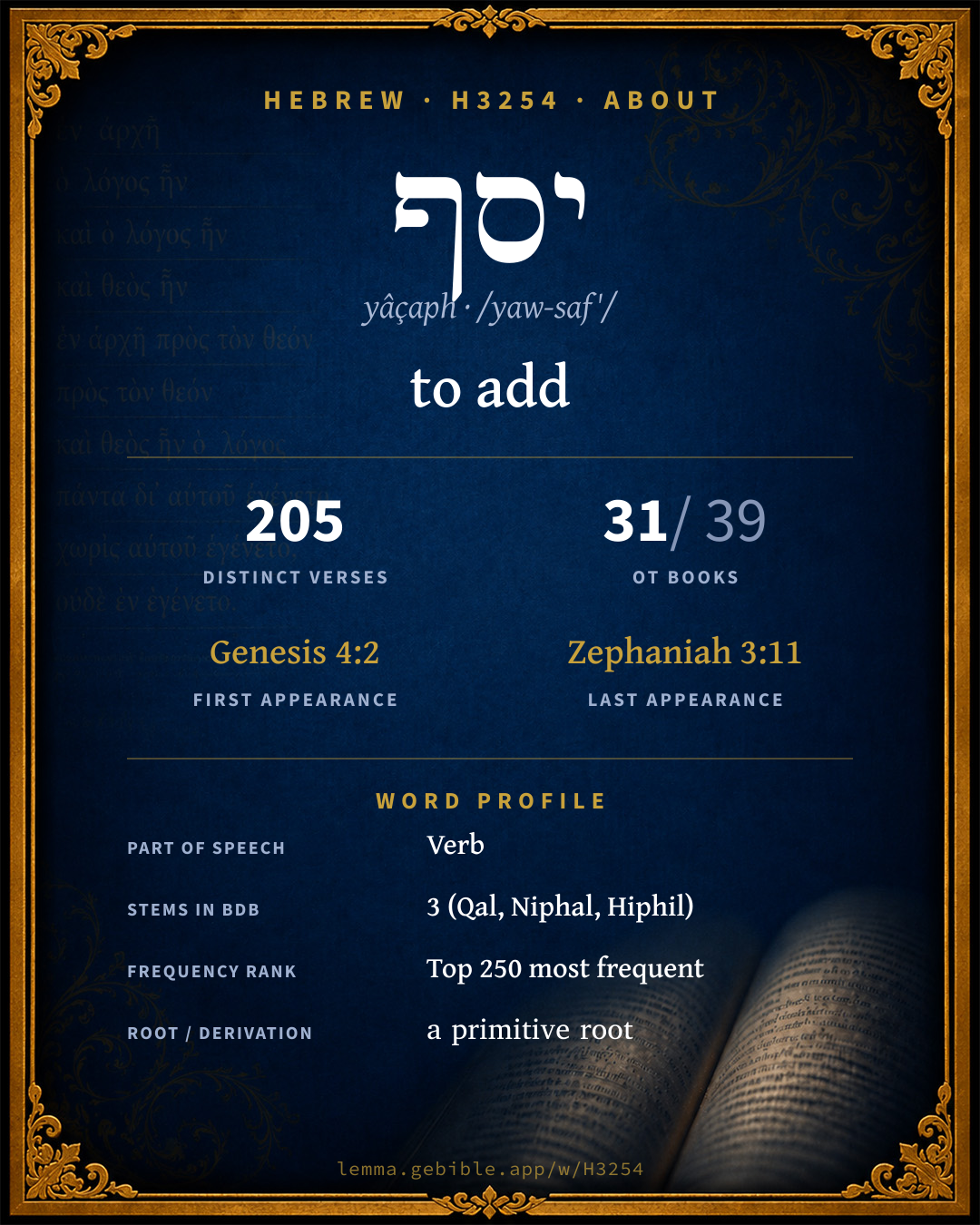
יָסַף
to add
also: increase, do again fuller range ↓
Full lexicon entry — Brown-Driver-Briggs (BDB)
From Brown-Driver-Briggs (BDB)
Where this word appears
See every Hiphil verb in the Hebrew Bible →
Grammar key — what these labels mean
Part of speech
- Verb
- An action or state-of-being word.
Stem
- Hiphil
- The causative active stem (“he caused / brought about”). Here: ‘add’
- Qal
- The basic, simple active stem — the plain form of the verb (“he wrote”).
- Niphal
- Usually the simple passive or reflexive of the Qal (“he was written”). Here: ‘join’
Form
- Imperfect
- An incomplete, ongoing, or future action (“he will / would write”).
- Sequential Imperfect
- An imperfect with prefixed waw — the standard past-narrative form (waw-consecutive imperfect).
- Jussive
- A third- or second-person volitional form expressing wish or command (“let him write”).
- Sequential Perfect
- A perfect with prefixed waw continuing a preceding imperfect or command (waw-consecutive perfect).
- Perfect
- A completed action or state — Hebrew marks aspect (completeness) more than strict tense (“he wrote”).
- Infinitive Construct
- A bound verbal noun, frequently with prepositions (“to write / in writing”).
- Participle Active
- A verbal adjective expressing ongoing or characteristic action (“writing / one who writes”).
- Cohortative
- A first-person volitional form expressing wish or resolve (“let me / let us write”).
State
- Absolute
- The independent form of a noun, not bound to a following word.
Person
- 3rd Person
- The one spoken about (“he / she / it / they”).
- 1st Person
- The speaker (“I / we”).
- 2nd Person
- The one addressed (“you”).
Gender
- Masculine
- Grammatically masculine.
- Common
- Either gender — not distinguished for this form.
- Feminine
- Grammatically feminine.
Number
- Singular
- One.
- Plural
- More than one (in Hebrew, generally three or more).
Grammatical forms 36 distinct
- Verb, Hiphil, Imperfect, 3rd Person, Masculine, Singular 34 times (16%)
- Verb, Hiphil, Sequential Imperfect, 3rd Person, Masculine, Singular 29 times (14%)
- Verb, Hiphil, Imperfect, 1st Person, Common, Singular 23 times (11%)
- Verb, Hiphil, Jussive, 3rd Person, Masculine, Singular 16 times (8%)
- Verb, Hiphil, Sequential Imperfect, 3rd Person, Masculine, Plural 11 times (5%)
- Verb, Hiphil, Imperfect, 3rd Person, Masculine, Plural 9 times (4%)
- Verb, Hiphil, Imperfect, 2nd Person, Masculine, Singular 8 times (4%)
- Verb, Hiphil, Imperfect, 2nd Person, Masculine, Plural 8 times (4%)
+28 more forms (72 occurrences)
Parsed forms decoded from the imported morphology (morphhb / Westminster Leningrad Codex — WLC text public domain, morphhb tagging CC BY 4.0), counted across 210 parsed occurrences — not distinct verses.
Page 2 of 2 — showing verses 201–205 of 205 distinct verses where H3254 appears, across 31 books. Click any verse to open its interlinear word-by-word view. Verse text shown in the World English Bible for context — . Each verse’s Hebrew form is shown with its reference; the English is not keyword-highlighted, since the data carries no word-level English alignment. Use “Compare translations” on any verse to read it across multiple English versions. This concordance covers the Hebrew Bible; Septuagint (Greek Old Testament) occurrences are not indexed here.
Amos 4 verses
- Amos 7:13 תוֹסִ֥יף Hiphil impf 2ms but don't prophesy again any more at Bethel; for it is the king's sanctuary, and it is a royal house!"
- Amos 8:2 אוֹסִ֥יף Hiphil impf 1cs He said, "Amos, what do you see?" I said, "A basket of summer fruit." Then Yahweh said to me, "The end has come on my people Israel. I will not again pass by them any more.
Jonah 1 verse
Nahum 1 verse
Zephaniah 1 verse
About this entry
At a glance — auto-summarized from this page’s data, not written by a person. Every figure links to its source below. This summary describes the numbers; it doesn’t interpret them.
At its core, יסף (yâçaph) means “to add.” Older and newer Bibles part ways — “again” in the King James Version, “and” (unfoldingWord Literal Text) in modern versions. See the renderings breakdown. It turns up in 205 verses across 31 books, a common footprint. Scripture first uses it in Genesis 4:2. Read the stem: it spans 3 stems, including Qal and Niphal. Dig into 205-verse concordance and the renderings breakdown below.
Gloss history
Strong's 1890 vs modern scholarship
About this word
Strong's H3254 catalogs a Hebrew word from the Hebrew Old Testament.
These counts are not copied from any lexicon or concordance. They are computed here, from the morphology-tagged Hebrew Old Testament. What Lemma adds →
- 205
- distinct verses
- The word appears in 205 distinct verses.
- 31 / 39
- OT books
- The word appears in 31 of 39 Old Testament books.
- #231
- by frequency
- Top 250 most frequent Hebrew words (rank 231 of 8,640 Hebrew words by occurrence).
View all 205 occurrences in the concordance →
Most concentrated in
- Isaiah 18 verses 9%
- 1 Samuel 17 verses 8%
- Deuteronomy 14 verses 7%
By section of the Old Testament
By traditional corpus
Conventional, traditional groupings — biblical authorship is debated, so this is a traditional corpus grouping, not an authorship claim. Each share is this word’s portion of its verses in that division of the Hebrew canon. Each figure is a share of the word’s 205 distinct verses.
- Prophets (Nevi'im) 94 verses · 46%
- Torah (Pentateuch) 56 verses · 27%
- Writings (Ketuvim) 55 verses · 27%
How translations render this word
Counts come from each version’s own published word-to-Strong’s tagging or interlinear alignment — an approximate guide to how each version renders this word, not a word-level alignment the data otherwise carries. Because each total is that version’s own tagged count, the per-version totals vary from one another and need not match the appearance or distinct-verse counts above. These counts may also differ from a printed concordance because Lemma counts each distinctly tagged rendering and does not collapse phrase taggings into a single head-word total. This is a fixed set of word-tagged versions (KJV, ASV, BSB, ULT) and does not change with the reading translation you choose elsewhere. Each version’s license is shown beside its name below (and on Sources).
- King James Version: Again 40×, More 28×, Any more 6×
- American Standard Version: Again 38×, More 23×, Me 9×
- Berean Standard Bible: Again 39×, Longer 19×, More 12×
- unfoldingWord Literal Text: And 32×, Continue 29×, Add 26×
King James Version Public Domain
Renders H3254 across 215 tagged occurrences — most commonly:
Plus other, less common renderings. Plus 89 renderings that appear only once — usually multi-word phrases or single function words the recovered tagging swept in, not distinct renderings. Not rendered by a distinct English word in 4 further occurrences.
American Standard Version Public Domain
Renders H3254 across 214 tagged occurrences — most commonly:
Plus other, less common renderings. Plus 82 renderings that appear only once — usually multi-word phrases or single function words the recovered tagging swept in, not distinct renderings.
Berean Standard Bible Public Domain
Renders H3254 across 201 tagged occurrences — most commonly:
Plus other, less common renderings. Plus 63 renderings that appear only once — usually multi-word phrases or single function words the recovered tagging swept in, not distinct renderings. Not rendered by a distinct English word in 11 further occurrences.
unfoldingWord Literal Text CC BY-SA 4.0
Renders H3254 across 320 tagged occurrences — most commonly:
Plus other, less common renderings. Plus 52 renderings that appear only once — usually multi-word phrases or single function words the recovered tagging swept in, not distinct renderings.
9 senses and sub-senses in the full BDB
Hebrew verbs can shift meaning by stem (binyan): Qal is the basic action, Niphal is often passive or reflexive, Piel often intensifies or makes it factitive, and Hiphil is typically causative. The senses below are grouped under the stem BDB assigns to each.
What do BDB’s symbols mean?
BDB uses these scholarly abbreviations:
| Symbol | Meaning |
|---|---|
| 𝔊 | the Septuagint (the ancient Greek translation, LXX) |
| 𝔙 | the Vulgate (the Latin translation) |
| 𝔖 | the Syriac version (the Peshitta) |
| 𝔗 | the Targum (the Aramaic translation) |
| ψ | the Psalms |
| √ | root (the underlying root or stem) |
| ‖ | parallel passage (a synonymous or contrasted parallel) |
| † | the dagger: every passage where the word occurs is cited |
The 9 senses and sub-senses the full Brown-Driver-Briggs lexicon distinguishes for this word, in lexicon order (not ranked by frequency), with BDB’s own verbatim wording and sub-sense lettering. Shown in Hebrew script with BDB’s own scholarly abbreviations. The condensed entry is in the Lexicon Entry tab. See also the Forms in the corpus table below.
Qal
- Pf. יָסַף Gn 38:26 +; יָֽסְפָה Gn 8:12; וְיָֽסְפָה consec. 2 K 19:30 = Is 37:31; יָסַ֫פְתָּ Is 26:15; 2 Ch 9:6; וְיָסַפְתָּ֫ Dt 19:9, etc.; Imv. סְפוּ Is 29:1; Je 7:21; + Inf. cstr. לָסֶ֫פֶת for MT לִסְפּוֹת Nu 32:14; Is 30:1 (Ges§ 69. 2. R); Pt. יוֹסִף (read יוֹסֵף) Is 29:14; 38:5 (Kö i 403 adds Ec 1:18 יוֹסִיף, from form and connexion less likely); pl. יֹסְפִים Dt 5:22;—add sq. acc. + על 1 S 12:19; Je 7:21; 45:3; Is 29:1; 30:1; 38:5; Dt 19:9 (+ עוד), Lv 22:14; 26:21; 27:13, 15, 19, 27; sq. acc. 2 K 19:30 = Is 37:31, Nu 32:14; 2 Ch 9:6 sq. על (no acc. יָסַפְתָּ עַל־הַשְּׁמוּעָה אֲשֶׁר שָׁמָ֑עְתִּי); sq. לְ (no acc.) = increase Is 26:15(×2) (יָסַפְתָּ לַגּוֹי); sq. acc. increase, have more 29:19 (וְיָסְֽפוּ עֲנָוִים ביהוה שִׂמְחָה); 14 times sq. inf. Gn 8:12 (לֹא יָסְֽפָה שׁוּב אליו עוֹד, i.e. it did not again return unto him), 38:26 (+ עוד), Lv 26:18 Nu 32:15 (+ עוד), Dt 5:22 (+ עוֹד), 20:8 Ju 8:28; 13:21 (+ עוד), 1 S 7:13 (+ עוד), 15:35; 27:4 (וְלאֹ יָו֯סַף עוֹד), 2 S 2:28 (+ עוד), 2 K 6:23 (+ עוֹד), Is 29:14; cf. Nu 11:25; Dt 5:19, where inf. not expressed, but implied from context; both c. לֹא and did not do it again. e.g. Genesis 38:26
Niphal
- Pf. נוֹסַף Je 36:32; וְנ׳ consec. Ex 1:10; Nu 36:3; 3 fs. וְנוֹסְפָה consec. Nu 36:4; Pt. וְנוֹסָף Pr 11:24; נוֹסָפוֹת Is 15:9;— e.g. Jeremiah 36:32
- 1. join (intr.), join oneself to (עַל) Ex 1:10. e.g. Exodus 1:10
- 2. be joined, added to (עַל) Nu 36:3, 4 Je 36:32; pt. abs. is increased Pr 11:24; pt. fem. pl. = things added, additions (i.e additional calamities) Is 15:9. e.g. Numbers 36:3
Hiphil
- Pf. הֹסִיף 2 K 24:7; הוֹסַ֫פְתָּ 1 K 10:7 etc.; Impf.164 יוֹסִיף Jos 23:13 +; juss. יוֹסֵף Gn 30:24 +; י֫וֹסֶף (bef. tone) Pr 1:5; 9:9; וַיּ֫וֹסֶף Is 7:10 +; וַיֹּ֫אסֶף 1 S 18:29; 2 ms. תּוֹסִיף Am 7:13 +; juss. תֹּסֵף Dt 13:1; תּוֹסַ֑ף Jb 40:32; תּוֹסְףִ Pr 30:6; אוֹסִיף Ho 1:6 +; volunt. אוֹסֵף 9:15; אֹסֵף Dt 18:16 + Ez 5:16 (del. Co); אֹסִ֫פָה 2 S 12:8 + prob. Dt 32:23 (for MT אַסְפֶּה); 3 mpl. יוֹסִפ֫וּן 1 K 19:2; 2 mpl. תּוֹסִ֫יפוּ Is 1:5 +; תֹּסִפ֫וּן Gn 44:23 + 2 times; תֹּאסִפ֫וּן Ex 5:7 (per contr. 2 S 6:1 ψ 104:29, cf. sub אסף), etc.; Pt. pl. מוֹסִיפִים Ne 13:18; Inf. cstr. הוֹסִיף Lv 19:25 + 3 times;— e.g. 2 Kings 24:7
- 1. add (= Qal) sq. acc. + עַל 2 K 20:6; Lv 5:16, 24; 27:31; Nu 5:7; Jb 34:37 (Elihu), ψ 61:7; Pr 16:23; Ez 5:16 (v. supr.), Ne 13:18 + Dt 32:23; sq. acc. + לְ Gn 30:24; Pr 3:2; 9:11; sq. acc. + אֶל 1 K 10:7 (i.e. thou hast more wisdom and prosperity than is reported); sq. acc. + עִם Pr 10:22; cf. וְהוֹסַפְתִּ֫י עַל־כָּל־תְּהִלָּֽתְךָ ψ 71:14 (i.e. increase); וְהוֹסַ֫פְתִּי חכמה על כל־אשׁר־היה לְפָנַי Ec 1:16 (‖ הִגְדַּ֫לְתִּי) (i.e. gain more); cf. 2:9 (‖ וְגָדַ֫לְתִּי); ה׳ לכם תבואתו Lv 19:25 (i.e. yield more); וַיּ֫וֹסֶף אַחְאָב לַעֲשׂוֹת לְהַכְעִים אֶת־יהוה … מִכֹּל וגו׳ 1 K 16:33 (did more to provoke); add to, increase (sq. על) no obj. expr. ה׳ על־חטאתנו 2 Ch 28:13; ה׳ על־אשׁמת ישׂראל Ezr 10:10; עליו אֵין להוס֔יף Ec 3:14 (opp. לִגְרֹעַ), cf. Dt 4:2; 13:1; 1 K 12:11, 14; 1 Ch 22:14; 2 Ch 10:11, 14; Pr 30:6; ψ 115:14; sq. אֶל (no other obj. expr.) Ez 23:14; = give in addition וְאֹסִפָה לך 2 S 12:8; מַה־יֹּסִיף לָךְ ψ 120:4 (‖ מַה־יִּתֵּן לְךָ); especially in phr. כה יעשׂה אלהים (י׳) לך (לי) וכה יוסיף 1 S 3:17 so may God do to thee and more also, 14:44; 20:13; 25:22; 2 S 3:9 (וכה יוסיף לו), v 35; 19:14; 1 K 2:23; 2 K 6:31; Ru 1:17; subj. heathen gods 1 K 19:2; 20:10; c. acc. ה׳ אֹמֶץ add strength = grow stronger Jb 17:9, cf. Pr 1:5; 9:9; Ec 1:18(×2), also Is 1:5 Pr 16:21; also, where subj. different from indirect obj. Pr 10:27 (יראת י׳ יוסיף ימים), 19:4; 23:28; = multiply ה׳ עליכם כָּכֶם אלף פעמים Dt 1:11 cf. 1 Ch 21:3; וְיוֹסֵף י׳ אלהיךָ אל־העם כָּהֵם וְכָהֵם מֵאָה פְעָמִים 2 S 24:3; cf. וַיֹּסֶף י׳ את־כל־אשׁר לְאִיּוֹב לְמִשְׁנֶה Jb 42:10. e.g. 2 Kings 20:6
- 2.
- a. sq. inf. (with or without לְ) add to do = do again or more (in Hex only JE & D); + עוֹד Gn 8:21(×2); 18:29; 37:5, 8; Ex 10:29; 14:13; Nu 25:13 Dt 3:26; 17:16; 19:20; 28:68; Ju 9:37; 20:28; 1 S 3:6; 18:29 (increase), 23:4; 27:4 (Kt), 2 S 2:22; 5:22; 7:20 (inf. om. in ‖ 1 Ch 17:18), 14:10; 18:22 2 K 24:7 Am 7:8, 13; 8:2; Is 8:5; 10:20; 23:12; 51:22; Na 2:1; Zp 3:11; Je 31:12; Ez 36:12; ψ 10:18; 77:8; 78:17; inf. om. Pr 19:19; 1 Ch 17:18; עוֹד om. Gn 4:2, 12; 8:10; 44:23; Ex 5:7; 8:25; 9:28, 34; 10:28; Nu 25:19, 25; Dt 13:12; 18:16; 25:3; Jos 7:12; 23:13; Ju 2:21; 3:12; 4:1; 10:6, 13; 13:1; 20:22, 23; 1 S 3:8, 21; 9:8; 19:8; 20:17; 2 S 3:34; 7:10; 24:1; 2 K 21:8; Is 1:13; 7:10; 24:20; Ho 9:15; 13:2; Am 5:2; 1 Ch 17:9; 2 Ch 28:22; 33:8; Jb 27:1; 29:1; ψ 41:9; La 4:15, 16, 22; Jon 2:5; inf. om. Ex 11:6; Dt 25:3; Jb 20:9; 34:32 (Elihu), 38:11; 40:5, 32; Jo 2:2; cf. also ה׳ עֲבוֹר Nu 22:26 i.e. went on further. e.g. Genesis 8:21
- b. sq. Impf. c. וַ· (of past time) Gn 25:1; 1 S 19:21; Est 8:3; Jb 36:1 (Elihu), Dn 10:18; + עוֹד Gn 38:5; Ju 11:14; 1 Ch 14:13. e.g. Genesis 25:1
- c. sq. Impf. asynd. (Ges§ 120, 1 b, 2b) לא תוסיפי יקראו־לָךְ Is 47:1, 5; אוסיף אֲבַקְשֶׁנּוּ עוֹד Pr 23:35; לא אוסיף עוֹד אֲרַחֵם אֶת־בֵּית ישׂראל Ho 1:6; לא יוסיף יָבֹא־בך עוד Is 52:1. e.g. Isaiah 47:1
Senses from the full Brown-Driver-Briggs lexicon (Brown, Driver, Briggs; Oxford 1906 — public domain), digitized via Sefaria, supplemented by the OpenScriptures HebrewLexicon (CC BY 4.0). Full attribution on Sources.
Word origin
vb. add (NH id., Hiph.; Aramaic Aph. אוֹסִיף, ܐܰܘܣܶܦ; Ph. יסף; MI29 יספתי, 1:21 לספת; Sab. וסף Hom ZMG 1892, 530; Assyrian esêpu dub. (eṣêpu Dl)—
— Brown-Driver-Briggs (Oxford 1906, public domain), digitized via Sefaria, supplemented by the OpenScriptures HebrewLexicon (CC BY 4.0). See Sources.
Origin: a primitive root
Jastrow Dictionary
A second Hebrew/Aramaic lexicon for comparison, covering Aramaic and post-biblical (Talmudic, Targumic, Midrashic) usage that the biblical-Hebrew BDB does not. Matched by lemma rather than by Strong’s number, so a lemma may carry more than one Jastrow headword (shown separately below), and the entries cover usage well beyond the Bible.
יָסַף
- , Hif. הוֹסִיף to heap up, to add (with על). Snh. XI, 3 להוֹסִיף על דברי וכ׳ thus adding to the words of the Scribes (against Deut. IV, 2). Ib. 88ᵇ ויש בו להו׳ when there is a possibility to add. Ib. ואם ה׳ גורע and if he did add, he diminishes (violates the law). Ib. 29ᵃ המוֹסִיף, v. גָּרַע I. Tosef. Sabb. VI (VII), 17 והאומר הוֹסִיפוּ על השולחן (not ואומר) and who (from superstition) says, Add (put one more) to the table; a. fr.—Yalk. Lev. 559 מוֹסַפְנִי על וכ׳ (Sifra Metsora beg. מוסיף אני) I will add to what thou saidst. e.g. Deuteronomy 4:2
- , Hithpa. הִתּוֹסַף to be added; to be added to, increase, wax. Mekh. Bo. s. 16; Yalk. Ex. 217 והשני נ׳ לו and the second name was added to the first (without abrogating the first). Ex. R. s. 7, beg. נ׳ לו עוד וכ׳ two additional years (of imprisonment) were given him. Sabb. 152ᵃ ת"ח … חכמתן מִתּוֹסֶפֶת עליהן Ms. M. (ed. חכמה נִיתּוֹסֶפֶת בהן) when scholars grow old, their wisdom grows with their age; ib. טפשותן מתוספת וכ׳, v. טִפְּשׁוּת.
יְסַף
- Af. אוֹסִיף, אוֹסֵף same, to add, increase; to do again. Targ. Deut. I, 11.—Targ. Gen. VIII, 10; a. fr.—Sabb. 116ᵇ אנא … אלא לאוֹסָפֵי וכ׳ Ms. M. (v. Rabb. D. S. a. l. note) I have not come to diminish from but to add to the law of Moses. Y. Ber. IV, 7ᶜ אוֹסְפוּן עליה add thereto.—Part. pass. מוֹסַף, f. מוֹסְפָא. Kidd. 20ᵃ והא מ׳ ואזלא but this (the debt on interest) is continually growing; a. fr.
- to be added. Targ. Gen. XLIX, 26; a. fr.—Ber. 28ᵃ אִתּוֹסְפוּ כמה ספסלי many forms had to be added (to accommodate the hearers). Ib. א׳ ד׳ מאהוכ׳ four hundred forms were added; a. e.
A Dictionary of the Targumim, the Talmud Babli and Yerushalmi, and the Midrashic Literature (Marcus Jastrow; London, Luzac, 1903) — Public Domain. Digitized via Sefaria. Digitized via Sefaria. Full attribution on Sources.
Forms in the corpus
The 159 distinct written forms H3254 takes in the Hebrew Bible, most frequent first — each parse links to that stem’s occurrences in the concordance. Hebrew forms include their vowel points and cantillation, so a single lemma takes many written forms.
The 60 most common forms are shown; 99 rarer forms follow in the full concordance.
Same root — word family
Other BDB entries built from the same root as H3254, grouped by Strong’s listed origin. These share a root / origin per the lexicon — not necessarily a shared meaning. Each links to that word’s own entry.
Derived from this word
Proper names from this root
People and places named from this root — a name, not an additional meaning of the word.
Compare all same-root words → Showing 4 of 5 — not the complete family. 3 of the same-root words are proper names (people or places). They share a root, not necessarily a meaning.
Septuagint verse parallels
This word appears in 197 verses that also exist in the Greek Old Testament (Septuagint), out of the 205 Hebrew verses it occurs in. You can read those verses in Greek by switching the Old Testament edition to the Septuagint.
Read these verses in the Septuagint
- Genesis 4:2
- Exodus 1:10
- Leviticus 5:16
- Numbers 5:7
- Deuteronomy 1:11
- Joshua 7:12
- Judges 2:21
- Ruth 1:17
- 1 Samuel 3:6
- 2 Samuel 2:22
- 1 Kings 2:23
- 2 Kings 6:23
This is a verse-level parallel only — the same verses exist in both the Hebrew and Greek Old Testaments. No word-level Hebrew↔Greek correspondence is claimed: the data carries no such alignment, so no Greek word is shown as this Hebrew word’s translation. Coverage is not total — the Septuagint omits the deuterocanon and renumbers the Psalms, so some Hebrew verses have no direct Greek parallel.