
1 Kings 2:23

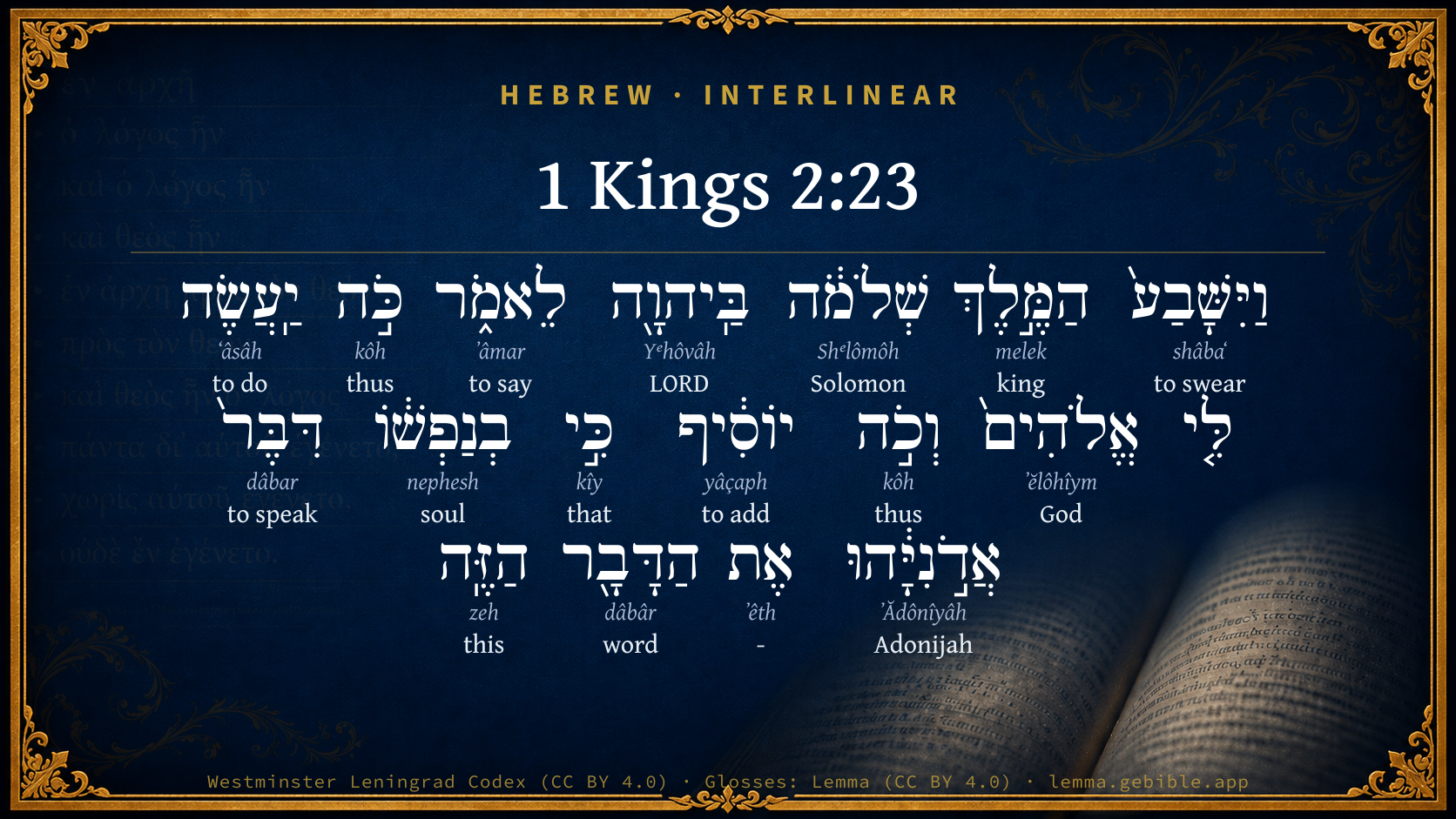
Hebrew (Westminster Leningrad Codex) 1 Kings 2:23 appears in the Hebrew Old Testament. The text above is from the Westminster Leningrad Codex. Each word links to its Strong’s number, a concise gloss, and parsing drawn from the Open Scriptures Hebrew Bible morphology. Click any word for its full Brown-Driver-Briggs (BDB) entry.
Download image
Cite this verse

1 Kings 2:23 (World English Bible). Public Domain. Lemma interlinear Bible study tool, https://lemma.gebible.app/v/1-kings/2/23.

Show BibTeX & RIS
BibTeX
RIS
English Translation
Then king Solomon swore by Yahweh, saying, God do so to me, and more also, if Adonijah has not spoken this word against his own life.
World English Bible · Public Domain
Download a study sheet

One document with this verse’s original text, its word-by-word gloss line, the meaning frame, cross-references with their text, attributed commentary, and full source and license credits — printable, and it pastes into notes with its structure intact.

This verse Autodidact and up

Study sheet (.html) Plain text (.txt)

A passage Seminary Student

Up to 50 verses in one chapter. A passage sheet keeps up to 6 commentary sources and 12 cross-references per verse, in the order this page ranks them, and says so on the sheet whenever that leaves anything out. Ask for a single verse and you get the Autodidact verse sheet above.

Everything on this page stays free to read, with no account — the sheet is a download of what is already on screen, not access to it.

Want to remove ads? Support Godless Engineer
Compare translations 3

The same verse in 3 English versions, stacked beneath the original-language interlinear above. Click any original word for its lexicon entry.

Each is an independent rendering of the whole verse — the interlinear is not word-aligned to these translations.

Highlighted words mark where these versions differ — a whole-verse word diff, not a word-by-word alignment.

  • World English Bible Public Domain
    Then king Solomon swore by Yahweh, saying, God do so to me, and more also, if Adonijah has not spoken this word against his own life.
  • King James Version Public Domain
    Then king Solomon sware by the LORD, saying, God do so to me, and more also, if Adonijah have not spoken this word against his own life.
  • unfoldingWord Literal Text CC BY-SA 4.0
    And King Solomon swore by Yahweh, saying, “Thus may God do to me, and thus may he add, for against his life Adonijah has spoken this word.

unfoldingWord Literal Text — © unfoldingWord, licensed CC BY-SA 4.0. Word-aligned USFM3 via Door43 (git.door43.org/unfoldingWord/en_ult).

Versions to compare (up to 4)

3 of 4 selected

Show all 18 translations

Every available English version of this verse, each an independent rendering of the whole verse.

  • World English Bible Public Domain
    Then king Solomon swore by Yahweh, saying, God do so to me, and more also, if Adonijah has not spoken this word against his own life.
  • Berean Standard Bible Public Domain
    Then King Solomon swore by the LORD: “May God punish me, and ever so severely, if Adonijah has not made this request at the expense of his life.
  • Majority Standard Bible Public Domain
    Then King Solomon swore by the LORD: “May God punish me, and ever so severely, if Adonijah has not made this request at the expense of his life.
  • King James Version Public Domain
    Then king Solomon sware by the LORD, saying, God do so to me, and more also, if Adonijah have not spoken this word against his own life.
  • American Standard Version (1901) Public Domain
    Then king Solomon sware by Jehovah, saying, God do so to me, and more also, if Adonijah hath not spoken this word against his own life.
  • Revised Version (1885) Public Domain
    Then king Solomon sware by the LORD, saying, God do so to me, and more also, if Adonijah have not spoken this word against his own life.
  • Geneva Bible (1599) Public Domain
    Then King Salomon sware by the Lord, saying, God doe so to me and more also, if Adoniiah hath not spoken this worde against his owne life.
  • Douay-Rheims (1899) Public Domain
    Then king Solomon swore by the Lord, saying: So and so may God do to me, and add more, if Adonias hath not spoken this word against his own life.
  • Young's Literal Translation Public Domain
    And king Solomon sweareth by Jehovah, saying, `Thus doth God to me, and thus He doth add -- surely against his soul hath Adonijah spoken this word;
  • Literal Standard Version CC BY-SA 4.0
    And King Solomon swears by YHWH, saying, “Thus God does to me, and thus He adds—surely Adonijah has spoken this word against his [own] soul;
  • Unlocked Literal Bible CC BY-SA 4.0
    Then King Solomon swore by Yahweh, saying, “May God do so to me, and more also, if Adonijah has not spoken this word against his own life.
  • unfoldingWord Literal Text CC BY-SA 4.0
    And King Solomon swore by Yahweh, saying, “Thus may God do to me, and thus may he add, for against his life Adonijah has spoken this word.
  • Darby Bible Public Domain
    And king Solomon swore by Jehovah saying, God do so to me, and more also, -- Adonijah has spoken this word against his own life!
  • World Messianic Bible Public Domain
    Then King Solomon swore by the LORD, saying, “God do so to me, and more also, if Adonijah has not spoken this word against his own life.
  • Webster's Bible Public Domain
    Then king Solomon swore by the LORD, saying, God do so to me, and more also, if Adonijah hath not spoken this word against his own life.
  • Free Bible Version CC BY-SA 4.0
    Then King Solomon vowed before the Lord, “May God punish me, really punish me, if what Adonijah has asked for doesn't cost him his life.
  • Bible in Basic English Public Domain
    Then King Solomon took an oath by the Lord, saying, May God's punishment be on me if Adonijah does not give payment for these words with his life.
  • JPS Tanakh (1917) Public Domain
    Then king Solomon swore by the LORD, saying: 'God do so to me, and more also, if Adonijah have not spoken this word against his own life.

Literal Standard Version (2020), Covenant Press — licensed CC BY-SA 4.0. Text via the HelloAO Bible API (eBible.org). Unlocked Literal Bible (unfoldingWord) — licensed CC BY-SA 4.0. Text via the HelloAO Bible API (eBible.org). unfoldingWord Literal Text — © unfoldingWord, licensed CC BY-SA 4.0. Word-aligned USFM3 via Door43 (git.door43.org/unfoldingWord/en_ult). Free Bible Version, Dr. Jonathan Gallagher — licensed CC BY-SA 4.0. Text via the HelloAO Bible API (eBible.org).

Word by word

More ways to search: Search by grammar → Find every occurrence → Compare this word →

Practice this passage: Drill this verse → Learn its vocabulary →

אֲדֹ֣נִיָּ֔הוּ
ʼĂdônîyâh
H138
“Adonijah”
Noun, Proper
Part of Speech
Noun
Type
Proper
Full BDB Definition

Origin: from H113 and H3050

TWOT: None

Adonijah = "my lord is Jehovah" - fourth son of David and Solomon's rival for the throne - Levite sent by Jehoshaphat to teach the Law - a chief of the people who co-operated with Nehemiah
  1. וַיִּשָּׁבַע֙ shâbaʻ H7650 “and · to swear” Conjunction + Verb, Niphal, Sequential Imperfect, 3rd Person, Masculine, Singular
  2. הַמֶּ֣לֶךְ melek H4428 “the · king” Particle, Definite Article + Noun, Common, Masculine, Singular, Absolute
  3. שְׁלֹמֹ֔ה Shᵉlômôh H8010 “Solomon” Noun, Proper
  4. בַּֽיהוָ֖ה Yᵉhôvâh H3068 “in/at · LORD” Preposition + Noun, Proper
  5. לֵאמֹ֑ר ʼâmar H559 “to say” Preposition + Verb, Qal, Infinitive Construct
  6. כֹּ֣ה kôh H3541 “thus” Adverb
  7. יַֽעֲשֶׂה ʻâsâh H6213 “to do” Verb, Qal, Jussive, 3rd Person, Masculine, Singular
  8. אֱלֹהִים֙ ʼĕlôhîym H430 “God(s)” Noun, Common, Masculine, Plural, Absolute
  9. וְכֹ֣ה kôh H3541 “and · thus” Conjunction + Adverb
  10. יוֹסִ֔יף yâçaph H3254 “to add” Verb, Hiphil, Jussive, 3rd Person, Masculine, Singular
  11. כִּ֣י kîy H3588 “that” Conjunction
  12. בְנַפְשׁ֔וֹ nephesh H5315 “in/at · soul · his” Preposition + Noun, Common, Both, Singular, Construct + Suffix, Personal, 3rd Person, Masculine, Singular
  13. דִּבֶּר֙ dâbar H1696 “to speak” Verb, Piel, Perfect, 3rd Person, Masculine, Singular
  14. אֶת ʼêth H853 “-” Particle, Direct Object
  15. הַדָּבָ֖ר dâbâr H1697 “the · word” Particle, Definite Article + Noun, Common, Masculine, Singular, Absolute
  16. הַזֶּֽה zeh H2088 “the · this” Particle, Definite Article + Pronoun, Demonstrative, Masculine, Singular

About this verse

These counts appear in no published source. They are computed here, from the morphology-tagged text and Lemma’s own curated glosses. What Lemma adds →

18
words
16
distinct lemmas
Historical
section

Shared distinctive vocabulary

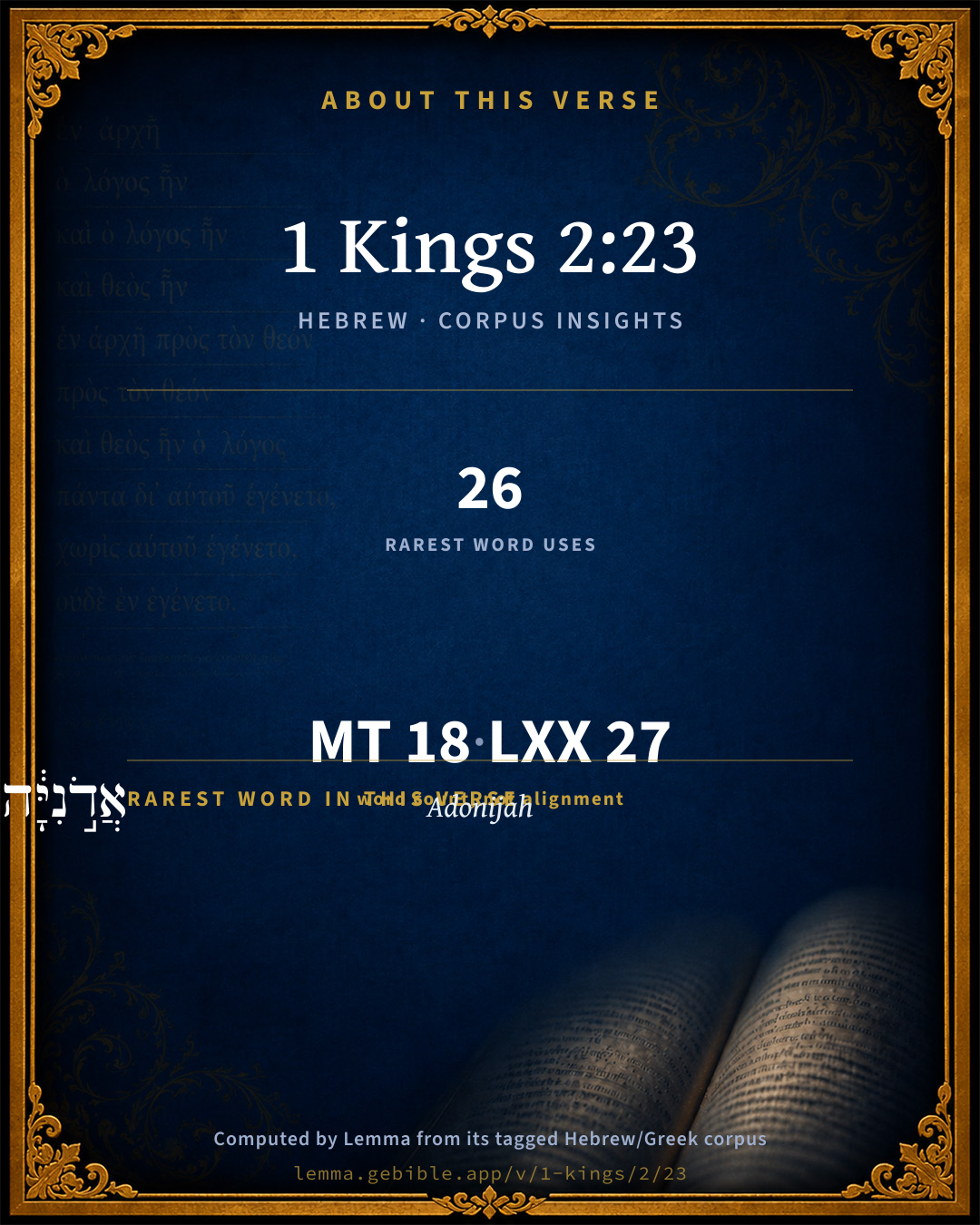
אֲדֹ֣נִיָּ֔הוּ Adonijah H138 occurs in 26 verses of the Hebrew Bible. Also found in:

Grammatical profile

  • 5 verbs
  • 7 nouns
  • 1 pronoun
  • 1 preposition
  • 1 conjunction
  • 2 adverbs
  • 1 particle

Verb forms

  • וַיִּשָּׁבַע֙ Niphal · Sequential Imperfect
  • לֵאמֹ֑ר Qal · Infinitive Construct
  • יַֽעֲשֶׂה Qal · Jussive
  • יוֹסִ֔יף Hiphil · Jussive
  • דִּבֶּר֙ Piel · Perfect

Repetition

A word recurs within this verse — often emphatic in Hebrew:

  • כֹּ֣ה thus H3541 ×2

Hebrew & Septuagint length

In English translation the verse runs 26 words from the Hebrew and 30 from the Septuagint (LXX English) — closely comparable.

A rough comparison of the two English renderings, which tokenize alike — not a word-level alignment.

Word counts can differ between the Hebrew and the Greek without any difference in meaning — e.g. the Hebrew direct-object marker אֵת has no separate Greek word, and Greek often adds the article ὁ.

In the original languages it is 18 Hebrew tokens and 27 Greek tokens — but the two are counted differently (Hebrew bundles its prefixes and suffixes into one token; the Greek is in lemma form), so that isn’t a like-for-like length.

Cross-references

12

Topical passages linked to 1 Kings 2:23 in the Treasury of Scripture Knowledge — connected by theme and wording, ordered by reader-vote popularity; previews shown in the World English Bible.

  • Ruth 1:17 where you die, will I die, and there will I be buried: Yahweh do so to me, and more also, if anything but death part you and me."
  • Psalms 64:8 Their own tongues shall ruin them. All who see them will shake their heads.
  • Psalms 140:9 As for the head of those who surround me, Let the mischief of their own lips cover them.
  • 1 Samuel 14:44 Saul said, God do so and more also; for you shall surely die, Jonathan.
  • 2 Samuel 3:9 God do so to Abner, and more also, if, as Yahweh has sworn to David, I don't do even so to him;
  • 2 Samuel 3:35 All the people came to cause David to eat bread while it was yet day; but David swore, saying, God do so to me, and more also, if I taste bread, or anything else, until the sun be down.
  • 2 Samuel 19:13 Say you to Amasa, Aren't you my bone and my flesh? God do so to me, and more also, if you aren't captain of the host before me continually in the room of Joab.
  • 1 Kings 20:10 Ben Hadad sent to him, and said, The gods do so to me, and more also, if the dust of Samaria shall suffice for handfuls for all the people who follow me.
  • 2 Kings 6:31 Then he said, God do so to me, and more also, if the head of Elisha the son of Shaphat shall stand on him this day.
  • Proverbs 18:6–7 A fool's lips come into strife, And his mouth invites beatings.
  • Ecclesiastes 10:12 The words of a wise man's mouth are gracious; but a fool is swallowed by his own lips.
  • Luke 19:22 "He said to him, 'Out of your own mouth will I judge you, you wicked servant! You knew that I am an exacting man, taking up that which I didn't lay down, and reaping that which I didn't sow.

Cross-references courtesy of OpenBible.info (CC BY 4.0).

Hebrew and Greek witnesses Masoretic Hebrew ↔ Greek Septuagint

The same verse in the two great witnesses to the Old Testament, shown verse-for-verse.

These are two independent witnesses, not word-aligned to each other, and the Septuagint is shown in lemma (dictionary) form.

Hebrew 1 Kings 2:23 Masoretic · Westminster Leningrad Codex

וַיִּשָּׁבַע֙ הַמֶּ֣לֶךְ שְׁלֹמֹ֔ה בַּֽיהוָ֖ה לֵאמֹ֑ר כֹּ֣ה יַֽעֲשֶׂה לִּ֤י אֱלֹהִים֙ וְכֹ֣ה יוֹסִ֔יף כִּ֣י בְנַפְשׁ֔וֹ דִּבֶּר֙ אֲדֹ֣נִיָּ֔הוּ אֶת הַדָּבָ֖ר הַזֶּֽה

Then king Solomon swore by Yahweh, saying, God do so to me, and more also, if Adonijah has not spoken this word against his own life.

World English Bible · Public Domain

Greek LXX 1 Kings 2:23 Septuagint · lemma form

καί ὄμνυμι ὁ βασιλεύς σαλωμών κατά ὁ κύριος λέγω ὅδε ποιέω ἐγώ ὁ θεός καί ὅδε προςτίθημι ὅτι κατά ὁ ψυχή αὐτός λαλέω αδωνίας ὁ λόγος οὗτος

And king Solomon swore by the Lord, saying, God do so to me, and more also, if it be not that Adonias has spoken this word against his own life.

LXX2012 (modern English Septuagint) · Public Domain

On this verse, Ellicott's Commentary for English Readers discusses the Septuagint’s reading. Read the note in Commentary ↓

Hebrew: Westminster Leningrad Codex (CC BY 4.0). Greek: Septuagint (public domain); English from LXX2012 (modern English Septuagint) (Public Domain). How the Septuagint differs from the Hebrew →

Targum (Aramaic paraphrase)

1

The Targum is the ancient Jewish Aramaic paraphrase of the Hebrew Scriptures — an interpretive translation, not the Hebrew text itself. Onkelos (literal) and Pseudo-Jonathan (expansive) render the Torah, and Jonathan the Prophets. Coverage is partial: where no permissively-licensed English translation exists for a verse, only the Aramaic is shown. This is verse-level text, not a word-by-word alignment to the Hebrew.

  1. Targum Jonathan Prophets (Joshua–Malachi)
    וְקַיֵם מַלְכָּא שְׁלֹמֹה בְמֵימְרָא דַייָ לְמֵימָר כְּדֵין יַעְבֵּיד לִי אֱלֹהִים וּכְדֵין יוֹסִיף אֲרֵי בְנַפְשֵׁיהּ מַלֵיל אֲדוֹנִיָהוּ יַת פִּתְגָמָא הָדֵין:

    (no public-domain English translation for this verse)

    Targum Jonathan — Aramaic: “Mikraot Gedolot” (public domain). English: “Sefaria Community Translation” (CC0 1.0 (public-domain dedication)); “London "Chaldee Paraphrase," 1871” (public domain). Text via Sefaria.

Commentary

Notes on 1 Kings 2:23 from classic Christian and Jewish commentators (each source and its license shown beneath its notes). The classic Christian expositions comment on the surrounding passage and are grouped to its opening verse, so a note may address several verses; the Jewish commentaries on the Tanakh (Rashi and others) are per-verse, so they appear only where the commentator wrote on this verse.

Lemma curates 59 commentaries, every one of them public domain or Creative Commons licensed, each selected and text-cleaned for this edition rather than reprinted as found. About our sources →

Trapp's Complete Commentary

John Trapp

1Ki 2:23 Then king Solomon sware by the LORD, saying, God do so to me, and more also, if Adonijah have not spoken this word against his own life.

Ver. 23. And Solomon sware.] That his mother, seeing him so resolute, might no more solicit.

John Trapp, A Commentary or Exposition upon All the Books of the Old and New Testament (1647–1656) — public domain. Text from a community e-Sword module.

Joseph Benson's Commentary

1Ki 2:23. Then King Solomon sware by the Lord — Once here, and again 1Ki 2:24, which he did to oblige himself irrevocably to perform his resolution, and to prevent all intercession for Adonijah’s life, the matter being, he believed, of the greatest importance to him.

Joseph Benson's Commentary on the Old and New Testaments (1811–1818) — public domain. Text from a community e-Sword module.

Jamieson, Fausset & Brown

Robert Jamieson, A. R. Fausset & David Brown

God do so to me, and more also--the common form of introducing a solemn oath.

if Adonijah have not spoken this word against his own life--Whether there was a treasonable design to conceal under this request or not, the act, according to Eastern notions, was criminal, and of dangerous consequence to the state. There is no ground of censure upon Solomon for cruelty or precipitation in this instance. He had pardoned Adonijah's former conspiracy; but this new attempt was rebellion against the viceroy appointed by the divine King and called for condign punishment. The office of executioner was among the Hebrews, as in other ancient countries of the East, performed unceremoniously and privately--often without any previous warning--by the captain of the guard, or one of his officers (Mat 14:10).

Jamieson, Fausset & Brown — Commentary Critical and Explanatory on the Whole Bible (1871) — public domain (CC PDM 1.0). Text via the HelloAO Bible API.

Ellicott's Commentary for English Readers

(23) God do so to me, and more also.—See Rth_1:17; 1Sa_3:17; 1Sa_14:44; 1Sa_20:13; 1Sa_25:22, 2Sa_11:14, &c. This well-known formula of imprecation—which the LXX. renders, “May God do these things to me and add these things also “—was probably accompanied with some gesture signifying utter destruction.

A Bible Commentary for English Readers, edited by Charles John Ellicott (1878–1897) — public domain. Text from a community e-Sword module.

The Cambridge Bible for Schools and Colleges

gen. ed. J. J. S. Perowne

23. God do so to me, and more also] This is a very idiomatic rendering for the Hebrew, which is literally ‘Thus shall God do to me, and thus shall He add.’ The expression occurs again in 1Ki_19:2, 1Ki_20:10, and in 2Ki_6:31 as well as several times in the books of Samuel, and in Rth_1:17.

The Cambridge Bible for Schools and Colleges (gen. ed. J. J. S. Perowne; Cambridge University Press, 1878–1918) — public domain. Text from a community e-Sword module.

John Gill's Exposition

Now therefore, as the Lord liveth,.... Which is another oath; and one may easily perceive hereby in what a temper and disposition Solomon was, how warm, earnest, and vehement, how resolute against the petition, and how determined he was to punish Adonijah and his confederates:

which hath established me, and set me upon the throne of David my father, and who hath made me an house, as he promised; who had placed him on his father's throne, and established him there, in spite of all his enemies, and had given him a firm and stable kingdom, which was not to be shaken and subverted by the power and policy of conspirators, according to the promise of God by Nathan, Sa2 7:11;

Adonijah shall be put to death this day; both for his former conspiracy, he only having had a reprieve, and which was to continue on his good behaviour, Kg1 1:51, and for his fresh attempt in forming treasonable schemes to ascend the throne if possible; wherefore, being a dangerous man, and no longer to be trusted, Solomon was determined to dispatch him at once, and being established in his kingdom, he had nothing to fear from those in the conspiracy with him.

John Gill's Exposition of the Whole Bible (1746–1763) — public domain (CC PDM 1.0). Text via the HelloAO Bible API.

Albert Barnes' Notes on the Bible

Against his own life - Adonijah had forfeited his life by his former conduct, and his pardon had been merely conditional 1Ki 1:52.

Albert Barnes' Notes on the Bible (1834–1885) — public domain. Text from a community e-Sword/MySword module.

Matthew Poole's English Annotations

Sware by the Lord; once here, and again, 1Ki 2:24; which he did to oblige himself irrevocably to it, and to prevent all intercessions for his life, it being of so great importance to him.

Matthew Poole's English Annotations on the Holy Bible (1683–1685) — public domain. Text from a community e-Sword/MySword module.

The Pulpit Commentary

Then king Solomon sware by the Lord, saying, God do so to me, and more also a common form of adjuration (Rth_1:17; 1Sa_14:44 1Sa_20:13; = 2Sa_3:9 2Sa_19:13, etc.) Gott soil mich fort und fort strafen. Bahr, if or "that." yKi constantly follows formulae of swearing, as in all the passages just cited. Cf. the use of oti in New Testament. The order of the next words in the Hebrew is noticeable against his life spake Adonijah this word. wvpnB, "at the peril or cost of his life." (Cf. 2Sa_23:17; Jos_23:11)

The Pulpit Commentary (1880–1919), ed. H.D.M. Spence-Jones & Joseph S. Exell — public domain. Text from a community e-Sword module.

Lesson kit

Teaching starters — assembled from the data on this page, not authored interpretation. Every prompt links to the verse data it draws on. Edit before teaching.

1 Kings, in the Historical, opens this verse with 18 words (16 distinct Hebrew lemmas). Its most distinctive word is ʼĂdônîyâh (“Adonijah”). A historical commentator’s framing appears above. Read the whole chapter for the surrounding context.

Discussion questions

  1. What does “Adonijah” (ʼĂdônîyâh) contribute to the verse as a whole?
  2. 2 Samuel 3:4 shares the word «Adonijah» with this verse. How do the two illuminate each other?
  3. “thus” occurs 2× in this one verse. What is the effect of the repetition?
  4. These translations render this verse differently; the difference is in the English rendering, not the original. What questions does that raise?
  5. The verb «וַיִּשָּׁבַע֙» is Niphal Sequential Imperfect. How does its form color the action?
  6. Reading how Trapp's Complete Commentary and Joseph Benson's Commentary read this verse, where do the two commentators agree and where do they part?

Things to notice

Reading settings

Reading text

Shown beneath each verse's original-language words.

Old Testament
Old Testament edition

Read the OT as the Masoretic Hebrew (MT) or the Greek Septuagint (LXX).

English shown for the Greek Septuagint (in the Hebrew ↔ Greek comparison).

Comparing translations? Open the Compare panel on any verse page to stack up to four side by side.