
Hosea 1:6

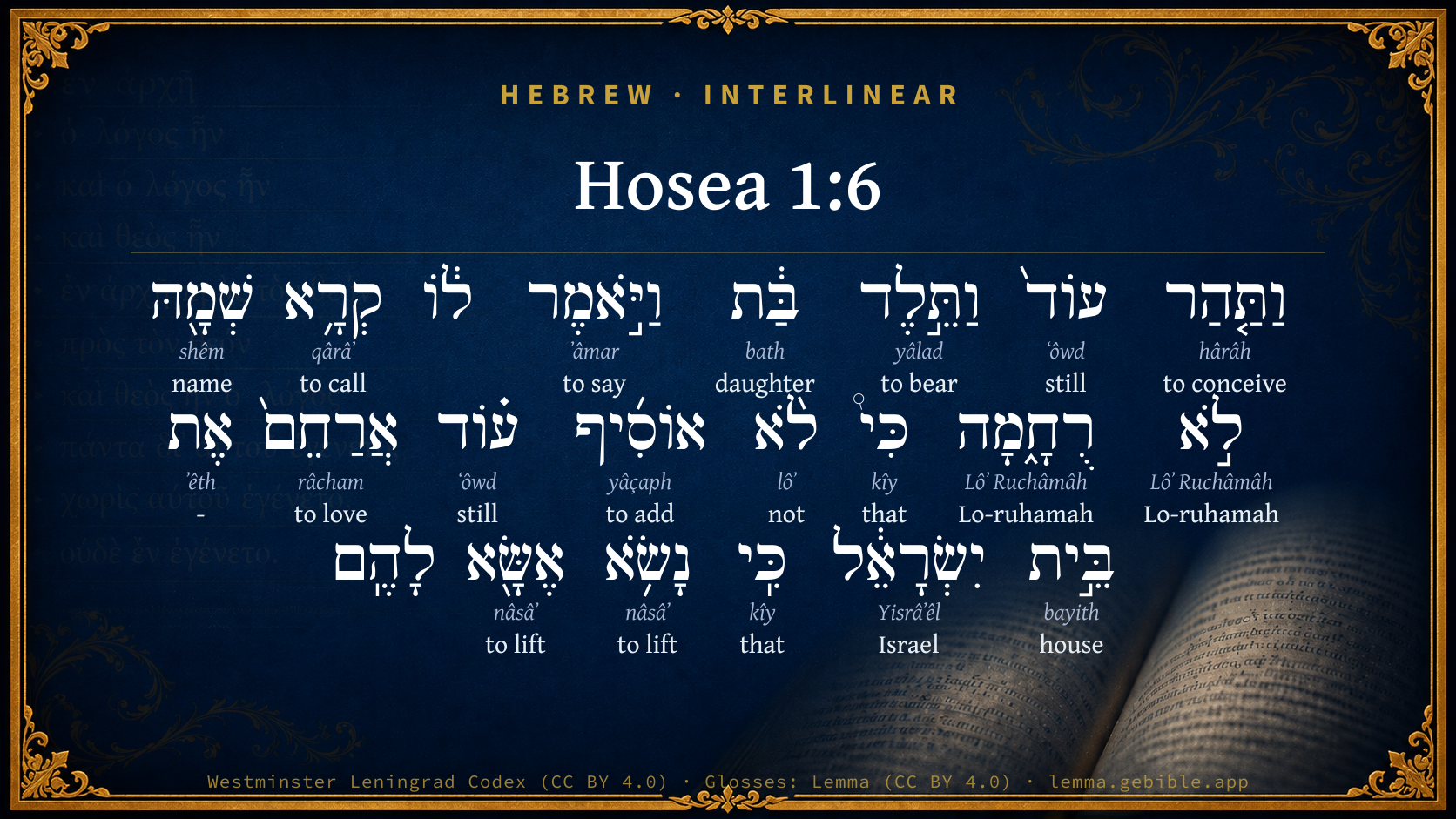
Hebrew (Westminster Leningrad Codex) Hosea 1:6 appears in the Hebrew Old Testament. The text above is from the Westminster Leningrad Codex. Each word links to its Strong’s number, a concise gloss, and parsing drawn from the Open Scriptures Hebrew Bible morphology. Click any word for its full Brown-Driver-Briggs (BDB) entry.
Download image
Cite this verse

Hosea 1:6 (World English Bible). Public Domain. Lemma interlinear Bible study tool, https://lemma.gebible.app/v/hosea/1/6.

Show BibTeX & RIS
BibTeX
RIS
English Translation
She conceived again, and bore a daughter. Then he said to him, "Call her name Lo-Ruhamah; for I will no longer have mercy on the house of Israel, that I should in any way pardon them.
World English Bible · Public Domain
Highlights
  • 1 first appearance in the Hebrew Bible
Full analysis ↓
Download a study sheet

One document with this verse’s original text, its word-by-word gloss line, the meaning frame, cross-references with their text, attributed commentary, and full source and license credits — printable, and it pastes into notes with its structure intact.

This verse Autodidact and up

Study sheet (.html) Plain text (.txt)

A passage Seminary Student

Up to 50 verses in one chapter. A passage sheet keeps up to 6 commentary sources and 12 cross-references per verse, in the order this page ranks them, and says so on the sheet whenever that leaves anything out. Ask for a single verse and you get the Autodidact verse sheet above.

Everything on this page stays free to read, with no account — the sheet is a download of what is already on screen, not access to it.

Want to remove ads? Support Godless Engineer
Compare translations 3

The same verse in 3 English versions, stacked beneath the original-language interlinear above. Click any original word for its lexicon entry.

Each is an independent rendering of the whole verse — the interlinear is not word-aligned to these translations.

Highlighted words mark where these versions differ — a whole-verse word diff, not a word-by-word alignment.

  • World English Bible Public Domain
    She conceived again, and bore a daughter. Then he said to him, "Call her name Lo-Ruhamah; for I will no longer have mercy on the house of Israel, that I should in any way pardon them.
  • King James Version Public Domain
    And she conceived again, and bare a daughter. And God said unto him, Call her name Loruhamah: for I will no more have mercy upon the house of Israel; but I will utterly take them away.
  • unfoldingWord Literal Text CC BY-SA 4.0
    And she conceived again and bore a daughter. And he said to him, “Call her name Lo Ruhamah, for I will not continue again to have compassion on the house of Israel, but carrying away, I will carry them away.

unfoldingWord Literal Text — © unfoldingWord, licensed CC BY-SA 4.0. Word-aligned USFM3 via Door43 (git.door43.org/unfoldingWord/en_ult).

Versions to compare (up to 4)

3 of 4 selected

Show all 18 translations

Every available English version of this verse, each an independent rendering of the whole verse.

  • World English Bible Public Domain
    She conceived again, and bore a daughter. Then he said to him, "Call her name Lo-Ruhamah; for I will no longer have mercy on the house of Israel, that I should in any way pardon them.
  • Berean Standard Bible Public Domain
    Gomer again conceived and gave birth to a daughter, and the LORD said to Hosea, “Name her Lo-ruhamah, for I will no longer have compassion on the house of Israel, that I should ever forgive them.
  • Majority Standard Bible Public Domain
    Gomer again conceived and gave birth to a daughter, and the LORD said to Hosea, “Name her Lo-ruhamah, for I will no longer have compassion on the house of Israel, that I should ever forgive them.
  • King James Version Public Domain
    And she conceived again, and bare a daughter. And God said unto him, Call her name Loruhamah: for I will no more have mercy upon the house of Israel; but I will utterly take them away.
  • American Standard Version (1901) Public Domain
    And she conceived again, and bare a daughter. And `Jehovah' said unto him, Call her name Lo-ruhamah; for I will no more have mercy upon the house of Israel, that I should in any wise pardon them.
  • Revised Version (1885) Public Domain
    And she conceived again, and bare a daughter. And the LORD said unto him, Call her name Lo-ruhamah: for I will no more have mercy upon the house of Israel, that I should in any wise pardon them.
  • Geneva Bible (1599) Public Domain
    She conceiued yet againe, and bare a daughter, and God saide vnto him, Call her name Lo-ruhamah: for I will no more haue pitie vpon the house of Israel: but I wil vtterly take them away.
  • Douay-Rheims (1899) Public Domain
    And she conceived again, and bore a daughter, and he said to him: Call her name, Without mercy: for I will not add any more to have mercy on the house of Israel, but I will utterly forget them.
  • Young's Literal Translation Public Domain
    And she conceiveth again, and beareth a daughter, and He saith to him, `Call her name Lo-Ruhamah, for I add no more to pity the house of Israel, for I do utterly take them away;
  • Literal Standard Version CC BY-SA 4.0
    And she conceives again, and bears a daughter, and He says to him, “Call her name Lo-Ruhamah [(Not Loved)], for I no longer pity the house of Israel, for I utterly take them away;
  • Unlocked Literal Bible CC BY-SA 4.0
    Gomer conceived again and bore a daughter. Then Yahweh said to Hosea, “Call her name Lo-Ruhamah, for I will no longer have mercy on the house of Israel, that I should forgive them at all.
  • unfoldingWord Literal Text CC BY-SA 4.0
    And she conceived again and bore a daughter. And he said to him, “Call her name Lo Ruhamah, for I will not continue again to have compassion on the house of Israel, but carrying away, I will carry them away.
  • Darby Bible Public Domain
    And she conceived again, and bore a daughter. And he said unto him, Call her name Lo-ruhamah; for I will no more have mercy upon the house of Israel, so that I should pardon them.
  • World Messianic Bible Public Domain
    She conceived again, and bore a daughter. Then he said to him, “Call her name Lo-Ruhamah, for I will no longer have mercy on the house of Israel, that I should in any way pardon them.
  • Webster's Bible Public Domain
    And she conceived again, and bore a daughter. And God said to him, Call her name Lo-ruhamah: for I will no more have mercy upon the house of Israel; but I will utterly take them away.
  • Free Bible Version CC BY-SA 4.0
    Gomer became pregnant again and gave birth to a daughter. The Lord told Hosea, “Call her Lo-ruhamah, because I will no longer love the house of Israel and certainly not forgive them.
  • Bible in Basic English Public Domain
    And after that she gave birth to a daughter. And the Lord said, Give her the name Lo-ruhamah; for I will not again have mercy on Israel, to give them forgiveness.
  • JPS Tanakh (1917) Public Domain
    And she conceived again, and bore a daughter. And He said unto him: 'Call her name Lo-ruhamah; for I will no more have compassion upon the house of Israel, that I should in any wise pardon them.

Literal Standard Version (2020), Covenant Press — licensed CC BY-SA 4.0. Text via the HelloAO Bible API (eBible.org). Unlocked Literal Bible (unfoldingWord) — licensed CC BY-SA 4.0. Text via the HelloAO Bible API (eBible.org). unfoldingWord Literal Text — © unfoldingWord, licensed CC BY-SA 4.0. Word-aligned USFM3 via Door43 (git.door43.org/unfoldingWord/en_ult). Free Bible Version, Dr. Jonathan Gallagher — licensed CC BY-SA 4.0. Text via the HelloAO Bible API (eBible.org).

Word by word

More ways to search: Search by grammar → Find every occurrence → Compare this word →

Practice this passage: Drill this verse → Learn its vocabulary →

לֹ֣א
Lôʼ Ruchâmâh
H3819
“Lo-ruhamah”
Particle, Negative
Part of Speech
Particle
Type
Negative
Full BDB Definition

Origin: from H3808 and H7355

TWOT: None

Lo-ruhamah = "no mercy" - (Pual) symbolic name given by the prophet Hosea to his daughter
  1. וַתַּ֤הַר hârâh H2029 “and · to conceive” Conjunction + Verb, Qal, Sequential Imperfect, 3rd Person, Feminine, Singular
  2. עוֹד֙ ʻôwd H5750 “still” Adverb
  3. וַתֵּ֣לֶד yâlad H3205 “and · to bear” Conjunction + Verb, Qal, Sequential Imperfect, 3rd Person, Feminine, Singular
  4. בַּ֔ת bath H1323 “daughter” Noun, Common, Feminine, Singular, Absolute
  5. וַיֹּ֣אמֶר ʼâmar H559 “and · to say” Conjunction + Verb, Qal, Sequential Imperfect, 3rd Person, Masculine, Singular
  6. קְרָ֥א qârâʼ H7121 “call” Verb, Qal, Imperative, 2nd Person, Masculine, Singular
  7. שְׁמָ֖הּ shêm H8034 “name · her” Noun, Common, Masculine, Singular, Construct + Suffix, Personal, 3rd Person, Feminine, Singular
  8. רֻחָ֑מָה Lôʼ Ruchâmâh H3819 “Lo-ruhamah” Noun, Proper
  9. כִּי֩ kîy H3588 “that” Conjunction
  10. לֹ֨א lôʼ H3808 “not” Particle, Negative
  11. אוֹסִ֜יף yâçaph H3254 “to add” Verb, Hiphil, Imperfect, 1st Person, Common, Singular
  12. ע֗וֹד ʻôwd H5750 “still” Adverb
  13. אֲרַחֵם֙ râcham H7355 “to love” Verb, Piel, Imperfect, 1st Person, Common, Singular
  14. אֶת ʼêth H853 “-” Particle, Direct Object
  15. בֵּ֣ית bayith H1004 “house of” Noun, Common, Masculine, Singular, Construct
  16. יִשְׂרָאֵ֔ל Yisrâʼêl H3478 “Israel” Noun, Proper
  17. כִּֽי kîy H3588 “that” Conjunction
  18. נָשֹׂ֥א nâsâʼ H5375 “to lift” Verb, Qal, Infinitive Absolute
  19. אֶשָּׂ֖א nâsâʼ H5375 “to lift” Verb, Qal, Imperfect, 1st Person, Common, Singular

About this verse

These counts appear in no published source. They are computed here, from the morphology-tagged text and Lemma’s own curated glosses. What Lemma adds →

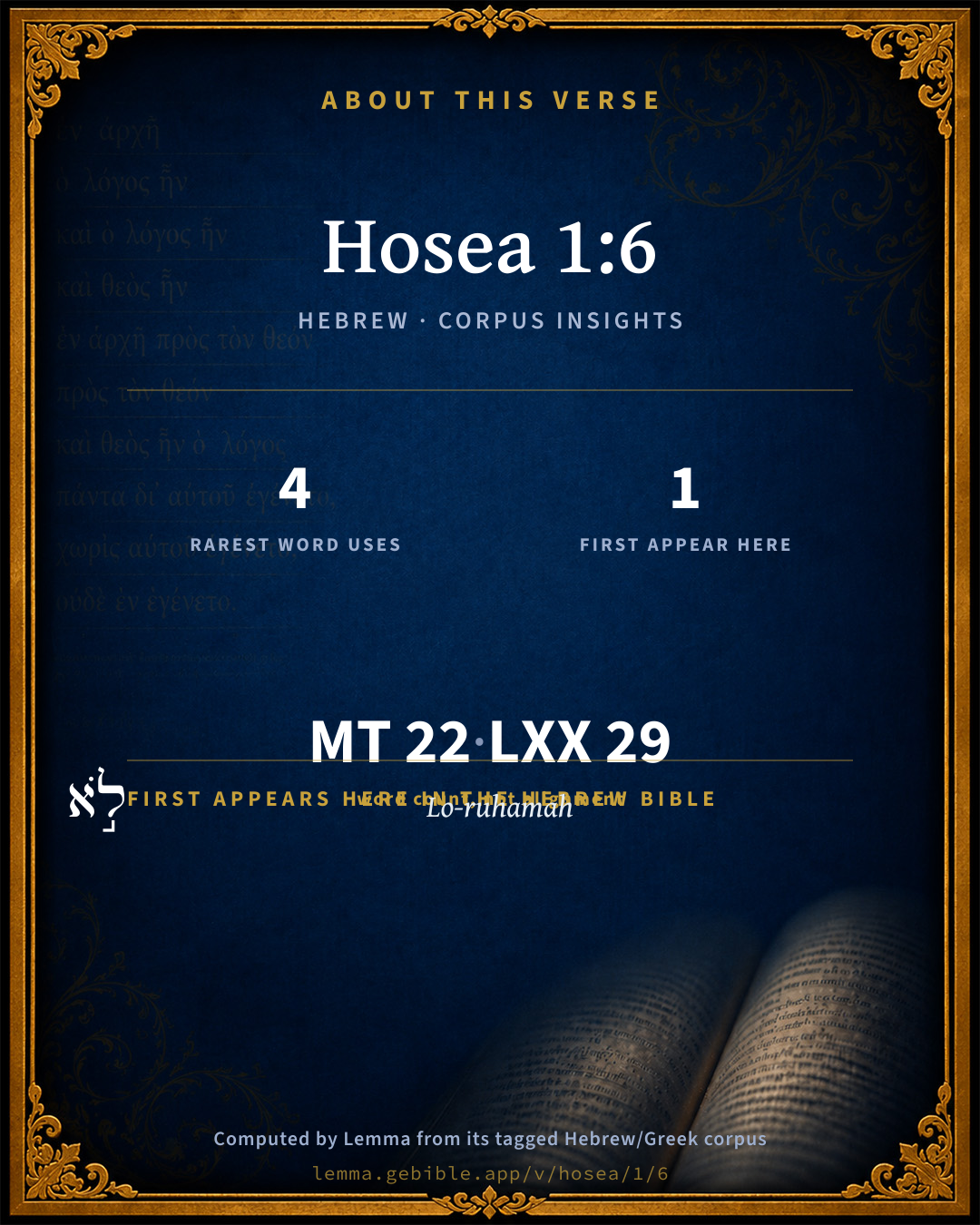
22
words
16
distinct lemmas
Prophets
section

Notable vocabulary

The rarest word here is לֹ֣א Lo-ruhamah H3819 — appearing just 4 times in the whole Hebrew Bible.

First appearance in Scripture

This word makes its first canonical appearance in the Hebrew Bible here:

  • לֹ֣א Lo-ruhamah H3819

Shared distinctive vocabulary

לֹ֣א Lo-ruhamah H3819 occurs in 2 verses of the Hebrew Bible. Also found in:

Grammatical profile

  • 8 verbs
  • 5 nouns
  • 2 prepositions
  • 2 conjunctions
  • 2 adverbs
  • 3 particles

Verb forms

  • וַתַּ֤הַר Qal · Sequential Imperfect
  • וַתֵּ֣לֶד Qal · Sequential Imperfect
  • וַיֹּ֣אמֶר Qal · Sequential Imperfect
  • קְרָ֥א Qal · Imperative
  • אוֹסִ֜יף Hiphil · Imperfect
  • אֲרַחֵם֙ Piel · Imperfect
  • נָשֹׂ֥א Qal · Infinitive Absolute
  • אֶשָּׂ֖א Qal · Imperfect

Repetition

Words recur within this verse — often emphatic in Hebrew:

  • עוֹד֙ still H5750 ×2
  • לֹ֣א Lo-ruhamah H3819 ×2
  • נָשֹׂ֥א to lift H5375 ×2
  • כִּי֩ that H3588 ×2

Hebrew & Septuagint length

In English translation the verse runs 36 words from the Hebrew and 38 from the Septuagint (LXX English) — closely comparable.

A rough comparison of the two English renderings, which tokenize alike — not a word-level alignment.

Word counts can differ between the Hebrew and the Greek without any difference in meaning — e.g. the Hebrew direct-object marker אֵת has no separate Greek word, and Greek often adds the article ὁ.

In the original languages it is 22 Hebrew tokens and 29 Greek tokens — but the two are counted differently (Hebrew bundles its prefixes and suffixes into one token; the Greek is in lemma form), so that isn’t a like-for-like length.

Cross-references

7

Topical passages linked to Hosea 1:6 in the Treasury of Scripture Knowledge — connected by theme and wording, ordered by reader-vote popularity; previews shown in the World English Bible.

  • 1 Peter 2:10 who in time past were no people, but now are God's people, who had not obtained mercy, but now have obtained mercy.
  • Hosea 2:23 I will sow her to me in the earth; And I will have mercy on her who had not obtained mercy; And I will tell those who were not my people, 'You are my people;' And they will say, 'My God!'"
  • 2 Kings 17:6 In the ninth year of Hoshea the king of Assyria took Samaria, and carried Israel away to Assyria, and placed them in Halah, and on the Habor, the river of Gozan, and in the cities of the Medes.
  • Isaiah 27:11 When the boughs of it are withered, they shall be broken off; the women shall come, and set them on fire; for it is a people of no understanding: therefore he who made them will not have compassion on them, and he who formed them will show them no favor.
  • Hosea 2:4 Indeed, on her children I will have no mercy; For they are children of unfaithfulness;
  • 2 Kings 17:23–41 until Yahweh removed Israel out of his sight, as he spoke by all his servants the prophets. So Israel was carried away out of their own land to Assyria to this day.
  • Hosea 9:15–17 "All their wickedness is in Gilgal; For there I hated them. Because of the wickedness of their deeds I will drive them out of my house! I will love them no more. All their princes are rebels.

Cross-references courtesy of OpenBible.info (CC BY 4.0).

Hebrew and Greek witnesses Masoretic Hebrew ↔ Greek Septuagint

The same verse in the two great witnesses to the Old Testament, shown verse-for-verse.

These are two independent witnesses, not word-aligned to each other, and the Septuagint is shown in lemma (dictionary) form.

Hebrew Hosea 1:6 Masoretic · Westminster Leningrad Codex

וַתַּ֤הַר עוֹד֙ וַתֵּ֣לֶד בַּ֔ת וַיֹּ֣אמֶר ל֔וֹ קְרָ֥א שְׁמָ֖הּ לֹ֣א רֻחָ֑מָה כִּי֩ לֹ֨א אוֹסִ֜יף ע֗וֹד אֲרַחֵם֙ אֶת בֵּ֣ית יִשְׂרָאֵ֔ל כִּֽי נָשֹׂ֥א אֶשָּׂ֖א לָהֶֽם

She conceived again, and bore a daughter. Then he said to him, "Call her name Lo-Ruhamah; for I will no longer have mercy on the house of Israel, that I should in any way pardon them.

World English Bible · Public Domain

Greek LXX Hosea 1:6 Septuagint · lemma form

καί συνλαμβάνω ἔτι καί τίκτω θυγάτηρ καί εἶπον αὐτός καλέω ὁ ὄνομα αὐτός οὐ-ἐλεέω διότι οὐ μή προςτίθημι ἔτι ἐλεέω ὁ οἶκος ὁ ἰσραήλ ἀλλά ἤ ἀντιτάσσω ἀντιτάσσω αὐτός

And she conceived again, and bore a daughter. And he said to him, Call her name, Unpitied: for I will no more have mercy on the house of Israel, but will surely set myself in array against them.

LXX2012 (modern English Septuagint) · Public Domain

On this verse, Trapp's Complete Commentary discusses the Septuagint’s reading. Read the note in Commentary ↓

Hebrew: Westminster Leningrad Codex (CC BY 4.0). Greek: Septuagint (public domain); English from LXX2012 (modern English Septuagint) (Public Domain). How the Septuagint differs from the Hebrew →

Targum (Aramaic paraphrase)

1

The Targum is the ancient Jewish Aramaic paraphrase of the Hebrew Scriptures — an interpretive translation, not the Hebrew text itself. Onkelos (literal) and Pseudo-Jonathan (expansive) render the Torah, and Jonathan the Prophets. Coverage is partial: where no permissively-licensed English translation exists for a verse, only the Aramaic is shown. This is verse-level text, not a word-by-word alignment to the Hebrew.

  1. Targum Jonathan Prophets (Joshua–Malachi)
    וְאוֹסִיפוּ וַעֲבַדוּ עוֹבָדִין בִּישִׁין וַאֲמַר לֵיהּ קְרֵי שׁוּמְהוֹן דְלָא רְחִימִין בְּעוֹבָדֵיהוֹן אֲרֵי לָא אוֹסִיף עוֹד לְרָחָמָא עַל בֵּית יִשְׂרָאֵל בְּרַם אִם יְתוּבוּן מִשְׁבַק אֶשְׁבּוֹק לְהוֹן:

    (no public-domain English translation for this verse)

    Targum Jonathan — Aramaic: “Mikraot Gedolot” (public domain). English: “Sefaria Community Translation” (CC0 1.0 (public-domain dedication)); “London "Chaldee Paraphrase," 1871” (public domain). Text via Sefaria.

Commentary

Notes on Hosea 1:6 from classic Christian and Jewish commentators (each source and its license shown beneath its notes). The classic Christian expositions comment on the surrounding passage and are grouped to its opening verse, so a note may address several verses; the Jewish commentaries on the Tanakh (Rashi and others) are per-verse, so they appear only where the commentator wrote on this verse.

Lemma curates 59 commentaries, every one of them public domain or Creative Commons licensed, each selected and text-cleaned for this edition rather than reprinted as found. About our sources →

Trapp's Complete Commentary

John Trapp

Hos 1:6 And she conceived again, and bare a daughter. And [God] said unto him, Call her name Loruhamah: for I will no more have mercy upon the house of Israel; but I will utterly take them away.

Ver. 6. And she conceived again] To show, in a continued allegory, the weak and woeful state of the ten tribes, when the Assyrian took from them all the land of Gilead and Galilee, together with all the land of Nephthali, and carried them captive, subduing, in a manner, five tribes of Israel: to wit, those without Jordan (who as they had first their inheritance given them, so they were now first carried captives), and the tribes of Zebulon and Nephthali, who were seated in the land of Galilee. And this was the first captivity of Israel: see 2Ki 15:29 Isa 9:1.

And bare a daughter] This age is compared to a daughter, because from that time forward, after the bow of Israel was so broken, as Hos 1:5, they should be no more able to defend themselves than if they were a commonwealth of women. Their spirits should be so cowed out and emasculated, their backs so bowed down with unsupportable burdens and bondages, that there was scarcely place left of a worse condition, nor hope of a better. Like them were those we read of Isa 51:23, that yielded to such as would but say to them, "Bow down that we may go over you." Or as those in Nahum, Nah 3:13, Their "men shall be as women," Aχηιδες ουκετ Aχαιοι, {a} timorous and cowardly, like Issachar’s ass, Gen 49:14 (whose lot fell in Galilee, Jos 19:18), or those fugitives of Ephraim, Jdg 12:4, that therefore bare a brand of dishonour, because they would not rather die bravely than live basely. Of such it may be said, as of harts and stags, they have great horns and strength, but do nothing with them, quia de est animus, because their spirits are imbased: as the Israelites in Egypt were of old by Pharaoh, and as the Grecians are to this day by the Turk.

Call her name Loruhamah] When God once calls a people or a person by this name, we may well write upon their doors (if any place be yet left for prayer, any good to be done by it), Lord, have mercy upon them: their condition is deplorable, if not desperate. Vade frater in cellam et dic, Miserere mei Deus, Brother, go into thy cell, and say, Lord, have mercy upon me, said Crantzius to Luther, when he began to declaim against the pope, for he looked upon him as an undone man, and yet he was not (Scaltet. Annal.). But those are doubly undone, to whom God shall say, as here to Israel,

I will no more have mercy] Heb., I will add no more to show mercy: but my so often abused mercy shall turn into fury. That it is not so yet with this sinful nation, that we are not yet a Loruhamah, an Aceldama, that we are not already as Sodom, and like unto Gomorrah, even a place of nettles and salt pits, a perpetual desolation, as another prophet hath it, we may well cry out, O the depth, the fathomless depth of God’s dear love to England, Isa 1:9 Zep 2:9. Certain it is that we have hitherto subsisted by a miracle of his mercy, and by a prop of his extraordinary patience. Certain it is that God hath not dealt with England according to his ordinary rule, but according to his prerogative royal. England (if one may so speak with reverence) is a paradox to the Bible. God grant that being lifted up to heaven with Capernaum in the abundance of blessings, she be not brought down to hell by the abuse of them; that God set not that sad impression of Loruhamah (worse than any black Theta) upon her, and make her know the worth of his undervalued favours by the want of them: why should it be said of us as once, Anglica gens est optima flens, et pessima ridens? why should we provoke the Lord so long till he shall resolve upon an evil, an only evil, i.e. without mixture of mercy, Eze 7:5; till the decree bring forth, Zep 2:2, and God pronounceth that fatal sentence against us that he did once against the old world, Fiat iustitia, ruat mundus, Let justice be done, though the world be thereby undone. "Of all God’s attributes he can least abide an abuse in his mercy; God’s mercy is precious" (saith one), "and he will not let it run out to waste; he will not be prodigal of it. There is a time wherein God will say, Now I have done, I have even done with this people, mercy hath had her turn, &c. I will not always serve them for a sinning-stock, but will take another course with them: I will take my own and be gone: and woe be unto them when I depart from them." When the sun is eclipsed, all creatures fade and flag here below. "Thou hiddest thy face, Lord, and I was troubled," Psa 30:7. David could not live but in the light of God’s countenance: he begs for mercy everywhere, as for life. Never did poor prisoner at the bar beg harder for a psalm of mercy than he doth, Psa 51:1, and other places. Neither would common mercies content him, he must have such as are proper and peculiar to God’s own people, even the "sure mercies of David." Oh, make sure of mercy, whatever you go without. And the rather, because there are a race of Loruhamahs, a sort of such among men as are excluded from mercy. God is not merciful to any wicked transgressors, Psa 59:5, that go on in their trespasses, Psa 68:21, that allow them and wallow in them. That last letter in God’s name had need to be well remembered, Exo 34:7, "He will by no means clear the guilty." And that terrible text should never be forgotten by those that are obstinate in an evil course, and bless themselves when God curseth them, Deu 29:19-20. God’s mercy goes often times in Scripture bounded by his truth: and as the same fire hath burning heat and cheerful light, so hath God plagues for the obstinate and mercy for the penitent. Surely as he is Pater miserationum, the Father of mercies: so he is Deus ultionum, the God of vengeances: as he hath ubera, blessings, so he hath verbera, whip, treasures of punishments for those, especially that kick at his bowels, that despise his longsufferance, that argue from love to liberty, which is the devil’s logic. Cavete a Melampygo.

But I will utterly take them away] Tollendo tollam, so Calvin renders it: and further tells us that some render it comburam, I will burn them; and indeed war is fitly compared to fire, that cruel element, and to extreme famine, Isa 9:19-20. The Vulgate Latin translateth it obliviscendo obliviscar, I will utterly forget them, and that is punishment enough: as when one carried himself insolently toward the state of Rome, a grave senator gave this counsel, Let us forget him, and he will soon remember himself. Woe be to those to whom Christ shall say, "Verily, I know you not," I have utterly forgotten you. Mercer rendereth it, Levabo, id est, proieciam, I will lift them up, that I may throw them down again with the greater poise. The LXX hath, "I will set myself against them in battle array." Now "the Lord is a man of war," Exo 15:3; yea, he is the Lord and Victor of wars, as the Chaldee there paraphraseth. But what meant the Chaldee here to render this text by parcendo parcam eis, sparing, I will spare them: is not this point blank against Loruhamah? How much better Tremellius, ut ullo pacto condonem istis, that I should any way forgive them. Have I not pardoned them enough already? may I not well by this time be weary of repenting? I will even break off my patience, and forbear to punish no longer: "I have long time holden my peace, I have been still and refrained myself; now will I cry like a travailing woman" (who bites in her pain as long as she is able), "I will destroy and devour at once: I will, I will," Isa 42:14 The ten tribes never returned out of captivity, unless it were some few of them that came up with the other two tribes out of Babylon, Ezr 2:1, by the appointment of Cyrus, and some others that fled home when Nineveh (where they were held captive) was destroyed; but for the generality of them, whether they abide in China or Tartary, or West Indies, I cannot tell you. Pareus rendereth it, nam tolerando toleravi eos, for I have a long while borne with their evil manners. And surely subito tollitur, qui diu toleratur, as an ancient saith, God’s patience will not always hold.

{a} Hom. II: sic Virg. Phrygiae, neque enim Phryges.

John Trapp, A Commentary or Exposition upon All the Books of the Old and New Testament (1647–1656) — public domain. Text from a community e-Sword module.

The Biblical Illustrator

Joseph S. Exell

Hos_1:6

I will no more have mercy upon the house of Israel.

Mercy put in the background

There is a time when God will not have mercy upon a kingdom, or upon a particular people. There is a time for the decree to come forth against a kingdom; a time when, though Noah, Job, and Daniel should stand before Him, yet He will not be entreated; though they cry, cry early, cry aloud, cry with tears, cry with fasting, yet God will not be entreated. Gods mercy is precious, and He will not let it run out to waste; He will not be prodigal of it; a time wherein God will say, Now I have done, I have done with this people, mercy has had her turn. Men best know what the worth of mercy is, when mercy is taken away from them. Well, saith God, you shall have no more; you have taken no notice that it was My mercy that helped you before, but when My mercy is gone, then you will know it; but then I win not add more. God usually takes not away His mercy fully from a people, or from a soul, until after much mercy has been received and abused. It is just with God, when mercy is abused, that we should never know further what mercy meant. Mercy as it is a precious thing, so it is a tender thing, and a dangerous thing to abuse. There is nothing that more quickly works the ruin of a people, or of a soul, than abused mercy. (Jeremiah Burroughs.)

Gods mercy

Mercy is a modification of goodness. God is good to all, but is only merciful to the suffering sinner. Mercy not only implies suffering, but suffering arising from sin.

I. Mercy withheld from some. Burroughs says, There are three estates of the people, signified by the three children of Hosea: first, their scattered estate, and that was signified by Jezreel, the first son. Their low and weak condition, signified by the daughter. Their being rejected and carried away, signified by the third child. God now threatened to withhold mercy from Israel, and we know that when He did so the consequence was national ruin. My Spirit shall not always strive with men.

II. Mercy bestowed upon others. I will have mercy upon the house of Judah. This mercy was signally shown to Judah. When the Assyrian armies had destroyed Samaria, and carried the Ten Tribes away into captivity, they proceeded to besiege Jerusalem; but God had mercy on the house of Judah, and saved them; they were saved by the Lord their God immediately, and not by sword or bow. When the Ten Tribes were contained in captivity, and their land was possessed by others, they being utterly taken away, god had mercy on the house of Judah and saved them, and after seventy years brought them back, not by might or power, but by the Spirit of the Lord of hosts. And truly most signal was the mercy shown to Judah, when in one night one hundred and eighty-five thousand of the Assyrian warriors were slain. Looking at the words in their spiritual application they suggest two remarks in relation to mans deliverance.

1. It is of mercy. I will have mercy upon the house of Judah, and will save them by the Lord their God. The deliverance of man from the guilt, the power and consequence of sin is entirely of Gods mercy, free, sovereign, boundless mercy. It is suggested that mans deliverance is--

2. By moral means. Will not save them by bow, nor by sword, nor by battle, by horses, nor by horsemen. No material force can deliver the soul from its spiritual difficulties and perils. Not by might, nor by power, but by My Spirit, saith, the Lord. Conclusion.. Use mercy rightly while you have it. Its grand design is to produce reformation of character and meetness for the high service and lofty fellowship with the great God, here and yonder, now and for ever. (Homilist.)

The sin against love

Men say they cannot believe in hell, because they cannot conceive how God may sentence men to misery for the breaking of laws they were born without power to keep. And one would agree with the inference if God had done any such thing. But for them which are under the law and the sentence of death, Christ died once; for all, that He might redeem them. Yet this does not make a hell less believable. When we see how almighty was that love of God in Christ Jesus, lifting our whole race and sending them forward with a freedom and a power of growth nothing else in history has won for them; when we prove again how weak it is, so that it is possible for millions of characters that have felt it to refuse its eternal influence for the sake of some base and transient passion; nay, when I myself know this power and this weakness of Christs love, so that one day being loyal I am raised beyond the reach of fear and of doubt, beyond the desire of sin and the habit of evil, and the next day finds me capable of putting it aside in preference for some slight enjoyment or ambition--then I know the peril and the terror of this love, that it may be to a man either heaven or hell. Believe then in hell, because you believe in the love of God--not in a hell to which God condemns men of His will and pleasure, but a hell into which men cast themselves from the very face of His love in Jesus Christ. (Geo. Adam Smith, D. D.)

The time of mercy ended

The Macedonian king, Alexander the Great, observed a very Singular custom in his method of carrying on war. Whenever he encamped before a fortified city, and laid siege to it, he caused to be set up a great lantern, which was kept lighted by day and night. This was a signal to the besieged, and what it meant was that as long as the lamp burned they had time to save themselves by surrender, but that when once the light should be extinguished the city and all that were in it would be irrevocably given over to destruction. And the conqueror kept his word with terrible consistency. Now it is the good pleasure of our God to have compassion and to show mercy. But a city or a people can arrive at such a pitch of moral corruption that the moral order of the world can only be saved by its destruction. (Otto Funcke.)

The Biblical Illustrator, edited by Joseph S. Exell (c. 1880s–1900s) — public domain. Text from a community e-Sword module.

Joseph Benson's Commentary

Hos 1:6. And she conceived again — It has been observed, that the children which the prophet’s wife bore represent certain distinct parts, or descriptions, of the Jewish nation, of the whole of which the mother was the emblem. Of her three children here mentioned, the eldest and the youngest were sons, the intermediate child was a daughter. “The eldest,” says Bishop Horsley, “I think, was the prophet’s son; but the last two were both bastards. In this I have the concurrence of Dr. Wells, acutely remarking, that whereas it is said, Hos 1:3, that the prophet’s wife conceived and bare a son to him, it is said of the other two children, only that she conceived and bare them; implying that the children she then bare, not being born, like the first, to the prophet, were not begotten by him.” Now, as the name imposed, by God’s direction, upon the eldest child, the prophet’s own son, typified the true children of God, and heirs of the promises among the Israelites; so the two bastard children, the bishop thinks, typified those parts of the Jewish people that were not Jezreel, or the seed of God. The first of these, the daughter, whose sex was the emblem of weakness, was called Lo-ruhamah, which signifies, unbeloved, or unpitied, or, as it is in the margin, in conformity with all the ancient visions, not having obtained mercy. “This daughter typified the people of the ten tribes, in the enfeebled state of their declining monarchy, torn by their intestine commotions and perpetual revolutions, harassed by powerful invaders, empoverished by their tyrannical exactions, and condemned by the just sentence of God to utter excision as a distinct kingdom, without hope of restoration: for so the type is explained by God himself,” declaring, I will utterly take them away — That is, I will cause them to be carried into captivity, never to return again in a body; and will utterly put an end to them, considered as a kingdom, or people distinct from Judah.

Joseph Benson's Commentary on the Old and New Testaments (1811–1818) — public domain. Text from a community e-Sword module.

Tyndale Open Study Notes

Tyndale Open Resources

1:6 Lo-ruhamah: The names of Hosea’s children were part of his prophetic message (cp. Isa 7:10–8:8).

Tyndale Open Study Notes — © Tyndale Open Resources, licensed CC BY-SA 4.0. Text via the HelloAO Bible API.

Geneva Bible (1599)

Geneva Bible translators

For the Israelites never returned after that they were taken captives by the Assyrians.

That is, not obtaining mercy: whereby he signifieth, that God’s favor was departed from them.

Geneva Bible (1599) marginal notes — public domain. Text via Bolls.life.

Jamieson, Fausset & Brown

Robert Jamieson, A. R. Fausset & David Brown

Lo-ruhamah--that is, "not an object of mercy or gracious favor."

take . . . away--Israel, as a kingdom, was never restored from Assyria, as Judah was from Babylon after seventy years. MAURER translates according to the primary meaning, "No more will I have mercy on the house of Israel, so as to pardon them."

Jamieson, Fausset & Brown — Commentary Critical and Explanatory on the Whole Bible (1871) — public domain (CC PDM 1.0). Text via the HelloAO Bible API.

Adam Clarke's Commentary

Verse 6. Call her Lo-ruhamah] לא רהמה, "Not having obtained mercy." This also was a prophetic or typical name; and the reason of its imposition is immediately given:

For I will no more have mercy] כי לא אושיף עיד ארחם ki lo osiph od arachem, "For I will no more add to have mercy upon the house of Israel." This refers to the total destruction of that kingdom.

Adam Clarke's Commentary on the Bible (1810–1826) — public domain. Text from a community e-Sword/MySword module.

John Calvin's Commentaries

The Prophet shows in this verse that things were become worse and worse in the kingdom of Israel, that they sinned, keeping within no limits, that they rushed headlong into the extremes of impiety. He has already told us, by calling them Jezreelites, that they were from the beginning rejected and degenerate; as though he said, “Your origin has nothing commendable in it; ye think yourselves to be very eminent, because ye derive your descent from holy Jacob; but ye are spurious children, born of a harlot: a brothel is not the house of Abraham, nor is the house of Abraham a brothel. Ye are then the offspring of debauchery.” But he now goes farther and says, that as time advanced, they had ever been falling into a worse state; for this word, Loruchamah, is a more disgraceful name than Jezreel: and the Lord also denounces here his vengeance more openly, when he says,

I will no more add to pursue with mercy the house of Israel רחם, rechem, means to pity, and also to love: but this second meaning is derived from the other; for רחם, rechem, is not simply to love, but to show gratuitous favour. By calling the daughter, then, Lo-ruchamah, God intimates that his favour was now taken away from the people. We know, indeed, that the people had been freely chosen; for if the cause of adoption be inquired for, it must be said to have been the mere mercy and goodness of God. Now then God, in repudiating the people, says, “Ye are like a daughter whom her father casts away and disowns, because he deems her unworthy of his favour.” We now, then, comprehend the design of the Prophet; for, after having shown the Israelites to have been from the beginning spurious, and not the true children of Abraham, he now adds, that, in course of time, they had become so corrupt, that God would now utterly disown them, and would no longer deem them as his house. He, therefore, charges them with something more grievous than before, by saying, ‘Call this daughter Lo-ruchamah;’ for she was born after Jezreel. Here he describes by degrees the state of the people, that it continually degenerated. Though they were at the beginning depraved; but they were now, after the lapse of some time, utterly unworthy of God’s favour.

I will no more add, he says, to pursue with favour the house of Israel. God here shows what constant forbearance he had exercised towards this people. I will no more add, he says; as though the Lord had said, “I do not now sally forth at the first heat of wrath to take vengeance on you, as passionate men are wont to do, who seize the sword as soon as any affront is given; I become not so suddenly hot with anger. I have, therefore, hitherto borne with you; but now your obstinacy is intolerable; I will not then bear with you any more.” The Prophet, as we see, evidently intimates that the Israelites had very long abused the Lord’s mercy, while he spared them, so that now the ripe time of vengeance had come; for the Lord had, for many years showed his favour to them, though they never ceased at any time to seek destruction to themselves. Hence we learn, as stated yesterday, that the Prophet’s vehemence was not hasty: for God had before given warnings, more than sufficient, to the Israelites; he had also forgiven them many sins; he had borne with them until the state of things proved that they were altogether incurable. Since, then, the forbearance of God produced no effect on them, it was necessary to come to this last remedy, that the Lord should, as it were, with a drawn sword, appear as a judge to take vengeance.

He afterwards says, כי נשוא אשא להם, ki neshua asha lem. This sentence is variously explained. Some think that the verb is derived from the root נשה, nesche, with a final ה, he; which means “to forget”, as though it was said “By forgetting, I will forget them;” and the sense is not unsuitable. The Chaldean paraphraser wholly departs from this meaning, for he renders the clause, “By sparing, I will spare them.” There is no reason for this; for God, as the context clearly shows, does not yet promise pardon to them; this meaning, then, cannot stand. They come nearer to the design of the Prophet who thus translate, “I will bring to them,” that is, the enemy; for נשא, nesha, signifies to take, and also to bring into the middle. But I prefer embracing their opinion who consider that להם, lem, is placed here for אותם, autem; for the servile letter ל, lamed, has often the same meaning with the particle את, at, which is prefixed to an objective case. Then the rendering is, literally given, “For, by taking away, I will take them away:” and the Hebrews often use this mode of speaking, and the sense is plainer, “By taking away, I will take them away.” Some render the passage, “I will burn them;” but this explanation is rather harsh. I am satisfied with the meaning, to take, but I understand it in the sense of taking away. Then it is, “By taking away, I will take them away.”

And this is what the following verse confirms; for when the Prophet speaks of the house of Judah, the Lord says, “With mercy will I follow the house of Judah, and will save them.” The Prophet sets “to save” and “to take away” in opposition the one to the other.

We may then learn by the context what he meant by these words, and that is, that Israel had hitherto stood through the Lord’s mercy; as though he said, “How has it happened that ye continue as yet alive? Do you think yourselves to be safe through your own valour? Nay, my mercy has hitherto preserved you. Now, then, when I shall withdraw my favour from you, your ruin will be inevitable; you must necessarily perish, and be brought to nothing: for as I have hitherto preserved you, so I will utterly tear you away and destroy you.” A profitable lesson may be farther gathered from this passage, and that is, that hypocrites deceive themselves when they boast of the present favour of God, and, at the same time, exult without any fear against him; for as God for a time spares and tolerates them, so he can justly destroy and reduce them to nothing. But the next verse must be also joined.

John Calvin's Commentaries (1540-1563) — public domain. Text from the Calvin Translation Society English edition (1840s-50s) via the Christian Classics Ethereal Library (ccel.org). Calvin's coverage is partial (roughly two-thirds of the Bible); uncommented books and verses are honest gaps, never fabricated. The 19th-century editor's footnotes and remarks are omitted so the notes are faithfully Calvin's own voice.

Ellicott's Commentary for English Readers

(6) Lo-ruhamah.—“Unloved,” or, perhaps, “unpitied.” The prophet’s growing despondency about his country’s future is revealed in her name. The rest of the verse is best rendered—For I will no longer have pity on the house of Israel, that I should indeed forgive them.

A Bible Commentary for English Readers, edited by Charles John Ellicott (1878–1897) — public domain. Text from a community e-Sword module.

The Cambridge Bible for Schools and Colleges

gen. ed. J. J. S. Perowne

6. bare a daughter] The nation being personified sometimes as a man, sometimes as a woman.

Lo-ruhamah] i.e., Uncompassionated.

but I will utterly take them away] Rather, that I should forgive them.

The Cambridge Bible for Schools and Colleges (gen. ed. J. J. S. Perowne; Cambridge University Press, 1878–1918) — public domain. Text from a community e-Sword module.

John Gill's Exposition

And she conceived again, and bare a daughter,.... One of the weaker sex; denoting the weaker state of the kingdom of Israel after Jeroboam, as Kimchi thinks; Zachariah his son reigning but six months, and Shallum the son of Jabesh, his successor, reigned but one month, Kg2 15:8,

and God said unto him, call her name Loruhamah; which signifies, "she hath not obtained mercy": and what follows explains it to the same sense. The Targum is,

"and they added and did evil works; and he said unto him call their name, who obtained not mercy by their works:''

for I will no more have mercy upon the house of Israel; as he had heretofore, sparing them time after time, though they continued to sin against him; but now he would spare them no longer, but deliver them up into the hands of their enemies, as he did a part of them, first into the hands of Tiglathpileser king of Assyria, and then to Shalmaneser, Kg2 15:29, otherwise, in the latter day, mercy will be shown them again, especially in a spiritual way, when they shall be converted, and believe in Christ, and all Israel shall be saved, as well as possess their own land again; see Hos 1:10,

but I will utterly take them away; out of their land, from being a kingdom and nation, which was done by Shalmaneser, another king of Assyria, Kg2 17:6, or, "bringing I will bring into them", or "against them" (w); that is, an enemy, the same king of Assyria: or, "but forgetting I will forget them" (x), as some render it, and remember them no more, till the fulness of time comes: or, "through pardoning I have pardoned", or "spared them" (y); that is, in times past. The Targum is,

"but if they return, pardoning I will pardon them;''

which will be done in the latter day.

(w) "adducendo adducam contra cos", Munster; "importando importabo eis", Drusius; so Kimchi and Ben Melech. (x) "Obliviscendo obliviscar eorum", V. L. Pagninus. (y) "Quamvis omnino condonaverim eis", Piscator; "quamvis haetenus condonando condonaverim eis", so some in Drusius.

John Gill's Exposition of the Whole Bible (1746–1763) — public domain (CC PDM 1.0). Text via the HelloAO Bible API.

Albert Barnes' Notes on the Bible

Call her name Lo-ruhamah - The name is rendered in Paul “not beloved” Rom 9:25, in Peter, “hath not obtained mercy” 1Pe 2:10. Love and mercy are both contained in the full meaning of the intensive form of the Hebrew word, which expresses the deep tender yearnings of the inmost soul over one loved; as in the words Psa 103:13, “As a father pitieth (yearneth over) his own children, so the Lord pitieth (yearneth over) them that fear Him.” It is “tender love” in Him who pitieth; “mercy,” as shown to him who needeth mercy. The punishment, foretold under the name of the daughter, “Unpitied,” is a great enlargement of that conveyed under the name of the first son, “God shall scatter.” Judah too was carried captive, and scattered; but after the 70 years, she was restored. The 10 tribes, it is now foretold, when scattered, should, as a whole, be cut off from the tender mercy of God, scattered by Him, and as a whole, never be restored. Those only were restored, who, when Judah returned from captivity, clave to her, or subsequently, one by one, were united to her.

But I will utterly take them away - Literally, “for, taking away, I will take away from them, or with regard to them,” namely, everything . He specifies nothing; He excepts nothing; only, with that awful emphasis, He dwells on the taking away, as that which He had determined to do to the utmost. This is the thought, which He wills to dwell on the As a little while after, God says, that He would be nothing to them, so here, where He in fact repeats this one thought, “take away, take away, from them,” the guilty conscience of Israel would at once, supply, “all.” When God threatens, the sinful or awakened soul sees instinctively what draws down the lightning of God’s wrath, and where it will fall.

Albert Barnes' Notes on the Bible (1834–1885) — public domain. Text from a community e-Sword/MySword module.

Haydock's Catholic Bible Commentary

Without mercy. Lo Ruchamah. (Challoner) --- Some copies of Septuagint and St. Paul read, "not beloved," Romans ix. 25. Samaria shall surely perish. After the death of Jeroboam II, the kingdom was all in confusion, and in sixty-two years time became extinct. It was afterwards blended with Juda.

George Leo Haydock (1774–1849), Haydock's Catholic Family Bible and Commentary, 1859 edition — public domain. Excludes Psalms (Douay-Rheims chapter numbering differs from Protestant) and Deuterocanonical books (Catholic canon only).

Matthew Poole's English Annotations

And she, Gomer, the hieroglyphic wife, who was to be a sign to Israel,

conceived again, whether visionary or really it comes to one, and bare a daughter; which is to be a sign too, as was her mother. It is too nice which Ribera observes, that the state grew weaker, as appeared by the bringing forth of one of the weaker sex. This daughter was fit to be an emblem, and therefore it is a daughter rather than a son, though it will be next a son and no daughter. But

Lo-ruhamah is feminine, and in congruity of speech it must be a female who bears this name. God said unto him: as before God imposed, so now again he imposeth a name, signifying what he would do with Israel. Though God direct what it shall be, the prophet is to give the name. Lo-ruhamah, Not pitied. Israel’s name had been through many ages Ruhamah, i.e. Pitied. God had with marvellous patience forborne them, and with tender bowels pitied them, and saved them from enemies, but now Israel should be no more pitied as formerly, God would throw them up to the rage of usurpers, and to the merciless hands of prosperous conspirators; so Menahem mercilessly ripped up women with child in Tiphsah, 2Ki 15:16, and God gave up this bloody tyrant into the hand of Tiglath-pileser.

I will no more have mercy; I was wont to add mercy unto mercy for Israel, I was never weary of showing them mercy, but I will do no more so for them; my pity saved them in Jeroboam’s time, and raised them to a great height and glory, but now they shall, unpitied by me, sink lower and lower. Restraints of Divine pity are sure forerunners of destruction, Jer 13:14.

Upon the house of Israel: this to me seems a qualifying of the former threat; though the house of Israel as a body politic, as a kingdom, under this character, shall no more be as it hath been, pitied, yet many among them may obtain mercy in the days of gospel grace, and many of them had mercy showed to them by the Lord, when they joined with Judah in the return from Babylon’s captivity; but the whole house, the families of the ten tribes, united in a kingdom, shall no more be to God Ruhamah, but ever Lo-ruhamah. Thus it hath been through the long series of two thousand four hundred years and more.

I will utterly take them away; taking away I will take away, till the whole kingdom is utterly overthrown, and removed out of the land wherein. it once had flourished. Thus some were taken away by the sword of civil wars, some ruined by oppression of the prevailing faction in those divided times, whole cities and all the land of Naphtali was taken away by Tiglath-pileser, 2Ki 15:29, and at last all swept away by Shalmaneser, 2Ki 17:3-5.

Matthew Poole's English Annotations on the Holy Bible (1683–1685) — public domain. Text from a community e-Sword/MySword module.

Whedon's Commentary on the Bible

Daniel D. Whedon

6, 7. Birth of Lo-ruhamah. 6. The second child of the union was a daughter.

Lo-ruhamah — Meaning She is not pitied, or loved; that is, she does not experience the love which is ordinarily bestowed by parents upon their children. The reason for giving this name is also stated. Israel, the child of Jehovah (Hos_11:1), is no longer loved or pitied by him to the extent that a child might expect love and pity; but Jehovah has not yet entirely cast off the people (Hos_1:9).

But I will utterly take them away — Better, with R.V., “that I should in any wise pardon them”; a perfectly legitimate translation (Jer_12:1; compare Gen_40:15, G.-K., 166b). There is no grammatical necessity for the rendering, “No, rather I will surely pardon them,” which Marti makes the basis for omitting the clause as a later addition, because the thought expressed is out of place in this connection. His translation being unwarranted there is no necessity for omitting the words.

Daniel D. Whedon (gen. ed.), Commentary on the Old and New Testaments (1874–1909) — public domain. Text from a community e-Sword module.

The Pulpit Commentary

And she conceived again, and bare a daughter. And God said unto him, Call her name Lo-ruhamah. The first birth symbolized the blood-guiltiness and idolatry of Israel, and the consequent destruction. Two other births follow to confirm the certainty of the coming calamity, to develop it further, and exhibit the nation ever which it impended under new phases, as also to show the prospect of deliverance to be hopeless. The change of sex may indicate the totality of the nation, male and female, as Keil thinks; or rather the weak and defenseless condition of Israel after their bow was broken and their power crushed by the enemy. They are new ready to be led into captivity, like a female helpless and powerless and exposed to ell the insults of the conquerors. The birth of the daughter is thus explained by Kimchi: "After she had borne a so which is a proverbial reference to Jeroboam the son of Joash... she bore a daughter, who refers parabolically to Zechariah and to Shallum son of Jabesh, who reigned after him, who were weak as a female." The name given to the child is Unpitied, or Unfavored, if ruchamah be taken as a mutilated participle, the initial mere being dropped, though it is not found in close connection with a participle; or, She-is-not-pitied, if the word be a verb. In either case, the mercy which if exercised would save her from the miseries of captivity, is clean gone; and the love which, if it existed, would prompt that exercise of mercy, is no longer to be looked for. For I will no more have mercy upon the house of Israel; but I will utterly take them away (margin, that I should altogether pardon them). Aben Ezra quotes the correct meaning as follows: "Some say that ylyn is that I have up till now forgiven their iniquity; "and Kimchi: "Hitherto I have forgiven and pardoned them, because I have had mercy upon them; but I shall continue to do so no more." dw, again, from dW, to return or repeat. The construction of the first clause is peculiar. Rosenm cites as parallel Isa_47:1, 5 andPro 23:35; but more exact parallels are 1Sa_2:3 and Hos_6:3, in both of which, and also in the text, Kimchi and Aben Ezra understand asker before the second verb. The last clause of the verse, however, presents a real difficulty, as we may infer from the variety of interpretations to which it has been subjected. The LXX has Anqitassomenov antitaxomai , "But I will surely set myself in array against them." Jerome, confounding the verb with hcn translates, "But I will entirely forget them." Rashi: "I will distribute to them a portion of their cup and of their deeds," viz. as they have deserved by their deeds, Kimchi: "I will raise up enemies against them, who shall carry them into captivity and lay waste their land." Aben Ezra: "I will take them away;" he quotes for this meaning of the text Job_32:2, and takes the prefix le as the Aramaic sign of the accusative, giving as a notable example of the same 2Sa_3:30, haregu leabner for eth-abner. The Syriac Version is similar. A more feasible rendering, if the meaning of "take away" be retained, is that of Hengstenberg and others, who translate it: "I will utterly take away from them, or with regard to them," viz. everything. We prefer the sense of "pardon," as given in the Chaldee; in the margin of the Authorized Version; by Ewald, Wunsche, and Delitzsch; and mentioned by Aben Ezra and Kimchi. Thus it will read: "I will no more favor them that I should verily forgive them." The flint verb literally means the pitiful yearning of parental love the strong feeling of affection which the Greeks expressed by storgh . Paul"s rendering of the word with the privative denotes absence of love; and Peter"s the absence of mercy. Both notions are contained in the word, and their relation is well explained by Pussy, who says, It is tender love in him who pitieth; mercy as shown to him who needeth mercy." Now, the connection between such tenderness of love and forgiving mercy is natural and close. Many an instance of this had been experienced in the previous history of Israel; many a time God"s compassion had been extended to his erring people, notwithstanding their manifold provocations; but that day is gone the Divine long-suffering is exhausted. Once Israel is carried captive, there shall be no return; no mercy to restore them, as in the case of Judah.

Mercy denied.

The iniquity of Israel surpassed that of the sister kingdom of Judah. Hence the awful message of the Lord to the former, contrasting with the declaration of favor made towards the latter. There is perhaps nothing more terrible in the whole of revelation than the name symbolically given to the daughter of Hosea, regarded as representing the idolatrous and rebellions nation of Israel the Unpitied!

I. THERE IS A WITNESS TO THE ENORMITY OF HUMAN SIN. Men sometimes imagine that God is indifferent to the conduct of man. But the truth is that while he is merciful, while his mercy endureth forever, he is not on this account an unobservant Governor. If he were not righteous, his mercy would be unmeaning. If he forgets to be gracious, if he lays aside his compassion, that which provokes him to such action must be iniquity of the deepest dye.

II THIS WITNESS IS ALL THE MORE STRIKING BECAUSE OF GOD"S MERCIFUL NATURE AND DISPOSITION. That some kings show no pity to their enemies, to rebels and traitors, seems only natural; their character is stern and unforgiving. But this is far from being the case with Jehovah. All Scripture concurs in exhibiting him as rich in mercy, as delighting in mercy, as unfailing in mercy. If, then, he in any case refuses or withholds mercy, his most glorious attribute seems to be in abeyance. He does not refuse mercy for his own pleasure, but only when its exercise would lead to anarchy and encourage rebellion.

III THE REFUSAL OF MERCY IS NOT IRREVOCABLE. It is not for us to question the consistency of contiguous representations of the Divine government and purposes. We take them as we find them. And we observe that even when denunciations so terrible as that of the text have been uttered, after all they are followed by promises of deliverance and blessing.

IV ACCORDINGLY THE THREATS OF GOD SHOULD NOT LEAD THE SINNER TO DESPAIR, BUT RATHER TO REPENTANCE. TO some temperaments especially, language like that of the text is productive of great depression as well as of serious concern. Let it, however, be remembered that to dread the Divine displeasure is one step towards the Divine favor. It is the insensible and impenitent who are working out their own destruction; whilst the man who trembles at God"s word is in the way for blessing. They who deserve no mercy may nevertheless obtain mercy; but only by sincere contrition, unrestrained confession, deep repentance, and a confidence in the Divine grace, which is warranted by the gospel of Jesus Christ. T.

Vers. 6, 7. God"s mercy.

"For I will no more have mercy upon the house of Israel; but I will utterly take them away. But I will have mercy upon the house of Judah, and will save them by the Lord their God, and will not save them by bow, nor by sword, nor by battle, by horses, nor by horsemen." This passage leads us to con template God"s mercy. Mercy is a modification of goodness. God is good to all, but is only merciful to the suffering sinner. Mercy not only implies suffering, but suffering arising from s/n. If suffering were a necessity springing out of the constitution of things, its removal or mitigation would be an act of justice rather than mercy. Earth is a sphere where God shows his mercy, for here is suffering springing from sin. Here we have

I. MERCY WITHHELD FROM SOME. "For I will no more have mercy upon the house of Israel; but I will utterly take them away." "There are," says Burroughs," three estates of the people, signified by the three children of Hosea: First, their scattered estate, and that was signified by Jezreel, the first son, and the story of that you have in 2Ki_15:9-19, where you may read their woeful seditions; for Zachariah reigned but six months, and then Shallum slew him, and reigned in his stead; and he reigned but one month, for Menahem came and smote Shallum and slew him, and reigned in his stead; so here were nothing but murders and seditions amongst them. A scattered people. The scattered state of the people of Israel was their weak condition signified by the daughter; and the history of that you have from ver. 16 of that chapter onwards, where, when Pul, the King of Assyria, came against Israel, Menahem yielded to him his demand, gave him a thousand talents of silver to go from him, and laid a tax upon the people for it. Here they were brought into a very low and weak condition. And afterwards this King of Assyria came to them again, and carried part of them into captivity. The third child was Lo-ammi, and the history of the state of the people signified by what you have in 2Ki_17:6, where they were fully carried away and wholly rejected for ever. And because they were a little before that time grown up to some strength more than formerly, therefore this last was a son." God now threatened to withhold mercy from Israel, and we know that when he did so the consequence was national ruin. Where mercy has been abused the time comes when it is withheld, and the subjects are left abandoned of God. When mercy is withheld from nations they perish, from Churches they decay, from families they sink to corruption, from individuals they are lost. "My Spirit shall not always strive with men;" "Ephraim is joined to idols: let him alone.

II MERCY BESTOWED UPON OTHERS. "I will have mercy upon the house of Judah." This mercy was signally shown to Judah. When the Assyrian armies had destroyed Samaria, and carried the ten tribes away into captivity, they proceeded to besiege Jerusalem; but God had mercy on the house of Judah, and saved them; they were saved by the Lord their God immediately, and not by sword or " bow." When the ten tribes were carried into captivity, and their land was possessed by others, they being utterly taken away, God had mercy on the house of Judah and saved them, and after seventy years brought them back, not by might or power, but by the Spirit of the Lord of hosts." And truly most signal was the mercy shown to Judah, when in one night one hundred and eighty-five thousand of the Assyrian warriors were slain. The angel of death spread his wings on the blast, And breath"d in the face of the foe as he pass"d; And the eyes of the sleepers wax"d deadly and chill, And their hearts but once heav"d and for ever grew still! And there lay the steed with his nostril all wide, But through it there roll"d not the breath of his pride, And the foam of his gasping lay white on the turf, And cold as the spray of the rock-beating surf. And there lay the rider distorted and pale, With the dew on his brow and the rust on his mail; And the tents were all silent, the banners alone, The lances unlifted, the trumpet unblown.

Looking at the words in their spiritual application, they suggest two remarks in relation to man"s deliverance.

1. It is of mercy. I will have mercy upon the house of Judah, and will save them by the Lord their God." The deliverance of man from the guilt, the power, and consequence of sin is entirely of God"s mercy free, sovereign, boundless mercy.

2. It is by moral means. "Will not save them by bow, nor by sword, nor by battle, by horses, nor by horsemen." No material force can deliver the soul from its spiritual difficulties and perils. Moral means alone can effect the object." Not by might, nor by power, but by my Spirit, saith the Lord.

CONCLUSION. Use mercy rightly while you have it. Its grand design is to produce reformation of character and meetness for the high service and lofty fellowship with the great God, here and yonder, now and forever. D.T.

The Pulpit Commentary (1880–1919), ed. H.D.M. Spence-Jones & Joseph S. Exell — public domain. Text from a community e-Sword module.

John Wesley's Explanatory Notes

Lo-ruhamah - Not pitied. Israel's name had been through many ages Ruhamah, that is, pitied. God had pitied them, and saved them from their enemies. But now Israel should be no more pitied, God would throw them up to the rage of usurpers, and conspirators.

John Wesley, Explanatory Notes Upon the Whole Bible (1754–1765) — public domain. Text via the GEBible commentary corpus.

unfoldingWord translationNotes

Door43 World Missions Community

Lo-Ruhamah

This name means "no mercy." The translator may choose to represent this meaning as the name. AT: "No Mercy" (See: How to Translate Names)

translationWords

Yahweh

Hosea

name

mercy

Israel

forgive

Judah

God

save

bow and arrow

sword

horse

horseman

unfoldingWord translationNotes — © Distant Shores Media and the Door43 World Missions Community, licensed CC BY-SA 4.0. Source: git.door43.org/Door43/en_tn.

Rashi

Rabbi Shlomo Yitzchaki (Rashi)

I will not continue to grant clemency Heb. אֲרַחֵם, like לְרַחֵם, to grant clemency.

but I will mete out their portion to them I will mete out to them the portion of their cup and their deed. This expression is like (Gen. 43:34), “And he gave out portions (וַיִּשָּׂא מַשְׂאֹת).”

Rashi on the Tanakh — English translations: “The Judaica Press complete Tanach with Rashi, translated by A. J. Rosenberg” (CC BY 4.0); “Pentateuch with Rashi's commentary by M. Rosenbaum and A.M. Silbermann, 1929-1934” (public domain); “The Metsudah Tanach series, Lakewood, N.J” (CC BY 4.0); and “The Book of Joshua, Metsudah Publications, 1997” (CC BY 4.0). Text via Sefaria.

Lesson kit

Teaching starters — assembled from the data on this page, not authored interpretation. Every prompt links to the verse data it draws on. Edit before teaching.

Hosea, in the Prophets, opens this verse with 22 words (16 distinct Hebrew lemmas). Its most distinctive word is Lôʼ Ruchâmâh (“Lo-ruhamah”). A historical commentator’s framing appears above. Read the whole chapter for the surrounding context.

Discussion questions

  1. The word Lôʼ Ruchâmâh carries the sense “Lo-ruhamah.” How does it shape the verse?
  2. This is the first place “Lo-ruhamah” appears in Scripture (first appears here). What does its debut here establish?
  3. How does Hosea 1:8, which shares the word «Lo-ruhamah», read alongside this verse?
  4. What does the repetition of “still” (2× in this one verse) do in this verse?
  5. These translations render this verse differently; the difference is in the English rendering, not the original. What questions does that raise?
  6. «וַתַּ֤הַר» is a Qal Sequential Imperfect verb. How does that grammatical form shape the action described?
  7. Compare how Trapp's Complete Commentary and The Biblical Illustrator read this verse. Where do they agree or differ?

Things to notice

Reading settings

Reading text

Shown beneath each verse's original-language words.

Old Testament
Old Testament edition

Read the OT as the Masoretic Hebrew (MT) or the Greek Septuagint (LXX).

English shown for the Greek Septuagint (in the Hebrew ↔ Greek comparison).

Comparing translations? Open the Compare panel on any verse page to stack up to four side by side.