
2 Kings 24:7

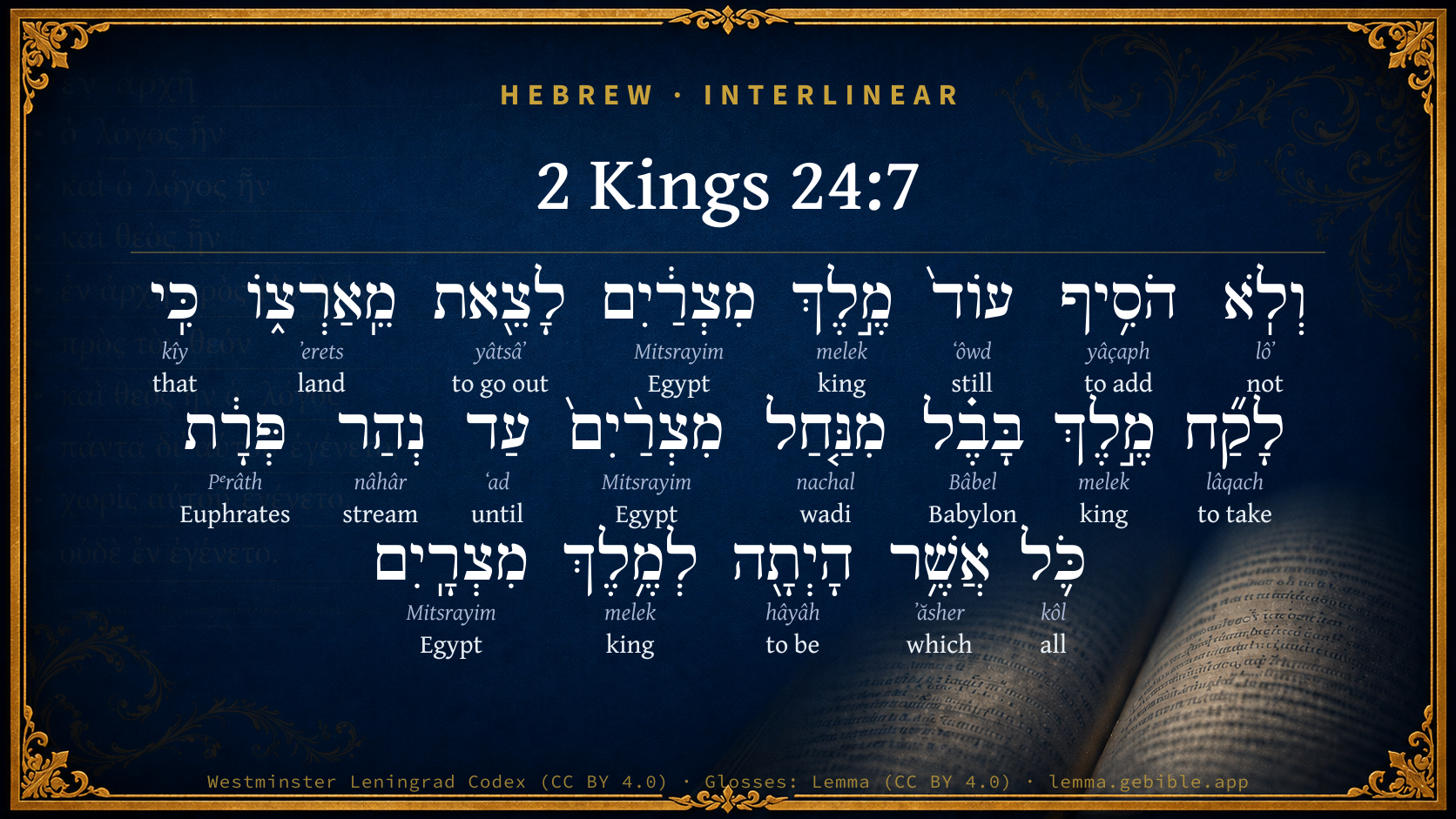
Hebrew (Westminster Leningrad Codex) 2 Kings 24:7 appears in the Hebrew Old Testament. The text above is from the Westminster Leningrad Codex. Each word links to its Strong’s number, a concise gloss, and parsing drawn from the Open Scriptures Hebrew Bible morphology. Click any word for its full Brown-Driver-Briggs (BDB) entry.
Download image
Cite this verse

2 Kings 24:7 (World English Bible). Public Domain. Lemma interlinear Bible study tool, https://lemma.gebible.app/v/2-kings/24/7.

Show BibTeX & RIS
BibTeX
RIS
English Translation
The king of Egypt didn't come again out of his land any more; for the king of Babylon had taken, from the brook of Egypt to the river Euphrates, all that pertained to the king of Egypt.
World English Bible · Public Domain
Download a study sheet

One document with this verse’s original text, its word-by-word gloss line, the meaning frame, cross-references with their text, attributed commentary, and full source and license credits — printable, and it pastes into notes with its structure intact.

This verse Autodidact and up

Study sheet (.html) Plain text (.txt)

A passage Seminary Student

Up to 50 verses in one chapter. A passage sheet keeps up to 6 commentary sources and 12 cross-references per verse, in the order this page ranks them, and says so on the sheet whenever that leaves anything out. Ask for a single verse and you get the Autodidact verse sheet above.

Everything on this page stays free to read, with no account — the sheet is a download of what is already on screen, not access to it.

Want to remove ads? Support Godless Engineer
Compare translations 3

The same verse in 3 English versions, stacked beneath the original-language interlinear above. Click any original word for its lexicon entry.

Each is an independent rendering of the whole verse — the interlinear is not word-aligned to these translations.

Highlighted words mark where these versions differ — a whole-verse word diff, not a word-by-word alignment.

  • World English Bible Public Domain
    The king of Egypt didn't come again out of his land any more; for the king of Babylon had taken, from the brook of Egypt to the river Euphrates, all that pertained to the king of Egypt.
  • King James Version Public Domain
    And the king of Egypt came not again any more out of his land: for the king of Babylon had taken from the river of Egypt unto the river Euphrates all that pertained to the king of Egypt.
  • unfoldingWord Literal Text CC BY-SA 4.0
    And the king of Egypt did not resume again to go out from his land, because the king of Babylon took all that had been to the king of Egypt from the wadi of Egypt to the Euphrates River.

unfoldingWord Literal Text — © unfoldingWord, licensed CC BY-SA 4.0. Word-aligned USFM3 via Door43 (git.door43.org/unfoldingWord/en_ult).

Versions to compare (up to 4)

3 of 4 selected

Show all 18 translations

Every available English version of this verse, each an independent rendering of the whole verse.

  • World English Bible Public Domain
    The king of Egypt didn't come again out of his land any more; for the king of Babylon had taken, from the brook of Egypt to the river Euphrates, all that pertained to the king of Egypt.
  • Berean Standard Bible Public Domain
    Now the king of Egypt did not march out of his land again, because the king of Babylon had taken all his territory, from the Brook of Egypt to the Euphrates River.
  • Majority Standard Bible Public Domain
    Now the king of Egypt did not march out of his land again, because the king of Babylon had taken all his territory, from the Brook of Egypt to the Euphrates River.
  • King James Version Public Domain
    And the king of Egypt came not again any more out of his land: for the king of Babylon had taken from the river of Egypt unto the river Euphrates all that pertained to the king of Egypt.
  • American Standard Version (1901) Public Domain
    And the king of Egypt came not again any more out of his land; for the king of Babylon had taken, from the brook of Egypt unto the river Euphrates, all that pertained to the king of Egypt.
  • Revised Version (1885) Public Domain
    And the king of Egypt came not again any more out of his land: for the king of Babylon had taken, from the brook of Egypt unto the river Euphrates, all that pertained to the king of Egypt.
  • Geneva Bible (1599) Public Domain
    And the King of Egypt came no more out of his lande: for the King of Babel had taken from the riuer of Egypt, vnto the riuer Perath, all that pertained to the King of Egypt.
  • Douay-Rheims (1899) Public Domain
    And the king of Egypt came not again any more out of his own country: for the king of Babylon had taken all that had belonged to the king of Egypt, from the river of Egypt, unto the river Euphrates.
  • Young's Literal Translation Public Domain
    And the king of Egypt hath not added any more to go out from his own land, for the king of Babylon hath taken, from the brook of Egypt unto the river Phrat, all that had been to the king of Egypt.
  • Literal Standard Version CC BY-SA 4.0
    And the king of Egypt has not added anymore to go out from his own land, for the king of Babylon has taken, from the Brook of Egypt to the Euphrates River, all that had been to the king of Egypt.
  • Unlocked Literal Bible CC BY-SA 4.0
    The king of Egypt did not attack any more out of his land, because the king of Babylon had conquered all the lands that had been controlled by the king of Egypt, from the brook of Egypt to the Euphrates River.
  • unfoldingWord Literal Text CC BY-SA 4.0
    And the king of Egypt did not resume again to go out from his land, because the king of Babylon took all that had been to the king of Egypt from the wadi of Egypt to the Euphrates River.
  • Darby Bible Public Domain
    And the king of Egypt came not again any more out of his land, for the king of Babylon had taken all that belonged to the king of Egypt, from the torrent of Egypt to the river Euphrates.
  • World Messianic Bible Public Domain
    The king of Egypt didn’t come out of his land any more; for the king of Babylon had taken, from the brook of Egypt to the river Euphrates, all that belonged to the king of Egypt.
  • Webster's Bible Public Domain
    And the king of Egypt came not again any more out of his land: for the king of Babylon had taken from the river of Egypt to the river Euphrates all that pertained to the king of Egypt.
  • Free Bible Version CC BY-SA 4.0
    The king of Egypt didn't leave his country again for the king of Babylon had taken all the territory that used to belong to him, from the Wadi of Egypt all the way to the Euphrates River.
  • Bible in Basic English Public Domain
    And the king of Egypt did not come out of his land again, for the king of Babylon had taken all his country, from the stream of Egypt to the river Euphrates.
  • JPS Tanakh (1917) Public Domain
    And the king of Egypt came not again any more out of his land; for the king of Babylon had taken, from the Brook of Egypt unto the river Euphrates, all that pertained to the king of Egypt.

Literal Standard Version (2020), Covenant Press — licensed CC BY-SA 4.0. Text via the HelloAO Bible API (eBible.org). Unlocked Literal Bible (unfoldingWord) — licensed CC BY-SA 4.0. Text via the HelloAO Bible API (eBible.org). unfoldingWord Literal Text — © unfoldingWord, licensed CC BY-SA 4.0. Word-aligned USFM3 via Door43 (git.door43.org/unfoldingWord/en_ult). Free Bible Version, Dr. Jonathan Gallagher — licensed CC BY-SA 4.0. Text via the HelloAO Bible API (eBible.org).

Word by word

More ways to search: Search by grammar → Find every occurrence → Compare this word →

Practice this passage: Drill this verse → Learn its vocabulary →

פְּרָ֔ת
Pᵉrâth
H6578
“Euphrates”
Noun, Proper
Part of Speech
Noun
Type
Proper
Full BDB Definition

Origin: from an unused root meaning to break forth

TWOT: None

Euphrates = "fruitfulness" - the largest and longest river of western Asia; rises from two chief sources in the Armenian mountains and flows into the Persian Gulf
  1. וְלֹֽא lôʼ H3808 “and · not” Conjunction + Particle, Negative
  2. הֹסִ֥יף yâçaph H3254 “to add” Verb, Hiphil, Perfect, 3rd Person, Masculine, Singular
  3. עוֹד֙ ʻôwd H5750 “still” Adverb
  4. מֶ֣לֶךְ melek H4428 “king of” Noun, Common, Masculine, Singular, Construct
  5. מִצְרַ֔יִם Mitsrayim H4714 “Egypt” Noun, Proper
  6. לָצֵ֖את yâtsâʼ H3318 “to go out” Preposition + Verb, Qal, Infinitive Construct
  7. מֵֽאַרְצ֑וֹ ʼerets H776 “from · land · his” Preposition + Noun, Common, Both, Singular, Construct + Suffix, Personal, 3rd Person, Masculine, Singular
  8. כִּֽי kîy H3588 “that” Conjunction
  9. לָקַ֞ח lâqach H3947 “to take” Verb, Qal, Perfect, 3rd Person, Masculine, Singular
  10. מֶ֣לֶךְ melek H4428 “king of” Noun, Common, Masculine, Singular, Construct
  11. בָּבֶ֗ל Bâbel H894 “Babylon” Noun, Proper
  12. מִנַּ֤חַל nachal H5158 “from · wadi of” Preposition + Noun, Common, Masculine, Singular, Construct
  13. מִצְרַ֨יִם֙ Mitsrayim H4714 “Egypt” Noun, Proper
  14. עַד ʻad H5704 “until” Preposition
  15. נְהַר nâhâr H5104 “stream of” Noun, Common, Masculine, Singular, Construct
  16. כֹּ֛ל kôl H3605 “all” Noun, Common, Masculine, Singular, Absolute
  17. אֲשֶׁ֥ר ʼăsher H834 “which” Particle, Relative
  18. הָיְתָ֖ה hâyâh H1961 “to be” Verb, Qal, Perfect, 3rd Person, Feminine, Singular
  19. לְמֶ֥לֶךְ melek H4428 “to/for · king of” Preposition + Noun, Common, Masculine, Singular, Construct
  20. מִצְרָֽיִם Mitsrayim H4714 “Egypt” Noun, Proper

About this verse

These counts appear in no published source. They are computed here, from the morphology-tagged text and Lemma’s own curated glosses. What Lemma adds →

21
words
17
distinct lemmas
Historical
section

Notable vocabulary

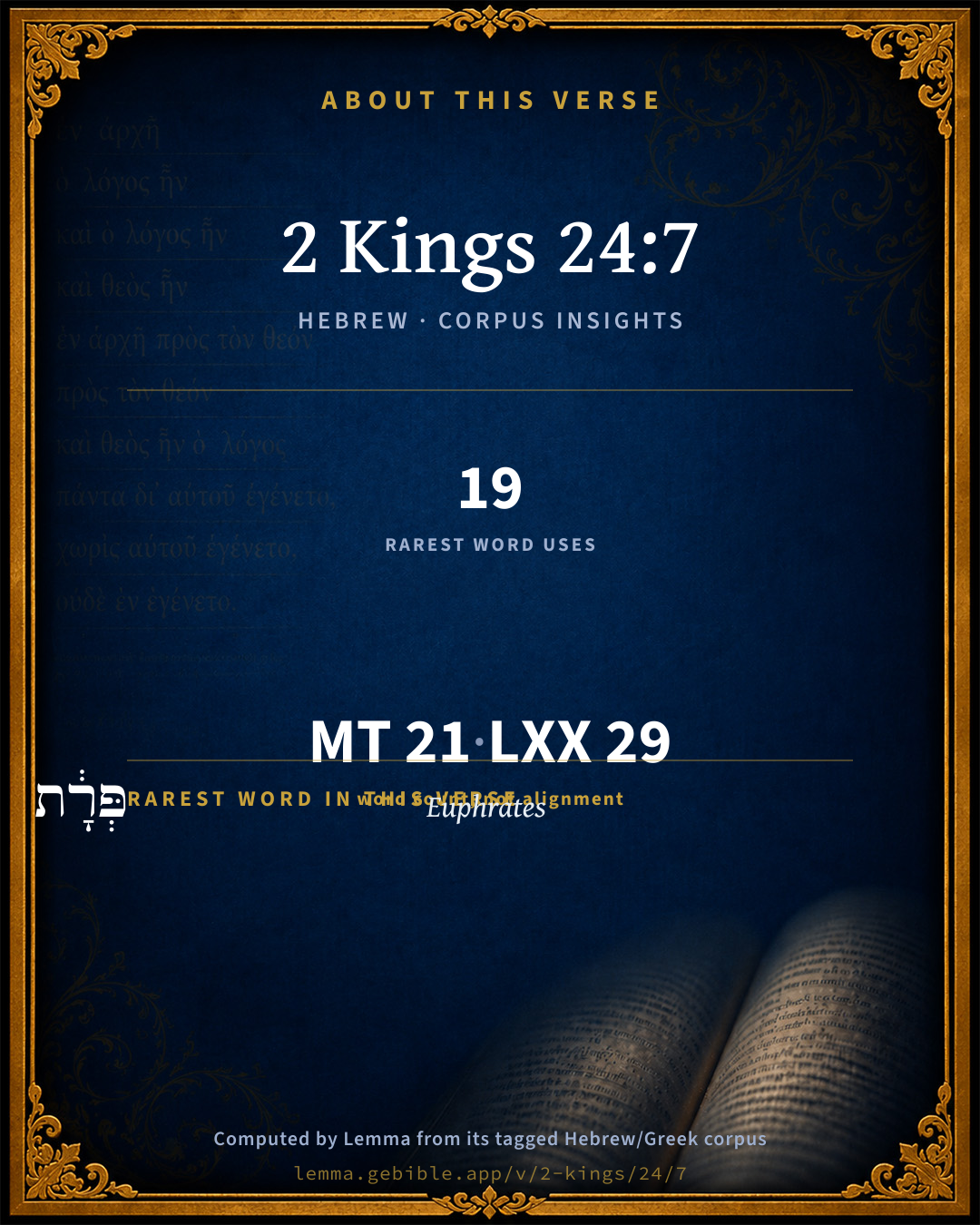
The rarest word here is פְּרָ֔ת Euphrates H6578 — appearing just 19 times in the whole Hebrew Bible.

Shared distinctive vocabulary

פְּרָ֔ת Euphrates H6578 occurs in 19 verses of the Hebrew Bible. Also found in:

Grammatical profile

  • 4 verbs
  • 12 nouns
  • 1 preposition
  • 1 conjunction
  • 1 adverb
  • 2 particles

Verb forms

  • הֹסִ֥יף Hiphil · Perfect
  • לָצֵ֖את Qal · Infinitive Construct
  • לָקַ֞ח Qal · Perfect
  • הָיְתָ֖ה Qal · Perfect

Repetition

Words recur within this verse — often emphatic in Hebrew:

  • מֶ֣לֶךְ king H4428 ×3
  • מִצְרַ֔יִם Egypt H4714 ×3

Hebrew & Septuagint length

In English translation the verse runs 37 words from the Hebrew and 38 from the Septuagint (LXX English) — closely comparable.

A rough comparison of the two English renderings, which tokenize alike — not a word-level alignment.

Word counts can differ between the Hebrew and the Greek without any difference in meaning — e.g. the Hebrew direct-object marker אֵת has no separate Greek word, and Greek often adds the article ὁ.

In the original languages it is 21 Hebrew tokens and 29 Greek tokens — but the two are counted differently (Hebrew bundles its prefixes and suffixes into one token; the Greek is in lemma form), so that isn’t a like-for-like length.

Cross-references

7

Topical passages linked to 2 Kings 24:7 in the Treasury of Scripture Knowledge — connected by theme and wording, ordered by reader-vote popularity; previews shown in the World English Bible.

  • Jeremiah 37:5–7 Pharaoh's army was come forth out of Egypt; and when the Chaldeans who were besieging Jerusalem heard news of them, they broke up from Jerusalem.
  • Jeremiah 46:2 Of Egypt: concerning the army of Pharaoh Necoh king of Egypt, which was by the river Euphrates in Carchemish, which Nebuchadrezzar king of Babylon struck in the fourth year of Jehoiakim the son of Josiah, king of Judah.
  • Genesis 15:18 In that day Yahweh made a covenant with Abram, saying, "To your seed have I given this land, from the river of Egypt to the great river, the river Euphrates:
  • Numbers 34:5 and the border shall turn about from Azmon to the brook of Egypt, and the goings out of it shall be at the sea.
  • Joshua 15:4 and it passed along to Azmon, and went out at the brook of Egypt; and the goings out of the border were at the sea: this shall be your south border.
  • 1 Kings 4:21 Solomon ruled over all the kingdoms from the River to the land of the Philistines, and to the border of Egypt: they brought tribute, and served Solomon all the days of his life.
  • Isaiah 27:12 It shall happen in that day, that Yahweh will beat off [his fruit] from the flood of the River to the brook of Egypt; and you shall be gathered one by one, you children of Israel.

Cross-references courtesy of OpenBible.info (CC BY 4.0).

Hebrew and Greek witnesses Masoretic Hebrew ↔ Greek Septuagint

The same verse in the two great witnesses to the Old Testament, shown verse-for-verse.

These are two independent witnesses, not word-aligned to each other, and the Septuagint is shown in lemma (dictionary) form.

Hebrew 2 Kings 24:7 Masoretic · Westminster Leningrad Codex

וְלֹֽא הֹסִ֥יף עוֹד֙ מֶ֣לֶךְ מִצְרַ֔יִם לָצֵ֖את מֵֽאַרְצ֑וֹ כִּֽי לָקַ֞ח מֶ֣לֶךְ בָּבֶ֗ל מִנַּ֤חַל מִצְרַ֨יִם֙ עַד נְהַר פְּרָ֔ת כֹּ֛ל אֲשֶׁ֥ר הָיְתָ֖ה לְמֶ֥לֶךְ מִצְרָֽיִם

The king of Egypt didn't come again out of his land any more; for the king of Babylon had taken, from the brook of Egypt to the river Euphrates, all that pertained to the king of Egypt.

World English Bible · Public Domain

Greek LXX 2 Kings 24:7 Septuagint · lemma form

καί οὐ προςτίθημι ἔτι βασιλεύς αἴγυπτος ἐκἔρχομαι ἐκ ὁ γῆ αὐτός ὅτι λαμβάνω βασιλεύς βαβυλών ἀπό ὁ χείμαρρος αἴγυπτος ἕως ὁ ποταμός εὐφράτης πᾶς ὅσος εἰμί ὁ βασιλεύς αἴγυπτος

And the king of Egypt came no more out of his land: for the king of Babylon took away all that belonged to the king of Egypt from the river of Egypt as far as the river Euphrates.

LXX2012 (modern English Septuagint) · Public Domain

Hebrew: Westminster Leningrad Codex (CC BY 4.0). Greek: Septuagint (public domain); English from LXX2012 (modern English Septuagint) (Public Domain). How the Septuagint differs from the Hebrew →

Targum (Aramaic paraphrase)

1

The Targum is the ancient Jewish Aramaic paraphrase of the Hebrew Scriptures — an interpretive translation, not the Hebrew text itself. Onkelos (literal) and Pseudo-Jonathan (expansive) render the Torah, and Jonathan the Prophets. Coverage is partial: where no permissively-licensed English translation exists for a verse, only the Aramaic is shown. This is verse-level text, not a word-by-word alignment to the Hebrew.

  1. Targum Jonathan Prophets (Joshua–Malachi)
    וְלָא אוֹסִיף עוֹד מַלְכָּא דְמִצְרַיִם לְמִפַּק מֵאַרְעֵיהּ אֲרֵי נְסִיב מַלְכָּא דְבָבֶל מִנַחַל מִצְרַיִם עַד נְהַר פְּרָת כֹּל דַהֲוָה לְמַלְכָּא דְמִצְרָיִם:

    (no public-domain English translation for this verse)

    Targum Jonathan — Aramaic: “Mikraot Gedolot” (public domain). English: “Sefaria Community Translation” (CC0 1.0 (public-domain dedication)); “London "Chaldee Paraphrase," 1871” (public domain). Text via Sefaria.

Commentary

Notes on 2 Kings 24:7 from classic Christian and Jewish commentators (each source and its license shown beneath its notes). The classic Christian expositions comment on the surrounding passage and are grouped to its opening verse, so a note may address several verses; the Jewish commentaries on the Tanakh (Rashi and others) are per-verse, so they appear only where the commentator wrote on this verse.

Lemma curates 59 commentaries, every one of them public domain or Creative Commons licensed, each selected and text-cleaned for this edition rather than reprinted as found. About our sources →

Trapp's Complete Commentary

John Trapp

2Ki 24:7 And the king of Egypt came not again any more out of his land: for the king of Babylon had taken from the river of Egypt unto the river Euphrates all that pertained to the king of Egypt.

Ver. 7. For the king of Babylon had taken.] About this time died Nabopolassar the father of Nebuchadnezzar: whereupon he, committing the care of his captives to his friends in the army, hastened to Babylon, where, taking upon him the empire, he distributed the captives by colonies into fit places in the country of Babylon, as saith Berosus. {a}

{a} Rer. Chald., lib. xxx.

John Trapp, A Commentary or Exposition upon All the Books of the Old and New Testament (1647–1656) — public domain. Text from a community e-Sword module.

Joseph Benson's Commentary

2Ki 24:7. The king of Egypt came not again out of his own land — In this king’s days. He could not now come to protect the king of Judah, being scarce able to defend his own kingdom.

Joseph Benson's Commentary on the Old and New Testaments (1811–1818) — public domain. Text from a community e-Sword module.

Tyndale Open Study Notes

Tyndale Open Resources

24:7 The king of Egypt did not venture out of his country after that because of Nebuchadnezzar’s overwhelming strength. Any hope Judah had of help from Egypt was in vain (see Jer 2:36; 46:2-12; Ezek 29:6, 16). • The Brook of Egypt has been identified as either the Wadi el-Arish at the edge of the Nile delta, or as Nahal Besor, which lies south of Gaza.

Tyndale Open Study Notes — © Tyndale Open Resources, licensed CC BY-SA 4.0. Text via the HelloAO Bible API.

Geneva Bible (1599)

Geneva Bible translators

Or, Euphrates.

Geneva Bible (1599) marginal notes — public domain. Text via Bolls.life.

Jamieson, Fausset & Brown

Robert Jamieson, A. R. Fausset & David Brown

the king of Egypt--that is, Pharaoh-nechoh.

Jamieson, Fausset & Brown — Commentary Critical and Explanatory on the Whole Bible (1871) — public domain (CC PDM 1.0). Text via the HelloAO Bible API.

Adam Clarke's Commentary

Verse 7. The king of Egypt came not again] He was so crushed by the Babylonians that he was obliged to confine himself within the limits of his own states, and could no more attempt any conquests. The text tells us how much he had lost by the Babylonians. See on 2Kg 24:1.

Adam Clarke's Commentary on the Bible (1810–1826) — public domain. Text from a community e-Sword/MySword module.

Ellicott's Commentary for English Readers

(7) And the king of Egypt came not again any more . . .—The verse indicates the posture of political affairs at the time when Jehoiachin succeeded his father. Necho had been deprived by Nebuchadnezzar of all his conquests, and so crippled that he durst not venture again beyond his own borders. Thus Judah was left, denuded of all external help, to face the consequences of its revolt from Babylon, which speedily overtook it (2Ki_24:10).

From the river (torrent) of Egypt—i.e., the Wady-el-Arish. The details of this campaign of Nebuchadnezzar are not recorded. It is clear, from the statement before us, that before the battle of Carchemish Necho had made himself master of the whole of Syria and the country east of the Jordan.

A Bible Commentary for English Readers, edited by Charles John Ellicott (1878–1897) — public domain. Text from a community e-Sword module.

The Cambridge Bible for Schools and Colleges

gen. ed. J. J. S. Perowne

7. the king of Egypt came not again any more] The whole Asiatic possessions of Egypt had been conquered by the Babylonians, who now become the prominent heathen people in the Scripture story.

from the river [R.V. brook] of Egypt] This is not the Nile, but the modern Wadi El Arish, a desert stream toward the border of Egypt. See note on 1Ki_8:65 for its identification.

The Cambridge Bible for Schools and Colleges (gen. ed. J. J. S. Perowne; Cambridge University Press, 1878–1918) — public domain. Text from a community e-Sword module.

John Gill's Exposition

Jehoiachin was eighteen years old when he began to reign,.... In Ch2 36:9 he is said to be but eight years old; which may be reconciled by observing, that he might be made and declared king by his father, in the first year of his reign, who reigned eleven years, so that he was eight years old when he began to reign with him, and eighteen when he began to reign alone (q). Dr. Lightfoot (r) gives another solution of this difficulty, that properly speaking he was eighteen years old when he began to reign, but, in an improper sense, the son of eight years, or the eighth year, as the Hebrew phrase is; that is, he fell in the lot of the eighth year of the captivity of Judah, which was in the latter end of the third, or the beginning of the fourth of his father's reign, and the first of Nebuchadnezzar's, and it was now in the eighth of Nebuchadnezzar that he was king, see Kg2 24:12, but very probably in Ch2 36:9 there is a mistake in the copyist of eight for eighteen, since in the Arabic and Syriac versions it is there eighteen, as here:

he reigned in Jerusalem three months; the ten days besides are here omitted for shortness, Ch2 36:9.

and his mother's name was Nehushta, the daughter of Elnathan of Jerusalem; a person no doubt well known in those times.

(q) So in Seder Olam Rabba, c. 25. (r) Works, vol. 1. p. 122.

John Gill's Exposition of the Whole Bible (1746–1763) — public domain (CC PDM 1.0). Text via the HelloAO Bible API.

Albert Barnes' Notes on the Bible

Neco, from the year of the battle of Carchemish, confined himself to his own country and made no efforts to recover Syria or Judaea.

Albert Barnes' Notes on the Bible (1834–1885) — public domain. Text from a community e-Sword/MySword module.

Haydock's Catholic Bible Commentary

Egypt, at least from the eastern mouth of the Nile, at Damietta, to the Euphrates. Nechao had conquered all those countries: but now he was driven into his ancient territories. After some time he attempted to relieve Sedecias, but war repulsed by Nabuchodonosor, who soon after took Jerusalem, Jeremias xxxvii. 6. (Calmet) --- Again, during the reign of Joachin. (Du Hamel)

George Leo Haydock (1774–1849), Haydock's Catholic Family Bible and Commentary, 1859 edition — public domain. Excludes Psalms (Douay-Rheims chapter numbering differs from Protestant) and Deuterocanonical books (Catholic canon only).

Matthew Poole's English Annotations

The king of Egypt came not again, to wit, in this king’s days; nor until Zedekiah’s time, Jer 37:6,7; nor to any purpose. He could not now come out to protect the king of Judah, being scarce able to defend his own kingdom.

Matthew Poole's English Annotations on the Holy Bible (1683–1685) — public domain. Text from a community e-Sword/MySword module.

Whedon's Commentary on the Bible

Daniel D. Whedon

7. The king of Egypt came not again — But a subsequent king named Hophra sent an army to raise the siege of Jerusalem. Jer_37:5-11. “This remark is here inserted to show under what circumstances Jehoiakim succeeded his father, (2Ki_24:6,) and how it came that he reigned for so short a time. 2Ki_24:8. Necho had finally retired from Asia after such losses that he could not venture again to meet his victorious enemy, and, therefore, Judah could expect no more support from him. Much less could it attempt alone to resist the conqueror from whom it had revolted.” — Bahr.

King of Babylon had taken — Compare Jer_46:2.

River of Egypt — The Wady el-Arish which formed the south-western boundary of the land of Promise. See on 1Ki_8:65, and Jos_13:3.

Daniel D. Whedon (gen. ed.), Commentary on the Old and New Testaments (1874–1909) — public domain. Text from a community e-Sword module.

The Pulpit Commentary

And the King of Egypt earns not again any mere out of his land. Nechoh"s two expeditions were enough for him. In the first he was completely successful, defeated Josiah, (2Ki_23:29) overran Syria as far as Carchemish, and made Phoenicia, Judaea, and probably the adjacent countries tributary to him. In the second (Jer_46:2-12) he suffereda calamitous reverse, was himself defeated with great slaughter, forced to fly hastily, and to relinquish all his conquests. After this, he "came not any more out of his land." Whatever hopes he held out to Judaea or to Tyre, he was not bold enough to challenge the Babylonians to a third trial of strength, but remained peaceably within his own borders. For the King of Babylon had taken from the river of Egypt. The ljn is not the Nile, but the Wady el Arish, the generally dry watercourse, which was the ordinarily accepted boundary between Egypt and Syria (see 1 Kings. (Isa_27:12) The Nile is the rhn; Unto the river Euphrates all that pertained to the King of Egypt; i.e. all that he had conquered and made his own in his first expedition in the year B.C. 608.

The Pulpit Commentary (1880–1919), ed. H.D.M. Spence-Jones & Joseph S. Exell — public domain. Text from a community e-Sword module.

John Wesley's Explanatory Notes

Came not - In this king's days. He could not now come to protect the king of Judah, being scarce able to defend his own kingdom.

John Wesley, Explanatory Notes Upon the Whole Bible (1754–1765) — public domain. Text via the GEBible commentary corpus.

unfoldingWord translationNotes

Door43 World Missions Community

The king of Egypt did not attack any more out of his land

"The king of Egypt did not come out of his land any more to attack other people groups"

translationWords

king

Egypt

Babylon

Egypt

Euphrates River

unfoldingWord translationNotes — © Distant Shores Media and the Door43 World Missions Community, licensed CC BY-SA 4.0. Source: git.door43.org/Door43/en_tn.

Rashi

Rabbi Shlomo Yitzchaki (Rashi)

Left his land. To aid Yehoyakim.

For the king of Bavel had taken, etc. For he defeated him in battle in the fourth year of Yehoyakim in Charchemish on the Euphrates River, as it is written in the Book of Yirmiyohu.

Rashi on the Tanakh — English translations: “The Judaica Press complete Tanach with Rashi, translated by A. J. Rosenberg” (CC BY 4.0); “Pentateuch with Rashi's commentary by M. Rosenbaum and A.M. Silbermann, 1929-1934” (public domain); “The Metsudah Tanach series, Lakewood, N.J” (CC BY 4.0); and “The Book of Joshua, Metsudah Publications, 1997” (CC BY 4.0). Text via Sefaria.

Lesson kit

Teaching starters — assembled from the data on this page, not authored interpretation. Every prompt links to the verse data it draws on. Edit before teaching.

2 Kings, in the Historical, opens this verse with 21 words (17 distinct Hebrew lemmas). Its most distinctive word is Pᵉrâth (“Euphrates”). A historical commentator’s framing appears above. Read the whole chapter for the surrounding context.

Discussion questions

  1. The word Pᵉrâth carries the sense “Euphrates.” How does it shape the verse?
  2. How does Genesis 2:14, which shares the word «Euphrates», read alongside this verse?
  3. What does the repetition of “king” (3× in this one verse) do in this verse?
  4. The translations on this page render this verse differently — a whole-verse word diff, not a word-by-word alignment. What might account for the different wordings?
  5. «הֹסִ֥יף» is a Hiphil Perfect verb. How does that grammatical form shape the action described?
  6. Compare how Trapp's Complete Commentary and Joseph Benson's Commentary read this verse. Where do they agree or differ?

Things to notice

Reading settings

Reading text

Shown beneath each verse's original-language words.

Old Testament
Old Testament edition

Read the OT as the Masoretic Hebrew (MT) or the Greek Septuagint (LXX).

English shown for the Greek Septuagint (in the Hebrew ↔ Greek comparison).

Comparing translations? Open the Compare panel on any verse page to stack up to four side by side.