Jeremiah 45:3

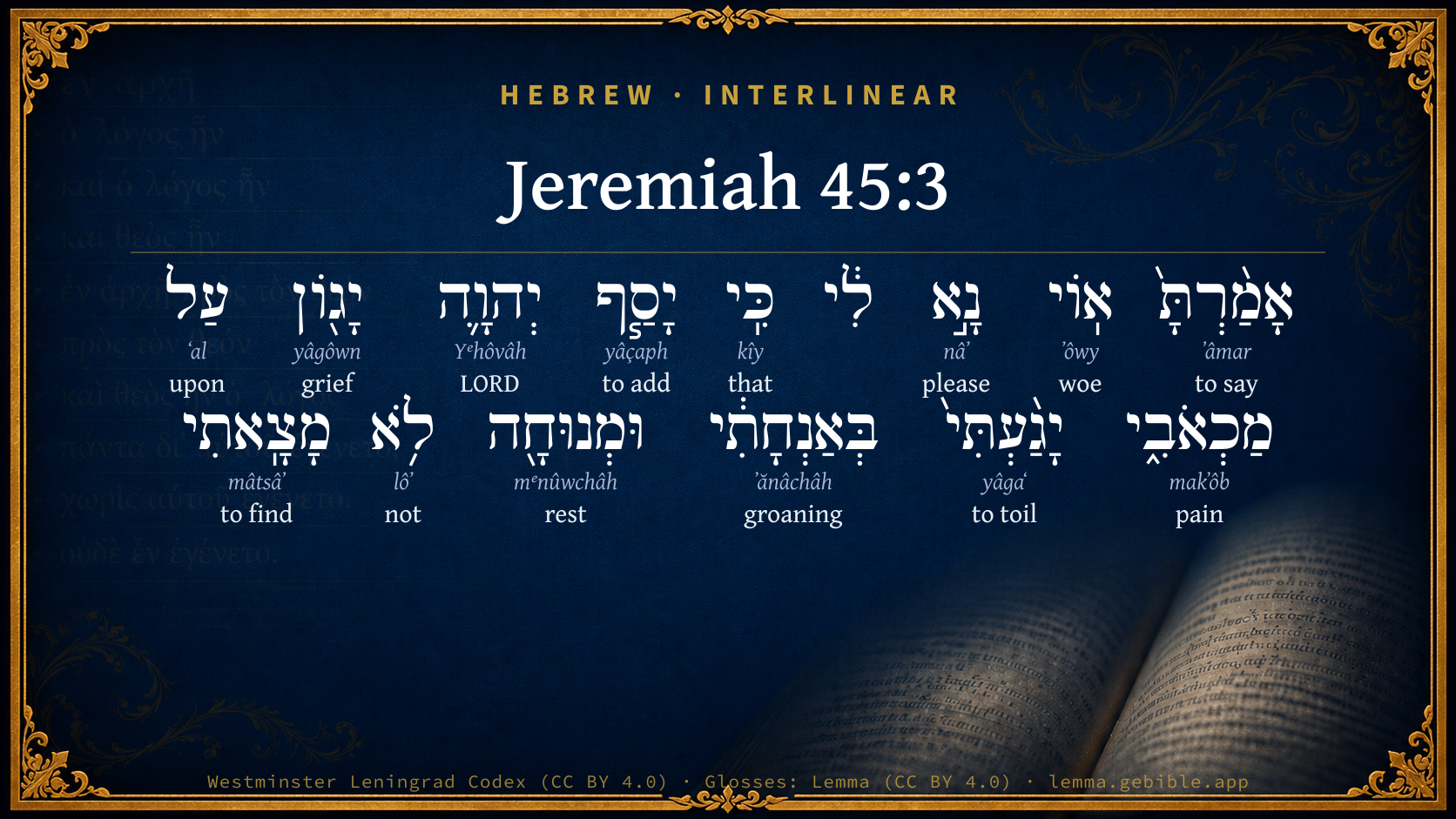
Hebrew (Westminster Leningrad Codex) Jeremiah 45:3 appears in the Hebrew Old Testament. The text above is from the Westminster Leningrad Codex. Each word links to its Strong’s number, a concise gloss, and parsing drawn from the Open Scriptures Hebrew Bible morphology. Click any word for its full Brown-Driver-Briggs (BDB) entry.
Download image
Cite this verse

Jeremiah 45:3 (World English Bible). Public Domain. Lemma interlinear Bible study tool, https://lemma.gebible.app/v/jeremiah/45/3.

Show BibTeX & RIS
BibTeX
RIS
English Translation
You did say, Woe is me now! for Yahweh has added sorrow to my pain; I am weary with my groaning, and I find no rest.
World English Bible · Public Domain
Download a study sheet

One document with this verse’s original text, its word-by-word gloss line, the meaning frame, cross-references with their text, attributed commentary, and full source and license credits — printable, and it pastes into notes with its structure intact.

This verse Autodidact and up

Study sheet (.html) Plain text (.txt)

A passage Seminary Student

Up to 50 verses in one chapter. A passage sheet keeps up to 6 commentary sources and 12 cross-references per verse, in the order this page ranks them, and says so on the sheet whenever that leaves anything out. Ask for a single verse and you get the Autodidact verse sheet above.

Everything on this page stays free to read, with no account — the sheet is a download of what is already on screen, not access to it.

Want to remove ads? Support Godless Engineer
Compare translations 3

The same verse in 3 English versions, stacked beneath the original-language interlinear above. Click any original word for its lexicon entry.

Each is an independent rendering of the whole verse — the interlinear is not word-aligned to these translations.

Highlighted words mark where these versions differ — a whole-verse word diff, not a word-by-word alignment.

  • World English Bible Public Domain
    You did say, Woe is me now! for Yahweh has added sorrow to my pain; I am weary with my groaning, and I find no rest.
  • King James Version Public Domain
    Thou didst say, Woe is me now! for the LORD hath added grief to my sorrow; I fainted in my sighing, and I find no rest.
  • unfoldingWord Literal Text CC BY-SA 4.0
    You have said, ‘Woe is me, for Yahweh has added agony to my pain. My groaning has wearied me; I find no rest.’

unfoldingWord Literal Text — © unfoldingWord, licensed CC BY-SA 4.0. Word-aligned USFM3 via Door43 (git.door43.org/unfoldingWord/en_ult).

Versions to compare (up to 4)

3 of 4 selected

Show all 18 translations

Every available English version of this verse, each an independent rendering of the whole verse.

  • World English Bible Public Domain
    You did say, Woe is me now! for Yahweh has added sorrow to my pain; I am weary with my groaning, and I find no rest.
  • Berean Standard Bible Public Domain
    You have said, ‘Woe is me because the LORD has added sorrow to my pain! I am worn out with groaning and have found no rest.’”
  • Majority Standard Bible Public Domain
    You have said, ‘Woe is me because the LORD has added sorrow to my pain! I am worn out with groaning and have found no rest.’”
  • King James Version Public Domain
    Thou didst say, Woe is me now! for the LORD hath added grief to my sorrow; I fainted in my sighing, and I find no rest.
  • American Standard Version (1901) Public Domain
    Thou didst say, Woe is me now! for Jehovah hath added sorrow to my pain; I am weary with my groaning, and I find no rest.
  • Revised Version (1885) Public Domain
    Thou didst say, Woe is me now! for the LORD hath added sorrow to my pain; I am weary with my groaning, and I find no rest.
  • Geneva Bible (1599) Public Domain
    Thou diddest say, Wo is me nowe: for the Lord hath laied sorrow vnto my sorrowe: I fainted in my mourning, and I can finde no rest.
  • Douay-Rheims (1899) Public Domain
    Thou hast said: Woe is me, wretch that I am, for the Lord hath added sorrow to my sorrow: I am wearied with my groans, and I find no rest.
  • Young's Literal Translation Public Domain
    `Thou hast said, Wo to me, now, for Jehovah hath added sorrow to my pain, I have been wearied with my sighing, and rest I have not found.
  • Literal Standard Version CC BY-SA 4.0
    You have said, Woe to me, now, for YHWH has added sorrow to my pain, I have been wearied with my sighing, and I have not found rest.
  • Unlocked Literal Bible CC BY-SA 4.0
    You have said, 'Woe is me, for Yahweh has added agony to my pain. My groaning has wearied me; I find no rest.'
  • unfoldingWord Literal Text CC BY-SA 4.0
    You have said, ‘Woe is me, for Yahweh has added agony to my pain. My groaning has wearied me; I find no rest.’
  • Darby Bible Public Domain
    Thou didst say, Woe unto me! for Jehovah hath added grief to my sorrow; I am weary with my sighing, and I find no rest.
  • World Messianic Bible Public Domain
    ‘You said, “Woe is me now! For the LORD has added sorrow to my pain! I am weary with my groaning, and I find no rest.”’
  • Webster's Bible Public Domain
    Thou didst say, Woe is me now! for the LORD hath added grief to my sorrow; I fainted in my sighing, and I find no rest.
  • Free Bible Version CC BY-SA 4.0
    You've been complaining, saying, “I'm in so much trouble because the Lord has given me sorrow to make my pain worse! I've worn myself out with my groans. I can't get any relief.”
  • Bible in Basic English Public Domain
    You said, Sorrow is mine! for the Lord has given me sorrow in addition to my pain; I am tired with the sound of my sorrow, and I get no rest.
  • JPS Tanakh (1917) Public Domain
    Woe is me now! for the LORD hath added sorrow to my pain; I am weary with my groaning, and I find no rest.

Literal Standard Version (2020), Covenant Press — licensed CC BY-SA 4.0. Text via the HelloAO Bible API (eBible.org). Unlocked Literal Bible (unfoldingWord) — licensed CC BY-SA 4.0. Text via the HelloAO Bible API (eBible.org). unfoldingWord Literal Text — © unfoldingWord, licensed CC BY-SA 4.0. Word-aligned USFM3 via Door43 (git.door43.org/unfoldingWord/en_ult). Free Bible Version, Dr. Jonathan Gallagher — licensed CC BY-SA 4.0. Text via the HelloAO Bible API (eBible.org).

Word by word

More ways to search: Search by grammar → Find every occurrence → Compare this word →

Practice this passage: Drill this verse → Learn its vocabulary →

בְּאַנְחָתִ֔י
ʼănâchâh
H585
“in/at · groaning · my”
Preposition + Noun, Common, Feminine, Singular, Construct + Suffix, Personal, 1st Person, Common, Singular
Part of Speech
Preposition + Noun
Type
Common
Gender
Feminine
Number
Singular
State
Construct
Full BDB Definition

Origin: from H585

TWOT: 127a

sighing, groaning (expression of grief or physical distress)
  1. אָמַ֨רְתָּ֙ ʼâmar H559 “to say” Verb, Qal, Perfect, 2nd Person, Masculine, Singular
  2. אֽוֹי ʼôwy H188 “woe” Particle, Interjection
  3. נָ֣א nâʼ H4994 “please” Particle, Exhortation
  4. כִּֽי kîy H3588 “that” Conjunction
  5. יָסַ֧ף yâçaph H3254 “to add” Verb, Qal, Perfect, 3rd Person, Masculine, Singular
  6. יְהוָ֛ה Yᵉhôvâh H3068 “LORD” Noun, Proper
  7. יָג֖וֹן yâgôwn H3015 “grief” Noun, Common, Masculine, Singular, Absolute
  8. עַל ʻal H5921 “upon” Preposition
  9. מַכְאֹבִ֑י makʼôb H4341 “pain · my” Noun, Common, Masculine, Singular, Construct + Suffix, Personal, 1st Person, Common, Singular
  10. יָגַ֨עְתִּי֙ yâgaʻ H3021 “to toil” Verb, Qal, Perfect, 1st Person, Common, Singular
  11. וּמְנוּחָ֖ה mᵉnûwchâh H4496 “and · rest” Conjunction + Noun, Common, Both, Singular, Absolute
  12. לֹ֥א lôʼ H3808 “not” Particle, Negative
  13. מָצָֽאתִי mâtsâʼ H4672 “to find” Verb, Qal, Perfect, 1st Person, Common, Singular

About this verse

These counts appear in no published source. They are computed here, from the morphology-tagged text and Lemma’s own curated glosses. What Lemma adds →

15
words
14
distinct lemmas
Prophets
section

Notable vocabulary

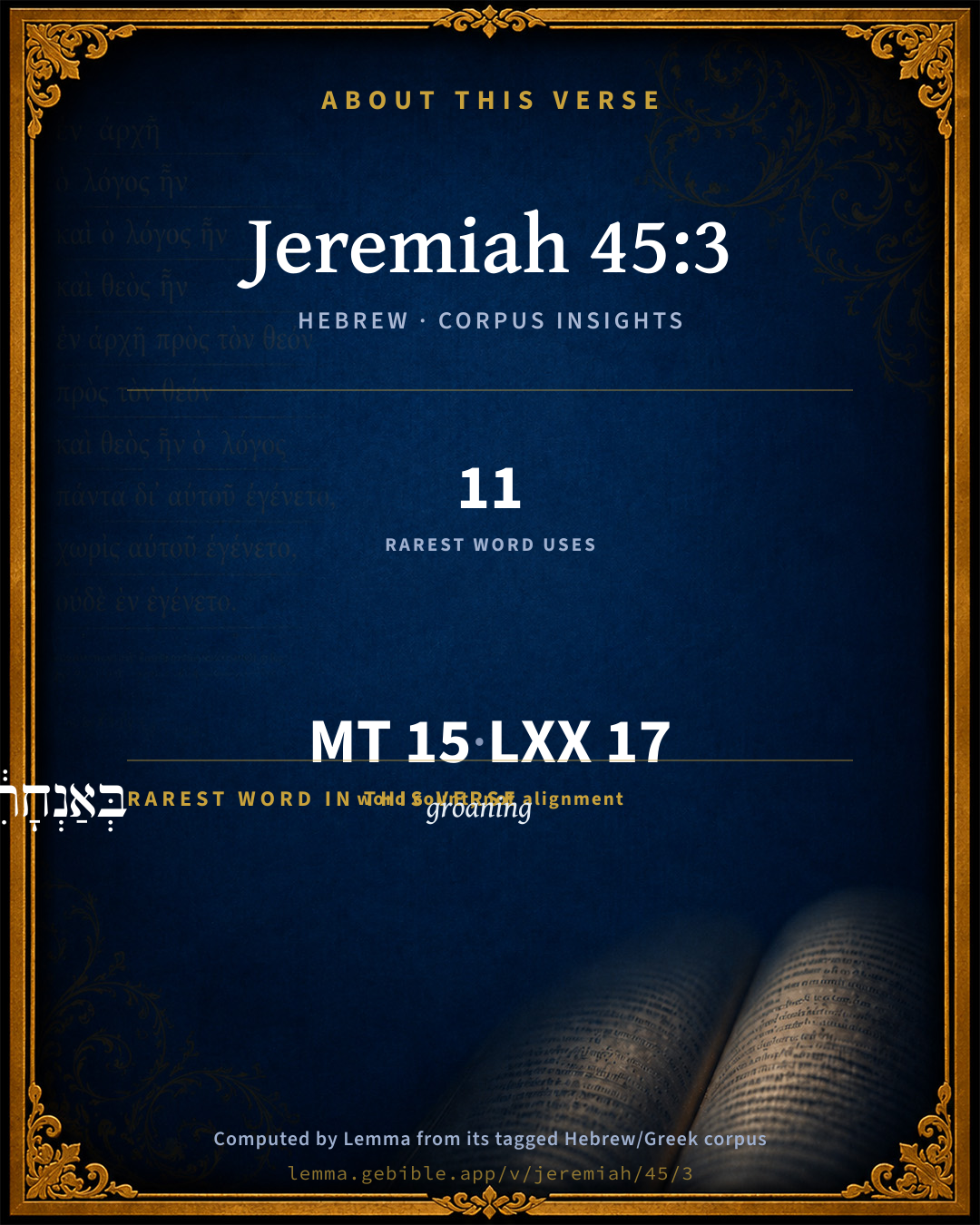
The rarest word here is בְּאַנְחָתִ֔י groaning H585 — appearing just 11 times in the whole Hebrew Bible.

Shared distinctive vocabulary

בְּאַנְחָתִ֔י groaning H585 occurs in 11 verses of the Hebrew Bible. Also found in:

Grammatical profile

  • 4 verbs
  • 5 nouns
  • 2 prepositions
  • 1 conjunction
  • 3 particles

Verb forms

  • אָמַ֨רְתָּ֙ Qal · Perfect
  • יָסַ֧ף Qal · Perfect
  • יָגַ֨עְתִּי֙ Qal · Perfect
  • מָצָֽאתִי Qal · Perfect

Hebrew & Septuagint length

In the original languages it is 15 Hebrew tokens and 17 Greek tokens — but the two are counted differently (Hebrew bundles its prefixes and suffixes into one token; the Greek is in lemma form), so that isn’t a like-for-like length.

Cross-references

26

Topical passages linked to Jeremiah 45:3 in the Treasury of Scripture Knowledge — connected by theme and wording, ordered by reader-vote popularity; previews shown in the World English Bible.

  • 2 Corinthians 4:1 Therefore seeing we have this ministry, even as we obtained mercy, we don't faint.
  • 2 Corinthians 4:16 Therefore we don't faint, but though our outward man is decaying, yet our inward man is renewed day by day.
  • Galatians 6:9 Let us not be weary in doing good, for we will reap in due season, if we don't give up.
  • Genesis 37:34–35 Jacob tore his clothes, and put sackcloth on his loins, and mourned for his son many days.
  • Genesis 42:36–38 Jacob, their father, said to them, "You have bereaved me of my children! Joseph is no more, Simeon is no more, and you want to take Benjamin away. All these things are against me."
  • Numbers 11:11–15 Moses said to Yahweh, Why have you dealt ill with your servant? and why haven't I found favor in your sight, that you lay the burden of all this people on me?
  • Joshua 7:7–9 Joshua said, Alas, Lord Yahweh, why have you at all brought this people over the Jordan, to deliver us into the hand of the Amorites, to cause us to perish? would that we had been content and lived beyond the Jordan!
  • Job 16:11–13 God delivers me to the ungodly, And casts me into the hands of the wicked.
  • Job 23:2 "Even today is my complaint rebellious. His hand is heavy in spite of my groaning.
  • Psalms 6:6 I am weary with my groaning; Every night I flood my bed; I drench my couch with my tears.
  • Psalms 27:13 I am still confident of this: I will see the goodness of Yahweh in the land of the living.
  • Psalms 42:7 Deep calls to deep at the noise of your waterfalls. All your waves and your billows have swept over me.
  • Psalms 69:3 I am weary with my crying. My throat is dry. My eyes fail, looking for my God.
  • Psalms 77:3–4 I remember God, and I groan. I complain, and my spirit is overwhelmed. Selah.
  • Psalms 120:5 Woe is me, that I live in Meshech, That I dwell among the tents of Kedar!
  • Proverbs 24:10 If you falter in the time of trouble, Your strength is small.
  • Jeremiah 8:18 Oh that I could comfort myself against sorrow! my heart is faint within me.
  • Jeremiah 9:1 Oh that my head were waters, and my eyes a spring of tears, that I might weep day and night for the slain of the daughter of my people!
  • Jeremiah 15:10–21 Woe is me, my mother, that you have borne me a man of strife and a man of contention to the whole earth! I have not lent, neither have men lent to me; [yet] everyone of them does curse me.
  • Jeremiah 20:7–18 Yahweh, you have persuaded me, and I was persuaded; you are stronger than I, and have prevailed: I am become a laughing-stock all the day, every one mocks me.
  • Lamentations 1:13 From on high has he sent fire into my bones, and it prevails against them; He has spread a net for my feet, he has turned me back: He has made me desolate and faint all the day.
  • Lamentations 1:22 Let all their wickedness come before you; Do to them, as you have done to me for all my transgressions: For my sighs are many, and my heart is faint.
  • Lamentations 3:1–19 I am the man that has seen affliction by the rod of his wrath.
  • Lamentations 3:32 For though he cause grief, yet will he have compassion according to the multitude of his loving kindnesses.
  • 2 Thessalonians 3:13 But you, brothers, don't be weary in doing well.
  • Hebrews 12:3–5 For consider him who has endured such contradiction of sinners against himself, that you don't grow weary, fainting in your souls.

Cross-references courtesy of OpenBible.info (CC BY 4.0).

Hebrew and Greek witnesses Masoretic Hebrew ↔ Greek Septuagint

The same verse in the two great witnesses to the Old Testament, shown verse-for-verse.

These are two independent witnesses, not word-aligned to each other, and the Septuagint is shown in lemma (dictionary) form.

Hebrew Jeremiah 45:3 Masoretic · Westminster Leningrad Codex

אָמַ֨רְתָּ֙ אֽוֹי נָ֣א לִ֔י כִּֽי יָסַ֧ף יְהוָ֛ה יָג֖וֹן עַל מַכְאֹבִ֑י יָגַ֨עְתִּי֙ בְּאַנְחָתִ֔י וּמְנוּחָ֖ה לֹ֥א מָצָֽאתִי

You did say, Woe is me now! for Yahweh has added sorrow to my pain; I am weary with my groaning, and I find no rest.

World English Bible · Public Domain

Greek LXX Structure differs

In the Septuagint, Jeremiah is about an eighth shorter than the Hebrew and arranges its material differently — the Oracles Against the Nations (Hebrew chapters 46–51) appear in the middle of the Greek book, after 25:13. Because the chapter and verse boundaries do not line up, a verse-for-verse comparison with the Hebrew is not shown.

A verse-for-verse comparison isn’t shown here because the chapters and verses don’t line up. Switch to the LXX edition with the MT / LXX toggle above to read the Greek directly.

Hebrew: Westminster Leningrad Codex (CC BY 4.0). Greek: Septuagint (public domain); English from a public-domain English Septuagint. How the Septuagint differs from the Hebrew →

Targum (Aramaic paraphrase)

1

The Targum is the ancient Jewish Aramaic paraphrase of the Hebrew Scriptures — an interpretive translation, not the Hebrew text itself. Onkelos (literal) and Pseudo-Jonathan (expansive) render the Torah, and Jonathan the Prophets. Coverage is partial: where no permissively-licensed English translation exists for a verse, only the Aramaic is shown. This is verse-level text, not a word-by-word alignment to the Hebrew.

  1. Targum Jonathan Prophets (Joshua–Malachi)
    אֲמַרְתְּ וַי כְּעַן לִי אֲרֵי אוֹסִיף יְיָ דַוָן עַל תַּבְרִי לָאֵיתִי בְּתֵינְחָתִי וּנְבוּאָה לָא אַשְׁכְּחֵית:

    (no public-domain English translation for this verse)

    Targum Jonathan — Aramaic: “Mikraot Gedolot” (public domain). English: “Sefaria Community Translation” (CC0 1.0 (public-domain dedication)); “London "Chaldee Paraphrase," 1871” (public domain). Text via Sefaria.

Commentary

Notes on Jeremiah 45:3 from classic Christian and Jewish commentators (each source and its license shown beneath its notes). The classic Christian expositions comment on the surrounding passage and are grouped to its opening verse, so a note may address several verses; the Jewish commentaries on the Tanakh (Rashi and others) are per-verse, so they appear only where the commentator wrote on this verse.

Lemma curates 59 commentaries, every one of them public domain or Creative Commons licensed, each selected and text-cleaned for this edition rather than reprinted as found. About our sources →

Trapp's Complete Commentary

John Trapp

Jer 45:3 Thou didst say, Woe is me now! for the LORD hath added grief to my sorrow; I fainted in my sighing, and I find no rest.

Ver. 3. Thou didst say,] i.e., Thou didst think, like a poor pusillanimous creature as thou art. But Jeremiah could pity him in this infirmity, because it had sometime been his own case, {Jer 15:10} and may befall the best. Pray for me, I say, pray for me, said Father Latimer, for sometimes I am so fearful and faint hearted that I could even run into a mouse hole.

For the Lord hath added grief to my sorrow.] So do we oft complain, non quia dura sed quia molles patimur, without cause, through feeblemindedness. And when we speak of our crosses, we are eloquent oft beyond truth; we add, we multiply, we rise in our discourse, as here.

John Trapp, A Commentary or Exposition upon All the Books of the Old and New Testament (1647–1656) — public domain. Text from a community e-Sword module.

Joseph Benson's Commentary

Jer 45:3-5. Thou didst say, Wo is me now, &c. — “The sorrows which I felt for the threatenings denounced against my country and religion are increased by my own troubles, being sought after by the king’s command in order to be put to death:” see Jer 36:26. The Lord saith, That which I have built will I break down, &c. — The land and people which have so long flourished under the peculiar care of my providence I resolve now to give up to utter destruction: see Jer 31:28. And seekest thou great things for thyself? — Dost thou aspire to honour, dignity, and prosperity, or expect to be exempted from adversity and trouble in a time of great and common calamity? Seek them not — Never think of any thing of the kind; for, behold, I bring evil on all flesh — Upon the whole country where thou livest, and upon all orders and degrees of men therein. But thy life will I give unto thee for a prey — Thy life shall be preserved, but under such circumstances that thou shalt have reason to look on thyself as peculiarly indebted to the divine providence for so singular and extraordinary a favour. See note on Jer 21:9, where the same proverbial expression occurs, and is further explained.

Joseph Benson's Commentary on the Old and New Testaments (1811–1818) — public domain. Text from a community e-Sword module.

Tyndale Open Study Notes

Tyndale Open Resources

45:3 Jehoiakim had threatened to kill both Jeremiah and Baruch, which forced the prophet and the scribe into hiding. Baruch was physically exhausted, and he felt sorry for himself.

Tyndale Open Study Notes — © Tyndale Open Resources, licensed CC BY-SA 4.0. Text via the HelloAO Bible API.

Geneva Bible (1599)

Geneva Bible translators

Baruch moved with an inconsiderate zeal of Jeremiah’s imprisonment, but chiefly for the destruction of the people, and the Temple, maketh this lamentation, as Ps. 6:6.

Geneva Bible (1599) marginal notes — public domain. Text via Bolls.life.

Jamieson, Fausset & Brown

Robert Jamieson, A. R. Fausset & David Brown

Thou didst say, &c.--Jeremiah does not spare his disciple, but unveils his fault, namely, fear for his life by reason of the suspicions which he incurred in the eyes of his countrymen (compare Jer 36:17), as if he was in sympathy with the Chaldeans (Jer 43:3), and instigator of Jeremiah; also ingratitude in speaking of his "grief," &c., whereas he ought to deem himself highly blessed in being employed by God to record Jeremiah's prophecies.

added--rescued from the peril of my first writing (Jer 36:26). I am again involved in a similar peril. He upbraids God as dealing harshly with him.

I fainted--rather, "I am weary."

no rest--no quiet resting-place.

Jamieson, Fausset & Brown — Commentary Critical and Explanatory on the Whole Bible (1871) — public domain (CC PDM 1.0). Text via the HelloAO Bible API.

Adam Clarke's Commentary

Verse 3. Thou didst say, Wo is me now!] All that were the enemies of Jeremiah became his enemies too; and he needed these promises of support.

The Lord hath added grief to my sorrow] He had mourned for the desolations that were coming on his country, and now he mourns for the dangers to which he feels his own life exposed; for we find, from Jer 36:26, that the king had given commandment to take both Baruch and Jeremiah, in order that they might be put to death at the instance of his nobles.

Adam Clarke's Commentary on the Bible (1810–1826) — public domain. Text from a community e-Sword/MySword module.

John Calvin's Commentaries

The prophecy is afterwards more clearly expressed, Thus saith Jehovah of Baruch. The Prophet sets on him and accosts him, in order that he might fill his mind with holy fear, in order to correct that sinful fear, by which he was impeded in strenuously serving God. Thou hast said, the cause of the reproof is expressed — thou hast said, Wo is to me now! for Jehovah has added sorrow to my grief Barnch no doubt wished to withdraw from his office, as is the case with those who are too much pressed, when they find that they are unequal to their task; they seek hiding-places and become runagates. Such, then, was the feeling of Baruch when he said, Wo is to me now! It was highly honorable to be a scribe to a Prophet, for it was the same thing as though he received words from the mouth of an angel. It was then unworthy and disgraceful for the holy servant of God to complain of his own misery, when yet it was an evidence of singular favor, that God had been pleased to choose him for such an office. Here then the ingratitude of Baruch is condemned, when he exclaimed that he was miserable, while yet he ought to have deemed it a singular happiness, that God had called him to that work.

He says, Jehovah has added sorrow to my grief Here the ingratitude of Baruch breaks out still more; for he ex-postulated with God, as though he had said, that he was not kindly treated. And there is an implied reproach in this complaint; for it is the same thing as though he called in question God’s justice, and charged him with too much severity. At the same time he complains that there was no end, as though he had said, that he had already suffered too much, and that God was not acting kindly with him, because he added evils to evils, Jehovah, he says, has added sorrow to my grief. It seems that יגון, igun, is more than מכאב, mecab, for Baruch intimates that he had already suffered grief there being an occasion for it; but that now an addition of sorrow or mourning was made to so many griefs.

We hence conclude, that Baruch did not shrink immediately at the first conflict, as slothful men do; but that he vacillated in the middle of his course. And this ought to be carefully observed; for they who have once courageously performed their office, think themselves endued as with angelic fortitude. Hence it comes that they boldly disregard all dangers, because they believe themselves to be invincible. But we see that Baruch was for a time a strenuous and courageous servant of God; but when there appeared no end, he began to grow faint. Let us then learn constantly to flee to God and to seek of him a new increase of grace, so that he may sustain us by the power of his Spirit, and raise us up, when fallen, for otherwise we cannot but fall every moment, even when our career seems glorious; but let us learn, being mindful of our infirmities, to ask the Lord to hold us up and to stretch forth his hand to us every day. This is what we are to observe in the example of Baruch, when he says, that sorrow was added to his grief.

But he afterwards expresses the same thing more clearly; I have labored in my groaning, he says, and found no rest By these words also, he testifies that he had been exposed to various evils, that his troubles were not as yet alleviated, or that he was not freed from dangers, and that at length he succumbed, for no rest was given him. We hence see what I have already stated, that Baruch was not refractory immediately at starting, but that when he had already made progress, having completed a part of the race, he was overcome with trials and overwhelmed, before he reached the goal.

John Calvin's Commentaries (1540-1563) — public domain. Text from the Calvin Translation Society English edition (1840s-50s) via the Christian Classics Ethereal Library (ccel.org). Calvin's coverage is partial (roughly two-thirds of the Bible); uncommented books and verses are honest gaps, never fabricated. The 19th-century editor's footnotes and remarks are omitted so the notes are faithfully Calvin's own voice.

The Cambridge Bible for Schools and Colleges

gen. ed. J. J. S. Perowne

3. sorrow to my pain] The “pain” was caused by the thought of his fellow-countrymen’s sins and of the judgements impending on them; the “sorrow” by knowing what was in store for himself.

The Cambridge Bible for Schools and Colleges (gen. ed. J. J. S. Perowne; Cambridge University Press, 1878–1918) — public domain. Text from a community e-Sword module.

John Gill's Exposition

Thus shalt thou say unto him,.... This is spoken to Jeremiah, and is an order from the Lord to him, what he should say in his name to Baruch:

the Lord saith thus, behold, that which I have built will I break down, and that which I have planted I will pluck up; the Jewish nation, both as to church and state; which the Lord had built up as a spacious and beautiful house to dwell in, and had planted as a vineyard, and set it with pleasant plants; but now would demolish this building, and destroy this plantation:

even this whole land; not a few cities only, or only Jerusalem the metropolis, but the whole land of Judea; no part of it but what should be left desolate. So the Targum,

"even the whole land of Israel, which is mine.''

John Gill's Exposition of the Whole Bible (1746–1763) — public domain (CC PDM 1.0). Text via the HelloAO Bible API.

Albert Barnes' Notes on the Bible

Grief to my sorrow - Baruch’s sorrow is caused by the sinfulness of the Jewish nation, to which God adds grief by showing how severely it will be punished.

I fainted in - Or, “am weary with” Psa 6:6.

Albert Barnes' Notes on the Bible (1834–1885) — public domain. Text from a community e-Sword/MySword module.

Matthew Poole's English Annotations

Upon Baruch’s reading the prophecies after he had wrote them from the mouth of Jeremiah, both he and Jeremiah were sent for before the princes, and advised to hide themselves, as we read, Jer 36:15,19. This probably disturbed Baruch, and made him lament his condition in such-like expressions, of which the prophet had heard, probably by revelation from God.

Matthew Poole's English Annotations on the Holy Bible (1683–1685) — public domain. Text from a community e-Sword/MySword module.

Whedon's Commentary on the Bible

Daniel D. Whedon

THE MESSAGE, Jer_45:2-5.

3. Grief to my sorrow — Better, sorrow to my pain; pain at the sin and obduracy of the people; sorrow for their calamities.

I fainted in my sighing — I am weary with sighing. An expression similar to that of Psa_6:7. It is one of numerous illustrations in the Old Testament showing how thoroughly interwoven were these psalms with the common thought and experience of the people.

Daniel D. Whedon (gen. ed.), Commentary on the Old and New Testaments (1874–1909) — public domain. Text from a community e-Sword module.

The Pulpit Commentary

Hath added grief to my sorrow. Baruch felt "sorrow" or "pain" at the sinfulness of the people; "grief" or "anxiety" was added by Jeremiah"s announcement of the judgment. I fainted in my sighing; rather, I am weary with my sighing; comp. Psa_6:7 (Authorized Version, 6).

The Pulpit Commentary (1880–1919), ed. H.D.M. Spence-Jones & Joseph S. Exell — public domain. Text from a community e-Sword module.

John Wesley's Explanatory Notes

I find no rest - Upon Baruch's reading the prophecies both he and Jeremiah were advised to hide themselves. This probably disturbed Baruch, and made him lament his condition.

John Wesley, Explanatory Notes Upon the Whole Bible (1754–1765) — public domain. Text via the GEBible commentary corpus.

Rashi

Rabbi Shlomo Yitzchaki (Rashi)

but I have found no rest Heb. ומנוחה. The Shechinah has not rested upon me to prophesy. Cf. “And the spirit rested (ותנח) upon them” (Num. 12:26). “Why am I different from the disciples of the prophets? Joshua served Moses and the Holy Spirit rested upon him. Elisha served Elijah and the Holy Spirit rested upon him. Why am I different?”

Rashi on the Tanakh — English translations: “The Judaica Press complete Tanach with Rashi, translated by A. J. Rosenberg” (CC BY 4.0); “Pentateuch with Rashi's commentary by M. Rosenbaum and A.M. Silbermann, 1929-1934” (public domain); “The Metsudah Tanach series, Lakewood, N.J” (CC BY 4.0); and “The Book of Joshua, Metsudah Publications, 1997” (CC BY 4.0). Text via Sefaria.

Lesson kit

Teaching starters — assembled from the data on this page, not authored interpretation. Every prompt links to the verse data it draws on. Edit before teaching.

Jeremiah, in the Prophets, opens this verse with 15 words (14 distinct Hebrew lemmas). Its most distinctive word is ʼănâchâh (“groaning”). A historical commentator’s framing appears above. Read the whole chapter for the surrounding context.

Discussion questions

  1. What does “groaning” (ʼănâchâh) contribute to the verse as a whole?
  2. How does Job 3:24, which shares the word «groaning», read alongside this verse?
  3. These translations render this verse differently; the difference is in the English rendering, not the original. What questions does that raise?
  4. «אָמַ֨רְתָּ֙» is a Qal Perfect verb. How does that grammatical form shape the action described?
  5. Compare how Trapp's Complete Commentary and Joseph Benson's Commentary read this verse. Where do they agree or differ?

Things to notice

Reading settings

Reading text

Shown beneath each verse's original-language words.

Old Testament
Old Testament edition

Read the OT as the Masoretic Hebrew (MT) or the Greek Septuagint (LXX).

English shown for the Greek Septuagint (in the Hebrew ↔ Greek comparison).

Comparing translations? Open the Compare panel on any verse page to stack up to four side by side.