
1 Kings 20:10

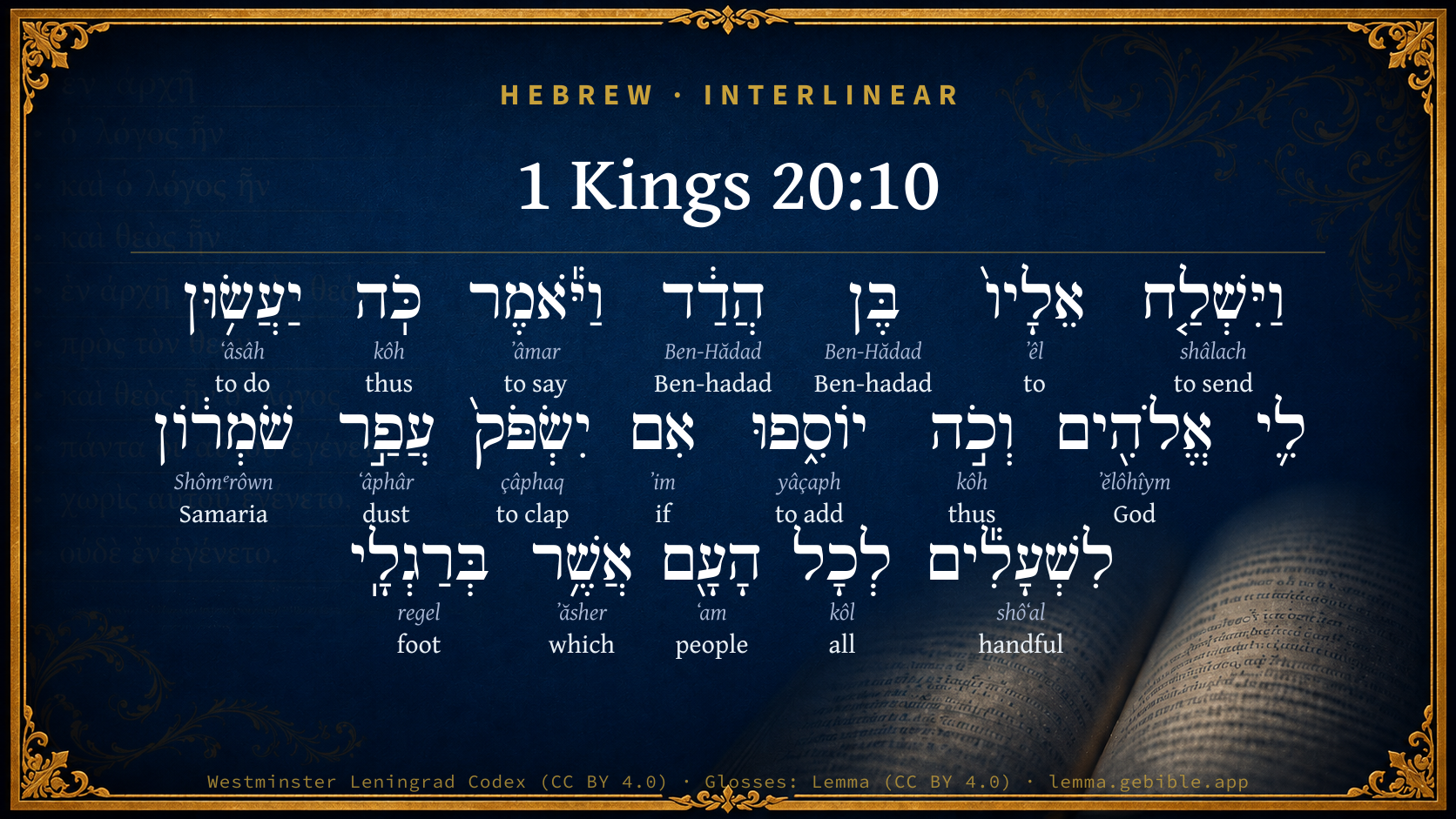
Hebrew (Westminster Leningrad Codex) 1 Kings 20:10 appears in the Hebrew Old Testament. The text above is from the Westminster Leningrad Codex. Each word links to its Strong’s number, a concise gloss, and parsing drawn from the Open Scriptures Hebrew Bible morphology. Click any word for its full Brown-Driver-Briggs (BDB) entry.
Download image
Cite this verse

1 Kings 20:10 (World English Bible). Public Domain. Lemma interlinear Bible study tool, https://lemma.gebible.app/v/1-kings/20/10.

Show BibTeX & RIS
BibTeX
RIS
English Translation
Ben Hadad sent to him, and said, The gods do so to me, and more also, if the dust of Samaria shall suffice for handfuls for all the people who follow me.
World English Bible · Public Domain
Highlights
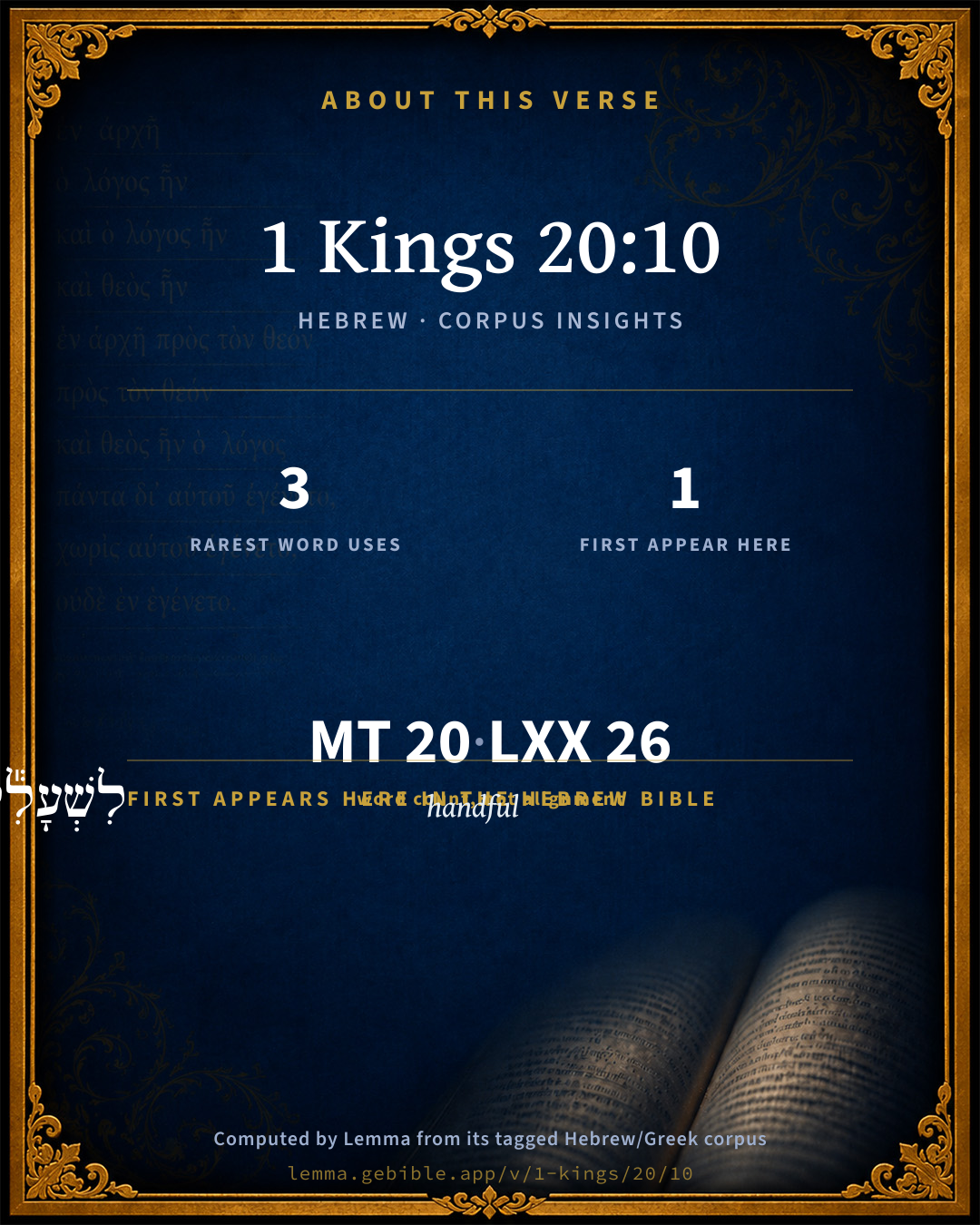
  • 1 first appearance in the Hebrew Bible
Full analysis ↓
Download a study sheet

One document with this verse’s original text, its word-by-word gloss line, the meaning frame, cross-references with their text, attributed commentary, and full source and license credits — printable, and it pastes into notes with its structure intact.

This verse Autodidact and up

Study sheet (.html) Plain text (.txt)

A passage Seminary Student

Up to 50 verses in one chapter. A passage sheet keeps up to 6 commentary sources and 12 cross-references per verse, in the order this page ranks them, and says so on the sheet whenever that leaves anything out. Ask for a single verse and you get the Autodidact verse sheet above.

Everything on this page stays free to read, with no account — the sheet is a download of what is already on screen, not access to it.

Want to remove ads? Support Godless Engineer
Compare translations 3

The same verse in 3 English versions, stacked beneath the original-language interlinear above. Click any original word for its lexicon entry.

Each is an independent rendering of the whole verse — the interlinear is not word-aligned to these translations.

Highlighted words mark where these versions differ — a whole-verse word diff, not a word-by-word alignment.

  • World English Bible Public Domain
    Ben Hadad sent to him, and said, The gods do so to me, and more also, if the dust of Samaria shall suffice for handfuls for all the people who follow me.
  • King James Version Public Domain
    And Benhadad sent unto him, and said, The gods do so unto me, and more also, if the dust of Samaria shall suffice for handfuls for all the people that follow me.
  • unfoldingWord Literal Text CC BY-SA 4.0
    And Ben Hadad sent to him and said, “Thus may the gods do to me, and thus may they add, if the dust of Samaria is enough for handfuls for all of the people who at my feet!”

unfoldingWord Literal Text — © unfoldingWord, licensed CC BY-SA 4.0. Word-aligned USFM3 via Door43 (git.door43.org/unfoldingWord/en_ult).

Versions to compare (up to 4)

3 of 4 selected

Show all 18 translations

Every available English version of this verse, each an independent rendering of the whole verse.

  • World English Bible Public Domain
    Ben Hadad sent to him, and said, The gods do so to me, and more also, if the dust of Samaria shall suffice for handfuls for all the people who follow me.
  • Berean Standard Bible Public Domain
    Then Ben-hadad sent another message to Ahab: “May the gods deal with me, and ever so severely, if enough dust remains of Samaria for each of my men to have a handful.”
  • Majority Standard Bible Public Domain
    Then Ben-hadad sent another message to Ahab: “May the gods deal with me, and ever so severely, if enough dust remains of Samaria for each of my men to have a handful.”
  • King James Version Public Domain
    And Benhadad sent unto him, and said, The gods do so unto me, and more also, if the dust of Samaria shall suffice for handfuls for all the people that follow me.
  • American Standard Version (1901) Public Domain
    And Ben-hadad sent unto him, and said, The gods do so unto me, and more also, if the dust of Samaria shall suffice for handfuls for all the people that follow me.
  • Revised Version (1885) Public Domain
    And Ben-hadad sent unto him, and said, The gods do so unto me, and more also, if the dust of Samaria shall suffice for handfuls for all the people that follow me.
  • Geneva Bible (1599) Public Domain
    And Ben-hadad sent vnto him, and sayde, The gods do so to me and more also, if the dust of Samaria be ynough to all the people that follow me, for euery man an handfull.
  • Douay-Rheims (1899) Public Domain
    And the messengers returning brought him word. And he sent again and said: Such and such things may the gods do to me, and more may they add, if the dust of Samaria shall suffice for handfuls for all the people that follow me.
  • Young's Literal Translation Public Domain
    And Ben-Hadad sendeth unto him, and saith, `Thus do the gods to me, and thus do they add, if the dust of Samaria suffice for handfuls for all the people who `are' at my feet.'
  • Literal Standard Version CC BY-SA 4.0
    And Ben-Hadad sends to him and says, “Thus the gods do to me, and thus do they add, if the dust of Samaria suffice for handfuls for all the people who [are] at my feet.”
  • Unlocked Literal Bible CC BY-SA 4.0
    Then Ben Hadad sent his reply to Ahab, and said, “May the gods do so to me and more also, if even the ashes of Samaria will be enough for all the people who follow me to have a handful each.”
  • unfoldingWord Literal Text CC BY-SA 4.0
    And Ben Hadad sent to him and said, “Thus may the gods do to me, and thus may they add, if the dust of Samaria is enough for handfuls for all of the people who at my feet!”
  • Darby Bible Public Domain
    And Ben-Hadad sent to him and said, The gods do so to me, and more also, if the dust of Samaria shall suffice for handfuls for all the people that follow me!
  • World Messianic Bible Public Domain
    Ben Hadad sent to him, and said, “The gods do so to me, and more also, if the dust of Samaria will be enough for handfuls for all the people who follow me.”
  • Webster's Bible Public Domain
    And Ben-hadad sent to him, and said, The gods do so to me, and more also, if the dust of Samaria shall suffice for handfuls for all the people that follow me.
  • Free Bible Version CC BY-SA 4.0
    Ben-hadad responded to him, “May the gods do as much to me and more if there remains enough dust in Samaria to give my subjects a handful each!”
  • Bible in Basic English Public Domain
    Then Ben-hadad sent to him, saying, May the gods' punishment be on me if there is enough of the dust of Samaria for all the people at my feet to take some in their hands.
  • JPS Tanakh (1917) Public Domain
    And Ben-hadad sent unto him, and said: 'The gods do so unto me, and more also, if the dust of Samaria shall suffice for handfuls for all the people that follow me.'

Literal Standard Version (2020), Covenant Press — licensed CC BY-SA 4.0. Text via the HelloAO Bible API (eBible.org). Unlocked Literal Bible (unfoldingWord) — licensed CC BY-SA 4.0. Text via the HelloAO Bible API (eBible.org). unfoldingWord Literal Text — © unfoldingWord, licensed CC BY-SA 4.0. Word-aligned USFM3 via Door43 (git.door43.org/unfoldingWord/en_ult). Free Bible Version, Dr. Jonathan Gallagher — licensed CC BY-SA 4.0. Text via the HelloAO Bible API (eBible.org).

Word by word

More ways to search: Search by grammar → Find every occurrence → Compare this word →

Practice this passage: Drill this verse → Learn its vocabulary →

לִשְׁעָלִ֕ים
shôʻal
H8168
“to/for · handfuls”
Preposition + Noun, Common, Masculine, Plural, Absolute
Part of Speech
Preposition + Noun
Type
Common
Gender
Masculine
Number
Plural
State
Absolute
Full BDB Definition

Origin: from an unused root meaning to hollow out

TWOT: 2432a

hollow hand, hollow of hand, handful - hollow hand, hollow of hand - handful
  1. וַיִּשְׁלַ֤ח shâlach H7971 “and · to send” Conjunction + Verb, Qal, Sequential Imperfect, 3rd Person, Masculine, Singular
  2. אֵלָיו֙ ʼêl H413 “to · him” Preposition + Suffix, Personal, 3rd Person, Masculine, Singular
  3. בֶּן Ben-Hădad H1130 “Ben-hadad” Noun, Proper
  4. הֲדַ֔ד Ben-Hădad H1130 “Ben-hadad” Noun, Proper
  5. וַיֹּ֕אמֶר ʼâmar H559 “and · to say” Conjunction + Verb, Qal, Sequential Imperfect, 3rd Person, Masculine, Singular
  6. כֹּֽה kôh H3541 “thus” Adverb
  7. יַעֲשׂ֥וּן ʻâsâh H6213 “to do” Verb, Qal, Jussive, 3rd Person, Masculine, Plural + Suffix, n
  8. אֱלֹהִ֖ים ʼĕlôhîym H430 “God(s)” Noun, Common, Masculine, Plural, Absolute
  9. וְכֹ֣ה kôh H3541 “and · thus” Conjunction + Adverb
  10. יוֹסִ֑פוּ yâçaph H3254 “to add” Verb, Hiphil, Jussive, 3rd Person, Masculine, Plural
  11. אִם ʼim H518 “if” Conjunction
  12. יִשְׂפֹּק֙ çâphaq H5606 “to clap” Verb, Qal, Imperfect, 3rd Person, Masculine, Singular
  13. עֲפַ֣ר ʻâphâr H6083 “dust of” Noun, Common, Masculine, Singular, Construct
  14. שֹׁמְר֔וֹן Shômᵉrôwn H8111 “Samaria” Noun, Proper
  15. לְכָל kôl H3605 “to/for · all of” Preposition + Noun, Common, Masculine, Singular, Construct
  16. הָעָ֖ם ʻam H5971 “the · people” Particle, Definite Article + Noun, Common, Masculine, Singular, Absolute
  17. אֲשֶׁ֥ר ʼăsher H834 “which” Particle, Relative
  18. בְּרַגְלָֽי regel H7272 “in/at · feet · my” Preposition + Noun, Common, Feminine, Dual, Construct + Suffix, Personal, 1st Person, Common, Singular

About this verse

These counts appear in no published source. They are computed here, from the morphology-tagged text and Lemma’s own curated glosses. What Lemma adds →

20
words
17
distinct lemmas
Historical
section

Notable vocabulary

The rarest word here is לִשְׁעָלִ֕ים handful H8168 — appearing just 3 times in the whole Hebrew Bible.

First appearance in Scripture

This word makes its first canonical appearance in the Hebrew Bible here:

  • לִשְׁעָלִ֕ים handful H8168

Shared distinctive vocabulary

לִשְׁעָלִ֕ים handful H8168 occurs in 3 verses of the Hebrew Bible. Also found in:

Grammatical profile

  • 5 verbs
  • 9 nouns
  • 2 prepositions
  • 1 conjunction
  • 2 adverbs
  • 1 particle

Verb forms

  • וַיִּשְׁלַ֤ח Qal · Sequential Imperfect
  • וַיֹּ֕אמֶר Qal · Sequential Imperfect
  • יַעֲשׂ֥וּן Qal · Jussive
  • יוֹסִ֑פוּ Hiphil · Jussive
  • יִשְׂפֹּק֙ Qal · Imperfect

Repetition

Words recur within this verse — often emphatic in Hebrew:

  • בֶּן Ben-hadad H1130 ×2
  • כֹּֽה thus H3541 ×2

Hebrew & Septuagint length

In English translation the verse runs 32 words from the Hebrew and 35 from the Septuagint (LXX English) — closely comparable.

A rough comparison of the two English renderings, which tokenize alike — not a word-level alignment.

Word counts can differ between the Hebrew and the Greek without any difference in meaning — e.g. the Hebrew direct-object marker אֵת has no separate Greek word, and Greek often adds the article ὁ.

In the original languages it is 20 Hebrew tokens and 26 Greek tokens — but the two are counted differently (Hebrew bundles its prefixes and suffixes into one token; the Greek is in lemma form), so that isn’t a like-for-like length.

Cross-references

8

Topical passages linked to 1 Kings 20:10 in the Treasury of Scripture Knowledge — connected by theme and wording, ordered by reader-vote popularity; previews shown in the World English Bible.

  • 1 Kings 19:2 Then Jezebel send a messenger to Elijah, saying, So let the gods do to me, and more also, if I don't make your life as the life of one of them by tomorrow about this time.
  • Exodus 11:8 All these your servants shall come down to me, and bow down themselves to me, saying, 'Get out, and all the people who follow you; and after that I will go out.'" He went out from Pharaoh in hot anger.
  • Judges 4:10 Barak called Zebulun and Naphtali together to Kedesh; and there went up ten thousand men at his feet: and Deborah went up with him.
  • 2 Samuel 17:12–13 So shall we come on him in some place where he shall be found, and we will light on him as the dew falls on the ground; and of him and of all the men who are with him we will not leave so much as one.
  • 2 Kings 19:23–24 By your messengers you have defied the Lord, and have said, With the multitude of my chariots am I come up to the height of the mountains, to the innermost parts of Lebanon; and I will cut down the tall cedars of it, and the choice fir trees of it; and I will enter into his farthest lodging-place, the forest of his fruitful field.
  • Isaiah 10:13–14 For he has said, By the strength of my hand I have done it, and by my wisdom; for I have understanding: and I have removed the bounds of the peoples, and have robbed their treasures, and like a valiant man I have brought down those who sit [on thrones]:
  • Isaiah 37:24–25 By your servants have you defied the Lord, and have said, With the multitude of my chariots am I come up to the height of the mountains, to the innermost parts of Lebanon; and I will cut down the tall cedars of it, and the choice fir trees of it; and I will enter into its farthest height, the forest of its fruitful field;
  • Acts 23:12 When it was day, some of the Jews banded together, and bound themselves under a curse, saying that they would neither eat nor drink until they had killed Paul.

Cross-references courtesy of OpenBible.info (CC BY 4.0).

Hebrew and Greek witnesses Masoretic Hebrew ↔ Greek Septuagint

The same verse in the two great witnesses to the Old Testament, shown verse-for-verse.

These are two independent witnesses, not word-aligned to each other, and the Septuagint is shown in lemma (dictionary) form.

Hebrew 1 Kings 20:10 Masoretic · Westminster Leningrad Codex

וַיִּשְׁלַ֤ח אֵלָיו֙ בֶּן הֲדַ֔ד וַיֹּ֕אמֶר כֹּֽה יַעֲשׂ֥וּן לִ֛י אֱלֹהִ֖ים וְכֹ֣ה יוֹסִ֑פוּ אִם יִשְׂפֹּק֙ עֲפַ֣ר שֹׁמְר֔וֹן לִשְׁעָלִ֕ים לְכָל הָעָ֖ם אֲשֶׁ֥ר בְּרַגְלָֽי

Ben Hadad sent to him, and said, The gods do so to me, and more also, if the dust of Samaria shall suffice for handfuls for all the people who follow me.

World English Bible · Public Domain

Greek LXX 1 Kings 20:10 Septuagint · lemma form

καί ἐν καταἵζω δύο ἀνήρ υἱός παράνομος ἐκ ἐναντίος αὐτός καί καταμαρτυρέω αὐτός λέγω εὐλογέω θεός καί βασιλεύς καί ἐκἄγω αὐτός καί λιθοβολέω αὐτός καί ἀποθνήσκω

And set two men, sons of transgressors, before him, and let them testify against him, saying, He blessed God and the king: and let them lead him forth, and stone him, and let them die.

LXX2012 (modern English Septuagint) · Public Domain

On this verse, Ellicott's Commentary for English Readers discusses the Septuagint’s reading. Read the note in Commentary ↓

Hebrew: Westminster Leningrad Codex (CC BY 4.0). Greek: Septuagint (public domain); English from LXX2012 (modern English Septuagint) (Public Domain). How the Septuagint differs from the Hebrew →

Targum (Aramaic paraphrase)

1

The Targum is the ancient Jewish Aramaic paraphrase of the Hebrew Scriptures — an interpretive translation, not the Hebrew text itself. Onkelos (literal) and Pseudo-Jonathan (expansive) render the Torah, and Jonathan the Prophets. Coverage is partial: where no permissively-licensed English translation exists for a verse, only the Aramaic is shown. This is verse-level text, not a word-by-word alignment to the Hebrew.

  1. Targum Jonathan Prophets (Joshua–Malachi)
    וּשְׁלַח לֵיהּ בַּר הֲדַד וַאֲמַר כְּדֵין יַעְבְּדוּן לִי דַחֲלָתָא וּכְדֵין יוֹסִפוּן אִם יִסְפּוֹק עַפְרָא דְשׁוֹמְרוֹן לְמֵיסַב בִּשְׁעוֹלֵי פַרְסַת רִגְלֵי עַמָא דְעִמִי:

    (no public-domain English translation for this verse)

    Targum Jonathan — Aramaic: “Mikraot Gedolot” (public domain). English: “Sefaria Community Translation” (CC0 1.0 (public-domain dedication)); “London "Chaldee Paraphrase," 1871” (public domain). Text via Sefaria.

Commentary

Notes on 1 Kings 20:10 from classic Christian and Jewish commentators (each source and its license shown beneath its notes). The classic Christian expositions comment on the surrounding passage and are grouped to its opening verse, so a note may address several verses; the Jewish commentaries on the Tanakh (Rashi and others) are per-verse, so they appear only where the commentator wrote on this verse.

Lemma curates 59 commentaries, every one of them public domain or Creative Commons licensed, each selected and text-cleaned for this edition rather than reprinted as found. About our sources →

Trapp's Complete Commentary

John Trapp

1Ki 20:10 And Benhadad sent unto him, and said, The gods do so unto me, and more also, if the dust of Samaria shall suffice for handfuls for all the people that follow me.

Ver. 10. The gods do so to me, and more also.] Indictio belli plusquam Thrasonica. Such prodigious pride and presumption usually precedeth ruin. Thus Julian the apostate, going against the Persians, vowed at his return to sacrifice the blood of Christians. So the Constable of France vowed the destruction of Geneva, but God forbade it.

If the dust of Samaria.] We shall be able not only to reduce it to dust, but also to carry it away in our hands when we have so done; quanquam aurum quaerebant Syri, non arenam, although it was not dust they came for, but gold, silver, and all desirables. {1Ki 20:5-6}

John Trapp, A Commentary or Exposition upon All the Books of the Old and New Testament (1647–1656) — public domain. Text from a community e-Sword module.

Tyndale Open Study Notes

Tyndale Open Resources

20:10-11 Ben-hadad’s third delegation delivered an ultimatum: Surrender or die. His caustic threat to thoroughly plunder Samaria was reinforced with a curse, an example of the psychological warfare often practiced in the ancient Near East (see 2 Kgs 18:19-35). • Ahab’s third reply to Ben-hadad contained proverbial wisdom. The outcome of the conflict was not yet sealed.

Tyndale Open Study Notes — © Tyndale Open Resources, licensed CC BY-SA 4.0. Text via the HelloAO Bible API.

Geneva Bible (1599)

Geneva Bible translators

Much less shall there be found any prey that is worth anything, when they shall be so many.

Geneva Bible (1599) marginal notes — public domain. Text via Bolls.life.

Adam Clarke's Commentary

Verse 10. If the dust of Samaria shall suffice] This is variously understood. Jonathan translates thus: "If the dust of Shomeron shall be sufficient for the soles of the feet of the people that shall accompany me;" i.e., I shall bring such an army that there will scarcely be room for them to stand in Samaria and its vicinity.

Adam Clarke's Commentary on the Bible (1810–1826) — public domain. Text from a community e-Sword/MySword module.

Ellicott's Commentary for English Readers

(10) The dust of Samaria—when razed to the ground. The phrase probably implies a threat of destruction, as well as a boast of overwhelming strength. Josephus (Ant. viii. 14, 2) has a curious explanation—that, if each of the Syrians took only a handful of dust, they could raise a mound against the city, higher than the walls of Samaria.

The historian, with a touch of patriotic scorn, paints Ben-hadad as a luxurious and insolent braggart. He receives the message at a feast, “drinking himself drunk,” and, stung by its tone of sarcasm, does not condescend to bestir himself, but orders his servants to an instant attack. The command is given, with a haughty brevity, in a single word (“Set”), which may be “Array troops,” or “Place engines,” as in the margin. The LXX. translates, “Build a stockade” (for attack on the walls).

A Bible Commentary for English Readers, edited by Charles John Ellicott (1878–1897) — public domain. Text from a community e-Sword module.

The Cambridge Bible for Schools and Colleges

gen. ed. J. J. S. Perowne

10. if the dust of Samaria shall suffice for handfuls for all the people that follow me] i.e. I will bring such a host that if each man were but to take with him a handful of earth, Samaria would be all carried away. The boastful tone is quite of a piece with all Ben-hadad’s previous conduct.

The LXX. has read שֻׁעָלִים instead of שְׁעָלִים and so instead of ‘handfuls’ it gives ταο͂ς ἀλώπεξι = ‘for the foxes (or jackals).’ Josephus explains Ben-hadad’s threat to have meant, that the Syrian army, bringing each man his handful of earth, would make a mound against Samaria higher than the present walls. Thus contemptuously hinting at the ease with which he could overthrow the Israelitish fortifications. The original text is incapable of such a sense.

The Cambridge Bible for Schools and Colleges (gen. ed. J. J. S. Perowne; Cambridge University Press, 1878–1918) — public domain. Text from a community e-Sword module.

John Gill's Exposition

And Benhadad sent unto him, and said,.... That is, to Ahab:

the gods do so unto me, and more also; bring greater evils upon me than I can think or express:

if the dust of Samaria shall suffice for handfuls for all the people that follow me, signifying that he made no doubt of it of reducing it to dust by numbers of men he should bring with him, which would be so many, that if each was to take an handful of dust of the ruins of Samaria, there would not enough for them all; which was an hectoring and parabolical speech, uttered in his wrath and fury.

John Gill's Exposition of the Whole Bible (1746–1763) — public domain (CC PDM 1.0). Text via the HelloAO Bible API.

Albert Barnes' Notes on the Bible

If the dust of Samaria shall suffice for handfuls ... - In its general sense this phrase is undoubtedly a boast that the number of Ben-hadad’s troops was such as to make resistance vain and foolish. We may parallel it with the saying of the Trachinian at Thermopylae, that the Persian arrows would darken the light of the sun. Probably the exact meaning is, “When your town is reduced to ruins, as it will be if you resist, the entire heap will not suffice to furnish a handful of dust to each soldier of my army, so many are they.” There was a threat in the message as well as a boast.

Albert Barnes' Notes on the Bible (1834–1885) — public domain. Text from a community e-Sword/MySword module.

Haydock's Catholic Bible Commentary

Handfuls. Hebrew shohal. The Septuagint, read "shuhal" and render it, "suffice for the foxes, for all the people, (even for) my infantry;" (Haydock) as if his forces were so numerous as to cover the whole land, and leave no room for even foxes to occupy. The hyperbole is equally great, supposing that his soldiers could by each taking a handful, or what might stick to his feet, (Chaldean) carry off all Samaria. Josephus intimates, that Benadad speaks of erecting terraces of equal height with the walls; others, that he would level the city with the ground, Ezechiel xxvi. 4. (Sanctius)

George Leo Haydock (1774–1849), Haydock's Catholic Family Bible and Commentary, 1859 edition — public domain. Excludes Psalms (Douay-Rheims chapter numbering differs from Protestant) and Deuterocanonical books (Catholic canon only).

Matthew Poole's English Annotations

If I do not assault thy city with so potent and numerous an army, that shall turn all thy city into a heap of dust, and shall be sufficient to carry it all away, though every soldier take but one handful of it: see the like boast 2Sa 17:13.

Matthew Poole's English Annotations on the Holy Bible (1683–1685) — public domain. Text from a community e-Sword/MySword module.

Whedon's Commentary on the Bible

Daniel D. Whedon

10. If the dust of Samaria shall suffice for handfuls — That is, I will bring such a host that all the dust of the city of Samaria will not be sufficient to give each soldier a handful. This threat involved the idea of reducing the entire city to dust and ashes. Some have incorrectly taken שׁעלים, handfuls, to mean soles of the feet, and have explained: The dust of Samaria will not be sufficient room for the soles of the feet of the multitude of soldiers. Josephus explains it that Ben-hadad threatened to bring so vast an army that, by only each man of his army taking a handful of earth, they would raise a mound higher than the walls of Samaria. But this has no support in the Scripture text.

Daniel D. Whedon (gen. ed.), Commentary on the Old and New Testaments (1874–1909) — public domain. Text from a community e-Sword module.

The Pulpit Commentary

And Ben-hadad sent unto him, and said These words would be quite superfluous, if the oaths of which we now hear were the "word" of ver. 9, The gods do so unto me, and more also, (see notes on 1Ki_2:23 1Ki_19:2) if the dust of Samaria shall suffice for handfuls The meaning of pugilli, is fixed by Isa_40:12, and Eze_13:19 for all the people that follow me. Heb. that are in my feet. Same expression Jud_1:4:16 5:15; 1Sa_25:27; 2Sa_15:17, etc. This thoroughly Oriental piece of bluster and boasting, which was intended, no doubt, to strike terror into the hearts of king and people, has been variously interpreted, but the meaning appears to be sufficiently clear. Ben-bahad vows that he will make Samaria a heap of dust, and at the same time affirms that so overwhelming is his host, that this dust will be insufficient to fill the hands of his soldiers. Rawlinson compares with it the well-known saying of the Trachinian to Dieneces, that the Median arrows would obscure the sun (Heb 7:226), but 2Sa_17:18 is still more apposite.

The gods do so to me,".etc. How often has the swearer to eat his words. The hero does; he never talks of what he will do. "Victory is to be achieved, not to be sworn." This vulgar fashion of calling upon God to do oneself some hurt thus appears to be of great antiquity. But it always proceeds from those who have very little belief in God at all. The profane swearer is practically an infidel, so far as the gods he invokes are concerned. An Italian workman was once reproved in a Roman studio for the oaths which he swore by the sacred name of Gesu. "Oh," said he boldly, "I"m not afraid of Him at all." Then, lowering his voice to a whisper, he added, "I"ll tell you what I"m afraid of: it is His blessed mother" He never swore by the Deity he believed in.

The Pulpit Commentary (1880–1919), ed. H.D.M. Spence-Jones & Joseph S. Exell — public domain. Text from a community e-Sword module.

John Wesley's Explanatory Notes

And said, &c. - If I do not assault thy city with so numerous an army, as shall turn all thy city into an heap of dust, and shall be sufficient to carry it all away, though every soldier take but one handful of it.

John Wesley, Explanatory Notes Upon the Whole Bible (1754–1765) — public domain. Text via the GEBible commentary corpus.

Rashi

Rabbi Shlomo Yitzchaki (Rashi)

If the dust of Shomron will be sufficient for the soles of the feet, etc. [Targum Yonoson rendered,] “to take with the footsteps of all the people who are with me,” the earth that sticks to the sole of the feet.

For the soles of the feet. An expression of, “treading with the sole of the foot,” and similarly, “in a narrow path [משעול] of the vineyards,” and similarly, “who measured the water with his step [בשעלו],” for He trod in the Red Sea, as it is stated, “You tramped them in the sea with Your horses.”

Will be sufficient. If there is enough.

Rashi on the Tanakh — English translations: “The Judaica Press complete Tanach with Rashi, translated by A. J. Rosenberg” (CC BY 4.0); “Pentateuch with Rashi's commentary by M. Rosenbaum and A.M. Silbermann, 1929-1934” (public domain); “The Metsudah Tanach series, Lakewood, N.J” (CC BY 4.0); and “The Book of Joshua, Metsudah Publications, 1997” (CC BY 4.0). Text via Sefaria.

Lesson kit

Teaching starters — assembled from the data on this page, not authored interpretation. Every prompt links to the verse data it draws on. Edit before teaching.

1 Kings, in the Historical, opens this verse with 20 words (17 distinct Hebrew lemmas). Its most distinctive word is shôʻal (“handful”). A historical commentator’s framing appears above. Read the whole chapter for the surrounding context.

Discussion questions

  1. How does “handful” (shôʻal) shape what this verse is saying?
  2. The word “handful” first appears here in Scripture. What is being introduced at this debut?
  3. Isaiah 40:12 shares the word «handful» with this verse. How do the two illuminate each other?
  4. “Ben-hadad” occurs 2× in this one verse. What is the effect of the repetition?
  5. These translations render this verse differently. What is at stake in choosing one wording over another?
  6. The verb «וַיִּשְׁלַ֤ח» is Qal Sequential Imperfect. How does its form color the action?
  7. Reading how Trapp's Complete Commentary and Tyndale Open Study Notes read this verse, where do the two commentators agree and where do they part?

Things to notice

Reading settings

Reading text

Shown beneath each verse's original-language words.

Old Testament
Old Testament edition

Read the OT as the Masoretic Hebrew (MT) or the Greek Septuagint (LXX).

English shown for the Greek Septuagint (in the Hebrew ↔ Greek comparison).

Comparing translations? Open the Compare panel on any verse page to stack up to four side by side.