
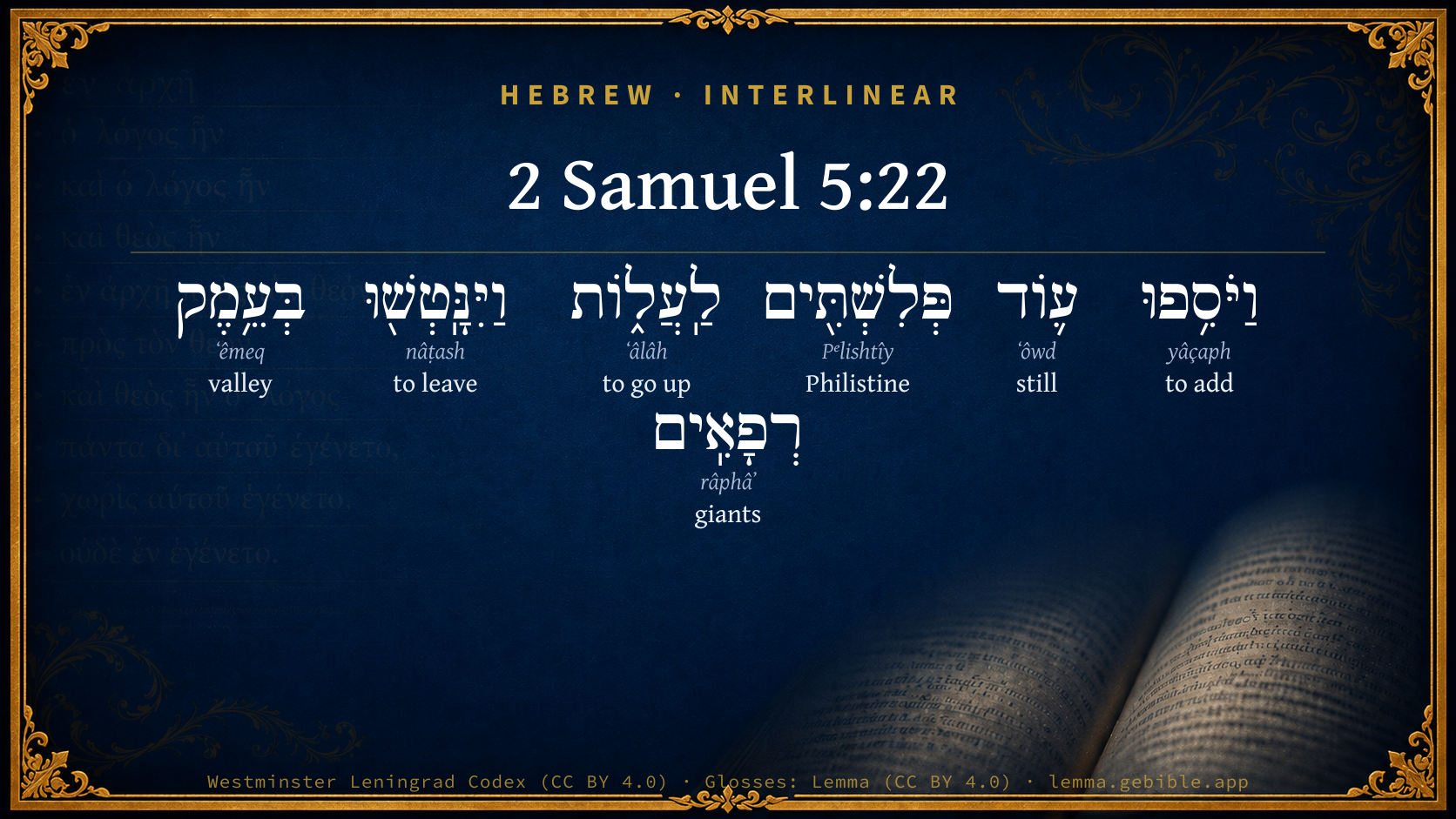
2 Samuel 5:22

Hebrew (Westminster Leningrad Codex) 2 Samuel 5:22 appears in the Hebrew Old Testament. The text above is from the Westminster Leningrad Codex. Each word links to its Strong’s number, a concise gloss, and parsing drawn from the Open Scriptures Hebrew Bible morphology. Click any word for its full Brown-Driver-Briggs (BDB) entry.
Download image
Cite this verse

2 Samuel 5:22 (World English Bible). Public Domain. Lemma interlinear Bible study tool, https://lemma.gebible.app/v/2-samuel/5/22.

Show BibTeX & RIS
BibTeX
RIS
English Translation
The Philistines came up yet again, and spread themselves in the valley of Rephaim.
World English Bible · Public Domain
Download a study sheet

One document with this verse’s original text, its word-by-word gloss line, the meaning frame, cross-references with their text, attributed commentary, and full source and license credits — printable, and it pastes into notes with its structure intact.

This verse Autodidact and up

Study sheet (.html) Plain text (.txt)

A passage Seminary Student

Up to 50 verses in one chapter. A passage sheet keeps up to 6 commentary sources and 12 cross-references per verse, in the order this page ranks them, and says so on the sheet whenever that leaves anything out. Ask for a single verse and you get the Autodidact verse sheet above.

Everything on this page stays free to read, with no account — the sheet is a download of what is already on screen, not access to it.

Want to remove ads? Support Godless Engineer
Compare translations 3

The same verse in 3 English versions, stacked beneath the original-language interlinear above. Click any original word for its lexicon entry.

Each is an independent rendering of the whole verse — the interlinear is not word-aligned to these translations.

Highlighted words mark where these versions differ — a whole-verse word diff, not a word-by-word alignment.

  • World English Bible Public Domain
    The Philistines came up yet again, and spread themselves in the valley of Rephaim.
  • King James Version Public Domain
    And the Philistines came up yet again, and spread themselves in the valley of Rephaim.
  • unfoldingWord Literal Text CC BY-SA 4.0
    And the Philistines resumed again to go up, and they spread themselves out in the Valley of the Raphaites.

unfoldingWord Literal Text — © unfoldingWord, licensed CC BY-SA 4.0. Word-aligned USFM3 via Door43 (git.door43.org/unfoldingWord/en_ult).

Versions to compare (up to 4)

3 of 4 selected

Show all 18 translations

Every available English version of this verse, each an independent rendering of the whole verse.

  • World English Bible Public Domain
    The Philistines came up yet again, and spread themselves in the valley of Rephaim.
  • Berean Standard Bible Public Domain
    Once again the Philistines came up and spread out in the Valley of Rephaim.
  • Majority Standard Bible Public Domain
    Once again the Philistines came up and spread out in the Valley of Rephaim.
  • King James Version Public Domain
    And the Philistines came up yet again, and spread themselves in the valley of Rephaim.
  • American Standard Version (1901) Public Domain
    And the Philistines came up yet again, and spread themselves in the valley of Rephaim.
  • Revised Version (1885) Public Domain
    And the Philistines came up yet again, and spread themselves in the valley of Rephaim.
  • Geneva Bible (1599) Public Domain
    Againe the Philistims came vp, and spred themselues in the valley of Rephaim.
  • Douay-Rheims (1899) Public Domain
    And they left there their idols: which David and his men took away.
  • Young's Literal Translation Public Domain
    And the Philistines add again to come up, and are spread out in the valley of Rephaim,
  • Literal Standard Version CC BY-SA 4.0
    And the Philistines add again to come up, and are spread out in the Valley of Rephaim,
  • Unlocked Literal Bible CC BY-SA 4.0
    Then the Philistines came up again and spread out once more in the Valley of Rephaim.
  • unfoldingWord Literal Text CC BY-SA 4.0
    And the Philistines resumed again to go up, and they spread themselves out in the Valley of the Raphaites.
  • Darby Bible Public Domain
    And the Philistines came up yet again, and spread themselves in the valley of Rephaim.
  • World Messianic Bible Public Domain
    The Philistines came up yet again and spread themselves in the valley of Rephaim.
  • Webster's Bible Public Domain
    And the Philistines came yet again, and spread themselves in the valley of Rephaim.
  • Free Bible Version CC BY-SA 4.0
    A while later the Philistines came again and spread out across the Valley of Rephaim.
  • Bible in Basic English Public Domain
    And the Philistines came up again, and went in every direction in the valley of Rephaim.
  • JPS Tanakh (1917) Public Domain
    And the Philistines came up yet again, and spread themselves in the valley of Rephaim.

Literal Standard Version (2020), Covenant Press — licensed CC BY-SA 4.0. Text via the HelloAO Bible API (eBible.org). Unlocked Literal Bible (unfoldingWord) — licensed CC BY-SA 4.0. Text via the HelloAO Bible API (eBible.org). unfoldingWord Literal Text — © unfoldingWord, licensed CC BY-SA 4.0. Word-aligned USFM3 via Door43 (git.door43.org/unfoldingWord/en_ult). Free Bible Version, Dr. Jonathan Gallagher — licensed CC BY-SA 4.0. Text via the HelloAO Bible API (eBible.org).

Word by word

More ways to search: Search by grammar → Find every occurrence → Compare this word →

Practice this passage: Drill this verse → Learn its vocabulary →

About this verse

These counts appear in no published source. They are computed here, from the morphology-tagged text and Lemma’s own curated glosses. What Lemma adds →

7
words
7
distinct lemmas
Historical
section

Notable vocabulary

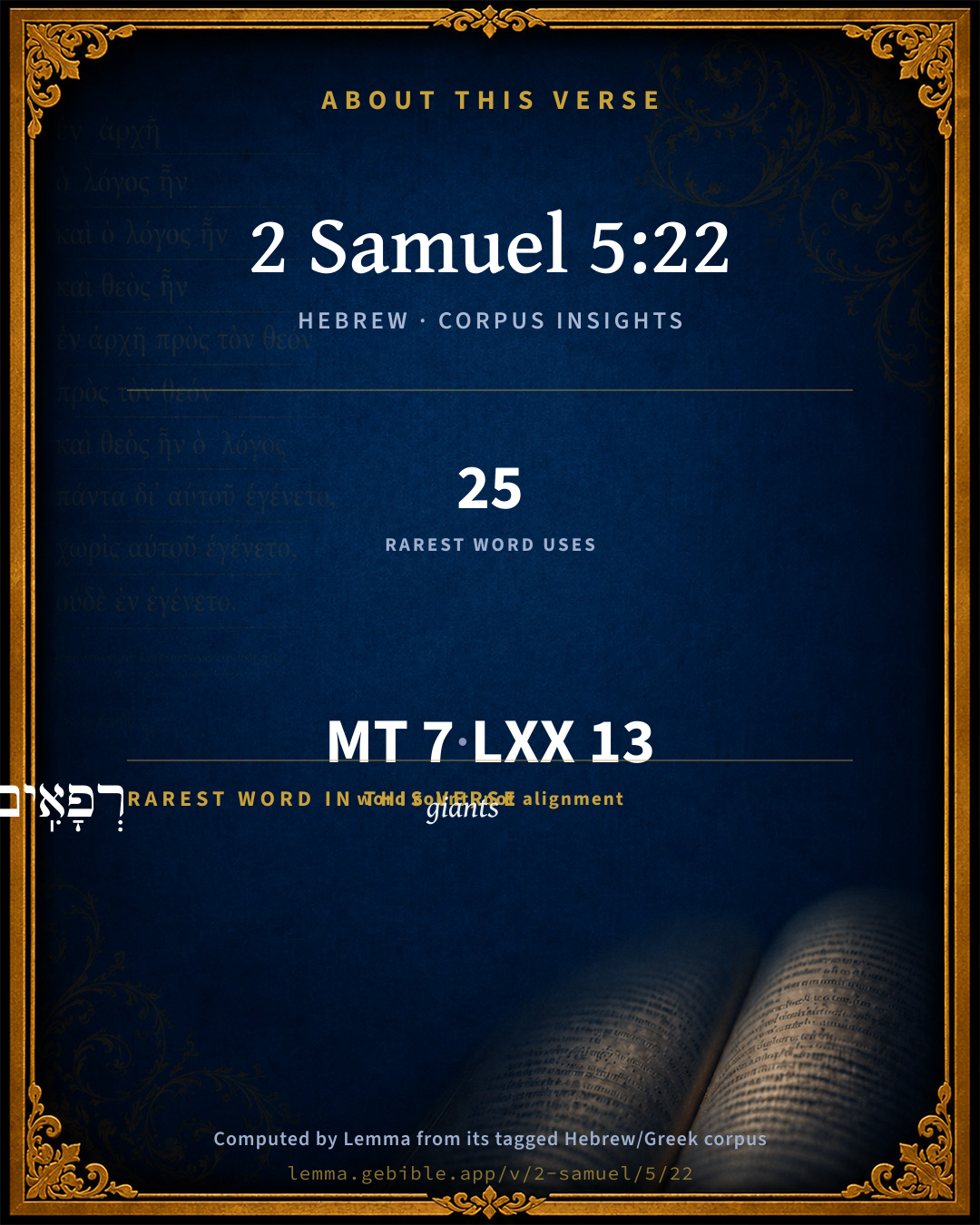
The rarest word here is רְפָאִֽים giants H7497 — appearing just 25 times in the whole Hebrew Bible.

Shared distinctive vocabulary

רְפָאִֽים giants H7497 occurs in 24 verses of the Hebrew Bible. Also found in:

Grammatical profile

  • 3 verbs
  • 3 nouns
  • 1 adverb

Verb forms

  • וַיֹּסִ֥פוּ Hiphil · Sequential Imperfect
  • לַֽעֲל֑וֹת Qal · Infinitive Construct
  • וַיִּנָּֽטְשׁ֖וּ Niphal · Sequential Imperfect

Hebrew & Septuagint length

In English translation the verse runs 14 words from the Hebrew and 14 from the Septuagint (LXX English) — the same length.

A rough comparison of the two English renderings, which tokenize alike — not a word-level alignment.

Word counts can differ between the Hebrew and the Greek without any difference in meaning — e.g. the Hebrew direct-object marker אֵת has no separate Greek word, and Greek often adds the article ὁ.

In the original languages it is 7 Hebrew tokens and 13 Greek tokens — but the two are counted differently (Hebrew bundles its prefixes and suffixes into one token; the Greek is in lemma form), so that isn’t a like-for-like length.

Cross-references

3

Topical passages linked to 2 Samuel 5:22 in the Treasury of Scripture Knowledge — connected by theme and wording, ordered by reader-vote popularity; previews shown in the World English Bible.

  • 2 Samuel 5:18 Now the Philistines had come and spread themselves in the valley of Rephaim.
  • 1 Kings 20:22 The prophet came near to the king of Israel, and said to him, Go, strengthen yourself, and mark, and see what you do; for at the return of the year the king of Syria will come up against you.
  • 1 Chronicles 14:13 The Philistines yet again made a raid in the valley.

Cross-references courtesy of OpenBible.info (CC BY 4.0).

Hebrew and Greek witnesses Masoretic Hebrew ↔ Greek Septuagint

The same verse in the two great witnesses to the Old Testament, shown verse-for-verse.

These are two independent witnesses, not word-aligned to each other, and the Septuagint is shown in lemma (dictionary) form.

Hebrew 2 Samuel 5:22 Masoretic · Westminster Leningrad Codex

וַיֹּסִ֥פוּ ע֛וֹד פְּלִשְׁתִּ֖ים לַֽעֲל֑וֹת וַיִּנָּֽטְשׁ֖וּ בְּעֵ֥מֶק רְפָאִֽים

The Philistines came up yet again, and spread themselves in the valley of Rephaim.

World English Bible · Public Domain

Greek LXX 2 Samuel 5:22 Septuagint · lemma form

καί προςτίθημι ἔτι ἀλλόφυλος ὁ ἀναβαίνω καί συνπίπτω ἐν ὁ κοιλάς ὁ τιτάν

And the Philistines came up yet again, and assembled in the valley of Giants.

LXX2012 (modern English Septuagint) · Public Domain

Hebrew: Westminster Leningrad Codex (CC BY 4.0). Greek: Septuagint (public domain); English from LXX2012 (modern English Septuagint) (Public Domain). How the Septuagint differs from the Hebrew →

Targum (Aramaic paraphrase)

1

The Targum is the ancient Jewish Aramaic paraphrase of the Hebrew Scriptures — an interpretive translation, not the Hebrew text itself. Onkelos (literal) and Pseudo-Jonathan (expansive) render the Torah, and Jonathan the Prophets. Coverage is partial: where no permissively-licensed English translation exists for a verse, only the Aramaic is shown. This is verse-level text, not a word-by-word alignment to the Hebrew.

  1. Targum Jonathan Prophets (Joshua–Malachi)
    וְאוֹסִיפוּ עוֹד פְּלִשְׁתָּאֵי לְמֵיסַק וְאִיתְרַטִישׁוּ בְּמֵישַׁר גִיבָּרַיָא:

    (no public-domain English translation for this verse)

    Targum Jonathan — Aramaic: “Mikraot Gedolot” (public domain). English: “Sefaria Community Translation” (CC0 1.0 (public-domain dedication)); “London "Chaldee Paraphrase," 1871” (public domain). Text via Sefaria.

Commentary

Notes on 2 Samuel 5:22 from classic Christian and Jewish commentators (each source and its license shown beneath its notes). The classic Christian expositions comment on the surrounding passage and are grouped to its opening verse, so a note may address several verses; the Jewish commentaries on the Tanakh (Rashi and others) are per-verse, so they appear only where the commentator wrote on this verse.

Lemma curates 59 commentaries, every one of them public domain or Creative Commons licensed, each selected and text-cleaned for this edition rather than reprinted as found. About our sources →

Trapp's Complete Commentary

John Trapp

2Sa 5:22 And the Philistines came up yet again, and spread themselves in the valley of Rephaim.

Ver. 22. And the Philistines came up yet again.] They will have the other bout, though to their bane. No warning will serve obdurate hearts Cimon the Athenian triumphed over the Persians twice in one day. David shall do little less over these foolhardy Philistines.

John Trapp, A Commentary or Exposition upon All the Books of the Old and New Testament (1647–1656) — public domain. Text from a community e-Sword module.

Joseph Benson's Commentary

2Sa 5:22-23. And spread themselves — The expression intimates, that they were very numerous, and made a very formidable appearance. So we read, Rev 20:9, of the enemies of the church going up on the breadth of the earth. But the wider they spread themselves, the fairer mark they are for God’s arrows. And when David inquired of the Lord — Though he had been successful before, yet he would attempt nothing further without God’s direction; to whom he knew he owed his former victory. He said, Thou shalt not go up — That is, not directly, to fight in a pitched battle as before. So the following words explain it. But fetch a compass behind them — Where they least expect thee. God’s purposes and promises do not exclude or render unnecessary men’s endeavours.

Joseph Benson's Commentary on the Old and New Testaments (1811–1818) — public domain. Text from a community e-Sword module.

Geneva Bible (1599)

Geneva Bible translators

Meaning, the valley of giants, which David called Baal Perazim, because of his victory.

Geneva Bible (1599) marginal notes — public domain. Text via Bolls.life.

Jamieson, Fausset & Brown

Robert Jamieson, A. R. Fausset & David Brown

the Philistines came up yet again--The next year they renewed their hostile attempt with a larger force, but God manifestly interposed in David's favor.

Jamieson, Fausset & Brown — Commentary Critical and Explanatory on the Whole Bible (1871) — public domain (CC PDM 1.0). Text via the HelloAO Bible API.

Ellicott's Commentary for English Readers

(22) Came up yet again.—As David had not followed up his victory (probably because he was not yet in condition to do so) the Philistines repeated their attack in the same place.

A Bible Commentary for English Readers, edited by Charles John Ellicott (1878–1897) — public domain. Text from a community e-Sword module.

John Gill's Exposition

And let it be, when thou hearest the sound of a going in the tops of the mulberry trees,.... Of a going of the wind on the tops of these trees, making a rustling upon them, and that in such a manner as to resemble the going of men, or march of armies, as if they were moving in the air over the tops of the mulberry trees; which Jarchi and R. Isaiah interpret of angels being sent of God, and moving at that time to help David, and destroy the Philistines; so the Targum on Ch1 14:15. These trees being in Judea account for silk there, Eze 16:10; though some think time was not known so early; others suppose it was, and to be the Hebrew byssus mentioned by Pausanias (a), as being of a yellow colour:

that then thou shall bestir thyself; or move towards the camp of the Philistines, and fall upon them in the rear, who, by reason of the sound in the trees, would not hear the motion of the Israelites; or, if they heard it, would take it to be no other than the motion of the trees they heard, both sounds being confounded together; or they would take the sound they heard for the motion of the enemy in the front, and give way, and so fall into the hands of the Israelites in their rear, which must throw them into the utmost confusion and consternation:

for then shall the Lord go out before thee to smite the host of the Philistines: by an angel or angels; so the Targum,"for then shall go forth the angel of the Lord, to make thee prosperous to slay in the camp of the Philistines;''

that being the precise time for the salvation of Israel, and the destruction of the Philistines, and the token of it.

(a) Eliac. sive, l. 5. p. 294.

John Gill's Exposition of the Whole Bible (1746–1763) — public domain (CC PDM 1.0). Text via the HelloAO Bible API.

Matthew Poole's English Annotations

The Philistines came up again, doubtless with greater force, as those that saw their all lay at stake.

Matthew Poole's English Annotations on the Holy Bible (1683–1685) — public domain. Text from a community e-Sword/MySword module.

Whedon's Commentary on the Bible

Daniel D. Whedon

22. Came up yet again — Probably soon after the defeat just recorded. They were chagrined at the loss of their gods, and probably David had not followed up his victory.

Thou shalt not go up — So as to meet and attack them face to face as before.

Daniel D. Whedon (gen. ed.), Commentary on the Old and New Testaments (1874–1909) — public domain. Text from a community e-Sword module.

The Pulpit Commentary

The Philistines came up yet again. Their first defeat had probably not been accompanied by much slaughter; for David"s men were few in number, though brave as lions. Retreating then to some distance, the Philistines called in their garrisons, and waited also for reinforcements from home, and then advanced again to the same spot. And as David was prepared to attack them in front, he also must now have gathered round him the chivalry of Israel.

Vers. 22, 23 (THE VALLEY OF REPHAIM.) (1Ch_14:13, 1Ch_14:14)

Renewed conflict.

1. The life of a godly man on earth is a warfare which is perpetually renewed. Hardly has one conflict been passed through before another awaits him with old or new and more formidable foes: the world, the flesh, the devil; ignorance, idolatries, oppressions, sin and misery of all kinds. (1Sa_17:1-11) Yea, each day the "good warfare" begins afresh. "The approach of duty is as a battlefield" (Essenian maxim). "On awaking in the morning, the first thing to be observed by thine inward sight is the listed field in which thou art enclosed; the law of the combat being that he who fights not must there lie dead forever" (Scupeli).

2. Signal success in one conflict does not ensure the like in the next; and it ought, therefore, to be always associated with humility, watchfulness, and prayer; from lack of which many a victory has been turned into a defeat, it was a motto of King Alfred ("Si modo victor eras," etc.)

If today thou be conqueror, beware of the fight of tomorrow; If today thou be conquered, prepare for the fight of tomorrow.

1. One victory affords ground for the confident expectation of another, when the latter is looked for in the same spirit as the former, with dependence on the strength of God, submission to his will, devotion to his glory and the good of his people. "David inquired of the Lord again.

2. The special means to be employed in every new conflict must be adapted to the special circumstances of the case; and both the wisdom to perceive them and the might to make them effectual are from the Lord. "Thou shalt not go up" (directly, in front of them, as in the former conflict, and as he was about to do again); "go round about them to their rear, and come upon them opposite the mulberry trees" (a spot, probably well known to David and his men, where a cluster or grove of baca trees would favour their attack), etc. "The words teach us that in our own strength, and merely with the human weapons of reason and science, we are not to make war against the adversary. Success can only be calculated upon when the conflict is undertaken under the influence of the Holy Spirit of God breathed forth, and in the immediate blessed experience of the gracious presence of the Lord and of the truth of his Word" (Krummacher). D.

The Pulpit Commentary (1880–1919), ed. H.D.M. Spence-Jones & Joseph S. Exell — public domain. Text from a community e-Sword module.

John Wesley's Explanatory Notes

And spread themselves - The expression intimates, that they were very numerous, and made a very formidable appearance. So we read, Rev. xx, 9, of the church's enemies going up on the breadth of the earth. But the wider they spread themselves, the fairer mark they are for God's arrows.

John Wesley, Explanatory Notes Upon the Whole Bible (1754–1765) — public domain. Text via the GEBible commentary corpus.

unfoldingWord translationNotes

Door43 World Missions Community

the Philistines came up again

They "came up" because the Philistines lived at a lower elevation than David's stronghold.

Valley of Rephaim

This is the name of a place. (See: How to Translate Names)

balsam woods

"Balsam" here is a type of tree, and the "woods" describe many balsam trees growing together. (See: How to Translate Names)

translationWords

Philistines

David

Yahweh

unfoldingWord translationNotes — © Distant Shores Media and the Door43 World Missions Community, licensed CC BY-SA 4.0. Source: git.door43.org/Door43/en_tn.

Rashi

Rabbi Shlomo Yitzchaki (Rashi)

The valley of Rephaim. It is next to Yerusholoyim [as can be seen] in the book of Yehoshua (15, 8).

Rashi on the Tanakh — English translations: “The Judaica Press complete Tanach with Rashi, translated by A. J. Rosenberg” (CC BY 4.0); “Pentateuch with Rashi's commentary by M. Rosenbaum and A.M. Silbermann, 1929-1934” (public domain); “The Metsudah Tanach series, Lakewood, N.J” (CC BY 4.0); and “The Book of Joshua, Metsudah Publications, 1997” (CC BY 4.0). Text via Sefaria.

Lesson kit

Teaching starters — assembled from the data on this page, not authored interpretation. Every prompt links to the verse data it draws on. Edit before teaching.

2 Samuel, in the Historical, opens this verse with 7 words (7 distinct Hebrew lemmas). Its most distinctive word is râphâʼ (“giants”). A historical commentator’s framing appears above. Read the whole chapter for the surrounding context.

Discussion questions

  1. How does “giants” (râphâʼ) shape what this verse is saying?
  2. Genesis 14:5 shares the word «giants» with this verse. How do the two illuminate each other?
  3. The translations on this page render this verse differently — a whole-verse word diff, not a word-by-word alignment. What might account for the different wordings?
  4. The verb «וַיֹּסִ֥פוּ» is Hiphil Sequential Imperfect. How does its form color the action?
  5. Reading how Trapp's Complete Commentary and Joseph Benson's Commentary read this verse, where do the two commentators agree and where do they part?

Things to notice

Reading settings

Reading text

Shown beneath each verse's original-language words.

Old Testament
Old Testament edition

Read the OT as the Masoretic Hebrew (MT) or the Greek Septuagint (LXX).

English shown for the Greek Septuagint (in the Hebrew ↔ Greek comparison).

Comparing translations? Open the Compare panel on any verse page to stack up to four side by side.