
Judges 20:23

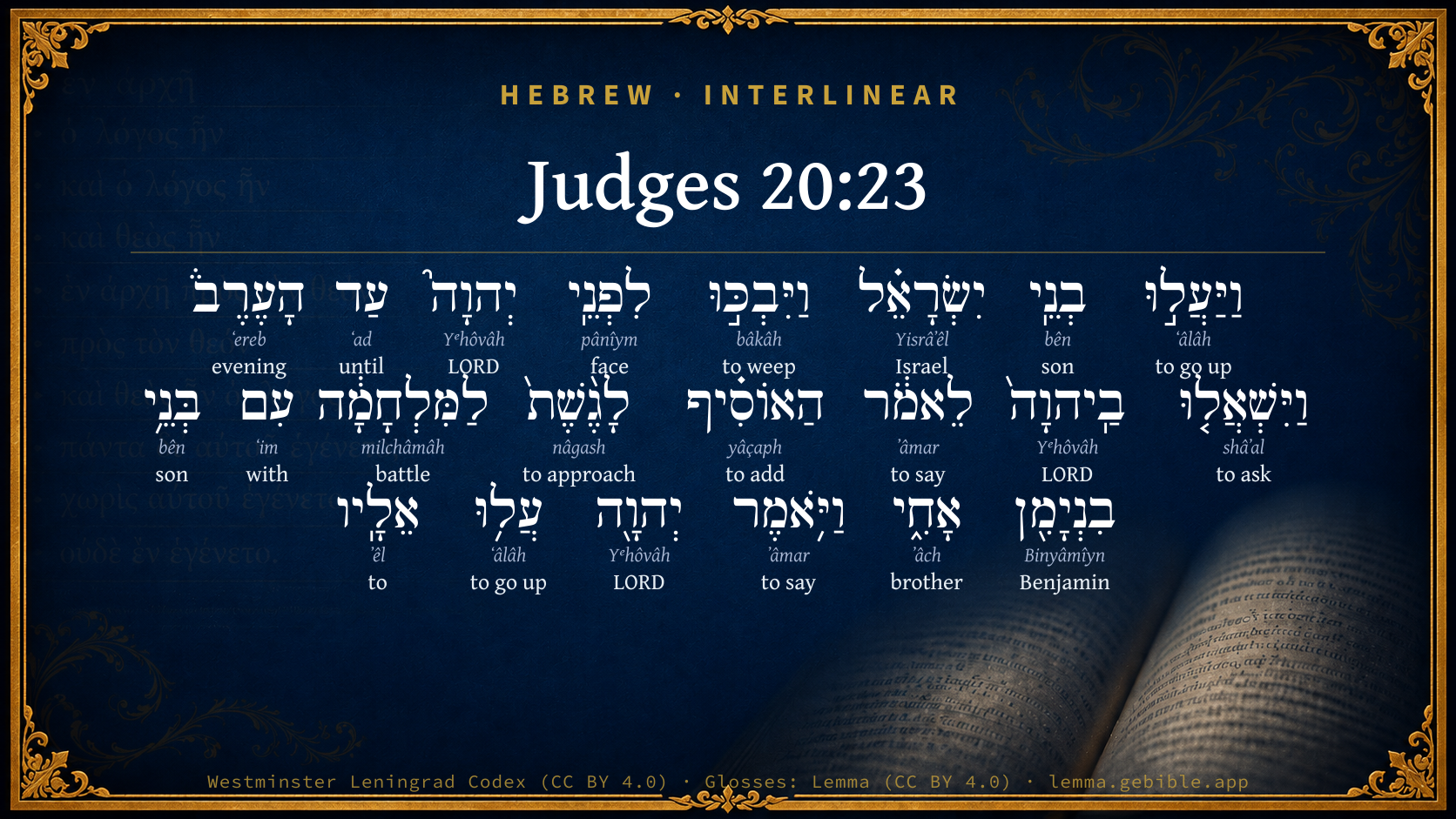
Hebrew (Westminster Leningrad Codex) Judges 20:23 appears in the Hebrew Old Testament. The text above is from the Westminster Leningrad Codex. Each word links to its Strong’s number, a concise gloss, and parsing drawn from the Open Scriptures Hebrew Bible morphology. Click any word for its full Brown-Driver-Briggs (BDB) entry.
Download image
Cite this verse

Judges 20:23 (World English Bible). Public Domain. Lemma interlinear Bible study tool, https://lemma.gebible.app/v/judges/20/23.

Show BibTeX & RIS
BibTeX
RIS
English Translation
The children of Israel went up and wept before Yahweh until even; and they asked of Yahweh, saying, Shall I again draw near to battle against the children of Benjamin my brother? Yahweh said, Go up against him.
World English Bible · Public Domain
Download a study sheet

One document with this verse’s original text, its word-by-word gloss line, the meaning frame, cross-references with their text, attributed commentary, and full source and license credits — printable, and it pastes into notes with its structure intact.

This verse Autodidact and up

Study sheet (.html) Plain text (.txt)

A passage Seminary Student

Up to 50 verses in one chapter. A passage sheet keeps up to 6 commentary sources and 12 cross-references per verse, in the order this page ranks them, and says so on the sheet whenever that leaves anything out. Ask for a single verse and you get the Autodidact verse sheet above.

Everything on this page stays free to read, with no account — the sheet is a download of what is already on screen, not access to it.

Want to remove ads? Support Godless Engineer
Compare translations 3

The same verse in 3 English versions, stacked beneath the original-language interlinear above. Click any original word for its lexicon entry.

Each is an independent rendering of the whole verse — the interlinear is not word-aligned to these translations.

Highlighted words mark where these versions differ — a whole-verse word diff, not a word-by-word alignment.

  • World English Bible Public Domain
    The children of Israel went up and wept before Yahweh until even; and they asked of Yahweh, saying, Shall I again draw near to battle against the children of Benjamin my brother? Yahweh said, Go up against him.
  • King James Version Public Domain
    (And the children of Israel went up and wept before the LORD until even, and asked counsel of the LORD, saying, Shall I go up again to battle against the children of Benjamin my brother? And the LORD said, Go up against him.)
  • unfoldingWord Literal Text CC BY-SA 4.0
    For the sons of Israel had gone up and wept to the face of Yahweh until the evening. And they had inquired of Yahweh, saying, “Shall I resume to approach to battle with the sons of Benjamin, my brother?” And Yahweh had said, “Go up against him.”

unfoldingWord Literal Text — © unfoldingWord, licensed CC BY-SA 4.0. Word-aligned USFM3 via Door43 (git.door43.org/unfoldingWord/en_ult).

Versions to compare (up to 4)

3 of 4 selected

Show all 18 translations

Every available English version of this verse, each an independent rendering of the whole verse.

  • World English Bible Public Domain
    The children of Israel went up and wept before Yahweh until even; and they asked of Yahweh, saying, Shall I again draw near to battle against the children of Benjamin my brother? Yahweh said, Go up against him.
  • Berean Standard Bible Public Domain
    They went up and wept before the LORD until evening, inquiring of Him, “Should we again draw near for battle against our brothers the Benjamites?” And the LORD answered, “Go up against them.”
  • Majority Standard Bible Public Domain
    They went up and wept before the LORD until evening, inquiring of Him, “Should we again draw near for battle against our brothers the Benjamites?” And the LORD answered, “Go up against them.”
  • King James Version Public Domain
    (And the children of Israel went up and wept before the LORD until even, and asked counsel of the LORD, saying, Shall I go up again to battle against the children of Benjamin my brother? And the LORD said, Go up against him.)
  • American Standard Version (1901) Public Domain
    And the children of Israel went up and wept before Jehovah until even; and they asked of Jehovah, saying, Shall I again draw nigh to battle against the children of Benjamin my brother? And Jehovah said, Go up against him.
  • Revised Version (1885) Public Domain
    (And the children of Israel went up and wept before the LORD until even; and they asked of the LORD, saying, Shall I again draw nigh to battle against the children of Benjamin my brother? And the LORD said, Go up against him.)
  • Geneva Bible (1599) Public Domain
    (For the children of Israel had gone vp and wept before the Lord vnto the euening, and had asked of the Lord, saying, Shall I goe againe to battel against the children of Beniamin my brethren? and the Lord said, Go vp against them)
  • Douay-Rheims (1899) Public Domain
    Yet so that they first went up and wept before the Lord until night: and consulted him, and said: Shall I go out any more to fight against the children of Benjamin my brethren, or not? And he answered them: Go up against them, and join battle.
  • Young's Literal Translation Public Domain
    And the sons of Israel go up and weep before Jehovah till the evening, and ask of Jehovah, saying, `Do I add to draw nigh to battle with the sons of Benjamin, my brother?' And Jehovah saith, `Go up against him.'
  • Literal Standard Version CC BY-SA 4.0
    And the sons of Israel go up and weep before YHWH until the evening, and ask of YHWH, saying, “Do I add to draw near to battle with the sons of my brother Benjamin?” And YHWH says, “Go up against him.”
  • Unlocked Literal Bible CC BY-SA 4.0
    Then the people of Israel went up and they wept before Yahweh until evening, and they sought direction from Yahweh. They said, “Should we go again to fight against our brothers, the people of Benjamin?” Yahweh said, “Attack them!”
  • unfoldingWord Literal Text CC BY-SA 4.0
    For the sons of Israel had gone up and wept to the face of Yahweh until the evening. And they had inquired of Yahweh, saying, “Shall I resume to approach to battle with the sons of Benjamin, my brother?” And Yahweh had said, “Go up against him.”
  • Darby Bible Public Domain
    And the people of Israel went up and wept before the LORD until the evening; and they inquired of the LORD, "Shall we again draw near to battle against our brethren the Benjaminites?" And the LORD said, "Go up against them."
  • World Messianic Bible Public Domain
    The children of Israel went up and wept before the LORD until evening; and they asked of the LORD, saying, “Shall I again draw near to battle against the children of Benjamin my brother?” The LORD said, “Go up against him.”
  • Webster's Bible Public Domain
    (And the children of Israel went up and wept before the LORD until evening, and asked counsel of the LORD, saying, Shall I go up again to battle against the children of Benjamin my brother? And the LORD said, Go up against him.)
  • Free Bible Version CC BY-SA 4.0
    The Israelites went and cried before the Lord until the evening and asked, “Should we go and attack the Benjamites again, our relatives?” “Go and attack them,” the Lord replied.
  • Bible in Basic English Public Domain
    Now the children of Israel went up, weeping before the Lord till evening, requesting the Lord and saying, Am I to go forward again to the fight against the children of Benjamin my brother? And the Lord said, Go up against him.
  • JPS Tanakh (1917) Public Domain
    And the children of Israel went up and wept before the LORD until even; and they asked of the LORD, saying: 'Shall I again draw nigh to battle against the children of Benjamin my brother?' And the LORD said: 'Go up against him.'

Literal Standard Version (2020), Covenant Press — licensed CC BY-SA 4.0. Text via the HelloAO Bible API (eBible.org). Unlocked Literal Bible (unfoldingWord) — licensed CC BY-SA 4.0. Text via the HelloAO Bible API (eBible.org). unfoldingWord Literal Text — © unfoldingWord, licensed CC BY-SA 4.0. Word-aligned USFM3 via Door43 (git.door43.org/unfoldingWord/en_ult). Free Bible Version, Dr. Jonathan Gallagher — licensed CC BY-SA 4.0. Text via the HelloAO Bible API (eBible.org).

Word by word

More ways to search: Search by grammar → Find every occurrence → Compare this word →

Practice this passage: Drill this verse → Learn its vocabulary →

וַיִּבְכּ֣וּ
bâkâh
H1058
“and · to weep”
Conjunction + Verb, Qal, Sequential Imperfect, 3rd Person, Masculine, Plural
Part of Speech
Conjunction + Verb
Stem
Qal
Form
Sequential Imperfect
Person
3rd Person
Gender
Masculine
Number
Plural
Full BDB Definition

Origin: a primitive root

TWOT: 243

to weep, bewail, cry, shed tears - (Qal) - to weep (in grief, humiliation, or joy) - to weep bitterly (with cognate acc.) - to weep upon (embrace and weep) - to bewail - (Piel) participle - lamenting - bewailing
  1. וַיַּעֲל֣וּ ʻâlâh H5927 “and · to go up” Conjunction + Verb, Qal, Sequential Imperfect, 3rd Person, Masculine, Plural
  2. בְנֵֽי bên H1121 “sons of” Noun, Common, Masculine, Plural, Construct
  3. יִשְׂרָאֵ֗ל Yisrâʼêl H3478 “Israel” Noun, Proper
  4. לִפְנֵֽי pânîym H6440 “to/for · face(s) of” Preposition + Noun, Common, Both, Plural, Construct
  5. יְהוָה֮ Yᵉhôvâh H3068 “LORD” Noun, Proper
  6. עַד ʻad H5704 “until” Preposition
  7. הָעֶרֶב֒ ʻereb H6153 “the · evening” Particle, Definite Article + Noun, Common, Masculine, Singular, Absolute
  8. וַיִּשְׁאֲל֤וּ shâʼal H7592 “and · to ask” Conjunction + Verb, Qal, Sequential Imperfect, 3rd Person, Masculine, Plural
  9. בַֽיהוָה֙ Yᵉhôvâh H3068 “in/at · LORD” Preposition + Noun, Proper
  10. לֵאמֹ֔ר ʼâmar H559 “to say” Preposition + Verb, Qal, Infinitive Construct
  11. הַאוֹסִ֗יף yâçaph H3254 “to add” Particle, Interrogative + Verb, Hiphil, Imperfect, 1st Person, Common, Singular
  12. לָגֶ֨שֶׁת֙ nâgash H5066 “to approach” Preposition + Verb, Qal, Infinitive Construct
  13. לַמִּלְחָמָ֔ה milchâmâh H4421 “to/for the · battle” Preposition, Determined + Noun, Common, Feminine, Singular, Absolute
  14. עִם ʻim H5973 “with” Preposition
  15. בְּנֵ֥י bên H1121 “sons of” Noun, Common, Masculine, Plural, Construct
  16. בִנְיָמִ֖ן Binyâmîyn H1144 “Benjamin” Noun, Proper
  17. אָחִ֑י ʼâch H251 “brother · my” Noun, Common, Masculine, Singular, Construct + Suffix, Personal, 1st Person, Common, Singular
  18. וַיֹּ֥אמֶר ʼâmar H559 “and · to say” Conjunction + Verb, Qal, Sequential Imperfect, 3rd Person, Masculine, Singular
  19. יְהוָ֖ה Yᵉhôvâh H3068 “LORD” Noun, Proper
  20. עֲל֥וּ ʻâlâh H5927 “go up” Verb, Qal, Imperative, 2nd Person, Masculine, Plural
  21. אֵלָֽיו ʼêl H413 “to · him” Preposition + Suffix, Personal, 3rd Person, Masculine, Singular

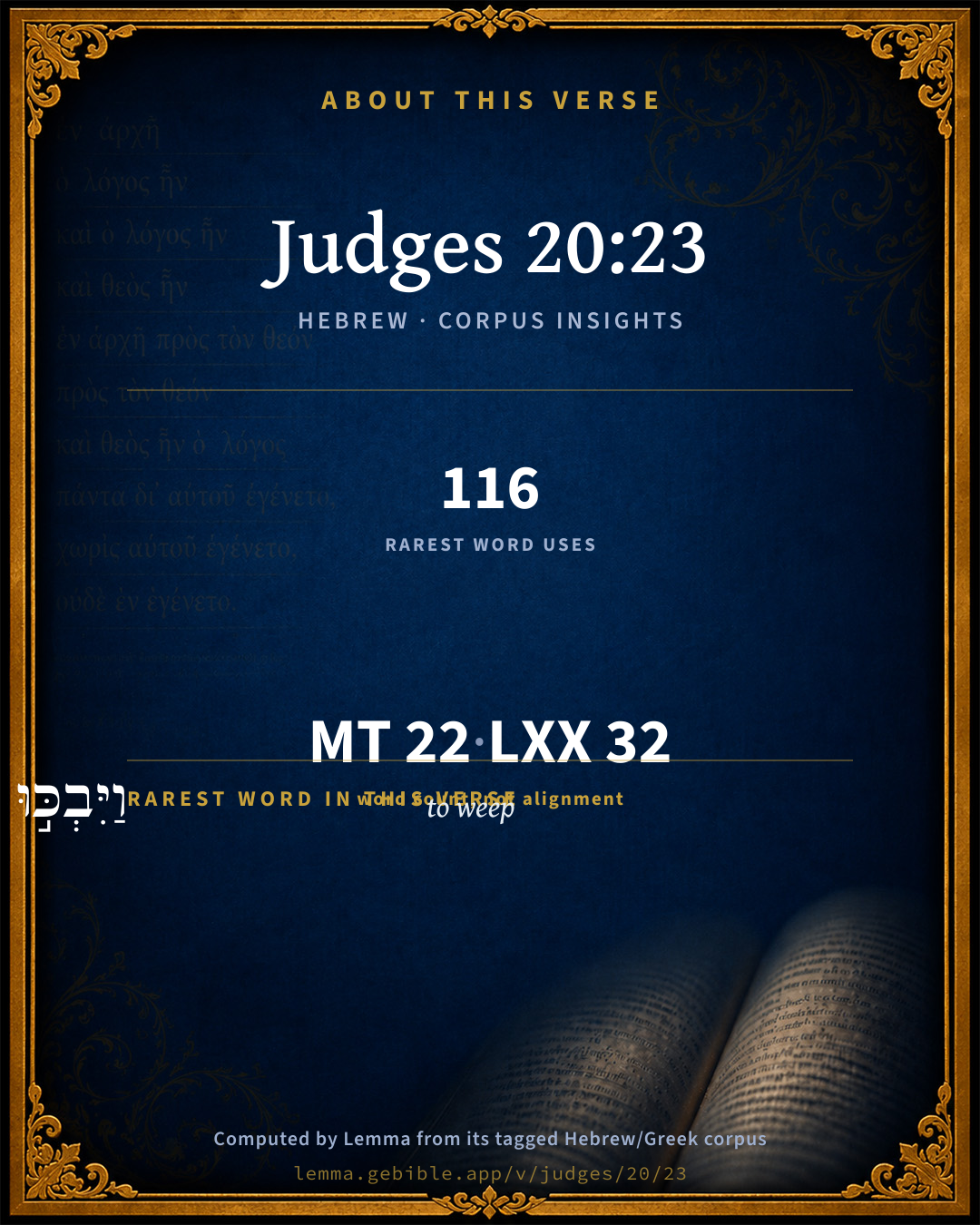
About this verse

These counts appear in no published source. They are computed here, from the morphology-tagged text and Lemma’s own curated glosses. What Lemma adds →

22
words
17
distinct lemmas
Historical
section

Grammatical profile

  • 8 verbs
  • 11 nouns
  • 3 prepositions

Verb forms

  • וַיַּעֲל֣וּ Qal · Sequential Imperfect
  • וַיִּבְכּ֣וּ Qal · Sequential Imperfect
  • וַיִּשְׁאֲל֤וּ Qal · Sequential Imperfect
  • לֵאמֹ֔ר Qal · Infinitive Construct
  • הַאוֹסִ֗יף Hiphil · Imperfect
  • לָגֶ֨שֶׁת֙ Qal · Infinitive Construct
  • וַיֹּ֥אמֶר Qal · Sequential Imperfect
  • עֲל֥וּ Qal · Imperative

Repetition

Words recur within this verse — often emphatic in Hebrew:

  • יְהוָה֮ LORD H3068 ×3
  • וַיַּעֲל֣וּ to go up H5927 ×2
  • בְנֵֽי son H1121 ×2
  • לֵאמֹ֔ר to say H559 ×2

Hebrew & Septuagint length

In English translation the verse runs 38 words from the Hebrew and 42 from the Septuagint (LXX English) — closely comparable.

A rough comparison of the two English renderings, which tokenize alike — not a word-level alignment.

Word counts can differ between the Hebrew and the Greek without any difference in meaning — e.g. the Hebrew direct-object marker אֵת has no separate Greek word, and Greek often adds the article ὁ.

In the original languages it is 22 Hebrew tokens and 32 Greek tokens — but the two are counted differently (Hebrew bundles its prefixes and suffixes into one token; the Greek is in lemma form), so that isn’t a like-for-like length.

Cross-references

5

Topical passages linked to Judges 20:23 in the Treasury of Scripture Knowledge — connected by theme and wording, ordered by reader-vote popularity; previews shown in the World English Bible.

  • Judges 20:26–27 Then all the children of Israel, and all the people, went up, and came to Bethel, and wept, and sat there before Yahweh, and fasted that day until even; and they offered burnt-offerings and peace-offerings before Yahweh.
  • Joshua 7:6 Joshua tore his clothes, and fell to the earth on his face before the ark of Yahweh until the evening, he and the elders of Israel; and they put dust on their heads.
  • Psalms 78:34–36 When he killed them, then they inquired after him. They returned and sought God earnestly.
  • Hosea 5:15 I will go and return to my place, until they acknowledge their offense, And seek my face. In their affliction they will seek me earnestly."
  • Judges 20:18 The children of Israel arose, and went up to Bethel, and asked counsel of God; and they said, Who shall go up for us first to battle against the children of Benjamin? Yahweh said, Judah [shall go up] first.

Cross-references courtesy of OpenBible.info (CC BY 4.0).

Hebrew and Greek witnesses Masoretic Hebrew ↔ Greek Septuagint

The same verse in the two great witnesses to the Old Testament, shown verse-for-verse.

These are two independent witnesses, not word-aligned to each other, and the Septuagint is shown in lemma (dictionary) form.

Hebrew Judges 20:23 Masoretic · Westminster Leningrad Codex

וַיַּעֲל֣וּ בְנֵֽי יִשְׂרָאֵ֗ל וַיִּבְכּ֣וּ לִפְנֵֽי יְהוָה֮ עַד הָעֶרֶב֒ וַיִּשְׁאֲל֤וּ בַֽיהוָה֙ לֵאמֹ֔ר הַאוֹסִ֗יף לָגֶ֨שֶׁת֙ לַמִּלְחָמָ֔ה עִם בְּנֵ֥י בִנְיָמִ֖ן אָחִ֑י וַיֹּ֥אמֶר יְהוָ֖ה עֲל֥וּ אֵלָֽיו

The children of Israel went up and wept before Yahweh until even; and they asked of Yahweh, saying, Shall I again draw near to battle against the children of Benjamin my brother? Yahweh said, Go up against him.

World English Bible · Public Domain

Greek LXX Judges 20:23 Septuagint · lemma form

καί ἀναβαίνω ὁ υἱός ἰσραήλ καί κλαίω ἐνώπιον κύριος ἕως ἑσπέρα καί ἐρωτάω ἐν κύριος λέγω εἰ προςτίθημι ἐγγίζω εἰς παράταξις πρός υἱός βενιαμίν ἀδελφός ἐγώ καί εἶπον κύριος ἀναβαίνω πρός αὐτός

And the children of Israel went up, and wept before the Lord till evening, and enquired of the Lord, saying, Shall we again draw near to battle with our brethren the children of Benjamin? and the Lord said, Go up against them.

LXX2012 (modern English Septuagint) · Public Domain

Hebrew: Westminster Leningrad Codex (CC BY 4.0). Greek: Septuagint (public domain); English from LXX2012 (modern English Septuagint) (Public Domain). How the Septuagint differs from the Hebrew →

Targum (Aramaic paraphrase)

1

The Targum is the ancient Jewish Aramaic paraphrase of the Hebrew Scriptures — an interpretive translation, not the Hebrew text itself. Onkelos (literal) and Pseudo-Jonathan (expansive) render the Torah, and Jonathan the Prophets. Coverage is partial: where no permissively-licensed English translation exists for a verse, only the Aramaic is shown. This is verse-level text, not a word-by-word alignment to the Hebrew.

  1. Targum Jonathan Prophets (Joshua–Malachi)
    וּסְלִיקוּ בְנֵי יִשְׂרָאֵל וּבְכוֹ קֳדָם יְיָ עַד רַמְשָׁא וּשְׁאִילוּ בְמֵימְרָא דַייָ לְמֵימַר הַאוֹסִיף לְמִקְרַב לְאַגָחָא קְרָבָא עִם בְּנֵי בִנְיָמִין אֲחִי וַאֲמַר יְיָ סַקוּ עֲלֵיהוֹן:

    (no public-domain English translation for this verse)

    Targum Jonathan — Aramaic: “Mikraot Gedolot” (public domain). English: “Sefaria Community Translation” (CC0 1.0 (public-domain dedication)); “London "Chaldee Paraphrase," 1871” (public domain). Text via Sefaria.

Commentary

Notes on Judges 20:23 from classic Christian and Jewish commentators (each source and its license shown beneath its notes). The classic Christian expositions comment on the surrounding passage and are grouped to its opening verse, so a note may address several verses; the Jewish commentaries on the Tanakh (Rashi and others) are per-verse, so they appear only where the commentator wrote on this verse.

Lemma curates 59 commentaries, every one of them public domain or Creative Commons licensed, each selected and text-cleaned for this edition rather than reprinted as found. About our sources →

Trapp's Complete Commentary

John Trapp

Jdg 20:23 (And the children of Israel went up and wept before the LORD until even, and asked counsel of the LORD, saying, Shall I go up again to battle against the children of Benjamin my brother? And the LORD said, Go up against him.)

Ver. 23. Wept before the Lord until even.] Yet more for their losses than for their offences: at least, they were not yet so thoroughly humbled, their repentance was not so deep and downright, so soaking and souring with the greatness of godly sorrow, as was fitting. David’s heart was leavened. {Psa 73:21} "Peter wept bitterly," {Mat 26:75} and that for sin as it is sin, offensivum Dei, et aversivum a Deo, an offence against God, and an aversion from God.

Go up against him.] Thy brother though he be. They neither prayed for success, nor doth God promise them any; but answereth them according to the idols of their hearts, of which they had not yet repented. They had forgotten, belike, what Joshua had foretold them; {Jos 24:19-20} - "Ye cannot serve the Lord," i.e., unless ye will be thorough in his service, "for he is a holy God, he is a jealous God, he will not forgive your transgressions nor your sins. If ye fosake the Lord, and serve strange gods, then he will turn and do you hurt, and consume you, after that he hath done you good."

John Trapp, A Commentary or Exposition upon All the Books of the Old and New Testament (1647–1656) — public domain. Text from a community e-Sword module.

Adam Clarke's Commentary

Verse 23. Go up against him.] It appears most evident that the Israelites did not seek the protection of God. They trusted in the goodness of their cause and in the multitude of their army. God humbled them, and delivered them into the hands of their enemies, and showed them that the race was not to the swift, nor the battle to the strong.

Adam Clarke's Commentary on the Bible (1810–1826) — public domain. Text from a community e-Sword/MySword module.

Ellicott's Commentary for English Readers

(23) And the children of Israel.—This verse is parenthetical and retrospective. The whole narrative is arranged in a very simple manner, and shows an unformed archaic style.

Against the children of Benjamin my brother.—The words “my brother” show a sort of compunction, an uneasy sense that possibly, in spite of the first answer by Urim, God did not approve of a fratricidal war.

A Bible Commentary for English Readers, edited by Charles John Ellicott (1878–1897) — public domain. Text from a community e-Sword module.

The Cambridge Bible for Schools and Colleges

gen. ed. J. J. S. Perowne

23. wept before the Lord] Cf. Jdg_20:26, Jdg_2:4, Jdg_21:2. After went up we should supply to Beth-el, as in Jdg_20:26.

The Cambridge Bible for Schools and Colleges (gen. ed. J. J. S. Perowne; Cambridge University Press, 1878–1918) — public domain. Text from a community e-Sword module.

John Gill's Exposition

And the children of Israel went up and wept before the Lord until even,.... The evening of the day in which the battle was fought; not that the whole army went up to Shiloh to the house of God there, but a deputation of them, who lamented their defeat, and the loss of so many lives, but not their sins and transgressions, and particularly the idolatry they had been guilty of:

and asked counsel of the Lord, saying, shall we go up again to battle against the children of Benjamin my brother? they seemed to have some doubt, by the loss they sustained, whether they were right in going to war with Benjamin, especially as he was their brother; and therefore the question now is, not who should go up first, which was already determined, but whether they should go at all; and still they do not ask any help of God in battle, nor success, but were depending on their numbers, and the justness of their cause, and therefore neither is promised to them, only they have an answer to their question:

and the Lord said, go up against him; for Benjamin was certainly in the wrong, and therefore the Israelites are directed to go against him, and they also were not sufficiently chastised, nor thoroughly humbled.

John Gill's Exposition of the Whole Bible (1746–1763) — public domain (CC PDM 1.0). Text via the HelloAO Bible API.

Haydock's Catholic Bible Commentary

And join battle. This is an explanation of Hebrew, "against him." (Haydock) --- The Israelites still neglected to sue for the divine protection, trusting in their numbers. God sends them again to battle, and suffers them to be routed. Did he deceive them? By no means. He wished them to learn the important lesson of self-diffidence, and he had not promised them the victory. (Haydock) --- But after they had humbled themselves, He acts like a master. I will deliver, &c., ver. 28. (Calmet)

George Leo Haydock (1774–1849), Haydock's Catholic Family Bible and Commentary, 1859 edition — public domain. Excludes Psalms (Douay-Rheims chapter numbering differs from Protestant) and Deuterocanonical books (Catholic canon only).

Matthew Poole's English Annotations

Went up and wept; not so much for their sins as for their defeat and loss, as appears by the sequel.

Against the children of Benjamin my brother; they impute their ill success not to their own sins, as they had great reason to do, but to their taking up arms against their brethren, the lawfulness whereof they now begin to doubt of. But still they persist in their former neglect of seeking God’s assistance in the way which he had appointed, as they themselves acknowledge presently, by doing those very things which now they sinfully neglected, Jdg 20:26, and therefore are again justly punished.

Go up against him: God answers to their question; but as they did not desire his assistance and success, so he doth not promise it.

Matthew Poole's English Annotations on the Holy Bible (1683–1685) — public domain. Text from a community e-Sword/MySword module.

Whedon's Commentary on the Bible

Daniel D. Whedon

23. Went up and wept — Though they had sought to speak lightly of their losses, and to assure themselves of victory, there was a secret sadness and a gloomy sense of loss. Though their loss had not thoroughly subdued them, it had manifestly humbled them, and now they weep as well as ask of God; and their question is not, Who shall go up first? but, Shall I go up again to battle against the children of Benjamin my brother? There is a noticeable humility behind this question, as compared with that of Jdg_20:18, but it lacks the depth and penitence that appear in Jdg_20:26-28. It is noticeable, too, that in Jdg_20:18 they ask of God, while here and afterwards they inquire of Jehovah, the covenant God of Israel, as if in the former instance they had failed to recognise Jehovah in his proper character as their covenant God.

Go up against him — Jehovah does not espouse the cause of Benjamin, though he grants him signal victories. His purpose is first to humble the mightier forces of Israel, who have been glowing too much in their own strength.

Daniel D. Whedon (gen. ed.), Commentary on the Old and New Testaments (1874–1909) — public domain. Text from a community e-Sword module.

The Pulpit Commentary

And the children of Israel went up and wept, etc. This verse must precede chronologically ver. 22, and explains the circumstances under which the battle referred to in ver. 22 took place. The unexpected repulse they had met with had begun to produce its intended effect. There was a humbling of themselves before God, a brokenness of spirit, a deepened sense of dependence upon God, and a softening of their feelings towards their brother Benjamin. All this was shown as they again went to the tabernacle at Bethel to ask the Lord (ver. 18).

HOMILIES BY W.F. ADENEY Ver. 23. Lessons of defeat.

The Christian sometimes encounters defeat in the enterprises of spiritual warfare in the battle of the inner life, in efforts to destroy the wickedness and misery of the world, in missionary campaigns.

I DEFEAT SHOULD AROUSE REFLECTION. The Israelites had acted hastily under the impulse of sudden indignation. In defeat they were thrown back to think of the object and methods of their war. This war against a brother tribe was a terrible undertaking. Was it necessary? No war should be undertaken till it is absolutely necessary. It may be our duty to oppose our own brethren; but this should be done only after serious reflection. We are sometimes allowed to fail that we may consider more deeply all that is involved in actions attended with serious consequences.

II DEFEAT SHOULD INDUCE HUMILITY AND REPENTANCE. The Israelites had been too self-confident. Enraged at the wickedness of one town, they had not realised their own sin, nor how this wickedness was but one act of national depravity. They were now the champions of justice. The position thus assumed by them would blind them to their own failings and stimulate pride. When Christian men do battle against some monstrous evil, they too are in danger of falling into similar failings of pride and self-righteousness. Defeat is then a wholesome humiliation leading to repentance. If we are to testify against the sin of others, we too must not forget that we also are sinners.

III DEFEAT SHOULD LEAD US TO SEEK COUNSEL OF GOD.

1. The Israelites had consulted some oracle, some "gods," before going toward. After defeat they turned to the true God, the Eternal. We often need to fail before we will learn to pray. Then we see that our wisdom is to follow God"s will.

2. The Israelites did not simply ask for success. They asked whether or no they should go up to war. We should not pray for God"s blessing on the enterprise which we are obstinately pursuing irrespective of his will, but should first ask for light to teach us whether we should pursue it.

3. The Israelites did not ask for God"s strength, but only for his guidance. Perhaps if they had invoked his aid they would not have failed a second time. We need trust in God and reliance on his help for perfect success.

IV DEFEAT SHOULD LEAD TO RENEWED AND IMPROVED EFFORT. Through repeated defeats Israel persevered on to victory. So it is with the Christian. "Though he fall, he shall not be utterly cast down". A. (Psa_37:24)

The Pulpit Commentary (1880–1919), ed. H.D.M. Spence-Jones & Joseph S. Exell — public domain. Text from a community e-Sword module.

John Wesley's Explanatory Notes

Wept - Not so much for their sins, as for their defeat and loss. My brother-They impute their ill success, not to their own sins, but to their taking up arms against their brethren. But still they persist in their former neglect of seeking God's assistance in the way which he had appointed, as they themselves acknowledged presently, by doing those very things which now they neglected.

John Wesley, Explanatory Notes Upon the Whole Bible (1754–1765) — public domain. Text via the GEBible commentary corpus.

Keil & Delitzsch

C. F. Keil & F. Delitzsch

But before renewing the conflict they went up to Bethel, wept there before Jehovah, i.e., before the sanctuary of the ark, where Jehovah was present in the midst of His people, enthroned between the cherubim, until the evening, and then inquired of the Lord (again through the high priest) "Shall I again draw near to war with the children of Benjamin my brother" (i.e., renew the war with him)? The answer ran thus: "Advance against him."

Keil & Delitzsch — Biblical Commentary on the Old Testament (1861–1891) — public domain (CC PDM 1.0). Text via the HelloAO Bible API. (Old Testament only.)

Lesson kit

Teaching starters — assembled from the data on this page, not authored interpretation. Every prompt links to the verse data it draws on. Edit before teaching.

Judges, in the Historical, opens this verse with 22 words (17 distinct Hebrew lemmas). Its most distinctive word is bâkâh (“to weep”). A historical commentator’s framing appears above. Read the whole chapter for the surrounding context.

Discussion questions

  1. What does “to weep” (bâkâh) contribute to the verse as a whole?
  2. How does Judges 20:26–27, which shares this passage’s theme, read alongside this verse?
  3. What does the repetition of “LORD” (3× in this one verse) do in this verse?
  4. The translations on this page render this verse differently — a whole-verse word diff, not a word-by-word alignment. What might account for the different wordings?
  5. «וַיַּעֲל֣וּ» is a Qal Sequential Imperfect verb. How does that grammatical form shape the action described?
  6. Compare how Trapp's Complete Commentary and Adam Clarke's Commentary read this verse. Where do they agree or differ?

Things to notice

Reading settings

Reading text

Shown beneath each verse's original-language words.

Old Testament
Old Testament edition

Read the OT as the Masoretic Hebrew (MT) or the Greek Septuagint (LXX).

English shown for the Greek Septuagint (in the Hebrew ↔ Greek comparison).

Comparing translations? Open the Compare panel on any verse page to stack up to four side by side.