
Numbers 36:4

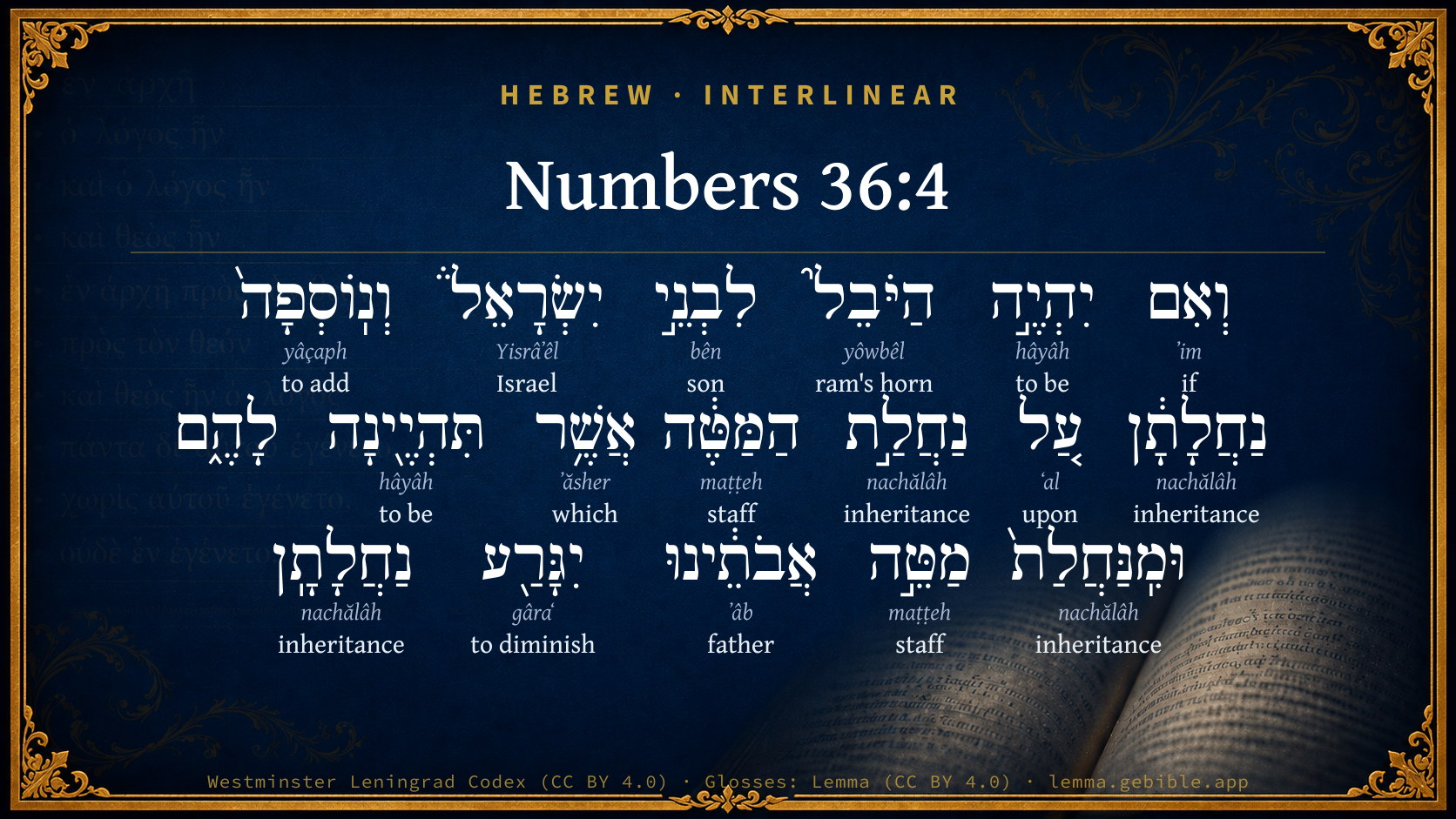
Hebrew (Westminster Leningrad Codex) Numbers 36:4 appears in the Hebrew Old Testament. The text above is from the Westminster Leningrad Codex. Each word links to its Strong’s number, a concise gloss, and parsing drawn from the Open Scriptures Hebrew Bible morphology. Click any word for its full Brown-Driver-Briggs (BDB) entry.
Download image
Cite this verse

Numbers 36:4 (World English Bible). Public Domain. Lemma interlinear Bible study tool, https://lemma.gebible.app/v/numbers/36/4.

Show BibTeX & RIS
BibTeX
RIS
English Translation
When the jubilee of the children of Israel shall be, then will their inheritance be added to the inheritance of the tribe whereunto they shall belong: so will their inheritance be taken away from the inheritance of the tribe of our fathers.
World English Bible · Public Domain
Download a study sheet

One document with this verse’s original text, its word-by-word gloss line, the meaning frame, cross-references with their text, attributed commentary, and full source and license credits — printable, and it pastes into notes with its structure intact.

This verse Autodidact and up

Study sheet (.html) Plain text (.txt)

A passage Seminary Student

Up to 50 verses in one chapter. A passage sheet keeps up to 6 commentary sources and 12 cross-references per verse, in the order this page ranks them, and says so on the sheet whenever that leaves anything out. Ask for a single verse and you get the Autodidact verse sheet above.

Everything on this page stays free to read, with no account — the sheet is a download of what is already on screen, not access to it.

Want to remove ads? Support Godless Engineer
Compare translations 3

The same verse in 3 English versions, stacked beneath the original-language interlinear above. Click any original word for its lexicon entry.

Each is an independent rendering of the whole verse — the interlinear is not word-aligned to these translations.

Highlighted words mark where these versions differ — a whole-verse word diff, not a word-by-word alignment.

  • World English Bible Public Domain
    When the jubilee of the children of Israel shall be, then will their inheritance be added to the inheritance of the tribe whereunto they shall belong: so will their inheritance be taken away from the inheritance of the tribe of our fathers.
  • King James Version Public Domain
    And when the jubilee of the children of Israel shall be, then shall their inheritance be put unto the inheritance of the tribe whereunto they are received: so shall their inheritance be taken away from the inheritance of the tribe of our fathers.
  • unfoldingWord Literal Text CC BY-SA 4.0
    And when it will be the Jubilee for the sons of Israel, then their inheritance will be added onto the inheritance of the tribe which they belong to, and their inheritance will be withdrawn from the inheritance of the tribe of our fathers.”

unfoldingWord Literal Text — © unfoldingWord, licensed CC BY-SA 4.0. Word-aligned USFM3 via Door43 (git.door43.org/unfoldingWord/en_ult).

Versions to compare (up to 4)

3 of 4 selected

Show all 18 translations

Every available English version of this verse, each an independent rendering of the whole verse.

  • World English Bible Public Domain
    When the jubilee of the children of Israel shall be, then will their inheritance be added to the inheritance of the tribe whereunto they shall belong: so will their inheritance be taken away from the inheritance of the tribe of our fathers.
  • Berean Standard Bible Public Domain
    And when the Jubilee for the Israelites comes, their inheritance will be added to the tribe into which they marry and taken away from the tribe of our fathers.”
  • Majority Standard Bible Public Domain
    And when the Jubilee for the Israelites comes, their inheritance will be added to the tribe into which they marry and taken away from the tribe of our fathers.”
  • King James Version Public Domain
    And when the jubilee of the children of Israel shall be, then shall their inheritance be put unto the inheritance of the tribe whereunto they are received: so shall their inheritance be taken away from the inheritance of the tribe of our fathers.
  • American Standard Version (1901) Public Domain
    And when the jubilee of the children of Israel shall be, then will their inheritance be added unto the inheritance of the tribe whereunto they shall belong: so will their inheritance be taken away from the inheritance of the tribe of our fathers.
  • Revised Version (1885) Public Domain
    And when the jubile of the children of Israel shall be, then shall their inheritance be added unto the inheritance of the tribe whereunto they shall belong: so shall their inheritance be taken away from the inheritance of the tribe of our fathers.
  • Geneva Bible (1599) Public Domain
    Also when the Iubile of the children of Israel commeth, then shall their inheritance be put vnto the inheritance of the tribe whereof they shall be: so shall their inheritance be taken away from the inheritance of the tribe of our fathers.
  • Douay-Rheims (1899) Public Domain
    And so it shall come to pass, that when the jubilee, that is, the fiftieth year of remission, is come, the distribution made by the lots shall be confounded, and the possession of the one shall pass to the others.
  • Young's Literal Translation Public Domain
    and if it is the jubilee of the sons of Israel, then hath their inheritance been added to the inheritance of the tribe which is theirs, and from the inheritance of the tribe of our fathers is their inheritance withdrawn.'
  • Literal Standard Version CC BY-SA 4.0
    and if it is the Jubilee of the sons of Israel, then their inheritance has been added to the inheritance of the tribe which is theirs, and their inheritance is withdrawn from the inheritance of the tribe of our fathers.”
  • Unlocked Literal Bible CC BY-SA 4.0
    In that case, when the year of Jubilee of the people of Israel comes, then their share will be joined to the share of the tribe that they have joined. In this way, their share will be taken away from the share of our ancestors' tribe.”
  • unfoldingWord Literal Text CC BY-SA 4.0
    And when it will be the Jubilee for the sons of Israel, then their inheritance will be added onto the inheritance of the tribe which they belong to, and their inheritance will be withdrawn from the inheritance of the tribe of our fathers.”
  • Darby Bible Public Domain
    And when the jubilee of the children of Israel shall come, then shall their inheritance be added to the inheritance of the tribe to which they shall belong; and their inheritance shall be taken away from the inheritance of the tribe of our fathers.
  • World Messianic Bible Public Domain
    When the jubilee of the children of Israel comes, then their inheritance will be added to the inheritance of the tribe to which they shall belong. So their inheritance will be taken away from the inheritance of the tribe of our fathers.”
  • Webster's Bible Public Domain
    And when the jubilee of the children of Israel shall be, then will their inheritance be put to the inheritance of the tribe into which they are received: so shall their inheritance be taken away from the inheritance of the tribe of our fathers.
  • Free Bible Version CC BY-SA 4.0
    So when the Jubilee for the Israelites comes around, their allocation would be added to the tribe into which they marry, and taken away from our fathers' tribe.”
  • Bible in Basic English Public Domain
    And at the time of the Jubilee of the children of Israel, their property will be joined to the heritage of the tribe of which they are part and will be taken away from the heritage of the tribe of our fathers.
  • JPS Tanakh (1917) Public Domain
    And when the jubilee of the children of Israel shall be, then will their inheritance be added unto the inheritance of the tribe whereunto they shall belong; so will their inheritance be taken away from the inheritance of the tribe of our fathers.'

Literal Standard Version (2020), Covenant Press — licensed CC BY-SA 4.0. Text via the HelloAO Bible API (eBible.org). Unlocked Literal Bible (unfoldingWord) — licensed CC BY-SA 4.0. Text via the HelloAO Bible API (eBible.org). unfoldingWord Literal Text — © unfoldingWord, licensed CC BY-SA 4.0. Word-aligned USFM3 via Door43 (git.door43.org/unfoldingWord/en_ult). Free Bible Version, Dr. Jonathan Gallagher — licensed CC BY-SA 4.0. Text via the HelloAO Bible API (eBible.org).

Word by word

More ways to search: Search by grammar → Find every occurrence → Compare this word →

Practice this passage: Drill this verse → Learn its vocabulary →

יִגָּרַ֖ע
gâraʻ
H1639
“to diminish”
Verb, Niphal, Imperfect, 3rd Person, Masculine, Singular
Part of Speech
Verb
Stem
Niphal
Form
Imperfect
Person
3rd Person
Gender
Masculine
Number
Singular
Full BDB Definition

Origin: a primitive root

TWOT: 384

to diminish, restrain, withdraw, abate, keep back, do away, take from, clip - (Qal) - to diminish - to restrain - to withdraw - (Niphal) - to be withdrawn - to be restrained - (Piel) to withdraw, draw up
  1. וְאִם ʼim H518 “and · if” Conjunction + Conjunction
  2. יִהְיֶ֣ה hâyâh H1961 “to be” Verb, Qal, Imperfect, 3rd Person, Masculine, Singular
  3. הַיֹּבֵל֮ yôwbêl H3104 “the · ram's horn” Particle, Definite Article + Noun, Common, Masculine, Singular, Absolute
  4. לִבְנֵ֣י bên H1121 “to/for · sons of” Preposition + Noun, Common, Masculine, Plural, Construct
  5. יִשְׂרָאֵל֒ Yisrâʼêl H3478 “Israel” Noun, Proper
  6. וְנֽוֹסְפָה֙ yâçaph H3254 “and · to add” Conjunction + Verb, Niphal, Sequential Perfect, 3rd Person, Feminine, Singular
  7. נַחֲלָתָ֔ן nachălâh H5159 “inheritance · their” Noun, Common, Feminine, Singular, Construct + Suffix, Personal, 3rd Person, Feminine, Plural
  8. עַ֚ל ʻal H5921 “upon” Preposition
  9. נַחֲלַ֣ת nachălâh H5159 “inheritance of” Noun, Common, Feminine, Singular, Construct
  10. הַמַּטֶּ֔ה maṭṭeh H4294 “the · staff” Particle, Definite Article + Noun, Common, Masculine, Singular, Absolute
  11. אֲשֶׁ֥ר ʼăsher H834 “which” Particle, Relative
  12. תִּהְיֶ֖ינָה hâyâh H1961 “to be” Verb, Qal, Imperfect, 3rd Person, Feminine, Plural
  13. וּמִֽנַּחֲלַת֙ nachălâh H5159 “and · from · inheritance of” Conjunction + Preposition + Noun, Common, Feminine, Singular, Construct
  14. מַטֵּ֣ה maṭṭeh H4294 “staff of” Noun, Common, Masculine, Singular, Construct
  15. אֲבֹתֵ֔ינוּ ʼâb H1 “fathers · our” Noun, Common, Masculine, Plural, Construct + Suffix, Personal, 1st Person, Common, Plural
  16. נַחֲלָתָֽן nachălâh H5159 “inheritance · their” Noun, Common, Feminine, Singular, Construct + Suffix, Personal, 3rd Person, Feminine, Plural

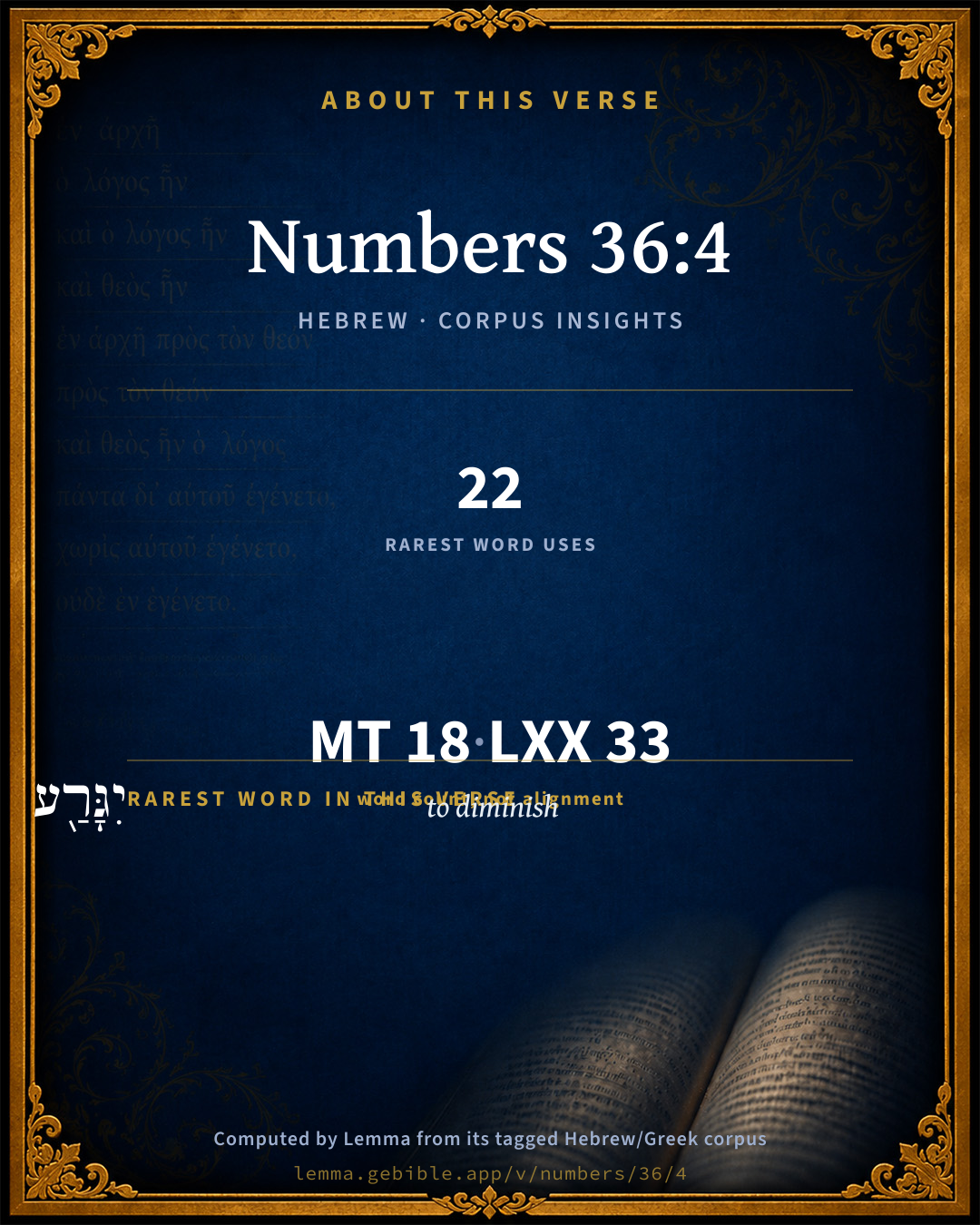
About this verse

These counts appear in no published source. They are computed here, from the morphology-tagged text and Lemma’s own curated glosses. What Lemma adds →

18
words
12
distinct lemmas
Pentateuch
section

Notable vocabulary

The rarest word here is יִגָּרַ֖ע to diminish H1639 — appearing just 22 times in the whole Hebrew Bible.

Shared distinctive vocabulary

יִגָּרַ֖ע to diminish H1639 occurs in 21 verses of the Hebrew Bible. Also found in:

Grammatical profile

  • 4 verbs
  • 10 nouns
  • 2 prepositions
  • 1 conjunction
  • 1 particle

Verb forms

  • יִהְיֶ֣ה Qal · Imperfect
  • וְנֽוֹסְפָה֙ Niphal · Sequential Perfect
  • תִּהְיֶ֖ינָה Qal · Imperfect
  • יִגָּרַ֖ע Niphal · Imperfect

Repetition

Words recur within this verse — often emphatic in Hebrew:

  • נַחֲלָתָ֔ן inheritance H5159 ×4
  • יִהְיֶ֣ה to be H1961 ×2
  • הַמַּטֶּ֔ה staff H4294 ×2

Hebrew & Septuagint length

In English translation the verse runs 42 words from the Hebrew and 43 from the Septuagint (LXX English) — closely comparable.

A rough comparison of the two English renderings, which tokenize alike — not a word-level alignment.

Word counts can differ between the Hebrew and the Greek without any difference in meaning — e.g. the Hebrew direct-object marker אֵת has no separate Greek word, and Greek often adds the article ὁ.

In the original languages it is 18 Hebrew tokens and 33 Greek tokens — but the two are counted differently (Hebrew bundles its prefixes and suffixes into one token; the Greek is in lemma form), so that isn’t a like-for-like length.

Cross-references

4

Topical passages linked to Numbers 36:4 in the Treasury of Scripture Knowledge — connected by theme and wording, ordered by reader-vote popularity; previews shown in the World English Bible.

  • Leviticus 25:10–18 You shall make the fiftieth year holy, and proclaim liberty throughout the land to all its inhabitants. It shall be a jubilee to you; and each of you shall return to his own property, and each of you shall return to his family.
  • Leviticus 25:23 "'The land shall not be sold in perpetuity, for the land is mine; for you are strangers and live as foreigners with me.
  • Isaiah 61:2 to proclaim the year of Yahweh's favor, and the day of vengeance of our God; to comfort all who mourn;
  • Luke 4:18–19 "The Spirit of the Lord is on me, Because he has anointed me to preach good news to the poor. He has sent me to heal the brokenhearted, To proclaim release to the captives, Recovering of sight to the blind, To deliver those who are crushed,

Cross-references courtesy of OpenBible.info (CC BY 4.0).

Hebrew and Greek witnesses Masoretic Hebrew ↔ Greek Septuagint

The same verse in the two great witnesses to the Old Testament, shown verse-for-verse.

These are two independent witnesses, not word-aligned to each other, and the Septuagint is shown in lemma (dictionary) form.

Hebrew Numbers 36:4 Masoretic · Westminster Leningrad Codex

וְאִם יִהְיֶ֣ה הַיֹּבֵל֮ לִבְנֵ֣י יִשְׂרָאֵל֒ וְנֽוֹסְפָה֙ נַחֲלָתָ֔ן עַ֚ל נַחֲלַ֣ת הַמַּטֶּ֔ה אֲשֶׁ֥ר תִּהְיֶ֖ינָה לָהֶ֑ם וּמִֽנַּחֲלַת֙ מַטֵּ֣ה אֲבֹתֵ֔ינוּ יִגָּרַ֖ע נַחֲלָתָֽן

When the jubilee of the children of Israel shall be, then will their inheritance be added to the inheritance of the tribe whereunto they shall belong: so will their inheritance be taken away from the inheritance of the tribe of our fathers.

World English Bible · Public Domain

Greek LXX Numbers 36:4 Septuagint · lemma form

ἐάν δέ γίγνομαι ὁ ἄφεσις ὁ υἱός ἰσραήλ καί προςτίθημι ὁ κληρονομία αὐτός ἐπί ὁ κληρονομία ὁ φυλή ὅς ἄν γίγνομαι γυνή καί ἀπό ὁ κληρονομία φυλή πατριά ἐγώ ἀποαἱρέω ὁ κληρονομία αὐτός

And if there shall be a release of the children of Israel, then shall their inheritance be added to the inheritance of the tribe into which the women marry, and their inheritance, shall be taken away from the inheritance of our family's tribe.

LXX2012 (modern English Septuagint) · Public Domain

Hebrew: Westminster Leningrad Codex (CC BY 4.0). Greek: Septuagint (public domain); English from LXX2012 (modern English Septuagint) (Public Domain). How the Septuagint differs from the Hebrew →

Targum (Aramaic paraphrase)

2

The Targum is the ancient Jewish Aramaic paraphrase of the Hebrew Scriptures — an interpretive translation, not the Hebrew text itself. Onkelos (literal) and Pseudo-Jonathan (expansive) render the Torah, and Jonathan the Prophets. Coverage is partial: where no permissively-licensed English translation exists for a verse, only the Aramaic is shown. This is verse-level text, not a word-by-word alignment to the Hebrew.

  1. Targum Onkelos Torah (Genesis–Deuteronomy)
    וְאִם יְהֵי יוֹבֵלָא לִבְנֵי יִשְׂרָאֵל וְתִתּוֹסַף אַחֲסַנְתְּהוֹן עַל אַחֲסָנַת שִׁבְטָא דִי תְהֶוְיָן לְהוֹן וּמֵאַחֲסָנַת שִׁבְטָא דְאֲבְהָתָנָא יִתְמְנַע אַחֲסַנְתְּהֶן

    (no public-domain English translation for this verse)

    Targum Onkelos — Aramaic: “Onkelos Genesis” (public domain); “Onkelos Exodus” (public domain); “Onkelos Leviticus” (public domain); “Onkelos Numbers” (public domain); “Onkelos Deuteronomy” (public domain). English: “Sefaria Community Translation” (CC0 1.0 (public-domain dedication)); “J.W. Etheridge. The Targums of Onkelos and Jonathan Ben Uzziel on the Pentateuch. London: Longmans, Green, 1862” (public domain). Text via Sefaria.

  2. Targum Pseudo-Jonathan Torah (Genesis–Deuteronomy)
    וְאִין יֶהֱוֵי יוּבְלָא לִבְנֵי יִשְרָאֵל וְתִיתוֹסַף אַחְסַנְתְּהוֹן עַל אַחְסָנַת שִׁבְטַיָא דְיֶהֱוְיָן לְהוֹן וּמֵאַחְסָנַת שִׁבְטָא דְאַבְהָתָנָא יִתְמְנַע אַחְסַנְתְּהוֹן

    And at the Jubilee of the Beni Israel their inheritance will be added to that of their tribe in which they will be; and their possession will have been withdrawn from the inheritance of our father's tribe.

    Targum Pseudo-Jonathan — Aramaic: “Targum Jonathan on Genesis” (public domain); “Targum Jonathan on Exodus” (public domain); “Targum Jonathan on Leviticus” (public domain); “Targum Jonathan on Numbers” (public domain); “Targum Jonathan on Deuteronomy” (public domain). English: “The Targum of Jonathan ben Uzziel, trans. J. W. Etheridge, London, 1862” (public domain). Text via Sefaria.

Commentary

Notes on Numbers 36:4 from classic Christian and Jewish commentators (each source and its license shown beneath its notes). The classic Christian expositions comment on the surrounding passage and are grouped to its opening verse, so a note may address several verses; the Jewish commentaries on the Tanakh (Rashi and others) are per-verse, so they appear only where the commentator wrote on this verse.

Lemma curates 59 commentaries, every one of them public domain or Creative Commons licensed, each selected and text-cleaned for this edition rather than reprinted as found. About our sources →

Joseph Benson's Commentary

Num 36:4. When the jubilee shall be, &c. — The jubilee itself, they remonstrate, though designed, among other purposes, to preserve a perfect distinction of estates, tribes, and families, would afford no remedy for this inconvenience, since these inheritances would descend, at the jubilee, by the common right of marriage, to the heirs of these women, should they marry into another tribe.

Joseph Benson's Commentary on the Old and New Testaments (1811–1818) — public domain. Text from a community e-Sword module.

Geneva Bible (1599)

Geneva Bible translators

Signifying that at no time it could return, for in the Jubilee all things returned to their own tribes.

Geneva Bible (1599) marginal notes — public domain. Text via Bolls.life.

Ellicott's Commentary for English Readers

(4) And when the jubile of the children of Israel shall be.—Up to the year of jubile it was possible that the inheritance might revert to the tribe of Manasseh, either by purchase, or as the result of the marriages of the daughters proving childless. At the jubile the transfer of the inheritance to the tribe or tribes into which the daughters of Zelophehad might have married would become permanent.

A Bible Commentary for English Readers, edited by Charles John Ellicott (1878–1897) — public domain. Text from a community e-Sword module.

The Cambridge Bible for Schools and Colleges

gen. ed. J. J. S. Perowne

4. In the year of Jubile, i.e. every fiftieth year, all purchased land returned to its original owners, or their descendants. But the law of Jubile would not affect the cases in which land was inherited by persons of another tribe. It would, indeed, be inherited by descendants of Zelophehad in the female line, but this would not prevent it from being permanently severed from the tribe of Manasseh.

The law of Jubile is contained in Leviticus 25. See notes in the commentary in this series. The word ‘Jubile’ is formed from the Heb. yôbhçl, a ‘ram’s horn’ trumpet. The fiftieth year was called ‘the year of the yôbhçl,’ or, more shortly, ‘the yôbhçl,’ because it was ushered in by the blowing of trumpets.

The Cambridge Bible for Schools and Colleges (gen. ed. J. J. S. Perowne; Cambridge University Press, 1878–1918) — public domain. Text from a community e-Sword module.

John Gill's Exposition

And when the jubilee of the children of Israel shall be,.... At which time inheritances were to be restored to the original proprietors of them; yet this would be of no service in the present case, but rather the contrary, since it would fix the inheritances of these daughters in another tribe or in other tribes into which they should marry; and so Aben Ezra and Jarchi interpret it, "though" there shall be a jubilee, that will be of no advantage; it will not remedy this inconvenience: for

then shall their inheritance be put unto the inheritance of the tribe whereunto they are received; it being one principal part of the business of the jubilee year to settle the inheritances of every tribe; and these daughters being married into another tribe, of consequence their inheritance would be placed there; or should it be sold by their husbands, or their sons, at the year of jubilee it would be restored to them as of such a tribe:

so shall their inheritance be taken away from the inheritance of the tribe of our fathers; and thereby be a lessening of it; and every tribe being ambitious of preserving and increasing its grandeur, this affair sensibly affected the heads of this tribe.

John Gill's Exposition of the Whole Bible (1746–1763) — public domain (CC PDM 1.0). Text via the HelloAO Bible API.

Haydock's Catholic Bible Commentary

That is, an explanation of the jubilee, added by St. Jerome, who gives the sense of the Hebrew, though not the very words. --- Lots. Hebrew, "when the jubilee of the children of Israel is come, then shall their inheritance be added to that of the tribe in which they are received; so shall their inheritance be taken away from the inheritance of the tribe of our fathers." (Haydock)

George Leo Haydock (1774–1849), Haydock's Catholic Family Bible and Commentary, 1859 edition — public domain. Excludes Psalms (Douay-Rheims chapter numbering differs from Protestant) and Deuterocanonical books (Catholic canon only).

Matthew Poole's English Annotations

Which God appointed principally for this end, to preserve the inheritance in the hands of the tribes and families to which they were first given.

Matthew Poole's English Annotations on the Holy Bible (1683–1685) — public domain. Text from a community e-Sword/MySword module.

Whedon's Commentary on the Bible

Daniel D. Whedon

4. The jubilee — Lev_25:8-55, notes. “Strictly speaking, the hereditary property would pass at once, when the marriage took place, to the tribe into which an heiress married, and not merely at the year of jubilee. But up to the year of jubilee it was always possible that the hereditary property might revert to the tribe of Manasseh, either through the marriage being childless, or through the purchase of the inheritance.

But in the year of jubilee all landed property that had been alienated was to return to its original proprietor or his heir. Lev_25:33, etc. In this way the transfer of an inheritance from one tribe to another, which took place in consequence of a marriage, would be established in perfect unity.” — Keil and Delitzsch.

Daniel D. Whedon (gen. ed.), Commentary on the Old and New Testaments (1874–1909) — public domain. Text from a community e-Sword module.

The Pulpit Commentary

When the jubilee of the children of Israel shall be. It is remarkable that this is the only reference by name to the Jubilee (lbewOy, jubeel; not jubilee, which is the vulgar form of the same word derived from the Latin jubiheus) to be found in the Scriptures. Some allusions more or less doubtful have been pointed out in the prophets, but the only one which seems incontrovertible is in Eze_46:17, and belongs to the ideal regime of that vision. Jeremiah"s right of redemption over the lands of his family was probably due to the fact that they were priestly lands, (Jos_21:18 Jer_1:1 Jer_32:7-9) and as such incapable of permanent alienation. It is, therefore, doubtful whether the Jubilee was ever actually observed, although the principle upon which it rested, the equity of redemption which no Israelite could divest himself of, was undoubtedly acknowledged. (see notes on Le 25) Then shall their inheritance be put unto the inheritance of the tribe whereunto they are received.

It is again remarkable that the one explicit reference to the Jubilee should be only to an indirect consequence of its practical working. The Jubilee could not really transfer the property of the heiress to her husband"s tribe, but it would in effect confirm that transfer, and make it permanent. In practice no property would be considered to have finally changed hands until the year of Jubilee, when an extensive re-settlement took place, and when all titles not successfully challenged would be considered as confirmed. Since the title of the heiress"s children could not be challenged, and since any intermediate disposition of the land must then determine, the Jubilee would seem to effect the transfer of which it compelled the recognition. It is, however, none the less strange that the Manassites should have laid such stress upon the practical effects of a piece of legislation which had never yet come into use. It seems to point to the conclusion that the same thing had been customary among them in their Egyptian homes, and that they were acquainted, at least by tradition, with its actual working.

The Pulpit Commentary (1880–1919), ed. H.D.M. Spence-Jones & Joseph S. Exell — public domain. Text from a community e-Sword module.

Rashi

Rabbi Shlomo Yitzchaki (Rashi)

ואם יהיה היבל may mean AND IF THERE WILL BE THE JUBILEE — From this R. Judah said: The observance of the Jubilee will cease at some time or other (Sifra, Vayikra Dibbura d'Nedavah, Section 13 1 on Leviticus 2:14).

ואם יהיה היבל may mean, too: AND WHEN THERE WILL BE THE JUBILEE [THEN WILL THEIR INHERITANCE BE ADDED TO THE INHERITANCE OF THE TRIBE TO WHICH THEY SHALL BELONG] — meaning: This is no sale of land so that it returns to the original owner at the Jubilee, for a heritage never returns. Therefore even when the Jubilee will be, the inheritance will not return to its tribe, and it will follow that it will be added על נחלת המטה אשר תהיינה להם TO THE INHERITANCE OF THE TRIBE TO WHICH THEY SHALL BELONG.

Rashi on the Tanakh — English translations: “The Judaica Press complete Tanach with Rashi, translated by A. J. Rosenberg” (CC BY 4.0); “Pentateuch with Rashi's commentary by M. Rosenbaum and A.M. Silbermann, 1929-1934” (public domain); “The Metsudah Tanach series, Lakewood, N.J” (CC BY 4.0); and “The Book of Joshua, Metsudah Publications, 1997” (CC BY 4.0). Text via Sefaria.

Ibn Ezra

Rabbi Abraham ibn Ezra

And even when the Yoveil occurs. And even if there will be a Yoveil, we will not hope to return the inheritance to us, it will always just be an addition to the inheritance of the tribe.

Ibn Ezra on the Tanakh — English translations: “Sefaria Community Translation” (CC0 1.0 (public-domain dedication)); “Yalkut, Sifsei Chachomim Chumash, Metsudah Publications, 2009” (CC BY 4.0); and “Commentary of Ibn Ezra on Isaiah - trans. by M. Friedlander, 1873” (public domain). Text via Sefaria.

Lesson kit

Teaching starters — assembled from the data on this page, not authored interpretation. Every prompt links to the verse data it draws on. Edit before teaching.

Numbers, in the Pentateuch, opens this verse with 18 words (12 distinct Hebrew lemmas). Its most distinctive word is gâraʻ (“to diminish”). A historical commentator’s framing appears above. Read the whole chapter for the surrounding context.

Discussion questions

  1. The word gâraʻ carries the sense “to diminish.” How does it shape the verse?
  2. How does Exodus 5:8, which shares the word «to diminish», read alongside this verse?
  3. What does the repetition of “inheritance” (4× in this one verse) do in this verse?
  4. These translations render this verse differently; the difference is in the English rendering, not the original. What questions does that raise?
  5. «יִהְיֶ֣ה» is a Qal Imperfect verb. How does that grammatical form shape the action described?
  6. Compare how Joseph Benson's Commentary and Geneva Bible (1599) read this verse. Where do they agree or differ?

Things to notice

Reading settings

Reading text

Shown beneath each verse's original-language words.

Old Testament
Old Testament edition

Read the OT as the Masoretic Hebrew (MT) or the Greek Septuagint (LXX).

English shown for the Greek Septuagint (in the Hebrew ↔ Greek comparison).

Comparing translations? Open the Compare panel on any verse page to stack up to four side by side.