
2 Samuel 7:10

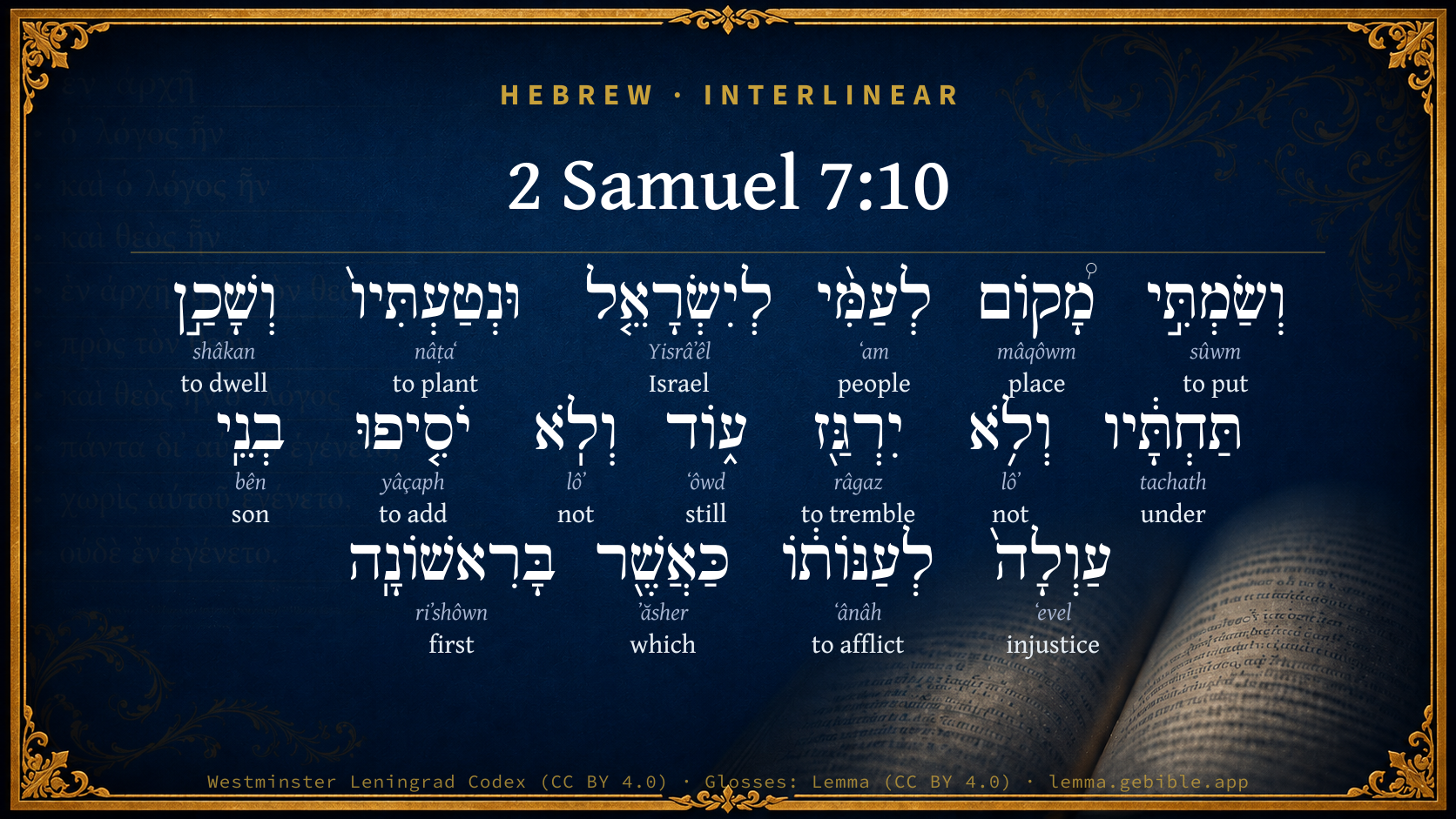
Hebrew (Westminster Leningrad Codex) 2 Samuel 7:10 appears in the Hebrew Old Testament. The text above is from the Westminster Leningrad Codex. Each word links to its Strong’s number, a concise gloss, and parsing drawn from the Open Scriptures Hebrew Bible morphology. Click any word for its full Brown-Driver-Briggs (BDB) entry.
Download image
Cite this verse

2 Samuel 7:10 (World English Bible). Public Domain. Lemma interlinear Bible study tool, https://lemma.gebible.app/v/2-samuel/7/10.

Show BibTeX & RIS
BibTeX
RIS
English Translation
I will appoint a place for my people Israel, and will plant them, that they may dwell in their own place, and be moved no more; neither shall the children of wickedness afflict them any more, as at the first,
World English Bible · Public Domain
Download a study sheet

One document with this verse’s original text, its word-by-word gloss line, the meaning frame, cross-references with their text, attributed commentary, and full source and license credits — printable, and it pastes into notes with its structure intact.

This verse Autodidact and up

Study sheet (.html) Plain text (.txt)

A passage Seminary Student

Up to 50 verses in one chapter. A passage sheet keeps up to 6 commentary sources and 12 cross-references per verse, in the order this page ranks them, and says so on the sheet whenever that leaves anything out. Ask for a single verse and you get the Autodidact verse sheet above.

Everything on this page stays free to read, with no account — the sheet is a download of what is already on screen, not access to it.

Want to remove ads? Support Godless Engineer
Compare translations 3

The same verse in 3 English versions, stacked beneath the original-language interlinear above. Click any original word for its lexicon entry.

Each is an independent rendering of the whole verse — the interlinear is not word-aligned to these translations.

Highlighted words mark where these versions differ — a whole-verse word diff, not a word-by-word alignment.

  • World English Bible Public Domain
    I will appoint a place for my people Israel, and will plant them, that they may dwell in their own place, and be moved no more; neither shall the children of wickedness afflict them any more, as at the first,
  • King James Version Public Domain
    Moreover I will appoint a place for my people Israel, and will plant them, that they may dwell in a place of their own, and move no more; neither shall the children of wickedness afflict them any more, as beforetime,
  • unfoldingWord Literal Text CC BY-SA 4.0
    And I have established a place for my people, for Israel, and I will plant him that he may dwell under him, and he will not tremble anymore, and the sons of wickedness will not continue to afflict him as at first,

unfoldingWord Literal Text — © unfoldingWord, licensed CC BY-SA 4.0. Word-aligned USFM3 via Door43 (git.door43.org/unfoldingWord/en_ult).

Versions to compare (up to 4)

3 of 4 selected

Show all 18 translations

Every available English version of this verse, each an independent rendering of the whole verse.

  • World English Bible Public Domain
    I will appoint a place for my people Israel, and will plant them, that they may dwell in their own place, and be moved no more; neither shall the children of wickedness afflict them any more, as at the first,
  • Berean Standard Bible Public Domain
    And I will provide a place for My people Israel and will plant them so that they may dwell in a place of their own and be disturbed no more. No longer will the sons of wickedness oppress them as they did at the beginning
  • Majority Standard Bible Public Domain
    And I will provide a place for My people Israel and will plant them so that they may dwell in a place of their own and be disturbed no more. No longer will the sons of wickedness oppress them as they did at the beginning
  • King James Version Public Domain
    Moreover I will appoint a place for my people Israel, and will plant them, that they may dwell in a place of their own, and move no more; neither shall the children of wickedness afflict them any more, as beforetime,
  • American Standard Version (1901) Public Domain
    And I will appoint a place for my people Israel, and will plant them, that they may dwell in their own place, and be moved no more; neither shall the children of wickedness afflict them any more, as at the first,
  • Revised Version (1885) Public Domain
    And I will appoint a place for my people Israel, and will plant them, that they may dwell in their own place, and be moved no more; neither shall the children of wickedness afflict them any more, as at the first,
  • Geneva Bible (1599) Public Domain
    (Also I will appoynt a place for my people Israel, and will plant it, that they may dwell in a place of their owne, and moue no more, neither shall wicked people trouble them any more as before time,
  • Douay-Rheims (1899) Public Domain
    And I will appoint a place for my people Israel, and I will plant them, and they shall dwell therein, and shall be disturbed no more: neither shall the children of iniquity afflict them any more as they did before,
  • Young's Literal Translation Public Domain
    and I have appointed a place for My people, for Israel, and have planted it, and it hath tabernacled in its place, and it is not troubled any more, and the sons of perverseness do not add to afflict it any more, as in the beginning,
  • Literal Standard Version CC BY-SA 4.0
    and I have appointed a place for My people, for Israel, and have planted it, and it has dwelt in its place, and it is not troubled anymore, and the sons of perverseness do not add to afflict it anymore, as in the beginning,
  • Unlocked Literal Bible CC BY-SA 4.0
    I will appoint a place for my people Israel and will plant them there, so that they may live in their own place and be troubled no more. No longer will wicked people oppress them, as they did before,
  • unfoldingWord Literal Text CC BY-SA 4.0
    And I have established a place for my people, for Israel, and I will plant him that he may dwell under him, and he will not tremble anymore, and the sons of wickedness will not continue to afflict him as at first,
  • Darby Bible Public Domain
    And I will appoint a place for my people, for Israel, and will plant them, that they may dwell in a place of their own, and be disturbed no more; neither shall the sons of wickedness afflict them any more, as formerly,
  • World Messianic Bible Public Domain
    I will appoint a place for my people Israel, and will plant them, that they may dwell in their own place and be moved no more. The children of wickedness will not afflict them any more, as at the first,
  • Webster's Bible Public Domain
    Moreover, I will appoint a place for my people Israel, and will plant them, that they may dwell in a place of their own, and move no more; neither shall the children of wickedness afflict them any more, as formerly.
  • Free Bible Version CC BY-SA 4.0
    I will choose a place for my people Israel. I will settle them there and they won't be disturbed anymore. Evil people won't persecute them as they used to,
  • Bible in Basic English Public Domain
    And I will make a resting-place for my people Israel, planting them there, so that they may be living in the place which is theirs, and never again be moved; and never again will they be troubled by evil men as they were at the first,
  • JPS Tanakh (1917) Public Domain
    And I will appoint a place for My people Israel, and will plant them, that they may dwell in their own place, and be disquieted no more; neither shall the children of wickedness afflict them any more, as at the first,

Literal Standard Version (2020), Covenant Press — licensed CC BY-SA 4.0. Text via the HelloAO Bible API (eBible.org). Unlocked Literal Bible (unfoldingWord) — licensed CC BY-SA 4.0. Text via the HelloAO Bible API (eBible.org). unfoldingWord Literal Text — © unfoldingWord, licensed CC BY-SA 4.0. Word-aligned USFM3 via Door43 (git.door43.org/unfoldingWord/en_ult). Free Bible Version, Dr. Jonathan Gallagher — licensed CC BY-SA 4.0. Text via the HelloAO Bible API (eBible.org).

Word by word

More ways to search: Search by grammar → Find every occurrence → Compare this word →

Practice this passage: Drill this verse → Learn its vocabulary →

יִרְגַּ֖ז
râgaz
H7264
“to tremble”
Verb, Qal, Imperfect, 3rd Person, Masculine, Singular
Part of Speech
Verb
Stem
Qal
Form
Imperfect
Person
3rd Person
Gender
Masculine
Number
Singular
Full BDB Definition

Origin: a primitive root

TWOT: 2112

tremble, quake, rage, quiver, be agitated, be excited, be perturbed - (Qal) to quake, be disquieted, be excited, be perturbed - (Hiphil) to cause to quake, disquiet, enrage, disturb - (Hithpael) to excite oneself
  1. וְשַׂמְתִּ֣י sûwm H7760 “and · to put” Conjunction + Verb, Qal, Sequential Perfect, 1st Person, Common, Singular
  2. מָ֠קוֹם mâqôwm H4725 “place” Noun, Common, Masculine, Singular, Absolute
  3. לְעַמִּ֨י ʻam H5971 “to/for · people · my” Preposition + Noun, Common, Masculine, Singular, Construct + Suffix, Personal, 1st Person, Common, Singular
  4. לְיִשְׂרָאֵ֤ל Yisrâʼêl H3478 “to/for · Israel” Preposition + Noun, Proper
  5. וּנְטַעְתִּיו֙ nâṭaʻ H5193 “and · to plant · him” Conjunction + Verb, Qal, Sequential Perfect, 1st Person, Common, Singular + Suffix, Personal, 3rd Person, Masculine, Singular
  6. וְשָׁכַ֣ן shâkan H7931 “and · to dwell” Conjunction + Verb, Qal, Sequential Perfect, 3rd Person, Masculine, Singular
  7. תַּחְתָּ֔יו tachath H8478 “under · him” Preposition + Suffix, Personal, 3rd Person, Masculine, Singular
  8. וְלֹ֥א lôʼ H3808 “and · not” Conjunction + Particle, Negative
  9. ע֑וֹד ʻôwd H5750 “still” Adverb
  10. וְלֹֽא lôʼ H3808 “and · not” Conjunction + Particle, Negative
  11. יֹסִ֤יפוּ yâçaph H3254 “to add” Verb, Hiphil, Imperfect, 3rd Person, Masculine, Plural
  12. בְנֵֽי bên H1121 “sons of” Noun, Common, Masculine, Plural, Construct
  13. עַוְלָה֙ ʻevel H5766 “injustice” Noun, Common, Both, Singular, Absolute
  14. לְעַנּוֹת֔וֹ ʻânâh H6031 “to afflict · him” Preposition + Verb, Piel, Infinitive Construct + Suffix, Personal, 3rd Person, Masculine, Singular
  15. כַּאֲשֶׁ֖ר ʼăsher H834 “like/as · which” Preposition + Particle, Relative
  16. בָּרִאשׁוֹנָֽה riʼshôwn H7223 “in/at the · first” Preposition, Determined + Adjective, Adjective, Feminine, Singular, Absolute

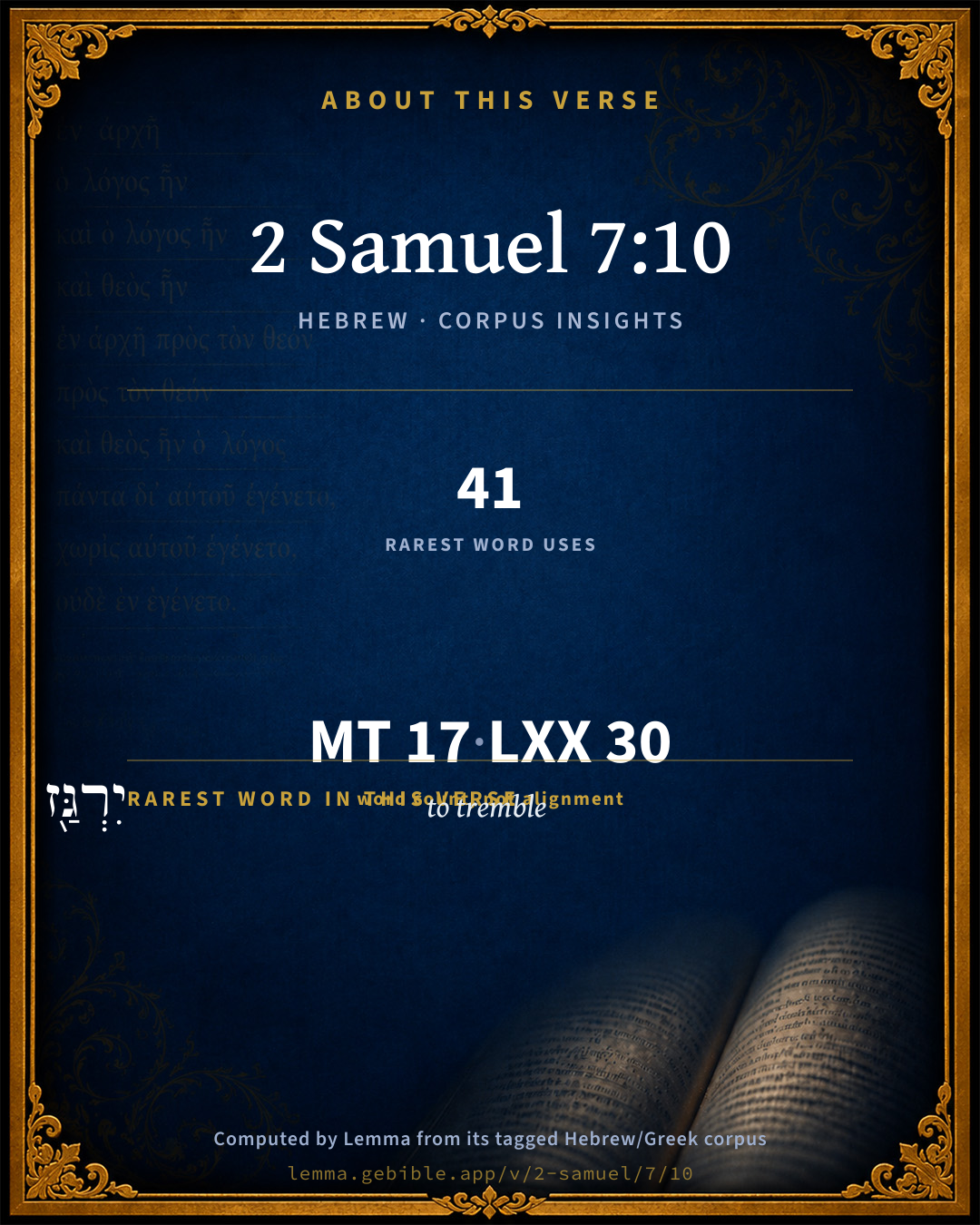
About this verse

These counts appear in no published source. They are computed here, from the morphology-tagged text and Lemma’s own curated glosses. What Lemma adds →

17
words
16
distinct lemmas
Historical
section

Shared distinctive vocabulary

יִרְגַּ֖ז to tremble H7264 occurs in 40 verses of the Hebrew Bible. Also found in:

Grammatical profile

  • 6 verbs
  • 5 nouns
  • 1 adjective
  • 1 preposition
  • 1 adverb
  • 3 particles

Verb forms

  • וְשַׂמְתִּ֣י Qal · Sequential Perfect
  • וּנְטַעְתִּיו֙ Qal · Sequential Perfect
  • וְשָׁכַ֣ן Qal · Sequential Perfect
  • יִרְגַּ֖ז Qal · Imperfect
  • יֹסִ֤יפוּ Hiphil · Imperfect
  • לְעַנּוֹת֔וֹ Piel · Infinitive Construct

Repetition

A word recurs within this verse — often emphatic in Hebrew:

  • וְלֹ֥א not H3808 ×2

Hebrew & Septuagint length

In English translation the verse runs 40 words from the Hebrew and 43 from the Septuagint (LXX English) — closely comparable.

A rough comparison of the two English renderings, which tokenize alike — not a word-level alignment.

Word counts can differ between the Hebrew and the Greek without any difference in meaning — e.g. the Hebrew direct-object marker אֵת has no separate Greek word, and Greek often adds the article ὁ.

In the original languages it is 17 Hebrew tokens and 30 Greek tokens — but the two are counted differently (Hebrew bundles its prefixes and suffixes into one token; the Greek is in lemma form), so that isn’t a like-for-like length.

Cross-references

19

Topical passages linked to 2 Samuel 7:10 in the Treasury of Scripture Knowledge — connected by theme and wording, ordered by reader-vote popularity; previews shown in the World English Bible.

  • Amos 9:15 I will plant them on their land, And they will no more be plucked up out of their land which I have given them," says Yahweh your God.
  • 1 Chronicles 17:9 I will appoint a place for my people Israel, and will plant them, that they may dwell in their own place, and be moved no more; neither shall the children of wickedness waste them any more, as at the first,
  • Jeremiah 24:6 For I will set my eyes on them for good, and I will bring them again to this land: and I will build them, and not pull them down; and I will plant them, and not pluck them up.
  • Isaiah 60:18 Violence shall no more be heard in your land, desolation nor destruction within your borders; but you shall call your walls Salvation, and your gates Praise.
  • Ezekiel 37:25–27 They shall dwell in the land that I have given to Jacob my servant, in which your fathers lived; and they shall dwell therein, they, and their children, and their children's children, forever: and David my servant shall be their prince for ever.
  • Psalms 89:22–23 No enemy will tax him. No wicked man will oppress him.
  • Ezekiel 28:24 There shall be no more a pricking brier to the house of Israel, nor a hurting thorn of any that are round about them, that did despite to them; and they shall know that I am the Lord Yahweh.
  • Psalms 80:8 You brought a vine out of Egypt. You drove out the nations, and planted it.
  • Exodus 15:17 You shall bring them in, and plant them in the mountain of your inheritance, The place, Yahweh, which you have made for yourself to dwell in; The sanctuary, Lord, which your hands have established.
  • Jeremiah 18:9 At what instant I shall speak concerning a nation, and concerning a kingdom, to build and to plant it;
  • Isaiah 5:7 For the vineyard of Yahweh of Hosts is the house of Israel, And the men of Judah his pleasant plant: And he looked for justice, but, behold, oppression; For righteousness, but, behold, a cry of distress.
  • Hosea 2:18 In that day I will make a covenant for them with the animals of the field, And with the birds of the sky, And with the creeping things of the ground. I will break the bow, the sword, and the battle out of the land, And will make them lie down safely.
  • Revelation 21:4 He will wipe away from them every tear from their eyes. Death will be no more; neither will there be mourning, nor crying, nor pain, any more. The first things have passed away."
  • Isaiah 5:2 He dug it up, Gathered out its stones, Planted it with the choicest vine, Built a tower in its midst, And also cut out a winepress therein. He looked for it to yield grapes, But it yielded wild grapes.
  • Exodus 1:13–14 The Egyptians ruthlessly made the children of Israel serve,
  • Exodus 1:22 Pharaoh charged all his people, saying, "You shall cast every son who is born into the river, and every daughter you shall save alive."
  • Judges 4:3 The children of Israel cried to Yahweh: for he had nine hundred chariots of iron; and twenty years he mightily oppressed the children of Israel.
  • 1 Samuel 13:17 The spoilers came out of the camp of the Philistines in three companies: one company turned to the way that leads to Ophrah, to the land of Shual;
  • Psalms 44:4 You are my King, God. Command victories for Jacob!

Cross-references courtesy of OpenBible.info (CC BY 4.0).

Hebrew and Greek witnesses Masoretic Hebrew ↔ Greek Septuagint

The same verse in the two great witnesses to the Old Testament, shown verse-for-verse.

These are two independent witnesses, not word-aligned to each other, and the Septuagint is shown in lemma (dictionary) form.

Hebrew 2 Samuel 7:10 Masoretic · Westminster Leningrad Codex

וְשַׂמְתִּ֣י מָ֠קוֹם לְעַמִּ֨י לְיִשְׂרָאֵ֤ל וּנְטַעְתִּיו֙ וְשָׁכַ֣ן תַּחְתָּ֔יו וְלֹ֥א יִרְגַּ֖ז ע֑וֹד וְלֹֽא יֹסִ֤יפוּ בְנֵֽי עַוְלָה֙ לְעַנּוֹת֔וֹ כַּאֲשֶׁ֖ר בָּרִאשׁוֹנָֽה

I will appoint a place for my people Israel, and will plant them, that they may dwell in their own place, and be moved no more; neither shall the children of wickedness afflict them any more, as at the first,

World English Bible · Public Domain

Greek LXX 2 Samuel 7:10 Septuagint · lemma form

καί τίθημι τόπος ὁ λαός ἐγώ ὁ ἰσραήλ καί καταφυτεύω αὐτός καί κατασκηνόω κατά ἑαυτοῦ καί οὐ μεριμνάω οὐκέτι καί οὐ προςτίθημι υἱός ἀδικία ὁ ταπεινόω αὐτός καθώς ἀπό ἀρχή

And I will appoint a place for my people Israel, and will plant them, and they shall dwell by themselves, and shall be no more distressed; and the son of iniquity shall no more afflict them, as he has done from the beginning,

LXX2012 (modern English Septuagint) · Public Domain

Hebrew: Westminster Leningrad Codex (CC BY 4.0). Greek: Septuagint (public domain); English from LXX2012 (modern English Septuagint) (Public Domain). How the Septuagint differs from the Hebrew →

Targum (Aramaic paraphrase)

1

The Targum is the ancient Jewish Aramaic paraphrase of the Hebrew Scriptures — an interpretive translation, not the Hebrew text itself. Onkelos (literal) and Pseudo-Jonathan (expansive) render the Torah, and Jonathan the Prophets. Coverage is partial: where no permissively-licensed English translation exists for a verse, only the Aramaic is shown. This is verse-level text, not a word-by-word alignment to the Hebrew.

  1. Targum Jonathan Prophets (Joshua–Malachi)
    וְאַשְׁוֵי אֲתַר מְתַקֵן לְעַמִי יִשְׂרָאֵל וַאֲקַיְמִנוּן וְיִשְׁרוּן בְּאַתְרְהוֹן וְלָא יְזוּעוּן עוֹד וְלָא יוֹסְפוּן בְּנֵי רִשְׁעָא לְעַנָיוּתְהוֹן כִּדְבְּקַדְמֵיתָא:

    (no public-domain English translation for this verse)

    Targum Jonathan — Aramaic: “Mikraot Gedolot” (public domain). English: “Sefaria Community Translation” (CC0 1.0 (public-domain dedication)); “London "Chaldee Paraphrase," 1871” (public domain). Text via Sefaria.

Commentary

Notes on 2 Samuel 7:10 from classic Christian and Jewish commentators (each source and its license shown beneath its notes). The classic Christian expositions comment on the surrounding passage and are grouped to its opening verse, so a note may address several verses; the Jewish commentaries on the Tanakh (Rashi and others) are per-verse, so they appear only where the commentator wrote on this verse.

Lemma curates 59 commentaries, every one of them public domain or Creative Commons licensed, each selected and text-cleaned for this edition rather than reprinted as found. About our sources →

The Cambridge Bible for Schools and Colleges

gen. ed. J. J. S. Perowne

10. Moreover I will appoint] It is probably best to take the verbs here as perfects: And I have appointed … and have planted them, and they dwell in their own place. For the metaphor of planting, comp. Exo_15:17; Psa_44:2.

and move no more] Better, and shall not be disturbed any more.

the children of wickedness] Sons of wickedness = wicked men. Cp. Psa_89:22.

10, 11. as beforetime, and as since the time] It is best to connect the first clause of 2Sa_7:11 with 2Sa_7:10. Beforetime refers to the beginning of the nation’s history in Egypt; since, &c. to the various oppressions they had suffered from the beginning of the period of the Judges down to the present.

and have caused thee to rest] And have given thee rest, as in 2Sa_7:1; to be connected with the verbs at the beginning of 2Sa_7:10, I have appointed … and have planted them.

Also, &c.] Or, And the Lord hath told thee, referring to the communications made to David by Samuel. Cp. 1Sa_25:28.

The Cambridge Bible for Schools and Colleges (gen. ed. J. J. S. Perowne; Cambridge University Press, 1878–1918) — public domain. Text from a community e-Sword module.

Trapp's Complete Commentary

John Trapp

2Sa 7:10 Moreover I will appoint a place for my people Israel, and will plant them, that they may dwell in a place of their own, and move no more; neither shall the children of wickedness afflict them any more, as beforetime,

Ver. 10. Moreover I will appoint,] q.d., For thy further comfort and encouragement, I do thee to know, that I will settle and felicitate thy subjects: who shall sit still and see golden days under thine and thy son’s government.

Neither shall the children of wickedness.] A fit description of tyrants and persecutors; brats of wickedness, that hell-hag; as Job calleth sparks the sons of fire, being engendered by it upon fuel.

John Trapp, A Commentary or Exposition upon All the Books of the Old and New Testament (1647–1656) — public domain. Text from a community e-Sword module.

Tyndale Open Study Notes

Tyndale Open Resources

7:10-11a never be disturbed: Through David and his heirs, a lasting peace would engulf the land, in contrast with the intermittent and temporary periods of peace during the days of the judges, when one predatory nation after another shattered Israel’s well-being. God’s promise of rest from all your enemies was first mentioned by Joshua (Josh 1:13, 15; 22:4), and later realized in the ministry of some of the judges (Judg 3:11, 30; 5:31; 8:28).

Tyndale Open Study Notes — © Tyndale Open Resources, licensed CC BY-SA 4.0. Text via the HelloAO Bible API.

Geneva Bible (1599)

Geneva Bible translators

He promiseth them quietness, if they will walk in his fear and obedience.

Geneva Bible (1599) marginal notes — public domain. Text via Bolls.life.

Adam Clarke's Commentary

Verse 10. I will appoint a place] I have appointed a place, and have planted them. See the observations at the end. 2Sa 7:25.

Adam Clarke's Commentary on the Bible (1810–1826) — public domain. Text from a community e-Sword/MySword module.

Ellicott's Commentary for English Readers

(10) Will appoint . . . will plant.—There is no change of tense in the original; read, have appointed, . . . have planted.

(11) And as since the time.—These words are connected with the last clause of the verse before. The Lord says that He had now given His people rest under David, not allowing “the children of wickedness to afflict them any more as before time,” when they were in Egypt, nor as in the troubled period of the judges, “since the time that I commanded judges,” &c.

A Bible Commentary for English Readers, edited by Charles John Ellicott (1878–1897) — public domain. Text from a community e-Sword module.

John Gill's Exposition

Moreover, I will appoint a place for my people Israel,.... The land of Canaan: this the Lord had of old appointed to them, and had introduced them into and settled them in it, but not entirely and alone; in many places the Canaanites had inhabited; but now they should be expelled, and the Israelites should have the place to themselves:

and will plant them; so that they shall take root and flourish, and continue:

that they may dwell in a place of their own; and not as they dwelt in Egypt, in a land that was not theirs; or "under themselves" (x); under their own rulers and governors:

and move no more; as they did in the times of the judges, when, sinning against God, they were often delivered into their enemies' hands, and carried captives:

neither shall the children of wickedness afflict them any more, as beforetime; when in Egypt, and in the times of the judges; all which is supposed, provided they did not depart from the Lord, but abode by his word, worship, and ordinances, and obeyed his will; for it was by their obedience they held their tenure of the land of Canaan, see Isa 1:19; or all this may respect future times, when they shall be converted to the Messiah, and return to their own land, and ever continue in it, and never more be harassed and distressed, Jer 32:41.

(x) "sub se", Montanus.

John Gill's Exposition of the Whole Bible (1746–1763) — public domain (CC PDM 1.0). Text via the HelloAO Bible API.

Albert Barnes' Notes on the Bible

Moreover I will appoint ... - It should be: And I have appointed a place, etc., and have planted them, etc. This was already done by the consolidation of David’s kingdom. The contrast between this and 2Sa 7:11 is that of the troubled, unsettled times of the Judges and the frequent servitudes of Israel in those times, with the settled prosperity and independence of the kingdom of David and Solomon.

Albert Barnes' Notes on the Bible (1834–1885) — public domain. Text from a community e-Sword/MySword module.

Haydock's Catholic Bible Commentary

Before, provided they be faithful. These promises are conditional.

George Leo Haydock (1774–1849), Haydock's Catholic Family Bible and Commentary, 1859 edition — public domain. Excludes Psalms (Douay-Rheims chapter numbering differs from Protestant) and Deuterocanonical books (Catholic canon only).

Matthew Poole's English Annotations

I will appoint a place, i.e. I will make room for them; whereas hitherto they have been much constrained and distressed by their enemies, Or, I will establish (for so that verb sometimes signifies)

a place for them, i.e. I will establish them in their place or land. Some learned men render the verse thus, and the Hebrew words will bear it: And I have appointed (or assigned, or given) a place for my people Israel, (to wit, the land of Canaan,) and have planted them in it, that they may dwell in their own place, and be no more driven to and fro; or rather, and they shall dwell in their own place, &c.; i.e. as I did long ago appoint it to them, and afterwards planted them, or put them into actual possession; so now they shall continue or dwell in it, in spite of all their enemies.

For my people Israel. Among the favours which God had vouchsafed, and would vouchsafe to David, he reckons his blessings to the people of Israel, because they were great blessings to David; partly because the strength and happiness of a king consists in great part in the multitude and happiness of his people; and partly because David was a man of a pious and public spirit, and therefore no less affected with Israel’s felicity than with his own.

In a place of their own, i.e. in their own land, not in strange lands, nor mixed with other people.

As beforetime; either, first, As in the land of Egypt; and so he goes downward to the judges. Or, secondly, As in Saul’s time; and so he ascends to the judges.

Matthew Poole's English Annotations on the Holy Bible (1683–1685) — public domain. Text from a community e-Sword/MySword module.

Whedon's Commentary on the Bible

Daniel D. Whedon

10. I will appoint — All the versions have, with strange unanimity, translated שׂמתי, I have appointed, as if it were in the future tense. All difficulty is removed and the sense made plain when it is properly translated as the preterit: I have appointed a place, etc., namely, the land of Canaan.

Will plant — Rather, have planted.

As beforetime — When in the bondage of Egypt.

Daniel D. Whedon (gen. ed.), Commentary on the Old and New Testaments (1874–1909) — public domain. Text from a community e-Sword module.

The Pulpit Commentary

Vers. 10, 11. Moreover I will appoint... will plant. For "moreover," the Hebrew has "and." The tenses also continue the same: "And I have appointed and have planted." It is all part of the same act. As regards the second verb, the past tense alone makes sense. Jehovah was not about to plant Israel in a place of their own, hut had just done so completely. For David"s kingdom had given them security, and with it the power of doing for God that duty which was Israel"s special office in the world. Had the anarchy of the times of the judges continued, and the energies of the nation been spent in a hard struggle for existence, that rapid advance in literature which followed upon the institution of Samuel"s schools, and which filled David"s court with poets and chroniclers, never could have existed, and prophecy would have been impossible. The age of Hezekiah was apparently the culminating period of Hebrew civilization, after which came the depressing influences of the Assyrian invasions, and then long exile, followed by a second weary struggle for existence. If writing was at first a mystery and an art known only to priests, it became throughout the monarchy the possession especially of the prophets, who were Israel"s learned men. At the head of their roll stands the matchless Isaiah, and to render it possible for his genius to display itself, not only Samuel"s schools, but the security of David"s era of conquest, and the long peace and magnificence of Solomon"s reign, were all necessary. When "God had given David rest from his enemies round about," he had thereby finally appointed a place for Israel and had planted them there. There is, perhaps, some difficulty in the verb forms at the end of ver. 11, but none in the meaning. The reign of David marks an era in the national life. Under him Israel obtained secure possession of the place appointed for it; and now, having no longer to waste its energies in perpetual fighting, the national life grows upwards, and attains to culture, to thought, and civilization. Canaan is now their own, and instead of being mere warriors, they develop national institutions and a national character. What could men do that belongs to a higher and nobler life who were in daily fear of being swept away by Canaanites and Midianites, by Philistines and Ammonites? This miserable period is described as "beforetime," and as "since the day that I commanded judges to be over my people Israel." And here a colon should be placed; and the Hebrew will then proceed, "But now I have caused thee to rest from thine enemies, the anarchy and its attendant weakness is over; "and Jehovah telleth thee that Jehovah will make thee a house." Rest has been given; the establishment of David"s family as the Messianic lineage is to follow (see on this promise,. (1Sa_2:35)

The Pulpit Commentary (1880–1919), ed. H.D.M. Spence-Jones & Joseph S. Exell — public domain. Text from a community e-Sword module.

John Wesley's Explanatory Notes

Appoint - That is, I will make room for them, whereas hitherto they have been much distressed by their enemies. Or, I will establish a place for them, that is, I will establish them in their place or land. My people - Among the favours which God had vouchsafed, and would vouchsafe to David, he reckons his blessings to Israel, because they were great blessings to David; partly, because the strength and happiness of a king consists in the multitude and happiness of his people; and partly, because David was a man of a public spirit, and therefore no less affected with Israel's felicity than with his own. Before time - Namely in Egypt.

John Wesley, Explanatory Notes Upon the Whole Bible (1754–1765) — public domain. Text via the GEBible commentary corpus.

unfoldingWord translationNotes

Door43 World Missions Community

General Information:

Yahweh continues describing his promises to King David through the prophet Nathan.

I will appoint a place

"I will choose a place"

will plant them there

Yahweh causing the people to live in the land permanently and securely is spoken of as if he would plant them in the land. (See: Metaphor)

be troubled no more

This can be stated in active form. AT: "no one will ever trouble them" (See: Active or Passive)

from the days

"from the time"

I commanded judges

After the people of Israel entered the land of Canaan and before they had kings to rule them, God appointed leaders called "judges" to lead them in times of trouble.

to be over my people Israel

To be in authority is referred to as being over someone. AT: "to rule my people Israel" (See: Idiom)

Now I will give you rest from all your enemies ... declare to you that I will make you a house

If in 2 Samuel 7:8-9 you translated the direct quotations as indirect quotation, then here you may need to translate "you" as "him" or "his." AT: "Now I will give him rest from all his enemies ... declare to him that I will make him a house" (See: Quotes Within Quotes and Direct and Indirect Quotations)

I will give you rest from all your enemies

"I will give you safety from all your enemies." Here "rest" is an abstract noun. AT: "I will make all your enemies stop attacking you" (See: Abstract Nouns)

I will make you a house

Here the metonym "house" refers to David's ancestors continuing on as the rulers of Israel. In 2 Samuel 7:4 Yahweh asked David if he would be the one to build a house for Yahweh. There "house" represented a temple. If your language has a word that can express both ideas, use it here and in 2Sa 7:4. (See: Metonymy)

translationWords

appoint

trouble

evil

oppress

command

judge, judges

rest

house

unfoldingWord translationNotes — © Distant Shores Media and the Door43 World Missions Community, licensed CC BY-SA 4.0. Source: git.door43.org/Door43/en_tn.

Rashi

Rabbi Shlomo Yitzchaki (Rashi)

I will make a place. I still want to quiet [things] that my people [should have] quiet and tranquility during the days of your son['s reign].

Rashi on the Tanakh — English translations: “The Judaica Press complete Tanach with Rashi, translated by A. J. Rosenberg” (CC BY 4.0); “Pentateuch with Rashi's commentary by M. Rosenbaum and A.M. Silbermann, 1929-1934” (public domain); “The Metsudah Tanach series, Lakewood, N.J” (CC BY 4.0); and “The Book of Joshua, Metsudah Publications, 1997” (CC BY 4.0). Text via Sefaria.

Lesson kit

Teaching starters — assembled from the data on this page, not authored interpretation. Every prompt links to the verse data it draws on. Edit before teaching.

2 Samuel, in the Historical, opens this verse with 17 words (16 distinct Hebrew lemmas). Its most distinctive word is râgaz (“to tremble”). A historical commentator’s framing appears above. Read the whole chapter for the surrounding context.

Discussion questions

  1. The word râgaz carries the sense “to tremble.” How does it shape the verse?
  2. How does Genesis 45:24, which shares the word «to tremble», read alongside this verse?
  3. What does the repetition of “not” (2× in this one verse) do in this verse?
  4. These translations render this verse differently. What is at stake in choosing one wording over another?
  5. «וְשַׂמְתִּ֣י» is a Qal Sequential Perfect verb. How does that grammatical form shape the action described?
  6. Compare how The Cambridge Bible for Schools and Colleges and Trapp's Complete Commentary read this verse. Where do they agree or differ?

Things to notice

Reading settings

Reading text

Shown beneath each verse's original-language words.

Old Testament
Old Testament edition

Read the OT as the Masoretic Hebrew (MT) or the Greek Septuagint (LXX).

English shown for the Greek Septuagint (in the Hebrew ↔ Greek comparison).

Comparing translations? Open the Compare panel on any verse page to stack up to four side by side.