
Proverbs 19:4

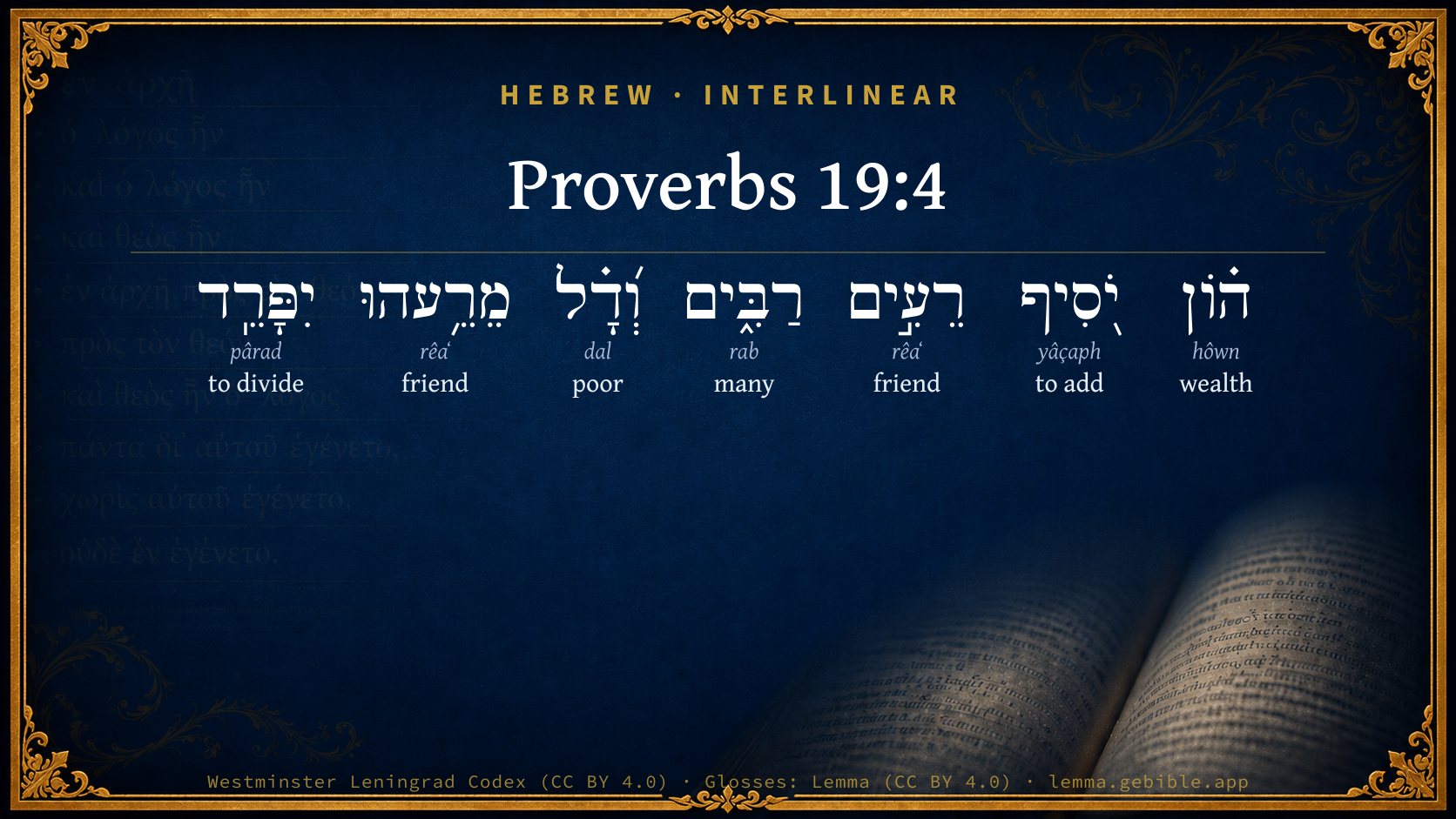
Hebrew (Westminster Leningrad Codex) Proverbs 19:4 appears in the Hebrew Old Testament. The text above is from the Westminster Leningrad Codex. Each word links to its Strong’s number, a concise gloss, and parsing drawn from the Open Scriptures Hebrew Bible morphology. Click any word for its full Brown-Driver-Briggs (BDB) entry.
Download image
Cite this verse

Proverbs 19:4 (World English Bible). Public Domain. Lemma interlinear Bible study tool, https://lemma.gebible.app/v/proverbs/19/4.

Show BibTeX & RIS
BibTeX
RIS
English Translation
Wealth adds many friends, But the poor is separated from his friend.
World English Bible · Public Domain
Download a study sheet

One document with this verse’s original text, its word-by-word gloss line, the meaning frame, cross-references with their text, attributed commentary, and full source and license credits — printable, and it pastes into notes with its structure intact.

This verse Autodidact and up

Study sheet (.html) Plain text (.txt)

A passage Seminary Student

Up to 50 verses in one chapter. A passage sheet keeps up to 6 commentary sources and 12 cross-references per verse, in the order this page ranks them, and says so on the sheet whenever that leaves anything out. Ask for a single verse and you get the Autodidact verse sheet above.

Everything on this page stays free to read, with no account — the sheet is a download of what is already on screen, not access to it.

Want to remove ads? Support Godless Engineer
Compare translations 3

The same verse in 3 English versions, stacked beneath the original-language interlinear above. Click any original word for its lexicon entry.

Each is an independent rendering of the whole verse — the interlinear is not word-aligned to these translations.

Highlighted words mark where these versions differ — a whole-verse word diff, not a word-by-word alignment.

  • World English Bible Public Domain
    Wealth adds many friends, But the poor is separated from his friend.
  • King James Version Public Domain
    Wealth maketh many friends; but the poor is separated from his neighbour.
  • unfoldingWord Literal Text CC BY-SA 4.0
    Wealth adds many companions, but a lowly one is separated from his companions.

unfoldingWord Literal Text — © unfoldingWord, licensed CC BY-SA 4.0. Word-aligned USFM3 via Door43 (git.door43.org/unfoldingWord/en_ult).

Versions to compare (up to 4)

3 of 4 selected

Show all 18 translations

Every available English version of this verse, each an independent rendering of the whole verse.

  • World English Bible Public Domain
    Wealth adds many friends, But the poor is separated from his friend.
  • Berean Standard Bible Public Domain
    Wealth attracts many friends, but a poor man is deserted by his friend.
  • Majority Standard Bible Public Domain
    Wealth attracts many friends, but a poor man is deserted by his friend.
  • King James Version Public Domain
    Wealth maketh many friends; but the poor is separated from his neighbour.
  • American Standard Version (1901) Public Domain
    Wealth addeth many friends; But the poor is separated from his friend.
  • Revised Version (1885) Public Domain
    Wealth addeth many friends: but the poor is separated from his friend.
  • Geneva Bible (1599) Public Domain
    Riches gather many friends: but the poore is separated from his neighbour.
  • Douay-Rheims (1899) Public Domain
    Riches make many friends: but from the poor man, even they whom he had, depart.
  • Young's Literal Translation Public Domain
    Wealth addeth many friends, And the poor from his neighbour is separated.
  • Literal Standard Version CC BY-SA 4.0
    Wealth adds many friends, || And the poor is separated from his neighbor.
  • Unlocked Literal Bible CC BY-SA 4.0
    Wealth adds many friends, but a poor person is separated from his friends.
  • unfoldingWord Literal Text CC BY-SA 4.0
    Wealth adds many companions, but a lowly one is separated from his companions.
  • Darby Bible Public Domain
    Wealth addeth many friends; but the poor is separated from his friend.
  • World Messianic Bible Public Domain
    Wealth adds many friends, but the poor is separated from his friend.
  • Webster's Bible Public Domain
    Wealth maketh many friends; but the poor is separated from his neighbor.
  • Free Bible Version CC BY-SA 4.0
    If you're rich, you get a lot of friends, but if you're poor, you lose any friends you had.
  • Bible in Basic English Public Domain
    Wealth makes a great number of friends; but the poor man is parted from his friend.
  • JPS Tanakh (1917) Public Domain
    Wealth addeth many friends; but as for the poor, his friend separateth himself from him.

Literal Standard Version (2020), Covenant Press — licensed CC BY-SA 4.0. Text via the HelloAO Bible API (eBible.org). Unlocked Literal Bible (unfoldingWord) — licensed CC BY-SA 4.0. Text via the HelloAO Bible API (eBible.org). unfoldingWord Literal Text — © unfoldingWord, licensed CC BY-SA 4.0. Word-aligned USFM3 via Door43 (git.door43.org/unfoldingWord/en_ult). Free Bible Version, Dr. Jonathan Gallagher — licensed CC BY-SA 4.0. Text via the HelloAO Bible API (eBible.org).

Word by word

More ways to search: Search by grammar → Find every occurrence → Compare this word →

Practice this passage: Drill this verse → Learn its vocabulary →

About this verse

These counts appear in no published source. They are computed here, from the morphology-tagged text and Lemma’s own curated glosses. What Lemma adds →

7
words
6
distinct lemmas
Wisdom
section

Shared distinctive vocabulary

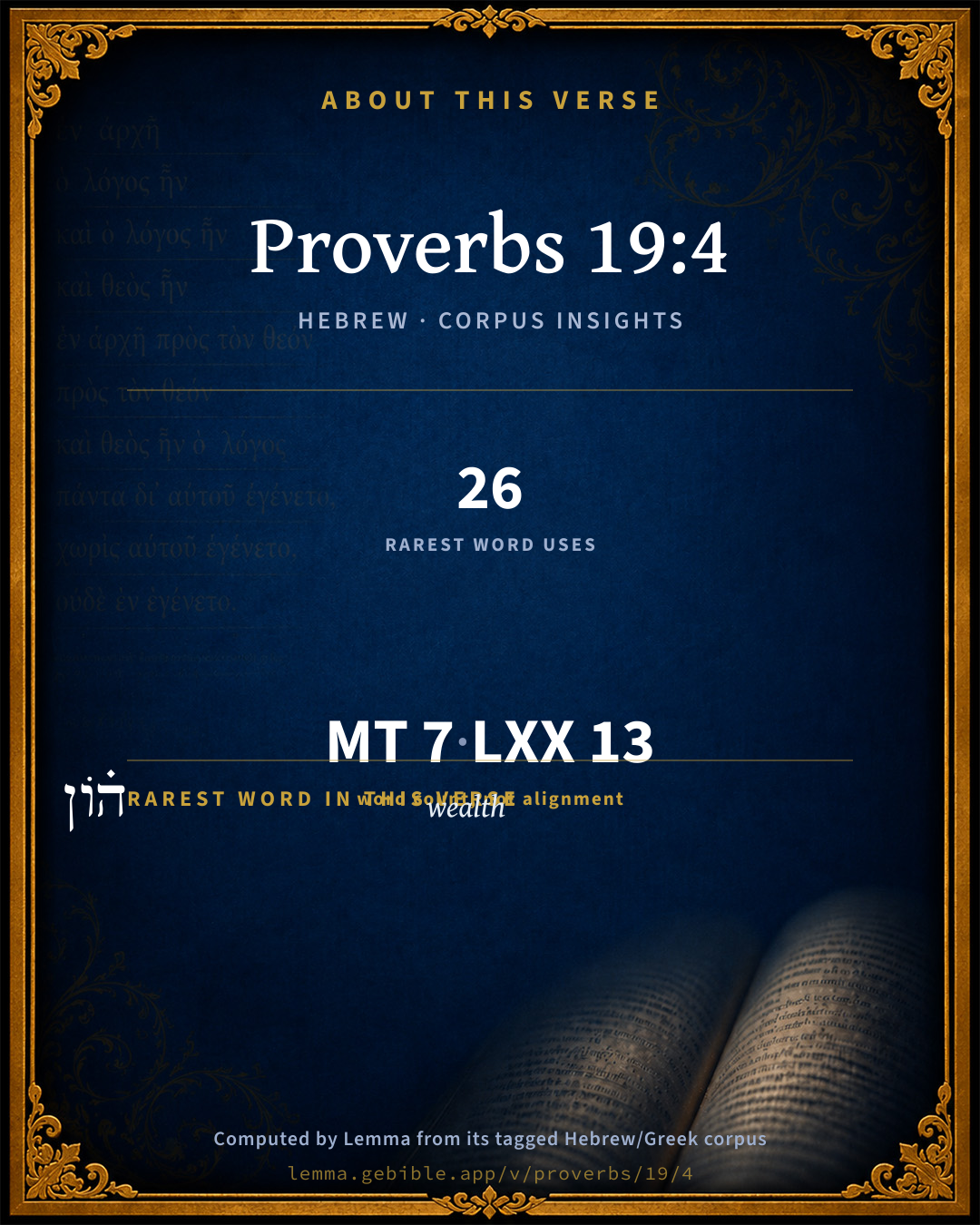
ה֗וֹן wealth H1952 occurs in 26 verses of the Hebrew Bible. Also found in:

Grammatical profile

  • 2 verbs
  • 3 nouns
  • 2 adjectives

Verb forms

  • יֹ֭סִיף Hiphil · Imperfect
  • יִפָּרֵֽד Niphal · Imperfect

Repetition

A word recurs within this verse — often emphatic in Hebrew:

  • רֵעִ֣ים friend H7453 ×2

Hebrew & Septuagint length

In English translation the verse runs 12 words from the Hebrew and 15 from the Septuagint (LXX English) — closely comparable.

A rough comparison of the two English renderings, which tokenize alike — not a word-level alignment.

Word counts can differ between the Hebrew and the Greek without any difference in meaning — e.g. the Hebrew direct-object marker אֵת has no separate Greek word, and Greek often adds the article ὁ.

In the original languages it is 7 Hebrew tokens and 13 Greek tokens — but the two are counted differently (Hebrew bundles its prefixes and suffixes into one token; the Greek is in lemma form), so that isn’t a like-for-like length.

Cross-references

6

Topical passages linked to Proverbs 19:4 in the Treasury of Scripture Knowledge — connected by theme and wording, ordered by reader-vote popularity; previews shown in the World English Bible.

  • Proverbs 14:20 The poor person is shunned even by his own neighbor, But the rich person has many friends.
  • Proverbs 19:6–7 Many will entreat the favor of a ruler, And everyone is a friend to a man who gives gifts.
  • Job 19:13–17 "He has put my brothers far from me. My acquaintances are wholly estranged from me.
  • Luke 15:13–15 Not many days after, the younger son gathered all of this together and traveled into a far country. There he wasted his property with riotous living.
  • Job 6:15–23 My brothers have dealt deceitfully as a brook, As the channel of brooks that pass away;
  • Proverbs 10:15 The rich man's wealth is his strong city. The destruction of the poor is their poverty.

Cross-references courtesy of OpenBible.info (CC BY 4.0).

Hebrew and Greek witnesses Masoretic Hebrew ↔ Greek Septuagint

The same verse in the two great witnesses to the Old Testament, shown verse-for-verse.

These are two independent witnesses, not word-aligned to each other, and the Septuagint is shown in lemma (dictionary) form.

Hebrew Proverbs 19:4 Masoretic · Westminster Leningrad Codex

ה֗וֹן יֹ֭סִיף רֵעִ֣ים רַבִּ֑ים וְ֝דָ֗ל מֵרֵ֥עהוּ יִפָּרֵֽד

Wealth adds many friends, But the poor is separated from his friend.

World English Bible · Public Domain

Greek LXX Proverbs 19:4 Septuagint · lemma form

πλοῦτος προςτίθημι φίλος πολύς ὁ δέ πτωχός καί ἀπό ὁ ὑποἄρχω φίλος λείπω

Wealth acquires many friends; but the poor is deserted even of the friend he has.

LXX2012 (modern English Septuagint) · Public Domain

On this verse, The Cambridge Bible for Schools and Colleges discusses the Septuagint’s reading. Read the note in Commentary ↓

Hebrew: Westminster Leningrad Codex (CC BY 4.0). Greek: Septuagint (public domain); English from LXX2012 (modern English Septuagint) (Public Domain). How the Septuagint differs from the Hebrew →

Commentary

Notes on Proverbs 19:4 from classic Christian and Jewish commentators (each source and its license shown beneath its notes). The classic Christian expositions comment on the surrounding passage and are grouped to its opening verse, so a note may address several verses; the Jewish commentaries on the Tanakh (Rashi and others) are per-verse, so they appear only where the commentator wrote on this verse.

Lemma curates 59 commentaries, every one of them public domain or Creative Commons licensed, each selected and text-cleaned for this edition rather than reprinted as found. About our sources →

Trapp's Complete Commentary

John Trapp

Pro 19:4 Wealth maketh many friends; but the poor is separated from his neighbour.

Ver. 4. Wealth maketh many friends.] Res amicos invenit, saith he in Plautus. Wine, saith Athenaeus, hath ελκοστικον τι προς φιλιαν, a force in it to make friendship. Wealth we are sure hath; but as that is no sound love that comes out of cups - it is but ollaris amicitia; friendship of the cup, so neither are they to be trusted that wealth wins to us. Hired friends are seldom either satisfied or sure, but, like the ravens in Arabia, that, full gorged, have a tunable, sweet record, but empty, screech horribly. Flies soon fasten upon honey, and vermin will haunt a house where food is to be gotten.

But the poor is separated from his neighbour.] Who either turns from him as a stranger, or against him as an enemy. Nero being condemned to die, and not finding any one that would fall upon him and despatch him, cried out, Itane, nec amicum, nec inimicum habeo? Have I now neither friend nor foe that will do this for me?

John Trapp, A Commentary or Exposition upon All the Books of the Old and New Testament (1647–1656) — public domain. Text from a community e-Sword module.

The Biblical Illustrator

Joseph S. Exell

Pro_19:4

Wealth maketh many friends; but the poor is separated from his neighbour.

The rich and the poor

Nothing upon earth is so powerful as money. It is a force before which everything bows. Wealth is such a mighty power, that one possessing it does not feel his dependence as other men do. Being more easily spoiled than other men, his salvation is more difficult. This accounts for everything the gospel has to say about rich men. In speaking of wealth, we are very apt to make the mistake of supposing that only very rich men are wealthy. The Bible accounts that man wealthy who, free from debt, has anything left after making provision for actual necessities of life. Poverty is isolation. When we become poor we become lonely. Either friends withdraw from us or we with- draw from them. When one gets really poor he is pretty much left by his brethren. They may not mean to shun him, but they let him pretty severely alone. The poor are the material we Christians are to work upon. To these we are to let our light shine. It is our holiest work to stop this separation of the poor from his neighbours. The poor are here by Divine intention. The poor help to save our souls. We are not to relieve them only; we are to help them. Giving is not enough to fulfil our Christian duty towards them. Helping the poor to help themselves is the most Christlike thing you can do. Machinery in religious life is to be avoided. It is of use only as it helps to concentrate energy. (G. R. Van de Water.)

Poverty, riches, and social selfishness

I. The trials of poverty.

1. Degradation. The poor useth entreaties. To beg of a fellow-man is a degradation; it is that from which our manhood revolts. The poor useth entreaties. They have to mortify the natural independence of their spirit. They are subjected to--

2. Insolent treatment. The rich answereth roughly.

3. Social desertion. The poor is separated from his neighbour. Who in this selfish world will make friends with the poor, however superior in intellect or excellent in character? When the wealthy man with his large circle of friends becomes poor the poles of his magnet are reversed, and his old friends feel the repulsion.

II. The temptations of wealth.

1. Upon the mind of its possessor. It tends to promote haughtiness and insolence. The rich answereth roughly. The temptation of wealth is revealed--

2. Upon the mind of the wealthy mans circle. Wealth maketh many friends.

III. The selfishness of society. Every man is a friend to him that giveth gifts. (Homilist.)

Friendship of the world

When I see leaves drop from their trees in the beginning of autumn, just such, think I, is the friendship of the world; just such are the comforts and joys of this life. While the sap of maintenance lasts my friends will swarm in abundance, my joys and comforts will abide with me; but when the sap ceases, the spring which supplies them fails; in the winter of my need they leave me naked. (H. G. Salter.)

Friends sought far money

In Dr. Guthries Autobiography there is a good illustration of the unhappy state of cynicism into which the rich are prone to fall. There he relates how, in a winter of extraordinary severity, he made an appeal to a lady who had succeeded to a prodigious fortune, on behalf of the starving poor of his parish. In doing so he had no very sanguine hope of success. On being ushered into her room, she turned round, and showing her thin, spare figure, and a face that looked as if it had been cut out of mahogany, grinned and said, I am sorry to see ye. What do you want? I suppose you are here seeking siller. The very thing I am here for, was the Doctors frank reply. Her next remark demonstrated how little power her riches had of conferring happiness; and with all her wealth of flatterers, what a poor, lonely, desolate, miserable creature this possessor of more than a million sterling was. Ah, she said, there is nobody comes to see me or seek me; but its the money, the money they are after. We are glad to be able to relate that this rich old lady gave to Dr. Guthrie fifty pounds for the poor--an act which we hope shed a gleam of sunshine into her dark life.

The Biblical Illustrator, edited by Joseph S. Exell (c. 1880s–1900s) — public domain. Text from a community e-Sword module.

Matthew Henry's Commentary

Here, 1. We may see how strong men's love of money is, that they will love any man, how undeserving soever he be otherwise, if he has but a deal of money and is free with it, so that they may hope to be the better for it. Wealth enables a man to send many presents, make many entertainments, and do many good offices, and so gains him many friends, who pretend to love him, for they flatter him and make their court to him, but really love what he has, or rather love themselves, hoping to get by him. 2. We may see how weak men's love of one another is. He who, while he prospered, was beloved and respected, if he fall into poverty is separated from his neighbour, is not owned nor looked upon, not visited nor regarded, is bidden to keep his distance and told he is troublesome. Even one that has been his neighbour and acquaintance will turn his face from him and pass by on the other side. Because men's consciences tell them they ought to relieve and succour such, they are willing to have this excuse, that they did not see them.

Matthew Henry's Commentary on the Whole Bible (1708–1710) — public domain (CC PDM 1.0). Text via the HelloAO Bible API.

Jamieson, Fausset & Brown

Robert Jamieson, A. R. Fausset & David Brown

(Compare Pro 14:20). Such facts are often adduced with implied disapprobation.

Jamieson, Fausset & Brown — Commentary Critical and Explanatory on the Whole Bible (1871) — public domain (CC PDM 1.0). Text via the HelloAO Bible API.

Adam Clarke's Commentary

Verse 4. The poor is separated from his neighbour.] Because he has the "disease of all-shunned poverty."

Adam Clarke's Commentary on the Bible (1810–1826) — public domain. Text from a community e-Sword/MySword module.

Ellicott's Commentary for English Readers

(4) The poor is separated from his neighbour.—Or, but the feeble, his friend separates himself (from him). It was just in order to counteract these selfish instincts of mankind that the merciful provisions of such passages as Deu_15:7. sqq., and Luk_14:13, were laid upon God’s people.

A Bible Commentary for English Readers, edited by Charles John Ellicott (1878–1897) — public domain. Text from a community e-Sword module.

The Cambridge Bible for Schools and Colleges

gen. ed. J. J. S. Perowne

4. maketh] Rather, addeth; προστίθησι, LXX.; addunt (divitiæ), Vulg.; the contrast being between the new friends gained by wealth, and the existing friend (R.V.) lost by poverty, ὁ δὲ πτωχὸς καὶ ἀπὸ τοῦ ὑπάρχοντος φίλου λείπεται, LXX.; A paupere autem et hi, quos habuit, separantur, Vulg.

The Cambridge Bible for Schools and Colleges (gen. ed. J. J. S. Perowne; Cambridge University Press, 1878–1918) — public domain. Text from a community e-Sword module.

John Gill's Exposition

Wealth maketh many friends,.... Or "adds" (f); it increases the number of them: so the poet (g), "donec eris felix, multos numerabis amicos"; and to this agrees what the wise man says, Pro 14:20;

but the poor is separated from his neighbour; or "friend" (h); he will not visit him as he did in his prosperity, nor suffer him to come into his house or company, or come near him; he is separated from his affection, friendship, and presence: so another poet (i),

"if thou art rich, thou wilt have many friends; but, if poor, few.''

(f) "addit", Junius & Tremellius, Piscator. (g) Ovid. (h) "ab amico sua", Pagninus, Montanus, Baynus, Junius & Tremeliius, Piscator, Michaelis; "a sodali sua", Schultens. (i) Theognis.

John Gill's Exposition of the Whole Bible (1746–1763) — public domain (CC PDM 1.0). Text via the HelloAO Bible API.

Matthew Poole's English Annotations

Is disowned and forsaken by those who are most obliged to help him.

Matthew Poole's English Annotations on the Holy Bible (1683–1685) — public domain. Text from a community e-Sword/MySword module.

Whedon's Commentary on the Bible

Daniel D. Whedon

4. Wealth — Literally, ease or competence.

Maketh many friends — At least such as are professedly so. The poor man is neglected by those who ought to be his friends. Compare Pro_14:20, and Pro_19:6-7.

Daniel D. Whedon (gen. ed.), Commentary on the Old and New Testaments (1874–1909) — public domain. Text from a community e-Sword module.

The Pulpit Commentary

Wealth maketh many friends. (vers. 6, 7 Pro_14:20) A Greek gnome expresses the same truth Eamay exomen filouv . The poor is separated from his neighbour. But it is better to make the act of separation emanate from the friend (as the Hebrew allows), and to render, with the Revised Version, The friend of the poor separateth himself from him. The word for "poor" is here dal, which means "feeble," "languid;" so ver. 17; and the came word (rea), "friend" or "neighbor," is used in both clauses. The idea of man"s selfishness is carried on in vers. 6 and 7. The Law of Moses had tried to counteract it, (Deu_15:7, etc.) but it was Christianity that introduced the practical realization of the law of love, and the honouring of the poor as members of Christ. Septuagint, "But the poor is deserted even by his whilom friend."

The Pulpit Commentary (1880–1919), ed. H.D.M. Spence-Jones & Joseph S. Exell — public domain. Text from a community e-Sword module.

Keil & Delitzsch

C. F. Keil & F. Delitzsch

4 Wealth bringeth many friends;

But the reduced - his friend separateth himself.

The very same contrast, though otherwise expressed, we had at Pro 14:20. Regarding הון, vid., vol. i, p. 63. דל is the tottering, or he who has fallen into a tottering condition, who has no resources, possesses no means. The accentuation gives Mugrash to the word (according to which the Targ. translates), for it is not the subject of יפּרד: the reduced is separated (pass. Niph.) by his misfortunes, or must separate himself (reflex. Niph.) from his friend (מרעהוּ, as Ecc 4:4, prae socio suo); but subject of the virtual pred. מרעהוּ יפּרד: the reduced - his friend (מרעהו, as Pro 19:7) separates himself, i.e., (according to the nature of the Semitic substantival clause) he is such (of such a fate) that his friend sets himself free, whereby ממּנּוּ may be omitted as self-obvious; נפרד means one who separates himself, Pro 18:1. If we make דל the subject of the separatur, then the initiative of the separation from the friend is not expressed.

Keil & Delitzsch — Biblical Commentary on the Old Testament (1861–1891) — public domain (CC PDM 1.0). Text via the HelloAO Bible API. (Old Testament only.)

Bridges on Proverbs

Charles Bridges

We have had the substance of this Proverb before. (Pro 14:20 . Compare Pro 19:6 .) It is nominally true, that wealth maketh many friends. But generally they are little worth. ’Riches have them’ — says Bishop Hall — ’not the man.’†1 The principle is selfishness; no earnest of true and permanent friendship. Few among them will be found "loving at all times, brethren born for adversity." (Pro 17:17 .) God has made poverty a gradation of rank; and as such we are bound to regard it. Man makes it a wall of separation. It tries our own faith and patience, and not less the love and sincerity of our faith.†2

This want of sympathy with the poor is a serious evil. It separates those, whom God has linked together by a mutual bond of reciprocal interest; the rich being the guardians and protectors of the poor; the poor being the strength and support of the rich. But too often the poor know their wealthier neighbors, only as living in the most luxurious indulgence, while they themselves are left in the sense of their poverty, unaided and uncared for. This could never be, if the gospel had leavened the mass with its own Divine principle of love. But what — if the LORD’s poor be separated from his selfish neighbor. (Pro 19:7 .) There is One that "knoweth his soul in adversity" (Psa 31:7 ), and that hath pledged his word — "I will never leave thee, nor forsake thee." (Heb 13:5 .) Yes — this is the joy and the stay of his confidence — "I am poor and needy; but the LORD thinketh on me." (Psa 40:17 .) Poverty may separate him from his neighbor. But who or what shall separate him from his God? (Rom 8:38-39 .) "Joint-heir as he is with him, whom God hath appointed heir of all things," what can he want?†3 ’If it were possible for him to stand absolutely in need of the use and service of the whole creation, all the creatures in the world would surely wait on him, and be appropriated to him.’†4 With such an inheritance as his, why should he fret for a few years’ poverty or neglect? Earth’s short vision will soon be past; and then comes the eternal reality of unclouded joy.

Footnotes:

†1 Works, viii. 77. Compare Sir 13:22, Sir 13:32 .

†2 Amicus certus in re incertâ cernitur. — Cicero.

†3 Rom 8:17. Heb 1:2, with 1Co 3:21-23 .

†4 Bishop Reynolds’ Works, p. 11.

Charles Bridges, An Exposition of the Book of Proverbs (1846) — public domain. Text from a community e-Sword module.

Kretzmann's Popular Commentary

Paul E. Kretzmann

v. 4. Wealth maketh many friends, for people seek the favor of the wealthy, in the hope of obtaining some benefit for themselves; but the poor is separated from his neighbor, it is the way of the world to leave the impoverished to his own resources and to ignore him.

Paul E. Kretzmann, Popular Commentary of the Bible (1921–1924) — public domain. Text from a community e-Sword module.

Rashi

Rabbi Shlomo Yitzchaki (Rashi)

Wealth adds many friends Heb. רעים רבים, many lovers. And it can be interpreted as concerning one who learned Torah.

Rashi on the Tanakh — English translations: “The Judaica Press complete Tanach with Rashi, translated by A. J. Rosenberg” (CC BY 4.0); “Pentateuch with Rashi's commentary by M. Rosenbaum and A.M. Silbermann, 1929-1934” (public domain); “The Metsudah Tanach series, Lakewood, N.J” (CC BY 4.0); and “The Book of Joshua, Metsudah Publications, 1997” (CC BY 4.0). Text via Sefaria.

Lesson kit

Teaching starters — assembled from the data on this page, not authored interpretation. Every prompt links to the verse data it draws on. Edit before teaching.

Proverbs, in the Wisdom, opens this verse with 7 words (6 distinct Hebrew lemmas). Its most distinctive word is hôwn (“wealth”). A historical commentator’s framing appears above. Read the whole chapter for the surrounding context.

Discussion questions

  1. What does “wealth” (hôwn) contribute to the verse as a whole?
  2. How does Psalms 44:12, which shares the word «wealth», read alongside this verse?
  3. What does the repetition of “friend” (2× in this one verse) do in this verse?
  4. The translations on this page render this verse differently — a whole-verse word diff, not a word-by-word alignment. What might account for the different wordings?
  5. «יֹ֭סִיף» is a Hiphil Imperfect verb. How does that grammatical form shape the action described?
  6. Compare how Trapp's Complete Commentary and The Biblical Illustrator read this verse. Where do they agree or differ?

Things to notice

Reading settings

Reading text

Shown beneath each verse's original-language words.

Old Testament
Old Testament edition

Read the OT as the Masoretic Hebrew (MT) or the Greek Septuagint (LXX).

English shown for the Greek Septuagint (in the Hebrew ↔ Greek comparison).

Comparing translations? Open the Compare panel on any verse page to stack up to four side by side.