Ezekiel 23:14

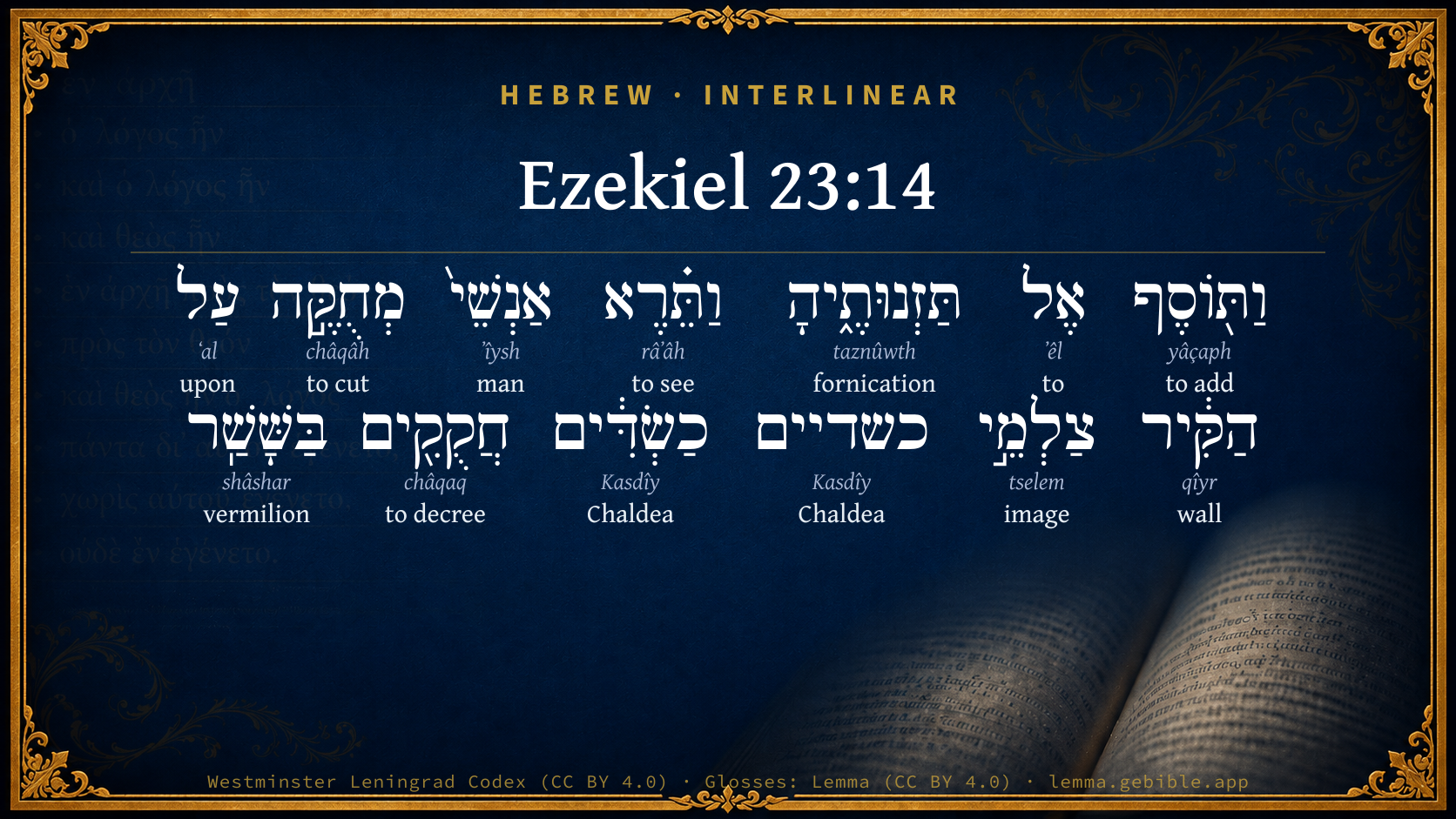
Hebrew (Westminster Leningrad Codex) Ezekiel 23:14 appears in the Hebrew Old Testament. The text above is from the Westminster Leningrad Codex. Each word links to its Strong’s number, a concise gloss, and parsing drawn from the Open Scriptures Hebrew Bible morphology. Click any word for its full Brown-Driver-Briggs (BDB) entry.
Download image
Cite this verse

Ezekiel 23:14 (World English Bible). Public Domain. Lemma interlinear Bible study tool, https://lemma.gebible.app/v/ezekiel/23/14.

Show BibTeX & RIS
BibTeX
RIS
English Translation
She increased her prostitution; for she saw men portrayed on the wall, the images of the Chaldeans portrayed with vermilion,
World English Bible · Public Domain
Download a study sheet

One document with this verse’s original text, its word-by-word gloss line, the meaning frame, cross-references with their text, attributed commentary, and full source and license credits — printable, and it pastes into notes with its structure intact.

This verse Autodidact and up

Study sheet (.html) Plain text (.txt)

A passage Seminary Student

Up to 50 verses in one chapter. A passage sheet keeps up to 6 commentary sources and 12 cross-references per verse, in the order this page ranks them, and says so on the sheet whenever that leaves anything out. Ask for a single verse and you get the Autodidact verse sheet above.

Everything on this page stays free to read, with no account — the sheet is a download of what is already on screen, not access to it.

Want to remove ads? Support Godless Engineer
Compare translations 3

The same verse in 3 English versions, stacked beneath the original-language interlinear above. Click any original word for its lexicon entry.

Each is an independent rendering of the whole verse — the interlinear is not word-aligned to these translations.

Highlighted words mark where these versions differ — a whole-verse word diff, not a word-by-word alignment.

  • World English Bible Public Domain
    She increased her prostitution; for she saw men portrayed on the wall, the images of the Chaldeans portrayed with vermilion,
  • King James Version Public Domain
    And that she increased her whoredoms: for when she saw men pourtrayed upon the wall, the images of the Chaldeans pourtrayed with vermilion,
  • unfoldingWord Literal Text CC BY-SA 4.0
    Then she increased her prostitution even more. She saw men carved on walls, figures of Chaldeans painted in red,

unfoldingWord Literal Text — © unfoldingWord, licensed CC BY-SA 4.0. Word-aligned USFM3 via Door43 (git.door43.org/unfoldingWord/en_ult).

Versions to compare (up to 4)

3 of 4 selected

Show all 18 translations

Every available English version of this verse, each an independent rendering of the whole verse.

  • World English Bible Public Domain
    She increased her prostitution; for she saw men portrayed on the wall, the images of the Chaldeans portrayed with vermilion,
  • Berean Standard Bible Public Domain
    But Oholibah carried her prostitution even further. She saw the men portrayed on the wall, images of the Chaldeans, engraved in vermilion,
  • Majority Standard Bible Public Domain
    But Oholibah carried her prostitution even further. She saw the men portrayed on the wall, images of the Chaldeans, engraved in vermilion,
  • King James Version Public Domain
    And that she increased her whoredoms: for when she saw men pourtrayed upon the wall, the images of the Chaldeans pourtrayed with vermilion,
  • American Standard Version (1901) Public Domain
    And she increased her whoredoms; for she saw men portrayed upon the wall, the images of the Chaldeans portrayed with vermilion,
  • Revised Version (1885) Public Domain
    And she increased her whoredoms; for she saw men pourtrayed upon the wall, the images of the Chaldeans pourtrayed with vermilion,
  • Geneva Bible (1599) Public Domain
    And that she encreased her fornications: for when she sawe men painted vpon the wall, the images of the Caldeans painted with vermelon,
  • Douay-Rheims (1899) Public Domain
    And she increased her fornications: and when she had seen men painted on the wall, the images of the Chaldeans set forth in colours,
  • Young's Literal Translation Public Domain
    And she doth add unto her whoredoms, And she seeth graved men on the wall, Pictures of Chaldeans, graved with red lead,
  • Literal Standard Version CC BY-SA 4.0
    And she adds to her whoredoms, || And she sees men carved on the wall, || Pictures of Chaldeans, carved with vermillion,
  • Unlocked Literal Bible CC BY-SA 4.0
    Then she increased her prostitution even more. She saw men carved on walls, figures of Chaldeans painted in red,
  • unfoldingWord Literal Text CC BY-SA 4.0
    Then she increased her prostitution even more. She saw men carved on walls, figures of Chaldeans painted in red,
  • Darby Bible Public Domain
    And she increased her fornications; for she saw men portrayed upon the wall, the images of the Chaldeans portrayed with vermilion,
  • World Messianic Bible Public Domain
    “She increased her prostitution; for she saw men portrayed on the wall, the images of the Kasdim portrayed with red,
  • Webster's Bible Public Domain
    And that she increased her prostitutions: for when she saw men pourtrayed upon the wall, the images of the Chaldeans pourtrayed with vermilion.
  • Free Bible Version CC BY-SA 4.0
    However, Oholibah's prostitution was even worse. She saw pictures of Babylonian soldiers wearing bright red uniforms painted on the wall.
  • Bible in Basic English Public Domain
    And her loose behaviour became worse; for she saw men pictured on a wall, pictures of the Chaldaeans painted in bright red,
  • JPS Tanakh (1917) Public Domain
    And she increased her harlotries; for she saw men portrayed upon the wall, the images of the Chaldeans portrayed with vermilion,

Literal Standard Version (2020), Covenant Press — licensed CC BY-SA 4.0. Text via the HelloAO Bible API (eBible.org). Unlocked Literal Bible (unfoldingWord) — licensed CC BY-SA 4.0. Text via the HelloAO Bible API (eBible.org). unfoldingWord Literal Text — © unfoldingWord, licensed CC BY-SA 4.0. Word-aligned USFM3 via Door43 (git.door43.org/unfoldingWord/en_ult). Free Bible Version, Dr. Jonathan Gallagher — licensed CC BY-SA 4.0. Text via the HelloAO Bible API (eBible.org).

Word by word

More ways to search: Search by grammar → Find every occurrence → Compare this word →

Practice this passage: Drill this verse → Learn its vocabulary →

בַּשָּׁשַֽׁר
shâshar
H8350
“in/at the · vermilion”
Preposition, Determined + Noun, Common, Masculine, Singular, Absolute
Part of Speech
Preposition + Noun
Type
Common
Gender
Masculine
Number
Singular
State
Absolute
Full BDB Definition

Origin: perhaps from the base of H8324 in the sense of that of H8320

TWOT: 2476

red colour, vermilion - formerly gained from 'kermes' insect
  1. וַתּ֖וֹסֶף yâçaph H3254 “and · to add” Conjunction + Verb, Hiphil, Sequential Imperfect, 3rd Person, Feminine, Singular
  2. אֶל ʼêl H413 “to” Preposition
  3. תַּזְנוּתֶ֑יהָ taznûwth H8457 “fornications · her” Noun, Common, Feminine, Plural, Construct + Suffix, Personal, 3rd Person, Feminine, Singular
  4. וַתֵּ֗רֶא râʼâh H7200 “and · to see” Conjunction + Verb, Qal, Sequential Imperfect, 3rd Person, Feminine, Singular
  5. אַנְשֵׁי֙ ʼîysh H376 “men of” Noun, Common, Masculine, Plural, Construct
  6. מְחֻקֶּ֣ה châqâh H2707 “cut” Verb, Pual, Participle Passive, Masculine, Singular, Absolute
  7. עַל ʻal H5921 “upon” Preposition
  8. הַקִּ֔יר qîyr H7023 “the · wall” Particle, Definite Article + Noun, Common, Masculine, Singular, Absolute
  9. צַלְמֵ֣י tselem H6754 “images of” Noun, Common, Masculine, Plural, Construct
  10. כשדיים Kasdîy H3778 “Chaldeans” Noun, Gentilic, Masculine, Plural, Absolute
  11. כַשְׂדִּ֔ים Kasdîy H3778 “Chaldeans” Noun, Gentilic, Masculine, Plural, Absolute
  12. חֲקֻקִ֖ים châqaq H2710 “decreed” Verb, Qal, Participle Passive, Masculine, Plural, Absolute

About this verse

These counts appear in no published source. They are computed here, from the morphology-tagged text and Lemma’s own curated glosses. What Lemma adds →

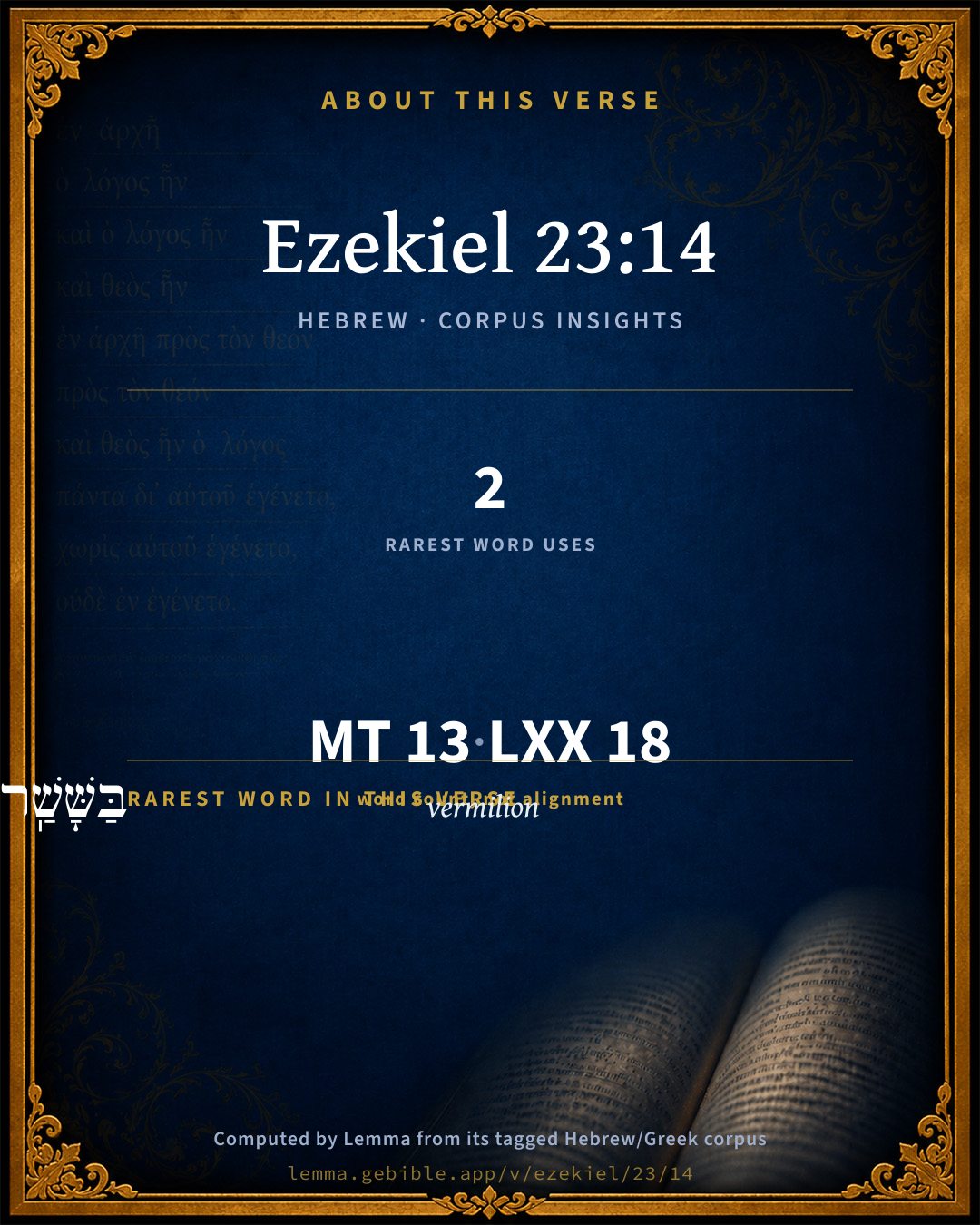
13
words
12
distinct lemmas
Prophets
section

Notable vocabulary

The rarest word here is בַּשָּׁשַֽׁר vermilion H8350 — appearing just 2 times in the whole Hebrew Bible.

Shared distinctive vocabulary

בַּשָּׁשַֽׁר vermilion H8350 occurs in 2 verses of the Hebrew Bible. Also found in:

Grammatical profile

  • 4 verbs
  • 7 nouns
  • 2 prepositions

Verb forms

  • וַתּ֖וֹסֶף Hiphil · Sequential Imperfect
  • וַתֵּ֗רֶא Qal · Sequential Imperfect
  • מְחֻקֶּ֣ה Pual · Participle Passive
  • חֲקֻקִ֖ים Qal · Participle Passive

Repetition

A word recurs within this verse — often emphatic in Hebrew:

  • כשדיים Chaldea H3778 ×2

Hebrew & Septuagint length

In English translation the verse runs 20 words from the Hebrew and 21 from the Septuagint (LXX English) — closely comparable.

A rough comparison of the two English renderings, which tokenize alike — not a word-level alignment.

Word counts can differ between the Hebrew and the Greek without any difference in meaning — e.g. the Hebrew direct-object marker אֵת has no separate Greek word, and Greek often adds the article ὁ.

In the original languages it is 13 Hebrew tokens and 18 Greek tokens — but the two are counted differently (Hebrew bundles its prefixes and suffixes into one token; the Greek is in lemma form), so that isn’t a like-for-like length.

Cross-references

5

Topical passages linked to Ezekiel 23:14 in the Treasury of Scripture Knowledge — connected by theme and wording, ordered by reader-vote popularity; previews shown in the World English Bible.

  • Ezekiel 8:10 So I went in and saw; and see, every form of creeping things, and abominable animals, and all the idols of the house of Israel, portrayed on the wall round about.
  • Jeremiah 22:14 who says, I will build me a wide house and spacious chambers, and cuts him out windows; and it is ceiling with cedar, and painted with vermilion.
  • Isaiah 46:1 Bel bows down, Nebo stoops; their idols are on the animals, and on the cattle: the things that you carried about are made a load, a burden to the weary [animal].
  • Jeremiah 50:2 Declare you among the nations and publish, and set up a standard; publish, and don't conceal: say, Babylon is taken, Bel is disappointed, Merodach is dismayed; her images are disappointed, her idols are dismayed.
  • Ezekiel 16:29 You have moreover multiplied your prostitution to the land of merchants, to Chaldea; and yet you weren't satisfied with this.

Cross-references courtesy of OpenBible.info (CC BY 4.0).

Hebrew and Greek witnesses Masoretic Hebrew ↔ Greek Septuagint

The same verse in the two great witnesses to the Old Testament, shown verse-for-verse.

These are two independent witnesses, not word-aligned to each other, and the Septuagint is shown in lemma (dictionary) form.

Hebrew Ezekiel 23:14 Masoretic · Westminster Leningrad Codex

וַתּ֖וֹסֶף אֶל תַּזְנוּתֶ֑יהָ וַתֵּ֗רֶא אַנְשֵׁי֙ מְחֻקֶּ֣ה עַל הַקִּ֔יר צַלְמֵ֣י כשדיים כַשְׂדִּ֔ים חֲקֻקִ֖ים בַּשָּׁשַֽׁר

She increased her prostitution; for she saw men portrayed on the wall, the images of the Chaldeans portrayed with vermilion,

World English Bible · Public Domain

Greek LXX Ezekiel 23:14 Septuagint · lemma form

καί προςτίθημι πρός ὁ πορνεία αὐτός καί ὁράω ἀνήρ ζωγραφέω ἐπί ὁ τοῖχος εἰκών χαλδαῖος ζωγραφέω ἐν γραφίς

And she increased her fornication, and she saw men painted on the wall, likenesses of the Chaldeans painted with a pencil,

LXX2012 (modern English Septuagint) · Public Domain

Hebrew: Westminster Leningrad Codex (CC BY 4.0). Greek: Septuagint (public domain); English from LXX2012 (modern English Septuagint) (Public Domain). How the Septuagint differs from the Hebrew →

Targum (Aramaic paraphrase)

1

The Targum is the ancient Jewish Aramaic paraphrase of the Hebrew Scriptures — an interpretive translation, not the Hebrew text itself. Onkelos (literal) and Pseudo-Jonathan (expansive) render the Torah, and Jonathan the Prophets. Coverage is partial: where no permissively-licensed English translation exists for a verse, only the Aramaic is shown. This is verse-level text, not a word-by-word alignment to the Hebrew.

  1. Targum Jonathan Prophets (Joshua–Malachi)
    וְאוֹסִיפַת עַל טַעֲוָתָהּ וַחֲזַת גַבְרִין מְצַיְרִין עַל כָּתְלָא צַלְמֵי כַסְדָאֵי מְצַיְרִין בְּסַמְמָנַיָא:

    (no public-domain English translation for this verse)

    Targum Jonathan — Aramaic: “Mikraot Gedolot” (public domain). English: “Sefaria Community Translation” (CC0 1.0 (public-domain dedication)); “London "Chaldee Paraphrase," 1871” (public domain). Text via Sefaria.

Commentary

Notes on Ezekiel 23:14 from classic Christian and Jewish commentators (each source and its license shown beneath its notes). The classic Christian expositions comment on the surrounding passage and are grouped to its opening verse, so a note may address several verses; the Jewish commentaries on the Tanakh (Rashi and others) are per-verse, so they appear only where the commentator wrote on this verse.

Lemma curates 59 commentaries, every one of them public domain or Creative Commons licensed, each selected and text-cleaned for this edition rather than reprinted as found. About our sources →

Trapp's Complete Commentary

John Trapp

Eze 23:14 And [that] she increased her whoredoms: for when she saw men pourtrayed upon the wall, the images of the Chaldeans pourtrayed with vermilion,

Ver. 14. For when she saw men portrayed upon the wall.] So unbridled was her lust that she fell to doting upon those quos tantum per umbram et imaginem aspexerat, whose pictures only she had beheld. In some Popish churches there are to be seen wanton pictures, such as do rather kindle lust than quicken devotion. An eyewitness {a} hath told us in print that in some places they will assemble various of the fairest courtezans, when they would draw a picture of the Virgin Mary, to draw the most modest beauty of a virgin out of the flagrancy of harlots.

{a} Spec. Eur.

John Trapp, A Commentary or Exposition upon All the Books of the Old and New Testament (1647–1656) — public domain. Text from a community e-Sword module.

Geneva Bible (1599)

Geneva Bible translators

This declareth that no words are able sufficiently to express the rage of idolaters, and therefore the holy Ghost here compareth them to those which in their raging love and filthy lusts dote upon the images and paintings of them after whom they lust.

Geneva Bible (1599) marginal notes — public domain. Text via Bolls.life.

Jamieson, Fausset & Brown

Robert Jamieson, A. R. Fausset & David Brown

vermilion--the peculiar color of the Chaldeans, as purple was of the Assyrians. In striking agreement with this verse is the fact that the Assyrian sculptures lately discovered have painted and colored bas-reliefs in red, blue, and black. The Jews (for instance Jehoiakim, Jer 22:14) copied these (compare Eze 8:10).

Jamieson, Fausset & Brown — Commentary Critical and Explanatory on the Whole Bible (1871) — public domain (CC PDM 1.0). Text via the HelloAO Bible API.

Adam Clarke's Commentary

Verse 14. Men pourtrayed upon the wall] See on Eze 8:10.

Adam Clarke's Commentary on the Bible (1810–1826) — public domain. Text from a community e-Sword/MySword module.

Ellicott's Commentary for English Readers

(14) Men portrayed upon the wall.—Such portraitures, with evidence that they were once executed in brilliant colours, are characteristic both of Egypt and Assyria, where stone for sculpture abounded. From the close connection in race and customs between the Assyrians and Babylonians, it cannot be doubted that the same portraitures were also common upon the more perishable brick of the latter, of whom the prophet is now speaking. The monuments fully concur in representing the warriors of Assyria and Babylonia as delighting in extreme gorgeousness of apparel, but it is difficult to render into English with accuracy each particular of their dress. The exiles, whom Ezekiel immediately addressed, were familiar with these pictures, and his way of speaking of them was important in checking any disposition to fall into idolatries by means of them.

A Bible Commentary for English Readers, edited by Charles John Ellicott (1878–1897) — public domain. Text from a community e-Sword module.

The Cambridge Bible for Schools and Colleges

gen. ed. J. J. S. Perowne

14. and that she increased] Rather: And she added to her whoredoms, with full stop at Eze_23:13. It was certainly the custom in Babylonia to draw figures of men and the like upon the walls; it is not probable, however, that such figures of Chaldean warriors had actually been seen in Jerusalem. The prophet combines the Babylonian custom with the reports of Chaldean military splendour current in Judah. Even when Babylon was still a vassal state of Assyria Hezekiah entered into intrigues with it, Isaiah 39. In later times it was the rivalry between Babylon and Egypt that drew Judah into the whirl of imperial politics, and left her from the time of the battle of Carchemish and the defeat of Egypt subject to Babylon (b.c. 604).

The Cambridge Bible for Schools and Colleges (gen. ed. J. J. S. Perowne; Cambridge University Press, 1878–1918) — public domain. Text from a community e-Sword module.

John Gill's Exposition

And that she increased her whoredoms,.... Added to the number of her idols, increased her idols, and even was guilty of more than her sister:

for when she saw men portrayed on the wall; of the temple, as idols were, Eze 8:10 or upon the wall of a private house, where they were worshipped as household gods:

the images of the Chaldeans portrayed with vermilion: the images of their heroes, who after death were deified; and these, being drawn upon the wall with vermilion, which, being mixed with ceruse, made a flesh colour, were worshipped; as Bel, Nebo, Merodach, which are names of their idols, Isa 46:1 or these were graven on the walls, or etched out upon them with minium or red lead; or rather were "painted" (r), as some render the word, with minium, vermilion, or cinnabar, which are the same; See Gill on Jer 22:14, and it may be observed, that it was usual with the Heathens to paint the images and statues of their gods with these. Thus Virgil (s) represents Pan, the god of Arcadia, coloured red with minium or vermilion; and Pausanius (t) speaks of the statue of Bacchus being besmeared with cinnabar: and Pliny (u) says the face of the image of Jupiter used to be anointed with minium or vermilion on festival days; and observes, that the nobles of Ethiopia used to colour themselves all over with it; this being the colour of the images of their gods, which they reckoned more august, majestic, and sacred. Hence the Romans, in their triumphs, used to paint themselves with vermilion; particularly it is said of Augustus Caesar, that he did this to make himself the more conspicuous and respectable, after the example of the Assyrians and Medes (w): and the triumphers chose to be rubbed all over with a red colour, that they might, according to Isidore (x), resemble the divine fire.

(r) "depictas sinopide", Pagninus; "pictas minio", Piscator. (s) "Pan deus Arcadiae venit, quem vidimus ipsi Sanguineis ebuli baccis, minioque rubentern." Bucolic. Eclog. 10. (t) Achaica, sive l. 7. p. 452. & Arcadica, sive l. 8. p. 520. (u) Nat. Hist. l. 33. c. 7. (w) Alex. ab Alex. Genial. Dier. l. 6. c. 6. p. 332. (x) Originum, l. 18. c. 2.

John Gill's Exposition of the Whole Bible (1746–1763) — public domain (CC PDM 1.0). Text via the HelloAO Bible API.

Albert Barnes' Notes on the Bible

After Israel’s captivity Judah intrigued first with Assyria, then with Babylon, courting their monarchs, imitating their customs, and learning their idolatries.

Pourtrayed upon the wall - The monuments of Nineveh show how the walls of its palaces were adorned with figures precisely answering to this description. There is evidence that these sculptures were highly colored with vermilion, or rather, red ochre.

Albert Barnes' Notes on the Bible (1834–1885) — public domain. Text from a community e-Sword/MySword module.

Haydock's Catholic Bible Commentary

Colours. She was enamoured at the account or picture of these people, without ever having seen them.

George Leo Haydock (1774–1849), Haydock's Catholic Family Bible and Commentary, 1859 edition — public domain. Excludes Psalms (Douay-Rheims chapter numbering differs from Protestant) and Deuterocanonical books (Catholic canon only).

Matthew Poole's English Annotations

Increased her whoredoms; added to the number of her idolatries.

When she saw men portrayed upon the wall: wherever it was the Jews saw, there it was they doted on their persons and habits: it is probable enough they might see them in the idol temples, or in the house of the king of Judah, or of the great men, who promoted the friendships and leagues with these nations.

The images; the counterfeits of strangers, and such as were far off, as the Chaldeans were.

With vermilion; which, as it is a very glossy and shining colour, so, duly mixed with ceruse, doth lively express the colour of man’s flesh.

Matthew Poole's English Annotations on the Holy Bible (1683–1685) — public domain. Text from a community e-Sword/MySword module.

Whedon's Commentary on the Bible

Daniel D. Whedon

14. And that — Rather, And yet. Eze_23:13 should close with a period. This verse opens to view Judah’s affiliations with Babylon. Jerusalem early saw that Babylon was to become a great power and courted its favor even while it was yet a vassal of Assyria (Isaiah 39).

Daniel D. Whedon (gen. ed.), Commentary on the Old and New Testaments (1874–1909) — public domain. Text from a community e-Sword module.

The Pulpit Commentary

The sin of Judah went a stop further than that of Samaria. She courted the alliance of the Chaldeans. Probably the sojourn of Manasseh at Babylon (2Ch_33:11) led him to see in that city a possible rival to Assyria. The embassy of Merodach-Baladan to Hezekiah (Isa 39) implies, on the other hand, that Babylon was looking to Judah for support against Assyria. The prophet represents this political coquetting, so to speak, as another act of whoredom. Aholibah saw the images of the Chaldeans portrayed with vermilion (probably "red ochre:" colors seem to have been used largely both in Assyrian and Babylonian sculpture as in Egyptian, and Judah seems to have copied them, (Jer_22:14) and fell in love with them. As the passions of a Messalina might be roused by sensuous pictures of masculine beauty, so Judah was led on by what her envoys reported of the magnificence of the palaces, the strength of the armies, of the Chaldeans. The journey of Jonah to Nineveh, and those implied in Hos_7:11, as well as the prophecy of Nahum, all indicate a more or less intimate knowledge of the Mesopotamian monarchies. The mission of Merodach-Baladan would be naturally followed by a return embassy from Judah. A later instance under Zedekiah meets us in Jer_29:3.

The Pulpit Commentary (1880–1919), ed. H.D.M. Spence-Jones & Joseph S. Exell — public domain. Text from a community e-Sword module.

unfoldingWord translationNotes

Door43 World Missions Community

General Information:

Yahweh continues his metaphor in which he speaks of the cities of Jerusalem and Samaria as if they were two prostitutes. This metaphor continues through Ezekiel 23:34. (See: Metaphor)

turbans

hats made out of long cloth and wrapped around the top of a man's head

had the appearance of officers of chariot troops, the likeness of sons

The abstract nouns "likeness" and "appearance" can be translated with verbal phrases. AT: "appeared the way officers of chariot troops do, and they looked like sons" (See: Abstract Nouns)

chariot troops

soldiers who drive chariots and who run ahead of and beside them

sons of Babylonia

"Babylonians"

translationWords

Chaldea

chariot

Babylon

unfoldingWord translationNotes — © Distant Shores Media and the Door43 World Missions Community, licensed CC BY-SA 4.0. Source: git.door43.org/Door43/en_tn.

Rashi

Rabbi Shlomo Yitzchaki (Rashi)

And she increased her harlotries to lust for images that she had not seen [in actuality], only their likeness,

engraved on the wall with types of drawings, whereas her sister did not do anything like this.

images of Chaldeans The likeness of Chaldean men, who were unusual in their attire.

with types of drawings [Heb. בַּשָׁשַׁר,] types of drawings.

Rashi on the Tanakh — English translations: “The Judaica Press complete Tanach with Rashi, translated by A. J. Rosenberg” (CC BY 4.0); “Pentateuch with Rashi's commentary by M. Rosenbaum and A.M. Silbermann, 1929-1934” (public domain); “The Metsudah Tanach series, Lakewood, N.J” (CC BY 4.0); and “The Book of Joshua, Metsudah Publications, 1997” (CC BY 4.0). Text via Sefaria.

Lesson kit

Teaching starters — assembled from the data on this page, not authored interpretation. Every prompt links to the verse data it draws on. Edit before teaching.

Ezekiel, in the Prophets, opens this verse with 13 words (12 distinct Hebrew lemmas). Its most distinctive word is shâshar (“vermilion”). A historical commentator’s framing appears above. Read the whole chapter for the surrounding context.

Discussion questions

  1. What does “vermilion” (shâshar) contribute to the verse as a whole?
  2. How does Jeremiah 22:14, which shares the word «vermilion», read alongside this verse?
  3. What does the repetition of “Chaldea” (2× in this one verse) do in this verse?
  4. These translations render this verse differently; the difference is in the English rendering, not the original. What questions does that raise?
  5. «וַתּ֖וֹסֶף» is a Hiphil Sequential Imperfect verb. How does that grammatical form shape the action described?
  6. Compare how Trapp's Complete Commentary and Geneva Bible (1599) read this verse. Where do they agree or differ?

Things to notice

Reading settings

Reading text

Shown beneath each verse's original-language words.

Old Testament
Old Testament edition

Read the OT as the Masoretic Hebrew (MT) or the Greek Septuagint (LXX).

English shown for the Greek Septuagint (in the Hebrew ↔ Greek comparison).

Comparing translations? Open the Compare panel on any verse page to stack up to four side by side.