
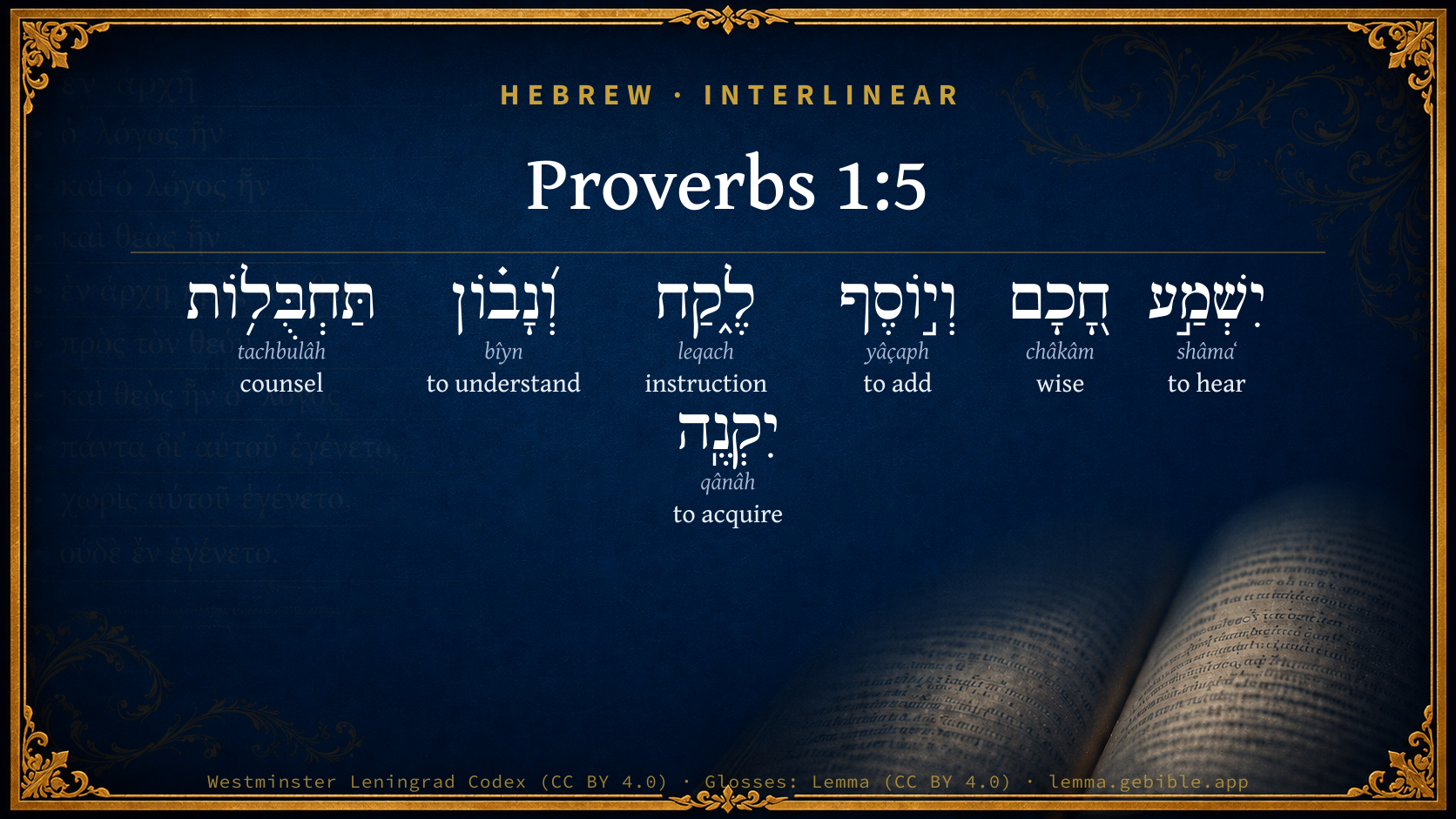
Proverbs 1:5

Hebrew (Westminster Leningrad Codex) Proverbs 1:5 appears in the Hebrew Old Testament. The text above is from the Westminster Leningrad Codex. Each word links to its Strong’s number, a concise gloss, and parsing drawn from the Open Scriptures Hebrew Bible morphology. Click any word for its full Brown-Driver-Briggs (BDB) entry.
Download image
Cite this verse

Proverbs 1:5 (World English Bible). Public Domain. Lemma interlinear Bible study tool, https://lemma.gebible.app/v/proverbs/1/5.

Show BibTeX & RIS
BibTeX
RIS
English Translation
That the wise man may hear, and increase in learning; That the man of understanding may attain to sound counsel:
World English Bible · Public Domain
Download a study sheet

One document with this verse’s original text, its word-by-word gloss line, the meaning frame, cross-references with their text, attributed commentary, and full source and license credits — printable, and it pastes into notes with its structure intact.

This verse Autodidact and up

Study sheet (.html) Plain text (.txt)

A passage Seminary Student

Up to 50 verses in one chapter. A passage sheet keeps up to 6 commentary sources and 12 cross-references per verse, in the order this page ranks them, and says so on the sheet whenever that leaves anything out. Ask for a single verse and you get the Autodidact verse sheet above.

Everything on this page stays free to read, with no account — the sheet is a download of what is already on screen, not access to it.

Want to remove ads? Support Godless Engineer
Compare translations 3

The same verse in 3 English versions, stacked beneath the original-language interlinear above. Click any original word for its lexicon entry.

Each is an independent rendering of the whole verse — the interlinear is not word-aligned to these translations.

Highlighted words mark where these versions differ — a whole-verse word diff, not a word-by-word alignment.

  • World English Bible Public Domain
    That the wise man may hear, and increase in learning; That the man of understanding may attain to sound counsel:
  • King James Version Public Domain
    A wise man will hear, and will increase learning; and a man of understanding shall attain unto wise counsels:
  • unfoldingWord Literal Text CC BY-SA 4.0
    (may a wise one hear and increase learning, and an understanding one acquire guidance),

unfoldingWord Literal Text — © unfoldingWord, licensed CC BY-SA 4.0. Word-aligned USFM3 via Door43 (git.door43.org/unfoldingWord/en_ult).

Versions to compare (up to 4)

3 of 4 selected

Show all 18 translations

Every available English version of this verse, each an independent rendering of the whole verse.

  • World English Bible Public Domain
    That the wise man may hear, and increase in learning; That the man of understanding may attain to sound counsel:
  • Berean Standard Bible Public Domain
    let the wise listen and gain instruction, and the discerning acquire wise counsel
  • Majority Standard Bible Public Domain
    let the wise listen and gain instruction, and the discerning acquire wise counsel
  • King James Version Public Domain
    A wise man will hear, and will increase learning; and a man of understanding shall attain unto wise counsels:
  • American Standard Version (1901) Public Domain
    That the wise man may hear, and increase in learning; And that the man of understanding may attain unto sound counsels:
  • Revised Version (1885) Public Domain
    That the wise man may hear, and increase in learning; and that the man of understanding may attain unto sound counsels:
  • Geneva Bible (1599) Public Domain
    A wise man shall heare and increase in learning, and a man of vnderstanding shall attayne vnto wise counsels,
  • Douay-Rheims (1899) Public Domain
    A wise man shall hear and shall be wiser: and he that understandeth, shall possess governments.
  • Young's Literal Translation Public Domain
    (The wise doth hear and increaseth learning, And the intelligent doth obtain counsels.)
  • Literal Standard Version CC BY-SA 4.0
    (The wise hear and increase learning, || And the intelligent obtain counsels.)
  • Unlocked Literal Bible CC BY-SA 4.0
    Let wise people listen and increase their learning, and let discerning people get guidance,
  • unfoldingWord Literal Text CC BY-SA 4.0
    (may a wise one hear and increase learning, and an understanding one acquire guidance),
  • Darby Bible Public Domain
    He that is wise will hear, and will increase learning; and the intelligent will gain wise counsels:
  • World Messianic Bible Public Domain
    that the wise man may hear, and increase in learning; that the man of understanding may attain to sound counsel;
  • Webster's Bible Public Domain
    A wise man will hear, and will increase learning; and a man of understanding shall attain to wise counsels:
  • Free Bible Version CC BY-SA 4.0
    Wise people will listen and gain in learning, and those who have good judgment will gain skills in guidance,
  • Bible in Basic English Public Domain
    (The wise man, hearing, will get greater learning, and the acts of the man of good sense will be wisely guided:)
  • JPS Tanakh (1917) Public Domain
    That the wise man may hear, and increase in learning, and the man of understanding may attain unto wise counsels;

Literal Standard Version (2020), Covenant Press — licensed CC BY-SA 4.0. Text via the HelloAO Bible API (eBible.org). Unlocked Literal Bible (unfoldingWord) — licensed CC BY-SA 4.0. Text via the HelloAO Bible API (eBible.org). unfoldingWord Literal Text — © unfoldingWord, licensed CC BY-SA 4.0. Word-aligned USFM3 via Door43 (git.door43.org/unfoldingWord/en_ult). Free Bible Version, Dr. Jonathan Gallagher — licensed CC BY-SA 4.0. Text via the HelloAO Bible API (eBible.org).

Word by word

More ways to search: Search by grammar → Find every occurrence → Compare this word →

Practice this passage: Drill this verse → Learn its vocabulary →

About this verse

These counts appear in no published source. They are computed here, from the morphology-tagged text and Lemma’s own curated glosses. What Lemma adds →

7
words
7
distinct lemmas
Wisdom
section

Notable vocabulary

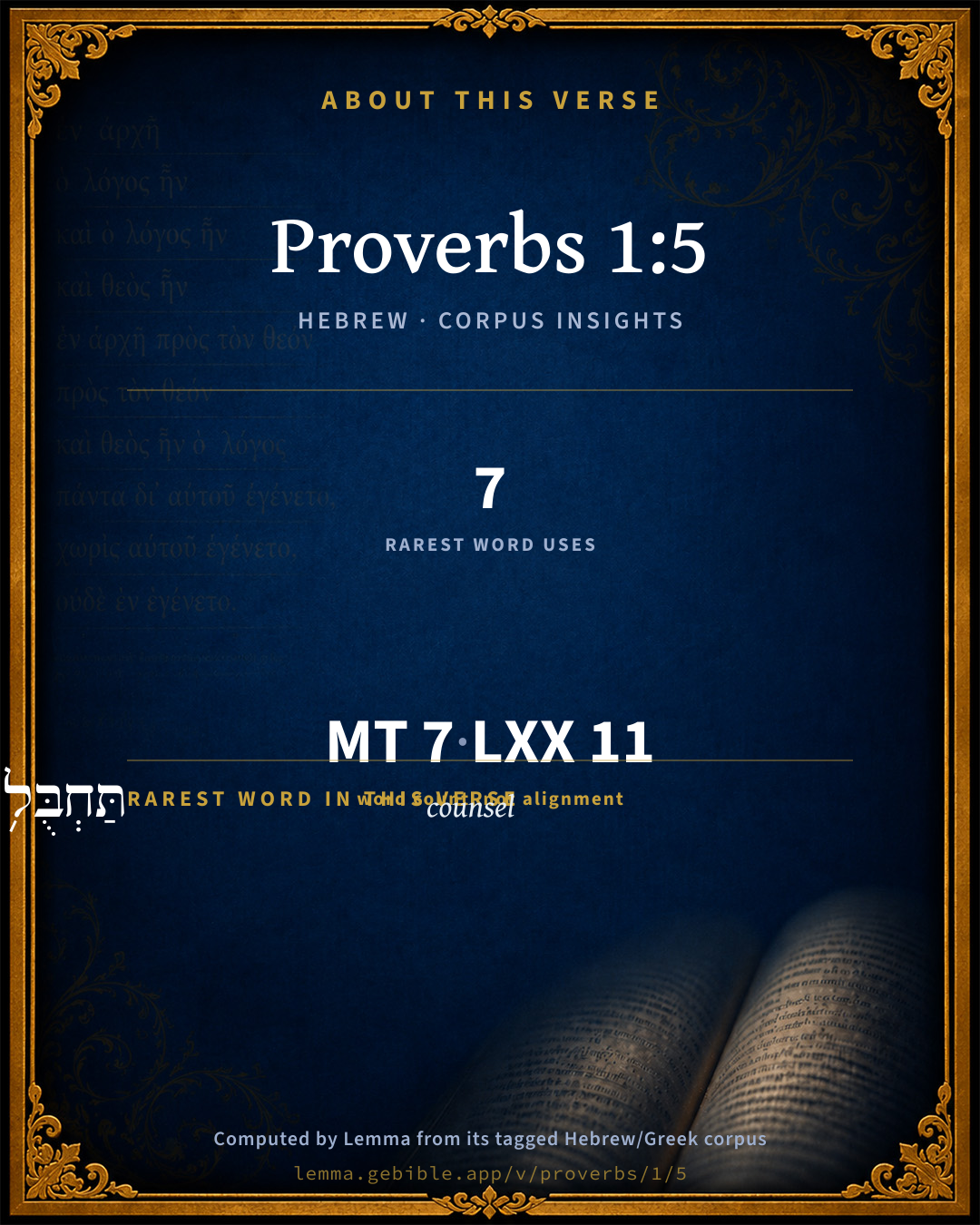
The rarest word here is תַּחְבֻּל֥וֹת counsel H8458 — appearing just 7 times in the whole Hebrew Bible.

Shared distinctive vocabulary

תַּחְבֻּל֥וֹת counsel H8458 occurs in 6 verses of the Hebrew Bible. Also found in:

Grammatical profile

  • 4 verbs
  • 3 nouns

Verb forms

  • יִשְׁמַ֣ע Qal · Imperfect
  • וְי֣וֹסֶף Hiphil · Imperfect
  • וְ֝נָב֗וֹן Niphal · Participle Active
  • יִקְנֶֽה Qal · Imperfect

Hebrew & Septuagint length

In English translation the verse runs 20 words from the Hebrew and 19 from the Septuagint (LXX English) — closely comparable.

A rough comparison of the two English renderings, which tokenize alike — not a word-level alignment.

Word counts can differ between the Hebrew and the Greek without any difference in meaning — e.g. the Hebrew direct-object marker אֵת has no separate Greek word, and Greek often adds the article ὁ.

In the original languages it is 7 Hebrew tokens and 11 Greek tokens — but the two are counted differently (Hebrew bundles its prefixes and suffixes into one token; the Greek is in lemma form), so that isn’t a like-for-like length.

Cross-references

9

Topical passages linked to Proverbs 1:5 in the Treasury of Scripture Knowledge — connected by theme and wording, ordered by reader-vote popularity; previews shown in the World English Bible.

  • Proverbs 12:1 Whoever loves correction loves knowledge, But he who hates reproof is stupid.
  • Proverbs 9:9 Instruct a wise man, and he will be still wiser. Teach a righteous man, and he will increase in learning.
  • 1 Corinthians 10:15 I speak as to wise men. Judge what I say.
  • Job 34:10 "Therefore listen to me, you men of understanding: Far be it from God, that he should do wickedness, From the Almighty, that he should commit iniquity.
  • Job 34:16 "If now you have understanding, hear this. Listen to the voice of my words.
  • Psalms 119:98–100 Your commandments make me wiser than my enemies, For your commandments are always with me.
  • Job 34:34 Men of understanding will tell me, Yes, every wise man who hears me:
  • 2 Chronicles 25:16 It happened, as he talked with him, that [the king] said to him, Have we made you of the king's counsel? Stop! Why should you be struck down? Then the prophet stopped, and said, I know that God has determined to destroy you, because you have done this, and have not listened to my counsel.
  • 1 Samuel 25:32–33 David said to Abigail, Blessed be Yahweh, the God of Israel, who sent you this day to meet me:

Cross-references courtesy of OpenBible.info (CC BY 4.0).

Hebrew and Greek witnesses Masoretic Hebrew ↔ Greek Septuagint

The same verse in the two great witnesses to the Old Testament, shown verse-for-verse.

These are two independent witnesses, not word-aligned to each other, and the Septuagint is shown in lemma (dictionary) form.

Hebrew Proverbs 1:5 Masoretic · Westminster Leningrad Codex

יִשְׁמַ֣ע חָ֭כָם וְי֣וֹסֶף לֶ֑קַח וְ֝נָב֗וֹן תַּחְבֻּל֥וֹת יִקְנֶֽה

That the wise man may hear, and increase in learning; That the man of understanding may attain to sound counsel:

World English Bible · Public Domain

Greek LXX Proverbs 1:5 Septuagint · lemma form

ὅδε γάρ ἀκούω σοφός σοφός εἰμί ὁ δέ νοήμων κυβέρνησις κτάομαι

For by the hearing of these a wise man will be wiser, and man of understanding will gain direction;

LXX2012 (modern English Septuagint) · Public Domain

On this verse, John Gill's Exposition discusses the Septuagint’s reading. Read the note in Commentary ↓

Hebrew: Westminster Leningrad Codex (CC BY 4.0). Greek: Septuagint (public domain); English from LXX2012 (modern English Septuagint) (Public Domain). How the Septuagint differs from the Hebrew →

Commentary

Notes on Proverbs 1:5 from classic Christian and Jewish commentators (each source and its license shown beneath its notes). The classic Christian expositions comment on the surrounding passage and are grouped to its opening verse, so a note may address several verses; the Jewish commentaries on the Tanakh (Rashi and others) are per-verse, so they appear only where the commentator wrote on this verse.

Lemma curates 59 commentaries, every one of them public domain or Creative Commons licensed, each selected and text-cleaned for this edition rather than reprinted as found. About our sources →

John Gill's Exposition

A wise man will hear,.... With great attention, and hearken to the proverbs and wise sayings herein delivered; for here are many things entertaining to men of years and wisdom, as well as instructive to young men and simple ones;

and will increase learning; or "add" (k) to his stock of learning; or, as the Targum,

"will add knowledge;''

see Pe2 1:5; or, "will be wiser", as the Vulgate Latin version. This is said to show the excellency of this book, and the extensive usefulness of it; indeed wise men will get knowledge where fools cannot, and increase learning where others can get none: there are few books but a wise man will get something out of; and especially such a book as this, and as the Scriptures are;

and a man of understanding shall attain unto wise counsels; a man of a spiritual understanding arrives to the knowledge of the wise counsels of God; the doctrines of the Gospel, which are the "whole counsel" of God; are recondite wisdom, the hidden wisdom of God, which no wisdom of man is comparable to. It is the wisest scheme that was ever formed, and which the wit of man could never have devised, even salvation by Jesus Christ; and which was laid in God's "counsels of old", which are "faithfulness" and "truth"; the knowledge of which is attained unto by one that is spiritually wise. Moreover, a man that thoroughly understands the things contained in this book is fit to be a counsellor of others in things human and divine; in things moral, civil, and spiritual: he is fit to be in the cabinet council of princes, to be a counsellor of kings; yea, to have the reins of government in his hands. "He shall possess government"; so the Septuagint, Vulgate Latin, and Arabic versions: or, "he shall possess the helm" (l); sit as a pilot there, as the word may signify, and steer the ship aright in which he is; whether it be his family, or the church of God, or a city or corporation, or a kingdom: this book, rightly understood by him, will furnish him with rules to do all things well and wisely.

(k) "addet", Pagninus, Montanus, Mercerus, Cocceius, Michaelis, Schultens. (l) "gubernacula possidebit", V. L. "metaphora a nauclero desumpta", Schultens.

John Gill's Exposition of the Whole Bible (1746–1763) — public domain (CC PDM 1.0). Text via the HelloAO Bible API.

Trapp's Complete Commentary

John Trapp

Pro 1:5 A wise [man] will hear, and will increase learning; and a man of understanding shall attain unto wise counsels:

Ver. 5. A wise man will hear.] Hearing and seeing are by Aristotle called "the learned senses," because by these doors learning, yea, life, entereth into the soul. {Isa 55:3} David Chytraeus, when he lay dying, lifted up himself to hear the discourses of his friends that sat by him, and said that he should die with better cheer if he might die learning something. {a}

And will increase learning.] "Take heed what you hear: unto you that hear shall more be given." {Mar 4:24} {See Trapp on "Mar 4:24"} Only ponder and apply what you hear. For they that do otherwise are like the wolf, who never attain to any more divine learning than to spell Pater ; father, but when they should come to put together, and to apply it to their souls, they say agnus , lamb, - their minds running a-madding after the profits and pleasures of the world, and they thinking those little less than mad that "run to and fro to increase knowledge." {Dan 12:4}

{a} " Si moribundus etiam aliquid didicisset." - Melch. Adam.

John Trapp, A Commentary or Exposition upon All the Books of the Old and New Testament (1647–1656) — public domain. Text from a community e-Sword module.

The Biblical Illustrator

Joseph S. Exell

Pro_1:5

A wise man will hear, and will increase learning; and a man of understanding shall attain unto wise counsels.

The increase of knowledge

I. No man is so wise but he may learn more. And that both in theoretical and practical knowledge, how to think better, and how to do better. Be not content with that measure of knowledge ye have, but labour still for more.

II. Much knowledge comes in at the ear. Hearing and seeing are by Aristotle called the learned senses, because by these doors learning enters into the soul. Yea, and lips also. The ears are the conduit pipes of wisdom to convey it to us.

III. The Scripture brings in increase of knowledge. Because--

1. It is the highest book in the world.

2. All heavenly wisdom in other books comes from thence, as waters in rivers from the fountain.

IV. Scripture learning is the best learning. It is the most profound knowledge. It is the most profitable.

V. Natural parts well used help much in religion. Pauls learning was a great help to him, and Solomons high reach. It is a wonder what may be attained by industry and Gods blessing upon it. (Francis Taylor.)

The Biblical Illustrator, edited by Joseph S. Exell (c. 1880s–1900s) — public domain. Text from a community e-Sword module.

Joseph Benson's Commentary

Pro 1:5-6. A wise man will hear — Is not self-conceited, as fools are, but willing to learn from others, and, therefore, will attend to the following instructions; and will increase learning — Thereby he will gain this great benefit, he will increase in knowledge and wisdom. This he adds, to show that this book is useful and necessary, not only to the ignorant, but also to the most wise and knowing persons; and shall attain unto wise counsels — Not to deep speculations, but practical knowledge and wisdom, the art of governing himself, or others, well and prudently. To understand a proverb, &c. — That is, the interpretation of a proverb, or the meaning and use of the wise sayings of God or men: to know this practically, and for his direction and benefit; for practice is the great design of this book. The words of the wise, and their dark sayings — Such as are hard to be understood by inconsiderate and carnal men; but may be found out by diligent and humble inquiry, and prayer for divine teaching.

Joseph Benson's Commentary on the Old and New Testaments (1811–1818) — public domain. Text from a community e-Sword module.

The Preacher's Complete Homiletical Commentary

Joseph S. Exell (gen. ed.)

CRITICAL NOTES.—

Pro_1:5. Wise counsels, or “capability to guide,” literally “helmsmanship.”

MAIN HOMILETICS OF THE PARAGRAPH.—Pro_1:5-6

THE CHARACTERISTICS OF A WISE MAN

I. He will hear. He shows that he values what he has already attained by giving heed to those who are able to add to his knowledge. Those who know the most are the most open to receive fresh knowledge.

II. The necessary consequence of this willingness to hear is a growth in knowledge. The wise man “will increase learning.” There is an absolute promise in connection with spiritual wisdom. “Whosoever hath, to him shall be given, and whosoever hath not, from him shall be taken even that which he seemeth to have” (Luk_8:18). He who has wisdom to give heed shall have his wisdom increased by giving heed. To those who are willing to hear, that which was once dark and difficult becomes clear and plain. They “understand a proverb and the interpretation; the words of the wise and their dark sayings.” This hearing implies more than a mere reception of sound. It includes a desire to translate precepts into deeds. Many who can understand the grammatical construction and literal meaning of the Divine oracles cannot apprehend their spiritual signification because they do not desire to submit to their guidance. This was the condition of many of the Scribes and Pharisees in the days of our Lord. They saw and yet were blind (Mat_13:13; Joh_9:39). “If any man will do his will, he shall know of the doctrine,” etc. (Joh_7:17).

III. This growth in knowledge gives a man a guide for his own life and enables him to guide others. (For “wise counsels,” see Critical Notes). Such a man will not sound all the mysteries of life or of God, but enough will be made plain to give him a compass by which to steer; and he will be able to lead others. A diligent pupil will by-and-by be fit for a teacher. How fully was the truth of these verses exemplified in the history of the Apostles. What dull pupils they were at first, and even until after their Master’s resurrection. (Luk_24:25.) But their willingness to be disciples—learners—fitted them at length to “go and teach all nations.” (Mat_28:19.) Continuing in Christ’s Word, they came to “know the truth,” according to His promise. (Joh_8:31.)

OUTLINES AND SUGGESTIVE COMMENTS

Pro_1:5. True wisdom is never stationary, but always progressive; because it secures the ground behind it as a basis for further advances. “He who is not adding is wasting; he who is not increasing knowledge is losing from it,” says Rabbi Hillel.—Fausset.

As long ago as the time of Melancthon it was recognised as a significant fact that wisdom claims as her hearers and pupils, not only the simple, the young, and the untaught, but those who are already advanced in the knowledge of the truth, the wise and experienced. It is indeed Divine wisdom in regard to which these assertions are made, and it is precisely as it is within the department of the New Testament with the duty of faith, and of growth in believing knowledge, which duty in no stage of the Christian life in this world ever loses its validity and its binding power. Compare Luk_17:5; Eph_4:15-16; Col_1:11; Col_2:19; 2Th_1:3; 2Pe_3:18.—Lange’s Commentary.

Pro_1:6. If the law be dark to any, the fault is not in the lawgiver, but in those that should better understand it.—Trapp.

The sayings of the wise are but words (two or three words), and it is their shortness that maketh them to be dark. Now, David says: “I will incline mine ear unto a parable”—there is his study to understand; “I will open my dark saying upon the harp”—there is the interpretation. It is not David, but He who came from David, that there is spoken of, and who, despising inanimate instruments, having made this world and the little world man, and by His Holy Spirit having compacted his soul and body, doth praise the Lord by an instrument of many voices, and to this instrument man doth sing the knowledge of His truth. Wherefore to understand the words of His wise prophets and penmen, we must go to Him.—Jermin.

The Preacher's Complete Homiletical Commentary (gen. ed. Joseph S. Exell; Funk & Wagnalls, c. 1892) — public domain (pre-1929). A full-Bible homiletical/sermon-outline anthology covering 65 of 66 books (2 John is absent from the source module). Text from a community e-Sword module.

Geneva Bible (1599)

Geneva Bible translators

As he showeth that these parables containing the effect of religion as touching manners and doctrine, do appertain to the simple people: so doth he declare that the same is also necessary for them that are wise and learned.

Geneva Bible (1599) marginal notes — public domain. Text via Bolls.life.

Jamieson, Fausset & Brown

Robert Jamieson, A. R. Fausset & David Brown

Such writings the wise, who pursue right ends by right means, will value.

learning--not the act, but matter of it.

wise counsels--or the art and principles of governing.

Jamieson, Fausset & Brown — Commentary Critical and Explanatory on the Whole Bible (1871) — public domain (CC PDM 1.0). Text via the HelloAO Bible API.

Adam Clarke's Commentary

Verse 5. A wise man will hear] I shall not only give such instructions as may be suitable to the youthful and inexperienced, but also to those who have much knowledge and understanding. So said St. Paul: We speak wisdom among them that are perfect. This and the following verse are connected in the old MS. and in Coverdale: "By hearyinge the wyse man shall come by more wysdome; and by experience he shall be more apte to understonde a parable and the interpretation thereof; the wordes of the wyse and the darke speaches of the same."

Adam Clarke's Commentary on the Bible (1810–1826) — public domain. Text from a community e-Sword/MySword module.

Ellicott's Commentary for English Readers

(5) A wise man will hear.—That is, if he listen to these proverbs. (Comp. Pro_9:9.) It is not the young only who will derive profit from them.

A man of understanding.—Or rather, of discernment.

Wise counsels.—Literally, arts of seamanship: i.e., guiding himself and others aright through the “waves of this troublesome world.”

A Bible Commentary for English Readers, edited by Charles John Ellicott (1878–1897) — public domain. Text from a community e-Sword module.

The Cambridge Bible for Schools and Colleges

gen. ed. J. J. S. Perowne

5. A wise man will hear] Or, That the wise man may hear, R.V., making the clause a continuation of the direct statement of the design of the Book.

learning] Lit. taking, and so that which is taken, or learned. He will increase his store. σοφὸς σοφώτερος ἔσται, LXX. sapiens sapientior erit, Vulg.

wise counsels] Or, sound counsels, R.V. The figure of steering a ship, involved in the Heb. word for counsels, is preserved in the rendering both of the LXX. (κυβέρνησιν κτήσεται. Comp. κυβερνήσεις, 1Co_12:28), and of the Vulg. gubernacula. “Skill and facility in the management of life. Comp. Pro_11:14; Pro_12:5; Job_37:12.” Lange, Comm. ad loc.

The Cambridge Bible for Schools and Colleges (gen. ed. J. J. S. Perowne; Cambridge University Press, 1878–1918) — public domain. Text from a community e-Sword module.

Albert Barnes' Notes on the Bible

But it is not for the young only that he writes. The “man of understanding” may gain “wise counsels,” literally, the power to “steer” his course rightly on the dangerous seas of life. This “steersmanship,” it may be noted, is a word almost unique to Proverbs (compare “counsel” in Pro 11:14; Pro 12:5; Pro 24:6).

Albert Barnes' Notes on the Bible (1834–1885) — public domain. Text from a community e-Sword/MySword module.

Haydock's Catholic Bible Commentary

CHAPTER I.

Wiser. "Tamdiu audiendum & discendum est, quamdiu nescias, & si proverbio credimus, quamdiu vivas," says Seneca, ep. 77. --- Governments. And be fit to govern others, (Worthington) as well as himself. (Calmet)

George Leo Haydock (1774–1849), Haydock's Catholic Family Bible and Commentary, 1859 edition — public domain. Excludes Psalms (Douay-Rheims chapter numbering differs from Protestant) and Deuterocanonical books (Catholic canon only).

Matthew Poole's English Annotations

Will hear; is not self-conceited, as fools are, but willing to learn from others; and therefore will attend to the following instructions.

Will increase learning; and thereby will gain this great benefit, to grow in knowledge and wisdom. This he adds to show that this book is useful and necessary, not only to the simple, but also to the moist wise and knowing persons.

Unto wise counsels; not to deep speculations, but practical consideration; to the art of governing himself or others well and prudently.

Matthew Poole's English Annotations on the Holy Bible (1683–1685) — public domain. Text from a community e-Sword/MySword module.

Whedon's Commentary on the Bible

Daniel D. Whedon

5. As to the other class, of more advanced and comparatively educated pupils, being already trained to thought and study, he has confidence that they will, from habit and education, hear, attend to his instructions, and so add to their acquirements; and thus, being already of more mature understanding, (nabhon, see Pro_1:2, discriminating,) they נבון shall attain unto, get, gain, or establish their counsels, or well-concerted designs. The term rendered wise counsels (steersmanship, or capability to guide) is somewhat obscure, and has given the critics trouble. The general sense of the verse seems to be an expression of confidence that this class of persons will, by means of his instructions, increase in their acquisitions, and so succeed in their ardent and deliberate pursuit of useful knowledge as to obtain the power to steer their course safely through life.

Daniel D. Whedon (gen. ed.), Commentary on the Old and New Testaments (1874–1909) — public domain. Text from a community e-Sword module.

The Pulpit Commentary

A wise man will hear, and will increase learning. The change of construction in the original is reproduced in the Authorized Version, but has been rendered variously. Thus Umbreit and Elster, regarding the verb mvyi (yish"ma ) as conditional, translate, "if the wise man hear;" on the other hand, Delitzsch and Zockler take it as voluntative," let the wise man hear," ete. The principle here enunciated is again stated in Pro_9:9, "Give instruction to a wise man, and he will be yet wiser," and finds expression under the gospel economy in the words of our Lord, "For whosoever hath, to him shall be given, and he shall have more abundance". (Mat_13:12; cf. Mat_25:29 Mar_4:25 Luk_8:18 and Luk_14:26) Learning; Hebrew, jql (lekakh), in the sense of being transmitted or received (Gesenius, Delitzsch, Dunn). A man of understanding (LXX, o nohmwn ; Vulgate, intelligens) is a person of intelligence who lays himself open to be instructed. Wise counsels; Hebrew, twOlBujT (takh"buloth).

This word is derived from lbjo (khevel), a ship rope, a denominative of lbejo (khovel), and only occurs in the plural. It signifies those maxims of prudence by which a man may direct his course aright through life (cf. regimen, Arabic). The imagery is taken from the management of a vessel, and is reproduced in the LXX kubernhsiv , and the Vulgate gubernatio. "Navigationi vitam comparat" (Mariana). The word is almost exclusively confined to the Proverbs, and occurs in Pro_11:14 Pro_12:5 Pro_20:18; and Pro_24:6, usually in a good sense, though it has the meaning of "stratagem" Pro_12:5. In the only other passage where it is found it is used of God"s power in turning about the clouds; of. Job_37:12, "And it i.e. the bright cloud is turned round about by his counsels (Wt lWBjtB, b"thakh"bulothau)." It is the practical correlative of "learning," in the first part of the verse.

The Pulpit Commentary (1880–1919), ed. H.D.M. Spence-Jones & Joseph S. Exell — public domain. Text from a community e-Sword module.

John Wesley's Explanatory Notes

Will hear - Is willing to learn. Attain to - The art of governing himself or others.

John Wesley, Explanatory Notes Upon the Whole Bible (1754–1765) — public domain. Text via the GEBible commentary corpus.

Bridges on Proverbs

Charles Bridges

Not only the simple and the young, but even the wise, may here gather instruction. For a truly wise man is one, not who has attained, but who knows that he "has not attained," and is pressing onward to perfection. (Php 3:12 . Compare 1Co 3:18 ; 1Co 3:8 :2.) David, while conscious of comparative attainments, was ever seeking for higher light. (Psa 119:89-100 ; with Psa 119:18, Psa 119:33-34 .) Indeed the richest stores would soon waste, without constant additions. Hearing is a great medium of knowledge. Jethro instructed Moses (Exo 18:17-26 ); our Lord his disciples. (Mat 13:11-16 . Joh 16:12 .) Peter enlightened is fellow-apostles. (Act 11:2-18 ) Priscilla and Aquila "instructed Apollos in the way of God more perfectly." (Act 18:24-26.) Indeed we must be hearers, ere we would be teachers. ’He gathers that hears; he spends that teacheth. If we spend before we gather, we shall soon prove bankrupts.’†1 The longer we learn, the more we feel ourselves to be learners; and the more ready we shall be to hear, that we may increase in learning. (Pro 9:9 ; Pro 18:15 .) And at such a crisis as this, both of the Church and of the world, how eagerly should we improve every medium of instruction, by which we might become "men of understanding, and attain wise counsels, to know what Israel ought to do"! (1Ch 12:32 .) The wise man himself expounded his words and dark sayings to the delight and instruction of his royal scholar (1Ki 10:1-5 ); so to a teachable hearer "the deep things of God" will be interpreted. (1Co 2:9-10 .) Hence the value of the Minister of God; "an interpreter, one of a thousand" (Job 33:23 . Compare Act 8:27-35 ); the divinely-appointed means of bringing to the perfection of knowledge. (Eph 4:11-15 . 1Th 3:10 .) Many disorders and heresies might have been spared to the Church, if, instead of indulging the perversity of an unsettled judgment, men had honoured "the Priest, as the messenger of the LORD of Hosts," and in humble simplicity had "sought the law at his mouth." (Mal 2:7 . Compare Heb 13:7, Heb 13:17 with 1Co 4:8; 1Co 3:2-4.) Self-will may resist this suggestion as Romish domination. But humble subjection to the faithful "steward of the mysteries of God," coming to learn, not to teach; to have, not the curiosity fed, but the conscience satisfied. This reverence of God’s ordinance will issue in the "good things of the heart established with grace." (Heb 13:9 ).

Footnotes

†1 Bishop Hall.

Charles Bridges, An Exposition of the Book of Proverbs (1846) — public domain. Text from a community e-Sword module.

Rashi

Rabbi Shlomo Yitzchaki (Rashi)

Let the wise man hear these proverbs.

and increase to his wisdom.

learning Heb. לקח, learning.

the wise man This is the one who has heard wisdom.

The understanding man who has knowledge superior to the knowledge of the wise man, for he knows how to derive one idea from another, and he adds to what he [has] heard.

Rashi on the Tanakh — English translations: “The Judaica Press complete Tanach with Rashi, translated by A. J. Rosenberg” (CC BY 4.0); “Pentateuch with Rashi's commentary by M. Rosenbaum and A.M. Silbermann, 1929-1934” (public domain); “The Metsudah Tanach series, Lakewood, N.J” (CC BY 4.0); and “The Book of Joshua, Metsudah Publications, 1997” (CC BY 4.0). Text via Sefaria.

Lesson kit

Teaching starters — assembled from the data on this page, not authored interpretation. Every prompt links to the verse data it draws on. Edit before teaching.

Proverbs, in the Wisdom, opens this verse with 7 words (7 distinct Hebrew lemmas). Its most distinctive word is tachbulâh (“counsel”). A historical commentator’s framing appears above. Read the whole chapter for the surrounding context.

Discussion questions

  1. What does “counsel” (tachbulâh) contribute to the verse as a whole?
  2. How does Job 37:12, which shares the word «counsel», read alongside this verse?
  3. These translations render this verse differently; the difference is in the English rendering, not the original. What questions does that raise?
  4. «יִשְׁמַ֣ע» is a Qal Imperfect verb. How does that grammatical form shape the action described?
  5. Compare how John Gill's Exposition and Trapp's Complete Commentary read this verse. Where do they agree or differ?

Things to notice

Reading settings

Reading text

Shown beneath each verse's original-language words.

Old Testament
Old Testament edition

Read the OT as the Masoretic Hebrew (MT) or the Greek Septuagint (LXX).

English shown for the Greek Septuagint (in the Hebrew ↔ Greek comparison).

Comparing translations? Open the Compare panel on any verse page to stack up to four side by side.