2 Kings 19:30

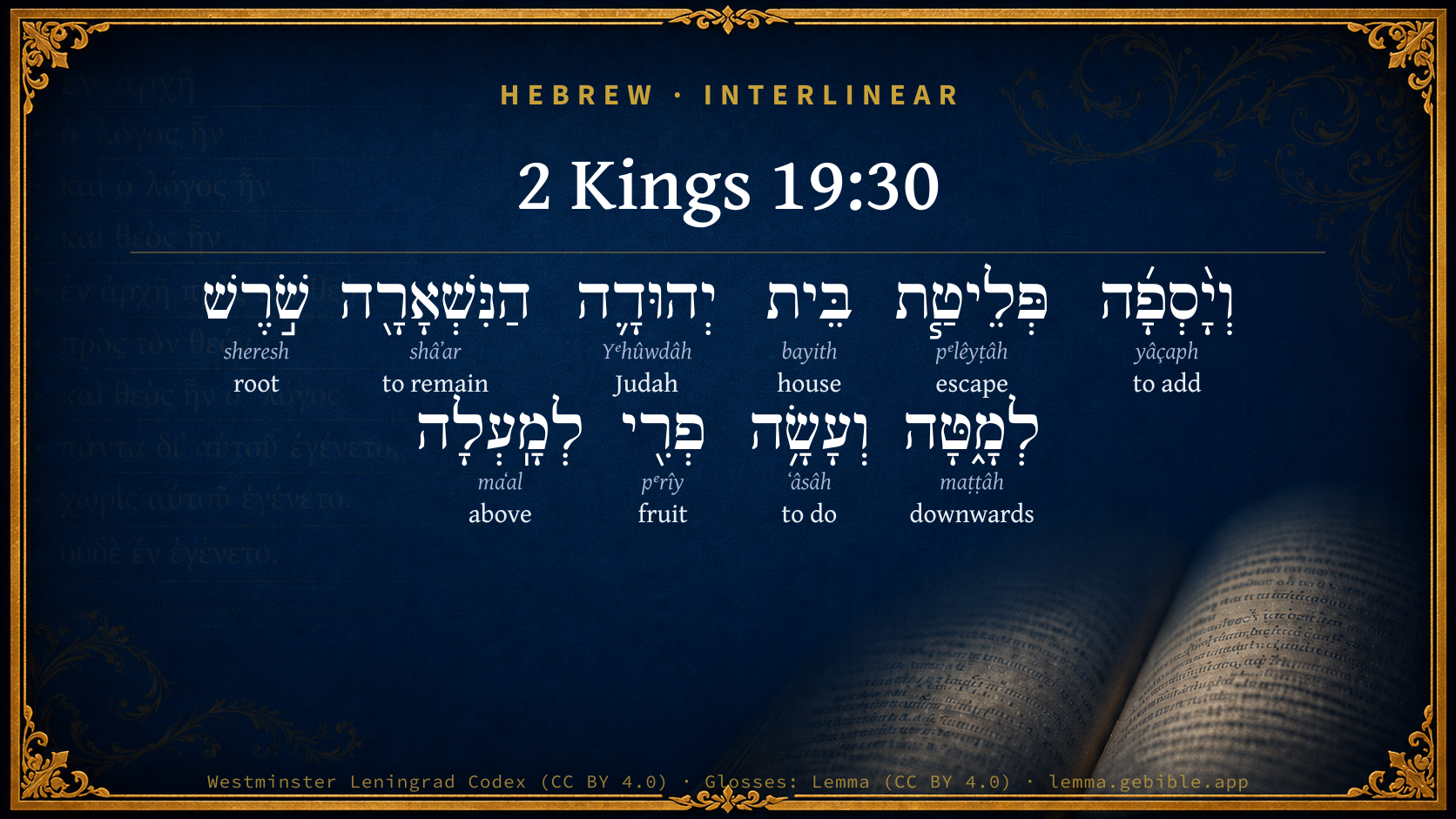
Hebrew (Westminster Leningrad Codex) 2 Kings 19:30 appears in the Hebrew Old Testament. The text above is from the Westminster Leningrad Codex. Each word links to its Strong’s number, a concise gloss, and parsing drawn from the Open Scriptures Hebrew Bible morphology. Click any word for its full Brown-Driver-Briggs (BDB) entry.
Download image
Cite this verse

2 Kings 19:30 (World English Bible). Public Domain. Lemma interlinear Bible study tool, https://lemma.gebible.app/v/2-kings/19/30.

Show BibTeX & RIS
BibTeX
RIS
English Translation
The remnant that has escaped of the house of Judah shall again take root downward, and bear fruit upward.
World English Bible · Public Domain
Download a study sheet

One document with this verse’s original text, its word-by-word gloss line, the meaning frame, cross-references with their text, attributed commentary, and full source and license credits — printable, and it pastes into notes with its structure intact.

This verse Autodidact and up

Study sheet (.html) Plain text (.txt)

A passage Seminary Student

Up to 50 verses in one chapter. A passage sheet keeps up to 6 commentary sources and 12 cross-references per verse, in the order this page ranks them, and says so on the sheet whenever that leaves anything out. Ask for a single verse and you get the Autodidact verse sheet above.

Everything on this page stays free to read, with no account — the sheet is a download of what is already on screen, not access to it.

Want to remove ads? Support Godless Engineer
Compare translations 3

The same verse in 3 English versions, stacked beneath the original-language interlinear above. Click any original word for its lexicon entry.

Each is an independent rendering of the whole verse — the interlinear is not word-aligned to these translations.

Highlighted words mark where these versions differ — a whole-verse word diff, not a word-by-word alignment.

  • World English Bible Public Domain
    The remnant that has escaped of the house of Judah shall again take root downward, and bear fruit upward.
  • King James Version Public Domain
    And the remnant that is escaped of the house of Judah shall yet again take root downward, and bear fruit upward.
  • unfoldingWord Literal Text CC BY-SA 4.0
    And the remaining survival of the house of Judah will again root downward, and it will make fruit upward.

unfoldingWord Literal Text — © unfoldingWord, licensed CC BY-SA 4.0. Word-aligned USFM3 via Door43 (git.door43.org/unfoldingWord/en_ult).

Versions to compare (up to 4)

3 of 4 selected

Show all 18 translations

Every available English version of this verse, each an independent rendering of the whole verse.

  • World English Bible Public Domain
    The remnant that has escaped of the house of Judah shall again take root downward, and bear fruit upward.
  • Berean Standard Bible Public Domain
    And the surviving remnant of the house of Judah will again take root below and bear fruit above.
  • Majority Standard Bible Public Domain
    And the surviving remnant of the house of Judah will again take root below and bear fruit above.
  • King James Version Public Domain
    And the remnant that is escaped of the house of Judah shall yet again take root downward, and bear fruit upward.
  • American Standard Version (1901) Public Domain
    And the remnant that is escaped of the house of Judah shall again take root downward, and bear fruit upward.
  • Revised Version (1885) Public Domain
    And the remnant that is escaped of the house of Judah shall again take root downward, and bear fruit upward.
  • Geneva Bible (1599) Public Domain
    And the remnant that is escaped of the house of Iudah, shall againe take roote downewarde, and beare fruite vpwarde.
  • Douay-Rheims (1899) Public Domain
    And whatsoever shall be left of the house of Juda, shall take root downward, and bear fruit upward.
  • Young's Literal Translation Public Domain
    And it hath continued -- The escaped of the house of Judah That hath been left -- to take root beneath, And hath made fruit upward.
  • Literal Standard Version CC BY-SA 4.0
    And it has continued—The escaped of the house of Judah || That has been left—to take root beneath, || And has made fruit upward.
  • Unlocked Literal Bible CC BY-SA 4.0
    The remnant of the house of Judah that survives will again take root and bear fruit.
  • unfoldingWord Literal Text CC BY-SA 4.0
    And the remaining survival of the house of Judah will again root downward, and it will make fruit upward.
  • Darby Bible Public Domain
    And the remnant that is escaped of the house of Judah Shall again take root downward, and bear fruit upward;
  • World Messianic Bible Public Domain
    The remnant that has escaped of the house of Judah will again take root downward, and bear fruit upward.
  • Webster's Bible Public Domain
    And the remnant that hath escaped of the house of Judah shall yet again take root downward, and bear fruit upward.
  • Free Bible Version CC BY-SA 4.0
    The remnant that's left of Judah will revive again, sending roots below and bearing fruit above.
  • Bible in Basic English Public Domain
    And those of Judah who are still living will again take root in the earth and give fruit.
  • JPS Tanakh (1917) Public Domain
    And the remnant that is escaped of the house of Judah shall again take root downward, and bear fruit upward.

Literal Standard Version (2020), Covenant Press — licensed CC BY-SA 4.0. Text via the HelloAO Bible API (eBible.org). Unlocked Literal Bible (unfoldingWord) — licensed CC BY-SA 4.0. Text via the HelloAO Bible API (eBible.org). unfoldingWord Literal Text — © unfoldingWord, licensed CC BY-SA 4.0. Word-aligned USFM3 via Door43 (git.door43.org/unfoldingWord/en_ult). Free Bible Version, Dr. Jonathan Gallagher — licensed CC BY-SA 4.0. Text via the HelloAO Bible API (eBible.org).

Word by word

More ways to search: Search by grammar → Find every occurrence → Compare this word →

Practice this passage: Drill this verse → Learn its vocabulary →

לְמָ֑טָּה
maṭṭâh
H4295
“to/for · downwards”
Preposition + Adverb
Part of Speech
Preposition + Adverb
Full BDB Definition

Origin: from H5786 with directive enclitic appended

TWOT: 1352a

downwards, below - downwards - under (of age) - beneath
  1. וְיָ֨סְפָ֜ה yâçaph H3254 “and · to add” Conjunction + Verb, Qal, Perfect, 3rd Person, Feminine, Singular
  2. פְּלֵיטַ֧ת pᵉlêyṭâh H6413 “escape of” Noun, Common, Feminine, Singular, Construct
  3. בֵּית bayith H1004 “house of” Noun, Common, Masculine, Singular, Construct
  4. יְהוּדָ֛ה Yᵉhûwdâh H3063 “Judah” Noun, Proper
  5. הַנִּשְׁאָרָ֖ה shâʼar H7604 “the · remaining” Particle, Definite Article + Verb, Niphal, Participle Active, Feminine, Singular, Absolute
  6. שֹׁ֣רֶשׁ sheresh H8328 “root” Noun, Common, Masculine, Singular, Absolute
  7. וְעָשָׂ֥ה ʻâsâh H6213 “and · to do” Conjunction + Verb, Qal, Sequential Perfect, 3rd Person, Masculine, Singular
  8. פְרִ֖י pᵉrîy H6529 “fruit” Noun, Common, Masculine, Singular, Absolute
  9. לְמָֽעְלָה maʻal H4605 “to/for · above · toward” Preposition + Adverb + Suffix, Demonstrative

About this verse

These counts appear in no published source. They are computed here, from the morphology-tagged text and Lemma’s own curated glosses. What Lemma adds →

10
words
10
distinct lemmas
Historical
section

Notable vocabulary

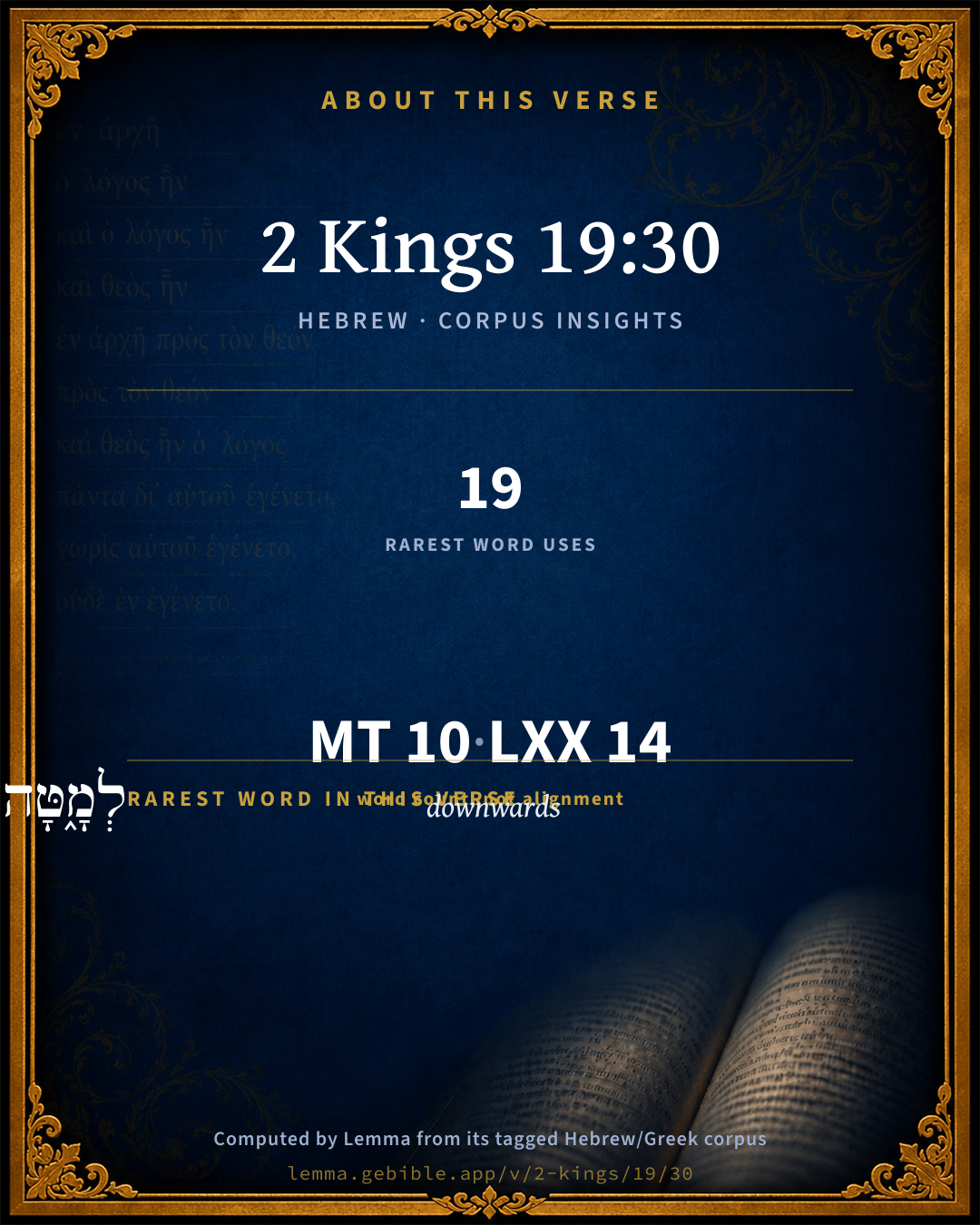
The rarest word here is לְמָ֑טָּה downwards H4295 — appearing just 19 times in the whole Hebrew Bible.

Shared distinctive vocabulary

לְמָ֑טָּה downwards H4295 occurs in 18 verses of the Hebrew Bible. Also found in:

Grammatical profile

  • 3 verbs
  • 5 nouns
  • 2 adverbs

Verb forms

  • וְיָ֨סְפָ֜ה Qal · Perfect
  • הַנִּשְׁאָרָ֖ה Niphal · Participle Active
  • וְעָשָׂ֥ה Qal · Sequential Perfect

Hebrew & Septuagint length

In English translation the verse runs 19 words from the Hebrew and 26 from the Septuagint (LXX English) — closely comparable.

A rough comparison of the two English renderings, which tokenize alike — not a word-level alignment.

Word counts can differ between the Hebrew and the Greek without any difference in meaning — e.g. the Hebrew direct-object marker אֵת has no separate Greek word, and Greek often adds the article ὁ.

In the original languages it is 10 Hebrew tokens and 14 Greek tokens — but the two are counted differently (Hebrew bundles its prefixes and suffixes into one token; the Greek is in lemma form), so that isn’t a like-for-like length.

Cross-references

7

Topical passages linked to 2 Kings 19:30 in the Treasury of Scripture Knowledge — connected by theme and wording, ordered by reader-vote popularity; previews shown in the World English Bible.

  • 2 Kings 19:4 It may be Yahweh your God will hear all the words of Rabshakeh, whom the king of Assyria his master has sent to defy the living God, and will rebuke the words which Yahweh your God has heard. Therefore lift up your prayer for the remnant that is left.
  • Isaiah 27:6 In days to come shall Jacob take root; Israel shall blossom and bud; and they shall fill the surface of the world with fruit.
  • 2 Chronicles 32:22–23 Thus Yahweh saved Hezekiah and the inhabitants of Jerusalem from the hand of Sennacherib the king of Assyria, and from the hand of all [others], and guided them on every side.
  • Isaiah 10:20–22 It shall come to pass in that day, that the remnant of Israel, and those who are escaped of the house of Jacob, shall no more again lean on him who struck them, but shall lean on Yahweh, the Holy One of Israel, in truth.
  • Isaiah 1:9 Unless Yahweh of hosts had left to us a very small remnant, We would have been as Sodom; We would have been like Gomorrah.
  • Isaiah 37:31–32 The remnant that is escaped of the house of Judah shall again take root downward, and bear fruit upward.
  • Psalms 80:9 You cleared the ground for it. It took deep root, and filled the land.

Cross-references courtesy of OpenBible.info (CC BY 4.0).

Hebrew and Greek witnesses Masoretic Hebrew ↔ Greek Septuagint

The same verse in the two great witnesses to the Old Testament, shown verse-for-verse.

These are two independent witnesses, not word-aligned to each other, and the Septuagint is shown in lemma (dictionary) form.

Hebrew 2 Kings 19:30 Masoretic · Westminster Leningrad Codex

וְיָ֨סְפָ֜ה פְּלֵיטַ֧ת בֵּית יְהוּדָ֛ה הַנִּשְׁאָרָ֖ה שֹׁ֣רֶשׁ לְמָ֑טָּה וְעָשָׂ֥ה פְרִ֖י לְמָֽעְלָה

The remnant that has escaped of the house of Judah shall again take root downward, and bear fruit upward.

World English Bible · Public Domain

Greek LXX 2 Kings 19:30 Septuagint · lemma form

καί προςτίθημι ὁ διασώζω οἶκος ιουδα ὁ ὑπολείπω ῥίζα κάτω καί ποιέω καρπός ἄνω

And he shall increase him that has escaped of the house of Juda: and the remnant shall strike root beneath, and it shall produce fruit above.

LXX2012 (modern English Septuagint) · Public Domain

Hebrew: Westminster Leningrad Codex (CC BY 4.0). Greek: Septuagint (public domain); English from LXX2012 (modern English Septuagint) (Public Domain). How the Septuagint differs from the Hebrew →

Targum (Aramaic paraphrase)

1

The Targum is the ancient Jewish Aramaic paraphrase of the Hebrew Scriptures — an interpretive translation, not the Hebrew text itself. Onkelos (literal) and Pseudo-Jonathan (expansive) render the Torah, and Jonathan the Prophets. Coverage is partial: where no permissively-licensed English translation exists for a verse, only the Aramaic is shown. This is verse-level text, not a word-by-word alignment to the Hebrew.

  1. Targum Jonathan Prophets (Joshua–Malachi)
    וְיוֹסְפוּן מְשֵׁיזְבַיָא דְבֵית יְהוּדָה דְאִשְׁתַּאֲרוּן כְּאִילַן דִי מְשַׁלַח שׁוֹרְשׁוֹהִי לְרַע וּמֵרִים נוֹפֵיהּ לְעֵילָא:

    (no public-domain English translation for this verse)

    Targum Jonathan — Aramaic: “Mikraot Gedolot” (public domain). English: “Sefaria Community Translation” (CC0 1.0 (public-domain dedication)); “London "Chaldee Paraphrase," 1871” (public domain). Text via Sefaria.

Commentary

Notes on 2 Kings 19:30 from classic Christian and Jewish commentators (each source and its license shown beneath its notes). The classic Christian expositions comment on the surrounding passage and are grouped to its opening verse, so a note may address several verses; the Jewish commentaries on the Tanakh (Rashi and others) are per-verse, so they appear only where the commentator wrote on this verse.

Lemma curates 59 commentaries, every one of them public domain or Creative Commons licensed, each selected and text-cleaned for this edition rather than reprinted as found. About our sources →

Trapp's Complete Commentary

John Trapp

2Ki 19:30 And the remnant that is escaped of the house of Judah shall yet again take root downward, and bear fruit upward.

Ver. 30. And the remnant that is escaped,] sc., From the sword of the Assyrian, which had devoured much flesh, and drunk much blood amongst them.

John Trapp, A Commentary or Exposition upon All the Books of the Old and New Testament (1647–1656) — public domain. Text from a community e-Sword module.

Joseph Benson's Commentary

2Ki 19:30. The remnant that is escaped shall yet again bear fruit upward — Shall increase and multiply greatly. It is a metaphor taken from plants. “The prophet passes from fields to men, and from the cultivation of land to the state of the church; for, having just said, that, being delivered from the Assyrians, they should cultivate their land as usual, he adds, that it should also come to pass that the kingdom and church, delivered from this calamity, should flourish again, increase, and bring forth much fruit; which we know happened under Hezekiah.” — Dodd.

Joseph Benson's Commentary on the Old and New Testaments (1811–1818) — public domain. Text from a community e-Sword module.

Geneva Bible (1599)

Geneva Bible translators

The Lord will multiply in great number, that small remnant of Judah that is escaped.

Geneva Bible (1599) marginal notes — public domain. Text via Bolls.life.

Adam Clarke's Commentary

Verse 30. The remnant - shall yet again take root] As your corn shall take root in the soil, and bring forth and abundantly multiply itself, so shall the Jewish people; the population shall be greatly increased, and the desolations occasioned by the sword soon be forgotten.

Adam Clarke's Commentary on the Bible (1810–1826) — public domain. Text from a community e-Sword/MySword module.

Ellicott's Commentary for English Readers

(30) The remnant that is escaped of the house of Judah.—Rather, the survival (survivors) of the house of Judah that are left. (Comp. Isa_11:11-16.)

Shall yet again take root.—Literally, shall add root, i.e., shall take firmer root, like a tree after a storm. The figure naturally follows on the language of 2Ki_19:29. It is thoroughly in the style of Isaiah. (Comp. Isa_6:13; Isa_27:6.)

A Bible Commentary for English Readers, edited by Charles John Ellicott (1878–1897) — public domain. Text from a community e-Sword module.

The Cambridge Bible for Schools and Colleges

gen. ed. J. J. S. Perowne

30. The remnant … shall yet again take rool] Just as in the case of their crops, so shall it be with the people. God shall preserve a remnant, as He was doing in the shed grain of the harvest, and these shall once more grow up, in spite of their present low estate.

The Cambridge Bible for Schools and Colleges (gen. ed. J. J. S. Perowne; Cambridge University Press, 1878–1918) — public domain. Text from a community e-Sword module.

Albert Barnes' Notes on the Bible

The remnant that is escaped - Terrible ravages seem to have been committed in the first attack (2Ki 18:13 note). And though the second invasion was comparatively harmless, yet it probably fell heavily on the cities of the west and the southwest. Thus the “escaped” were but “a remnant.”

Bear fruit upward - The flourishing time of Josiah is the special fulfillment of this prophecy 2Ki 23:15-20.

Albert Barnes' Notes on the Bible (1834–1885) — public domain. Text from a community e-Sword/MySword module.

Haydock's Catholic Bible Commentary

Upward, like a fruitful tree. (Haydock)

George Leo Haydock (1774–1849), Haydock's Catholic Family Bible and Commentary, 1859 edition — public domain. Excludes Psalms (Douay-Rheims chapter numbering differs from Protestant) and Deuterocanonical books (Catholic canon only).

Matthew Poole's English Annotations

i. e. shall increase and multiply greatly; a metaphor from plants. Compare Job 29:19.

Matthew Poole's English Annotations on the Holy Bible (1683–1685) — public domain. Text from a community e-Sword/MySword module.

Whedon's Commentary on the Bible

Daniel D. Whedon

30. The remnant… of Judah — Those who witness the sign just mentioned, having been delivered from the hand of Assyria. There is here a reference to the remnant for whom the king had asked Isaiah to pray. Ver.

Daniel D. Whedon (gen. ed.), Commentary on the Old and New Testaments (1874–1909) — public domain. Text from a community e-Sword module.

The Pulpit Commentary

And the remnant that is escaped of the house of Judah. Sennacherib, who in his first expedition had carried away out of Judaea 200, 150 prisoners ("Eponym Canon" p. 134, line 12), had in his second probably done considerable damage to the towns in the south-west of Palestine Lachish, for instance, which was a city of Judah. (2Ki_14:19) The open country had been wasted, great numbers killed, and many probably carried off by famine and pestilence. Thus both Hezekiah (ver. 4) and Isaiah regard the population still in the land as a mere "remnant." Shall yet again take root downwardi.e. , be firmly fixed and established in the land, like a vigorous tree that strikes its roots into the soil deeplyand bear fruit upward; i.e. exhibit all the outward signs of prosperity. The reign of Josiah, when the Jewish dominion embraced the whole of Palestine, (2Ki_23:15-20) was the special fulfillment of this prophecy.

The Pulpit Commentary (1880–1919), ed. H.D.M. Spence-Jones & Joseph S. Exell — public domain. Text from a community e-Sword module.

John Wesley's Explanatory Notes

The remnant, &c. - They shall be well fixt and provided for themselves, and then do good to others.

John Wesley, Explanatory Notes Upon the Whole Bible (1754–1765) — public domain. Text via the GEBible commentary corpus.

Lesson kit

Teaching starters — assembled from the data on this page, not authored interpretation. Every prompt links to the verse data it draws on. Edit before teaching.

2 Kings, in the Historical, opens this verse with 10 words (10 distinct Hebrew lemmas). Its most distinctive word is maṭṭâh (“downwards”). A historical commentator’s framing appears above. Read the whole chapter for the surrounding context.

Discussion questions

  1. What does “downwards” (maṭṭâh) contribute to the verse as a whole?
  2. How does Exodus 26:24, which shares the word «downwards», read alongside this verse?
  3. The translations on this page render this verse differently — a whole-verse word diff, not a word-by-word alignment. What might account for the different wordings?
  4. «וְיָ֨סְפָ֜ה» is a Qal Perfect verb. How does that grammatical form shape the action described?
  5. Compare how Trapp's Complete Commentary and Joseph Benson's Commentary read this verse. Where do they agree or differ?

Things to notice

Reading settings

Reading text

Shown beneath each verse's original-language words.

Old Testament
Old Testament edition

Read the OT as the Masoretic Hebrew (MT) or the Greek Septuagint (LXX).

English shown for the Greek Septuagint (in the Hebrew ↔ Greek comparison).

Comparing translations? Open the Compare panel on any verse page to stack up to four side by side.