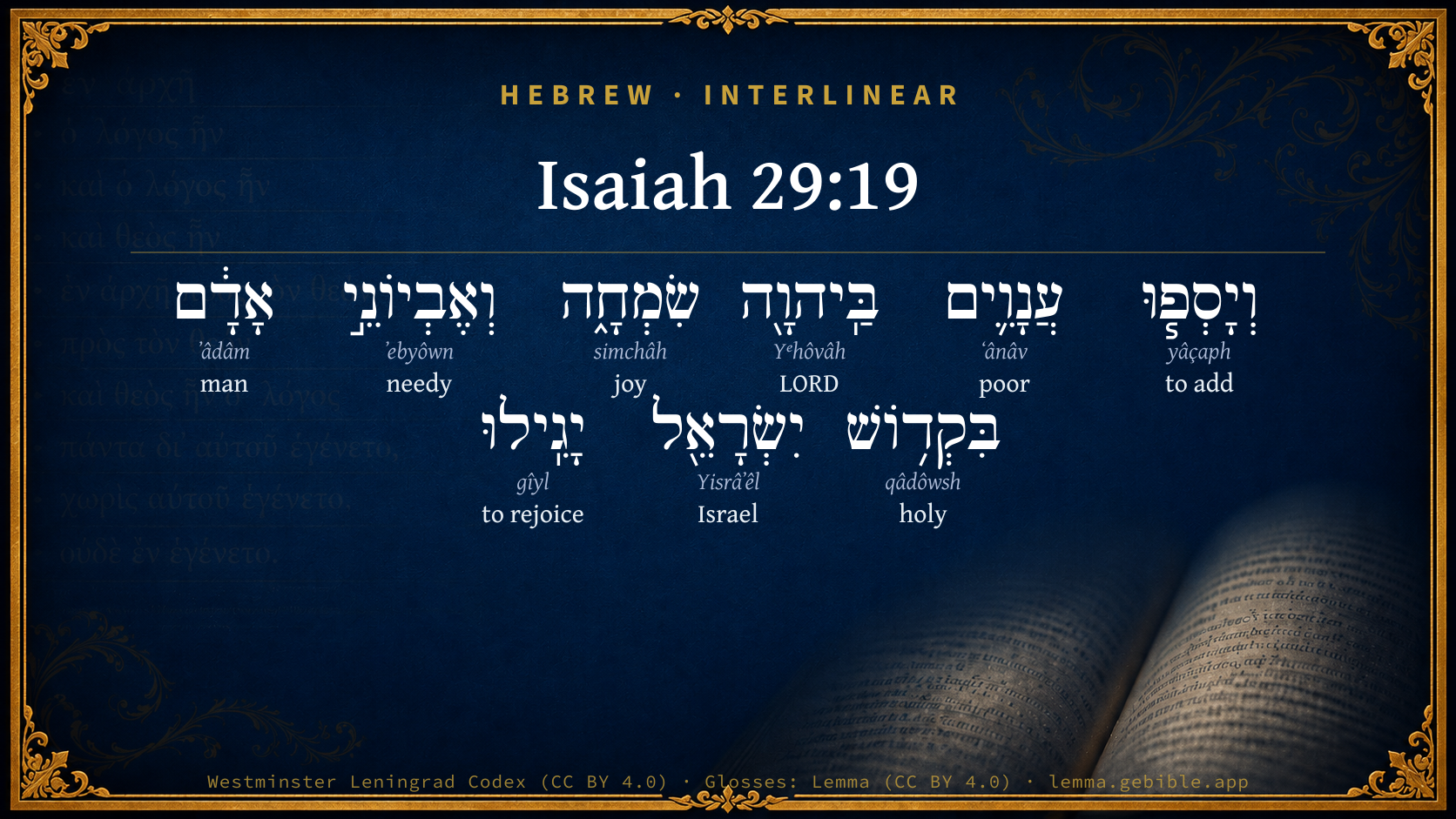
Isaiah 29:19

Hebrew (Westminster Leningrad Codex) Isaiah 29:19 appears in the Hebrew Old Testament. The text above is from the Westminster Leningrad Codex. Each word links to its Strong’s number, a concise gloss, and parsing drawn from the Open Scriptures Hebrew Bible morphology. Click any word for its full Brown-Driver-Briggs (BDB) entry.
Download image
Cite this verse

Isaiah 29:19 (World English Bible). Public Domain. Lemma interlinear Bible study tool, https://lemma.gebible.app/v/isaiah/29/19.

Show BibTeX & RIS
BibTeX
RIS
English Translation
The humble also shall increase their joy in Yahweh, and the poor among men shall rejoice in the Holy One of Israel.
World English Bible · Public Domain
Download a study sheet

One document with this verse’s original text, its word-by-word gloss line, the meaning frame, cross-references with their text, attributed commentary, and full source and license credits — printable, and it pastes into notes with its structure intact.

This verse Autodidact and up

Study sheet (.html) Plain text (.txt)

A passage Seminary Student

Up to 50 verses in one chapter. A passage sheet keeps up to 6 commentary sources and 12 cross-references per verse, in the order this page ranks them, and says so on the sheet whenever that leaves anything out. Ask for a single verse and you get the Autodidact verse sheet above.

Everything on this page stays free to read, with no account — the sheet is a download of what is already on screen, not access to it.

Want to remove ads? Support Godless Engineer
Compare translations 3

The same verse in 3 English versions, stacked beneath the original-language interlinear above. Click any original word for its lexicon entry.

Each is an independent rendering of the whole verse — the interlinear is not word-aligned to these translations.

Highlighted words mark where these versions differ — a whole-verse word diff, not a word-by-word alignment.

  • World English Bible Public Domain
    The humble also shall increase their joy in Yahweh, and the poor among men shall rejoice in the Holy One of Israel.
  • King James Version Public Domain
    The meek also shall increase their joy in the LORD, and the poor among men shall rejoice in the Holy One of Israel.
  • unfoldingWord Literal Text CC BY-SA 4.0
    And the poor will add rejoicing in Yahweh, and the needy of man will be glad in the Holy of Israel.

unfoldingWord Literal Text — © unfoldingWord, licensed CC BY-SA 4.0. Word-aligned USFM3 via Door43 (git.door43.org/unfoldingWord/en_ult).

Versions to compare (up to 4)

3 of 4 selected

Show all 18 translations

Every available English version of this verse, each an independent rendering of the whole verse.

  • World English Bible Public Domain
    The humble also shall increase their joy in Yahweh, and the poor among men shall rejoice in the Holy One of Israel.
  • Berean Standard Bible Public Domain
    The humble will increase their joy in the LORD, and the poor among men will rejoice in the Holy One of Israel.
  • Majority Standard Bible Public Domain
    The humble will increase their joy in the LORD, and the poor among men will rejoice in the Holy One of Israel.
  • King James Version Public Domain
    The meek also shall increase their joy in the LORD, and the poor among men shall rejoice in the Holy One of Israel.
  • American Standard Version (1901) Public Domain
    The meek also shall increase their joy in Jehovah, and the poor among men shall rejoice in the Holy One of Israel.
  • Revised Version (1885) Public Domain
    The meek also shall increase their joy in the LORD, and the poor among men shall rejoice in the Holy One of Israel.
  • Geneva Bible (1599) Public Domain
    The meeke in the Lord shall receiue ioye againe, and the poore men shall reioyce in the holy one of Israel.
  • Douay-Rheims (1899) Public Domain
    And the meek shall increase their joy in the Lord, and the poor men shall rejoice in the Holy One of Israel.
  • Young's Literal Translation Public Domain
    And the humble have added joy in Jehovah, And the poor among men In the Holy One of Israel rejoice.
  • Literal Standard Version CC BY-SA 4.0
    And the humble have added joy in YHWH, || And the poor among men || Rejoice in the Holy One of Israel.
  • Unlocked Literal Bible CC BY-SA 4.0
    The oppressed will again rejoice in Yahweh, and the poor among men will rejoice in the Holy One of Israel.
  • unfoldingWord Literal Text CC BY-SA 4.0
    And the poor will add rejoicing in Yahweh, and the needy of man will be glad in the Holy of Israel.
  • Darby Bible Public Domain
    and the meek shall increase their joy in Jehovah, and the needy among men shall rejoice in the Holy One of Israel.
  • World Messianic Bible Public Domain
    The humble also will increase their joy in the LORD, and the poor among men will rejoice in the Holy One of Israel.
  • Webster's Bible Public Domain
    The meek also shall increase their joy in the LORD, and the poor among men shall rejoice in the Holy One of Israel.
  • Free Bible Version CC BY-SA 4.0
    The humble will be even happier in the Lord, and the poor will find their joy in the Holy One of Israel.
  • Bible in Basic English Public Domain
    And the poor will have their joy in the Lord increased, and those in need will be glad in the Holy One of Israel.
  • JPS Tanakh (1917) Public Domain
    The humble also shall increase their joy in the LORD, and the neediest among men shall exult in the Holy One of Israel.

Literal Standard Version (2020), Covenant Press — licensed CC BY-SA 4.0. Text via the HelloAO Bible API (eBible.org). Unlocked Literal Bible (unfoldingWord) — licensed CC BY-SA 4.0. Text via the HelloAO Bible API (eBible.org). unfoldingWord Literal Text — © unfoldingWord, licensed CC BY-SA 4.0. Word-aligned USFM3 via Door43 (git.door43.org/unfoldingWord/en_ult). Free Bible Version, Dr. Jonathan Gallagher — licensed CC BY-SA 4.0. Text via the HelloAO Bible API (eBible.org).

Word by word

More ways to search: Search by grammar → Find every occurrence → Compare this word →

Practice this passage: Drill this verse → Learn its vocabulary →

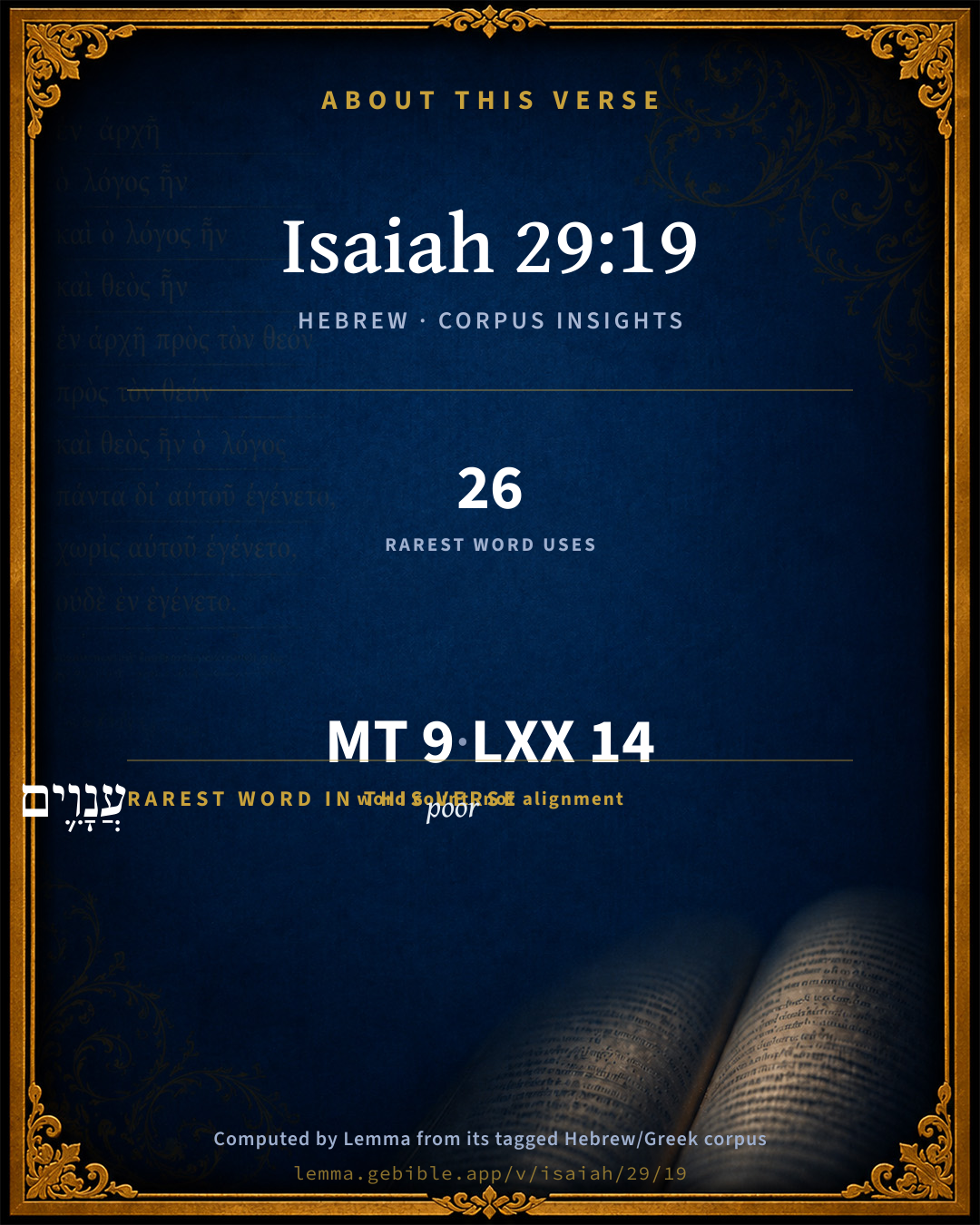
About this verse

These counts appear in no published source. They are computed here, from the morphology-tagged text and Lemma’s own curated glosses. What Lemma adds →

9
words
9
distinct lemmas
Prophets
section

Shared distinctive vocabulary

עֲנָוִ֛ים poor H6035 occurs in 24 verses of the Hebrew Bible. Also found in:

Grammatical profile

  • 2 verbs
  • 4 nouns
  • 3 adjectives

Verb forms

  • וְיָסְפ֧וּ Qal · Sequential Perfect
  • יָגִֽילוּ Qal · Imperfect

Hebrew & Septuagint length

In English translation the verse runs 22 words from the Hebrew and 24 from the Septuagint (LXX English) — closely comparable.

A rough comparison of the two English renderings, which tokenize alike — not a word-level alignment.

Word counts can differ between the Hebrew and the Greek without any difference in meaning — e.g. the Hebrew direct-object marker אֵת has no separate Greek word, and Greek often adds the article ὁ.

In the original languages it is 9 Hebrew tokens and 14 Greek tokens — but the two are counted differently (Hebrew bundles its prefixes and suffixes into one token; the Greek is in lemma form), so that isn’t a like-for-like length.

Cross-references

31

Topical passages linked to Isaiah 29:19 in the Treasury of Scripture Knowledge — connected by theme and wording, ordered by reader-vote popularity; previews shown in the World English Bible.

  • James 2:5 Listen, my beloved brothers. Didn't God choose those who are poor in this world to be rich in faith, and heirs of the Kingdom which he promised to those who love him?
  • Isaiah 61:1 The Spirit of the Lord Yahweh is on me; because Yahweh has anointed me to preach good news to the humble; he has sent me to bind up the broken-hearted, to proclaim liberty to the captives, and the opening [of the prison] to those who are bound;
  • Matthew 11:29 Take my yoke upon you, and learn from me, for I am gentle and lowly in heart; and you will find rest for your souls.
  • Psalms 25:9 He will guide the humble in justice. He will teach the humble his way.
  • Matthew 5:5 Blessed are the gentle, For they shall inherit the earth.
  • Matthew 11:5 the blind receive their sight, the lame walk, the lepers are cleansed, the deaf hear, the dead are raised up, and the poor have good news preached to them.
  • Psalms 37:11 But the humble shall inherit the land, And shall delight themselves in the abundance of peace.
  • Matthew 5:3 "Blessed are the poor in spirit, For theirs is the Kingdom of Heaven.
  • James 1:9 But let the brother in humble circumstances glory in his high position;
  • Psalms 12:5 "Because of the oppression of the weak and because of the groaning of the needy, I will now arise," says Yahweh; "I will set him in safety from those who malign him."
  • Isaiah 11:4 but with righteousness shall he judge the poor, and decide with equity for the humble of the earth; and he shall strike the earth with the rod of his mouth; and with the breath of his lips shall he kill the wicked.
  • Isaiah 61:10 I will greatly rejoice in Yahweh, my soul shall be joyful in my God; for he has clothed me with the garments of salvation, he has covered me with the robe of righteousness, as a bridegroom decks himself with a garland, and as a bride adorns herself with her jewels.
  • Zephaniah 2:3 Seek Yahweh, all you humble of the land, who have kept his ordinances. Seek righteousness. Seek humility. It may be that you will be hidden in the day of Yahweh's anger.
  • Psalms 9:18 For the needy shall not always be forgotten, Nor the hope of the poor perish forever.
  • Psalms 149:4 For Yahweh takes pleasure in his people. He crowns the humble with salvation.
  • Isaiah 14:30 The firstborn of the poor shall feed, and the needy shall lie down in safety; and I will kill your root with famine, and your remnant shall be killed.
  • Isaiah 14:32 What then shall one answer the messengers of the nation? That Yahweh has founded Zion, and in her shall the afflicted of his people take refuge.
  • Isaiah 41:16–18 You shall winnow them, and the wind shall carry them away, and the whirlwind shall scatter them; and you shall rejoice in Yahweh, you shall glory in the Holy One of Israel.
  • Isaiah 57:15 For thus says the high and lofty One who inhabits eternity, whose name is Holy: I dwell in the high and holy place, with him also who is of a contrite and humble spirit, to revive the spirit of the humble, and to revive the heart of the contrite.
  • Isaiah 66:2 For all these things has my hand made, and [so] all these things came to be, says Yahweh: but to this man will I look, even to him who is poor and of a contrite spirit, and who trembles at my word.
  • Habakkuk 3:18 Yet I will rejoice in Yahweh. I will be joyful in the God of my salvation!
  • Zephaniah 3:12–18 But I will leave in the midst of you an afflicted and poor people, and they will take refuge in the name of Yahweh.
  • 1 Corinthians 1:26–29 For you see your calling, brothers, that not many are wise according to the flesh, not many mighty, and not many noble;
  • Galatians 5:22–23 But the fruit of the Spirit is love, joy, peace, patience, kindness, goodness, faithfulness,
  • Ephesians 4:2 with all lowliness and humility, with patience, bearing with one another in love;
  • Philippians 2:1–3 If there is therefore any exhortation in Christ, if any consolation of love, if any fellowship of the Spirit, if any tender mercies and compassion,
  • Philippians 3:1–3 Finally, my brothers, rejoice in the Lord. To write the same things to you, to me indeed is not tiresome, but for you it is safe.
  • Philippians 4:4 Rejoice in the Lord always! Again I will say, Rejoice!
  • James 1:21 Therefore, putting away all filthiness and overflowing of wickedness, receive with humility the implanted word, which is able to save your souls.
  • James 3:13–18 Who is wise and understanding among you? Let him show by his good conduct that his deeds are done in gentleness of wisdom.
  • 1 Peter 2:1–3 Putting away therefore all wickedness, all deceit, hypocrisies, envies, and all evil speaking,

Cross-references courtesy of OpenBible.info (CC BY 4.0).

Hebrew and Greek witnesses Masoretic Hebrew ↔ Greek Septuagint

The same verse in the two great witnesses to the Old Testament, shown verse-for-verse.

These are two independent witnesses, not word-aligned to each other, and the Septuagint is shown in lemma (dictionary) form.

Hebrew Isaiah 29:19 Masoretic · Westminster Leningrad Codex

וְיָסְפ֧וּ עֲנָוִ֛ים בַּֽיהוָ֖ה שִׂמְחָ֑ה וְאֶבְיוֹנֵ֣י אָדָ֔ם בִּקְד֥וֹשׁ יִשְׂרָאֵ֖ל יָגִֽילוּ

The humble also shall increase their joy in Yahweh, and the poor among men shall rejoice in the Holy One of Israel.

World English Bible · Public Domain

Greek LXX Isaiah 29:19 Septuagint · lemma form

καί ἀγαλλιάομαι πτωχός διά κύριος ἐν εὐφροσύνη καί ὁ ἀποἐλπίζω ὁ ἄνθρωπος ἐνπίμπλημι εὐφροσύνη

and the poor shall rejoice with joy because of the Lord, and they that had no hope among men shall be filled with joy.

LXX2012 (modern English Septuagint) · Public Domain

Hebrew: Westminster Leningrad Codex (CC BY 4.0). Greek: Septuagint (public domain); English from LXX2012 (modern English Septuagint) (Public Domain). How the Septuagint differs from the Hebrew →

Targum (Aramaic paraphrase)

1

The Targum is the ancient Jewish Aramaic paraphrase of the Hebrew Scriptures — an interpretive translation, not the Hebrew text itself. Onkelos (literal) and Pseudo-Jonathan (expansive) render the Torah, and Jonathan the Prophets. Coverage is partial: where no permissively-licensed English translation exists for a verse, only the Aramaic is shown. This is verse-level text, not a word-by-word alignment to the Hebrew.

  1. Targum Jonathan Prophets (Joshua–Malachi)
    וְיוֹסְפוּן מְקַבְּלֵי עוּלְבָן בְּמֵימְרָא דַייָ חֶדְוָא וַחֲשִׁיכֵי בְּנֵי אֱנָשָׁא בְּמֵימַר קַדִישָׁא דְיִשְׂרָאֵל יִבְעוּן:

    And those that have suffered affliction on account of the WORD of the Lord shall increase their joy, and the poor of the sons of men shall rejoice in the Word of the holy One of Israel.

    Targum Jonathan — Aramaic: “Mikraot Gedolot” (public domain). English: “Sefaria Community Translation” (CC0 1.0 (public-domain dedication)); “London "Chaldee Paraphrase," 1871” (public domain). Text via Sefaria.

Commentary

Notes on Isaiah 29:19 from classic Christian and Jewish commentators (each source and its license shown beneath its notes). The classic Christian expositions comment on the surrounding passage and are grouped to its opening verse, so a note may address several verses; the Jewish commentaries on the Tanakh (Rashi and others) are per-verse, so they appear only where the commentator wrote on this verse.

Lemma curates 59 commentaries, every one of them public domain or Creative Commons licensed, each selected and text-cleaned for this edition rather than reprinted as found. About our sources →

Trapp's Complete Commentary

John Trapp

Isa 29:19 The meek also shall increase [their] joy in the LORD, and the poor among men shall rejoice in the Holy One of Israel.

Ver. 19. The meek also shall increase their joy in the Lord.] All sincere converts, such especially as have mastered and mortified their unruly passions and are cured of the fret, these shall add joy; these shall have joy upon joy, they shall "overabound exceedingly with joy." {2Co 7:4}

The poor among men.] The poor in spirit. These shall greatly rejoice, both for the mercy of God to themselves, and for the justice of God exercised upon others. {Isa 29:20-21}

John Trapp, A Commentary or Exposition upon All the Books of the Old and New Testament (1647–1656) — public domain. Text from a community e-Sword module.

The Biblical Illustrator

Joseph S. Exell

Isa_29:19

The poor among men shall rejoice in the Holy One of Israel

Reasons why the poor may rejoice in God

One of the most striking proofs of the Divine origin of Christianity is its universal adaptation to the condition and the wants of the whole family of men.

It is not designed to be the religion of a sect or an age, but the religion of the whole world. The universality of its character proves that it comes from Him who sustains all, preserves all, feeds and blesses all. We propose to assign reasons why the poor may well rejoice in the Holy One of Israel.

I. BECAUSE CHRIST IN HIS HUMILIATION CONDESCENDED TO BE POOR AND THUS HONOURED AND HALLOWED THE CONDITION OF THE POOR. Who of all the legislators, moralists, and teachers that have appeared in the world ever conferred such honour on humanity, or displayed such regard for the poor? Who, after this, shall dare to look down upon honest poverty! Who, after this, shall dare to convert want into a crime? Let the poor, then, rejoice in the Holy One of Israel. He can enter into your sorrows, and feel for your wretchedness.

II. BECAUSE THE BLESSINGS OF CHRISTS SALVATION ARE PROVIDED AND BESTOWED GRATUITOUSLY, AND ARE THUS PECULIARLY ADAPTED TO THE CONDITION OF THE POOR.

1. Money has been paid down for the imperial purple of Rome,--the empire of the Caesars has been sold to the highest bidder; but were salvation only to be purchased with money, or did it require resources in man himself, black despair might seize and petrify the heart of every poor man.

2. Or were salvation a work that required expensive and tedious elaboration at home,--were it like the erection of a palace, or the building of a pyramid, or the construction of such vast works as those by which you cross a gulf or span a sea,--alas for the poor! for then their souls must perish. But let the poor among men rejoice, for the salvation which the

Holy One of Israel provides and bestows is a salvation without money and without price.

3. There is another circumstance which ought mightily to enhance these Gospel blessings in the estimation of the poor; namely, the exclusion from many earthly privileges to which poverty subjects them. It is very true that many of the simpler, purer, and more exquisite pleasures of life are as free to the poor as to the rich. But in this world poverty does exclude from some privileges. But, oh! how does my heart, as that of a poor man, exult in the free salvation of the Lord Jesus Christ! Here, in the Gospel of Jesus, is full compensation for all the contumely and scorn cast on humble poverty.

III. BECAUSE, IN ADDITION TO ALL THAT HE HIMSELF HAS DONE FOR THEM, HIS AUTHORITY, AS A LAWGIVER, ENJOINS SPECIAL ATTENTION, CHARITY, AND SYMPATHY TOWARDS THE POOR.

IV. BECAUSE THE CONDITION OF POVERTY IS MORE FAVOURABLE THAN THAT OF RICHES TO THE RECEPTION OF CHRIST AND TO THE DISPLAY OF RELIGIOUS PRINCIPLE. The Saviours language seems fully to warrant this sentiment when He says, How hardly shall they that have riches enter into the kingdom of God!--and again: It is easier for a camel to go through the eye of a needle, than for a rich man to enter into the kingdom of heaven. Poverty seems to be the favourite element in which religious principle k produced and nurtured. It is in the atmosphere of the Poor that the light and heat of Divine truth love to radiate. (J. French.)

The Biblical Illustrator, edited by Joseph S. Exell (c. 1880s–1900s) — public domain. Text from a community e-Sword module.

The Preacher's Complete Homiletical Commentary

Joseph S. Exell (gen. ed.)

THE JOY OF THE MEEK

Isa_29:19. The meek also shall increase their joy in the Lord.

I. THE PERSONS HERE DESCRIBED.

Meekness does not mean timidity (2Ti_1:7); not the craven spirit of the coward, but the quiet power of the strong man (Pro_28:1). It does not mean the absence of courage, but the absence of that ignorant and arrogant self-sufficiency which Peter showed when he said, “Though all men forsake Thee, yet will not I.” It is that calmness of spirit which grows not out of reliance on self, but out of reliance on God. It is recorded of one whose courage at times had flashed up like a consuming fire, “Now the man Moses was very meek, above all the men which were upon the face of the earth.” His meekness was not feebleness, but a calm strength; quiet endurance in the doing of duty under difficulties. He was not provoked by the wrong-headedness or irritated by the ingratitude of the nation he wished to serve, but he quietly bore their stubbornness, and persisted in doing them good against their will. Hence a quiet doing and a quiet bearing of the will of God is one constituent in this quality of the mind “meekness.” It does not mean that equableness of disposition which comes from nature, so much as that calmness of spirit which comes from grace. It is one of the fruits of the Spirit (Gal_5:23). This quality of mind in God’s people is shown:

1. In their intercourse with God. In His presence they manifest “a humble, lowly, and contrite heart.” Theirs is not the spirit of the Pharisee, but the lowly contrition of the publican. Not “Stand by, for I am holier than thou,” but “I am not worthy,” &c. In a ready acceptance of the doctrines of grace and salvation through a Saviour crucified. Not like the Pharisees, who scorned the Saviour “as a root out of a dry ground,” but like those few elect souls, just and devout, who “were waiting for the consolation of Israel.” Christianity is a discipline of humility. In making men Christ-like it makes them meek. Jesus was meek and lowly, and He promises to those like Himself rest of soul.

2. In their submission to the allotments of Providence (Job_14:14; Job_13:15; Mic_7:9; Lev_10:3; 1Sa_3:18; H. E. I. 157, 158, &c.)

3. In their deportment before their fellow-men. They do not arrogate to themselves that superiority which despises and neglects others, but obey the apostolic injunctions (1Pe_2:17; 1Pe_3:8).

II. THE BLESSINGS GOD CONFERS UPON THEM.

1. He saves them. Often in outward troubles they become the charge and care of His providence (Zep_2:3). How wonderfully was Moses saved from the strivings and rebellions of the people! Leaving his vindication in the hands of the Great Judge, God took up his cause; and when the whole camp was against him, God delivered him. How wonderfully was Joseph delivered from the pit and the prison, and Jeremiah in the siege! But always are they saved from soul-destruction. “Saved in the Lord with an everlasting salvation.”

2. He beautifies them. “He will beautify the meek with salvation.” By the robe of righteousness, the inward adorning of the soul in every virtue, by the special manifestation of His mercy when most needed (chap. Isa_61:3), by giving them that esteem and commanding influence which often attracts and impresses their fellow-men.

3. He makes it appear that He delights in them. “The Lord taketh pleasure in His people.”

III. THEIR GRATEFUL RESPONSE.

“The poor among men shall rejoice in the Holy One of Israel.” They rejoice in His salvation; they praise Him in voice, and heart, and life (Isa_61:10).—Samuel Thodey.

RELIGIOUS JOY

Isa_29:19. The meek shall increase their joy.

It is commonly said that while religion is man’s duty and his interest, it is not productive of enjoyment. Yet the Bible is full of joyful expressions, and of exhortations to joy. It even meets the sorrows of humanity and brings joy out of them. Its association of joy with conditions not joyful is remarkable (Mat_5:3-5). Observe the contrasts in our passage (Isa_29:18-19). Circumstances are mentioned which amount to the removal of all alarm (Isa_29:20). From the outward fact, the faith of the persons here described rises to the hand that accomplished it.

Our subject is religious joy.

I. THE SOURCE WHENCE IT IS DERIVED.

“The Lord. The Holy One of Israel.” We rejoice in what we have desired, hoped for, and obtained. This does not exclude enjoyment of the blessings of the present life. They are closely associated with it. They suggest it. We ask whence they come. The habit of regarding earthly advantages as gifts from the hand of God keeps the divine character before us as that of a Being to be regarded with pleasure.

Thus, if we ascend to the spiritual region and contemplate the salvation of man, it includes the compassionate love of God, which gave His Son to impoverishment, suffering, and death; full forgiveness of sin; the various influences of the Divine Spirit; the elevated spiritual privileges and hopes bestowed on fallen men. All this came from the grace of God; it originated in His nature. “God is love.” But the God whose nature can be read in this way is not a God to repel, but attract; not a God of whom to stand in terrified awe, but a God in whom to rejoice.

And this result emerges if we take a more direct look at the divine character. We are supplied with verbal asseverations as well as historical illustrations. We read of the Almighty, the All-wise, the All-righteous, the All-holy, as well as the All-loving. Power, even with justice, would fail to produce joy. But a God of power, and love, and holiness can be a delight, because He can be loved.

But no object of delight can be considered a part from its subject. Nothing is universally delightful. Before you can enjoy anything you must have sympathy with it, a taste for it. There are people who cannot enjoy the finest concert. There must be the heart that is capable of joy in the Holy One of Israel, the heart of “the meek, the poor among men;” the heart changed by the grace of God.

II. THE ELEMENTS OF WHICH IT CONSISTS.

We know our feelings better by experience than by analysis. We can imagine a father so utterly unsatisfactory in his character and conduct that his own children are ashamed to mention his name. We can imagine one whose kindness, whose faultless conduct, whose commanding intellect render them proud of his name. They think of him with pleasure. Thus the poor among men rejoice in the Holy One of Israel.

If you attempt to examine, you will find that your joy in God is compounded of several other feelings, which, like tributary streams, swell with the river of your pleasure.

1. Gratitude. For experience of the divine goodness. It expresses itself in thanks and songs. You think with pleasure of one to whom you are grateful.

2. Affection. Love is closely akin to gratitude. And God has taken away all cause of alienation. The love of God in Christ possesses the heart. Love delights in its object (Rom_5:11).

3. Confidence. We trust Him entirely. In present distresses or future fears. If distrust crosses our minds, we dismiss it as inconsistent with the truth of which we have satisfied ourselves. Now if there is perfect confidence in Him on whom we depend, we cannot fail to rejoice in Him.

4. Approbation. We find the Holy One of Israel a Being in whom we can be infinitely satisfied. At no point, in no respect, could we desire Him to be different from what He is. Nor is it the admiration sometimes expressed for characters there is no desire to imitate. Christians earnestly desire likeness to God. Putting all these together, there must be joy in the Lord.

III. THE AUGMENTATION WHICH IT RECEIVES.

“The meek shall increase their joy in the Lord.” Earthly joy is short-lived. The objects from which it proceeds are liable to change and perish. Many of them, even if they continue, fall. They become flat by satiety and continuity. We outgrow them as a child outgrows his toys. But Christian joy is permanent and tends to increase, because its object remains the same for ever, while His fulness is ever unfolding itself. Knowing and experiencing more of God, there is more joy in Him. Thus there is a constant increase—in the present world, and in the world to come.

Would you enjoy this privilege? Then make it possible. Possess the character. Ye must be born again. Do not indulge sin. Keep Christ in your thoughts. Thus you will be superior to earthly enjoyments.—John Rawlinson.

The Preacher's Complete Homiletical Commentary (gen. ed. Joseph S. Exell; Funk & Wagnalls, c. 1892) — public domain (pre-1929). A full-Bible homiletical/sermon-outline anthology covering 65 of 66 books (2 John is absent from the source module). Text from a community e-Sword module.

Jamieson, Fausset & Brown

Robert Jamieson, A. R. Fausset & David Brown

meek--rather, the afflicted godly: the idea is, virtuous suffering (Isa 61:1; Psa 25:9; Psa 37:11) [BARNES].

poor among men--that is, the poorest of men, namely, the pious poor.

rejoice--when they see their oppressors punished (Isa 29:20-21), and Jehovah exhibited as their protector and rewarder (Isa 29:22-24; Isa 41:17; Jam 2:5).

Jamieson, Fausset & Brown — Commentary Critical and Explanatory on the Whole Bible (1871) — public domain (CC PDM 1.0). Text via the HelloAO Bible API.

Ellicott's Commentary for English Readers

(19) The meek also shall increase their joy in the Lord.—A new element enters into the ideal restoration of the future. Men had been weary of the name of the Holy One of Israel (Isa_30:11). In that better time it should be the source of joy and peace for the poor and the lowly, on whom Isaiah looked with all the yearnings of a prophet’s sympathy.

A Bible Commentary for English Readers, edited by Charles John Ellicott (1878–1897) — public domain. Text from a community e-Sword module.

The Cambridge Bible for Schools and Colleges

gen. ed. J. J. S. Perowne

19. The meek and poor (as in the Psalms) are the oppressed and down-trodden lower orders, as contrasted with the irreligious upper class (Isa_29:20 f.). They have now no hope but in Jehovah; then they shall obtain fresh joy in Him, because He has delivered them.

The Cambridge Bible for Schools and Colleges (gen. ed. J. J. S. Perowne; Cambridge University Press, 1878–1918) — public domain. Text from a community e-Sword module.

John Gill's Exposition

The meek also shall increase their joy in the Lord,.... The "meek", lowly, and humble, are such who are made sensible of sin, and become humble under a sense of it; who see the insufficiency of their own righteousness, and submit to the righteousness of Christ; who attribute all they have, and are, to the free grace of God, and quietly submit to every dispensation of Providence; who are not easily provoked by men, but bear much and long without reviling; who envy not those that are above them in gifts and grace, nor despise those that are below them, and think the worst of themselves, and the best of others; now these have joy in the Lord, in the Word of the Lord, as the Targum, in the Lord Jesus Christ; in the greatness and glory of his person as Jehovah, and so able to save to the uttermost; in him as the Lord their righteousness; in his blood and sacrifice, for the pardon and expiation of their sins; in his fulness as theirs, to supply their wants; in his salvation, being so great, so full, so free, and suitable to them: and whereas their joy may be interrupted through the corruptions of their hearts, the temptations of Satan, and divine desertions, they "shall add" (a) joy in the Lord, as in the original; they shall repeat it, it shall come again, it shall be restored unto them, and they shall afresh exercise it, and "increase" in it, as we render it; for spiritual joy may be increased by the discoveries of the love of God; by fresh views of Christ, through an increase of knowledge of him, and faith in him; by means of meditation and prayer, and by reading and hearing the word:

and the poor among men shall rejoice in the Holy One of Israel; or, "the poorest of men" (b), who were so in a literal sense; for such were the persons, both among Jews and Gentiles, who in the first times of the Gospel were brought to the knowledge of Christ, and faith in him, Mat 11:4 or such who are "poor in spirit"; not only spiritually poor, but who are sensible of their spiritual poverty, and apply to Christ for the true riches of grace: the words may be rendered, "Adam's poor"; such who are impoverished by Adam's fall, and are sensible of it; these, perceiving durable riches and righteousness, even unsearchable riches, in Christ, rejoice in him, "the Holy One of Israel"; who is holy in himself, the sanctifier of others, and is made satisfaction to all his people. The Targum is,

"in the word of the Holy One of Israel.''

This joy is not carnal, but spiritual; it is the fruit of the Spirit of God, and is called joy in the Holy Ghost; as it also is the joy of faith, which goes along with it, is through it, and increases as that does; it is peculiar to believers, unknown to the world, and is unspeakable, and full of glory: and such kind of rejoicing, and an increase of it, are what belong to Gospel times.

(a) "et addent", V. L. Pagninus: Montanus, (b) "mendici hominum", Pagninus, Montanus, Vatablus; "egentissimi hominum", Junius & Tremellius.

John Gill's Exposition of the Whole Bible (1746–1763) — public domain (CC PDM 1.0). Text via the HelloAO Bible API.

Albert Barnes' Notes on the Bible

The meek - The word ‘meek’ usually refers to those who are patient in the reception of injuries, but the Hebrew word used here (ענוים ‛ănâviym) means properly the oppressed, the afflicted, the unhappy Psa 9:13; Psa 10:12, Psa 10:17; Pro 3:34; Isa 11:4. It involves usually the idea of humility or “virtuous suffering” (compare Psa 25:9; Psa 37:11; Psa 69:33). Here it may denote the pious of the land who were oppressed, and subjected to trials.

Shall increase - Margin, as in Hebrew, ‘Add.’ It means, that they should greatly rejoice in the Lord. They should see the evidence of the fulfillment of his predictions; they should see the oppressors punished Isa 29:20-21, and Yahweh coming forth to be their protector and defender Isa 29:22-24.

And the poor among men - The poor people; or the needy. Doubtless the idea is that of the pious poor; those who feared God, and who had been subjected to the trials of oppression and poverty.

Albert Barnes' Notes on the Bible (1834–1885) — public domain. Text from a community e-Sword/MySword module.

Haydock's Catholic Bible Commentary

Rejoice. Our Saviour alludes to this text, (Luke vii. 22.) which, under the figure of the deliverance from captivity, points out the vocation of the Gentiles, chap. xxxv. 5., and xlii. 7, 19.

George Leo Haydock (1774–1849), Haydock's Catholic Family Bible and Commentary, 1859 edition — public domain. Excludes Psalms (Douay-Rheims chapter numbering differs from Protestant) and Deuterocanonical books (Catholic canon only).

Matthew Poole's English Annotations

The meek; the humble and meek believers, opposed to those proud and scornful Israelites or Jews, of whom he speaks in this and in the foregoing chapter. Shall increase their joy in the Lord; shall greatly rejoice in this, that the Lord and Holy One of Israel is now their God and portion.

The poor; either,

1. Spiritually, of which Mat 5:3. Or,

2. Outwardly, mean and despicable people, such as the Gentiles were in the opinion of the Jews, and such as the greatest part of the first believing Christians were, Mat 11:5; 1Co 1:26; Jam 2:5.

Matthew Poole's English Annotations on the Holy Bible (1683–1685) — public domain. Text from a community e-Sword/MySword module.

The Pulpit Commentary

The meek... the poor. The "evangelical prophet" anticipates the gospel in this, among other points that he promises his choicest blessings, not to the rich and mighty, but to the poor and meek. (comp. Isa_57:15 Isa_61:1)

The joy of the meek.

The meek also shall increase their joy in the Lord." It is quite usual to confuse the "meek" with the humble;" but, though the confusion may sometimes be excused, it is better to associate distinct meanings with each term. The humble" man is the Juan who thinks in a lowly way about himself. The "meek" man is the man who is concerned for the interests of others rather than himself, The ideal "meek" man has supreme concern for the interests of God. The "humble" man does not think of himself more highly than he ought to think. The "meek" man is really "disinterested." The Bible models of meekness are first, Moses, who sacrificed himself in his zeal for the interests of the Hebrews; and then, the Lord Jesus Christ, who sacrificed himself for the redemption of mankind. In precise harmony with this text, it is said of him, "Who, for the joy that was set before him, endured the cross, despising the shame, and is set down at the right hand of God." The immediate historical connection of the verse may be thus indicated: The scoffers jeered at Isaiah"s assurance that the distress arising from the Assyrian invasion would pass away; there was no need to think of Egypt; Jehovah could and would defend his own. Isaiah replies to them that they need only wait awhile, and they would learn that God rules, and the day of deliverance and restoration would prove a day of increased joy for all those meek and pious souls that held fast their trust in God. The expression, "shall increase their joy," suggests two very simple and natural divisions.

I THE MEEK HAVE THE JOY OF THEIR TRUST IN THE TIME OF PERIL. Even in the national distress they held their hope in God, and that hope was strength and cheer and song. They did not think so much about themselves and their troubles as about God and about the ways in which he would vindicate himself and make his glory known. Meek souls are taken out of themselves; and this is the secret of joy. Meek souls are so satisfied in those whom they trust that they can be quiet from fear of evil. "Blessed are the meek: for they shall inherit the earth." They are always rich; they may always be happy.

II THE MEEK HAVE THE JOY OF DELIVERANCE WHEN GOD"S DAY COMES. They are ready for it, expecting it, waiting to welcome it. They are not hindered by the sense of shame, as are the scoffers. Long expectation makes possession at last a keener, holier joy; and prepares them fully to enjoy all the blessings it brings. Still it is true that the meek have the best of life while they walk under its gloom, and they will have the best of heaven when its gates are opened for the ransomed. R.T.

The Pulpit Commentary (1880–1919), ed. H.D.M. Spence-Jones & Joseph S. Exell — public domain. Text from a community e-Sword module.

John Wesley's Explanatory Notes

Meek - The humble and meek believers. Poor - Mean and despicable people, such as the Gentiles were in the opinion of the Jews, and such as the greatest part of the first Christians were.

John Wesley, Explanatory Notes Upon the Whole Bible (1754–1765) — public domain. Text via the GEBible commentary corpus.

J. A. Alexander on Isaiah

Joseph Addison Alexander

“And the humble shall add joy (i.e., shall rejoice more and more) in Jehovah, and the poor among men in the Holy One of Israel shall rejoice.” As the preceding verse describes the happy effect of the promised change upon the intellectual views of those who should experience it, so this describes its influence in the promotion of their happiness. Not only should the ignorant be taught of God; but the wretched should be rendered happy in the enjoyment of His favor.

Joseph Addison Alexander, The Prophecies of Isaiah (1846–1847; New York: Scribner, 1870–1878) — public domain. Text from a community e-Sword module.

Rashi

Rabbi Shlomo Yitzchaki (Rashi)

And those who suffered The suffering ones, who bore the yoke of the Holy One, blessed be He, and His decrees.

Rashi on the Tanakh — English translations: “The Judaica Press complete Tanach with Rashi, translated by A. J. Rosenberg” (CC BY 4.0); “Pentateuch with Rashi's commentary by M. Rosenbaum and A.M. Silbermann, 1929-1934” (public domain); “The Metsudah Tanach series, Lakewood, N.J” (CC BY 4.0); and “The Book of Joshua, Metsudah Publications, 1997” (CC BY 4.0). Text via Sefaria.

Ibn Ezra

Rabbi Abraham ibn Ezra

The meek also shall increase, etc. The righteous will escape, when the fortified towns of Judah will be taken, and the judges of Ahaz will be no more, as I explained above (1:26).

Ibn Ezra on the Tanakh — English translations: “Sefaria Community Translation” (CC0 1.0 (public-domain dedication)); “Yalkut, Sifsei Chachomim Chumash, Metsudah Publications, 2009” (CC BY 4.0); and “Commentary of Ibn Ezra on Isaiah - trans. by M. Friedlander, 1873” (public domain). Text via Sefaria.

Lesson kit

Teaching starters — assembled from the data on this page, not authored interpretation. Every prompt links to the verse data it draws on. Edit before teaching.

Isaiah, in the Prophets, opens this verse with 9 words (9 distinct Hebrew lemmas). Its most distinctive word is ʻânâv (“poor”). A historical commentator’s framing appears above. Read the whole chapter for the surrounding context.

Discussion questions

  1. The word ʻânâv carries the sense “poor.” How does it shape the verse?
  2. Numbers 12:3 shares the word «poor» with this verse. How do the two illuminate each other?
  3. These translations render this verse differently; the difference is in the English rendering, not the original. What questions does that raise?
  4. The verb «וְיָסְפ֧וּ» is Qal Sequential Perfect. How does its form color the action?
  5. Reading how Trapp's Complete Commentary and The Biblical Illustrator read this verse, where do the two commentators agree and where do they part?

Things to notice

Reading settings

Reading text

Shown beneath each verse's original-language words.

Old Testament
Old Testament edition

Read the OT as the Masoretic Hebrew (MT) or the Greek Septuagint (LXX).

English shown for the Greek Septuagint (in the Hebrew ↔ Greek comparison).

Comparing translations? Open the Compare panel on any verse page to stack up to four side by side.