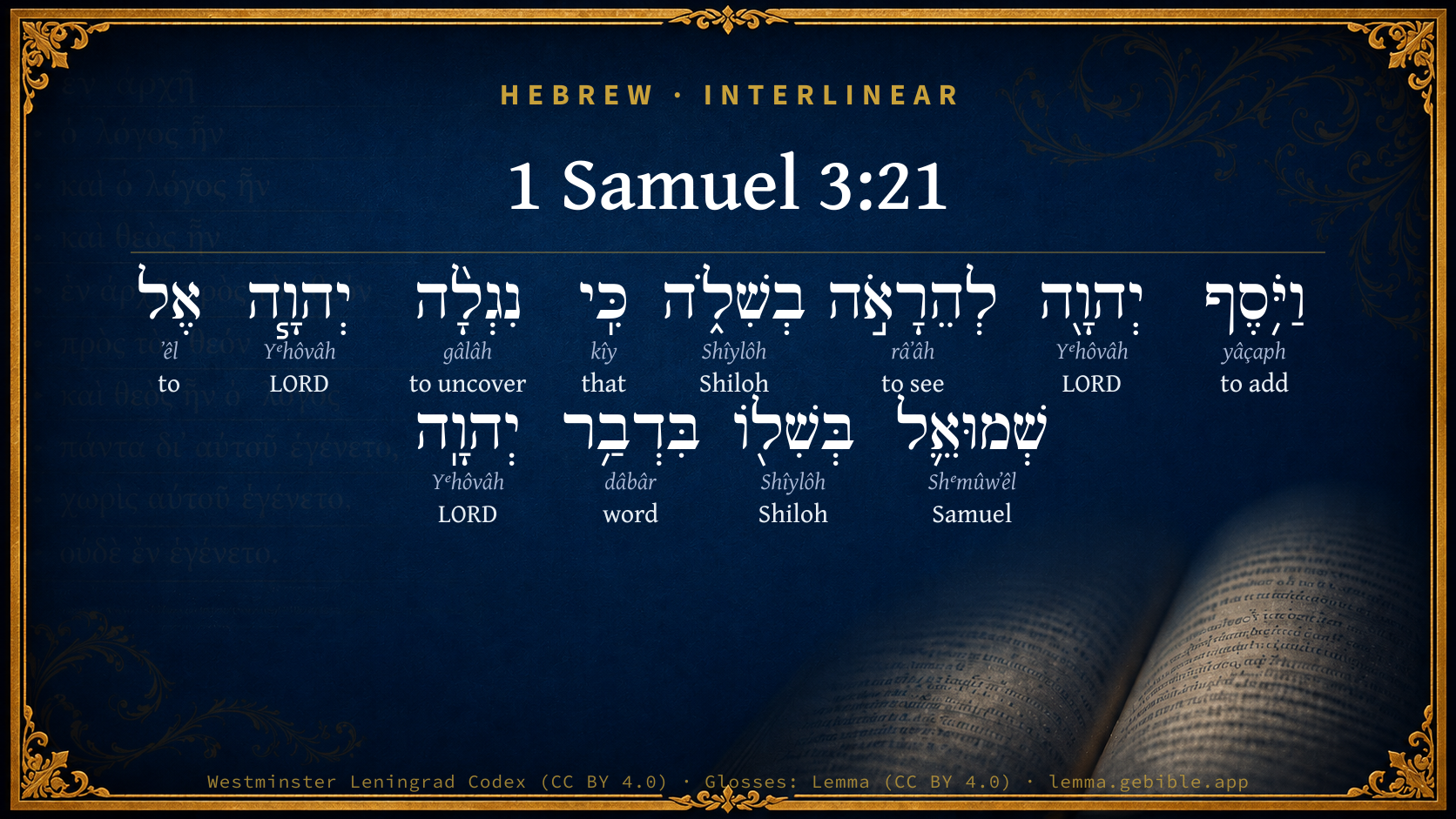
1 Samuel 3:21

Hebrew (Westminster Leningrad Codex) 1 Samuel 3:21 appears in the Hebrew Old Testament. The text above is from the Westminster Leningrad Codex. Each word links to its Strong’s number, a concise gloss, and parsing drawn from the Open Scriptures Hebrew Bible morphology. Click any word for its full Brown-Driver-Briggs (BDB) entry.
Download image
Cite this verse

1 Samuel 3:21 (World English Bible). Public Domain. Lemma interlinear Bible study tool, https://lemma.gebible.app/v/1-samuel/3/21.

Show BibTeX & RIS
BibTeX
RIS
English Translation
Yahweh appeared again in Shiloh; for Yahweh revealed himself to Samuel in Shiloh by the word of Yahweh.
World English Bible · Public Domain
Download a study sheet

One document with this verse’s original text, its word-by-word gloss line, the meaning frame, cross-references with their text, attributed commentary, and full source and license credits — printable, and it pastes into notes with its structure intact.

This verse Autodidact and up

Study sheet (.html) Plain text (.txt)

A passage Seminary Student

Up to 50 verses in one chapter. A passage sheet keeps up to 6 commentary sources and 12 cross-references per verse, in the order this page ranks them, and says so on the sheet whenever that leaves anything out. Ask for a single verse and you get the Autodidact verse sheet above.

Everything on this page stays free to read, with no account — the sheet is a download of what is already on screen, not access to it.

Want to remove ads? Support Godless Engineer
Compare translations 3

The same verse in 3 English versions, stacked beneath the original-language interlinear above. Click any original word for its lexicon entry.

Each is an independent rendering of the whole verse — the interlinear is not word-aligned to these translations.

Highlighted words mark where these versions differ — a whole-verse word diff, not a word-by-word alignment.

  • World English Bible Public Domain
    Yahweh appeared again in Shiloh; for Yahweh revealed himself to Samuel in Shiloh by the word of Yahweh.
  • King James Version Public Domain
    And the LORD appeared again in Shiloh: for the LORD revealed himself to Samuel in Shiloh by the word of the LORD.
  • unfoldingWord Literal Text CC BY-SA 4.0
    And Yahweh continued to appear in Shiloh. For Yahweh revealed himself to Samuel in Shiloh by the word of Yahweh.

unfoldingWord Literal Text — © unfoldingWord, licensed CC BY-SA 4.0. Word-aligned USFM3 via Door43 (git.door43.org/unfoldingWord/en_ult).

Versions to compare (up to 4)

3 of 4 selected

Show all 18 translations

Every available English version of this verse, each an independent rendering of the whole verse.

  • World English Bible Public Domain
    Yahweh appeared again in Shiloh; for Yahweh revealed himself to Samuel in Shiloh by the word of Yahweh.
  • Berean Standard Bible Public Domain
    And the LORD continued to appear at Shiloh, because there He revealed Himself to Samuel by His word.
  • Majority Standard Bible Public Domain
    And the LORD continued to appear at Shiloh, because there He revealed Himself to Samuel by His word.
  • King James Version Public Domain
    And the LORD appeared again in Shiloh: for the LORD revealed himself to Samuel in Shiloh by the word of the LORD.
  • American Standard Version (1901) Public Domain
    And Jehovah appeared again in Shiloh; for Jehovah revealed himself to Samuel in Shiloh by the word of Jehovah.
  • Revised Version (1885) Public Domain
    And the LORD appeared again in Shiloh: for the LORD revealed himself to Samuel in Shiloh by the word of the LORD.
  • Geneva Bible (1599) Public Domain
    And the Lord appeared againe in Shiloh: for the Lord reueiled himselfe to Samuel in Shiloh by his word.
  • Douay-Rheims (1899) Public Domain
    And the Lord again appeared in Silo, for the Lord revealed himself to Samuel in Silo, according to the word of the Lord. And the word of Samuel came to pass to all Israel.
  • Young's Literal Translation Public Domain
    And Jehovah addeth to appear in Shiloh, for Jehovah hath been revealed unto Samuel, in Shiloh, by the word of Jehovah.
  • Literal Standard Version CC BY-SA 4.0
    And YHWH adds to appear in Shiloh, for YHWH has been revealed to Samuel, in Shiloh, by the word of YHWH.
  • Unlocked Literal Bible CC BY-SA 4.0
    Yahweh appeared again in Shiloh, for he revealed himself to Samuel in Shiloh by his word.
  • unfoldingWord Literal Text CC BY-SA 4.0
    And Yahweh continued to appear in Shiloh. For Yahweh revealed himself to Samuel in Shiloh by the word of Yahweh.
  • Darby Bible Public Domain
    And Jehovah appeared again at Shiloh; for Jehovah revealed himself to Samuel at Shiloh by the word of Jehovah.
  • World Messianic Bible Public Domain
    The LORD appeared again in Shiloh; for the LORD revealed himself to Samuel in Shiloh by the LORD’s word.
  • Webster's Bible Public Domain
    And the LORD appeared again in Shiloh: for the LORD revealed himself to Samuel in Shiloh by the word of the LORD.
  • Free Bible Version CC BY-SA 4.0
    The Lord went on appearing at Shiloh, because there he revealed himself to Samuel and delivered his messages,
  • Bible in Basic English Public Domain
    And the Lord was seen again in Shiloh; for the Lord gave to Samuel in Shiloh the revelation of his word.
  • JPS Tanakh (1917) Public Domain
    And the LORD appeared again in Shiloh; for the LORD revealed Himself to Samuel in Shiloh by the word of the LORD.

Literal Standard Version (2020), Covenant Press — licensed CC BY-SA 4.0. Text via the HelloAO Bible API (eBible.org). Unlocked Literal Bible (unfoldingWord) — licensed CC BY-SA 4.0. Text via the HelloAO Bible API (eBible.org). unfoldingWord Literal Text — © unfoldingWord, licensed CC BY-SA 4.0. Word-aligned USFM3 via Door43 (git.door43.org/unfoldingWord/en_ult). Free Bible Version, Dr. Jonathan Gallagher — licensed CC BY-SA 4.0. Text via the HelloAO Bible API (eBible.org).

Word by word

More ways to search: Search by grammar → Find every occurrence → Compare this word →

Practice this passage: Drill this verse → Learn its vocabulary →

בְשִׁלֹ֑ה
Shîylôh
H7887
“in/at · Shiloh”
Preposition + Noun, Proper
Part of Speech
Preposition + Noun
Type
Proper
Full BDB Definition

Origin: from the same as H7886

TWOT: 2376

Shiloh = "place of rest" - a city in Ephraim and temporary home of the Ark of the Covenant and the Tabernacle, the place where Samuel grew up
  1. וַיֹּ֥סֶף yâçaph H3254 “and · to add” Conjunction + Verb, Hiphil, Sequential Imperfect, 3rd Person, Masculine, Singular
  2. יְהוָ֖ה Yᵉhôvâh H3068 “LORD” Noun, Proper
  3. לְהֵרָאֹ֣ה râʼâh H7200 “to see” Preposition + Verb, Niphal, Infinitive Construct
  4. כִּֽי kîy H3588 “that” Conjunction
  5. נִגְלָ֨ה gâlâh H1540 “to uncover” Verb, Niphal, Perfect, 3rd Person, Masculine, Singular
  6. יְהוָ֧ה Yᵉhôvâh H3068 “LORD” Noun, Proper
  7. אֶל ʼêl H413 “to” Preposition
  8. שְׁמוּאֵ֛ל Shᵉmûwʼêl H8050 “Samuel” Noun, Proper
  9. בְּשִׁל֖וֹ Shîylôh H7887 “in/at · Shiloh” Preposition + Noun, Proper
  10. בִּדְבַ֥ר dâbâr H1697 “in/at · word of” Preposition + Noun, Common, Masculine, Singular, Construct
  11. יְהוָֽה Yᵉhôvâh H3068 “LORD” Noun, Proper

About this verse

These counts appear in no published source. They are computed here, from the morphology-tagged text and Lemma’s own curated glosses. What Lemma adds →

12
words
9
distinct lemmas
Historical
section

Shared distinctive vocabulary

בְשִׁלֹ֑ה Shiloh H7887 occurs in 30 verses of the Hebrew Bible. Also found in:

Grammatical profile

  • 3 verbs
  • 7 nouns
  • 1 preposition
  • 1 conjunction

Verb forms

  • וַיֹּ֥סֶף Hiphil · Sequential Imperfect
  • לְהֵרָאֹ֣ה Niphal · Infinitive Construct
  • נִגְלָ֨ה Niphal · Perfect

Repetition

Words recur within this verse — often emphatic in Hebrew:

  • יְהוָ֖ה LORD H3068 ×3
  • בְשִׁלֹ֑ה Shiloh H7887 ×2

Hebrew & Septuagint length

In English translation the verse runs 18 words from the Hebrew and 57 from the Septuagint (LXX English) — the Septuagint runs noticeably longer here. See the side-by-side →

A rough comparison of the two English renderings, which tokenize alike — not a word-level alignment.

Word counts can differ between the Hebrew and the Greek without any difference in meaning — e.g. the Hebrew direct-object marker אֵת has no separate Greek word, and Greek often adds the article ὁ.

Cross-references

8

Topical passages linked to 1 Samuel 3:21 in the Treasury of Scripture Knowledge — connected by theme and wording, ordered by reader-vote popularity; previews shown in the World English Bible.

  • 1 Samuel 3:1 The child Samuel ministered to Yahweh before Eli. The word of Yahweh was precious in those days; there was no frequent vision.
  • Genesis 12:7 Yahweh appeared to Abram, and said, "I will give this land to your seed." He built an altar there to Yahweh, who appeared to him.
  • 1 Samuel 3:4 that Yahweh called Samuel; and he said, Here am I.
  • Genesis 15:1 After these things the word of Yahweh came to Abram in a vision, saying, "Don't be afraid, Abram. I am your shield, your exceedingly great reward."
  • Numbers 12:6 He said, Hear now my words: if there be a prophet among you, I Yahweh will make myself known to him in a vision, I will speak with him in a dream.
  • 1 Samuel 3:10 Yahweh came, and stood, and called as at other times, Samuel, Samuel. Then Samuel said, Speak; for your servant hears.
  • Amos 3:7 Surely the Lord Yahweh will do nothing, Unless he reveals his secret to his servants the prophets.
  • Hebrews 1:1 God, having in the past spoken to the fathers through the prophets at many times and in various ways,

Cross-references courtesy of OpenBible.info (CC BY 4.0).

Hebrew and Greek witnesses Masoretic Hebrew ↔ Greek Septuagint

The same verse in the two great witnesses to the Old Testament, shown verse-for-verse.

Here the Septuagint runs noticeably longer than the Hebrew — LXX2012 (modern English Septuagint) 57 words vs World English Bible 18. A rough length comparison of the two English translations, not a word-level alignment — read both below.

These are two independent witnesses, not word-aligned to each other, and the Septuagint is shown in lemma (dictionary) form.

Hebrew 1 Samuel 3:21 Masoretic · Westminster Leningrad Codex

וַיֹּ֥סֶף יְהוָ֖ה לְהֵרָאֹ֣ה בְשִׁלֹ֑ה כִּֽי נִגְלָ֨ה יְהוָ֧ה אֶל שְׁמוּאֵ֛ל בְּשִׁל֖וֹ בִּדְבַ֥ר יְהוָֽה

Yahweh appeared again in Shiloh; for Yahweh revealed himself to Samuel in Shiloh by the word of Yahweh.

World English Bible · Public Domain

Greek LXX 1 Samuel 3:21 Septuagint · lemma form

καί προςτίθημι κύριος δηλόω ἐν σηλωμ ὅτι ἀποκαλύπτω κύριος πρός σαμουηλ καί πιστεύω σαμουηλ προφήτης γίγνομαι ὁ κύριος εἰς πᾶς ἰσραήλ ἀπό ἄκρος ὁ γῆ καί ἕως ἄκρος καί ηλι πρεσβύτης σφόδρα καί ὁ υἱός αὐτός πορεύομαι πορεύομαι καί πονηρός ὁ ὁδός αὐτός ἐνώπιον κύριος

And the Lord manifested himself again in Selom, for the Lord revealed himself to Samuel; and Samuel was accredited to all Israel as a prophet to the Lord from one end of the land to the other: and Heli was very old, and his sons kept advancing in wickedness, and their way was evil before the Lord.

LXX2012 (modern English Septuagint) · Public Domain

Hebrew: Westminster Leningrad Codex (CC BY 4.0). Greek: Septuagint (public domain); English from LXX2012 (modern English Septuagint) (Public Domain). How the Septuagint differs from the Hebrew →

Targum (Aramaic paraphrase)

1

The Targum is the ancient Jewish Aramaic paraphrase of the Hebrew Scriptures — an interpretive translation, not the Hebrew text itself. Onkelos (literal) and Pseudo-Jonathan (expansive) render the Torah, and Jonathan the Prophets. Coverage is partial: where no permissively-licensed English translation exists for a verse, only the Aramaic is shown. This is verse-level text, not a word-by-word alignment to the Hebrew.

  1. Targum Jonathan Prophets (Joshua–Malachi)
    וְאוֹסִיף יְיָ לְאִתְגָלָאָה בְשִׁילֹה אֲרֵי אִתְגְלֵי יְיָ לִשְׁמוּאֵל בְשִׁילוֹ בְּפִתְגָמָא דַיָי:

    (no public-domain English translation for this verse)

    Targum Jonathan — Aramaic: “Mikraot Gedolot” (public domain). English: “Sefaria Community Translation” (CC0 1.0 (public-domain dedication)); “London "Chaldee Paraphrase," 1871” (public domain). Text via Sefaria.

Commentary

Notes on 1 Samuel 3:21 from classic Christian and Jewish commentators (each source and its license shown beneath its notes). The classic Christian expositions comment on the surrounding passage and are grouped to its opening verse, so a note may address several verses; the Jewish commentaries on the Tanakh (Rashi and others) are per-verse, so they appear only where the commentator wrote on this verse.

Lemma curates 59 commentaries, every one of them public domain or Creative Commons licensed, each selected and text-cleaned for this edition rather than reprinted as found. About our sources →

The Cambridge Bible for Schools and Colleges

gen. ed. J. J. S. Perowne

21. appeared again] Manifested himself in visions. Cp. 1Sa_3:10; 1Sa_3:15; and the ancient prophetic title of Seer (1Sa_9:9).

by the word of the Lord] By the communication of prophetic messages to Samuel. The state of things described in 1Sa_3:1 was now reversed. The “word of Jehovah” was no longer “rare,” there were visions “published abroad.”

Ch. 1Sa_4:1. And the word of Samuel came to all Israel] Samuel communicated to all Israel the divine revelation which he had received. This clause should form the conclusion of ch. 3, not the commencement of ch. 4. In the latter position it would naturally mean that it was Samuel who summoned all Israel to the disastrous war against the Philistines. But he is never once mentioned in connexion with the war, and does not reappear on the scene for twenty years at least (1Sa_7:2-3), though in all probability his prophetic activity here recorded was in part contemporaneous with the Philistine oppression, during which his growing influence was marking him out as the future national deliverer.

The Sept. here differs considerably from the present Hebrew text. Omitting obvious repetitions, 1Sa_3:21 stands as follows: “And the Lord appeared again in Selom, for the Lord was revealed to Samuel. And Eli was very old, and his sons walked perversely, and their way was evil in the sight of the Lord.”

The Cambridge Bible for Schools and Colleges (gen. ed. J. J. S. Perowne; Cambridge University Press, 1878–1918) — public domain. Text from a community e-Sword module.

Trapp's Complete Commentary

John Trapp

1Sa 3:21 And the LORD appeared again in Shiloh: for the LORD revealed himself to Samuel in Shiloh by the word of the LORD.

Ver. 21. By the word of the Lord.] That is, By Christ, {as 2Sa 7:21} or by prophetic revelation.

John Trapp, A Commentary or Exposition upon All the Books of the Old and New Testament (1647–1656) — public domain. Text from a community e-Sword module.

Tyndale Open Study Notes

Tyndale Open Resources

3:21-4:1a The Lord continued to appear: God reopened the lines of communication with Israel through Samuel (cp. 3:1). • Shiloh: See study note on 1:3.

Tyndale Open Study Notes — © Tyndale Open Resources, licensed CC BY-SA 4.0. Text via the HelloAO Bible API.

Geneva Bible (1599)

Geneva Bible translators

Hebrew, by the word of the Lord.

Geneva Bible (1599) marginal notes — public domain. Text via Bolls.life.

Adam Clarke's Commentary

Verse 21. The Lord appeared again] וישף יהוה להראה vaiyoseph Yehovah leheraoh, "And Jehovah added to appear; " that is, he continued to reveal himself to Samuel at Shiloh.

By the word of the Lord.] By the spirit and word of prophecy.

IN this chapter we read again of the fearful consequences of a neglected religious education. Eli's sons were wicked: their father knew the Lord; but he neither taught his children, nor restrained them by his parental authority. I have already had occasion to remark, that were a proper line of conduct pursued in the education of children, how few profligate sons and daughters, and how few broken-hearted parents should we find! The neglect of early religious education, connected with a wholesome and affectionate restraint, is the ruin of millions. Many parents, to excuse their indolence and most criminal neglect, say, "We cannot give our children grace." What do they mean by this? That God, not themselves, is the author of the irregularities and viciousness of their children. They may shudder at this imputation: but when they reflect that they have not given them right precepts, have not brought them under firm and affectionate restraint; have not showed them, by their own spirit, temper, and conduct, how they should be regulated in theirs; when either the worship of God has not been established in their houses, or they have permitted their children, on the most trifling pretenses, to absent themselves from it; when all these things are considered, they will find that, speaking after the manner of men, it would have been a very extraordinary miracle indeed if the children had been found preferring a path in which they did not see their parents conscientiously tread. Let those parents who continue to excuse themselves by saying, "We cannot give grace to our children," lay their hand on their conscience, and say whether they ever knew an instance where God withheld his grace, while they were, in humble subserviency to him, performing their duty. The real state of the case is this: parents cannot do God's work, and God will not do theirs; but if they use the means, and train up the child in the way he should go, God will not withhold his blessing.

It is not parental fondness, nor parental authority, taken separately, that can produce this beneficial effect. A father may be as fond of his offspring as Eli, and his children be sons of Belial; he may be as authoritative as the grand Turk, and his children despise and plot rebellion against him. But let parental authority be tempered with fatherly affection; and let the rein of discipline be steadily held by this powerful but affectionate hand; and there shall the pleasure of God prosper; there will he give his blessing, even life for evermore. Many fine families have been spoiled, and many ruined, by the separate exercise of these two principles. Parental affection, when alone, infallibly degenerates into foolish fondness; and parental authority frequently degenerates into brutal tyranny when standing by itself. The first sort of parents will be loved without being respected; the second sort will be dreaded, without either respect or esteem. In the first case obedience is not exacted, and is therefore felt to be unnecessary, as offenses of great magnitude pass without punishment or reprehension: in the second case, rigid exaction renders obedience almost impossible; and the smallest delinquency is often punished with the extreme of torture, which, hardening the mind, renders duty a matter of perfect indifference.

Parents, lay these things to heart: remember Eli and his sons; remember the dismal end of both! Teach your children to fear God - use wholesome discipline - be determined - begin in time - mingle severity and mercy together in all your conduct - and earnestly pray to God to second your godly discipline with the power and grace of his Spirit.

Education is generally defined that series of means by which the human understanding is gradually enlightened, and the dispositions of the heart are corrected, formed, and brought forth, between early infancy and the period when a young person is considered as qualified to take a part in active life. Whole nations have been corrupted, enfeebled, and destroyed, through the want of proper education: through this multitudes of families have degenerated; and a countless number of individuals have come to an untimely end. Parents who neglect this, neglect the present and eternal interests of their offspring.

Adam Clarke's Commentary on the Bible (1810–1826) — public domain. Text from a community e-Sword/MySword module.

John Gill's Exposition

And the Lord appeared again in Shiloh,.... In the tabernacle there; he had appeared before to Samuel, when he called him, and declared to him what he designed and resolved to do to Eli and his family, and now appeared again to him in the same place before the battle of the Israelites with the Philistines, of which there is an account in the following chapter. Such appearances had not been usual in Shiloh for a long time, but were now renewed and repeated:

for the Lord revealed himself to Samuel by the Word of the Lord; by Christ, the Word of the Lord, who appeared to him, it is probable, in an human form, as he was wont to do to the patriarchs and prophets, and by whom the Lord revealed his mind and will unto them, being the Angel of his presence, and the messenger of his covenant; or by giving him a word of command to be delivered by him to the children of Israel, and which is expressed and delivered, in the next chapter.

Next: 1 Samuel Chapter 4

John Gill's Exposition of the Whole Bible (1746–1763) — public domain (CC PDM 1.0). Text via the HelloAO Bible API.

Albert Barnes' Notes on the Bible

The state described in 1Sa 3:7 was henceforth reversed. Samuel now knew the Lord, and the Word of the Lord was revealed unto him.

Albert Barnes' Notes on the Bible (1834–1885) — public domain. Text from a community e-Sword/MySword module.

Matthew Poole's English Annotations

Or, did use to reveal his mind to Samuel.

By the word of the Lord, i.e. by his word, the noun for the pronoun, which is frequent, as Lev 14:15, &c.; by his word of command, which he chose to deliver to Israel by his mouth, as it here follows; or by his word of prophecy concerning future events.

Matthew Poole's English Annotations on the Holy Bible (1683–1685) — public domain. Text from a community e-Sword/MySword module.

Whedon's Commentary on the Bible

Daniel D. Whedon

21. The Lord appeared again — Rather, continued to appear; that is, from time to time.

Revealed himself — Discovered himself, or was unveiled. “The Lord uncovered the ear — such is the literal expression; a touching and significant figure, taken from the manner in which the possessor of a secret moves back the long hair of his friend, and whispers into the ear thus laid bare the word that no one else may hear. It is a figure which precisely expresses the most universal and philosophical idea conveyed by the term Revelation, thence appropriated in the theological language both of East and West.” — Stanley.

By the word of the Lord — By communications like the one just related. Literally, the expression is, In the word of the Lord. The word of the Lord was the very element in which he lived. Thus was Samuel caused to ask of Jehovah, that is, caused to be in continued intercourse with him, as he himself might ever be reminded by his very name. See note on 1Sa_1:28. Accordingly, the word of the Lord was no longer so costly and rare as it had previously been in Israel, (1Sa_3:1,) for throughout the land Samuel was known to habitually receive communications from Jehovah. “He is, also, the first instance of a prophet gradually raised for his office from the earliest dawn of reason. His work and his life are the counterparts of each other. With all the recollections of the ancient sanctuary impressed upon his mind, with the voice of God sounding in his ears, not, as in the case of the elder leaders and teachers of his people, amidst the roar of thunder and the clash of war, but in the still silence of the tabernacle, ere the lamp of God went out, he was the more fitted to meet the coming crisis, to become himself the centre of new institutions which should themselves become venerable as those in which he had been himself brought up.” — Stanley.

Daniel D. Whedon (gen. ed.), Commentary on the Old and New Testaments (1874–1909) — public domain. Text from a community e-Sword module.

The Pulpit Commentary

And Jehovah appeared again. Literally, "added to appear," i.e. revealed himself from time to time on all fit occasions. To appear, literally, "to be seen," is the verb used of waking vision (see on ver. 15).

By the word of Jehovah. Many of the old commentators refer this to the second person of the Holy Trinity, but he is himself Jehovah, as we affirm in the Te Deum: "We believe thee to be the Lord," i.e. the Jehovah of the Old Testament, usually translated, in deference to a Jewish superstition, "the LORD." As the Word, Christ is "the Word of God." The phrase really means, "by prophetic inspiration" revealing to Samuel the truth (comp. Isa_51:16; Jer_1:9)

The Pulpit Commentary (1880–1919), ed. H.D.M. Spence-Jones & Joseph S. Exell — public domain. Text from a community e-Sword module.

Rashi

Rabbi Shlomo Yitzchaki (Rashi)

For Adonoy revealed Himself to Shmuel. Because Scripture stated above, "The word of Adonoy was rare in those days," it states here that from now on, for Shmuel's sake, He revealed Himself repeatedly.

Rashi on the Tanakh — English translations: “The Judaica Press complete Tanach with Rashi, translated by A. J. Rosenberg” (CC BY 4.0); “Pentateuch with Rashi's commentary by M. Rosenbaum and A.M. Silbermann, 1929-1934” (public domain); “The Metsudah Tanach series, Lakewood, N.J” (CC BY 4.0); and “The Book of Joshua, Metsudah Publications, 1997” (CC BY 4.0). Text via Sefaria.

Lesson kit

Teaching starters — assembled from the data on this page, not authored interpretation. Every prompt links to the verse data it draws on. Edit before teaching.

1 Samuel, in the Historical, opens this verse with 12 words (9 distinct Hebrew lemmas). Its most distinctive word is Shîylôh (“Shiloh”). The Greek Septuagint runs longer here. A historical commentator’s framing appears above. Read the whole chapter for the surrounding context.

Discussion questions

  1. How does “Shiloh” (Shîylôh) shape what this verse is saying?
  2. Joshua 18:1 shares the word «Shiloh» with this verse. How do the two illuminate each other?
  3. “LORD” occurs 3× in this one verse. What is the effect of the repetition?
  4. Compared with the Hebrew, the Septuagint runs longer here. What questions does that raise?
  5. These translations render this verse differently; the difference is in the English rendering, not the original. What questions does that raise?
  6. The verb «וַיֹּ֥סֶף» is Hiphil Sequential Imperfect. How does its form color the action?
  7. Reading how The Cambridge Bible for Schools and Colleges and Trapp's Complete Commentary read this verse, where do the two commentators agree and where do they part?

Things to notice

  • These translations choose different wording for 6 words in this verse.
  • “LORD” occurs 3× in this single verse.
  • 9 distinct Hebrew lemmas span 12 words in this verse.

Reading settings

Reading text

Shown beneath each verse's original-language words.

Old Testament
Old Testament edition

Read the OT as the Masoretic Hebrew (MT) or the Greek Septuagint (LXX).

English shown for the Greek Septuagint (in the Hebrew ↔ Greek comparison).

Comparing translations? Open the Compare panel on any verse page to stack up to four side by side.