1 Samuel 20:17

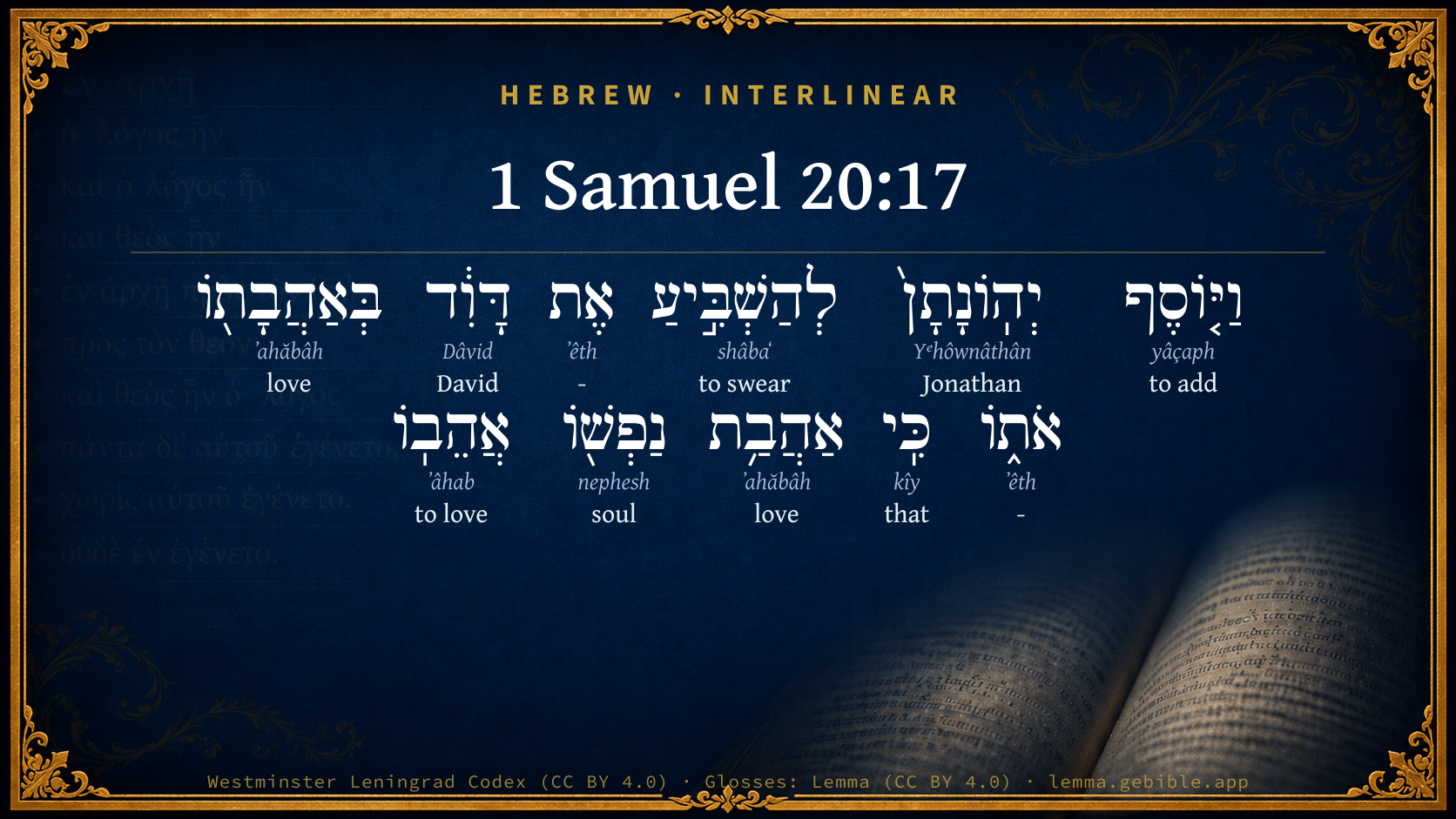
Hebrew (Westminster Leningrad Codex) 1 Samuel 20:17 appears in the Hebrew Old Testament. The text above is from the Westminster Leningrad Codex. Each word links to its Strong’s number, a concise gloss, and parsing drawn from the Open Scriptures Hebrew Bible morphology. Click any word for its full Brown-Driver-Briggs (BDB) entry.
Download image
Cite this verse

1 Samuel 20:17 (World English Bible). Public Domain. Lemma interlinear Bible study tool, https://lemma.gebible.app/v/1-samuel/20/17.

Show BibTeX & RIS
BibTeX
RIS
English Translation
Jonathan caused David to swear again, for the love that he had to him; for he loved him as he loved his own soul.
World English Bible · Public Domain
Download a study sheet

One document with this verse’s original text, its word-by-word gloss line, the meaning frame, cross-references with their text, attributed commentary, and full source and license credits — printable, and it pastes into notes with its structure intact.

This verse Autodidact and up

Study sheet (.html) Plain text (.txt)

A passage Seminary Student

Up to 50 verses in one chapter. A passage sheet keeps up to 6 commentary sources and 12 cross-references per verse, in the order this page ranks them, and says so on the sheet whenever that leaves anything out. Ask for a single verse and you get the Autodidact verse sheet above.

Everything on this page stays free to read, with no account — the sheet is a download of what is already on screen, not access to it.

Want to remove ads? Support Godless Engineer
Compare translations 3

The same verse in 3 English versions, stacked beneath the original-language interlinear above. Click any original word for its lexicon entry.

Each is an independent rendering of the whole verse — the interlinear is not word-aligned to these translations.

Highlighted words mark where these versions differ — a whole-verse word diff, not a word-by-word alignment.

  • World English Bible Public Domain
    Jonathan caused David to swear again, for the love that he had to him; for he loved him as he loved his own soul.
  • King James Version Public Domain
    And Jonathan caused David to swear again, because he loved him: for he loved him as he loved his own soul.
  • unfoldingWord Literal Text CC BY-SA 4.0
    And Jonathan added to make David swear by his love for him, for he loved him the loving of his soul.

unfoldingWord Literal Text — © unfoldingWord, licensed CC BY-SA 4.0. Word-aligned USFM3 via Door43 (git.door43.org/unfoldingWord/en_ult).

Versions to compare (up to 4)

3 of 4 selected

Show all 18 translations

Every available English version of this verse, each an independent rendering of the whole verse.

  • World English Bible Public Domain
    Jonathan caused David to swear again, for the love that he had to him; for he loved him as he loved his own soul.
  • Berean Standard Bible Public Domain
    And Jonathan had David reaffirm his vow out of love for him, for Jonathan loved David as he loved himself.
  • Majority Standard Bible Public Domain
    And Jonathan had David reaffirm his vow out of love for him, for Jonathan loved David as he loved himself.
  • King James Version Public Domain
    And Jonathan caused David to swear again, because he loved him: for he loved him as he loved his own soul.
  • American Standard Version (1901) Public Domain
    And Jonathan caused David to swear again, for the love that he had to him; for he loved him as he loved his own soul.
  • Revised Version (1885) Public Domain
    And Jonathan caused David to swear again, for the love that he had to him: for he loved him as he loved his own soul.
  • Geneva Bible (1599) Public Domain
    And againe Ionathan sware vnto Dauid, because he loued him (for he loued him as his owne soule)
  • Douay-Rheims (1899) Public Domain
    And Jonathan swore again to David, because he loved him: for he loved him as his own soul.
  • Young's Literal Translation Public Domain
    and Jonathan addeth to cause David to swear, because he loveth him, for with the love of his own soul he hath loved him.
  • Literal Standard Version CC BY-SA 4.0
    and Jonathan adds to cause David to swear, because he loves him, for he has loved him [as] the love [for] his own soul.
  • Unlocked Literal Bible CC BY-SA 4.0
    Jonathan made David vow again because of the love that he had for him, because he loved him as he loved his own soul.
  • unfoldingWord Literal Text CC BY-SA 4.0
    And Jonathan added to make David swear by his love for him, for he loved him the loving of his soul.
  • Darby Bible Public Domain
    And Jonathan caused David to swear again, by the love he had for him, for he loved him as he loved his own soul.
  • World Messianic Bible Public Domain
    Jonathan caused David to swear again, for the love that he had to him; for he loved him as he loved his own soul.
  • Webster's Bible Public Domain
    And Jonathan caused David to swear again, because he loved him: for he loved him as he loved his own soul.
  • Free Bible Version CC BY-SA 4.0
    Jonathan made David swear this once more by making an oath based on David's love for him, for Jonathan already loved David as he loved himself.
  • Bible in Basic English Public Domain
    And Jonathan again took an oath to David, because of his love for him: for David was as dear to him as his very soul.
  • JPS Tanakh (1917) Public Domain
    And Jonathan caused David to swear again, for the love that he had to him; for he loved him as he loved his own soul.

Literal Standard Version (2020), Covenant Press — licensed CC BY-SA 4.0. Text via the HelloAO Bible API (eBible.org). Unlocked Literal Bible (unfoldingWord) — licensed CC BY-SA 4.0. Text via the HelloAO Bible API (eBible.org). unfoldingWord Literal Text — © unfoldingWord, licensed CC BY-SA 4.0. Word-aligned USFM3 via Door43 (git.door43.org/unfoldingWord/en_ult). Free Bible Version, Dr. Jonathan Gallagher — licensed CC BY-SA 4.0. Text via the HelloAO Bible API (eBible.org).

Word by word

More ways to search: Search by grammar → Find every occurrence → Compare this word →

Practice this passage: Drill this verse → Learn its vocabulary →

בְּאַהֲבָת֖וֹ
ʼahăbâh
H160
“in/at · love · his”
Preposition + Noun, Common, Feminine, Singular, Construct + Suffix, Personal, 3rd Person, Masculine, Singular
Part of Speech
Preposition + Noun
Type
Common
Gender
Feminine
Number
Singular
State
Construct
Full BDB Definition

Origin: f of H158

TWOT: 29c

love - human love for human object - of man toward man - of man toward himself - between man and woman - sexual desire - God's love to His people
  1. וַיּ֤וֹסֶף yâçaph H3254 “and · to add” Conjunction + Verb, Hiphil, Sequential Imperfect, 3rd Person, Masculine, Singular
  2. יְהֽוֹנָתָן֙ Yᵉhôwnâthân H3083 “Jonathan” Noun, Proper
  3. לְהַשְׁבִּ֣יעַ shâbaʻ H7650 “to swear” Preposition + Verb, Hiphil, Infinitive Construct
  4. אֶת ʼêth H853 “-” Particle, Direct Object
  5. דָּוִ֔ד Dâvid H1732 “David” Noun, Proper
  6. אֹת֑וֹ ʼêth H853 “- · him” Particle, Direct Object + Suffix, Personal, 3rd Person, Masculine, Singular
  7. כִּֽי kîy H3588 “that” Conjunction
  8. אַהֲבַ֥ת ʼahăbâh H160 “love of” Noun, Common, Feminine, Singular, Construct
  9. נַפְשׁ֖וֹ nephesh H5315 “soul · his” Noun, Common, Both, Singular, Construct + Suffix, Personal, 3rd Person, Masculine, Singular
  10. אֲהֵבֽוֹ ʼâhab H157 “to love · him” Verb, Qal, Perfect, 3rd Person, Masculine, Singular + Suffix, Personal, 3rd Person, Masculine, Singular

About this verse

These counts appear in no published source. They are computed here, from the morphology-tagged text and Lemma’s own curated glosses. What Lemma adds →

11
words
9
distinct lemmas
Historical
section

Shared distinctive vocabulary

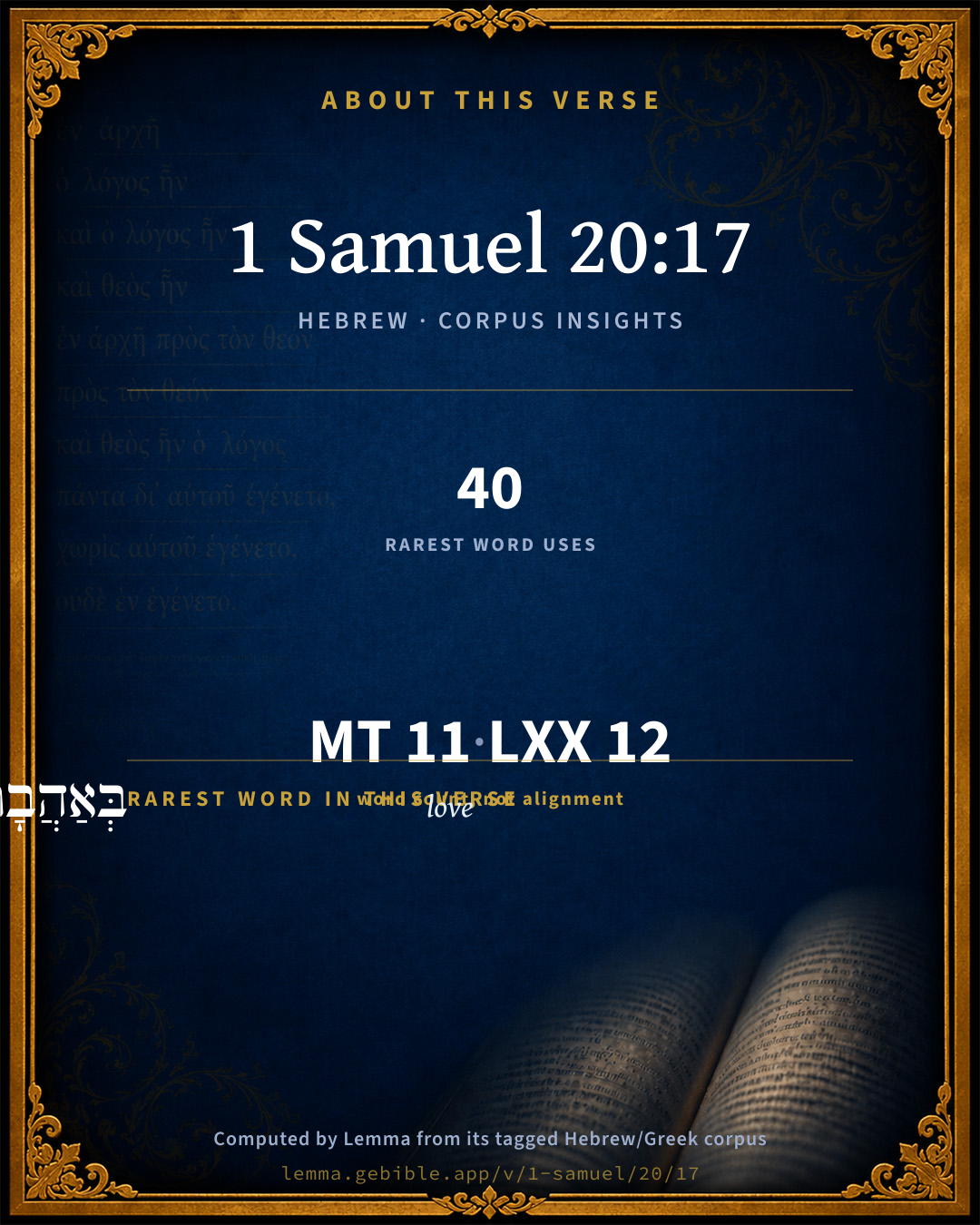
בְּאַהֲבָת֖וֹ love H160 occurs in 37 verses of the Hebrew Bible. Also found in:

Grammatical profile

  • 3 verbs
  • 5 nouns
  • 1 conjunction
  • 2 particles

Verb forms

  • וַיּ֤וֹסֶף Hiphil · Sequential Imperfect
  • לְהַשְׁבִּ֣יעַ Hiphil · Infinitive Construct
  • אֲהֵבֽוֹ Qal · Perfect

Repetition

A word recurs within this verse — often emphatic in Hebrew:

  • בְּאַהֲבָת֖וֹ love H160 ×2

Hebrew & Septuagint length

In English translation the verse runs 24 words from the Hebrew and 17 from the Septuagint (LXX English) — the Septuagint runs noticeably shorter here. See the side-by-side →

A rough comparison of the two English renderings, which tokenize alike — not a word-level alignment.

Word counts can differ between the Hebrew and the Greek without any difference in meaning — e.g. the Hebrew direct-object marker אֵת has no separate Greek word, and Greek often adds the article ὁ.

In the original languages it is 11 Hebrew tokens and 12 Greek tokens — but the two are counted differently (Hebrew bundles its prefixes and suffixes into one token; the Greek is in lemma form), so that isn’t a like-for-like length.

Cross-references

5

Topical passages linked to 1 Samuel 20:17 in the Treasury of Scripture Knowledge — connected by theme and wording, ordered by reader-vote popularity; previews shown in the World English Bible.

  • Proverbs 18:24 A man of many companions may be ruined, But there is a friend who sticks closer than a brother.
  • 1 Samuel 18:1 It happened, when he had made an end of speaking to Saul, that the soul of Jonathan was knit with the soul of David, and Jonathan loved him as his own soul.
  • 1 Samuel 18:3 Then Jonathan and David made a covenant, because he loved him as his own soul.
  • 2 Samuel 1:26 I am distressed for you, my brother Jonathan: Very pleasant have you been to me: Your love to me was wonderful, Passing the love of women.
  • Deuteronomy 13:6 If your brother, the son of your mother, or your son, or your daughter, or the wife of your bosom, or your friend, who is as your own soul, entice you secretly, saying, Let us go and serve other gods, which you have not known, you, nor your fathers;

Cross-references courtesy of OpenBible.info (CC BY 4.0).

Hebrew and Greek witnesses Masoretic Hebrew ↔ Greek Septuagint

The same verse in the two great witnesses to the Old Testament, shown verse-for-verse.

Here the Septuagint runs noticeably shorter than the Hebrew — LXX2012 (modern English Septuagint) 17 words vs World English Bible 24. A rough length comparison of the two English translations, not a word-level alignment — read both below.

These are two independent witnesses, not word-aligned to each other, and the Septuagint is shown in lemma (dictionary) form.

Hebrew 1 Samuel 20:17 Masoretic · Westminster Leningrad Codex

וַיּ֤וֹסֶף יְהֽוֹנָתָן֙ לְהַשְׁבִּ֣יעַ אֶת דָּוִ֔ד בְּאַהֲבָת֖וֹ אֹת֑וֹ כִּֽי אַהֲבַ֥ת נַפְשׁ֖וֹ אֲהֵבֽוֹ

Jonathan caused David to swear again, for the love that he had to him; for he loved him as he loved his own soul.

World English Bible · Public Domain

Greek LXX 1 Samuel 20:17 Septuagint · lemma form

καί προςτίθημι ἔτι ιωναθαν ὄμνυμι ὁ δαυίδ ὅτι ἀγαπάω ψυχή ἀγαπάω αὐτός

And Jonathan swore yet again to David, because he loved the soul of him that loved him.

LXX2012 (modern English Septuagint) · Public Domain

On this verse, The Pulpit Commentary discusses the Septuagint’s reading. Read the note in Commentary ↓

Hebrew: Westminster Leningrad Codex (CC BY 4.0). Greek: Septuagint (public domain); English from LXX2012 (modern English Septuagint) (Public Domain). How the Septuagint differs from the Hebrew →

Targum (Aramaic paraphrase)

1

The Targum is the ancient Jewish Aramaic paraphrase of the Hebrew Scriptures — an interpretive translation, not the Hebrew text itself. Onkelos (literal) and Pseudo-Jonathan (expansive) render the Torah, and Jonathan the Prophets. Coverage is partial: where no permissively-licensed English translation exists for a verse, only the Aramaic is shown. This is verse-level text, not a word-by-word alignment to the Hebrew.

  1. Targum Jonathan Prophets (Joshua–Malachi)
    וְאוֹסִיף יְהוֹנָתָן לְאוֹמָאָה יַת דָוִד בִּדְרָחִים יָתֵיהּ אֲרֵי רַחֲמַת נַפְשֵׁיהּ רַחֲמֵיהּ:

    (no public-domain English translation for this verse)

    Targum Jonathan — Aramaic: “Mikraot Gedolot” (public domain). English: “Sefaria Community Translation” (CC0 1.0 (public-domain dedication)); “London "Chaldee Paraphrase," 1871” (public domain). Text via Sefaria.

Commentary

Notes on 1 Samuel 20:17 from classic Christian and Jewish commentators (each source and its license shown beneath its notes). The classic Christian expositions comment on the surrounding passage and are grouped to its opening verse, so a note may address several verses; the Jewish commentaries on the Tanakh (Rashi and others) are per-verse, so they appear only where the commentator wrote on this verse.

Lemma curates 59 commentaries, every one of them public domain or Creative Commons licensed, each selected and text-cleaned for this edition rather than reprinted as found. About our sources →

Trapp's Complete Commentary

John Trapp

1Sa 20:17 And Jonathan caused David to swear again, because he loved him: for he loved him as he loved his own soul.

Ver. 17. And Jonathan caused David to swear again,] i.e., He required the like oath of him which he had made, that there might be a sure and steadfast league with him whom he so dearly loved. {a}

{a} Willet.

John Trapp, A Commentary or Exposition upon All the Books of the Old and New Testament (1647–1656) — public domain. Text from a community e-Sword module.

The Biblical Illustrator

Joseph S. Exell

1Sa_20:17

And Jonathan caused David to swear again because he loved him.

Love plighting troth

I. Now, first, great love desires to bind itself to the beloved one. And, first of all, remember that Jesus bound Himself to His people by covenant bonds.

2. Then, next, Jesus would have us bound to Him on our part. This kind of bond can never be all on one side, for true friendship leads to mutual love.

II. Great love desires renewed pledges from its object: Jonathan caused David to swear again, because he loved him: for he loved him as he loved his own soul.

1. It was not out, of distrust, but by reason of a sort of sacred jealousy, that Jonathan caused David to swear again. Our Saviour is as jealous of us as His Father is; the immeasurable greatness of the love of Jesus Christ to us moves Him to feel an infinite jealousy of us.

2. This is the only return we can make for His love.

3. It is for our highest benefit that we should do this. Our love is often so feeble and cold that it needs to be stirred up again.

4. We are often tempted and allured by other loves, and are apt, to lend a listening ear to the charmers fascinating voice.

5. It is for our benefit that we should often renew our pledges of love to our Lord, because we cannot be happy unless we are wholly taken up with love to Him. (C. H. Spurgeon.)

He loved him as he loved his own soul.

True friendship

I. true friendship reports itself by practical sympathy in times of distress.

1. This friendship was truly unselfish.

2. This friendship was truly generous. David was a shepherd boy, Jonathan the kings son.

3. This friendship was truly practical.

4. This friendship was truly reciprocal. David loved Jonathan as fervently as Jonathan loved David..

II. True friendship reports itself by solemn compacts in times of distress. And Jonathan caused David to swear again, because he loved him: for he loved him as he loved his own soul.

1. This covenant was formed in a reverent spirit. Jonathan appeals to God to witness his sincerity, to judge his motive, and to prosper his friend.

2. This covenant was submitted to a severe test.

3. This covenant was confirmed by an affectionate parting. (J. T. Woodhouse.)

The Biblical Illustrator, edited by Joseph S. Exell (c. 1880s–1900s) — public domain. Text from a community e-Sword module.

Tyndale Open Study Notes

Tyndale Open Resources

20:17 See 18:3; 23:16-18.

Tyndale Open Study Notes — © Tyndale Open Resources, licensed CC BY-SA 4.0. Text via the HelloAO Bible API.

Ellicott's Commentary for English Readers

(17) And Jonathan caused David to swear again.—Throughout this touching interview it is the prince who appears as the suppliant for the outlaw’s ruture kind offices. Jonathan—looking forward with absolute certainty to the day when his persecuted friend would be on the throne, and he in his grave—dreaded for his own fatherless children the fate which too probably awaited them, it having been in all ages a common custom in the East, when the dynasty was violently changed, to put to death the children and near relations of the former king.

A Bible Commentary for English Readers, edited by Charles John Ellicott (1878–1897) — public domain. Text from a community e-Sword module.

The Cambridge Bible for Schools and Colleges

gen. ed. J. J. S. Perowne

17. caused David to swear again, because, &c.] Jonathan exacted another oath beside that implied in 1Sa_20:16, because the intensity of his love impelled him to bind David by the strongest possible obligation. The Sept. however reads: “And Jonathan swore yet again to David.”

The Cambridge Bible for Schools and Colleges (gen. ed. J. J. S. Perowne; Cambridge University Press, 1878–1918) — public domain. Text from a community e-Sword module.

John Gill's Exposition

And Jonathan caused David to swear again,.... Or Jonathan added to make David swears (u); having sworn himself to make a covenant of friendship with David and his family, he moved and insisted on it, that David should swear to keep covenant with him, and his family:

because he loved him; it was not so much for the good and safety of his offspring that he made this motion, and was so desirous of renewing and enlarging his covenant with David, as it was his strong love and affection for him; being on that account desirous that there might be the strictest friendship imaginable retained between the two families; or he made him swear by his love to him, as some understand it, which is not so likely; the former sense is better, for he himself sware by the Lord, Sa1 20:12,

for he loved him as his own soul; or "with the love of his soul" (w); with the most cordial affection, with a truly hearty and sincere love, see Sa1 18:1.

(u) "et addidit", Pagninus, Montanus, Vatablus; so the Tigurine version. (w) "secundum dilectionem animae suae", Pagninus; "amore sui ipsius", Junius & Tremellius.

John Gill's Exposition of the Whole Bible (1746–1763) — public domain (CC PDM 1.0). Text via the HelloAO Bible API.

Matthew Poole's English Annotations

Heb. And Jonathan added or proceeded to make David swear, i.e. having himself sworn to David, or adjured David, in the foregoing verse, he here requires David’s oath to him, by way of restipulation or confirmation.

Because he loved him; because he had a true friendship for David, he desired that the covenant might be inviolably observed through all their generations.

Matthew Poole's English Annotations on the Holy Bible (1683–1685) — public domain. Text from a community e-Sword/MySword module.

The Pulpit Commentary

Jonathan caused David to swear again. So strong was his conviction in David"s future kingdom, and his wish that there should be an unbroken bond of love between the two families, that he makes David solemnly repeat his promise. The Septuagint and Vulgate, by altering the vowels, read, "And Jonathan sware again to David." At first sight this interpretation seems most in accordance with the reason given for the renewal of the oath, namely, Jonathan"s own love; but the Masoretic text agrees better with what has gone before, and with his wish that their covenant under no change of circumstances should be broken.

The Pulpit Commentary (1880–1919), ed. H.D.M. Spence-Jones & Joseph S. Exell — public domain. Text from a community e-Sword module.

John Wesley's Explanatory Notes

Swear again - Hebrew. and Jonathan added or proceeded to make David swear; that is, having himself sworn to David or adjured David, in the foregoing verse, he here requires David's oath to him, by way of restipulation or confirmation. Loved him - Because he had a true friendship for David, he desired that the covenant might be inviolably observed through all their generations.

John Wesley, Explanatory Notes Upon the Whole Bible (1754–1765) — public domain. Text via the GEBible commentary corpus.

unfoldingWord translationNotes

Door43 World Missions Community

he loved him as he loved his own soul

Here "his own soul" refers to himself. AT: "Jonathan loved David as much as he loved himself" (See: Synecdoche)

You will be missed

This can be stated in active form. AT: "My father will miss you" (See: Active or Passive)

when the business was in hand

Here "business was in hand" is an idiom that refers to when everything happened. AT: "when everything happened" (See: Idiom)

the stone Ezel

"Ezel" was the name of the stone. AT: "the stone that people call Ezel" (See: How to Translate Names)

translationWords

Jonathan

vow

love

soul

new moon

unfoldingWord translationNotes — © Distant Shores Media and the Door43 World Missions Community, licensed CC BY-SA 4.0. Source: git.door43.org/Door43/en_tn.

Lesson kit

Teaching starters — assembled from the data on this page, not authored interpretation. Every prompt links to the verse data it draws on. Edit before teaching.

1 Samuel, in the Historical, opens this verse with 11 words (9 distinct Hebrew lemmas). Its most distinctive word is ʼahăbâh (“love”). The Greek Septuagint runs shorter here. A historical commentator’s framing appears above. Read the whole chapter for the surrounding context.

Discussion questions

  1. What does “love” (ʼahăbâh) contribute to the verse as a whole?
  2. Deuteronomy 7:8 shares the word «love» with this verse. How do the two illuminate each other?
  3. “love” occurs 2× in this one verse. What is the effect of the repetition?
  4. Compared with the Hebrew, the Septuagint runs shorter here. What questions does that raise?
  5. These translations render this verse differently; the difference is in the English rendering, not the original. What questions does that raise?
  6. The verb «וַיּ֤וֹסֶף» is Hiphil Sequential Imperfect. How does its form color the action?
  7. Reading how Trapp's Complete Commentary and The Biblical Illustrator read this verse, where do the two commentators agree and where do they part?

Things to notice

Reading settings

Reading text

Shown beneath each verse's original-language words.

Old Testament
Old Testament edition

Read the OT as the Masoretic Hebrew (MT) or the Greek Septuagint (LXX).

English shown for the Greek Septuagint (in the Hebrew ↔ Greek comparison).

Comparing translations? Open the Compare panel on any verse page to stack up to four side by side.