
Proverbs 30:6

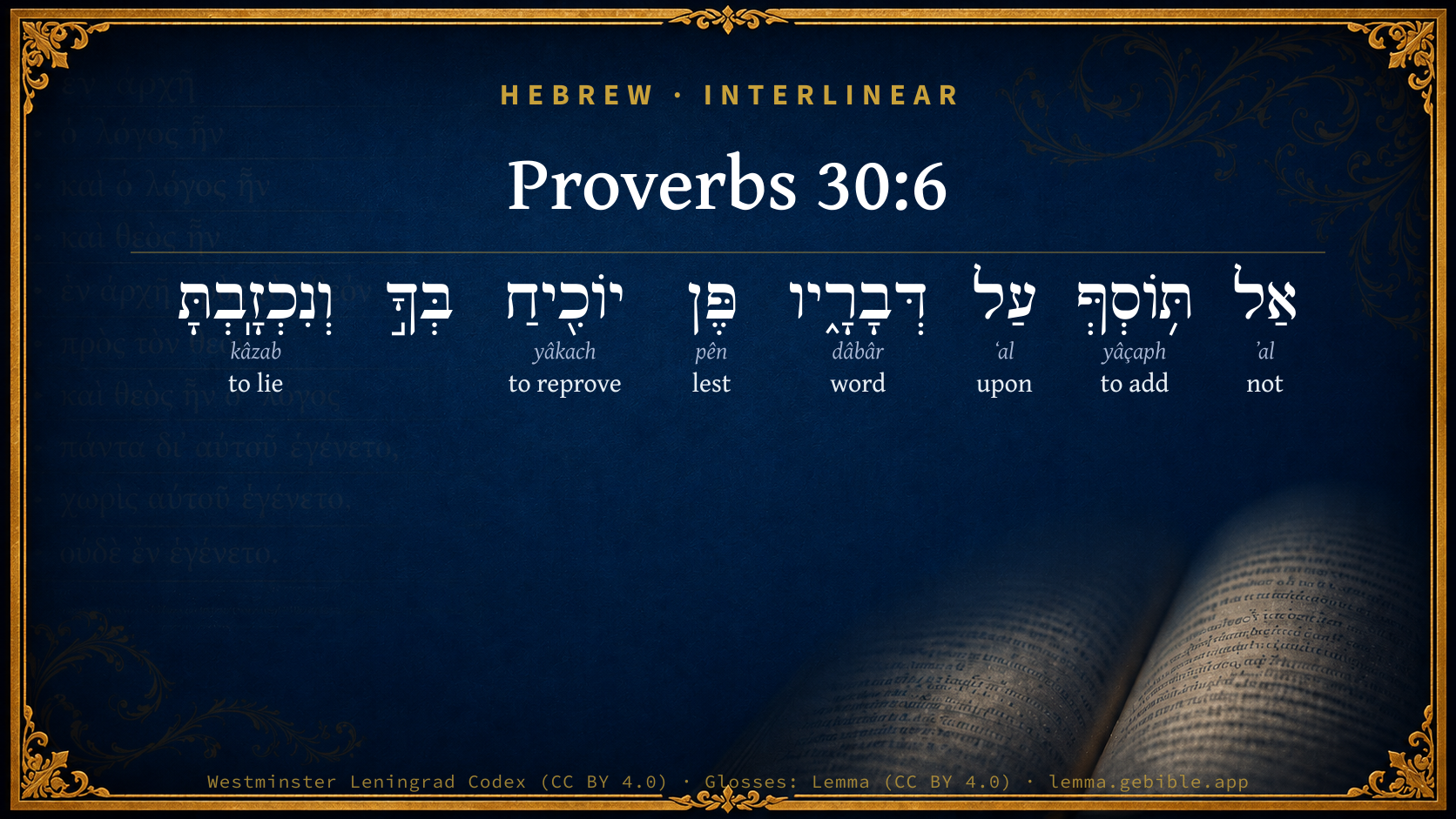
Hebrew (Westminster Leningrad Codex) Proverbs 30:6 appears in the Hebrew Old Testament. The text above is from the Westminster Leningrad Codex. Each word links to its Strong’s number, a concise gloss, and parsing drawn from the Open Scriptures Hebrew Bible morphology. Click any word for its full Brown-Driver-Briggs (BDB) entry.
Download image
Cite this verse

Proverbs 30:6 (World English Bible). Public Domain. Lemma interlinear Bible study tool, https://lemma.gebible.app/v/proverbs/30/6.

Show BibTeX & RIS
BibTeX
RIS
English Translation
Don't you add to his words, Lest he reprove you, and you be found a liar.
World English Bible · Public Domain
Download a study sheet

One document with this verse’s original text, its word-by-word gloss line, the meaning frame, cross-references with their text, attributed commentary, and full source and license credits — printable, and it pastes into notes with its structure intact.

This verse Autodidact and up

Study sheet (.html) Plain text (.txt)

A passage Seminary Student

Up to 50 verses in one chapter. A passage sheet keeps up to 6 commentary sources and 12 cross-references per verse, in the order this page ranks them, and says so on the sheet whenever that leaves anything out. Ask for a single verse and you get the Autodidact verse sheet above.

Everything on this page stays free to read, with no account — the sheet is a download of what is already on screen, not access to it.

Want to remove ads? Support Godless Engineer
Compare translations 3

The same verse in 3 English versions, stacked beneath the original-language interlinear above. Click any original word for its lexicon entry.

Each is an independent rendering of the whole verse — the interlinear is not word-aligned to these translations.

Highlighted words mark where these versions differ — a whole-verse word diff, not a word-by-word alignment.

  • World English Bible Public Domain
    Don't you add to his words, Lest he reprove you, and you be found a liar.
  • King James Version Public Domain
    Add thou not unto his words, lest he reprove thee, and thou be found a liar.
  • unfoldingWord Literal Text CC BY-SA 4.0
    Do not add upon his words, lest he rebuke you and you be shown a liar.

unfoldingWord Literal Text — © unfoldingWord, licensed CC BY-SA 4.0. Word-aligned USFM3 via Door43 (git.door43.org/unfoldingWord/en_ult).

Versions to compare (up to 4)

3 of 4 selected

Show all 18 translations

Every available English version of this verse, each an independent rendering of the whole verse.

  • World English Bible Public Domain
    Don't you add to his words, Lest he reprove you, and you be found a liar.
  • Berean Standard Bible Public Domain
    Do not add to His words, lest He rebuke you and prove you a liar.
  • Majority Standard Bible Public Domain
    Do not add to His words, lest He rebuke you and prove you a liar.
  • King James Version Public Domain
    Add thou not unto his words, lest he reprove thee, and thou be found a liar.
  • American Standard Version (1901) Public Domain
    Add thou not unto his words, Lest he reprove thee, and thou be found a liar.
  • Revised Version (1885) Public Domain
    Add thou not unto his words, lest he reprove thee, and thou be found a liar.
  • Geneva Bible (1599) Public Domain
    Put nothing vnto his wordes, least he reproue thee, and thou be found a lyar.
  • Douay-Rheims (1899) Public Domain
    Add not any thing to his words, lest thou be reproved, and found a liar:
  • Young's Literal Translation Public Domain
    Add not to His words, lest He reason with thee, And thou hast been found false.
  • Literal Standard Version CC BY-SA 4.0
    Do not add to His words, lest He reason with you, || And you have been found false.
  • Unlocked Literal Bible CC BY-SA 4.0
    Do not add to his words, or he will discipline you, and you will be proved to be a liar.
  • unfoldingWord Literal Text CC BY-SA 4.0
    Do not add upon his words, lest he rebuke you and you be shown a liar.
  • Darby Bible Public Domain
    Add thou not unto his words, lest he reprove thee, and thou be found a liar.
  • World Messianic Bible Public Domain
    Don’t you add to his words, lest he reprove you, and you be found a liar.
  • Webster's Bible Public Domain
    Add thou not to his words, lest he reprove thee, and thou be found a liar.
  • Free Bible Version CC BY-SA 4.0
    Don't add anything to his words, or he will criticize you and you'll be shown to be a liar.
  • Bible in Basic English Public Domain
    Make no addition to his words, or he will make clear your error, and you will be seen to be false.
  • JPS Tanakh (1917) Public Domain
    Add thou not unto His words, lest He reprove thee, and thou be found a liar.

Literal Standard Version (2020), Covenant Press — licensed CC BY-SA 4.0. Text via the HelloAO Bible API (eBible.org). Unlocked Literal Bible (unfoldingWord) — licensed CC BY-SA 4.0. Text via the HelloAO Bible API (eBible.org). unfoldingWord Literal Text — © unfoldingWord, licensed CC BY-SA 4.0. Word-aligned USFM3 via Door43 (git.door43.org/unfoldingWord/en_ult). Free Bible Version, Dr. Jonathan Gallagher — licensed CC BY-SA 4.0. Text via the HelloAO Bible API (eBible.org).

Word by word

More ways to search: Search by grammar → Find every occurrence → Compare this word →

Practice this passage: Drill this verse → Learn its vocabulary →

וְנִכְזָֽבְתָּ
kâzab
H3576
“and · to lie”
Conjunction + Verb, Niphal, Sequential Perfect, 2nd Person, Masculine, Singular
Part of Speech
Conjunction + Verb
Stem
Niphal
Form
Sequential Perfect
Person
2nd Person
Gender
Masculine
Number
Singular
Full BDB Definition

Origin: a primitive root

TWOT: 970

to lie, tell a lie, be a liar, be found a liar, be in vain, fail - (Qal) liar (participle) - (Niphal) to be proven to be lying - (Piel) - to lie, tell a lie, tell a lie with, deceive - to disappoint, fail - (Hiphil) to make a liar, prove to be a liar
  1. אַל ʼal H408 “not” Particle, Negative
  2. תּ֥וֹסְףְּ yâçaph H3254 “to add” Verb, Hiphil, Jussive, 2nd Person, Masculine, Singular
  3. עַל ʻal H5921 “upon” Preposition
  4. דְּבָרָ֑יו dâbâr H1697 “words · his” Noun, Common, Masculine, Plural, Construct + Suffix, Personal, 3rd Person, Masculine, Singular
  5. פֶּן pên H6435 “lest” Conjunction
  6. יוֹכִ֖יחַ yâkach H3198 “to reprove” Verb, Hiphil, Imperfect, 3rd Person, Masculine, Singular

About this verse

These counts appear in no published source. They are computed here, from the morphology-tagged text and Lemma’s own curated glosses. What Lemma adds →

8
words
7
distinct lemmas
Wisdom
section

Notable vocabulary

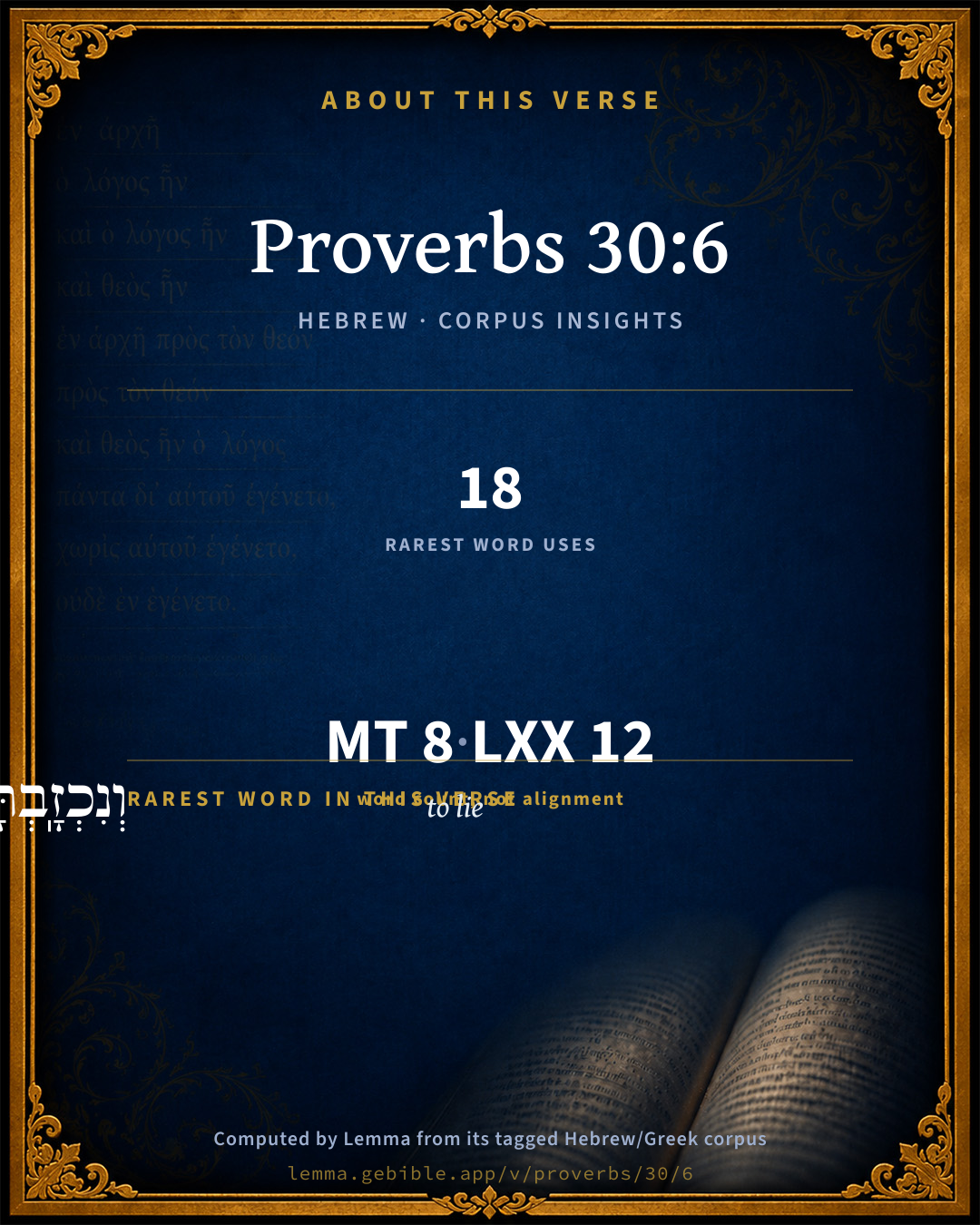
The rarest word here is וְנִכְזָֽבְתָּ to lie H3576 — appearing just 18 times in the whole Hebrew Bible.

Shared distinctive vocabulary

וְנִכְזָֽבְתָּ to lie H3576 occurs in 18 verses of the Hebrew Bible. Also found in:

Grammatical profile

  • 3 verbs
  • 1 noun
  • 2 prepositions
  • 1 conjunction
  • 1 particle

Verb forms

  • תּ֥וֹסְףְּ Hiphil · Jussive
  • יוֹכִ֖יחַ Hiphil · Imperfect
  • וְנִכְזָֽבְתָּ Niphal · Sequential Perfect

Hebrew & Septuagint length

In English translation the verse runs 16 words from the Hebrew and 15 from the Septuagint (LXX English) — closely comparable.

A rough comparison of the two English renderings, which tokenize alike — not a word-level alignment.

Word counts can differ between the Hebrew and the Greek without any difference in meaning — e.g. the Hebrew direct-object marker אֵת has no separate Greek word, and Greek often adds the article ὁ.

In the original languages it is 8 Hebrew tokens and 12 Greek tokens — but the two are counted differently (Hebrew bundles its prefixes and suffixes into one token; the Greek is in lemma form), so that isn’t a like-for-like length.

Cross-references

5

Topical passages linked to Proverbs 30:6 in the Treasury of Scripture Knowledge — connected by theme and wording, ordered by reader-vote popularity; previews shown in the World English Bible.

  • Deuteronomy 12:32 Whatever thing I command you, that shall you observe to do: you shall not add thereto, nor diminish from it.
  • Deuteronomy 4:2 You shall not add to the word which I command you, neither shall you diminish from it, that you may keep the commandments of Yahweh your God which I command you.
  • Revelation 22:18–19 I testify to everyone who hears the words of the prophecy of this book, if anyone adds to them, may God add to him the plagues which are written in this book.
  • Job 13:7–9 Will you speak unrighteously for God, And talk deceitfully for him?
  • 1 Corinthians 15:15 Yes, we are found false witnesses of God, because we testified about God that he raised up Christ, whom he didn't raise up, if it is so that the dead are not raised.

Cross-references courtesy of OpenBible.info (CC BY 4.0).

Hebrew and Greek witnesses Masoretic Hebrew ↔ Greek Septuagint

The same verse in the two great witnesses to the Old Testament, shown verse-for-verse.

These are two independent witnesses, not word-aligned to each other, and the Septuagint is shown in lemma (dictionary) form.

Hebrew Proverbs 30:6 Masoretic · Westminster Leningrad Codex

אַל תּ֥וֹסְףְּ עַל דְּבָרָ֑יו פֶּן יוֹכִ֖יחַ בְּךָ֣ וְנִכְזָֽבְתָּ

Don't you add to his words, Lest he reprove you, and you be found a liar.

World English Bible · Public Domain

Greek LXX Proverbs 30:6 Septuagint · lemma form

μή προςθέω ὁ λόγος αὐτός ἵνα μή ἐλέγχω σύ καί ψευδής γίγνομαι

Add not to his words, lest he reprove you, and you be made a liar.

LXX2012 (modern English Septuagint) · Public Domain

Hebrew: Westminster Leningrad Codex (CC BY 4.0). Greek: Septuagint (public domain); English from LXX2012 (modern English Septuagint) (Public Domain). How the Septuagint differs from the Hebrew →

Commentary

Notes on Proverbs 30:6 from classic Christian and Jewish commentators (each source and its license shown beneath its notes). The classic Christian expositions comment on the surrounding passage and are grouped to its opening verse, so a note may address several verses; the Jewish commentaries on the Tanakh (Rashi and others) are per-verse, so they appear only where the commentator wrote on this verse.

Lemma curates 59 commentaries, every one of them public domain or Creative Commons licensed, each selected and text-cleaned for this edition rather than reprinted as found. About our sources →

Trapp's Complete Commentary

John Trapp

Pro 30:6 Add thou not unto his words, lest he reprove thee, and thou be found a liar.

Ver. 6. Add thou not unto his words.] As the Jews at this day do by their traditions, which they arrogantly call mashlamnutha, completio, perfectio, {a} because they think that thereby the law is completed and perfected, as the Artemonites, and after them the schoolmen, corrupted the Scripture out of Aristotle and Theophrastus, turning all into questions and quillets. {b} As Mahomet joined his Alfurta, his service book, a horrible heap of all blasphemies, to the three parts of holy Scripture, as he divides them, the law, psalms, and gospel. As the Papists add their human inventions and unwritten verities, which they equalise unto, if not prefer before, the book of God, as appears by that heathenish decree of the Council of Trent. And when at the Council of Basil the Hussites denied to receive any doctrine that could not be proven by Scripture, Cardinal Cusan answered that Scriptures were not of the being of the Church, but of the well being, and that they were to be expounded according to the current rite of the Church, which, if it change its mind, the judgment of God is also changed. {c} Lastly, Such add to God’s word as wrest it and rack it; making it speak that which it never thought; causing it to go two miles where it would go but one; gnawing and tawing it to their own purposes, as the shoemaker taws {d} upper leather with his teeth. Tertullian calls Marcion the heretic, Mus Ponticus, of [from] his arroding and gnawing the Scripture, to make it serviceable to his errors.

Lest he reprove thee.] Both verbally and penally - both with words and blows. Lest he severely punish thee, as one that adds to his will, or imbaseth his coin.

And thou be found a liar.] As all Popish forgers and roisters at this day are found to be. God hath ever raised up such as have detected their impostures, and vindicated the purity and perfection of the sacred Scriptures.

{a} Buxtorf., Tiberius.

{b} Brightm. upon Rev., p. 292.

{c} Jacob Revius, Hist. Pontiff, p. 235.

{d} To make (skins) into leather by steeping them, after suitable preparation, in a solution of alum and salt; the product is white and pliant, and is known as alum, white, or Hungarian leather.

John Trapp, A Commentary or Exposition upon All the Books of the Old and New Testament (1647–1656) — public domain. Text from a community e-Sword module.

Joseph Benson's Commentary

Pro 30:6. Add thou not unto his words — As the word of God is pure, do not thou corrupt it, by adding to it thine own or other men’s inventions, or opinions; lest he reprove thee — By words or deeds; by discovering thy folly, and bringing thee to deserved shame and punishment; and thou be found a liar — Delivering thy own fancies and notions in the name, and as the truths of God, and thus being guilty of the worst of forgeries.

Joseph Benson's Commentary on the Old and New Testaments (1811–1818) — public domain. Text from a community e-Sword module.

Jamieson, Fausset & Brown

Robert Jamieson, A. R. Fausset & David Brown

Add . . . words--implying that his sole reliance was on God's all-sufficient teaching.

reprove thee--or, "convict thee"--and so the falsehood will appear.

Jamieson, Fausset & Brown — Commentary Critical and Explanatory on the Whole Bible (1871) — public domain (CC PDM 1.0). Text via the HelloAO Bible API.

Adam Clarke's Commentary

Verse 6. Add not thou unto his words] You can no more increase their value by any addition, than you can that of gold by adding any other metal to it. Take care that you do not any thing that this word forbids, nor leave undone any thing that it commands: for this is adding and diminishing in Scripture phrase.

Lest he reprove thee] Lest he try thy word by fire, as his has been tried; and it appear that, far from abiding the test, the fire shows thine to be reprobate silver; and so thou be found a falsifier of God's word, and a liar.

How amply has this been fulfilled in the case of the Romish Church! It has added all the gross stuff in the Apocrypha, besides innumerable legends and traditions, to the word of God! They have been tried by the refiner's fire. And this Church has been reproved, and found to be a liar, in attempting to filiate on the most holy God spurious writings discreditable to his nature.

Adam Clarke's Commentary on the Bible (1810–1826) — public domain. Text from a community e-Sword/MySword module.

Ellicott's Commentary for English Readers

(6) Lest he reprove thee.—Or, convict thee of thy falsehood.

A Bible Commentary for English Readers, edited by Charles John Ellicott (1878–1897) — public domain. Text from a community e-Sword module.

The Cambridge Bible for Schools and Colleges

gen. ed. J. J. S. Perowne

6. Add thou not] Do not mix with the pure silver of His words the dross of human speculations. “Noli investigare res quæ mentem humanam transcendunt (Pro_30:4), ut doctrinam divinitus patefactam inde compleas.” Maurer.

Pro_30:7-9. To the profitable reception of this word of God two things are necessary: first there must be “an honest and good heart,” and next there must be a lot removed from the dangerous extremes of wealth and poverty. For these two things therefore he prays earnestly.

The Cambridge Bible for Schools and Colleges (gen. ed. J. J. S. Perowne; Cambridge University Press, 1878–1918) — public domain. Text from a community e-Sword module.

John Gill's Exposition

Add thou not unto his words,.... To the words of God; as the Jews did, by joining their oral law, or the traditions of the elders, to the written word, and preferring them before it; and as the Papists, by making their unwritten traditions, and the sense and determinations of their church, equal to the Scriptures; and as all enthusiasts do, who set up their pretended dreams, visions, revelations, and prophecies, upon a foot with the word of God, or as superior to it; whereas that is, and that only, the rule and standard of faith and practice, and is a sufficient and perfect one; see Deu 4:2;

lest he reprove thee; that is, God; either by words or by blows, by threatenings and denunciations of his wrath and displeasure; or by chastisements and corrections for such daring pride, blasphemy, and wickedness; those who add to his words, he threatens to add plagues unto them, Rev 22:18;

and thou be found a liar; a forger, speaker, and spreader of doctrinal lies, such doctrines as are contrary to the word of truth; not being built on that, but upon human inventions, and additions to it.

John Gill's Exposition of the Whole Bible (1746–1763) — public domain (CC PDM 1.0). Text via the HelloAO Bible API.

Albert Barnes' Notes on the Bible

Men are not to mingle revealed truth with their own imaginations and traditions. In speculating on the unseen, the risk of error is indefinitely great, and that error God reproves by manifesting its falsehoods.

Albert Barnes' Notes on the Bible (1834–1885) — public domain. Text from a community e-Sword/MySword module.

Haydock's Catholic Bible Commentary

And not any thing contrary, Deuteronomy iv. 2., and xii. 32. --- Liar. Our Saviour condemned the false explanations of the Pharisees, as his Church does those of all heretics.

George Leo Haydock (1774–1849), Haydock's Catholic Family Bible and Commentary, 1859 edition — public domain. Excludes Psalms (Douay-Rheims chapter numbering differs from Protestant) and Deuterocanonical books (Catholic canon only).

Matthew Poole's English Annotations

And as the word of God is pure, do not thou corrupt or abuse it, by adding to it thine own or other men’s inventions and opinions, and delivering or receiving of them in the name and as the words of God. He here forbids only adding to it, not diminishing from it, which yet is equally forbidden, Deu 4:2; 12:32, because the Israelites then and always were, and others are, more prone to add than to diminish, because it is more easy to add under colour of interpreting, and because it is more agreeable to the humour of mankind, which is much delighted with its own inventions, as the experience of all ages showeth. Lest he reprove thee by words or deeds; by discovering thy folly, and bringing thee to deserved shame and punishment.

Matthew Poole's English Annotations on the Holy Bible (1683–1685) — public domain. Text from a community e-Sword/MySword module.

Whedon's Commentary on the Bible

Daniel D. Whedon

6. Add thou not unto his words — Similar warnings are found elsewhere. Comp. Deu_4:2; Deu_12:32. The writer seems familiar with the older Scriptures. Compare also Rev_22:18-19. These are solemn admonitions to which all teachers do well to take heed, and none more so than expositors, lest they make God say more or less than he has said, or something different from it, and thus be found liars before God — falsifiers of his truth. In vain may fallible man hope to escape all error in interpretation; but every one should bring to the work an honest mind to search after truth, and firmness sufficient to set forth his honest convictions.

Daniel D. Whedon (gen. ed.), Commentary on the Old and New Testaments (1874–1909) — public domain. Text from a community e-Sword module.

The Pulpit Commentary

Add thou not unto his words. God"s will, as announced in revelation, is to be simply accepted and acted upon, not watered down, not overstrained. This injunction had already been given in the old Law; (Deu_4:2 Deu_12:32) it is repeated in the New Testament with awful emphasis. (Rev_22:18, Rev_22:19) No human speculations or traditions may be mingled with God"s words; the glosses and explanations and definitions, affixed by rabbinical ingenuity to plain enactments, and proved to be false in morality and fatal to vital religion, are a commentary on the succeeding sentence, Lest he reprove thee, and thou be found a liar. The reproof is found in the consequences of such additions; the results to which they lead are such as show that no who asserts that these things are contained in the Word of God is a liar.

The Pulpit Commentary (1880–1919), ed. H.D.M. Spence-Jones & Joseph S. Exell — public domain. Text from a community e-Sword module.

Rashi

Rabbi Shlomo Yitzchaki (Rashi)

lest He prove to you, and you be found a liar He will prove to your face that through your addition you have come to sin, and certainly if you subtract.

Rashi on the Tanakh — English translations: “The Judaica Press complete Tanach with Rashi, translated by A. J. Rosenberg” (CC BY 4.0); “Pentateuch with Rashi's commentary by M. Rosenbaum and A.M. Silbermann, 1929-1934” (public domain); “The Metsudah Tanach series, Lakewood, N.J” (CC BY 4.0); and “The Book of Joshua, Metsudah Publications, 1997” (CC BY 4.0). Text via Sefaria.

Lesson kit

Teaching starters — assembled from the data on this page, not authored interpretation. Every prompt links to the verse data it draws on. Edit before teaching.

Proverbs, in the Wisdom, opens this verse with 8 words (7 distinct Hebrew lemmas). Its most distinctive word is kâzab (“to lie”). A historical commentator’s framing appears above. Read the whole chapter for the surrounding context.

Discussion questions

  1. How does “to lie” (kâzab) shape what this verse is saying?
  2. Numbers 23:19 shares the word «to lie» with this verse. How do the two illuminate each other?
  3. These translations render this verse differently. What is at stake in choosing one wording over another?
  4. The verb «תּ֥וֹסְףְּ» is Hiphil Jussive. How does its form color the action?
  5. Reading how Trapp's Complete Commentary and Joseph Benson's Commentary read this verse, where do the two commentators agree and where do they part?

Things to notice

Reading settings

Reading text

Shown beneath each verse's original-language words.

Old Testament
Old Testament edition

Read the OT as the Masoretic Hebrew (MT) or the Greek Septuagint (LXX).

English shown for the Greek Septuagint (in the Hebrew ↔ Greek comparison).

Comparing translations? Open the Compare panel on any verse page to stack up to four side by side.