

Psalms 41:8

Hebrew (Westminster Leningrad Codex) Psalms 41:8 appears in the Hebrew Old Testament. The text above is from the Westminster Leningrad Codex. Each word links to its Strong’s number, a concise gloss, and parsing drawn from the Open Scriptures Hebrew Bible morphology. Click any word for its full Brown-Driver-Briggs (BDB) entry.
Download image
Cite this verse

Psalms 41:8 (World English Bible). Public Domain. Lemma interlinear Bible study tool, https://lemma.gebible.app/v/psalms/41/8.

Show BibTeX & RIS
BibTeX
RIS
English Translation
"An evil disease," they say, "has afflicted him. Now that he lies he shall rise up no more."
World English Bible · Public Domain
Download a study sheet

One document with this verse’s original text, its word-by-word gloss line, the meaning frame, cross-references with their text, attributed commentary, and full source and license credits — printable, and it pastes into notes with its structure intact.

This verse Autodidact and up

Study sheet (.html) Plain text (.txt)

A passage Seminary Student

Up to 50 verses in one chapter. A passage sheet keeps up to 6 commentary sources and 12 cross-references per verse, in the order this page ranks them, and says so on the sheet whenever that leaves anything out. Ask for a single verse and you get the Autodidact verse sheet above.

Everything on this page stays free to read, with no account — the sheet is a download of what is already on screen, not access to it.

Want to remove ads? Support Godless Engineer
Compare translations 3

The same verse in 3 English versions, stacked beneath the original-language interlinear above. Click any original word for its lexicon entry.

Each is an independent rendering of the whole verse — the interlinear is not word-aligned to these translations.

Highlighted words mark where these versions differ — a whole-verse word diff, not a word-by-word alignment.

  • World English Bible Public Domain
    "An evil disease," they say, "has afflicted him. Now that he lies he shall rise up no more."
  • King James Version Public Domain
    An evil disease, say they, cleaveth fast unto him: and now that he lieth he shall rise up no more.
  • unfoldingWord Literal Text CC BY-SA 4.0
    “A matter of wickedness is poured on him, and he who has lain down will not repeat to rise.”

unfoldingWord Literal Text — © unfoldingWord, licensed CC BY-SA 4.0. Word-aligned USFM3 via Door43 (git.door43.org/unfoldingWord/en_ult).

Versions to compare (up to 4)

3 of 4 selected

Show all 18 translations

Every available English version of this verse, each an independent rendering of the whole verse.

  • World English Bible Public Domain
    "An evil disease," they say, "has afflicted him. Now that he lies he shall rise up no more."
  • Berean Standard Bible Public Domain
    “A vile disease has been poured into him; he will never get up from where he lies!”
  • Majority Standard Bible Public Domain
    “A vile disease has been poured into him; he will never get up from where he lies!”
  • King James Version Public Domain
    An evil disease, say they, cleaveth fast unto him: and now that he lieth he shall rise up no more.
  • American Standard Version (1901) Public Domain
    An evil disease, `say they', cleaveth fast unto him; And now that he lieth he shall rise up no more.
  • Revised Version (1885) Public Domain
    An evil disease, say they, cleaveth fast unto him: and now that he lieth he shall rise up no more.
  • Geneva Bible (1599) Public Domain
    A mischiefe is light vpon him, and he that lyeth, shall no more rise.
  • Douay-Rheims (1899) Public Domain
    All my enemies whispered together against me: they devised evils to me.
  • Young's Literal Translation Public Domain
    A thing of Belial is poured out on him, And because he lay down he riseth not again.
  • Literal Standard Version CC BY-SA 4.0
    A worthless thing is poured out on him, || And because he lay down he does not rise again.
  • Unlocked Literal Bible CC BY-SA 4.0
    They say, “An evil disease holds on tightly to him; now that he is lying down, he will rise up no more.”
  • unfoldingWord Literal Text CC BY-SA 4.0
    “A matter of wickedness is poured on him, and he who has lain down will not repeat to rise.”
  • Darby Bible Public Domain
    A thing of Belial cleaveth fast unto him; and now that he is laid down, he will rise up no more.
  • World Messianic Bible Public Domain
    “An evil disease”, they say, “has afflicted him. Now that he lies he shall rise up no more.”
  • Webster's Bible Public Domain
    \\41:7\\All that hate me whisper together against me: against me do they devise my hurt.
  • Free Bible Version CC BY-SA 4.0
    “He's been cursed with some terrible disease,” they say. “Now he's bed-ridden he'll never recover!”
  • Bible in Basic English Public Domain
    They say, He has an evil disease, which will not let him go: and now that he is down he will not get up again.
  • JPS Tanakh (1917) Public Domain
    (41-9) 'An evil thing cleaveth fast unto him; and now that he lieth, he shall rise up no more.'

Literal Standard Version (2020), Covenant Press — licensed CC BY-SA 4.0. Text via the HelloAO Bible API (eBible.org). Unlocked Literal Bible (unfoldingWord) — licensed CC BY-SA 4.0. Text via the HelloAO Bible API (eBible.org). unfoldingWord Literal Text — © unfoldingWord, licensed CC BY-SA 4.0. Word-aligned USFM3 via Door43 (git.door43.org/unfoldingWord/en_ult). Free Bible Version, Dr. Jonathan Gallagher — licensed CC BY-SA 4.0. Text via the HelloAO Bible API (eBible.org).

Word by word

More ways to search: Search by grammar → Find every occurrence → Compare this word →

Practice this passage: Drill this verse → Learn its vocabulary →

About this verse

These counts appear in no published source. They are computed here, from the morphology-tagged text and Lemma’s own curated glosses. What Lemma adds →

9
words
8
distinct lemmas
Wisdom
section

Shared distinctive vocabulary

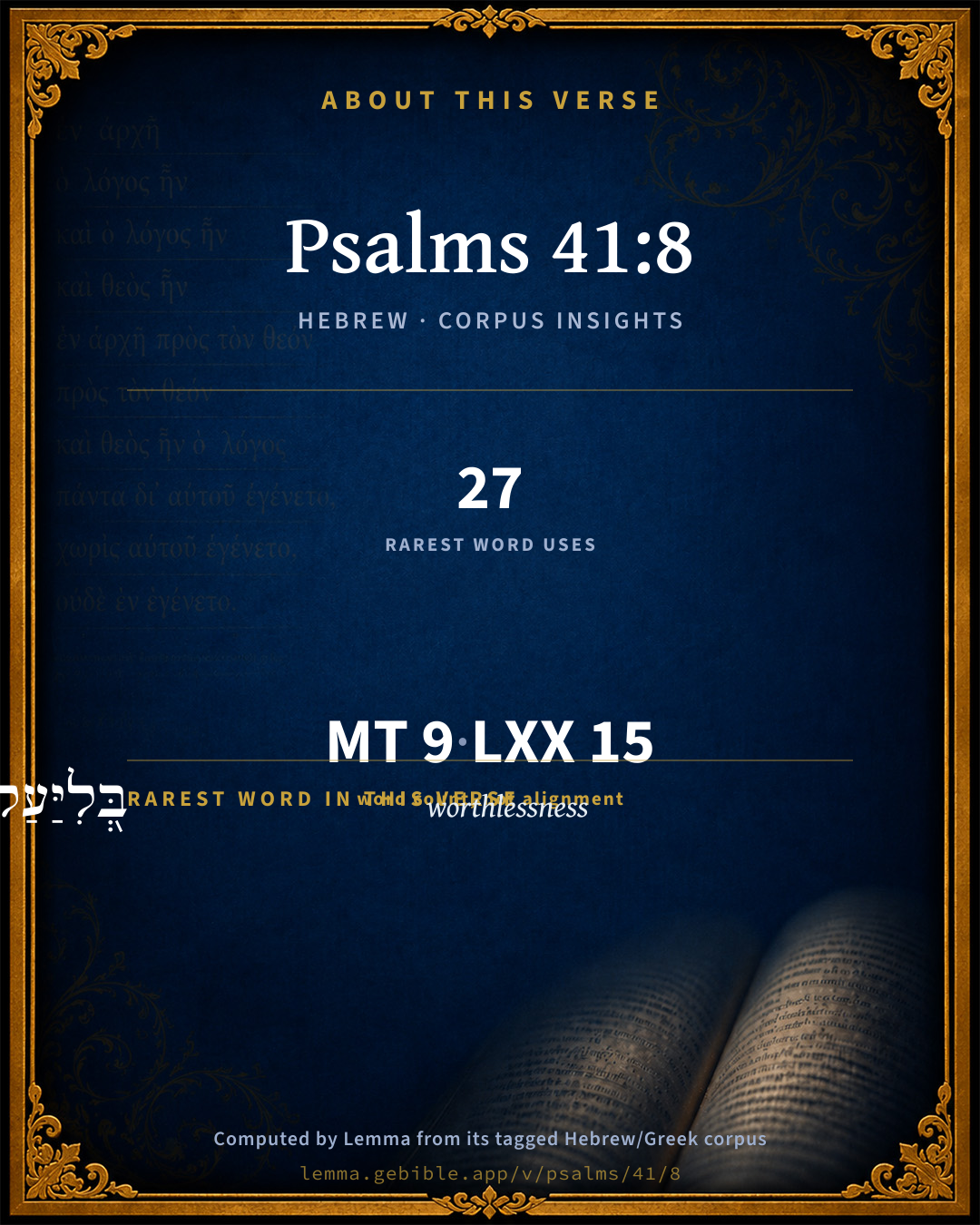
בְּ֭לִיַּעַל worthlessness H1100 occurs in 26 verses of the Hebrew Bible. Also found in:

Grammatical profile

  • 4 verbs
  • 2 nouns
  • 1 preposition
  • 2 particles

Verb forms

  • יָצ֣וּק Qal · Participle Passive
  • שָׁ֝כַ֗ב Qal · Perfect
  • יוֹסִ֥יף Hiphil · Imperfect
  • לָקֽוּם Qal · Infinitive Construct

Hebrew & Septuagint length

In English translation the verse runs 18 words from the Hebrew and 18 from the Septuagint (LXX English) — the same length.

A rough comparison of the two English renderings, which tokenize alike — not a word-level alignment.

Word counts can differ between the Hebrew and the Greek without any difference in meaning — e.g. the Hebrew direct-object marker אֵת has no separate Greek word, and Greek often adds the article ὁ.

In the original languages it is 9 Hebrew tokens and 15 Greek tokens — but the two are counted differently (Hebrew bundles its prefixes and suffixes into one token; the Greek is in lemma form), so that isn’t a like-for-like length.

Cross-references

7

Topical passages linked to Psalms 41:8 in the Treasury of Scripture Knowledge — connected by theme and wording, ordered by reader-vote popularity; previews shown in the World English Bible.

  • Psalms 71:11 Saying, "God has forsaken him. Pursue and take him, for no one will rescue him."
  • Matthew 27:41–46 Likewise the chief priests also mocking, with the scribes, the Pharisees, and the elders, said,
  • Luke 13:16 Ought not this woman, being a daughter of Abraham, whom Satan had bound eighteen long years, be freed from this bondage on the Sabbath day?"
  • Job 2:7–8 So Satan went forth from the presence of Yahweh, and struck Job with painful sores from the sole of his foot to his head.
  • Psalms 3:2 Many there are who say of my soul, "There is no help for him in God." Selah.
  • Psalms 38:3–7 There is no soundness in my flesh because of your indignation, Neither is there any health in my bones because of my sin.
  • Matthew 27:63–64 saying, "Sir, we remember what that deceiver said while he was still alive: 'After three days I will rise again.'

Cross-references courtesy of OpenBible.info (CC BY 4.0).

Hebrew and Greek witnesses Masoretic Hebrew ↔ Greek Septuagint

The same verse in the two great witnesses to the Old Testament, shown verse-for-verse.

You’re reading Greek Psalm 40 (Hebrew Psalm 41). The Septuagint counts the superscription, so verse numbers can differ from the Hebrew — chapter-level alignment, not verse-by-verse. Numbering follows Rahlfs.

These are two independent witnesses, not word-aligned to each other, and the Septuagint is shown in lemma (dictionary) form.

Hebrew Psalms 41:8 Masoretic · Westminster Leningrad Codex

דְּֽבַר בְּ֭לִיַּעַל יָצ֣וּק בּ֑וֹ וַאֲשֶׁ֥ר שָׁ֝כַ֗ב לֹא יוֹסִ֥יף לָקֽוּם

"An evil disease," they say, "has afflicted him. Now that he lies he shall rise up no more."

World English Bible · Public Domain

Greek LXX Greek Psalm 40:8 Septuagint · lemma form

ἐπί ὁ αὐτός κατά ἐγώ ψιθυρίζω πᾶς ὁ ἐχθρός ἐγώ κατά ἐγώ λογίζομαι κακός ἐγώ

They denounced a wicked word against me, saying, Now that he lies, shall he not rise up again?

LXX2012 (modern English Septuagint) · Public Domain

On this verse, Albert Barnes' Notes on the Bible discusses the Septuagint’s reading. Read the note in Commentary ↓

Hebrew: Westminster Leningrad Codex (CC BY 4.0). Greek: Septuagint (public domain); English from LXX2012 (modern English Septuagint) (Public Domain). How the Septuagint differs from the Hebrew →

Commentary

Notes on Psalms 41:8 from classic Christian and Jewish commentators (each source and its license shown beneath its notes). The classic Christian expositions comment on the surrounding passage and are grouped to its opening verse, so a note may address several verses; the Jewish commentaries on the Tanakh (Rashi and others) are per-verse, so they appear only where the commentator wrote on this verse.

Lemma curates 59 commentaries, every one of them public domain or Creative Commons licensed, each selected and text-cleaned for this edition rather than reprinted as found. About our sources →

Trapp's Complete Commentary

John Trapp

Psa 41:8 An evil disease, [say they], cleaveth fast unto him: and [now] that he lieth he shall rise up no more.

Ver. 8. An evil disease, say they, cleaveth fast unto him] Heb. A thing of Belial, a vengeance, hath befallen him; God, for his foul offence, hath put him over to the devil to be tormented by a pestilential disease, that will surely make an end of him, Omnes impietates quas perpetravit (R. Solom.). So Genebrard (that mad dog), in the fourth book of his Chronology, A. D. 1563, reckoning up those divers diseases whereof Calvin died, all which was well known to be false, addeth, An Herodes terribilius animam Satanae reddiderit, equidem nescio, Whether Herod yielded up his soul to the devil in a more horrible manner, I know not. With as little charity did Evagrius say of Justinian, the great lawgiver, ad supplicia iusto Dei iudicio apud iuferos luenda profectus est, he went to hell torments, when he died by God’s just judgment. And Luther of OEolampadius, Se credere (OEcolampadium ignitis Satanae telis et hastis confossum subitanea morte periisse (Lib. de Missa privata, A. D. 1533) - tantaene animis caelestibus irae? This false conceit is sufficiently confuted by the history of his life and death set forth by Simon Grynaeus, as also is that concerning Calvin, by his Life written by Beza, and others.

John Trapp, A Commentary or Exposition upon All the Books of the Old and New Testament (1647–1656) — public domain. Text from a community e-Sword module.

Albert Barnes' Notes on the Bible

An evil disease - Margin, “a thing of Belial.” The Hebrew is literally “a word of Belial.” This has been very variously understood and interpreted. The Septuagint renders it: λόγον παράνομον logon paranomon - wicked word; “a wicked determination” (Thompson); that is, they formed a wicked purpose against him, to wit, by saying that he was now confined to his bed, and could not rise again. The Latin Vulgate renders it in a similar manner: Verbum iniquitum constituerunt adversum me. Luther: “They have formed a wicked device (Bubenstuck) against me;” they behave in a knavish or wicked manner. DeWette, “Destruction (Verderben) or punishnnent (Strafe) is poured upon him.” The term rendered “disease” means properly “word” or “thing;” and Prof. Alexander renders it, “A word of Belial is poured upon him.” The word rendered “evil, Belial,” means literally “without use” - בליעל belı̂ya‛al - from בלי belı̂y, “not or without,” and יעל ya‛al, “use or profit.”

Then it means worthlessness, wickedness, destruction; and hence, in connection with man, denotes one who is wicked, worthless, abandoned. It is difficult to determine its meaning here. The connection Psa 41:3 would seem to suggest the idea adopted by our translators; the words themselves would seem rather to convey the idea of some reproach, or harsh saying - some vain, wicked, malicious words that were uttered against him. That there was disease in the case, and that the psalm was composed in view of it, and of the treatment which the author experienced from those who had been his professed friends when suffering under it, seems to me to be manifest from Psa 41:1, Psa 41:3-4, Psa 41:8; but it is probable that the reference in this expression is not to the disease, but to the words or the conduct of his calumniators. It is evident from the pronoun him - the third person - that this refers, as our translators have indicated by the words they say to something that they said in regard to him; something which they affirmed as the result of their observations on his condition, Psa 41:6-7. The true idea, therefore, I think is this: “They say - that is, those who came to see me said - A ‘word of evil’ - “a sentence of evil or destruction” - is poured upon him. He is suffering under such a ‘word of destruction;’ or, such a word (that is, sentence) as will involve his destruction, by way of punishment for his sins; therefore all is over with him, and he must die. He can hope to rise no more.” This would express the idea that they regarded his death as certain, for he seemed to be under a sentence which made that sure.

Cleaveth fast unto him - Or rather, “is poured upon him.” The word used here - צוּק tsûq - means:

(1) to be narrow, straitened, compressed; and then

(2) to pour out - as metal is poured out Job 28:2, or as words are poured out in prayer Isa 26:16.

Here it would seem to mean that such a sentence was poured upon him, or that he had become submerged or swallowed up under it. It was like the pouring out of a torrent on him, overwhelming him with floods of water, so that he could not hope to escape, or to rise again.

And now that he lieth, he shall rise up no more - There is no hope for him; no prospect that he will ever get up again. They felt that they might indulge their remarks, therefore, freely, as he would not be able to take revenge on them, and their expectations and hopes were about to be accomplished by his death. Compare Psa 41:5. As a part of his sufferings, all this was aggravated by the fact that they regarded those sufferings as full proof of his guilt; that he could not reply to their accusations; and that be was about to die under that imputation.

Albert Barnes' Notes on the Bible (1834–1885) — public domain. Text from a community e-Sword/MySword module.

Joseph Benson's Commentary

Psa 41:8-9. An evil disease cleaveth fast unto him — Hebrew, דבר בליעל, debar Belijagnal, a word, or thing of Belial. Literally, says Houbigant, A thing of Belial is poured out upon him, that is, his wickedness is brought round upon, or overflows him. The reproach wherewith they had loaded him, they hoped, would cleave so fast to him, that his name would perish with him, and they should gain their point. Or, their meaning was, The disease, wherewith he is now afflicted, will certainly make an end of him; for it is the punishment of some great, enormous crime, which he will not repent of, and which proves him, however he has appeared, a son of Belial. And now he lieth, he will rise up no more — Seeing God has begun to punish him, he will continue so to do till he destroy him, and then we shall be rid of him, and divide the spoil of his preferments. Yea, mine own familiar friend — Probably he means Ahithophel, who had been his bosom friend, and prime minister of state; in whom he had trusted, as one inviolably firm to him, and on whose advice he had relied much, in dealing with his enemies: which did eat of my bread — With whom he had been very intimate, and whom he had taken to sit at the table with him; nay, whom he had maintained and given a livelihood to, and so obliged both in gratitude and interest to adhere to him; hath lifted up his heel against me — A phrase implying injury joined with insolence and contempt; taken from an unruly horse, which kicks at him that owns and feeds it. He not only deserted, but insulted; opposed and endeavoured to supplant him. Those are wicked indeed, whom no courtesy done them, no confidence reposed in them, will oblige. Although these words were literally fulfilled in David, yet the Holy Ghost, who dictated them, looked further in them, even to Christ and Judas, in whom they received a further and fuller accomplishment; and to whom, therefore, they are applied, Joh 13:18.

Joseph Benson's Commentary on the Old and New Testaments (1811–1818) — public domain. Text from a community e-Sword module.

J. A. Alexander on Psalms

Joseph Addison Alexander

9. (Psa 41:8). A word of Belial is poured into him, and he who lies (there) shall arise no more. These are the words of his malignant visitors, either uttered in his presence, or to their companions after leaving him. The literal translation of the first clause is given, to shew its obscurity, and enable the reader to understand the different explanations of it which have been proposed. Some give word its not unfrequent idiomatic sense of thing, affair (1Sa 10:2, 2Sa 11:18-19, Psa 105:27), and Belial that a ruin or destruction, which they suppose it to have in Nah 1:11, and Psa 18:5 (4) above. But there, as elsewhere, it is better to retain its primary meaning, good for nothing, worthless, or as an abstract, worthlessness, a strong though negative expression for depravity. The whole phrase will then mean a wicked matter, a depraved affair. By this again some understand the disease with which he was afflicted, and which is then described as the result of his own wickedness; others the plan or plot devised by the speakers for the ruin of the sufferer. But this would hardly be described by themselves as a depraved affair. None of these explanations seem so natural or so exact, as that which gives to both words their customary meaning, and understands by a word of Belial a disgraceful charge or infamous reproach, which is then represented as the cause of his distress and his approaching death. The next phrase may either mean poured into his mind or soul, as a moral poison, producing agony and death; or poured upon him, so as to submerge or overwhelm him. In Job 41:15-16 (23, 24), the same Hebrew participle seems to be thrice used in the sense of poured out, melted, soldered, firmly fastened. So here the English Bible renders it cleaveth fast unto him, and the same meaning is assumed by some who understand by the preceding words a wicked plot or a destructive visitation, which is then described as cleaving fast to him so that he cannot shake it off or otherwise escape from it. The common version of the next words, now that he lieth, is extremely forced. The only natural construction of the relative is that which refers it to the sufferer himself. He who has lain down shall not add to rise, the common Hebrew method of expressing a continued or repeated action. See above, on Psa 10:18. The expression becomes still more graphic if we understand it to mean he who is lying (here before you), or he who lies there, i.e. in yonder house or chamber.

Joseph Addison Alexander, The Psalms Translated and Explained (1850) — public domain. Text from a community e-Sword module.

Geneva Bible (1599)

Geneva Bible translators

The enemies thought by his sharp punishments that God was become his mortal enemy.

Geneva Bible (1599) marginal notes — public domain. Text via Bolls.life.

Jamieson, Fausset & Brown

Robert Jamieson, A. R. Fausset & David Brown

An evil disease--literally, "a word of Belial," some slander.

cleaveth--literally, "poured on him."

that he lieth--who has now laid down, "he is utterly undone and our victory is sure."

Jamieson, Fausset & Brown — Commentary Critical and Explanatory on the Whole Bible (1871) — public domain (CC PDM 1.0). Text via the HelloAO Bible API.

Adam Clarke's Commentary

Verse 8. An evil disease, say they, cleaveth fast unto him] דבר בליעל יצוק בו debar beliyaal yatsuk bo, a thing, word, or pestilence of Belial, is poured out upon him. His disease is of no common sort; it is a diabolical malady.

He shall rise up no more.] His disease is incurable without a miracle; and he is too much hated of God to have one wrought for him. Some apply this to the death and resurrection of Christ; he lieth-he is dead and buried; he shall never rise again from the dead.

Adam Clarke's Commentary on the Bible (1810–1826) — public domain. Text from a community e-Sword/MySword module.

John Calvin's Commentaries

8. An evil deed of Belial cleaved fast to him. From this verse it appears that they had thus conspired together for his destruction, on the ground that they regarded him as a wicked man, and a person worthy of a thousand deaths. The insolence and arrogance which they manifested towards him proceeded from the false and wicked judgment which they had formed concerning him, and of which he made mention in the beginning of the psalm. They say, therefore, that an evil deed of Belial holds him shut up, and, as it were, bound fast. This the verb יצוק, yatsuk, properly signifies; but in translating the verse I have followed the rendering which is most commonly received, reading cleaveth fast to him, etc. This expression is by others rendered spreadeth upon him, but this interpretation seems to me to be too constrained. As to the word Belial, we have already spoken of it in the eighteenth psalm. But as grammarians maintain that it is compounded of בלי, beli, and יעל, yaäl, which signify not to rise, the expression, thing of Belial, (for so it is literally in the Hebrew,) I understand in this place as meaning an extraordinary and hateful crime, which, as we commonly say, can never be expiated, and from which there is no possibility of escape; unless, perhaps, some would rather refer it to the affliction itself under which he labored, as if his enemies had said that he was seized by some incurable malady. But whatever may be as to this, his enemies regarded it as absolutely certain that God was altogether hostile to him, and would never be reconciled towards him, since he was chastising him with so much severity. When they add in the following clause, he shall never be able to rise again, this clearly shows that they utterly cut off from him all hope of recovery. And certainly it was a sore temptation to David, who had in himself the testimony of a good conscience, to think that he was regarded by men as one who was pursued by the vengeance of God, nay, that they even cast him headlong into hell. But it pleased God thus to try his servant, that, trusting to the testimony of his own conscience, he should pay no regard to what men might say, or be troubled by the reproaches they might cast upon him. It was also his design to teach us, by his example, that we must seek the reward of our righteousness elsewhere than in this world, since we see with what unequal balances the world often sets itself to estimate the difference between virtue and vice.

John Calvin's Commentaries (1540-1563) — public domain. Text from the Calvin Translation Society English edition (1840s-50s) via the Christian Classics Ethereal Library (ccel.org). Calvin's coverage is partial (roughly two-thirds of the Bible); uncommented books and verses are honest gaps, never fabricated. The 19th-century editor's footnotes and remarks are omitted so the notes are faithfully Calvin's own voice.

Ellicott's Commentary for English Readers

(8) An evil disease.—Margin, thing of Belial. (For “Belial,” see Deu_13:13.) The expression may mean, as in LXX. and Vulg., “a lawless speech,” so the Chaldee, “a perverse word.” Syriac, “a word of iniquity,” or “a physical evil,” as in Authorised Version, or “a moral evil.” The verse is difficult, not only from this ambiguity, but also from that of the verb, which, according to the derivation we take, may mean “cleave” or “pour forth.” Modern scholars prefer the latter, understanding the image as taken from the process of casting metal. An incurable wound is poured out (welded) upon him. (Comp. “molten,” 1Ki_7:24; 1Ki_7:30.) This does not, however, suit the context nearly so well as the reading,

“A wicked saying have they directed against me:

Let the sick man never rise again,”

which has the support of the LXX. and Vulg., though they make of the last clause a question, “Shall not the sleeper rise again?”

A Bible Commentary for English Readers, edited by Charles John Ellicott (1878–1897) — public domain. Text from a community e-Sword module.

The Cambridge Bible for Schools and Colleges

gen. ed. J. J. S. Perowne

8. Render: A deadly mischief is poured out upon him.

The phrase a thing of belial is variously explained to mean an incurable disease or a matter of wickedness (cp. note on Psa_18:4). The use of it in Psa_101:3 (base thing), and Deu_15:9 (base thought) points to the latter as the primary sense. But probably the speakers do not distinguish between the moral cause—some monstrous crime—and the physical effect—a fatal illness—; but include the latter in the former. Cp. Shimei’s taunt, 2Sa_16:7.

cleaveth fast unto him] R.V. marg., is poured out upon him; perhaps, is molten, or, welded fast upon him. He will never be free from his guilt and its punishment.

The rendering in P.B.V., Let the sentence of guiltiness proceed against him, is quite impossible.

now that he lieth &c.] Now that he has taken to his bed he will never leave it again.

The Cambridge Bible for Schools and Colleges (gen. ed. J. J. S. Perowne; Cambridge University Press, 1878–1918) — public domain. Text from a community e-Sword module.

John Gill's Exposition

An evil disease, say they, cleaveth fast unto him,.... Not any bodily one, of which they might hope he would die; much less any foul disease, the disease of sin; but, as the phrase may be rendered, "a word of Belial" (y); that is, a wicked charge or accusation; a charge of sin brought against him by the sons of Belial, as of blasphemy and sedition, which they concluded would be fastened upon him, and stick by him, and in which they should succeed to their wishes; or else the shameful punishment the death of the cross, inflicted on him, which they fancied would fix an indelible mark of infamy and scandal on him, since cursed is he that hangeth on a tree;

and now that he lieth, let him rise up no more; has much as he was dead, of which they had full proof, and was laid in the grave, his tomb watched, and the stone rolled to it sealed; they thought all was safe, and it was all over with him, that he would never rise again, as he had given out, and his disciples incapable of committing a fraud they afterwards accused them with: this, according to the above learned writer, see Psa 41:6, was said by Absalom, as he thinks Ahithophel is the person designed in Psa 41:9.

(y) "verbum Belijahal", Montanus, Musculus, Cocceius, Gejerus.

John Gill's Exposition of the Whole Bible (1746–1763) — public domain (CC PDM 1.0). Text via the HelloAO Bible API.

Matthew Poole's English Annotations

An evil disease, Heb. a word or thing of Belial, i.e. either,

1. Some wicked calumny which they had raised, and which stuck close to him. Or,

2. His great wickedness, whereof this is a sign. Or rather,

3. This sore disease or mischief; either sent upon him in way of vengeance for his horrid crimes; or such as God useth to inflict upon the sons of Belial, to show that he is in truth such a one, whatsoever he pretends to the contrary.

He shall rise up no more; seeing God hath begun to punish him, he will make an end of him.

Matthew Poole's English Annotations on the Holy Bible (1683–1685) — public domain. Text from a community e-Sword/MySword module.

The Treasury of David

Charles H. Spurgeon

Ver. 8. An evil disease, say they, cleaveth fast unto him. They whisper that some curse has fallen upon him, and is riveted to him. They insinuate that a foul secret stains his character, the ghost whereof haunts his house, and never can be laid. An air of mystery is cast around this doubly dark saying, as if to show how indistinct are the mutterings of malice. Even thus was our Lord accounted "smitten of God and afflicted." His enemies conceived that God had forsaken him, and delivered him for ever into their hands. And now that he lieth he shall rise up no more. His sickness they hoped was mortal, and this was fine news for them. No more would the good man's holiness chide their sin, they would now be free from the check of his godliness. Like the friars around Wycliffe's bed, their prophesyings were more jubilant than accurate, but they were a sore scourge to the sick man. When the Lord smites his people with his rod of affliction for a small moment, their enemies expect to see them capitally executed, and prepare their jubilates to celebrate their funerals, but they are in too great a hurry, and have to alter their ditties and sing to another tune. Our Redeemer eminently foretokened this, for out of his lying in the grave he has gloriously risen. Vain the watch, the stone, the seal! Rising he pours confusion on his enemies.

Ver. 8. An evil disease, say they, cleaveth fast unto him. An evil deed of Belial cleaveth fast to him. Grammarians maintain that the word Belial is compounded of (ylb), beli, and (ley), yaal, which signify "not to rise" the expression, "thing of Belial" (for so it is literally in the Hebrew), I understand in this place as meaning an extraordinary and hateful crime which as we commonly say can never be expiated, and from which there is no possibility of escape; unless perhaps some would rather refer it to the affliction itself under which he laboured, as if his enemies had said that he was seized by some incurable malady. John Calvin.

Ver. 8. An evil disease, etc. What is here meant by (leylb-rkd) is matter of some difficulty. The ancient interpreters generally render it a perverse or mischievous, or wicked word; the Chaldee, a perverse word; the Syriac, a word of iniquity; the LXX logon paranomon; the Latin, iniquum verbum, a wicked word; the Arabic, words contrary to the law. And so in all probability it is set to signify a great slander, or calumny that as "men of Belial" are slanderous persons, so the speech of Belial shall signify a slanderous speech. And this is said to "cleave" to him on whom it is fastened, it being the nature of calumnies, when strongly affixed on any, to cleave fast, and leave some evil mark behind them. Henry Hammond.

Charles H. Spurgeon's The Treasury of David (1869–1885) — public domain. Psalms only. Text from a community e-Sword/MySword module.

Whedon's Commentary on the Bible

Daniel D. Whedon

8. An evil disease… cleaveth fast unto him—Hebrew, An affair of Belial is firm in him. On Belial, see Psa_18:4. דבר, (dabar,) (English version, disease,) may take the sense of matter, cause, forensically, that is, suit at law, as Exo_18:16; Exo_18:19-20; and יצוק, (yatzook,) (English version, cleaveth fast,) takes the sense of firmness, fixedness, as in Job_41:23, “they are firm in themselves;” and Job_41:24, “His heart is as firm as a stone; yea, as hard as a piece of the nether millstone.” [Hebrews of vers. 15, 16.] The sense is, that David’s sickness was regarded as evidence of a hopeless controversy with God, in which the king, who is supposed to be fixed and stubborn, would surely fall.

Daniel D. Whedon (gen. ed.), Commentary on the Old and New Testaments (1874–1909) — public domain. Text from a community e-Sword module.

The Pulpit Commentary

An evil disease (literally, a thing of Belial), say they, cleaveth fast unto him. (On the meaning of "Belial," see the comment on Psa_18:4) The "thing of Belial" here intended may, perhaps, be the disease from which David was suffering, but is more probably some disgraceful charge or infamous calumny which had been circulated concerning him, and was now crushing him down. This calumny is represented as poured out upon him like a coating of molten metal, (see Job_41:23, Job_41:24) and so cleaving to him. And now that he lieth; i.e. "now that he is prostrate upon a sick-bed." He shall rise up no more. He shall not recover, but die of his malady.

The Pulpit Commentary (1880–1919), ed. H.D.M. Spence-Jones & Joseph S. Exell — public domain. Text from a community e-Sword module.

Rashi

Rabbi Shlomo Yitzchaki (Rashi)

whisper about me something that is harmful to me, and what is that thought?...

Rashi on the Tanakh — English translations: “The Judaica Press complete Tanach with Rashi, translated by A. J. Rosenberg” (CC BY 4.0); “Pentateuch with Rashi's commentary by M. Rosenbaum and A.M. Silbermann, 1929-1934” (public domain); “The Metsudah Tanach series, Lakewood, N.J” (CC BY 4.0); and “The Book of Joshua, Metsudah Publications, 1997” (CC BY 4.0). Text via Sefaria.

Lesson kit

Teaching starters — assembled from the data on this page, not authored interpretation. Every prompt links to the verse data it draws on. Edit before teaching.

Psalms, in the Wisdom, opens this verse with 9 words (8 distinct Hebrew lemmas). Its most distinctive word is bᵉlîyaʻal (“worthlessness”). A historical commentator’s framing appears above. Read the whole chapter for the surrounding context.

Discussion questions

  1. How does “worthlessness” (bᵉlîyaʻal) shape what this verse is saying?
  2. How does Deuteronomy 13:13, which shares the word «worthlessness», read alongside this verse?
  3. The translations on this page render this verse differently — a whole-verse word diff, not a word-by-word alignment. What might account for the different wordings?
  4. «יָצ֣וּק» is a Qal Participle Passive verb. How does that grammatical form shape the action described?
  5. Compare how Trapp's Complete Commentary and Albert Barnes' Notes on the Bible read this verse. Where do they agree or differ?

Things to notice

Reading settings

Reading text

Shown beneath each verse's original-language words.

Old Testament
Old Testament edition

Read the OT as the Masoretic Hebrew (MT) or the Greek Septuagint (LXX).

English shown for the Greek Septuagint (in the Hebrew ↔ Greek comparison).

Comparing translations? Open the Compare panel on any verse page to stack up to four side by side.