

Proverbs 16:21

Hebrew (Westminster Leningrad Codex) Proverbs 16:21 appears in the Hebrew Old Testament. The text above is from the Westminster Leningrad Codex. Each word links to its Strong’s number, a concise gloss, and parsing drawn from the Open Scriptures Hebrew Bible morphology. Click any word for its full Brown-Driver-Briggs (BDB) entry.
Download image
Cite this verse

Proverbs 16:21 (World English Bible). Public Domain. Lemma interlinear Bible study tool, https://lemma.gebible.app/v/proverbs/16/21.

Show BibTeX & RIS
BibTeX
RIS
English Translation
The wise in heart shall be called prudent. Pleasantness of the lips promotes instruction.
World English Bible · Public Domain
Highlights
  • 1 first appearance in the Hebrew Bible
Full analysis ↓
Download a study sheet

One document with this verse’s original text, its word-by-word gloss line, the meaning frame, cross-references with their text, attributed commentary, and full source and license credits — printable, and it pastes into notes with its structure intact.

This verse Autodidact and up

Study sheet (.html) Plain text (.txt)

A passage Seminary Student

Up to 50 verses in one chapter. A passage sheet keeps up to 6 commentary sources and 12 cross-references per verse, in the order this page ranks them, and says so on the sheet whenever that leaves anything out. Ask for a single verse and you get the Autodidact verse sheet above.

Everything on this page stays free to read, with no account — the sheet is a download of what is already on screen, not access to it.

Want to remove ads? Support Godless Engineer
Compare translations 3

The same verse in 3 English versions, stacked beneath the original-language interlinear above. Click any original word for its lexicon entry.

Each is an independent rendering of the whole verse — the interlinear is not word-aligned to these translations.

Highlighted words mark where these versions differ — a whole-verse word diff, not a word-by-word alignment.

  • World English Bible Public Domain
    The wise in heart shall be called prudent. Pleasantness of the lips promotes instruction.
  • King James Version Public Domain
    The wise in heart shall be called prudent: and the sweetness of the lips increaseth learning.
  • unfoldingWord Literal Text CC BY-SA 4.0
    The wise of heart will be called an understanding one, and the sweetness of lips increases learning.

unfoldingWord Literal Text — © unfoldingWord, licensed CC BY-SA 4.0. Word-aligned USFM3 via Door43 (git.door43.org/unfoldingWord/en_ult).

Versions to compare (up to 4)

3 of 4 selected

Show all 18 translations

Every available English version of this verse, each an independent rendering of the whole verse.

  • World English Bible Public Domain
    The wise in heart shall be called prudent. Pleasantness of the lips promotes instruction.
  • Berean Standard Bible Public Domain
    The wise in heart are called discerning, and pleasant speech promotes instruction.
  • Majority Standard Bible Public Domain
    The wise in heart are called discerning, and pleasant speech promotes instruction.
  • King James Version Public Domain
    The wise in heart shall be called prudent: and the sweetness of the lips increaseth learning.
  • American Standard Version (1901) Public Domain
    The wise in heart shall be called prudent; And the sweetness of the lips increaseth learning.
  • Revised Version (1885) Public Domain
    The wise in heart shall be called prudent: and the sweetness of the lips increaseth learning.
  • Geneva Bible (1599) Public Domain
    The wise in heart shall bee called prudent: and the sweetenesse of the lippes shall increase doctrine.
  • Douay-Rheims (1899) Public Domain
    The wise in heart shall be called prudent: and he that is sweet in words shall attain to greater things.
  • Young's Literal Translation Public Domain
    To the wise in heart is called, `Intelligent,' And sweetness of lips increaseth learning.
  • Literal Standard Version CC BY-SA 4.0
    For the wise in heart is called intelligent, || And sweetness of lips increases learning.
  • Unlocked Literal Bible CC BY-SA 4.0
    The one who is wise in heart is called discerning and sweetness of speech improves the ability to teach.
  • unfoldingWord Literal Text CC BY-SA 4.0
    The wise of heart will be called an understanding one, and the sweetness of lips increases learning.
  • Darby Bible Public Domain
    The wise in heart is called intelligent, and the sweetness of the lips increaseth learning.
  • World Messianic Bible Public Domain
    The wise in heart shall be called prudent. Pleasantness of the lips promotes instruction.
  • Webster's Bible Public Domain
    The wise in heart shall be called prudent: and the sweetness of the lips increaseth learning.
  • Free Bible Version CC BY-SA 4.0
    If you think wisely you'll be called perceptive; if you speak pleasantly you'll be persuasive.
  • Bible in Basic English Public Domain
    The wise-hearted will be named men of good sense: and by pleasing words learning is increased.
  • JPS Tanakh (1917) Public Domain
    The wise in heart is called a man of discernment; and the sweetness of the lips increaseth learning.

Literal Standard Version (2020), Covenant Press — licensed CC BY-SA 4.0. Text via the HelloAO Bible API (eBible.org). Unlocked Literal Bible (unfoldingWord) — licensed CC BY-SA 4.0. Text via the HelloAO Bible API (eBible.org). unfoldingWord Literal Text — © unfoldingWord, licensed CC BY-SA 4.0. Word-aligned USFM3 via Door43 (git.door43.org/unfoldingWord/en_ult). Free Bible Version, Dr. Jonathan Gallagher — licensed CC BY-SA 4.0. Text via the HelloAO Bible API (eBible.org).

Word by word

More ways to search: Search by grammar → Find every occurrence → Compare this word →

Practice this passage: Drill this verse → Learn its vocabulary →

About this verse

These counts appear in no published source. They are computed here, from the morphology-tagged text and Lemma’s own curated glosses. What Lemma adds →

8
words
8
distinct lemmas
Wisdom
section

Notable vocabulary

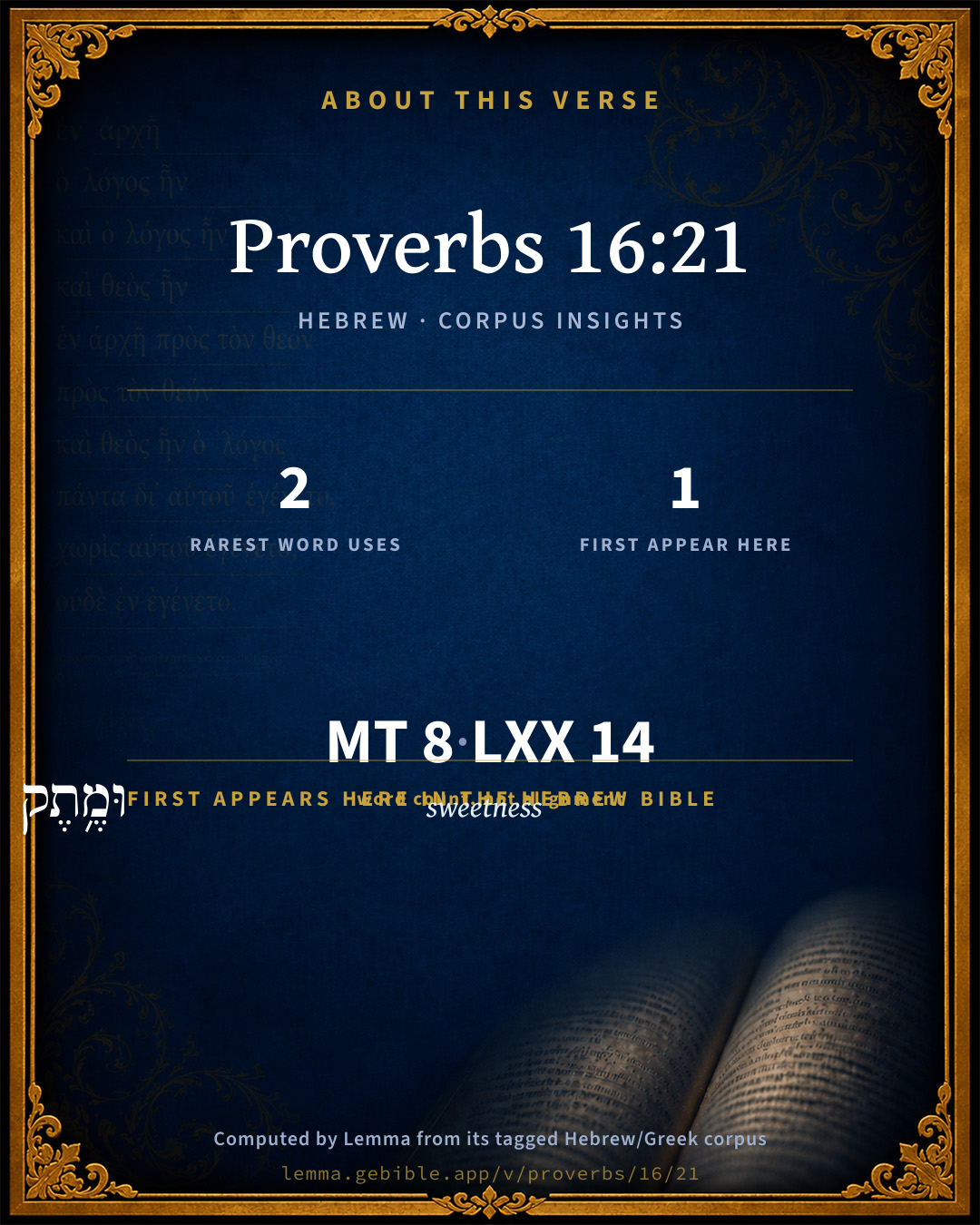
The rarest word here is וּמֶ֥תֶק sweetness H4986 — appearing just 2 times in the whole Hebrew Bible.

First appearance in Scripture

This word makes its first canonical appearance in the Hebrew Bible here:

  • וּמֶ֥תֶק sweetness H4986

Shared distinctive vocabulary

וּמֶ֥תֶק sweetness H4986 occurs in 2 verses of the Hebrew Bible. Also found in:

Grammatical profile

  • 3 verbs
  • 4 nouns
  • 1 adjective

Verb forms

  • יִקָּרֵ֣א Niphal · Imperfect
  • נָב֑וֹן Niphal · Participle Active
  • יֹסִ֥יף Hiphil · Imperfect

Hebrew & Septuagint length

In English translation the verse runs 14 words from the Hebrew and 17 from the Septuagint (LXX English) — closely comparable.

A rough comparison of the two English renderings, which tokenize alike — not a word-level alignment.

Word counts can differ between the Hebrew and the Greek without any difference in meaning — e.g. the Hebrew direct-object marker אֵת has no separate Greek word, and Greek often adds the article ὁ.

In the original languages it is 8 Hebrew tokens and 14 Greek tokens — but the two are counted differently (Hebrew bundles its prefixes and suffixes into one token; the Greek is in lemma form), so that isn’t a like-for-like length.

Cross-references

13

Topical passages linked to Proverbs 16:21 in the Treasury of Scripture Knowledge — connected by theme and wording, ordered by reader-vote popularity; previews shown in the World English Bible.

  • Proverbs 16:23–24 The heart of the wise instructs his mouth, And adds learning to his lips.
  • Proverbs 15:7 The lips of the wise spread knowledge; Not so with the heart of fools.
  • Isaiah 50:4 The Lord Yahweh has given me the tongue of those who are taught, that I may know how to sustain with words him who is weary: he wakens morning by morning, he wakens my ear to hear as those who are taught.
  • Proverbs 27:9 Perfume and incense bring joy to the heart; So does earnest counsel from a man's friend.
  • James 3:17 But the wisdom that is from above is first pure, then peaceful, gentle, reasonable, full of mercy and good fruits, without partiality, and without hypocrisy.
  • Luke 4:22 All testified about him, and wondered at the gracious words which proceeded out of his mouth, and they said, "Isn't this Joseph's son?"
  • John 7:46 The officers answered, "No man ever spoke like this man!"
  • 1 Kings 3:12 behold, I have done according to your word: behold, I have given you a wise and an understanding heart; so that there has been none like you before you, neither after you shall any arise like you.
  • Psalms 45:2 You are the most excellent of the sons of men. Grace has anointed your lips, Therefore God has blessed you forever.
  • Proverbs 10:8 The wise in heart accept commandments, But a chattering fool will fall.
  • Proverbs 23:15 My son, if your heart is wise, Then my heart will be glad, even mine:
  • Ecclesiastes 12:10 The Preacher sought to find out acceptable words, and that which was written blamelessly, words of truth.
  • Romans 16:19 For your obedience has become known to all. I rejoice therefore over you. But I desire to have you wise in that which is good, but innocent in that which is evil.

Cross-references courtesy of OpenBible.info (CC BY 4.0).

Hebrew and Greek witnesses Masoretic Hebrew ↔ Greek Septuagint

The same verse in the two great witnesses to the Old Testament, shown verse-for-verse.

These are two independent witnesses, not word-aligned to each other, and the Septuagint is shown in lemma (dictionary) form.

Hebrew Proverbs 16:21 Masoretic · Westminster Leningrad Codex

לַחֲכַם לֵ֭ב יִקָּרֵ֣א נָב֑וֹן וּמֶ֥תֶק שְׂ֝פָתַ֗יִם יֹסִ֥יף לֶֽקַח

The wise in heart shall be called prudent. Pleasantness of the lips promotes instruction.

World English Bible · Public Domain

Greek LXX Proverbs 16:21 Septuagint · lemma form

εἰμί ὁδός δοκέω εἰμί ὀρθός ἀνήρ ὁ μέντοι τελευταῖος αὐτός βλέπω εἰς πυθμήν ᾅδης

Men call the wise and understanding evil: but they that are pleasing in speech shall hear more.

LXX2012 (modern English Septuagint) · Public Domain

On this verse, The Pulpit Commentary discusses the Septuagint’s reading. Read the note in Commentary ↓

Hebrew: Westminster Leningrad Codex (CC BY 4.0). Greek: Septuagint (public domain); English from LXX2012 (modern English Septuagint) (Public Domain). How the Septuagint differs from the Hebrew →

Commentary

Notes on Proverbs 16:21 from classic Christian and Jewish commentators (each source and its license shown beneath its notes). The classic Christian expositions comment on the surrounding passage and are grouped to its opening verse, so a note may address several verses; the Jewish commentaries on the Tanakh (Rashi and others) are per-verse, so they appear only where the commentator wrote on this verse.

Lemma curates 59 commentaries, every one of them public domain or Creative Commons licensed, each selected and text-cleaned for this edition rather than reprinted as found. About our sources →

Trapp's Complete Commentary

John Trapp

Pro 16:21 The wise in heart shall be called prudent: and the sweetness of the lips increaseth learning.

Ver. 21. The wise in heart shall be called prudent.] He shall have the style and esteem of an intelligent, though not, haply, of an eloquent man. Of some it may be said, as Solinus {a} saith of his poly-histor to his friend Antius, Fermentum (ut ita dicam) cognitionis, ei magis in esse, quam bracteas eloquentiae deprehendas, - You may find more worth of wisdom in them than force of words. Bonaventure requireth to a perfect speech congruity, truth, and ornament. This latter some wise men want, and it is their ornament that they neglect ornament, as Cicero writes of Atticus, {b} and as Beza writes of Calvin, that he was facundiae contemptor et verborum parcus, sed minime ineptus scriptor - a plain but profitable author.

And the sweetness of the lips increaseth learning.] That is, eloquence with prudence edifieth, and is of singular use for the laying forth of a man’s talent to the good of others. As one being asked whether light was pleasant, replied, That is a blind man’s question; {c} so if any ask whether eloquence and a gracious utterance be useful in the Church of God, it is an insulse {d} and inficete {e} question. Zaneby, speaking of Calvin and Viret - who were preachers together at Geneva when he first came there out of Italy - uses these words: Sicut in Calvino insignem doctrinam, sic in Vireto singularein eloquentiam, et in commovendis affectibus efficacitatem admirabar; { f} i.e., As Calvin I admired for excellent learning, so did I Viret no less for his singular eloquence and efficacy in drawing affections. Beza also was of the same mind, as appears by that epigram of his:

“Gallica mirata est Calvinum ecclesia nuper,

Quo nemo docuit doctius:

Et miratur adhuc fundentem mella Viretum,

Quo nemo fatur dulcius.”

{a} Solin., Praefat.

{b} De libris Attici scriptum reliquit Cicero eos hoc ipso fuisse ornatos quod ornamenta negligerent.

{c} τυφλου ερωτημα.

{d} Lacking wit or sense; dull, insipid, stupid; senseless, absurd.

{e} Unfacetious; not witty

{f} Zanch., Miscel., Ep. Ded.

John Trapp, A Commentary or Exposition upon All the Books of the Old and New Testament (1647–1656) — public domain. Text from a community e-Sword module.

The Biblical Illustrator

Joseph S. Exell

Pro_16:21

The wise in heart shall be called prudent.

The wise in heart

I. These words are an assertion that true wisdom will show itself in a prudent conduct of life. His wisdom will gain him the reputation of a discreet, serious, and sensible man. Wisdom is the mother of intellectual and prudence of practical virtues. It may be said that wisdom may be separated from prudence, that knowing and doing are two things. There are many men in the world who have wise heads and foolish hearts--men of good capacities, clear understandings, well improved by reading and observation; but they have some odd humour, fond opinion, beloved lust, which hinders them from living according to their knowledge. Such wise men as these Solomon puts into the catalogue of his fools, because they have the means of doing well in their power, and make no use of them. The prudent man is careful to enter upon good ways, and walk uprightly in them. He chooses honest ends, and takes honest methods to attain them. A false and counterfeit wisdom is wholly made up of fallacies and cunning devices. The folly of fools is deceit. Their sense, learning, reasonings, and vivacity of wit serve but to heighten their folly, to sweeten their delusions, and confirm them in their errors. This is the case where wisdom rests only in the head: but when it descends to the heart, and warms the affections with the love of that which is good, it fails not to bless the world with a truly valuable and useful man. He that is truly wise differs from a conceited, talkative man in this, that he thankfully receives good advice, and avoids the dangers of which he is admonished.

II. A comparison between wisdom and eloquence. The powerful charms of eloquence add value to wisdom. Solomon in several places testifies his approbation of ornaments of speech. Wisdom and eloquence united together are very desirable talents in a legislator, governor, or teacher of religion. Moses and Jeremiah seem, however, to have lacked this gift of eloquence. Eloquence should be put under the direction of wisdom. There is no heresy or other error in religion but what has prevailed and gained acceptance by abused eloquence.

III. The words of the text intimate a rule of profitable teaching. In order to get wisdom, we must study to know ourselves, and see what faculties and talents God hath bestowed upon us, and by daily use and exercise improve them, and add both to their weight and number. Jesus Christ is called the Wisdom of God, as containing in Himself all the treasures of Divine wisdom. His hearers asked, Whence hath this man this wisdom? His prudence was far superior to the craft and contrivance of His enemies. He had also all external advantages of an eloquent speaker. They said, Never man spake like this man. The same gifts He promised to bestow on His apostles for the same end and purpose. He that seeks after wisdom by his prayers to God, and his reading and hearing of His holy Word, and honest, application of it in the ordering of his life, shall not seek in vain. Though his wisdom seem at first but as a grain of mustard-seed, by a diligent cultivation of it that wisdom will wonderfully increase and bring forth abundance of fruit. (W. Reading, M.A.)

Wise-hearted folk

The wise in heart are those who, under the influences of sound principles, know how to order their affairs with discretion. Men of the most splendid powers and attainments are not always the most remarkable for practical good sense. Better, therefore, in many respects, is the man whose wisdom regulates his temper and affections, his words and actions, aright. That is far more important for the production of personal and social happiness than the most brilliant genius without it. He shall be called prudent means his having a character for it: his being looked up to, respected, consulted, confided in, chosen as an adviser. Such a man is more valuable and useful than the man of mere learning, who has not discretion and common sense to guide the use of it. It is, at the same time, of great moment, that along with the possession of wisdom and prudence there be the sweetness of the lips, or honeyed lips, gentleness and persuasiveness of counsel, impressive eloquence of speech, which gives vast advantage in the application of wisdom for the benefit of others. It increaseth learning, effectually spreading it, rendering others wise as well as the possessor himself. If the wise in heart be understood of the truly, spiritually, divinely wise, then the phrase shall be called prudent must be interpreted, according to a common Hebrew idiom, as meaning is prudent, deserves to be so called. The sentiment will thus be the oft-repeated one, that true religion is the only genuine prudence. Godliness has the promise of the life that now is, as well as of that which is to come. (R. Wardlaw, D.D.)

The Biblical Illustrator, edited by Joseph S. Exell (c. 1880s–1900s) — public domain. Text from a community e-Sword module.

Geneva Bible (1599)

Geneva Bible translators

The sweet words of consolation, which come forth of a godly heart.

Geneva Bible (1599) marginal notes — public domain. Text via Bolls.life.

Matthew Henry's Commentary

Note, 1. Those that have solid wisdom will have the credit of it; it will gain them reputation, and they shall be called prudent grave men, and a deference will be paid to their judgment. Do that which is wise and good and thou shalt have the praise of the same. 2. Those that with their wisdom have a happy elocution, that deliver their sentiments easily and with a good grace, are communicative of their wisdom and have words at will, and good language as well as good sense, increase learning; they diffuse and propagate knowledge to others, and do good work with it, and by that means increase their own stock. They add doctrine, improve sciences, and do service to the commonwealth of learning. To him that has, and uses what he has, more shall be given.

Matthew Henry's Commentary on the Whole Bible (1708–1710) — public domain (CC PDM 1.0). Text via the HelloAO Bible API.

Jamieson, Fausset & Brown

Robert Jamieson, A. R. Fausset & David Brown

wise in heart--who rightly consider duty.

sweetness of the lips--eloquent discourse, persuades and instructs others.

Jamieson, Fausset & Brown — Commentary Critical and Explanatory on the Whole Bible (1871) — public domain (CC PDM 1.0). Text via the HelloAO Bible API.

Ellicott's Commentary for English Readers

(21) The sweetness of the lips increaseth learning.—Power to express the thoughts in graceful language adds greatly to the value of learning.

A Bible Commentary for English Readers, edited by Charles John Ellicott (1878–1897) — public domain. Text from a community e-Sword module.

The Cambridge Bible for Schools and Colleges

gen. ed. J. J. S. Perowne

21. “He who is wise will gain respect; but if he should also possess a pleasant manner of imparting his wisdom, he will be a more efficient teacher,” Rel. Tr. Soc. Commentary.

The Cambridge Bible for Schools and Colleges (gen. ed. J. J. S. Perowne; Cambridge University Press, 1878–1918) — public domain. Text from a community e-Sword module.

John Gill's Exposition

The wise in heart shall be called prudent,.... He that has true wisdom in the inward part; who knows his heart and the haughtiness of it; who has the fear of God in it, which is the beginning of wisdom; who is wise unto salvation, not only knows the scheme of it, but is experimentally acquainted with it; who has not head knowledge and wisdom only, but heart knowledge and wisdom, and behaves wisely in his life and conversation; who is so wise and endued with knowledge, as, out of a good conversation, to show his works with meekness of wisdom; such a man is called, reckoned, accounted, and spoken well of, as a prudent man among all wise and knowing persons;

and the sweetness of the lips increaseth learning; who, besides a wise heart and a knowing head, have the gift of elocution; can deliver themselves in a flowing easy style; can clothe their thoughts with proper words, and convey their ideas in clear expressions, in a very edifying and instructive manner: these communicate knowledge to others, and increase it in themselves: for, while they are improving others, they improve themselves and learning also, whether it be divine or human; these are such who are "apt to teach", Ti1 3:2; and if they have proper hearers to attend them, they will "increase in learning", as a just man does, Pro 9:9.

John Gill's Exposition of the Whole Bible (1746–1763) — public domain (CC PDM 1.0). Text via the HelloAO Bible API.

Albert Barnes' Notes on the Bible

The words point to the conditions of all true growth in wisdom; and he who has the gift of uttering it in winning speech increases it in himself and others.

Albert Barnes' Notes on the Bible (1834–1885) — public domain. Text from a community e-Sword/MySword module.

Haydock's Catholic Bible Commentary

Shall. Hebrew, "adds learning," both to himself and to others. Those who are wise and eloquent, must be preferred before those who have only the former qualification. (Calmet)

George Leo Haydock (1774–1849), Haydock's Catholic Family Bible and Commentary, 1859 edition — public domain. Excludes Psalms (Douay-Rheims chapter numbering differs from Protestant) and Deuterocanonical books (Catholic canon only).

Matthew Poole's English Annotations

The wise in heart shall be called prudent: the sense is either,

1. He who hath wisdom or sound knowledge in his heart, will show it by his prudence in ordering his actions. Or rather,

2. He who is truly wise, or prudent, or intelligent (all which words most commonly signify one and the same thing, both in this and in other books of Scripture) shall be so called or accounted by others.

The sweetness of the lips; eloquence added to wisdom; the faculty of expressing a man’s mind fitly, and freely, and acceptably.

Increaseth learning; both in himself, for whilst a man teacheth others he improveth himself; and especially in others, who by this means are induced to hear and receive his good instructions. Wisdom gets a man repute with others, but this faculty of right speaking makes a wise man more instrumental to do good to others.

Matthew Poole's English Annotations on the Holy Bible (1683–1685) — public domain. Text from a community e-Sword/MySword module.

Whedon's Commentary on the Bible

Daniel D. Whedon

21. Prudent — Or, intelligent.

Sweetness of the lips — Persuasive eloquence. If a wise man can add the charm of eloquence, his wisdom will be more instructive. “Sweetness of the lips makes a lesson better taken.” — Miller. Conant renders: “Learning adds sweetness to the lips.” Comp. Pro_15:2; Pro_16:23.

Daniel D. Whedon (gen. ed.), Commentary on the Old and New Testaments (1874–1909) — public domain. Text from a community e-Sword module.

The Pulpit Commentary

The wise in heart shall be called prudent. True wisdom is recognized and acknowledged as such, especially when it has the gift of expressing itself appropriately. (see on Pro_24:8) The sweetness (Pro_27:9) of the lips increaseth learning. People listen to instruction at the mouth of one who speaks well and winningly. Such a one augments knowledge in others, and in himself too, for he learns by teaching. Knowledge ought not to be buried in one"s own mind, but produced on fit occasions and in suitable words for the edification of others. Ecc 20:30, "Wisdom that is hid, and treasure that is hoarded up, what profit is in them both?". (see Mat_5:15) Septuagint, "The wise and prudent they call worthless (faulouv ); but they who are sweet in word shall hear more." Wise men are called bad and worthless by the vulgar herd, either because they do not impart all they know, or because they are envied fear their learning; but those who are eloquent and gracious in speech shall receive much instruction from what they bear, every one being ready to converse with them anal impart any knowledge which they possess.

The Pulpit Commentary (1880–1919), ed. H.D.M. Spence-Jones & Joseph S. Exell — public domain. Text from a community e-Sword module.

John Wesley's Explanatory Notes

The wise - He who is truly wise, shall be so accounted by others. Sweetness - Eloquence added to wisdom. Increaseth - Both in himself, for while a man teaches others, he improves himself; and others, who by this means are induced to hear and receive his instructions.

John Wesley, Explanatory Notes Upon the Whole Bible (1754–1765) — public domain. Text via the GEBible commentary corpus.

Keil & Delitzsch

C. F. Keil & F. Delitzsch

Four proverbs of wisdom with eloquence:

21 The wise in heart is called prudent,

And grace of the lips increaseth learning.

Elsewhere (Pro 1:5; Pro 9:9) הוסיף לקח means more than to gain learning, i.e., erudition in the ethico-practical sense, for sweetness of the lips (dulcedo orationis of Cicero) is, as to learning, without significance, but of so much the greater value for reaching; for grace of expression, and of exposition, particularly if it be not merely rhetorical, but, according to the saying pectus disertos facit, coming out of the heart, is full of mind, it imparts force to the instruction, and makes it acceptable. Whoever is wise of heart, i.e., of mind or spirit (לב = the N.T. νοῦς or πνεῦμα), is called, and is truly, נבון [learned, intelligent] (Fleischer compares to this the expression frequent in Isaiah, "to be named" = to be and appear to be, the Arab. du'ay lah); but there is a gift which highly increases the worth of this understanding or intelligence, for it makes it fruitful of good to others, and that is grace of the lips. On the lips (Pro 10:13) of the intelligent wisdom is found; but the form also, and the whole manner and way in which he gives expression to this wisdom, is pleasing, proceeding from a deep and tender feeling for the suitable and the beneficial, and thus he produces effects so much the more surely, and beneficently, and richly.

Keil & Delitzsch — Biblical Commentary on the Old Testament (1861–1891) — public domain (CC PDM 1.0). Text via the HelloAO Bible API. (Old Testament only.)

Bridges on Proverbs

Charles Bridges

The heart is the proper seat of wisdom.†1 There "it dwells with prudence."†2 Their combinedexercise is essential to the completeness of a Christian profession. Intellectual wisdom without a prudential application tends to no practical end. The pervading want of prudence gives needless offense to the gospel, and destroys influential weight of character. Often also do spiritual affections run to waste for want of prudent direction or discipline. Moral habits from this defect become either morbid or hardened. There is either a superstitious scrupulousness, or a reckless indifference; sometimes conscience about everything, sometimes about nothing. Prudent wisdom gives consistency to the whole system. The eye directs the foot, and we walk safely upon firm ground. ’Bright and sparkling parts are like diamonds, which may adorn the proprietor, but are not necessary for the good of the world. Whereas common sense’ (substantially identified with prudent wisdom) ’is like current coin. We have every day in the ordinary occurrences of life occasion for it. And if we would but call it into action, it would carry us much greater lengths than we seem to be aware of.’†3

These internal qualities gain increasing acceptance from external gifts. "When we are enriched with all utterance, as well as with all knowledge" (1Co 1:5 ); when we are enabled to clothe our thoughts in a flowing style and clear expression; this doubtless gives a great advantage in communicating knowledge. (Ecc 12:10-11 .) The sweetness of the lips increaseth learning. Ambrose’s mellifluous eloquence arrested and gradually brought conviction to Augustine’s mind.†4 Yet much more does this advantage belong to ’the sweet words of consolation, which come forth of a godly trust.’†5 Wisdom is in the heart, as in a treasury; and "out of the abundance of the heart the mouth speaketh."†6 When therefore "the heart is inditing a good matter, speaking of the things touching the King; the tongue," like the Apostle’s†7 — without any adventitious attractiveness, is "the pen of a ready writer."†8 And when without measure "grace was poured upon the lips"†9 of the King himself, what wonder that he should have constrained the admiration,†10 and fixed the attention,†11 of his hearers! How inestimable the privilege of his true disciples to sit at his feet, increasing learning from the sweetness of his lips!

Footnotes:

†1 Pro 2:10; Pro 10:8 .

†2 Pro 8:12. Hos 14:9 .

†3 Seed’s Sermons.

†4 Confess. Lib. v. c. 13, 14.

†5 Reformers’ Notes.

†6 Mat 12:34. Compare Pro 16:23 ; also Sir 40:21 .

†7 1Co 2:1-4 .

†8 Psa 45:1.

†9 Psa 45:2.

†10 Mat 7:28. Luk 4:22 . Joh 7:46 .

†11 Luk 19:48.

Charles Bridges, An Exposition of the Book of Proverbs (1846) — public domain. Text from a community e-Sword module.

Kretzmann's Popular Commentary

Paul E. Kretzmann

v. 21. The wise in heart shall be called prudent, regarded as possessing true discernment, and the sweetness of the lips increaseth learning, that is, where one makes use of grace, of a pleasant and attractive manner, in teaching, he will have easy access to ever-widening circles of hearers.

Paul E. Kretzmann, Popular Commentary of the Bible (1921–1924) — public domain. Text from a community e-Sword module.

unfoldingWord translationNotes

Door43 World Missions Community

The one who is wise in heart is called discerning

This person will have a reputation of being a discerning person. This can be stated in active form. AT: "People will call the one who is wise in heart discerning" or "The one who is wise in heart will have a reputation of being a discerning person" (See: Active or Passive)

The one who is wise in heart

Here the heart represents the mind and thoughts. AT: "The one who is wise" or "The one who is wise in his thinking" (See: Metonymy)

sweetness of speech

The writer speaks of kind or pleasant speech as if it were something that tastes sweet. AT: "kind speech" or "pleasant speech" (See: Metaphor)

Understanding is a fountain of life

The writer speaks of "Understanding" as if it were a fountain that continuously flows with water and which sustains the life of those who drink from it. AT: "Understanding is like a fountain flowing with life-giving water" (See: Metaphor)

translationWords

wise

heart

discern

fountain

life

fool

unfoldingWord translationNotes — © Distant Shores Media and the Door43 World Missions Community, licensed CC BY-SA 4.0. Source: git.door43.org/Door43/en_tn.

Rashi

Rabbi Shlomo Yitzchaki (Rashi)

The wise-hearted shall be called understanding He who learned wisdom from his teacher.

shall be called understanding. Ultimately, he will be understanding in matters and keen in his wisdom, and they will call him understanding.

and the sweetness of speech increases learning When a person explains his words to a pupil and makes his words sweet with reasons, he increases learning.

Rashi on the Tanakh — English translations: “The Judaica Press complete Tanach with Rashi, translated by A. J. Rosenberg” (CC BY 4.0); “Pentateuch with Rashi's commentary by M. Rosenbaum and A.M. Silbermann, 1929-1934” (public domain); “The Metsudah Tanach series, Lakewood, N.J” (CC BY 4.0); and “The Book of Joshua, Metsudah Publications, 1997” (CC BY 4.0). Text via Sefaria.

Lesson kit

Teaching starters — assembled from the data on this page, not authored interpretation. Every prompt links to the verse data it draws on. Edit before teaching.

Proverbs, in the Wisdom, opens this verse with 8 words (8 distinct Hebrew lemmas). Its most distinctive word is metheq (“sweetness”). A historical commentator’s framing appears above. Read the whole chapter for the surrounding context.

Discussion questions

  1. What does “sweetness” (metheq) contribute to the verse as a whole?
  2. This is the first place “sweetness” appears in Scripture (first appears here). What does its debut here establish?
  3. How does Proverbs 27:9, which shares the word «sweetness», read alongside this verse?
  4. The translations on this page render this verse differently — a whole-verse word diff, not a word-by-word alignment. What might account for the different wordings?
  5. «יִקָּרֵ֣א» is a Niphal Imperfect verb. How does that grammatical form shape the action described?
  6. Compare how Trapp's Complete Commentary and The Biblical Illustrator read this verse. Where do they agree or differ?

Things to notice

Reading settings

Reading text

Shown beneath each verse's original-language words.

Old Testament
Old Testament edition

Read the OT as the Masoretic Hebrew (MT) or the Greek Septuagint (LXX).

English shown for the Greek Septuagint (in the Hebrew ↔ Greek comparison).

Comparing translations? Open the Compare panel on any verse page to stack up to four side by side.