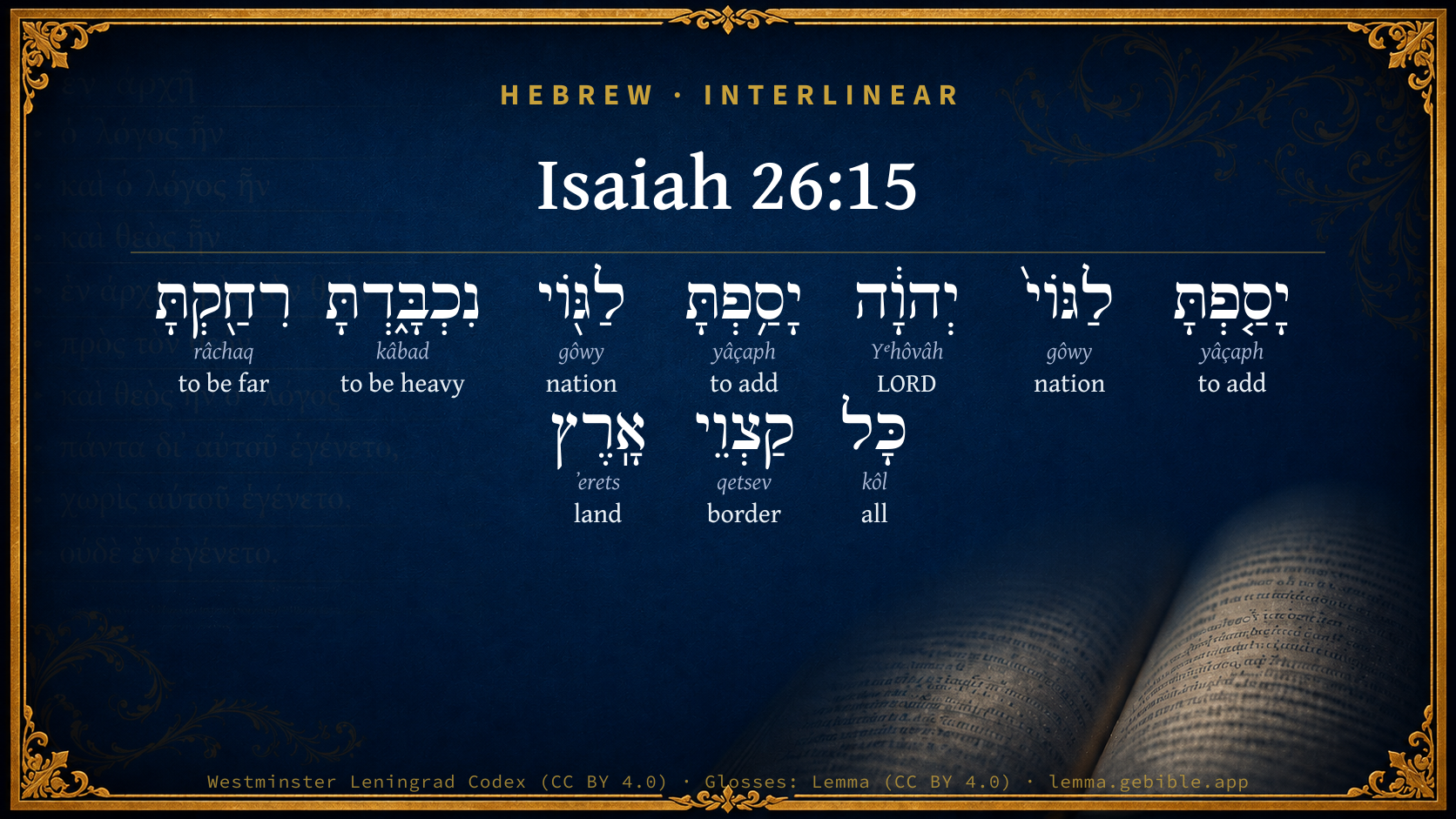
Isaiah 26:15

Hebrew (Westminster Leningrad Codex) Isaiah 26:15 appears in the Hebrew Old Testament. The text above is from the Westminster Leningrad Codex. Each word links to its Strong’s number, a concise gloss, and parsing drawn from the Open Scriptures Hebrew Bible morphology. Click any word for its full Brown-Driver-Briggs (BDB) entry.
Download image
Cite this verse

Isaiah 26:15 (World English Bible). Public Domain. Lemma interlinear Bible study tool, https://lemma.gebible.app/v/isaiah/26/15.

Show BibTeX & RIS
BibTeX
RIS
English Translation
You have increased the nation, O Yahweh, you have increased the nation; you are glorified; you have enlarged all the borders of the land.
World English Bible · Public Domain
Download a study sheet

One document with this verse’s original text, its word-by-word gloss line, the meaning frame, cross-references with their text, attributed commentary, and full source and license credits — printable, and it pastes into notes with its structure intact.

This verse Autodidact and up

Study sheet (.html) Plain text (.txt)

A passage Seminary Student

Up to 50 verses in one chapter. A passage sheet keeps up to 6 commentary sources and 12 cross-references per verse, in the order this page ranks them, and says so on the sheet whenever that leaves anything out. Ask for a single verse and you get the Autodidact verse sheet above.

Everything on this page stays free to read, with no account — the sheet is a download of what is already on screen, not access to it.

Want to remove ads? Support Godless Engineer
Compare translations 3

The same verse in 3 English versions, stacked beneath the original-language interlinear above. Click any original word for its lexicon entry.

Each is an independent rendering of the whole verse — the interlinear is not word-aligned to these translations.

Highlighted words mark where these versions differ — a whole-verse word diff, not a word-by-word alignment.

  • World English Bible Public Domain
    You have increased the nation, O Yahweh, you have increased the nation; you are glorified; you have enlarged all the borders of the land.
  • King James Version Public Domain
    Thou hast increased the nation, O LORD, thou hast increased the nation: thou art glorified: thou hadst removed it far unto all the ends of the earth.
  • unfoldingWord Literal Text CC BY-SA 4.0
    You have added to the nation, Yahweh, you have added to the nation. You are honored. You have broadened all of the borders of the land. q1

unfoldingWord Literal Text — © unfoldingWord, licensed CC BY-SA 4.0. Word-aligned USFM3 via Door43 (git.door43.org/unfoldingWord/en_ult).

Versions to compare (up to 4)

3 of 4 selected

Show all 18 translations

Every available English version of this verse, each an independent rendering of the whole verse.

  • World English Bible Public Domain
    You have increased the nation, O Yahweh, you have increased the nation; you are glorified; you have enlarged all the borders of the land.
  • Berean Standard Bible Public Domain
    You have enlarged the nation, O LORD; You have enlarged the nation. You have gained glory for Yourself; You have extended all the borders of the land.
  • Majority Standard Bible Public Domain
    You have enlarged the nation, O LORD; You have enlarged the nation. You have gained glory for Yourself; You have extended all the borders of the land.
  • King James Version Public Domain
    Thou hast increased the nation, O LORD, thou hast increased the nation: thou art glorified: thou hadst removed it far unto all the ends of the earth.
  • American Standard Version (1901) Public Domain
    Thou hast increased the nation, O Jehovah, thou hast increased the nation; thou art glorified; thou hast enlarged all the borders of the land.
  • Revised Version (1885) Public Domain
    Thou hast increased the nation, O LORD, thou hast increased the nation; thou art glorified: thou hast enlarged all the borders of the land.
  • Geneva Bible (1599) Public Domain
    Thou hast increased the nation, O Lord: thou hast increased the nation: thou art made glorious: thou hast enlarged all the coastes of the earth.
  • Douay-Rheims (1899) Public Domain
    Thou hast been favourable to the nation, O Lord, thou hast been favourable to the nation: art thou glorified? thou hast removed all the ends of the earth far off.
  • Young's Literal Translation Public Domain
    Thou hast added to the nation, O Jehovah, Thou hast added to the nation, Thou hast been honoured, Thou hast put far off all the ends of earth.
  • Literal Standard Version CC BY-SA 4.0
    You have added to the nation, O YHWH, || You have added to the nation, || You have been honored, || You have put all the ends of the earth far off.
  • Unlocked Literal Bible CC BY-SA 4.0
    You have increased the nation, Yahweh, you have increased the nation; you are honored; you have extended all the borders of the land.
  • unfoldingWord Literal Text CC BY-SA 4.0
    You have added to the nation, Yahweh, you have added to the nation. You are honored. You have broadened all of the borders of the land. q1
  • Darby Bible Public Domain
    Thou hast increased the nation, Jehovah, thou hast increased the nation: thou art glorified. Thou hadst removed [it] far [unto] all the ends of the earth.
  • World Messianic Bible Public Domain
    You have increased the nation, O LORD. You have increased the nation! You are glorified! You have enlarged all the borders of the land.
  • Webster's Bible Public Domain
    Thou hast increased the nation, O LORD, thou hast increased the nation; thou art glorified: thou hadst removed it far to all the ends of the earth.
  • Free Bible Version CC BY-SA 4.0
    You have made the nation grow, Lord, you have made the nation grow. You have expanded our borders of the land, and we honored you.
  • Bible in Basic English Public Domain
    You have made the nation great, O Lord, you have made it great; glory is yours: you have made wide the limits of the land.
  • JPS Tanakh (1917) Public Domain
    Thou hast gotten Thee honour with the nations, O LORD, yea, exceeding great honour with the nations; Thou art honoured unto the farthest ends of the earth.

Literal Standard Version (2020), Covenant Press — licensed CC BY-SA 4.0. Text via the HelloAO Bible API (eBible.org). Unlocked Literal Bible (unfoldingWord) — licensed CC BY-SA 4.0. Text via the HelloAO Bible API (eBible.org). unfoldingWord Literal Text — © unfoldingWord, licensed CC BY-SA 4.0. Word-aligned USFM3 via Door43 (git.door43.org/unfoldingWord/en_ult). Free Bible Version, Dr. Jonathan Gallagher — licensed CC BY-SA 4.0. Text via the HelloAO Bible API (eBible.org).

Word by word

More ways to search: Search by grammar → Find every occurrence → Compare this word →

Practice this passage: Drill this verse → Learn its vocabulary →

About this verse

These counts appear in no published source. They are computed here, from the morphology-tagged text and Lemma’s own curated glosses. What Lemma adds →

10
words
8
distinct lemmas
Prophets
section

Notable vocabulary

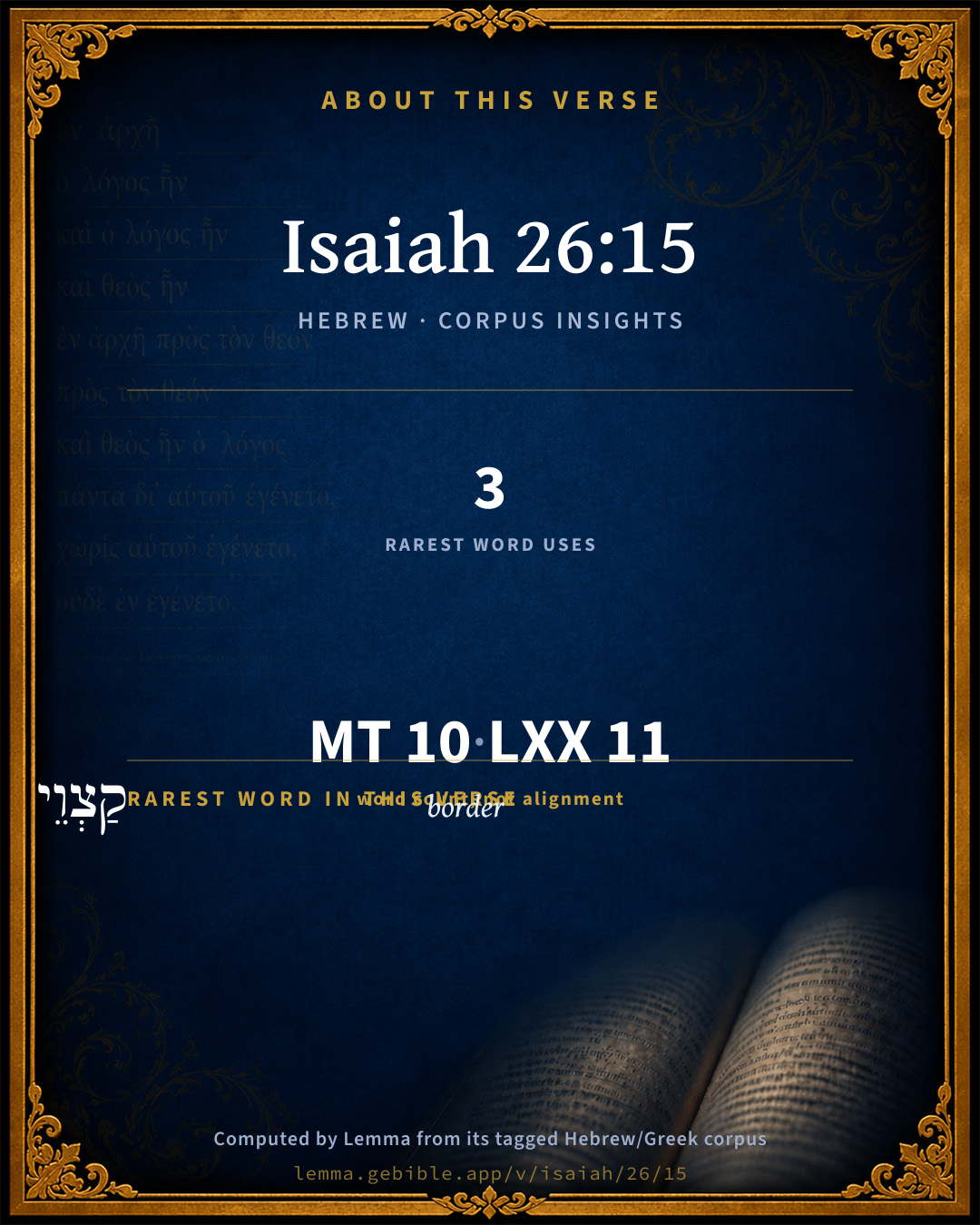
The rarest word here is קַצְוֵי border H7099 — appearing just 3 times in the whole Hebrew Bible.

Shared distinctive vocabulary

קַצְוֵי border H7099 occurs in 3 verses of the Hebrew Bible. Also found in:

Grammatical profile

  • 4 verbs
  • 6 nouns

Verb forms

  • יָסַ֤פְתָּ Qal · Perfect
  • יָסַ֥פְתָּ Qal · Perfect
  • נִכְבָּ֑דְתָּ Niphal · Perfect
  • רִחַ֖קְתָּ Piel · Perfect

Repetition

Words recur within this verse — often emphatic in Hebrew:

  • יָסַ֤פְתָּ to add H3254 ×2
  • לַגּוֹי֙ nation H1471 ×2

Hebrew & Septuagint length

In English translation the verse runs 24 words from the Hebrew and 10 from the Septuagint (LXX English) — the Septuagint runs noticeably shorter here. See the side-by-side →

A rough comparison of the two English renderings, which tokenize alike — not a word-level alignment.

Word counts can differ between the Hebrew and the Greek without any difference in meaning — e.g. the Hebrew direct-object marker אֵת has no separate Greek word, and Greek often adds the article ὁ.

In the original languages it is 10 Hebrew tokens and 11 Greek tokens — but the two are counted differently (Hebrew bundles its prefixes and suffixes into one token; the Greek is in lemma form), so that isn’t a like-for-like length.

Cross-references

31

Topical passages linked to Isaiah 26:15 in the Treasury of Scripture Knowledge — connected by theme and wording, ordered by reader-vote popularity; previews shown in the World English Bible.

  • Isaiah 9:3 You have multiplied the nation, you have increased their joy: they joy before you according to the joy in harvest, as men rejoice when they divide the spoil.
  • Genesis 12:2 I will make of you a great nation. I will bless you, and make your name great. You will be a blessing.
  • Genesis 13:16 I will make your offspring as the dust of the earth, so that if a man can number the dust of the earth, then your seed may also be numbered.
  • Numbers 23:10 Who can count the dust of Jacob, Or number the fourth part of Israel? Let me die the death of the righteous, Let my last end be like his!
  • Deuteronomy 10:22 Your fathers went down into Egypt with seventy persons; and now Yahweh your God has made you as the stars of the sky for multitude.
  • Nehemiah 9:23 Their children also multiplied you as the stars of the sky, and brought them into the land concerning which you did say to their fathers, that they should go in to possess it.
  • Isaiah 33:17 Your eyes shall see the king in his beauty: they shall see a land that reaches afar.
  • Isaiah 44:23 Sing, you heavens, for Yahweh has done it; shout, you lower parts of the earth; break forth into singing, you mountains, O forest, and every tree therein: for Yahweh has redeemed Jacob, and will glorify himself in Israel.
  • Isaiah 54:2–3 Enlarge the place of your tent, and let them stretch forth the curtains of your habitations; don't spare: lengthen your cords, and strengthen your stakes.
  • Isaiah 60:21 Your people also shall be all righteous; they shall inherit the land forever, the branch of my planting, the work of my hands, that I may be glorified.
  • Jeremiah 30:19 Out of them shall proceed thanksgiving and the voice of those who make merry: and I will multiply them, and they shall not be few; I will also glorify them, and they shall not be small.
  • Jeremiah 32:37 Behold, I will gather them out of all the countries, where I have driven them in my anger, and in my wrath, and in great indignation; and I will bring them again to this place, and I will cause them to dwell safely:
  • Ezekiel 5:12 A third part of you shall die with the pestilence, and with famine shall they be consumed in the midst of you; and a third part shall fall by the sword round about you; and a third part I will scatter to all the winds, and will draw out a sword after them.
  • Ezekiel 36:24 For I will take you from among the nations, and gather you out of all the countries, and will bring you into your own land.
  • John 12:23–28 Jesus answered them, "The time has come for the Son of Man to be glorified.
  • John 13:31–32 When he had gone out, Jesus said, "Now the Son of Man has been glorified, and God has been glorified in him.
  • John 15:8 "In this is my Father glorified, that you bear much fruit; and so you will be my disciples.
  • John 17:1 Jesus said these things, and lifting up his eyes to heaven, he said, "Father, the time has come. Glorify your Son, that your Son may also glorify you;
  • Revelation 11:15–18 The seventh angel sounded, and great voices in heaven followed, saying, "The kingdom of the world has become the Kingdom of our Lord, and of his Christ. He will reign forever and ever!"
  • Deuteronomy 28:64 Yahweh will scatter you among all peoples, from the one end of the earth even to the other end of the earth; and there you shall serve other gods, which you have not known, you nor your fathers, even wood and stone.
  • Deuteronomy 32:26–27 I said, I would scatter them afar, I would make the memory of them to cease from among men;
  • 1 Kings 8:46 If they sin against you (for there is no man who doesn't sin), and you are angry with them, and deliver them to the enemy, so that they carry them away captive to the land of the enemy, far off or near;
  • 2 Kings 17:6 In the ninth year of Hoshea the king of Assyria took Samaria, and carried Israel away to Assyria, and placed them in Halah, and on the Habor, the river of Gozan, and in the cities of the Medes.
  • 2 Kings 17:23 until Yahweh removed Israel out of his sight, as he spoke by all his servants the prophets. So Israel was carried away out of their own land to Assyria to this day.
  • 2 Kings 23:27 Yahweh said, I will remove Judah also out of my sight, as I have removed Israel, and I will cast off this city which I have chosen, even Jerusalem, and the house of which I said, My name shall be there.
  • Psalms 86:9–10 All nations you have made will come and worship before you, Lord. They shall glorify your name.
  • Isaiah 6:12 And Yahweh has removed men far away, And the forsaken places are many in the midst of the land.
  • Isaiah 10:22 For though your people, Israel, be as the sand of the sea, [only] a remnant of them shall return: a destruction [is] determined, overflowing with righteousness.
  • Luke 21:24 They will fall by the edge of the sword, and will be led captive into all the nations. Jerusalem will be trampled down by the Gentiles, until the times of the Gentiles are fulfilled.
  • Deuteronomy 4:27–28 Yahweh will scatter you among the peoples, and you shall be left few in number among the nations, where Yahweh shall lead you away.
  • Deuteronomy 28:25 Yahweh will cause you to be struck before your enemies; you shall go out one way against them, and shall flee seven ways before them: and you shall be tossed back and forth among all the kingdoms of the earth.

Cross-references courtesy of OpenBible.info (CC BY 4.0).

Hebrew and Greek witnesses Masoretic Hebrew ↔ Greek Septuagint

The same verse in the two great witnesses to the Old Testament, shown verse-for-verse.

Here the Septuagint runs noticeably shorter than the Hebrew — LXX2012 (modern English Septuagint) 10 words vs World English Bible 24. A rough length comparison of the two English translations, not a word-level alignment — read both below.

These are two independent witnesses, not word-aligned to each other, and the Septuagint is shown in lemma (dictionary) form.

Hebrew Isaiah 26:15 Masoretic · Westminster Leningrad Codex

יָסַ֤פְתָּ לַגּוֹי֙ יְהוָ֔ה יָסַ֥פְתָּ לַגּ֖וֹי נִכְבָּ֑דְתָּ רִחַ֖קְתָּ כָּל קַצְוֵי אָֽרֶץ

You have increased the nation, O Yahweh, you have increased the nation; you are glorified; you have enlarged all the borders of the land.

World English Bible · Public Domain

Greek LXX Isaiah 26:15 Septuagint · lemma form

προςτίθημι αὐτός κακός κύριος προςτίθημι κακός πᾶς ὁ ἔνδοξος ὁ γῆ

bring more evils on the glorious ones of the earth.

LXX2012 (modern English Septuagint) · Public Domain

On this verse, Ellicott's Commentary for English Readers discusses the Septuagint’s reading. Read the note in Commentary ↓

Hebrew: Westminster Leningrad Codex (CC BY 4.0). Greek: Septuagint (public domain); English from LXX2012 (modern English Septuagint) (Public Domain). How the Septuagint differs from the Hebrew →

Targum (Aramaic paraphrase)

1

The Targum is the ancient Jewish Aramaic paraphrase of the Hebrew Scriptures — an interpretive translation, not the Hebrew text itself. Onkelos (literal) and Pseudo-Jonathan (expansive) render the Torah, and Jonathan the Prophets. Coverage is partial: where no permissively-licensed English translation exists for a verse, only the Aramaic is shown. This is verse-level text, not a word-by-word alignment to the Hebrew.

  1. Targum Jonathan Prophets (Joshua–Malachi)
    אִתְגְלֵיתָא לְכַנָשָׁא מְבַדְרֵי עַמָךְ יְיָ אַף עָתִיד אַתְּ לְקָרָבָא גָלוּתְהוֹן לְאִתְגְלָאָה בִגְבוּרְתֵּךְ לְרַחָקָא כָּל רַשִׁיעַיָא לִגְהִנָם:

    Thou shalt reveal thyself to gather the dispersed of thy people, thou wilt bring together their captivity. Thou wilt reveal thyself in thy power to cast all the wicked into hell.

    Targum Jonathan — Aramaic: “Mikraot Gedolot” (public domain). English: “Sefaria Community Translation” (CC0 1.0 (public-domain dedication)); “London "Chaldee Paraphrase," 1871” (public domain). Text via Sefaria.

Commentary

Notes on Isaiah 26:15 from classic Christian and Jewish commentators (each source and its license shown beneath its notes). The classic Christian expositions comment on the surrounding passage and are grouped to its opening verse, so a note may address several verses; the Jewish commentaries on the Tanakh (Rashi and others) are per-verse, so they appear only where the commentator wrote on this verse.

Lemma curates 59 commentaries, every one of them public domain or Creative Commons licensed, each selected and text-cleaned for this edition rather than reprinted as found. About our sources →

Trapp's Complete Commentary

John Trapp

Isa 26:15 Thou hast increased the nation, O LORD, thou hast increased the nation: thou art glorified: thou hadst removed [it] far [unto] all the ends of the earth.

Ver. 15. Thou hast increased the nation,.] That righteous nation which keepeth the truth. {Isa 26:2} Some render and sense the words thus: "Thou hast indeed increased the nation," sc., of the Jews; thou hadst done it (oh sweet mercy, I am the better to speak of it, and therefore I speak it twice), but thou wast "heavy laden," sc., with their sins: therefore thou hast removed it far unto all the ends of the earth. Who knoweth not what a dispersed and despised people the Jews are in all places, banished as it were out of the world by a common consent of nations. "Be not therefore high minded, but fear." {Rom 11:20}

John Trapp, A Commentary or Exposition upon All the Books of the Old and New Testament (1647–1656) — public domain. Text from a community e-Sword module.

The Biblical Illustrator

Joseph S. Exell

Isa_26:15

Thou hast increased the nation, O Lord

The increase of the true Israel

On the first preaching of the Gospel, the Lord greatly increased the nation of them that are Israelites indeed.

In following ages the Lord still continued to increase them; hence the remarkable words of an ancient apologist for Christianity (Tertullian), who openly told the heathen that this despised sect had filled their cities and provinces, their councils and camps, the palace and the senate house, and what not,--that such was their multitude that should they have withdrawn themselves into some remote part of the world, the empire would have been depopulated and left in dismal solitude and silence. (R. Macculloch.)

The Biblical Illustrator, edited by Joseph S. Exell (c. 1880s–1900s) — public domain. Text from a community e-Sword module.

Joseph Benson's Commentary

Isa 26:15. Thou hast increased the nation — Namely, the Jewish nation, which multiplied exceedingly in Egypt, and afterward in Canaan, so that they filled the land. But the prophet perhaps foretels their increase after their return from captivity in Babylon; and, as some think, that increase of the church (called the righteous nation, Isa 26:2) which was to take place in gospel days. Thou art glorified — In faithfully fulfilling thy promises made to Abraham concerning the multiplication of his seed, and making him the father of many nations. Thou hast removed it far unto all the ends of the earth — Thou hast scattered thy people over all the world, so that they are found in every nation under heaven, where they are witnesses for thee, the only living and true God, against idolaters of all descriptions. This was the case before, and at the time of the coming of the Messiah, and of the opening of the gospel dispensation, Act 2:5. And in a little time, the Gentiles being called into the church of God, the Christians were spread over all parts of the Roman empire, and far beyond its utmost limits, and they were much more faithful witnesses or the truth than the Jews had ever been. But, as the Hebrew of the first clause of this verse, יספת לגוי, when literally rendered, is only, thou hast added to the nation; some think the prophet does not speak of adding to their number, or increasing them, but rather of adding to their plagues or chastisements. This, it must be acknowledged, would agree well with what follows. Then the interpretation of the next clauses would be, Thy justice is glorified in their punishment, and thou hast removed them out of their own land, and suffered them to be carried captive to the ends of the earth. This, as the reader will easily observe, would accord perfectly with what follows to the end of the chapter.

Joseph Benson's Commentary on the Old and New Testaments (1811–1818) — public domain. Text from a community e-Sword module.

Tyndale Open Study Notes

Tyndale Open Resources

26:15 This verse is a confident expression of thanks for God’s blessings. In Isaiah’s time, during King Hezekiah’s prosperous reign, the borders of the nation of Israel were extended, and people gave glory to God for his great deeds.

Tyndale Open Study Notes — © Tyndale Open Resources, licensed CC BY-SA 4.0. Text via the HelloAO Bible API.

Geneva Bible (1599)

Geneva Bible translators

To wit, the company of the faithful by the calling of the Gentiles.

Geneva Bible (1599) marginal notes — public domain. Text via Bolls.life.

Jamieson, Fausset & Brown

Robert Jamieson, A. R. Fausset & David Brown

hast--prophetical preterite (Isa 9:3).

hast removed . . . far . . . ends of . . . earth--rather, "Thou hast extended far all the borders of the land" [VITRINGA].

Jamieson, Fausset & Brown — Commentary Critical and Explanatory on the Whole Bible (1871) — public domain (CC PDM 1.0). Text via the HelloAO Bible API.

Ellicott's Commentary for English Readers

(15) Thou hast increased the nation . . .—The nation is, if we follow this rendering, Israel, whose prosperity the prophet contrasts with the downfall of its oppressors (comp. Isa_9:3). The LXX., however, gives, “Add thou evils to all the glorious ones,” as if referring to the “chastening” of exile in the next verse, and the use of the word “nation” (i.e., heathen) instead of “people,” is, perhaps, in favour of this rendering. “Nation,” however, is used for Israel in Isa_9:3, which is partly parallel to this passage.

Thou hadst removed it far unto all the ends of the earths—Better, Thou hast moved far off the borders of the land. The English Version seems to speak of the exile and dispersion of the people. “What is really meant is, probably, that Jehovah will restore it to its old remoter boundaries, as in the days of David and Solomon. This belongs, of course, to the ideal, and not the historical, restoration.

A Bible Commentary for English Readers, edited by Charles John Ellicott (1878–1897) — public domain. Text from a community e-Sword module.

The Cambridge Bible for Schools and Colleges

gen. ed. J. J. S. Perowne

15. Thou hast increased the nation] Probably an allusion to ch. Isa_9:3. There is no justification for taking the perfects here as prophetic perfects, or for understanding them in a precative sense. A real increase of the nation and its territory is regarded as already effected; this is one of the successes which Jehovah has wrought for His people.

thou art glorified] thou hast glorified thyself,—by thus exalting Israel.

thou hadst removed … earth] Render with R.V., thou hast enlarged all the borders of the land.

The Cambridge Bible for Schools and Colleges (gen. ed. J. J. S. Perowne; Cambridge University Press, 1878–1918) — public domain. Text from a community e-Sword module.

John Gill's Exposition

Thou hast increased the nation, O Lord, thou hast increased the nation,.... The righteous nation, Isa 26:2 the church of God, by the numerous conversions of Jews and Gentiles; when the nation of the Jews shall be born at once, and the fulness and forces of the Gentiles are brought in; when the kingdoms of this world will become the kingdoms of our Lord, and of his Christ: this increase is repeated, to denote the certainty of it, and because a matter of great moment and importance:

thou art glorified; as by the destruction of the antichristian powers, so by the enlargement of the church and kingdom of Christ; for now will the voices be heard in heaven, giving praise and glory to God: even those that are frightened with his judgments, as well as those that are affected with his goodness, will give glory to the God of heaven, Rev 11:13,

thou hadst removed it far unto all the ends of the earth: not the Jewish people now scattered throughout the world, but the righteous nation increased and enlarged, which now will be spread to the ends of the world; for Christ's kingdom will be from sea to sea, and from the river to the ends of the earth, Psa 72:8 it may be rendered, "thou hast removed afar off all the ends of the earth": so De Dieu, who interprets it of the great men of the earth, the excellent in it, the cornerstones of it; but perhaps it may be better to understand hereby every island and mountain fleeing away at the destruction of antichrist, and the enlargement of Christ's kingdom, Rev 16:20.

John Gill's Exposition of the Whole Bible (1746–1763) — public domain (CC PDM 1.0). Text via the HelloAO Bible API.

Albert Barnes' Notes on the Bible

Thou hast increased the nation - That is, the Jewish nation (see the note at Isa 9:3). The nation was not only enlarged by its regular increase of population, but many converts attended them on their return from Babylon, and probably many came in from surrounding nations on the rebuilding of their capital.

Thou hadst removed it far ... - Or rather, thou hast extended far all the borders of the land. The word rendered ‘removed’ (רחק râchaq) means usually to put far away, and here it may mean to put far away the borders or boundaries of the nation; that is, to extend them far. The word ‘unto’ is not in the original; and the phrase rendered ‘ends of the earth,’ may mean the borders. or boundaries of the land. The parallelism requires this construction, and it is indeed the obvious one, and has been adopted by Lowth and Noyes.

Albert Barnes' Notes on the Bible (1834–1885) — public domain. Text from a community e-Sword/MySword module.

Haydock's Catholic Bible Commentary

Nation of the Jews. (Calmet) --- Septuagint, "add evils to them, O Lord; add evils to the nobles of the land." (Haydock) --- Hebrew may have the same sense. --- Ends: princes, or the Chaldeans, sending them also into captivity; or thou hast propagated thy Church over the world.

George Leo Haydock (1774–1849), Haydock's Catholic Family Bible and Commentary, 1859 edition — public domain. Excludes Psalms (Douay-Rheims chapter numbering differs from Protestant) and Deuterocanonical books (Catholic canon only).

Matthew Poole's English Annotations

Thou hast increased the nation, Heb. Thou hast added to the nation; which may be understood either,

1. In way of mercy, of adding to their numbers, as our translation takes it; and so we have in effect the same phrase 2Sa 24:3, The Lord add to the people, &c., and Psa 115:14, in the Hebrew text, The Lord shall add upon or to you. Or,

2. In way of judgment, of adding to their plagues or miseries, of which we read Rev 22:18, in which sense the phrase is found in the Hebrew text, Psa 120:3, What shall be added to thee? and in that usual form of imprecation, The Lord do so to me, and more, Rth 1:17; 1Sa 3:17, &c., where it is in the Hebrew, The Lord do so to me, and add. And this sense seems to be favoured by the context, as also by the ancient Greek translators, who render the words, add to them evil or punishments. And so the word adding may be used emphatically and sarcastically. God indeed will add to them; but what? Not numbers, and power, and glory, as they expected, but plagues and judgments one after another. This

nation is supposed by the current of interpreters to be the people of Israel, emphatically called the nation. Possibly it may be the Assyrians, of whom he spoke in the last verse. But this I propose with submission.

Thou art glorified; thy justice is glorified in their punishment or destruction. Thou hadst removed it far unto all the ends of the earth; which may be understood either,

1. Of Israel, and that either in a way of mercy, Thou hast by destroying the Assyrians enlarged thy people, who were shut up in Jerusalem, so that now they may go to the remotest parts of the land; or in way of judgment, Thou hast removed thy people out of their own land, and suffered them to be carried captive to the ends of the earth. Or,

2. Of the Assyrians; Thou hast removed them from Jerusalem, which they had besieged, and caused them to flee into their own country, which in Scripture phrase was in the ends of the earth; of which see Isa 5:26; 13:5.

Matthew Poole's English Annotations on the Holy Bible (1683–1685) — public domain. Text from a community e-Sword/MySword module.

Whedon's Commentary on the Bible

Daniel D. Whedon

15. Increased the nation — The nation of reclaimed and purified Jews. Their enlargement was by successive colonies from the East for a hundred years after the first return from Babylon. Also, as the next clause asserts, (thou hadst removed it far unto all the ends of the earth,) by growth from proselytes made outside of Judea; though the law of parallelism requires “the ends of the earth” to mean the farthest limits of the literal land of Israel. So Lowth and Noyes. But this is too mechanical for poetry. Frequently the prophet contemplates the new Israel as extending to the converted of all nations of the earth.

Daniel D. Whedon (gen. ed.), Commentary on the Old and New Testaments (1874–1909) — public domain. Text from a community e-Sword module.

The Pulpit Commentary

Thou hast increased the nation; i.e. the "righteous nation" of ver. 2 not the Jewish people merely, but "the Israel of God who are to be "a great multitude, that no man can number, of all nations, and kindreds, and people, and tongues". (Rev_7:9) Thou hadst removed it. This rendering gives a very good sense. It makes the redeemed pass in thought from their present state of happiness and glory to that former time of tribulation and affliction when they were a remnant, scattered over the face of the earth, (Isa_24:13-15) driven into its uttermost corners, (Isa_24:16) oppressed and down-trodden by their enemies. But it is doubtful whether the Hebrew will bear the rendering. Most modern commentators translate, Thou hast extended far all the borders of the land," which is certainly the more natural meaning of the words. If we accept this view, we must regard the clause as continuing the idea contained in the former part of the verse the nation is increased in number, and its borders are advanced it is "a multitude that no man can number," and it has no narrower limits than the new earth," which has been given to it for its habitation. (Rev_21:1)

Vers. 15-21. The resurrection of Israel.

The population of Judah has been increased, and its borders extended. (For this cause of rejoicing cf. Isa_9:2 Isa_49:19, 20 54:1, etc.; Mic_2:1, 2 4:7 Oba_1:19, Oba_1:20) Probably he is thinking of the population and strength of the land in the days of David and Solomon, as typical of what is again to be in the happier times. But actually a period of gloom and suffering must precede the glorious restoration.

I THE PERIOD OF TROUBLE AND EXPECTATION. It is a pathetic picture of the soul in its attitude of anxious suspense. Jehovah was missed and longed for as the light which seems to tarry in the dark days of winter. Prayer was poured forth; and there was a period of acute suffering like that of the mother preceding the birth of a child. Hope was deceived and disappointed again and again. (cf. Isa_13:18 Isa_21:3) Still the land was not blessed, still the population was not restored. The prophet is thinking of the days after the return from exile.

II THE RESURRECTION Or THE PEOPLE. "Thy dead shall live." "Sublimely recovering himself, the prophet cries that God"s saints, though they are dead, shall live," and shall share the duties and privileges of regenerate Israel. The prophet sees, as it were, his countrymen returning from the under-world. So speaks Hosea: "After two days wilt he revive us: on the third day he will raise us up, and we shall live in his sight"; (Hos_6:2) left the vision of Ezekiel the valley of the dry bones. (Eze_37:1-10) With lively faith anticipating the event, he calls upon the new population to awake and cry. It is as if a dew had fallen on the barren land. This "dew of lights" is thought of as something supernatural, existing before the sun. In Psa_110:3 the ordinary dew is born out of the morning shower. "The dew from the glory of God falls like a heavenly seed into the bosom of the earth; and in consequence of this, the earth gives out from itself the shades which have hitherto been held fast beneath the ground, so that they appear alive again on the face of the earth" (Delitzsch). There is thus a connection between light and life, so often found in conjunction in religious thought. (Psa_36:9 Job_3:16-20 Joh_1:4) For as the return of the morning light is coincident with the refreshment of the strength, and the awakening to new effort, so in all spiritual parables of the revival of the nation or the individual, light brings life. The renaissance of knowledge precedes or coincides with the reformation of manners, the stir of new activities, the beginning of a new era. And this connection should never be forgotten, "And God said, Let there be light." Even so; and the darkness of superstition, of prejudice, of obscurantism, must be symptomatic of moral death. As the light arouses the sleeper, so the sleeper must bestir himself to greet it and rejoice in it. "Awake, thou that sleepest, and arise from the dead, and Christ shall give thee light.

III RETURN TO SELF-COMMUNION. From this enrapturing vision the prophet returns to the present, with all its sobering and in part depressing circumstances. "He has gained on behalf of his people the comforting certitude that a great exhibition of the Divine justice is on the point of taking place; and his counsel is to withdraw from the doomed into the privacy of communion with God" (Cheyne). While the storm of Divine judgment is sweeping by, let the people of God betake themselves to solitude and prayer. (cf. Psa_27:5 Psa_31:21 Mat_6:6) The opening of the door of the prayer-chamber is in times of distress the opening of the door into another world than this a scene of serenity and elevation. In the presence of our Father who seeth in secret, the problems of the hour are solved, or cease unduly to harass the mind. That which threatened to crush us is surmounted by the new energy of the spirit here imparted. "Prayer ardent opens heaven, lets down a stream Of glory on the consecrated hour Of man in audience with the Deity; Who worships the great God, that instant joins The first in heaven, and sets his foot on hell.

And it is but for "a little moment" that the wrath will last. (cf. Isa_10:24, 25 54:7, 8 Psa_30:6) "Just as Noah, behind whom Jehovah shut the door of the ark, was hidden in the ark while the floods of judgment poured down without, so should the Church be shut off from the world without in its life of prayer, because a judgment of Jehovah was at hand" (Delitzsch).

IV THE COMING FORTH OF JEHOVAH. (Cf. Mic_1:3) Where is the "place" of Jehovah? It is the supernatural sphere; and every great manifestation of judgment mingled with mercy is a "coming forth of Jehovah." Here it is expressly for judgment to punish men who have incurred blood-guilt, which is, in other words, sin. Yet in the heart of judgment still his pity and consolation live, and we" should keep it constantly before our eyes, when the wicked slay, mock, and ridicule us, and inflict upon us every kind of outrage and cruelty, God will at length make known that the cry of innocent blood has not been uttered in vain; for he never can forget his own people". J. (Luk_18:7)

The Pulpit Commentary (1880–1919), ed. H.D.M. Spence-Jones & Joseph S. Exell — public domain. Text from a community e-Sword module.

John Wesley's Explanatory Notes

The nation - This nation seems to be the people of Israel. Removed - Thou hast removed thy people out of their own land, and suffered them to be carried captive to the ends of the earth.

John Wesley, Explanatory Notes Upon the Whole Bible (1754–1765) — public domain. Text via the GEBible commentary corpus.

Keil & Delitzsch

C. F. Keil & F. Delitzsch

Israel, when it has such cause as this for praising Jehovah, will have become a numerous people once more. "Thou hast added to the nation, O Jehovah, hast added to the nation; glorified Thyself; moved out all the borders of the land." The verb יסף, which is construed in other cases with על, אל ,, here with ל, carried its object within itself: to add, i.e., to give an increase. The allusion is to the same thing as that which caused the prophet to rejoice in Isa 9:2 (compare Isa 49:19-20; Isa 54:1., Mic 2:12; Mic 4:7; Oba 1:19-20, and many other passages; and for richaktâ, more especially Mic 7:11). Just as Isa 26:13 recals the bondage in Egypt, and Isa 26:14 the destruction of Pharaoh in the Red Sea, so Isa 26:16 recals the numerical strength of the nation, and the extent of the country in the time of David and Solomon. At the same time, we cannot say that the prophet intended to recall these to mind. The antitypical relation, in which the last times stand to these events and circumstances of the past, is a fact in sacred history, though not particularly referred to here.

Keil & Delitzsch — Biblical Commentary on the Old Testament (1861–1891) — public domain (CC PDM 1.0). Text via the HelloAO Bible API. (Old Testament only.)

J. A. Alexander on Isaiah

Joseph Addison Alexander

“Thou hast added to the nation, oh Jehovah, Thou hast added to the nation; Thou hast glorified Thyself; Thou hast put far of all the ends of the land.” By this deliverance of Thy people from the service both of idols and idolaters, Thou hast added a great number to the remnant who were left in the Holy Land, so that larger territories will be needed for their occupation; and in doing all this, Thou hast made an exhibition of Thy power, justice, truth, and goodness. Thus understood, the whole verse is a grateful acknowledgement of what God had done for his suffering people. The enlargement of the boundaries may either be explained as a poetical description of the actual increase and expected growth of the nation, (Isa 49:19), or literally understood as referring to the fact, that after the return from exile the Jews were no longer restricted to their own proper territory, but extended themselves more or less over the whole country. The translation of the verb as a reflexive, rather than a simple passive, greatly adds to the strength of the expression.

Joseph Addison Alexander, The Prophecies of Isaiah (1846–1847; New York: Scribner, 1870–1878) — public domain. Text from a community e-Sword module.

unfoldingWord translationNotes

Door43 World Missions Community

You have increased the nation, Yahweh, you have increased the nation

This clause is repeated for emphasis. Here "nation" represents the people. AT: "You have greatly increased the number of people in our nation" (See: Parallelism and Metonymy)

translationWords

nation

Yahweh

honor

unfoldingWord translationNotes — © Distant Shores Media and the Door43 World Missions Community, licensed CC BY-SA 4.0. Source: git.door43.org/Door43/en_tn.

Rashi

Rabbi Shlomo Yitzchaki (Rashi)

You have added to the nation to Israel (Tan. Pinchas 16) You added to them Torah and greatness and honor, and the more that You added to them, the more You were honored, for they thank You and praise You for all the bounty, unlike the custom of the heathens (var. of Esau). Therefore, You rejected from before You all other ends of the earth, i.e., all distant nations. Behold, in their bounty, in this manner the Israelites bestow praise and honor upon You, and in their straits.

Rashi on the Tanakh — English translations: “The Judaica Press complete Tanach with Rashi, translated by A. J. Rosenberg” (CC BY 4.0); “Pentateuch with Rashi's commentary by M. Rosenbaum and A.M. Silbermann, 1929-1934” (public domain); “The Metsudah Tanach series, Lakewood, N.J” (CC BY 4.0); and “The Book of Joshua, Metsudah Publications, 1997” (CC BY 4.0). Text via Sefaria.

Ibn Ezra

Rabbi Abraham ibn Ezra

יספת Thou hast continued. Thou hast removed it far unto all the ends of the earth. The more Thou hast chastised Thy people, the more they acknowledged Thy glory, even when exiled from their country.

Ibn Ezra on the Tanakh — English translations: “Sefaria Community Translation” (CC0 1.0 (public-domain dedication)); “Yalkut, Sifsei Chachomim Chumash, Metsudah Publications, 2009” (CC BY 4.0); and “Commentary of Ibn Ezra on Isaiah - trans. by M. Friedlander, 1873” (public domain). Text via Sefaria.

Lesson kit

Teaching starters — assembled from the data on this page, not authored interpretation. Every prompt links to the verse data it draws on. Edit before teaching.

Isaiah, in the Prophets, opens this verse with 10 words (8 distinct Hebrew lemmas). Its most distinctive word is qetsev (“border”). The Greek Septuagint runs shorter here. A historical commentator’s framing appears above. Read the whole chapter for the surrounding context.

Discussion questions

  1. What does “border” (qetsev) contribute to the verse as a whole?
  2. How does Psalms 48:10, which shares the word «border», read alongside this verse?
  3. What does the repetition of “to add” (2× in this one verse) do in this verse?
  4. The Septuagint runs shorter here than the Hebrew. What might account for the difference?
  5. The translations on this page render this verse differently — a whole-verse word diff, not a word-by-word alignment. What might account for the different wordings?
  6. «יָסַ֤פְתָּ» is a Qal Perfect verb. How does that grammatical form shape the action described?
  7. Compare how Trapp's Complete Commentary and The Biblical Illustrator read this verse. Where do they agree or differ?

Things to notice

Reading settings

Reading text

Shown beneath each verse's original-language words.

Old Testament
Old Testament edition

Read the OT as the Masoretic Hebrew (MT) or the Greek Septuagint (LXX).

English shown for the Greek Septuagint (in the Hebrew ↔ Greek comparison).

Comparing translations? Open the Compare panel on any verse page to stack up to four side by side.