
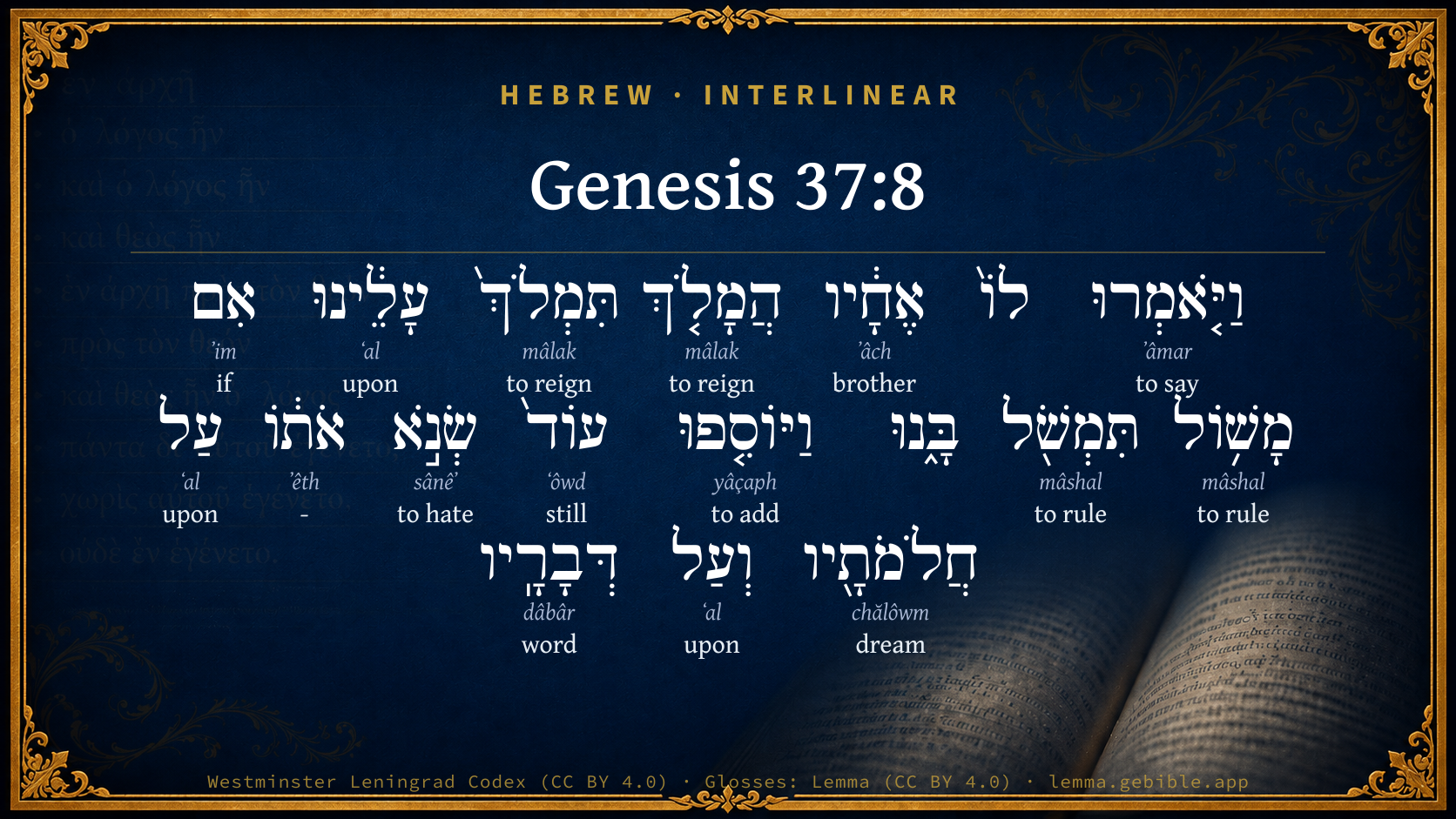
Genesis 37:8

Hebrew (Westminster Leningrad Codex) Genesis 37:8 appears in the Hebrew Old Testament. The text above is from the Westminster Leningrad Codex. Each word links to its Strong’s number, a concise gloss, and parsing drawn from the Open Scriptures Hebrew Bible morphology. Click any word for its full Brown-Driver-Briggs (BDB) entry.
Download image
Cite this verse

Genesis 37:8 (World English Bible). Public Domain. Lemma interlinear Bible study tool, https://lemma.gebible.app/v/genesis/37/8.

Show BibTeX & RIS
BibTeX
RIS
English Translation
His brothers said to him, "Will you indeed reign over us? Or will you indeed have dominion over us?" They hated him all the more for his dreams and for his words.
World English Bible · Public Domain
Download a study sheet

One document with this verse’s original text, its word-by-word gloss line, the meaning frame, cross-references with their text, attributed commentary, and full source and license credits — printable, and it pastes into notes with its structure intact.

This verse Autodidact and up

Study sheet (.html) Plain text (.txt)

A passage Seminary Student

Up to 50 verses in one chapter. A passage sheet keeps up to 6 commentary sources and 12 cross-references per verse, in the order this page ranks them, and says so on the sheet whenever that leaves anything out. Ask for a single verse and you get the Autodidact verse sheet above.

Everything on this page stays free to read, with no account — the sheet is a download of what is already on screen, not access to it.

Want to remove ads? Support Godless Engineer
Compare translations 3

The same verse in 3 English versions, stacked beneath the original-language interlinear above. Click any original word for its lexicon entry.

Each is an independent rendering of the whole verse — the interlinear is not word-aligned to these translations.

Highlighted words mark where these versions differ — a whole-verse word diff, not a word-by-word alignment.

  • World English Bible Public Domain
    His brothers said to him, "Will you indeed reign over us? Or will you indeed have dominion over us?" They hated him all the more for his dreams and for his words.
  • King James Version Public Domain
    And his brethren said to him, Shalt thou indeed reign over us? or shalt thou indeed have dominion over us? And they hated him yet the more for his dreams, and for his words.
  • unfoldingWord Literal Text CC BY-SA 4.0
    Then his brothers said to him, “Will you really reign over us? Will you really rule over us?” And they continued to hate him even more because of his dreams and because of his words.

unfoldingWord Literal Text — © unfoldingWord, licensed CC BY-SA 4.0. Word-aligned USFM3 via Door43 (git.door43.org/unfoldingWord/en_ult).

Versions to compare (up to 4)

3 of 4 selected

Show all 18 translations

Every available English version of this verse, each an independent rendering of the whole verse.

  • World English Bible Public Domain
    His brothers said to him, "Will you indeed reign over us? Or will you indeed have dominion over us?" They hated him all the more for his dreams and for his words.
  • Berean Standard Bible Public Domain
    “Do you intend to reign over us?” his brothers asked. “Will you actually rule us?” So they hated him even more because of his dream and his statements.
  • Majority Standard Bible Public Domain
    “Do you intend to reign over us?” his brothers asked. “Will you actually rule us?” So they hated him even more because of his dream and his statements.
  • King James Version Public Domain
    And his brethren said to him, Shalt thou indeed reign over us? or shalt thou indeed have dominion over us? And they hated him yet the more for his dreams, and for his words.
  • American Standard Version (1901) Public Domain
    And his brethren said to him, Shalt thou indeed reign over us? Or shalt thou indeed have dominion over us? And they hated him yet the more for his dreams, and for his words.
  • Revised Version (1885) Public Domain
    And his brethren said to him, Shalt thou indeed reign over us? or shalt thou indeed have dominion over us? And they hated him yet the more for his dreams, and for his words.
  • Geneva Bible (1599) Public Domain
    Then his brethren saide to him, What, shalt thou reigne ouer vs, and rule vs? or shalt thou haue altogether dominion ouer vs? And they hated him so much the more, for his dreames, and for his wordes.
  • Douay-Rheims (1899) Public Domain
    His brethren answered: Shalt thou be our king? or shall we be subject to thy dominion? Therefore this matter of his dreams and words ministered nourishment to their envy and hatred.
  • Young's Literal Translation Public Domain
    And his brethren say to him, `Dost thou certainly reign over us? dost thou certainly rule over us?' and they add still more to hate him, for his dreams, and for his words.
  • Literal Standard Version CC BY-SA 4.0
    And his brothers say to him, “Do you certainly reign over us? Do you certainly rule over us?” And they add still more to hate him, for his dreams, and for his words.
  • Unlocked Literal Bible CC BY-SA 4.0
    His brothers said to him, “Will you really reign over us? Will you actually rule over us?” They hated him even more for his dreams and for his words.
  • unfoldingWord Literal Text CC BY-SA 4.0
    Then his brothers said to him, “Will you really reign over us? Will you really rule over us?” And they continued to hate him even more because of his dreams and because of his words.
  • Darby Bible Public Domain
    And his brethren said to him, Wilt thou indeed be a king over us? wilt thou indeed rule over us? And they hated him yet the more for his dreams and for his words.
  • World Messianic Bible Public Domain
    His brothers asked him, “Will you indeed reign over us? Will you indeed have dominion over us?” They hated him all the more for his dreams and for his words.
  • Webster's Bible Public Domain
    And his brethren said to him, Shalt thou indeed reign over us? or shalt thou indeed have dominion over us? and they hated him yet the more for his dreams and for his words.
  • Free Bible Version CC BY-SA 4.0
    “Do you really think you're going to be our king?” they asked. “Do you honestly believe you're going to rule over us?” They hated him even more because of his dream and how he described it.
  • Bible in Basic English Public Domain
    And his brothers said to him, Are you to be our king? will you have authority over us? And because of his dream and his words, their hate for him became greater than ever.
  • JPS Tanakh (1917) Public Domain
    And his brethren said to him: 'Shalt thou indeed reign over us? or shalt thou indeed have dominion over us?' And they hated him yet the more for his dreams, and for his words.

Literal Standard Version (2020), Covenant Press — licensed CC BY-SA 4.0. Text via the HelloAO Bible API (eBible.org). Unlocked Literal Bible (unfoldingWord) — licensed CC BY-SA 4.0. Text via the HelloAO Bible API (eBible.org). unfoldingWord Literal Text — © unfoldingWord, licensed CC BY-SA 4.0. Word-aligned USFM3 via Door43 (git.door43.org/unfoldingWord/en_ult). Free Bible Version, Dr. Jonathan Gallagher — licensed CC BY-SA 4.0. Text via the HelloAO Bible API (eBible.org).

Word by word

More ways to search: Search by grammar → Find every occurrence → Compare this word →

Practice this passage: Drill this verse → Learn its vocabulary →

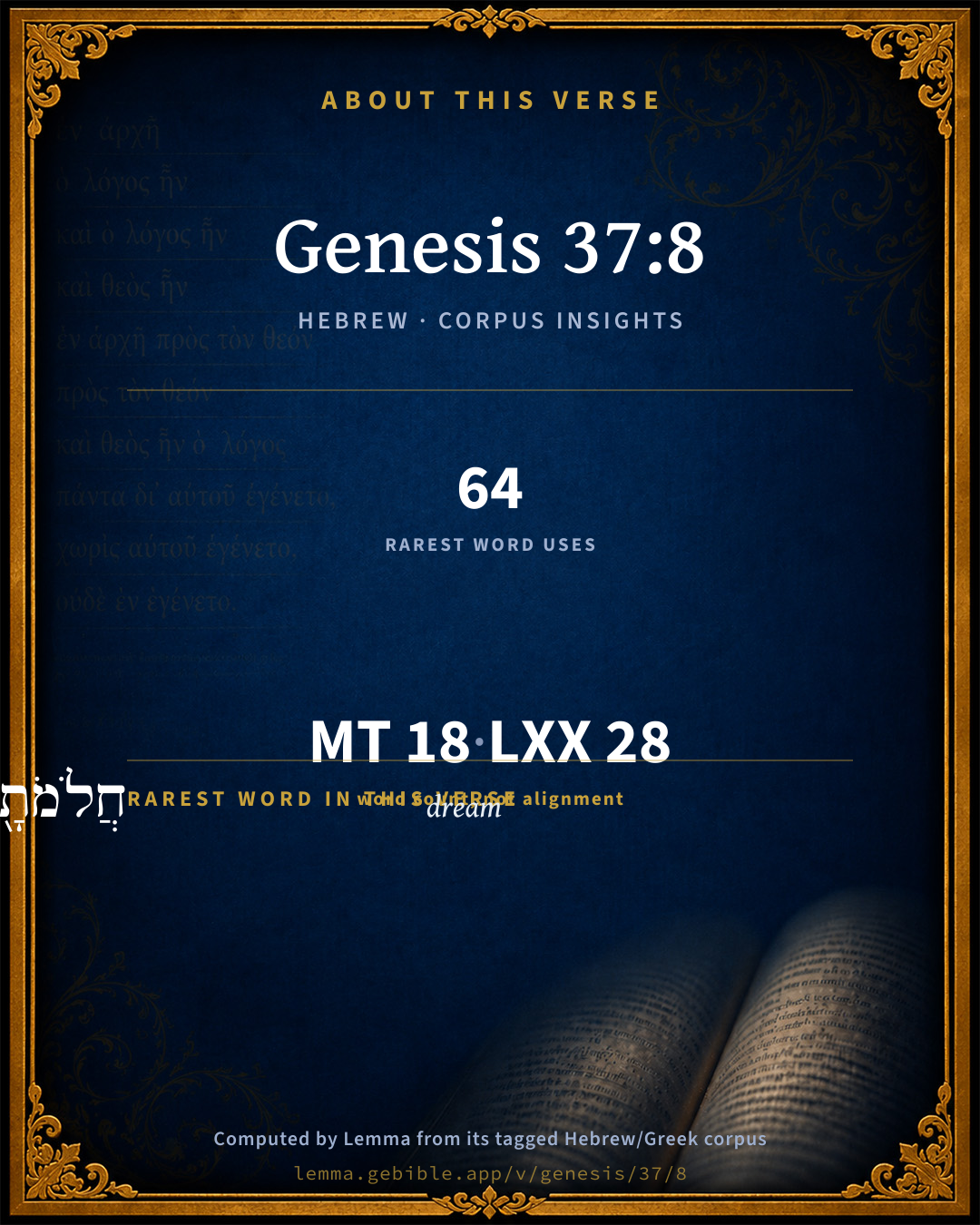
חֲלֹמֹתָ֖יו
chălôwm
H2472
“dreams · his”
Noun, Common, Masculine, Plural, Construct + Suffix, Personal, 3rd Person, Masculine, Singular
Part of Speech
Noun
Type
Common
Gender
Masculine
Number
Plural
State
Construct
Full BDB Definition

Origin: from H2492

TWOT: 663a

dream - dream (ordinary) - dream (with prophetic meaning)
  1. וַיֹּ֤אמְרוּ ʼâmar H559 “and · to say” Conjunction + Verb, Qal, Sequential Imperfect, 3rd Person, Masculine, Plural
  2. אֶחָ֔יו ʼâch H251 “brothers · his” Noun, Common, Masculine, Plural, Construct + Suffix, Personal, 3rd Person, Masculine, Singular
  3. הֲמָלֹ֤ךְ mâlak H4427 “to reign” Particle, Interrogative + Verb, Qal, Infinitive Absolute
  4. תִּמְלֹךְ֙ mâlak H4427 “to reign” Verb, Qal, Imperfect, 2nd Person, Masculine, Singular
  5. עָלֵ֔ינוּ ʻal H5921 “upon · us” Preposition + Suffix, Personal, 1st Person, Common, Plural
  6. אִם ʼim H518 “if” Conjunction
  7. מָשׁ֥וֹל mâshal H4910 “to rule” Verb, Qal, Infinitive Absolute
  8. תִּמְשֹׁ֖ל mâshal H4910 “to rule” Verb, Qal, Imperfect, 2nd Person, Masculine, Singular
  9. וַיּוֹסִ֤פוּ yâçaph H3254 “and · to add” Conjunction + Verb, Hiphil, Sequential Imperfect, 3rd Person, Masculine, Plural
  10. עוֹד֙ ʻôwd H5750 “still” Adverb
  11. שְׂנֹ֣א sânêʼ H8130 “to hate” Verb, Qal, Infinitive Construct
  12. אֹת֔וֹ ʼêth H853 “- · him” Particle, Direct Object + Suffix, Personal, 3rd Person, Masculine, Singular
  13. עַל ʻal H5921 “upon” Preposition
  14. וְעַל ʻal H5921 “and · upon” Conjunction + Preposition
  15. דְּבָרָֽיו dâbâr H1697 “words · his” Noun, Common, Masculine, Plural, Construct + Suffix, Personal, 3rd Person, Masculine, Singular

About this verse

These counts appear in no published source. They are computed here, from the morphology-tagged text and Lemma’s own curated glosses. What Lemma adds →

18
words
12
distinct lemmas
Pentateuch
section

Grammatical profile

  • 7 verbs
  • 3 nouns
  • 5 prepositions
  • 1 conjunction
  • 1 adverb
  • 1 particle

Verb forms

  • וַיֹּ֤אמְרוּ Qal · Sequential Imperfect
  • הֲמָלֹ֤ךְ Qal · Infinitive Absolute
  • תִּמְלֹךְ֙ Qal · Imperfect
  • מָשׁ֥וֹל Qal · Infinitive Absolute
  • תִּמְשֹׁ֖ל Qal · Imperfect
  • וַיּוֹסִ֤פוּ Hiphil · Sequential Imperfect
  • שְׂנֹ֣א Qal · Infinitive Construct

Repetition

Words recur within this verse — often emphatic in Hebrew:

  • עָלֵ֔ינוּ upon H5921 ×3
  • הֲמָלֹ֤ךְ to reign H4427 ×2
  • מָשׁ֥וֹל to rule H4910 ×2

Hebrew & Septuagint length

In English translation the verse runs 32 words from the Hebrew and 33 from the Septuagint (LXX English) — closely comparable.

A rough comparison of the two English renderings, which tokenize alike — not a word-level alignment.

Word counts can differ between the Hebrew and the Greek without any difference in meaning — e.g. the Hebrew direct-object marker אֵת has no separate Greek word, and Greek often adds the article ὁ.

In the original languages it is 18 Hebrew tokens and 28 Greek tokens — but the two are counted differently (Hebrew bundles its prefixes and suffixes into one token; the Greek is in lemma form), so that isn’t a like-for-like length.

Cross-references

12

Topical passages linked to Genesis 37:8 in the Treasury of Scripture Knowledge — connected by theme and wording, ordered by reader-vote popularity; previews shown in the World English Bible.

  • 1 Samuel 10:27 But certain worthless fellows said, How shall this man save us? They despised him, and brought him no present. But he held his peace.
  • Acts 7:35 "This Moses, whom they refused, saying, 'Who made you a ruler and a judge?'--God has sent him as both a ruler and a deliverer by the hand of the angel who appeared to him in the bush.
  • Genesis 49:26 The blessings of your father Have prevailed above the blessings of the ancient mountains, Above the bounty of the age-old hills. They will be on the head of Joseph, On the crown of the head of him who is separated from his brothers.
  • Genesis 37:4 His brothers saw that their father loved him more than all his brothers, and they hated him, and couldn't speak peaceably to him.
  • Exodus 2:14 He said, "Who made you a prince and a judge over us? Do you plan to kill me, as you killed the Egyptian?" Moses was afraid, and said, "Surely this thing is known."
  • 1 Samuel 17:28 Eliab his eldest brother heard when he spoke to the men; and Eliab's anger was kindled against David, and he said, Why are you come down? and with whom have you left those few sheep in the wilderness? I know your pride, and the naughtiness of your heart; for you have come down that you might see the battle.
  • Psalms 2:3–6 "Let's break their bonds apart, And cast away their cords from us."
  • Psalms 118:22 The stone which the builders rejected has become the head of the corner.
  • Luke 19:14 But his citizens hated him, and sent an envoy after him, saying, 'We don't want this man to reign over us.'
  • Luke 20:17 But he looked at them, and said, "Then what is this that is written, 'The stone which the builders rejected, The same was made the chief cornerstone?'
  • Acts 4:27–28 For truly, in this city against your holy servant, Jesus, whom you anointed, both Herod and Pontius Pilate, with the Gentiles and the people of Israel, were gathered together
  • Hebrews 10:29 How much worse punishment, do you think, will he be judged worthy of, who has trodden under foot the Son of God, and has counted the blood of the covenant with which he was sanctified an unholy thing, and has insulted the Spirit of grace?

Cross-references courtesy of OpenBible.info (CC BY 4.0).

Hebrew and Greek witnesses Masoretic Hebrew ↔ Greek Septuagint

The same verse in the two great witnesses to the Old Testament, shown verse-for-verse.

These are two independent witnesses, not word-aligned to each other, and the Septuagint is shown in lemma (dictionary) form.

Hebrew Genesis 37:8 Masoretic · Westminster Leningrad Codex

וַיֹּ֤אמְרוּ לוֹ֙ אֶחָ֔יו הֲמָלֹ֤ךְ תִּמְלֹךְ֙ עָלֵ֔ינוּ אִם מָשׁ֥וֹל תִּמְשֹׁ֖ל בָּ֑נוּ וַיּוֹסִ֤פוּ עוֹד֙ שְׂנֹ֣א אֹת֔וֹ עַל חֲלֹמֹתָ֖יו וְעַל דְּבָרָֽיו

His brothers said to him, "Will you indeed reign over us? Or will you indeed have dominion over us?" They hated him all the more for his dreams and for his words.

World English Bible · Public Domain

Greek LXX Genesis 37:8 Septuagint · lemma form

εἶπον δέ αὐτός ὁ ἀδελφός μή βασιλεύω βασιλεύω ἐπί ἐγώ ἤ κυριεύω κυριεύω ἐγώ καί προςτίθημι ἔτι μισέω αὐτός ἕνεκεν ὁ ἐνύπνιον αὐτός καί ἕνεκεν ὁ ῥῆμα αὐτός

And his brethren said to him, Shall you indeed reign over us, or shall you indeed be lord over us? And they hated him still more for his dreams and for his words.

LXX2012 (modern English Septuagint) · Public Domain

Hebrew: Westminster Leningrad Codex (CC BY 4.0). Greek: Septuagint (public domain); English from LXX2012 (modern English Septuagint) (Public Domain). How the Septuagint differs from the Hebrew →

Targum (Aramaic paraphrase)

2

The Targum is the ancient Jewish Aramaic paraphrase of the Hebrew Scriptures — an interpretive translation, not the Hebrew text itself. Onkelos (literal) and Pseudo-Jonathan (expansive) render the Torah, and Jonathan the Prophets. Coverage is partial: where no permissively-licensed English translation exists for a verse, only the Aramaic is shown. This is verse-level text, not a word-by-word alignment to the Hebrew.

  1. Targum Onkelos Torah (Genesis–Deuteronomy)
    וַאֲמָרוּ לֵהּ אֲחוֹהִי הֲמַלְכוּ אַתְּ מְדַמֵּי לְמִמְלַךְ עָלָנָא אוֹ שׁוּלְטָּן אַתְּ סְבִיר לְמִשְׁלַט בָּנָא וְאוֹסִיפוּ עוֹד סְנוֹ יָתֵהּ עַל חֶלְמוֹהִי וְעַל פִּתְגָמוֹהִי

    (no public-domain English translation for this verse)

    Targum Onkelos — Aramaic: “Onkelos Genesis” (public domain); “Onkelos Exodus” (public domain); “Onkelos Leviticus” (public domain); “Onkelos Numbers” (public domain); “Onkelos Deuteronomy” (public domain). English: “Sefaria Community Translation” (CC0 1.0 (public-domain dedication)); “J.W. Etheridge. The Targums of Onkelos and Jonathan Ben Uzziel on the Pentateuch. London: Longmans, Green, 1862” (public domain). Text via Sefaria.

  2. Targum Pseudo-Jonathan Torah (Genesis–Deuteronomy)
    וַאֲמָרוּ לֵיהּ אֲחוֹהִי הַלְמִמְלָךְ אַנְתְּ מְדַמֵי עֲלָנָא אִין לְמִשְׁלַט אַנְתְּ סְבִיר עֲלָנָא וְאוֹסִיפוּ תּוּב לְמִינְטַר לֵיהּ בָּבוּ עַל חֶלְמוֹי וְעַל פִּתְגָמוֹי

    And his brothers said to him, Art thou thinking to reign over us, or dost thou expect to have rule over us? And they added yet to keep enmity against him, for his dream and for his words.

    Targum Pseudo-Jonathan — Aramaic: “Targum Jonathan on Genesis” (public domain); “Targum Jonathan on Exodus” (public domain); “Targum Jonathan on Leviticus” (public domain); “Targum Jonathan on Numbers” (public domain); “Targum Jonathan on Deuteronomy” (public domain). English: “The Targum of Jonathan ben Uzziel, trans. J. W. Etheridge, London, 1862” (public domain). Text via Sefaria.

Commentary

Notes on Genesis 37:8 from classic Christian and Jewish commentators (each source and its license shown beneath its notes). The classic Christian expositions comment on the surrounding passage and are grouped to its opening verse, so a note may address several verses; the Jewish commentaries on the Tanakh (Rashi and others) are per-verse, so they appear only where the commentator wrote on this verse.

Lemma curates 59 commentaries, every one of them public domain or Creative Commons licensed, each selected and text-cleaned for this edition rather than reprinted as found. About our sources →

Trapp's Complete Commentary

John Trapp

Gen 37:8 And his brethren said to him, Shalt thou indeed reign over us? or shalt thou indeed have dominion over us? And they hated him yet the more for his dreams, and for his words.

Ver. 8. Shalt thou indeed reign over us?] They rightly interpreted the dream, yet stubbornly resist the revealed will of God. This leaves sin without a cloak, {Joh 15:22} as it did in the Pharisees. They rightly interpreted that place in Micah, {Mat 2:1-10} and yet, when Christ, to whom all their own signs did so well agree, came amongst them, they would by no means receive him; nay, they sent a message after him, saying, "We will not have this man to reign over us."

John Trapp, A Commentary or Exposition upon All the Books of the Old and New Testament (1647–1656) — public domain. Text from a community e-Sword module.

Joseph Benson's Commentary

Gen 37:8. Shalt thou indeed reign over us? — See here, 1st, How truly they interpreted his dream! The event exactly answered this interpretation, Gen 42:6, &c. 2d, How scornfully they resented it, Shalt thou, that art but one, reign over us, that are many? Thou that art the youngest, over us that are elder? The reign of Jesus Christ, our Joseph, is despised and opposed by an unbelieving world, who cannot endure to think that this man should reign over them. The dominion also of the upright in the morning of the resurrection is thought of with the utmost disdain. They hated him yet the more for his words — For this relation of his dream, which they imputed to his arrogancy.

Joseph Benson's Commentary on the Old and New Testaments (1811–1818) — public domain. Text from a community e-Sword module.

Tyndale Open Study Notes

Tyndale Open Resources

37:8 The brothers’ angry response to the revelation, in contrast to Joseph’s honesty and faithfulness, clearly demonstrates why they were not chosen for leadership: Leaders in God’s plan cannot be consumed with jealousy and hatred. In their anger, they missed an important part of the revelation—they too would be rulers (stars, 37:9) who would productively bind their sheaves (37:7).

Tyndale Open Study Notes — © Tyndale Open Resources, licensed CC BY-SA 4.0. Text via the HelloAO Bible API.

Geneva Bible (1599)

Geneva Bible translators

The more that God showed himself favorable to his, the more doth the malice of the wicked rage against them.

Geneva Bible (1599) marginal notes — public domain. Text via Bolls.life.

John Calvin's Commentaries

8. Shalt thou indeed reign over us? Here it is plainly shown to us that the paternal favor of God towards the elect, is like a fan to excite against them the enmity of the world. When the sons of Jacob heard that they were fighting in vain against God, their unjust hatred ought, by such means, to have been corrected. For it was as if God, setting himself in the midst, would repress their fury by these words, “Your impious conspiring will be fruitless; for although you boast, I have constituted as your chief, the man whose ruin your wicked envy hurries you to seek.” Perhaps, also, by this consolatory dream, he intended to alleviate the trouble of the holy youth. Yet their obstinacy caused it to be the more increased. Let us then learn not to be grieved if, at any time, the shining of the grace of God upon us should cause us to be envied. The sons of Jacob, however, were but too acute interpreters of the dream: yet they deride it as a fable, because it was repugnant to their wishes. Thus it often happens that they who are ill-disposed, quickly perceive what is the will of God: but, because they feel no reverence, they despise it. To this contumacy, however, succeeds a stupor which destroys their former quick-sightedness.

John Calvin's Commentaries (1540-1563) — public domain. Text from the Calvin Translation Society English edition (1840s-50s) via the Christian Classics Ethereal Library (ccel.org). Calvin's coverage is partial (roughly two-thirds of the Bible); uncommented books and verses are honest gaps, never fabricated. The 19th-century editor's footnotes and remarks are omitted so the notes are faithfully Calvin's own voice.

The Cambridge Bible for Schools and Colleges

gen. ed. J. J. S. Perowne

8. reign over us] Perhaps with a reference to the future kingdom of Ephraim, or to the leadership of “the house of Joseph” (Jdg_1:22).

The Cambridge Bible for Schools and Colleges (gen. ed. J. J. S. Perowne; Cambridge University Press, 1878–1918) — public domain. Text from a community e-Sword module.

John Gill's Exposition

And he dreamed yet another dream,.... Relating to the name subject as the former, and, for the confirmation of it, only the emblems are different, and more comprehensive:

and told it his brethren, and said, behold, I have dreamed a dream more; another dream, and which he told, either as not knowing fully the resentment of his brethren at his former dream, or in order to clear himself from any charge of feigning the dream, or having any ill intention in telling it; seeing he had another to the same purpose, and therefore thought fit to acquaint them with it, that they might more seriously consider of it, whether there was not something divine in it, which he himself began to think there was:

and, behold, the sun, and the moon, and the eleven stars, made their obeisance to me: in his dream it seemed to him, either that he was taken up into the starry heaven, and these luminaries bowed unto him, or else that they descended to him on earth, and paid their respects unto him.

John Gill's Exposition of the Whole Bible (1746–1763) — public domain (CC PDM 1.0). Text via the HelloAO Bible API.

Matthew Poole's English Annotations

For his relation of his dreams, which they imputed to his arrogancy.

Matthew Poole's English Annotations on the Holy Bible (1683–1685) — public domain. Text from a community e-Sword/MySword module.

The Pulpit Commentary

And his brethren (who had no difficulty in interpreting the symbol"s significance) said to him (with mingled indignation and contempt), Shalt thou indeed reign over us? literally, reigning, wilt thou reign? i.e. wilt thou actually reign over us? the emphasis resting on the action of the verb (vide Ewald, "Hebrews Synt.," or shalt thou indeed have dominion over us? The form of expression is the same as that of the preceding clause. And they hated him yet the more (literally and they added again to hate him) for (i.e. on account of) his dreams, and for (or, on account of) his words.

The Pulpit Commentary (1880–1919), ed. H.D.M. Spence-Jones & Joseph S. Exell — public domain. Text from a community e-Sword module.

John Wesley's Explanatory Notes

Shalt thou indeed reign over us? - See here,

1. How truly they interpreted his dream? The event exactly answered this interpretation, chap. xlii, 6, &c.

2. How scornfully they resented it, Shalt thou that art but one, reign over us that are many? Thou that art the youngest, over us that are elder? The reign of Jesus Christ, our Joseph, is despised and striven against by an unbelieving world, who cannot endure to think that this man should reign over them. The dominion also of the upright in the morning of the resurrection is thought of with the utmost disdain.

John Wesley, Explanatory Notes Upon the Whole Bible (1754–1765) — public domain. Text via the GEBible commentary corpus.

Rashi

Rabbi Shlomo Yitzchaki (Rashi)

ועל דבריו AND FOR HIS WORDS — for the evil report about them which he used to bring to their father.

Rashi on the Tanakh — English translations: “The Judaica Press complete Tanach with Rashi, translated by A. J. Rosenberg” (CC BY 4.0); “Pentateuch with Rashi's commentary by M. Rosenbaum and A.M. Silbermann, 1929-1934” (public domain); “The Metsudah Tanach series, Lakewood, N.J” (CC BY 4.0); and “The Book of Joshua, Metsudah Publications, 1997” (CC BY 4.0). Text via Sefaria.

Ramban (Nachmanides)

Rabbi Moshe ben Nachman (Ramban / Nachmanides)

SHALT THOU INDEED REIGN OVER US? OR SHALT THOU INDEED HAVE DOMINION OVER US? Rabbi Abraham ibn Ezra explained: “Shall we voluntarily make you king over us, or will you rule over us by force?” The opinion of Onkelos appears to be more correct. (reign) to mashal (dominion) if the explanation of Ibn Ezra is correct. Hence Ramban prefers Onkelos’ explanation which follows. He rendered it: “Shall you be king over us or some authority ruling us?” For people prostrate themselves before both. The verse thus means, “You will never be king or any kind of authority over us.”The meaning of the expression, And they continued to hate him still more for his dreams, and for his words, is that they hated him for the dreams and for relating the dreams to them in a boastful manner, even as it says, Hear, I pray you, this dream which I have dreamed.

Ramban (Nachmanides) on the Tanakh — English translation: “Commentary on the Torah by Ramban (Nachmanides). Translated and annotated by Charles B. Chavel. New York, Shilo Pub. House, 1971-1976” (CC BY 4.0). Text via Sefaria.

Radak

Rabbi David Kimhi (Radak)

ויאמרו לו אחיו, are you planning to lord it over us? If you have dreams of this kind, this only reflects dreams of power you entertain during the day.

על חלומותיו, the plural “dreams,” seeing that only one dream had been reported in detail, suggests there had been at least one more dream of which the Torah did not tell us its content. The other dream may not have directly aroused an intensification of the brothers’ hatred, or, the plural includes already the dream to come that has not been spelled out as yet. The Torah spelled out only two dreams as they were the ones fuelling the brothers’ jealousy of Joseph.

ועל דבריו, and on account of his overbearing manner, and the fact that he spread slanderous remarks about them.

Radak on the Tanakh — English translations: “Sefaria Community Translation” (CC0 1.0 (public-domain dedication)); “Eliyahu Munk, HaChut Hameshulash” (CC BY 4.0); “Rabbi Mike Feuer, Jerusalem Anthology” (CC BY 4.0); and “R. David Kimhi on the first book of Psalms, Translated by R.G. Finch, London, 1919” (public domain). Text via Sefaria.

Lesson kit

Teaching starters — assembled from the data on this page, not authored interpretation. Every prompt links to the verse data it draws on. Edit before teaching.

Genesis, in the Pentateuch, opens this verse with 18 words (12 distinct Hebrew lemmas). Its most distinctive word is chălôwm (“dream”). A historical commentator’s framing appears above. Read the whole chapter for the surrounding context.

Discussion questions

  1. The word chălôwm carries the sense “dream.” How does it shape the verse?
  2. 1 Samuel 10:27 shares this passage’s theme. How do the two illuminate each other?
  3. “upon” occurs 3× in this one verse. What is the effect of the repetition?
  4. These translations render this verse differently. What is at stake in choosing one wording over another?
  5. The verb «וַיֹּ֤אמְרוּ» is Qal Sequential Imperfect. How does its form color the action?
  6. Reading how Trapp's Complete Commentary and Joseph Benson's Commentary read this verse, where do the two commentators agree and where do they part?

Things to notice

Reading settings

Reading text

Shown beneath each verse's original-language words.

Old Testament
Old Testament edition

Read the OT as the Masoretic Hebrew (MT) or the Greek Septuagint (LXX).

English shown for the Greek Septuagint (in the Hebrew ↔ Greek comparison).

Comparing translations? Open the Compare panel on any verse page to stack up to four side by side.